


Luke 1:33
- καὶkaiandG2532CONJConjunction
- βασιλεύσειbasileuseiHe will reignG936V-FAI-3SVerb Future Active Indicative 3rd Singular
- ἐπὶepioverG1909PREPPreposition
- τὸνtontheG3588T-ASMDefinite article Accusative Singular Masculine
- οἶκονoikonhouseG3624N-ASMNoun Accusative Singular Masculine
- ἸακὼβIakōbof JacobG2384N-GSM-PNoun Genitive Singular Masculine Individual
- εἰςeistoG1519PREPPreposition
- τοὺςtoustheG3588T-APMDefinite article Accusative Plural Masculine
- αἰῶναςaiōnasagesG165N-APMNoun Accusative Plural Masculine
- καὶkaiandG2532CONJConjunction
- τῆςtēsof theG3588T-GSFDefinite article Genitive Singular Feminine
- βασιλείαςbasileiaskingdomG932N-GSFNoun Genitive Singular Feminine
- αὐτοῦautouof HimG846P-GSMPersonal pronoun Genitive Singular Masculine
- οὐκouknotG3756PRT-NNegative Particle Negative
- ἔσταιestaithere will beG1510V-FDI-3SVerb Future Middle Deponent Indicative 3rd Singular
- τέλοςtelosan end!G5056N-NSNNoun Nominative Singular Neuter
English is a literal word-by-word gloss of the Greek, not the KJV's wording. Why?
This is the original text the KJV's translators worked from — each Greek word with its own literal English meaning in this verse, prepared by scholars at Tyndale House, Cambridge. The KJV translates whole sentences, not word by word, so its wording differs: one Greek word can become several English words, and the KJV may choose “charity” where the gloss reads “love”. Both are faithful — they answer different questions. For the KJV's own rendering, switch to the KJV text.
Details
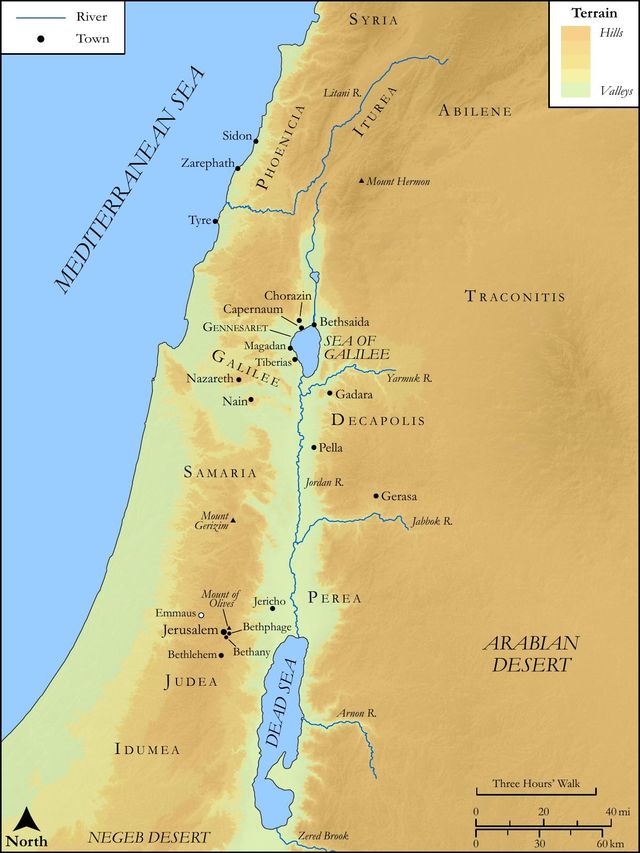
See on the biblical-era map
Study this verse
Public-domain commentary
Matthew Henry
From his Commentary on the Whole Bible. Henry comments on passages, not single verses — this entry covers Luke 1:26–38. His four-level outline is real structure in the source text, so it is rendered as structure.
We have here notice given us of all that it was fit we should know concerning the incarnation and conception of our blessed Saviour, six months after the conception of John. The same angel, Gabriel, that was employed in making known to Zacharias God's purpose concerning his son, is employed in this also; for in this, the same glorious work of redemption, which was begun in that, is carried on. As bad angels are none of the redeemed, so good angels are none of the redeemers; yet they are employed by the Redeemer as his messengers, and they go cheerfully on his errands, because they are his Father's humble servants, and his children's hearty friends and well-wishers.
I.We have here an account given of the mother of our Lord, of whom he was to be born, whom, though we are not to pray to, yet we ought to praise God for.
1.Her name was Mary, the same name with Miriam, the sister of Moses and Aaron; the name signifies exalted, and a great elevation it was to her indeed to be thus favoured above all the daughters of the house of David.
2.She was a daughter of the royal family, lineally descended from David, and she herself and all her friends knew it, for she went under the title and character of the house of David, though she was poor and low in the world; and she was enabled by God's providence, and the care of the Jews, to preserve their genealogies, to make it out, and as long as the promise of the Messiah was to be fulfilled it was worth keeping; but for those now, who are brought low in the world, to have descended from persons of honour, is not worth mentioning.
3.She was a virgin, a pure unspotted one, but espoused to one of the same royal stock, like her, however, of low estate; so that upon both accounts there was (as it was fit there should be) an equality between them; his name was Joseph; he also was of the house of David, Mat 1:20. Christ's mother was a virgin, because he was not to be born by ordinary generation, but miraculously; it was necessary that he should be so, that, though he must partake of the nature of man, yet not of the corruption of that nature: but he was born of a virgin espoused, made up to be married, and contracted, to put honour upon the married state, that that might not be brought into contempt (which was an ordinance in innocency) by the Redeemer's being born of a virgin.
4.She lived in Nazareth, a city of Galilee, a remote corner of the country, and in no reputation for religion or learning, but which bordered upon the heathen, and therefore was called Galilee of the Gentiles. Christ's having his relations resident there intimates favour in reserve for the Gentile world. And Dr. Lightfoot observes that Jonah was by birth a Galilean, and Elijah and Elisha very much conversant in Galilee, who were all famous prophets of the Gentiles. The angel was sent to her from Nazareth. Note, No distance or disadvantage of place shall be a prejudice to those for whom God has favours in store. The angel Gabriel carries his message as cheerfully to Mary and Nazareth in Galilee as to Zacharias in the temple at Jerusalem.
II.The address of the angel to her, Luk 1:28.
We are not told what she was doing, or how employed, when the angel came unto her; but he surprised her with this salutation, Hail, thou art highly favoured. This was intended to raise in her,
1.A value for herself; and, though it is very rare that any need to have any sparks struck into their breast with such design, yet in some, who like Mary pore only on their low estate, there is occasion for it.
2.An expectation of great news, not from abroad, but from above. Heaven designs, no doubt, uncommon favours for one whom an angel makes court to with such respect, Hail thou, chaire - rejoice thou; it was the usual form of salutation; it expresses an esteem of her, and good-will to her and her prosperity.
(1.)She is dignified: "Thou art highly favoured. God, in his choice of thee to be the mother of the Messiah, has put an honour upon thee peculiar to thyself, above that of Eve, who was the mother of all living." The vulgar Latin translates this grati plena - full of grace, and thence gathers that she had more of the inherent graces of the Spirit than ever any had; whereas it is certain that this bespeaks no other than the singular favour done her in preferring her to conceive and bear our blessed Lord, an honour which, since he was to be the seed of the woman, some woman must have, not for personal merit, but purely for the sake of free grace, and she is pitched upon. Even so, Father, because it seemed good unto thee.
(2.)She has the presence of God with her: "The Lord is with thee, though poor and mean, and perhaps now forecasting how to get a livelihood and maintain a family in the married state." The angel with this word raised the faith of Gideon (Jdg 6:12): The Lord is with thee. Nothing is to be despaired of, not the performance of any service, not the obtaining of any favour, though ever so great, if we have God with us. This word might put her in mind of the Immanuel, God with us, which a virgin shall conceive and bear (Isa 7:14), and why not she?
(3.)She has the blessing of God upon her: "Blessed art thou among women; not only thou shalt be accounted so by men, but thou shalt be so. Thou that art so highly favoured in this instance mayest expect in other things to be blessed." She explains this herself (Luk 1:48), All generations shall call me blessed. Compare it with that which Deborah saith of Jael, another that was the glory of her sex (Jdg 5:24), Blessed shall she be above women in the tent.
III.The consternation she was in, upon this address (Luk 1:29).
When she saw him, and the glories with which he was surrounded, she was troubled at the sight of him, and much more at his saying. Had she been a proud ambitious young woman, that aimed high, and flattered herself with the expectation of great things in the world, she would have been pleased at his saying, would have been puffed up with it, and (as we have reason to think she was a young woman of very good sense) would have had an answer ready, signifying so much: but, instead of that, she is confounded at it, as not conscious to herself of any thing that either merited or promised such great things; and she cast in her mind what manner of salutation this should be. Was it from heaven or of men? Was it to amuse her? was it to ensnare her? was it to banter her? or was there something substantial and weighty in it? But, of all the thoughts she had as to what manner of salutation it should be, I believe she had not the least idea of its being ever intended or used for a prayer, as it is, and has been, for many ages, by the corrupt, degenerate, and anti-christian ages of the church, and to be ten times repeated for the Lord's prayer once; so it is in the church of Rome. But her thoughtfulness upon this occasion gives a very useful intimation to young people of her sex, when addresses are made to them, to consider and cast in their minds what manner of salutations they are, whence they come, and what their tendency is, that they may receive them accordingly, and may always stand on their guard.
IV.The message itself which the angel had to deliver to her.
Some time the angel gives her to pause; but, observing that this did but increase her perplexity, he went on with his errand, Luk 1:30. To what he had said she made no reply; he therefore confirms it: "Fear not, Mary, I have no other design than to assure thee that thou hast found favour with God more than thou thinkest of, as there are many who think they are more favoured with God than they really are." Note, Those that have found favour with God should not give way to disquieting distrustful fears. Doth God favour thee? Fear not, though the world frown upon thee. Is he for thee? No matter who is against thee.
1.Though she is a virgin, she shall have the honour of being a mother: "Thou shalt conceive in thy womb, and bring forth a son, and thou shalt have the naming of him; thou shalt call his name Jesus," Luk 1:31. It was the sentence upon Eve, that, though she should have the honour to be the mother of all living, yet this mortification shall be an allay to that honour, that her desire shall be to her husband, and he shall rule over her, Gen 3:16. But Mary has the honour without the allay.
2.Though she lives in poverty and obscurity, yet she shall have the honour to be the mother of the Messiah; her son shall be named Jesus - a Saviour, such a one as the world needs, rather than such one as the Jews expect.
(1.)He will be very nearly allied to the upper world. He shall be great, truly great, incontestably great; for he shall be called the Son of the Highest, the Son of God who is the Highest; of the same nature, as the son is of the same nature with the father; and very dear to him, as the son is to the father. He shall be called, and not miscalled, the Son of the Highest; for he is himself God over all, blessed for evermore, Rom 9:5. Note, Those who are the children of God, though but by adoption and regeneration, are truly great, and therefore are concerned to be very good, Jo1 3:1, Jo1 3:2.
(2.)He will be very highly preferred in the lower world; for, though born under the most disadvantageous circumstances possible, and appearing in the form of a servant, yet the Lord God shall give unto him the throne of his father David, Luk 1:32. He puts her in mind that she was of the house of David; and that therefore, since neither the Salique law, nor the right of primogeniture, took place in the entail of his throne, it was not impossible but that she might bring forth an heir to it, and therefore might the more easily believe it when she was told by an angel from heaven that she should do so, that after the sceptre had been long departed from that ancient and honourable family it should now at length return to it again, to remain in it, not by succession, but in the same hand to eternity. His people will not give him that throne, will not acknowledge his right to rule them; but the Lord God shall give him a right to rule them, and set him as his king upon the holy hill of Zion. He assures her,
[1.]That his kingdom shall be spiritual: he shall reign over the house of Jacob, not Israel according to the flesh, for they neither came into his interests nor did they continue long a people; it must therefore be a spiritual kingdom, the house of Israel according to the promise, that he must rule over.
[2.]That it shall be eternal: he shall reign for ever, and of his kingdom there shall be no end, as there had been long since of the temporal reign of David's house, and would shortly be of the state of Israel. Other crowns endure not to every generation, but Christ's doth, Pro 27:24. The gospel is the last dispensation, we are to look for no other.
V.The further information given her, upon her enquiry concerning the birth of this prince.
1.It is a just enquiry which she makes: "How shall this be? Luk 1:34. How can I now presently conceive a child" (for so the angel meant) "when I know not a man; must it therefore be otherwise than by ordinary generation? If so, let me now how?" She knew that the Messiah must be born of a virgin; and, if she must be his mother, she desires to know how. This was not the language of her distrust, or any doubt of what the angel said, but of a desire to be further instructed.
2.It is a satisfactory answer that is given to it, Luk 1:35. (1.) She shall conceive by the power of the Holy Ghost, whose proper work and office is to sanctify, and therefore to sanctify the virgin for this purpose. The Holy Ghost is called the power of the Highest. Doth she ask how this shall be? This is enough to help her over all the difficulty there appears in it; a divine power will undertake it, not the power of an angel employed in it, as in other works of wonder, but the power of the Holy Ghost himself.
(2.)She must ask no questions concerning the way and manner how it shall be wrought; for the Holy Ghost, as the power of the Highest, shall overshadow her, as the cloud covered the tabernacle when the glory of God took possession of it, to conceal it from those that would too curiously observe the motions of it, and pry into the mystery of it. The formation of every babe in the womb, and the entrance of the spirit of life into it, is a mystery in nature; none knows the way of the spirit, nor how the bones are formed in the womb of her that is with child, Ecc 11:5. We were made in secret, Psa 139:15, Psa 139:16. Much more was the formation of the child Jesus a mystery; without controversy, great was the mystery of godliness, God manifest in the flesh, Ti1 3:16. It is a new thing created in the earth (Jer 31:22), concerning which we must not covet to be wise above what is written.
(3.)The child she shall conceive is a holy thing, and therefore must not be conceived by ordinary generation, because he must not share in the common corruption and pollution of the human nature. He is spoken of emphatically, That Holy Thing, such as never was; and he shall be called the Son of God, as the Son of the Father by eternal generation, as an indication of which he shall now be formed by the Holy Ghost in the present conception. His human nature must be so produced, as it was fit that should be which was to be taken into union with the divine nature.
3.It was a further encouragement to her faith to be told that her cousin Elisabeth, though stricken in years, was with child, Luk 1:36. Here is an age of wonders beginning, and therefore be not surprised: here is one among thy own relations truly great, though not altogether so great as this; it is usual with God to advance in working wonders. Greater works than these shall ye do. Though Elisabeth was, on the father's side, of the daughters of Aaron (Luk 1:5), yet on the mother's side she might be of the house of David, for those two families often intermarried, as an earnest of the uniting of the royalty and the priesthood of the Messiah. This is the sixth month with her that was called barren. This intimates, as Dr. Lightfoot thinks, that all the instances in the Old Testament of those having children that had been long barren, which was above nature, were designed to prepare the world for the belief of a virgin's bearing a son, which was against nature. And therefore, even in the birth of Isaac, Abraham saw Christ's day, foresaw such a miracle in the birth of Christ. The angel assures Mary of this, to encourage her faith, and concludes with that great truth, of undoubted certainty and universal use, For with God nothing shall be impossible (Luk 1:37), and, if nothing, then not this. Abraham therefore staggered not at the belief of the divine promise, because he was strong in his belief of the divine power, Rom 4:20, Rom 4:21. No word of God must be incredible to us, as long as no work of God is impossible to him.
VI.Her acquiescence in the will of God concerning her, Luk 1:38. She owns herself,
1.A believing subject to the divine authority: "Behold, the handmaid of the Lord. Lord, I am at thy service, at thy disposal, to do what thou commandest me." She objects not the danger of spoiling her marriage, and blemishing her reputation, but leaves the issue with God, and submits entirely to his will.
2.A believing expectant of the divine favour. She is not only content that it should be so, but humbly desires that it may be so: Be it unto me according to thy word. Such a favour as this it was not for her to slight, or be indifferent to; and for what God has promised he will be sought unto; by prayer we must put our amen, or so be it, to the promise. Remember, and perform thy word unto thy servant, upon which thou has caused me to hope. We must, as Mary here, guide our desires by the word of God, and ground our hopes upon it. Be it unto me according to thy word; just so, and no otherwise.
Hereupon, the angel departed from her; having completed the errand he was sent upon, he returned, to give an account of it, and receive new instructions. Converse with angels was always a transient thing, and soon over; it will be constant and permanent in the future state. It is generally supposed that just at this instant the virgin conceived, by the overshadowing power of the Holy Ghost: but, the scripture being decently silent concerning it, it doth not become us to be inquisitive, much less positive.
Historical interpretation
Eighteen Centuries of Reception
17 surviving comments on this verse. Each one is dated, so this reads as a timeline rather than a list.
Select a marker to jump to its quote. Markers stagger vertically where authors wrote within a few decades of each other.
And hear again how Isaiah in express words foretold that He should be born of a virgin; for he spoke thus: "Behold, a virgin shall conceive, and bring forth a son, and they shall say for His name, `God with us.'" For things which were incredible and seemed impossible with men, these God predicted by the Spirit of prophecy as about to come to pass, in order that, when they came to pass, there might be no unbelief, but faith, because of their prediction. But lest some, not understanding the prophecy now cited, should charge us with the very things we have been laying to the charge of the poets who say that Jupiter went in to women through lust, let us try to explain the words. This, then, "Behold, a virgin shall conceive," signifies that a virgin should conceive without intercourse. For if she had had intercourse with any one whatever, she was no longer a virgin; but the power of God having come upon the virgin, overshadowed her, and caused her while yet a virgin to conceive. And the angel of God who was sent to the same virgin at that time brought her good news, saying, "Behold, thou shalt conceive of the Holy Ghost, and shalt bear a Son, and He shall be called the Son of the Highest, and thou shalt call His name Jesus; for He shall save His people from their sins," -as they who have recorded all that concerns our Saviour Jesus Christ have taught, whom we believed, since by Isaiah also, whom we have now adduced, the Spirit of prophecy declared that He should be born as we intimated before. It is wrong, therefore, to understand the Spirit and the power of God as anything else than the Word, who is also the first-born of God, as the foresaid prophet Moses declared; and it was this which, when it came upon the virgin and overshadowed her, caused her to conceive, not by intercourse, but by power. And the name Jesus in the Hebrew language means Σωτήρ (Saviour) in the Greek tongue. Wherefore, too, the angel said to the virgin, "Thou shalt call His name Jesus, for He shall save His people from their sins." And that the prophets are inspired by no other than the Divine Word, even you, as I fancy, will grant.
And again, speaking in reference to the angel, he says: "But at that time the angel Gabriel was sent from God, who did also say to the virgin, Fear not, Mary; for you have found favour with God." [Luke 1:26, etc.] And he says concerning the Lord: "He shall be great, and shall be called the Son of the Highest: and the Lord God shall give unto Him the throne of His father David: and He shall reign over the house of Jacob for ever; and of His kingdom there shall be no end." [Luke 1:32-33] For who else is there who can reign uninterruptedly over the house of Jacob for ever, except Jesus Christ our Lord, the Son of the Most High God, who promised by the law and the prophets that He would make His salvation visible to all flesh; so that He would become the Son of man for this purpose, that man also might become the son of God?
From what the angel said to Mary, namely, “Elizabeth, your kinswoman,” it could be supposed that Mary was from the house of Levi. Nevertheless up to this, the prophecy was established within the framework of the husbands. The family of David continued as far as Joseph, who had espoused her, and the birth of her child was reckoned through the framework of the men, for the sake of the family of David. It is in Christ that the seed and family of David are brought to completion. Scripture is silent about Mary’s genealogy since it is the generations of men that it numbers and reckons. If Scripture had been accustomed to indicate the family line through the mothers, it would be in order for one to seek the family of Mary. But, lest the words “Elizabeth, your kinswoman” were to show that Mary was also from the house of Levi, take note that the Evangelist has said elsewhere, concerning Joseph and Mary, that “they were both of the house of David.” The angel did not say to Mary that Elizabeth was her sister but “Elizabeth, your kinswoman.”
The words “in the sixth month” are reckoned in relation to Elizabeth’s pregnancy. “The angel was sent to a virgin,” and he said to her, “Behold, in your virginity you will conceive in your womb and bear a son, and you shall call his name Jesus.” He was speaking about him who was to appear in the body. He did not say to her, “that name which is called Jesus,” but “you shall call his name.” This shows that this name is of the economy which is through the body, since Jesus in Hebrew means “Savior.” For the angel said, “You shall call his name Jesus,” that is, Savior, “for he shall save his people from sins.” This name therefore refers not to his nature but to his deeds.
(Epist. 236. ad Amphil.) Our Lord sat not on the earthly throne of David, the Jewish kingdom having been transferred to Herod. The seat of David is that on which our Lord reestablished His spiritual kingdom which should never be destroyed. Hence it follows, And he shall reign over the house of Jacob.
(Orat. in Diem Nat.) While the expectation of child-birth strikes a woman with terror, the sweet mention of her offspring calms her, as it is added, And thou shall call his name Jesus. The coming of the Saviour is the banishing of all fear.
But all are not as Mary, that when they conceive the word of the Holy Spirit, they bring forth; for some put forth the word prematurely, others have Christ in the womb, but not yet formed.
It was said also of John, that he shall be great, but of him indeed as of a great man, of Christ, as of the great God. For abundantly is poured forth the power of God; widely the greatness of the heavenly substance extended, neither confined by place, nor grasped by thought; neither determined by calculation, nor altered by age.
But he who earns favour in the sight of God has nothing to fear. Hence it follows, For thou hast found favour before God. But how shall any one find it, except through the means of his humility. For God giveth grace to the humble. (James 4:6, 1 Pet. 5:5.)
(non occ.) But since it seems shocking or unworthy to some men that God should inhabit a body, is the Sun, I would ask, the heat whereof is felt by each body that receives its rays, at all sullied as to its natural purity? Much more then does the Sun of Righteousness, in taking upon Himself a most pure body from the Virgin's womb, escape not only defilement, but even show forth His own mother in greater holiness.
(Hom. vii. in Matt.) Now He assigns to the present house of Jacob all those who were of the number of the Jews that believed on Him. For as Paul says, They are not all Israel which are of Israel, but the children of the promise are counted for the seed.
A heavenly fire engenders him, not flesh
Nor blood of father, nor impure desire.
By power of God a spotless maid conceives,
As in her virgin womb the Spirit breathes.
The mystery of this birth confirms our faith
That Christ is God: a maiden by the Spirit
Is wed, unstained by love; her purity
Remains intact; with child within, untouched
Without, bright in her chaste fertility,
Mother yet virgin, mother that knew not man.
Why, doubter, do you shake your silly head?
An angel makes this known with holy lips.
Will you not hearken to angelic words?
The Virgin blest, the shining messenger
Believed, and by her faith she Christ conceived.
Christ comes to men of faith and spurns the heart
Irresolute in trust and reverence.
The Virgin’s instant faith attracted
Christ into her womb and hid him there till birth.
Peter said: We preach one God and Father of our Lord Jesus Christ, that has made the heaven and the earth and the sea, and all that therein is, who is the true King; and of His kingdom there shall be no end. [Luke 1:33] Nero said: What king is lord? Paul said: The Saviour of all the nations. Simon said: I am he whom you speak of. Peter and Paul said: May it never be well with you, Simon, magician, and full of bitterness.
We should carefully note the order of the words here, and the more firmly they are engrafted in our heart, the more evident it will be that the sum total of our redemption consists in them. For they proclaim with perfect clarity that the Lord Jesus, that is, our Savior, was both the true Son of God the Father and the true Son of a mother who was a human being. “Behold,” he says, “you will conceive in your womb and give birth to a son” - acknowledge that this true human being assumed the true substance of flesh from the flesh of the Virgin! “He will be great and will be called the Son of the Most High” - confess too that this same Son is true God of true God, coeternal Son forever of the eternal Father!
Jesus is interpreted Saviour, or Healing.
Or by the house of Jacob he means the whole Church which either sprang from a good root, or though formerly a wild olive branch, has yet been for a reward of its faith grafted into the good olive tree. (Rom. 11:17.)
Let Nestorius then cease to say that the Virgin's Son is only man, and to deny that He is taken up by the Word of God into the unity of the Person. For the Angel when he says that the very same has David for His father whom he declares is called the Son of the Highest, demonstrates the one Person of Christ in two natures. The Angel uses the future tense (vocabitur, regnabit) not because, as the Heretics say, Christ was not before Mary, but because in the same person, man with God shares the same name of Son.
And he shall reign over the house of Jacob forever, and of his kingdom there shall be no end. And Isaiah said: His empire will be multiplied, and there shall be no end of peace. Upon the throne of David, and upon his kingdom, to establish it and to uphold it in judgement and in justice (Isa. IX). He did not say in the acquisition of earthly glories and treasures, not in the victory over many nations or the subjugation of proud cities, but in judgment and justice. For by these the kingdom of Christ is multiplied and established, both in each of the faithful and in the universal Church throughout the earth. For he calls the whole Church the house of Jacob, which, whether born from a good root or grafted in, although it was a wild olive, is rightfully grafted into a good olive tree by faith. After the triumph of his passion, the Savior addressing it says: “You who fear the Lord, praise him; all you offspring of Jacob, glorify him” (Psal. XXI). However, Jesus is not said to be great in future words and to be called the Son of the Most High, to accept the scepter of David, and to reign over the house of Jacob, because, as the heretics senselessly think and fall away from the truth, Christ did not exist before Mary, but that the man assumed into God was glorified by that glory which the Word of God had with the Father before the world was; that is, the same name of the Son would mean the same person of Christ, man with God, full of grace and truth.
The time had come when, having redeemed the world through his blood, he was to be acknowledged as king not of the house of David alone but also of the whole church; moreover, that he was maker and governor of all generations. Hence the angel properly said afterwards, “and the Lord God will give him the seat of David his father,” and he immediately added, “and he will reign in the house of Jacob forever.” Now the house of Jacob refers to the universal church, which through its faith in and confession of Christ pertains to the heritage of the patriarchs—either among those who took their physical origin from the stock of the patriarchs or among those who, though brought forth with respect to the flesh from other countries, were reborn in Christ by the spiritual washing.
(Severus Antiochenus.) And to make the Virgin mindful of the prophets, he adds, And the Lord God shall give unto him the seat of David, that she might know clearly, that He Who is to be born of her is that very Christ, Whom the prophets promised should be born of the seed of David.
(Geometer.) But to reign for ever is of none save God alone; and hence though because of the incarnation Christ is said to receive the seat of David, yet as being Himself God He is acknowledged to be the eternal King. It follows, And, his kingdom shall have no end, not in that He is God, but in that He is man also. Now indeed He has the kingdom of many nations, but finally he shall reign over all, when all things shall be put under Him. (1 Cor. 15:25.)
Wonder! God is come among humanity; he who cannot be contained is contained in a womb; the timeless enters time, and great mystery: his conception is without seed, his emptying past telling! So great is this mystery! For God empties himself, takes flesh and is fashioned as a creature, when the angel tells the pure Virgin of her conception: “Rejoice, you who are full of grace; the Lord who has great mercy is with you!”
There is an activity of God displayed throughout creation, a wholesale activity let us say which men refuse to recognize. The miracles done by God incarnate, living as a man in Palestine, perform the very same things as this wholesale activity, but at a different speed and on a smaller scale. One of their chief purposes is that men, having seen a thing done by personal power on the small scale, may recognize, when they see the same thing done on the large scale, that the power behind it is also personal – is indeed the very same person who lived among us two thousand years ago. The miracles in fact are a retelling in small letters of the very same story which is written across the whole world in letters too large for some of us to see...
I can understand the man who denies the miraculous altogether; but what is one to make of the people who admit some miracles but deny the Virgin Birth? Is it that for all their lip service to the laws of Nature there is only one law of Nature that they really believe? Or is it that they see in this miracle a slur upon sexual intercourse which is rapidly becoming the one thing venerated in a world without veneration? No miracle is in fact more significant. What happens in ordinary generation? What is a father’s function in the act of begetting? A microscopic particle of matter from his body fertilizes the female: and with that microscopic particle passes, it may be, the color of his hair and his great grandfather’s hanging lip, and the human form in all its complexity of bones, liver, sinews, heart, and limbs, and pre-human form which the embryo will recapitulate in the womb. Behind every spermatozoon lies the whole history of the universe: locked within it is no small part of the world’s future. That is God’s normal way of making a man – a process that takes centuries, beginning with the creation of matter itself, and narrowing to one second and one particle at the moment of begetting. And once again men will mistake the sense impressions which this creative act throws off for the act itself or else refer it to some infinite being such as Genius. Once, therefore, God does it directly, instantaneously; without a spermatozoon, without the millenniums of organic history behind the spermatozoon. There was of course another reason. This time He was creating not simply a man, but the man who was to be Himself: the only true Man. The process which leads to the spermatozoon has carried down with it through the centuries much undesirable silt; the life which reaches us by that normal route is tainted. To avoid that taint, to give humanity a fresh start, he once short-circuited the process. There is a vulgar anti-God paper which some anonymous donor sends me every week. In it recently I saw the taunt that we Christians believe in a God who committed adultery with the wife of a Jewish carpenter. The answer to that is that if you describe the action of God in fertilizing Mary as “adultery” then, in that sense, God would have committed adultery with every woman who ever had a baby. For what He did once without a human father, He does always even when He uses a human father as His instrument. For the human father in ordinary generation is only a carrier, sometimes an unwilling carrier, always the last in a long line of carriers, of life that comes from the supreme life. Thus the filth that our poor, muddled, sincere, resentful enemies fling at the Holy One, either does not stick, or, sticking, turns into glory.
Continue studying Luke 1:33 across the web’s major study libraries — every link below opens this exact verse, chapter, or book on the destination site.
Read & Compare
 BibleGatewayThis verse in more than 200 translations and 70 languages.
 Bible.comThe YouVersion reader — hundreds of translations, reading plans, and highlights.
 ESV.orgCrossway's official English Standard Version reader.
 NET BibleThe NET translation with 60,000+ translators' notes on every rendering decision.
 STEP BibleTyndale House's free study tool — original text, vocabulary, and scholarly resources.
 BibliaLogos Bible Software's free web reader.
 USCCBThe New American Bible (Revised Edition) with the U.S. bishops' study notes.
Commentaries
 BibleHub CommentariesDozens of classic commentaries on this verse, gathered on one page.
 StudyLightMore than 100 commentary sets — the largest collection on the web.
 BibleRefPlain-English commentary on what this verse means, verse by verse.
 Enduring WordDavid Guzik's free commentary on this chapter, widely used by Bible teachers.
 Bible Study ToolsVerse commentary alongside Greek and Hebrew study aids.
Original Language & Research
- BibleHub InterlinearThe verse word by word — original language, transliteration, and English.
- BibleHub LexiconEvery word's original-language definition and Strong's entry.
 Blue Letter BibleDeep-study tools — Strong's numbers, concordance, and word studies.
 CNTR CollationThe earliest Greek manuscripts of this verse, collated letter by letter.
Sermons, Hymns & Audio


TrulyRandomVerse is not affiliated with these sites and doesn’t control their content. They’re linked because they’re genuinely useful.
Summary
Luke 1:33, a pivotal declaration within the angel Gabriel's annunciation to Mary, profoundly reveals the nature, scope, and eternal duration of Jesus Christ's reign. This verse, following the announcement of Jesus' conception and His destined inheritance of David's throne, unequivocally establishes Him as the Messiah-King whose authority transcends all earthly limitations, promising a perpetual kingdom that will never cease.
Context
ShowHideLiterary Context
This powerful declaration is nestled within Gabriel's annunciation to Mary, immediately following the promise that she would conceive a son, Jesus, who would be called "the Son of the Highest" and would receive "the throne of his father David" (Luke 1:31-32). The progression from conception to divine sonship and then to royal inheritance sets the stage for the unparalleled nature of Jesus' kingship described in verse 33. It builds upon the expectation of a Davidic Messiah, yet elevates it to an eternal, divine plane, distinguishing Jesus' reign from any temporal earthly rule.
Historical & Cultural Context
First-century Judea was under Roman occupation, and the Jewish people harbored deep-seated messianic expectations, primarily for a political and military deliverer who would restore Israel's sovereignty and glory, akin to the golden age of King David. The phrase "house of Jacob" would immediately resonate with their national identity and covenant heritage. Gabriel's words, while affirming Jesus' Davidic lineage and royal destiny, simultaneously transcend these immediate political hopes by declaring an eternal kingdom, hinting at a spiritual and universal dominion far grander than a mere earthly restoration of Israel.
Key Themes
ShowHideLuke 1:33 contributes significantly to several overarching themes in Luke's Gospel and the broader biblical narrative. Messianic Kingship is central, unequivocally identifying Jesus as the promised King, not merely a prophet or teacher, but the sovereign ruler whose authority is divinely appointed and eternal. The theme of Eternal Reign is powerfully emphasized by the phrases "for ever" and "of his kingdom there shall be no end," highlighting the perpetual nature of Christ's rule, unlike any human empire that rises and falls. This directly connects to the Fulfillment of Prophecy, particularly the Davidic Covenant found in 2 Samuel 7:12-16, where God promises an everlasting dynasty to David's descendant. It also echoes the prophetic words of Isaiah 9:7 concerning the increase of His government and peace, which would have no end. Finally, the "house of Jacob" theme, while primarily referring to the nation of Israel, also foreshadows the broader, spiritual inclusion of all who are united with Christ by faith, whether Jew or Gentile, as part of this eternal kingdom, as seen in passages like Galatians 3:29.
Exposition and Analysis
ShowHideKey Word Analysis
ShowHideMeaning "to rule (literally or figuratively);--king, reign." This word denotes the exercise of royal authority and power. In the context of Jesus, it signifies His divine right to rule as King, not merely in a political sense, but over all creation and in the hearts of His people. It speaks to His sovereign dominion.
Meaning "properly, an age; by extension, perpetuity (also past); by implication, the world; specially (Jewish) a Messianic period (present or future):--age, course, eternal, (for) ever(-more), (n-)ever, (beginning of the, while the) world (began, without end)." Paired with the preposition eis (G1519, "to or into"), "for ever" (εἰς τὸν αἰῶνα, eis ton aiōna) literally means "into the age" or "into eternity," powerfully conveying an unending, perpetual duration that transcends temporal limits.
Meaning "properly, the point aimed at as a limit, i.e. (by implication) the conclusion of an act or state (termination (literally, figuratively or indefinitely), result (immediate, ultimate or prophetic), purpose); specially, an impost or levy (as paid):--+ continual, custom, end(-ing), finally, uttermost." When combined with the negative particle ou (G3756, "no or not"), "no end" (οὐκ ἔσται τέλος, ouk estai telos) emphatically declares the absolute and irreversible perpetuity of Christ's kingdom, indicating that it will never terminate or reach a conclusion.
Verse Breakdown
ShowHide"And he shall reign over the house of Jacob for ever;"
This clause declares the Messiah's royal authority and the specific people over whom He will reign. "He" refers directly to Jesus, whose kingship is divinely appointed. "The house of Jacob" primarily signifies the nation of Israel, emphasizing Jesus' fulfillment of the Davidic covenant and His role as the King of Israel. However, in a broader theological sense, it extends to all spiritual Israel—those who are children of Abraham by faith, encompassing both Jews and Gentiles united in Christ. The phrase "for ever" (εἰς τὸν αἰῶνα) underscores the eternal, unending nature of this reign, distinguishing it from all temporal human kingdoms.
"and of his kingdom there shall be no end."
This second clause reinforces and amplifies the first, using a different linguistic construction to convey the same profound truth of perpetuity. "His kingdom" refers to the realm of Christ's sovereign rule, which is spiritual, universal, and ultimately cosmic. The emphatic declaration "there shall be no end" (οὐκ ἔσται τέλος) serves as a powerful antithesis to the transient nature of all earthly powers and empires, asserting that Christ's dominion is not subject to decay, defeat, or dissolution. It is an everlasting kingdom, established by God, for God's eternal purposes.
Literary Devices
ShowHideLuke 1:33 employs several powerful literary devices to convey its profound message. Parallelism is evident in the two clauses, "And he shall reign over the house of Jacob for ever; and of his kingdom there shall be no end." Both phrases express the same core idea of an eternal, unending reign, reinforcing the concept through repetition and varied phrasing. This creates a sense of emphatic assurance and divine certainty. The language also utilizes Hyperbole in the sense of absolute, unending duration, which, while literally true for God's kingdom, uses an extreme statement to emphasize the stark contrast with all human kingdoms. The phrase "house of Jacob" functions as Synecdoche, where a part (Jacob's lineage) stands for the whole (God's chosen people, both physical Israel and, prophetically, spiritual Israel). Furthermore, the entire declaration is steeped in Prophetic Language, fulfilling ancient prophecies concerning the Messiah's eternal throne and kingdom, echoing the majestic pronouncements of Old Testament prophets.
Theological and Thematic Connections
ShowHideLuke 1:33 is a cornerstone for understanding the eternal nature of Christ's kingdom, directly linking the New Testament narrative to foundational Old Testament prophecies. It affirms God's unwavering faithfulness to His covenant promises, particularly the Davidic covenant, which foretold an everlasting throne for David's descendant. This verse elevates Jesus' kingship beyond any earthly political dominion, establishing His reign as a divine, perpetual reality that transcends time and human limitations. It assures believers that their ultimate allegiance is to a King whose authority is absolute and whose kingdom can never be overthrown, providing an anchor of hope and security in a transient world.
Reflection and Application
ShowHideLuke 1:33 offers profound assurance and a radical reorientation of perspective for believers today. In a world characterized by constant change, political instability, and the rise and fall of human powers, this verse reminds us that our ultimate hope rests in an unshakeable, eternal kingdom ruled by a faithful King. It calls us to shift our allegiance from temporary earthly systems to the enduring reign of Christ, shaping our priorities and actions. Knowing that we are citizens of an eternal kingdom empowers us to live with courage, peace, and purpose, trusting that God's plan will ultimately prevail and that His promises are eternally secure. This truth provides deep comfort in times of uncertainty and inspires unwavering commitment to His purposes.
Questions for Reflection
ShowHideFAQ
ShowHideWhat does "the house of Jacob" mean in this context, and is it only for literal Israel?
ShowHideWhile "the house of Jacob" primarily refers to the literal descendants of Jacob (Israel), in the New Testament, particularly in the context of Jesus' kingdom, it takes on a broader, spiritual meaning. It encompasses all those who are united with Christ by faith, whether Jew or Gentile, becoming spiritual children of Abraham and heirs of the promises. This is consistent with Paul's teaching that true Israel is not merely by physical descent but by faith (Romans 9:6-8). Therefore, Jesus' reign is over all who believe in Him, forming His spiritual kingdom.
How is Jesus' kingdom different from earthly kingdoms?
ShowHideJesus' kingdom fundamentally differs from earthly kingdoms in its nature, origin, and duration. Earthly kingdoms are temporal, established by human power, and eventually decline and fall. Jesus explicitly stated, "My kingdom is not of this world" (John 18:36). His kingdom is spiritual, originating from heaven, and established by divine authority. It operates by principles of righteousness, peace, and joy in the Holy Spirit (Romans 14:17). Most significantly, as Luke 1:33 declares, it is eternal, with "no end," contrasting sharply with the transient nature of all human empires.
Christ-Centered Fulfillment
ShowHideLuke 1:33 finds its ultimate and glorious fulfillment in the person and work of Jesus Christ. The angel Gabriel's declaration is not merely a prophetic statement but a divine blueprint for the Messiah's reign, which Jesus inaugurated through His first advent, death, resurrection, and ascension. Having conquered sin and death, Jesus was "exalted to the right hand of God" (Acts 2:33), where He now reigns as King of kings and Lord of lords, exercising all authority in heaven and on earth (Matthew 28:18). His kingdom, though spiritual and not of this world in its present form (John 18:36), is actively expanding through the proclamation of the Gospel and the transformation of hearts by the Holy Spirit (Colossians 1:13). The promise of an unending reign will be fully realized at His second coming, when "the kingdoms of this world are become the kingdoms of our Lord, and of his Christ; and he shall reign for ever and ever" (Revelation 11:15). Thus, Luke 1:33 assures believers that their present and future hope is anchored in the eternal, sovereign rule of Jesus, the true King of the "house of Jacob" and of all creation.