


1 Kings 15:8
- וַיִּשְׁכַּבvai·yish·Kavand he lay downH7901Conj-w ¦ V-Qal-ConsecImperf-3msVerb Qal Consecutive Imperfect 3rd Singular Masculineוַandיִּשְׁכַּבhe lay down
- אֲבִיָּם'a·vi·YamAbijamH38N-proper-mNoun Proper Masculine
- עִם'imwithH5973PrepPreposition
- אֲבֹתָיו'a·vo·Tavhis ancestorsH1N-fpc ¦ 3msNoun Plural Feminine Constructאֲבֹתָיancestorsוhis
- וַיִּקְבְּרוּvai·yik·be·Ruand people buriedH6912Conj-w ¦ V-Qal-ConsecImperf-3mpVerb Qal Consecutive Imperfect 3rd Plural Masculineוַandיִּקְבְּרוּpeople buried
- אֹתוֹ'o·To<obj.> himH853DirObjM ¦ 3msParticle Object Indicatorאֹת<obj.>וֹhim
- בְּעִירbe·'Irin [the] city ofH5892Prep-b ¦ N-fscNoun Singular Feminine Constructבְּinעִיר[the] city of
- דָּוִדda·VidDavidH1732N-proper-mNoun Proper Masculine
- וַיִּמְלֹךְvai·yim·Lokhand he became kingH4427Conj-w ¦ V-Qal-ConsecImperf-3msVerb Qal Consecutive Imperfect 3rd Singular Masculineוַandיִּמְלֹךְhe became king
- אָסָא'a·Sa'AsaH609N-proper-mNoun Proper Masculine
- בְנוֹve·Nohis sonH1121N-msc ¦ 3msNoun Singular Masculine Constructבְנsonוֹhis
- תַּחְתָּיוtach·Tavin place of himH8478N-mpc ¦ 3msNoun Plural Masculine Constructתַּחְתָּיin place ofוhim
English is a literal word-by-word gloss of the Hebrew, not the KJV's wording. Why?
This is the original text the KJV's translators worked from — each Hebrew word with its own literal English meaning in this verse, prepared by scholars at Tyndale House, Cambridge. The KJV translates whole sentences, not word by word, so its wording differs: one Hebrew word can become several English words, and the KJV may choose “the LORD” where the gloss reads “Yahweh”. Both are faithful — they answer different questions. For the KJV's own rendering, switch to the KJV text.
Details
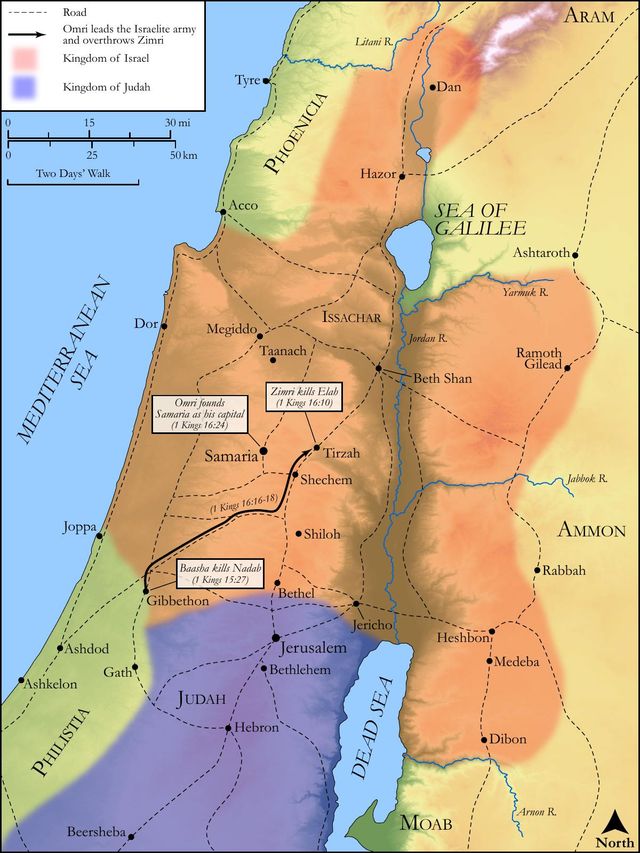
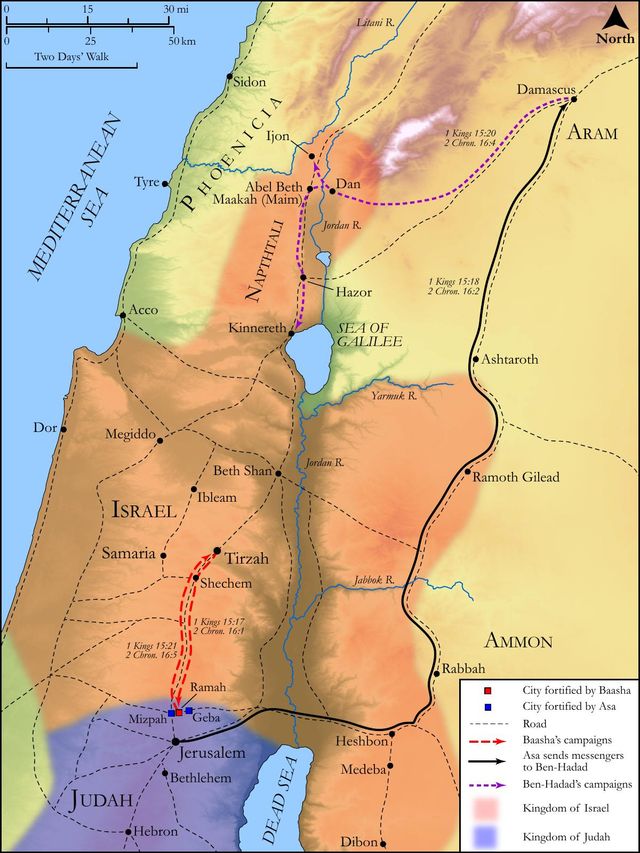
See on the biblical-era map

Study this verse
Public-domain commentary
Matthew Henry
From his Commentary on the Whole Bible. Henry comments on passages, not single verses — this entry covers 1 Kings 15:1–8. His three-level outline is real structure in the source text, so it is rendered as structure.
We have here a short account of the short reign of Abijam the son of Rehoboam king of Judah. He makes a better figure, 2 Chr. 13, where we have an account of his war with Jeroboam, the speech which he made before the armies engaged, and the wonderful victory he obtained by the help of God. There he is called Abijah - My father is the Lord, because no wickedness is there laid to his charge. But here, where we are told of his faults, Jah, the name of God, is, in disgrace to him, taken away from his name, and he is called Abijam. See Jer 22:24.
I.Few particulars are related concerning him.
1.Here began his reign in the beginning of Jeroboam's eighteenth year; for Rehoboam reigned but seventeen, Kg1 14:21. Jeroboam indeed survived Rehoboam, but Rehoboam's Abijah lived to succeed him and to be a terror to Jeroboam, while Jeroboam's Abijah (whom we read of Kg1 14:1) died before him.
2.He reigned scarcely three years, for he died before the end of Jeroboam's twentieth year, Kg1 15:9. Being made proud and secure by his great victory over Jeroboam (Ch2 13:21), God cut him off, to make way for his son Asa, who would be a better man.
3.His mother's name was Maachah, the daughter of Abishalom, that is, Absalom, David's son, as I am the rather inclined to think because two other of Rehoboam's wives were his near relations (Ch2 11:18), one the daughter of Jerimoth, David's son, and another the daughter of Eliab, David's brother. He took warning by his father not to marry strangers; yet thought it below him to marry his subjects, except they were of the royal family.
4.He carried on his father's wars with Jeroboam. As there was continual war between Rehoboam and Jeroboam, not set battles (these were forbidden, Kg1 12:24), but frequent encounters, especially upon the borders, one making incursions and reprisals on the other, so there was between Abijam and Jeroboam (Kg1 15:7), till Jeroboam, with a great army, invaded him, and then Abijam, not being forbidden to act in his own defence, routed him, and weakened him, so that he compelled him to be quiet during the rest of his reign, Ch2 13:20.
II.But, in general, we are told,
1.That he was not like David, had no hearty affection for the ordinances of God, though, to serve his purpose against Jeroboam, he pleaded his possession of the temple and priesthood, as that upon which he valued himself, Ch2 13:10-12. Many boast of their profession of godliness who are strangers to the power of it, and plead the truth of their religion who yet are not true to it. His heart was not perfect with the Lord his God. He seemed to have zeal, but he wanted sincerity; he began pretty well, but he fell off, and walked in all the sins of his father, followed his bad example, though he had seen the bad consequences of it. He that was all his days in war ought to have been so wise as to make and keep his peace with God, and not to make him his enemy, especially having found him so good a friend in his war with Jeroboam, Ch2 13:18. Let favour be shown to the wicked, yet will he not learn righteousness, Isa 26:10.
2.That yet it was for David's sake that he was advanced, and continued upon the throne; it was for his sake (Kg1 15:4, Kg1 15:5) that God thus set up his son after him; not for his own sake, nor for the sake of his father, in whose steps he trod, but for the sake of David, whose example he would not follow. Note, It aggravates the sin of a degenerate seed that they fare the better for the piety of their ancestors and owe their blessings to it, and yet will not imitate it. They stand upon that ground, and yet despise it, and trample upon it, and unreasonably ridicule and oppose that which they enjoy the benefit of. The kingdom of Judah was supported,
(1.)That David might have a lamp, pursuant to the divine ordination of a lamp for his anointed, Psa 132:17.
(2.)That Jerusalem might be established, not only that the honours put upon it in David's and Solomon's time might be preserved to it, but that it might be reserved to the honours designed for it in after-times. The character here given of David is very great - that he did that which was right in the eyes of the Lord; but the exception is very remarkable - save only in the matter of Uriah, including both his murder and the debauching of his wife. That was a bad matter; it was a remaining blot upon his name, a bar in his escutcheon, and the reproach of it was not wiped away, though the guilt was. David was guilty of other faults, but they were nothing in comparison of that; yet even that being repented of, though it be mentioned for warning to others, did not prevail to throw him out of the covenant, nor to cut off the entail of the promise upon his seed.
Continue studying 1 Kings 15:8 across the web’s major study libraries — every link below opens this exact verse, chapter, or book on the destination site.
Read & Compare
 BibleGatewayThis verse in more than 200 translations and 70 languages.
 Bible.comThe YouVersion reader — hundreds of translations, reading plans, and highlights.
 ESV.orgCrossway's official English Standard Version reader.
 NET BibleThe NET translation with 60,000+ translators' notes on every rendering decision.
 STEP BibleTyndale House's free study tool — original text, vocabulary, and scholarly resources.
 BibliaLogos Bible Software's free web reader.
 USCCBThe New American Bible (Revised Edition) with the U.S. bishops' study notes.
Commentaries
 BibleHub CommentariesDozens of classic commentaries on this verse, gathered on one page.
 StudyLightMore than 100 commentary sets — the largest collection on the web.
 BibleRefPlain-English commentary on what this verse means, verse by verse.
 Enduring WordDavid Guzik's free commentary on this chapter, widely used by Bible teachers.
 Bible Study ToolsVerse commentary alongside Greek and Hebrew study aids.
Original Language & Research
- BibleHub InterlinearThe verse word by word — original language, transliteration, and English.
- BibleHub LexiconEvery word's original-language definition and Strong's entry.
 Blue Letter BibleDeep-study tools — Strong's numbers, concordance, and word studies.
 SefariaThe Hebrew text with Rashi and centuries of Jewish commentary.
Sermons, Hymns & Audio


TrulyRandomVerse is not affiliated with these sites and doesn’t control their content. They’re linked because they’re genuinely useful.
Summary
1 Kings 15:8 concisely records the end of King Abijam's brief reign over Judah, detailing his death and burial, and immediately announcing the succession of his son, Asa, to the throne. This verse functions as a standard Deuteronomistic formula, marking a significant transition in the royal lineage and setting the stage for the subsequent narrative of Asa's kingship, which would bring a period of religious reform and relative faithfulness to the Lord.
Context
ShowHideLiterary Context
This verse serves as the concluding statement for the account of King Abijam's reign, which began in 1 Kings 15:1. The preceding verses (1 Kings 15:1-7) provide a summary of Abijam's three-year rule, emphasizing his unfaithfulness to the Lord by continuing the idolatrous practices of his father, Rehoboam, and failing to walk wholeheartedly with God, unlike his ancestor David. The narrative also notes his ongoing conflict with Jeroboam, the king of Israel. Verse 8, therefore, employs a conventional formula used throughout the Deuteronomistic history to signal the end of a king's rule and the beginning of the next, seamlessly transitioning the focus to Asa, whose reign is introduced in 1 Kings 15:9 and detailed thereafter. This formulaic conclusion provides narrative closure while maintaining the chronological flow of the royal succession.
Historical & Cultural Context
Abijam's short reign (c. 913-911 BC) occurred during the tumultuous early decades of the divided monarchy, following the schism of the united kingdom of Israel. The "city of David" refers to Jerusalem, specifically the ancient fortified area that King David conquered from the Jebusites and established as his capital and the royal burial ground for the kings of Judah. The phrase "slept with his fathers" is a widespread ancient Near Eastern and biblical euphemism for death, particularly for monarchs and patriarchs. This idiom signifies a natural, peaceful passing and the deceased's gathering to their ancestors, often implying burial in a family tomb or a designated royal necropolis. This cultural practice underscored the importance of lineage, continuity, and ancestral connection, especially for royal figures whose legitimacy was often tied to their dynastic heritage.
Key Themes
ShowHideThis concise verse powerfully contributes to several overarching themes within the books of Kings and the broader Deuteronomistic history. Firstly, it underscores the mortality of all human rulers, highlighting that even kings, despite their earthly power and divine appointment, are subject to death, thereby emphasizing the transient nature of human authority in stark contrast to God's eternal sovereignty. Secondly, it reinforces the continuity of the Davidic covenant, as the immediate succession from Abijam to Asa ensures the unbroken lineage of kings promised to David in 2 Samuel 7:12-16, even when individual kings like Abijam fall short of God's ideal. Finally, the swift transition sets the stage for the theme of divine providence in leadership, demonstrating God's sovereign hand in raising up leaders, whether righteous or unrighteous, to accomplish His purposes for His people. The subsequent narrative of Asa's reign, marked by a return to faithfulness, exemplifies this divine guidance, as seen in 1 Kings 15:11.
Exposition and Analysis
ShowHideKey Word Analysis
ShowHideFrom a primitive root meaning "to lie down (for rest, sexual connection, decease or any other purpose)." In this context, it is a common biblical euphemism for death, particularly for kings and patriarchs. It implies a peaceful, natural end to life, rather than a violent or sudden demise. This gentle phrasing underscores the common human experience of mortality, even for those in positions of power, and often carries the connotation of being gathered to one's ancestors.
From a root meaning "to watch" or "to be awake," referring to "a city (a place guarded by waking or a watch) in the widest sense (even of a mere encampment or post)." When combined with "David," it specifically refers to Jerusalem, the capital of Judah. Being buried in the "city of David" signifies a royal burial, often within a designated necropolis or royal tomb complex, affirming the king's legitimate place within the Davidic dynasty and the continuity of the royal line.
A primitive root meaning "to reign; inceptively, to ascend the throne; causatively, to induct into royalty." This word signifies the formal and legitimate assumption of royal authority. In the context of 1 Kings 15:8, it emphasizes the seamless transfer of power from Abijam to Asa, ensuring the continuity of the kingdom and the Davidic line, a critical aspect of the Deuteronomistic historical narrative.
Verse Breakdown
ShowHide"And Abijam slept with his fathers;"
This initial clause formally marks the end of King Abijam's three-year reign. The phrase "slept with his fathers" is a respectful and formulaic euphemism for his death, signifying a natural passing. It brings a definitive close to the narrative of his rule, which was largely characterized by unfaithfulness, and prepares the reader for the transition to the next monarch.
"and they buried him in the city of David:"
This part of the verse specifies the burial location of King Abijam. Being interred in "the city of David," which is Jerusalem, indicates a royal burial. This detail confirms his legitimate status as a king of Judah and his place within the established burial traditions of the Davidic dynasty, connecting him physically and symbolically to his royal predecessors and affirming the continuity of the royal line.
"and Asa his son reigned in his stead."
This final clause announces the immediate and legitimate succession of Abijam's son, Asa. The phrase "reigned in his stead" emphasizes the direct and uninterrupted transfer of power, ensuring the stability and continuity of the kingdom of Judah. This transition is pivotal, as Asa's reign would subsequently be described as a period of significant religious reform and a return to greater faithfulness to the Lord, marking a shift from the spiritual decline of his father and grandfather.
Literary Devices
ShowHide1 Kings 15:8 employs several significant literary devices that enrich its meaning and function within the broader narrative. The most prominent is Euphemism, particularly in the phrase "slept with his fathers," which serves as a gentle and respectful way to refer to death, avoiding a stark or harsh directness. This formulaic expression is characteristic of biblical historical writing, providing a consistent and dignified manner to mark the passing of monarchs. Another device is Formulaic Language, evident in the repetitive structure used to describe the end of a king's reign (death, burial, succession). This consistent pattern creates a sense of rhythm and predictability in the narrative, reinforcing the idea of divine order and the ongoing flow of history under God's sovereignty. Finally, the verse functions as a crucial Narrative Transition, effectively closing the account of Abijam's reign and immediately opening the door to the story of Asa, thereby maintaining the chronological and genealogical progression of the Deuteronomistic history and highlighting the seamless continuation of the Davidic dynasty.
Theological and Thematic Connections
ShowHide1 Kings 15:8, though brief, is rich with theological significance, particularly concerning God's unwavering faithfulness to His covenant and the nature of human leadership. The seamless transition of power from Abijam to Asa, despite Abijam's unrighteousness, powerfully underscores God's enduring commitment to the Davidic covenant, which promised an unbroken line of kings (2 Samuel 7:12-16). This verse also highlights the universal truth of human mortality, reminding us that even kings, with all their earthly power and influence, are subject to death, contrasting sharply with the eternal sovereignty and immutability of God. The succession of Asa, a king who would bring significant spiritual reforms, demonstrates God's providential hand in raising up leaders for His purposes, even after periods of spiritual decline. It is a testament to God's patience, His sovereign control over history, and His ongoing work in guiding His people towards righteousness and fulfilling His promises. The account of Abijam's reign is further elaborated in 2 Chronicles 13:1-22, providing additional context to his kingship.
Reflection and Application
ShowHideThis verse, marking the end of one reign and the beginning of another, offers profound lessons for contemporary believers regarding the nature of power, legacy, and divine sovereignty. It powerfully reminds us of the transient nature of all earthly authority and the inevitability of death for every individual, regardless of their status or influence. Abijam's brief and largely unrighteous reign is quickly succeeded by Asa's, who would bring significant spiritual reforms to Judah. This serves as a powerful reminder that while human leaders rise and fall, God's overarching plan for His people continues to unfold, often through unexpected transitions. It challenges us to consider the legacy we are building: not merely in terms of worldly achievements or personal fame, but in our faithfulness to God and our positive impact on those around us, particularly within the sphere of our influence. Our ultimate accountability is to the eternal King, and true, lasting influence is found in aligning our lives with His will, recognizing that our time, talents, and opportunities are precious gifts to be stewarded for His glory and the advancement of His kingdom.
Questions for Reflection
ShowHideFAQ
ShowHideWho was King Abijam, and what was his significance in the history of Judah?
ShowHideKing Abijam (also known as Abijah, particularly in 2 Chronicles 13) was the second king of the Southern Kingdom of Judah, reigning for a brief three years (c. 913-911 BC). He was the son of Rehoboam, who was Solomon's son, thereby placing him in the direct lineage of King David. His reign is primarily characterized by unfaithfulness to the Lord; 1 Kings 15:3 states that he "walked in all the sins of his father" and did not fully commit his heart to God. Despite his personal failings, God preserved his dynasty "for David's sake" (1 Kings 15:4), ensuring the continuity of the Davidic line in fulfillment of His covenant. His most notable historical event was a significant war against Jeroboam I, king of the Northern Kingdom of Israel, where he achieved a decisive victory, as recounted more extensively in 2 Chronicles 13.
What does the phrase "slept with his fathers" mean in a biblical context?
ShowHideThe phrase "slept with his fathers" is a common biblical euphemism for death, frequently used for kings and patriarchs throughout the Old Testament. It signifies a peaceful and natural passing, distinguishing it from a violent or untimely end. Beyond simply denoting death, it also carries the connotation of being gathered to one's ancestors in the grave, suggesting a continuity of lineage and a shared destiny with those who have died before. This expression is often followed by a mention of the burial place, such as the "city of David" for the kings of Judah, indicating their interment in the royal tombs alongside their predecessors. This formulaic expression highlights the mortality of all humans, even those in positions of power, and is a recurring motif throughout the books of Kings and Chronicles.
Why was it significant that Abijam was buried "in the city of David"?
ShowHideBeing buried "in the city of David" (Jerusalem) was highly significant for the kings of Judah. This location refers to the ancient part of Jerusalem, specifically the royal burial grounds established after King David conquered the city and made it his capital (2 Samuel 5:7). Burial in this specific location was a mark of honor and royal privilege, confirming the king's legitimate place within the Davidic dynasty and the continuity of the royal line. It distinguished those kings who were considered faithful or legitimate from others who might have been buried elsewhere due to their wickedness or a break in the succession. For Abijam, despite his unrighteousness, his burial in the city of David underscores God's faithfulness to His covenant with David, ensuring the perpetuation of his royal line and the stability of the kingdom of Judah, even when individual kings failed to uphold their covenant responsibilities.
Christ-Centered Fulfillment
ShowHide1 Kings 15:8, with its concise account of a king's death and the immediate succession of his son, finds profound Christ-centered fulfillment in the person and work of Jesus Christ, the ultimate King. Earthly kings like Abijam, despite their power and lineage, are subject to mortality, "sleeping with their fathers" and yielding their thrones to successors. This stark reality contrasts sharply with the eternal and unshakeable reign of Jesus, the true Son of David, whose kingdom "will have no end" (Luke 1:33). While Abijam's reign was marked by unrighteousness, foreshadowing the desperate need for a perfect King, Jesus is the perfectly righteous King whose life, atoning death, and glorious resurrection fully satisfy God's demands and bring true spiritual reform and redemption to His people, far beyond what any earthly king like Asa could achieve (Hebrews 7:26). His burial was not the final resting place of a mortal king, but the prelude to His triumphal resurrection, conquering death itself and ensuring that He does not "sleep with his fathers" in the sense of being held by death, but reigns eternally at God's right hand (Acts 2:24; Romans 6:9). Thus, 1 Kings 15:8 ultimately points to the ultimate King, Jesus, whose reign is eternal, perfectly righteous, and brings everlasting life to all who believe in Him (John 3:16), fulfilling the Davidic covenant in its most profound sense.