


1 Kings 15:1
Bible text: King James Version (1769 Blayney text) · Public domain
Bible text: Berean Standard Bible · Public domain
Bible text: American Standard Version (1901) · Public domain
Bible text: World English Bible, Messianic edition · Public domain
Bible text: Geneva Bible (1599) · Public domain
Bible text: Young's Literal Translation · Public domain
- וּבִשְׁנַתu·vish·Natand in yearH8141Conj-w ¦ Prep-b ¦ N-fscNoun Singular Feminine Constructוּandבִinשְׁנַתyear
- שְׁמֹנֶהshe·mo·Neheight-H8083N-csNoun Singular common gender Absolute
- עֶשְׂרֵה'es·RehteenH6240N-csNoun Singular common gender Absolute
- לַמֶּלֶךְla·Me·lekhof the kingH4428Prep-l ¦ N-msNoun Singular Masculine Absoluteלַof theמֶּלֶךְking
- יָרָבְעָםya·ra·ve·'AmJeroboamH3379N-proper-mNoun Proper Masculine
- בֶּןben[the] son ofH1121N-mscNoun Singular Masculine Construct
- נְבָטne·VatNebatH5028N-proper-mNoun Proper Masculine
- מָלַךְma·Lakhhe became kingH4427V-Qal-Perf-3msVerb Qal Perfect 3rd Singular Masculine
- אֲבִיָּם'a·vi·YamAbijamH38N-proper-mNoun Proper Masculine
- עַל'aloverH5921PrepPreposition
- יְהוּדָהye·hu·DahJudahH3063N-properNoun Proper Location
English is a literal word-by-word gloss of the Hebrew, not the KJV's wording. Why?
This is the original text the KJV's translators worked from — each Hebrew word with its own literal English meaning in this verse, prepared by scholars at Tyndale House, Cambridge. The KJV translates whole sentences, not word by word, so its wording differs: one Hebrew word can become several English words, and the KJV may choose “the LORD” where the gloss reads “Yahweh”. Both are faithful — they answer different questions. For the KJV's own rendering, switch to the KJV text.
Details
See on the biblical-era maps
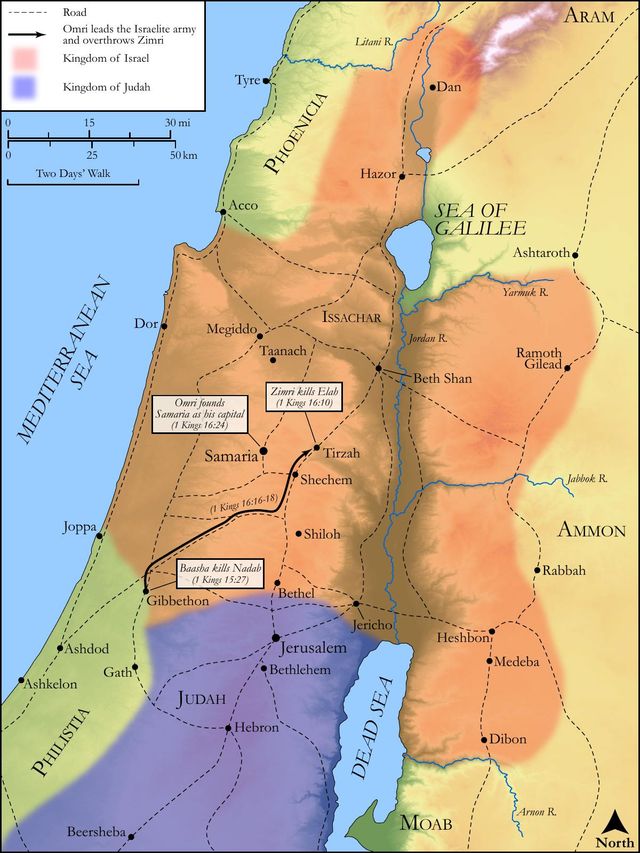
Study this verse
Public-domain commentary
Matthew Henry
From his Commentary on the Whole Bible. Henry comments on passages, not single verses — this entry covers 1 Kings 15:1–8. His three-level outline is real structure in the source text, so it is rendered as structure.
We have here a short account of the short reign of Abijam the son of Rehoboam king of Judah. He makes a better figure, 2 Chr. 13, where we have an account of his war with Jeroboam, the speech which he made before the armies engaged, and the wonderful victory he obtained by the help of God. There he is called Abijah - My father is the Lord, because no wickedness is there laid to his charge. But here, where we are told of his faults, Jah, the name of God, is, in disgrace to him, taken away from his name, and he is called Abijam. See Jer 22:24.
I.Few particulars are related concerning him.
1.Here began his reign in the beginning of Jeroboam's eighteenth year; for Rehoboam reigned but seventeen, Kg1 14:21. Jeroboam indeed survived Rehoboam, but Rehoboam's Abijah lived to succeed him and to be a terror to Jeroboam, while Jeroboam's Abijah (whom we read of Kg1 14:1) died before him.
2.He reigned scarcely three years, for he died before the end of Jeroboam's twentieth year, Kg1 15:9. Being made proud and secure by his great victory over Jeroboam (Ch2 13:21), God cut him off, to make way for his son Asa, who would be a better man.
3.His mother's name was Maachah, the daughter of Abishalom, that is, Absalom, David's son, as I am the rather inclined to think because two other of Rehoboam's wives were his near relations (Ch2 11:18), one the daughter of Jerimoth, David's son, and another the daughter of Eliab, David's brother. He took warning by his father not to marry strangers; yet thought it below him to marry his subjects, except they were of the royal family.
4.He carried on his father's wars with Jeroboam. As there was continual war between Rehoboam and Jeroboam, not set battles (these were forbidden, Kg1 12:24), but frequent encounters, especially upon the borders, one making incursions and reprisals on the other, so there was between Abijam and Jeroboam (Kg1 15:7), till Jeroboam, with a great army, invaded him, and then Abijam, not being forbidden to act in his own defence, routed him, and weakened him, so that he compelled him to be quiet during the rest of his reign, Ch2 13:20.
II.But, in general, we are told,
1.That he was not like David, had no hearty affection for the ordinances of God, though, to serve his purpose against Jeroboam, he pleaded his possession of the temple and priesthood, as that upon which he valued himself, Ch2 13:10-12. Many boast of their profession of godliness who are strangers to the power of it, and plead the truth of their religion who yet are not true to it. His heart was not perfect with the Lord his God. He seemed to have zeal, but he wanted sincerity; he began pretty well, but he fell off, and walked in all the sins of his father, followed his bad example, though he had seen the bad consequences of it. He that was all his days in war ought to have been so wise as to make and keep his peace with God, and not to make him his enemy, especially having found him so good a friend in his war with Jeroboam, Ch2 13:18. Let favour be shown to the wicked, yet will he not learn righteousness, Isa 26:10.
2.That yet it was for David's sake that he was advanced, and continued upon the throne; it was for his sake (Kg1 15:4, Kg1 15:5) that God thus set up his son after him; not for his own sake, nor for the sake of his father, in whose steps he trod, but for the sake of David, whose example he would not follow. Note, It aggravates the sin of a degenerate seed that they fare the better for the piety of their ancestors and owe their blessings to it, and yet will not imitate it. They stand upon that ground, and yet despise it, and trample upon it, and unreasonably ridicule and oppose that which they enjoy the benefit of. The kingdom of Judah was supported,
(1.)That David might have a lamp, pursuant to the divine ordination of a lamp for his anointed, Psa 132:17.
(2.)That Jerusalem might be established, not only that the honours put upon it in David's and Solomon's time might be preserved to it, but that it might be reserved to the honours designed for it in after-times. The character here given of David is very great - that he did that which was right in the eyes of the Lord; but the exception is very remarkable - save only in the matter of Uriah, including both his murder and the debauching of his wife. That was a bad matter; it was a remaining blot upon his name, a bar in his escutcheon, and the reproach of it was not wiped away, though the guilt was. David was guilty of other faults, but they were nothing in comparison of that; yet even that being repented of, though it be mentioned for warning to others, did not prevail to throw him out of the covenant, nor to cut off the entail of the promise upon his seed.
Historical interpretation
Historical reception
1 surviving comment on this verse from the historical church.
“Now in the eighteenth year of King Jeroboam son of Nebat, Abijam began to reign over Judah,” and under his rule the Jews obtained a magnificent victory over the Israelites in a battle, which was greater than all those fought before in their civil wars. It is said that after the two multitudes of soldiers were drawn up in fighting order, Abijam appeared to have four hundred thousand men, and Jeroboam eight hundred thousand. The Jews won, while the number of the Israelites who fell in action was larger than five hundred thousand, which is an extremely rare occurrence in history.
Continue studying 1 Kings 15:1 across the web’s major study libraries — every link below opens this exact verse, chapter, or book on the destination site.
Read & Compare
 BibleGatewayThis verse in more than 200 translations and 70 languages.
 Bible.comThe YouVersion reader — hundreds of translations, reading plans, and highlights.
 ESV.orgCrossway's official English Standard Version reader.
 NET BibleThe NET translation with 60,000+ translators' notes on every rendering decision.
 STEP BibleTyndale House's free study tool — original text, vocabulary, and scholarly resources.
 BibliaLogos Bible Software's free web reader.
 USCCBThe New American Bible (Revised Edition) with the U.S. bishops' study notes.
Commentaries
 BibleHub CommentariesDozens of classic commentaries on this verse, gathered on one page.
 StudyLightMore than 100 commentary sets — the largest collection on the web.
 BibleRefPlain-English commentary on what this verse means, verse by verse.
 Enduring WordDavid Guzik's free commentary on this chapter, widely used by Bible teachers.
 Bible Study ToolsVerse commentary alongside Greek and Hebrew study aids.
Original Language & Research
- BibleHub InterlinearThe verse word by word — original language, transliteration, and English.
- BibleHub LexiconEvery word's original-language definition and Strong's entry.
 Blue Letter BibleDeep-study tools — Strong's numbers, concordance, and word studies.
 SefariaThe Hebrew text with Rashi and centuries of Jewish commentary.
Sermons, Hymns & Audio


TrulyRandomVerse is not affiliated with these sites and doesn’t control their content. They’re linked because they’re genuinely useful.
Summary
1 Kings 15:1 serves as a pivotal chronological anchor within the Books of Kings, precisely marking the commencement of King Abijam's reign over Judah by synchronizing it with the eighteenth regnal year of King Jeroboam in the Northern Kingdom of Israel. This seemingly straightforward statement is crucial for establishing the interwoven timeline of the divided monarchy, highlighting the biblical author's meticulous historical framework and setting the stage for the subsequent account of Abijam's brief yet significant tenure on the throne of Judah, thereby continuing the divinely promised Davidic dynasty.
Context
ShowHideLiterary Context
This verse immediately follows the concluding summary of Rehoboam's reign in Judah (1 Kings 14:21-31), which details his spiritual failures, the idolatry in Judah, and his eventual death and burial. As is characteristic of the Deuteronomistic History found in the Books of Kings, the narrative seamlessly transitions to the succession of the next king in the Davidic line. By explicitly linking Abijam's ascension to Jeroboam's established reign in the Northern Kingdom, the text maintains a continuous, interwoven timeline for both the Southern and Northern Kingdoms, despite their political and religious separation. This chronological precision is a hallmark of the author's method, ensuring the reader understands the contemporary events unfolding in both Israel and Judah, and it sets the stage for Abijam's own narrative, which will detail his character, actions, and particularly his conflict with Jeroboam, as further elaborated in 1 Kings 15:2-8.
Historical & Cultural Context
The period described in 1 Kings 15:1 is one of deep political and religious division that arose after the united monarchy fractured following Solomon's death, a pivotal event narrated in 1 Kings 12. Jeroboam, the first king of the Northern Kingdom of Israel, had established alternative worship sites at Dan and Bethel, complete with golden calves, actively leading his people into idolatry and away from the legitimate worship at the Jerusalem temple. Judah, though retaining the Davidic line and the temple, was not immune to spiritual decline, as evidenced by Rehoboam's reign. Abijam's ascension signifies the continuation of the Davidic dynasty in Judah, a line to which God had made an eternal covenant promise, particularly in 2 Samuel 7:16. The precise dating by reference to Jeroboam's reign underscores the political reality of two distinct, often hostile, kingdoms coexisting in the land, with their histories inextricably linked by shared heritage and ongoing conflict.
Key Themes
ShowHideThe primary themes embedded within this verse include chronological precision, which is vital for the biblical author's overarching historical framework. This meticulous dating demonstrates God's sovereign and meticulous oversight of human history, revealing that events unfold according to His divine plan and timetable, even amidst human sin and political turmoil. Another key theme is the continuation of the Davidic covenant, as Abijam, Rehoboam's son, represents the unbroken lineage of kings in Judah. This highlights God's unwavering faithfulness to His promises, particularly the covenant made with David concerning an enduring dynasty, even when human actors, including the kings themselves, prove unfaithful. Finally, the verse underscores the enduring reality of the divided monarchy, reminding the reader of the ongoing political and religious separation between Israel and Judah. This division was a direct consequence of Solomon's sin and God's judgment, as prophesied in 1 Kings 11:11-13, serving as a constant backdrop to the narratives in Kings.
Exposition and Analysis
ShowHideKey Word Analysis
ShowHideFrom the root אָב (father) and יָם (sea), this name literally means "father of (the) sea" or "my father is the sea," potentially alluding to a pagan deity or a symbolic representation of power. However, it is widely understood as a variant of "Abijah" (Hebrew, ʼĂḇiyyāh'), meaning "My father is Yahweh." The use of "Abijam" in Kings and "Abijah" in Chronicles for the same king is a notable textual phenomenon. While some scholars propose a deliberate change in Kings to subtly reflect the king's unfaithfulness or distance from Yahweh, contrasting with the more positive portrayal in Chronicles, others suggest it is simply a scribal variation or a shortened form. Regardless, the name signifies a direct familial connection to Rehoboam and, through him, to the Davidic line.
Derived from רִיב (to contend) and עַם (people), this name means "(the) people will contend" or "he contends for the people." This name belongs to Jeroboam I, the first king of the Northern Kingdom of Israel, who is consistently portrayed in the Books of Kings as the archetype of apostasy. His establishment of golden calf worship at Dan and Bethel led Israel into widespread idolatry, setting a precedent for subsequent northern kings. His "eighteenth year" signifies a well-established, albeit ungodly, rule, serving as a primary chronological anchor for the Northern Kingdom's history against which the new reign in Judah is measured.
This primitive root verb signifies the formal act of assuming royal power and exercising sovereignty. It can also mean "to ascend the throne" or, causatively, "to induct into royalty." Its use here indicates the legitimate transfer of authority within the Davidic dynasty in Judah, emphasizing the king's role as ruler, judge, and military leader. The term highlights the continuity of the monarchy, despite the political fragmentation of the larger Israelite nation, and implies both the divine appointment and the human responsibility inherent in kingship.
Verse Breakdown
ShowHide"¶ Now in the eighteenth year of king Jeroboam the son of Nebat"
This opening clause meticulously establishes the precise chronological setting for Abijam's ascension to the throne. By referencing the long-standing reign of Jeroboam in the Northern Kingdom, the biblical author provides a fixed and verifiable point of reference, enabling readers to synchronize the parallel histories of Israel and Judah. It underscores the significant duration of Jeroboam's rule and implicitly contrasts the stability of his northern kingdom (at least in terms of his personal longevity) with the recent succession in Judah following Rehoboam's death.
"reigned Abijam over Judah"
This clause directly declares the commencement of Abijam's kingship. It identifies him as the new sovereign, succeeding his father Rehoboam, and importantly specifies his dominion as "over Judah." This geographical limitation is crucial, reinforcing the enduring reality of the divided monarchy. Furthermore, it underscores the continuation of the Davidic line, as Abijam is a direct descendant of King David, thereby maintaining the covenant promise of a perpetual dynasty in Jerusalem, even amidst the kingdom's fragmentation.
Literary Devices
ShowHide1 Kings 15:1 primarily employs Chronological Framing and Juxtaposition. The verse uses Chronological Framing by precisely dating Abijam's reign in relation to Jeroboam's, providing a clear temporal anchor for the narrative. This meticulous dating is a characteristic feature of the Books of Kings, establishing a reliable historical framework for the reader and demonstrating the biblical author's concern for historical accuracy and the orderly progression of God's plan. This device allows for the synchronization of events across the two separate kingdoms, enabling a coherent understanding of their intertwined histories. Furthermore, the verse implicitly uses Juxtaposition by placing the reign of Abijam (representing the legitimate Davidic line in Judah) directly against the backdrop of Jeroboam's reign (representing the apostate Northern Kingdom). This sets up the ongoing theological and political tension between the two kingdoms, a theme that will be further developed in the subsequent narratives of conflict, religious deviation, and divine judgment.
Theological and Thematic Connections
ShowHideThis seemingly simple chronological statement profoundly illustrates God's sovereign hand in history, even amidst the complexities of human politics, the consequences of sin, and the division of His chosen people. The meticulous dating of Abijam's reign, cross-referenced with Jeroboam's, underscores that God's plan unfolds precisely according to His timetable, regardless of the faithlessness of kings or the fragmentation of kingdoms. It highlights the enduring nature of the Davidic covenant, as God faithfully preserves a lineage in Judah through which His promises will ultimately be fulfilled, despite the moral failings of individual kings like Abijam. The ongoing reality of the divided monarchy serves as a stark reminder of the devastating consequences of disobedience and idolatry, yet also of God's patient preservation of a remnant and a chosen line for His ultimate redemptive purposes.
Reflection and Application
ShowHide1 Kings 15:1, despite its brevity and seemingly dry historical detail, offers profound insights for contemporary believers. It reminds us that God is the ultimate orchestrator of history, meticulously overseeing the rise and fall of nations and kings, even when human actions seem chaotic or contrary to His divine will. The Bible's attention to such precise historical details affirms its reliability not just as a spiritual guide but as a trustworthy historical record, encouraging us to approach all Scripture with diligence and faith. For us, this means recognizing that our lives, our times, and the events of our world are not random or accidental, but are held within the sovereign hand of a God who is working out His eternal purposes. This should inspire both humility and profound confidence: humility in recognizing our small but significant place within His grand narrative, and confidence that His promises, especially concerning the ultimate reign of Christ, will never fail, regardless of present circumstances. We are called to live faithfully within the times God has appointed for us, trusting His overarching plan.
Questions for Reflection
ShowHideFAQ
ShowHideWhy is this king called "Abijam" in 1 Kings but "Abijah" in 2 Chronicles?
ShowHideThe variation in the king's name, "Abijam" in 1 Kings 15:1 and "Abijah" in 2 Chronicles 13:1, refers to the same individual, Rehoboam's son and successor. The difference is likely due to a combination of factors. "Abijah" (Hebrew: ʼĂḇiyyāh) means "My father is Yahweh," a common theophoric name in Israel that explicitly reflects a connection to God. "Abijam" (Hebrew: ʼĂḇiyyām) could mean "My father is Yam" (a Canaanite sea god), or more likely, it is a simple scribal variant or a shortened form of "Abijah." Some scholars suggest that the Deuteronomistic historian (author of Kings) might have deliberately used "Abijam" to subtly reflect the king's moral failings or a perceived distance from Yahweh, contrasting with the more positive and theologically focused portrayal in Chronicles, which often emphasizes the Davidic line's connection to Yahweh. However, the most widely accepted view is that it is a slight textual variation or a simple scribal preference, as such minor differences in names are not uncommon in ancient texts. Both names clearly identify the same person and his place in the royal succession.
Christ-Centered Fulfillment
ShowHideThe seemingly mundane chronological detail of 1 Kings 15:1, marking the reign of Abijam, finds its ultimate and profound significance in the grand narrative of God's redemptive plan culminating in Jesus Christ. Abijam, despite his personal flaws and brief reign, was a direct descendant in the Davidic line, the very lineage through which God had promised an eternal King and an everlasting kingdom (2 Samuel 7:12-16). Every king who sat on David's throne in Judah, including Abijam, served as a vital, divinely preserved link in this messianic genealogy, pointing forward to the true and perfect King. Jesus Christ is the ultimate "Son of David" (as seen in the genealogies of Matthew 1:1 and Luke 3:31), the one whose kingdom is not divided, temporary, or marred by human sin, but is eternal, universal, and righteous. Unlike Abijam, whose reign was marked by conflict and limited to Judah, Jesus' reign is one of perfect peace, justice, and extends over all creation (Ephesians 1:20-22). Thus, even a historical marker like 1 Kings 15:1 subtly underscores God's unwavering faithfulness to His covenant promises, meticulously preserving the royal line through generations of flawed kings until the arrival of the Messiah, the King of kings, whose dominion will have no end (Revelation 11:15).