


2 Chronicles 13:22
- וְיֶתֶרve·Ye·terand [the] rest ofH3499Conj-w ¦ N-mscNoun Singular Masculine Constructוְandיֶתֶר[the] rest of
- דִּבְרֵיdiv·Rei[the] matters ofH1697N-mpcNoun Plural Masculine Construct
- אֲבִיָּה'a·vi·YahAbijahH29N-proper-mNoun Proper Masculine
- וּדְרָכָיוu·de·ra·Khavand his waysH1870Conj-w ¦ N-mpc ¦ 3msNoun Plural Masculine Constructוּandדְרָכָיwaysוhis
- וּדְבָרָיוu·de·va·Ravand his wordsH1697Conj-w ¦ N-mpc ¦ 3msNoun Plural Masculine Constructוּandדְבָרָיwordsוhis
- כְּתוּבִיםke·tu·Vim[are] writtenH3789V-Qal-PassPrtcpl-mpVerb Qal Participle Passive Plural Masculine Absolute
- בְּמִדְרַשׁbe·mid·Rashin [the] record ofH4097Prep-b ¦ N-mscNoun Singular Masculine Constructבְּinמִדְרַשׁ[the] record of
- הַנָּבִיאha·na·Vi'the prophetH5030Art ¦ N-msNoun Singular Masculine Absoluteהַtheנָּבִיאprophet
- עִדּוֹi·DoIddoH5714N-proper-mNoun Proper Masculine
English is a literal word-by-word gloss of the Hebrew, not the KJV's wording. Why?
This is the original text the KJV's translators worked from — each Hebrew word with its own literal English meaning in this verse, prepared by scholars at Tyndale House, Cambridge. The KJV translates whole sentences, not word by word, so its wording differs: one Hebrew word can become several English words, and the KJV may choose “the LORD” where the gloss reads “Yahweh”. Both are faithful — they answer different questions. For the KJV's own rendering, switch to the KJV text.
Details
See on the biblical-era map
Study this verse
Public-domain commentary
Matthew Henry
From his Commentary on the Whole Bible. Henry comments on passages, not single verses — this entry covers 2 Chronicles 13:13–22. His three-level outline is real structure in the source text, so it is rendered as structure.
We do not find that Jeroboam offered to make any answer at all to Abijah's speech. Though it was much to the purpose, he resolved not to heed it, and therefore he heard it as though he heard it not. He came to fight, not to dispute. The longest sword, he thought, would determine the matter, not the better cause. Let us therefore see the issue, whether right and religion carried the day or no.
I.Jeroboam, who trusted to his politics, was beaten.
He was so far from fair reasoning that he was not for fair fighting. We may suppose that he felt a sovereign contempt for Abijah's harangue. "One stratagem," thinks he, "is worth twenty such speeches; we will soon give him an answer to all his arguments; he shall soon find himself overpowered with numbers, surrounded on every side with the instruments of death, and then let him boast of his religion and his title to the crown." A parley, it is probable, was agreed on, yet Jeroboam basely takes the advantage of it, and, while he was treating, laid his ambushment behind Judah, against all the laws of arms. What honour could be expected in a servant when he reigned? Abijah was for peace, but, when he spoke, they were for war, Psa 120:7.
II.Abijah and his people, who trusted in their God, came off conquerors, notwithstanding the disproportion of their strength and numbers.
1.They were brought into a great strait, put into a great fright, for the battle was before and behind. A good cause, and one which is designed to be victorious, may for a season be involved in embarrassment and distress. It was David's case. They compassed me about like bees, Psa 118:10-12.
2.In their distress, when danger was on every side, which way should they look but upwards for deliverance? It is an unspeakable comfort that no enemy (not the most powerful or politic), no stratagem or ambushment, can cut off our communication with heaven; our way thitherward is always open.
(1.)They cried unto the Lord, Ch2 13:14. We hope they did this before they engaged in this war, but the distress they were in made them renew their prayers and quickened them to be importunate. God brings his people into straits, that he may teach them to cry unto him. Earnest praying is crying.
(2.)They relied on the God of their fathers, depended upon his power to help them and committed themselves to him, Ch2 13:18. The prayer of faith is the prevailing prayer, and this is that by which we overcome the world, even our faith, Jo1 5:4.
(3.)The priests sounded the trumpets to animate them by giving them an assurance of God's presence with them. It was not only a martial but a sacred sound, and put life into their faith.
(4.)They shouted in confidence of victory: "The day is our own, for God is with us." To the cry of the prayer they added the shout of faith, and so became more than conquerors.
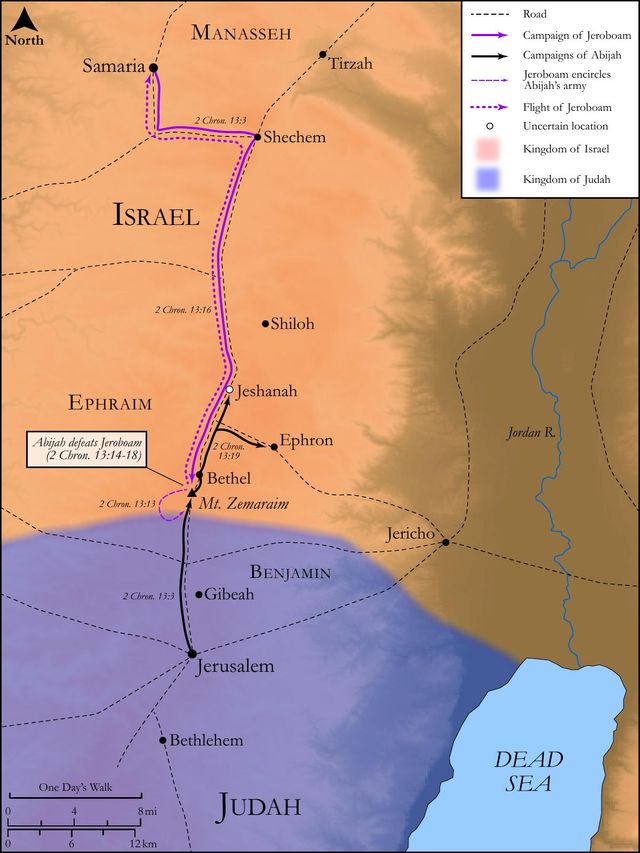
3.Thus they obtained a complete victory: As the men of Judah shouted for joy in God's salvation, God smote Jeroboam and his army with such terror and amazement that they could not strike a stroke, but fled with the greatest precipitation imaginable, and the conquerors gave no quarter, so that they put to the sword 500,000 chosen men (Ch2 13:17), more, it is said, than ever we read of in any history to have been killed in one battle; but the battle was the Lord's, who would thus chastise the idolatry of Israel and own the house of David. But see the sad effect of division: it was the blood of Israelites that was thus shed like water by Israelites, while the heathen, their neighbours, to whom the name of Israel had formerly been a terror, cried, Aha! so would we have it.
4.The consequence of this was that the children of Israel, though they were not brought back to the house of David (which by so great a blow surely they would have been had not the determinate counsel of God been otherwise), yet, for that time, were brought under, Ch2 13:18. Many cities were taken, and remained in the possession of the kings of Judah; as Bethel particularly, Ch2 13:19. What became of the golden calf there, when it came into the hands of the king of Judah, we are not told; perhaps it was removed to some place of greater safety, and at length to Samaria (Hos 8:5); yet in Jehu's time we find it at Bethel, Kg2 10:29. Perhaps Abijah, when it was in his power to demolish it, suffered it to stand, for his heart was not perfect with God; and, not improving what he had got for the honour of God, he soon lost it all again.
Lastly, The death of both of the conquered and of the conqueror, not long after. 1. Jeroboam never looked up after this defeat, though he survived it two or three years. He could not recover strength again, Ch2 13:20. The Lord struck him either with some bodily disease, of which he languished, or with melancholy and trouble of mind; his heart was broken, and vexation at his loss brought his head, probably by this time a hoary head, with sorrow to the grave. He escaped the sword of Abijah, but God struck him: and there is no escaping his sword. 2. Abijah waxed mighty upon it. What number of wives and children he had before does not appear; but now he multiplied his wives to fourteen in all, by whom he had thirty-eight children, Ch2 13:21. Happy is the man that hath his quiver full of those arrows. It seems, he had ways peculiar to himself, and sayings of his own, which were recorded with his acts in the history of those times, Ch2 13:22. But the number of his months was cut off in the midst, and, soon after his triumphs, death conquered the conqueror. Perhaps he was too much lifted up with his victories, and therefore God would not let him live long to enjoy the honour of them.
Continue studying 2 Chronicles 13:22 across the web’s major study libraries — every link below opens this exact verse, chapter, or book on the destination site.
Read & Compare
 BibleGatewayThis verse in more than 200 translations and 70 languages.
 Bible.comThe YouVersion reader — hundreds of translations, reading plans, and highlights.
 ESV.orgCrossway's official English Standard Version reader.
 NET BibleThe NET translation with 60,000+ translators' notes on every rendering decision.
 STEP BibleTyndale House's free study tool — original text, vocabulary, and scholarly resources.
 BibliaLogos Bible Software's free web reader.
 USCCBThe New American Bible (Revised Edition) with the U.S. bishops' study notes.
Commentaries
 BibleHub CommentariesDozens of classic commentaries on this verse, gathered on one page.
 StudyLightMore than 100 commentary sets — the largest collection on the web.
 BibleRefPlain-English commentary on what this verse means, verse by verse.
 Enduring WordDavid Guzik's free commentary on this chapter, widely used by Bible teachers.
 Bible Study ToolsVerse commentary alongside Greek and Hebrew study aids.
Original Language & Research
- BibleHub InterlinearThe verse word by word — original language, transliteration, and English.
- BibleHub LexiconEvery word's original-language definition and Strong's entry.
 Blue Letter BibleDeep-study tools — Strong's numbers, concordance, and word studies.
 SefariaThe Hebrew text with Rashi and centuries of Jewish commentary.
Sermons, Hymns & Audio


TrulyRandomVerse is not affiliated with these sites and doesn’t control their content. They’re linked because they’re genuinely useful.
Summary
2 Chronicles 13:22 serves as a concluding colophon for the three-year reign of King Abijah of Judah, providing a concise summary of his unrecorded deeds, character, and words, while directing the reader to an external, authoritative source—"the story of the prophet Iddo"—for a more comprehensive account. This verse exemplifies the Chronicler's divinely inspired yet selective approach to recording the history of God's people, emphasizing the theological purpose of the biblical narrative over exhaustive historical detail, and underscoring the vital role of prophetic documentation in ancient Israelite historiography.
Context
ShowHideLiterary Context
This verse formally concludes the Chronicler's account of King Abijah's brief but significant reign, which commenced in 2 Chronicles 13:1. The preceding narrative, particularly 2 Chronicles 13:1-21, focuses almost exclusively on Abijah's pivotal victory over Jeroboam I of Israel. This battle is presented not merely as a historical event but as a theological object lesson, illustrating God's active intervention and favor on behalf of Judah when they relied on Him, contrasting sharply with the apostasy of the northern kingdom. The Chronicler's characteristic brevity regarding other aspects of Abijah's rule, followed by a direct reference to an external source, is a recurring literary device throughout Chronicles (e.g., 2 Chronicles 9:29, 2 Chronicles 12:15), signaling that the biblical text is a divinely inspired, selective theological history, not an exhaustive secular chronicle.
Historical & Cultural Context
King Abijah reigned over the southern kingdom of Judah during a period marked by profound political and religious schism with the northern kingdom of Israel, which had seceded under Jeroboam I. This division, a consequence of Solomon's idolatry and Rehoboam's folly, created a volatile geopolitical landscape characterized by ongoing conflict. In the ancient Near East, it was common practice for royal scribes and chroniclers to maintain and cite older, more detailed records. Prophets, in particular, held a unique position; they were not merely foretellers of the future but also divinely appointed interpreters of God's actions in history, often serving as official court historians who documented events from a sacred perspective. The explicit mention of "the prophet Iddo" as the source for Abijah's "acts," "ways," and "sayings" underscores the cultural expectation that such authoritative records would be maintained and consulted, thereby lending immense credibility and historical grounding to the Chronicler's own divinely guided narrative.
Key Themes
ShowHideThis verse significantly contributes to several overarching themes within the book of Chronicles. Firstly, it reinforces the theme of Divine Historiography, illustrating that God's sovereign hand is not only in the unfolding of history but also in its preservation and recording through human instruments like prophets. The Chronicler's consistent reliance on and citation of external records, such as "the story of the prophet Iddo" (also referenced concerning Solomon in 2 Chronicles 9:29 and Rehoboam in 2 Chronicles 12:15), powerfully underscores the historical veracity and grounding of the biblical narrative. Secondly, it highlights the Authority and Enduring Role of Prophetic Records, emphasizing that prophets were not solely messengers of God's immediate word but also diligent chroniclers of their times, providing an inspired and authoritative perspective on historical events. Finally, it subtly reinforces the Theological Purpose of Scripture, demonstrating that the Bible is not an exhaustive encyclopedia of every event but rather a divinely curated and selective narrative that includes precisely what is necessary for understanding God's redemptive plan and His covenant dealings with His people, leaving other details to supplementary, albeit authoritative, sources.
Exposition and Analysis
ShowHideKey Word Analysis
ShowHideThis term properly denotes "an overhanging," implying "an excess," "superiority," or "remainder." In this context, it refers to the "remainder" or "residue" of Abijah's actions, ways, and sayings that are not detailed in the Chronicler's primary account, indicating that the biblical narrative is a selective summary rather than an exhaustive record.
This versatile word means "a word," but by implication, it can refer to "a matter," "thing," "affair," "deed," or "business." Its dual use here, referring to both "acts" (deeds, accomplishments) and "sayings" (words, pronouncements), highlights the comprehensive nature of the records kept by Iddo, encompassing both the king's actions and his verbal expressions.
This word literally means "a road (as trodden)," but figuratively, it refers to "a course of life" or "mode of action." In the context of a king, "his ways" encompass his character, conduct, moral disposition, administrative policies, and overall manner of governance, reflecting his faithfulness or unfaithfulness to God.
This term properly signifies "an investigation," and by implication, "a treatise" or "elaborate compilation." Unlike the later rabbinic interpretive method known as Midrash, here it denotes a written record that likely provided a more detailed, expansive, or even interpretive account of Abijah's reign than the summary given in Chronicles. It suggests a thorough historical document, possibly offering insights into the significance of events.
Verse Breakdown
ShowHide"And the rest of the acts of Abijah"
This phrase serves as a transitional colophon, signaling the conclusion of the Chronicler's primary narrative concerning Abijah. "The rest" indicates that the biblical account has focused on specific, theologically significant events (like the battle with Jeroboam) and is now acknowledging the existence of other, unmentioned "acts" or deeds and accomplishments of his reign.
"and his ways"
This refers to Abijah's character, his moral conduct, and the overall manner in which he governed and lived his life. It encompasses his spiritual disposition—whether he walked in the ways of the Lord or deviated from them—and his administrative style, offering a comprehensive view of his personal and public life.
"and his sayings"
This refers to Abijah's words, speeches, decrees, or significant pronouncements. This could include his powerful address before the battle against Jeroboam (as recorded in 2 Chronicles 13:4-12), suggesting that Iddo's record contained a more extensive collection of his utterances or perhaps the full text of those mentioned in the biblical narrative.
"[are] written in the story of the prophet Iddo"
This clause provides the authoritative external source for these additional details. The direct reference to "the prophet Iddo" lends immense credibility and divine authority, as prophets were divinely appointed figures whose records were considered trustworthy and inspired accounts of God's dealings in history. This statement confirms that the Chronicler had access to and consulted such meticulous historical documents, underscoring the diligent nature of ancient biblical historiography.
Literary Devices
ShowHide2 Chronicles 13:22 masterfully employs several significant literary devices. It functions as a Colophon, a concluding statement common in ancient Near Eastern texts that marks the end of a section and often directs the reader to a source for further information. This device provides a sense of closure to the narrative of Abijah's reign while simultaneously reassuring the reader of the historical depth and availability of more extensive records. Furthermore, the verse is a prime example of Intertextuality, as it explicitly references an external document, "the story of the prophet Iddo." This practice highlights the Chronicler's method of Historiography, demonstrating that he was not inventing history but was compiling, selecting, and interpreting existing records, often from prophetic sources, to construct a cohesive theological narrative. The Chronicler's selective inclusion of details, focusing on Abijah's reliance on God in battle, followed by this general reference, underscores the Theological Purpose of his work: to present a divinely guided history that emphasizes obedience, covenant faithfulness, and God's sovereignty, rather than an exhaustive secular account of every event.
Theological and Thematic Connections
ShowHideThis verse profoundly underscores the meticulous nature of divine providence, not only in guiding historical events but also in their preservation and documentation. It affirms that God's hand is intimately present in the recording of history, ensuring that precisely what is essential for His redemptive purposes is accurately transmitted to future generations. The Chronicler's consistent practice of citing external sources, particularly prophetic ones, validates the historical grounding of the biblical narrative while simultaneously highlighting its theological selectivity. It teaches us that while the Bible is historically accurate and rooted in real events, its primary aim is not to be an exhaustive historical encyclopedia, but rather a divinely inspired guide for faith and life, presenting God's dealings with humanity from His own sovereign perspective. The existence of these external records, now lost to us, serves to confirm the biblical account's rootedness in verifiable events and the diligent research of its ancient compilers, bolstering our confidence in the trustworthiness of Scripture.
Reflection and Application
ShowHide2 Chronicles 13:22 offers profound and enduring insights for contemporary believers, reinforcing the bedrock of our faith. It reminds us that the biblical narrative, though divinely inspired and concise in places, is deeply rooted in verifiable historical events, often supported by a wealth of ancient documentation. This should profoundly bolster our confidence in the Bible's reliability, trustworthiness, and historical accuracy, affirming that our faith is not based on myth but on the unfolding of God's purposes in real time and space. Furthermore, this verse highlights the multifaceted role of prophets, not just as foretellers of the future but as faithful historians and authoritative interpreters of God's active work in their own times. For us today, this means that God continues to work through diverse means—including scholarly research, historical inquiry, and the faithful witness of His people—to preserve and illuminate His truth across generations. We are called to appreciate the selective wisdom of Scripture, trusting that what God has chosen to reveal is precisely what we need for our spiritual journey, and that His overarching plan for humanity is meticulously unfolded, even if every detail of every life is not exhaustively recorded. This verse encourages us to delve into the depths of the biblical text with confidence, knowing that every word is purposeful and points to God's sovereign control over all history and His unwavering commitment to His covenant people.
Questions for Reflection
ShowHideFAQ
ShowHideWhat is the significance of "the prophet Iddo" being cited as a source?
ShowHideThe citation of "the prophet Iddo" in 2 Chronicles 13:22 is highly significant for several reasons. Firstly, it lends strong historical credibility to the Chronicler's account, indicating that he consulted and relied upon established, authoritative records of his time. Prophets in ancient Israel were not only spiritual leaders but often served as official royal historians, documenting events from a divine perspective. Iddo himself is mentioned elsewhere as a chronicler for King Solomon (2 Chronicles 9:29) and King Rehoboam (2 Chronicles 12:15), establishing him as a prominent and trusted figure whose writings were considered reliable and authoritative. His "story" (מִדְרָשׁ, midrâsh) likely contained a more detailed, perhaps even interpretive, account of Abijah's reign, affirming that the biblical text, while divinely inspired and fully sufficient for faith and practice, is a divinely curated, selective history, not an exhaustive secular one. This practice underscores the meticulous nature of ancient biblical historiography and the deep historical roots of the scriptural narrative.
Christ-Centered Fulfillment
ShowHideThe meticulous recording of history, particularly through prophetic voices like Iddo, serves as a powerful foreshadowing of the ultimate and perfect revelation of God's redemptive plan in Jesus Christ. Just as the "acts," "ways," and "sayings" of an earthly king were deemed worthy of detailed documentation, so too the life, ministry, and words of the King of Kings are recorded with divine precision and purpose in the Gospels and throughout the New Testament. The Old Testament's historical accounts, even with their references to external sources, ultimately point to a grander, unfolding narrative—God's sovereign plan of salvation that culminates in Christ. The prophets, who diligently documented the reigns of earthly kings, were themselves pointing forward to the coming Prophet, Priest, and King, Jesus, who would perfectly fulfill all the Law and the Prophets (Matthew 5:17). The very existence of these ancient records, preserved by God's providence, underscores His sovereignty over all history, leading irrevocably to the incarnation, crucifixion, and resurrection of the Lamb of God, who takes away the sin of the world!. In Christ, all the fragmented stories, prophetic insights, and historical details find their complete and eternal "story," revealing God's ultimate "acts," "ways," and "sayings" for humanity's salvation (Hebrews 1:1-3). He is the true and faithful witness, the Alpha and Omega, in whom all history finds its meaning and purpose (Revelation 1:8).