


2 Chronicles 13:17
- וַיַּכּוּvai·ya·Kuand they struck downH5221Conj-w ¦ V-Hiphil-ConsecImperf-3mpVerb Hiphil Consecutive Imperfect 3rd Plural Masculineוַandיַּכּוּthey struck down
- בָהֶםva·Hemamong themPrep-b ¦ 3mpSuffix Personal 3rd Plural Masculineבָamongהֶםthem
- אֲבִיָּה'a·vi·YahAbijahH29N-proper-mNoun Proper Masculine
- וְעַמּוֹve·'a·Moand his peopleH5971Conj-w ¦ N-msc ¦ 3msNoun Singular Masculine Constructוְandעַמּpeopleוֹhis
- מַכָּהma·Kaha strikingH4347N-fsNoun Singular Feminine Absolute
- רַבָּהra·BahgreatH7227Adj-fsAdjective Singular Feminine Absolute
- וַיִּפְּלוּvai·yi·pe·Luand they fellH5307Conj-w ¦ V-Qal-ConsecImperf-3mpVerb Qal Consecutive Imperfect 3rd Plural Masculineוַandיִּפְּלוּthey fell
- חֲלָלִיםcha·la·LimslainH2491Adj-mpAdjective Plural Masculine Absolute
- מִיִּשְׂרָאֵלmi·Yis·ra·'Elof IsraelH3478Prep-m ¦ N-properNoun Proper LocationמִofיִּשְׂרָאֵלIsrael
- חֲמֵשׁcha·meshfiveH2568N-cscNoun Singular common gender Construct
- מֵאוֹתme·'othundred<s>H3967N-fpNoun Plural Feminine Absolute
- אֶלֶף'E·lefthousandH505N-csNoun Singular common gender Absolute
- אִישׁ'ishmanH376N-msNoun Singular Masculine Absolute
- בָּחוּרba·ChurchosenH977V-Qal-PassPrtcpl-msVerb Qal Participle Passive Singular Masculine Absolute
English is a literal word-by-word gloss of the Hebrew, not the KJV's wording. Why?
This is the original text the KJV's translators worked from — each Hebrew word with its own literal English meaning in this verse, prepared by scholars at Tyndale House, Cambridge. The KJV translates whole sentences, not word by word, so its wording differs: one Hebrew word can become several English words, and the KJV may choose “the LORD” where the gloss reads “Yahweh”. Both are faithful — they answer different questions. For the KJV's own rendering, switch to the KJV text.
Details
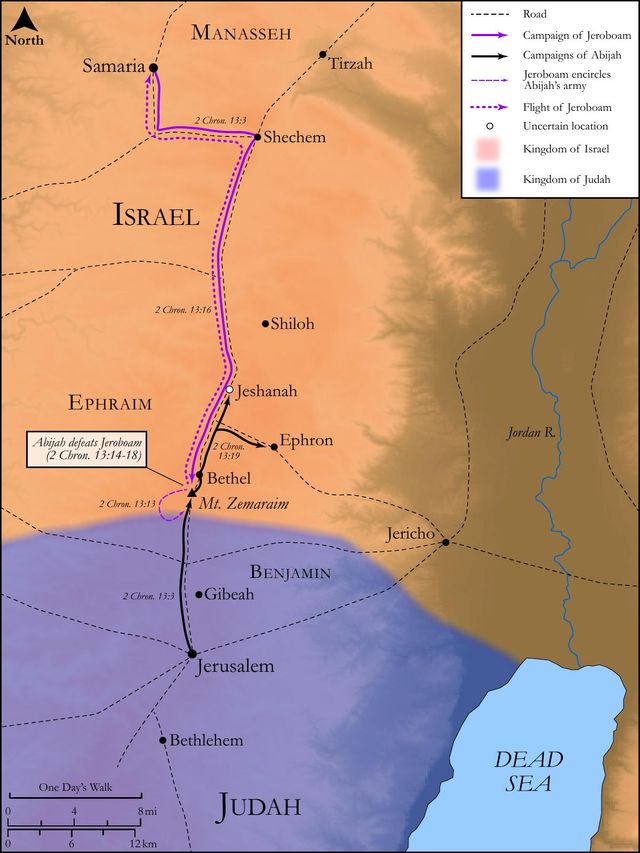
See on the biblical-era map
Study this verse
Public-domain commentary
Matthew Henry
From his Commentary on the Whole Bible. Henry comments on passages, not single verses — this entry covers 2 Chronicles 13:13–22. His three-level outline is real structure in the source text, so it is rendered as structure.
We do not find that Jeroboam offered to make any answer at all to Abijah's speech. Though it was much to the purpose, he resolved not to heed it, and therefore he heard it as though he heard it not. He came to fight, not to dispute. The longest sword, he thought, would determine the matter, not the better cause. Let us therefore see the issue, whether right and religion carried the day or no.
I.Jeroboam, who trusted to his politics, was beaten.
He was so far from fair reasoning that he was not for fair fighting. We may suppose that he felt a sovereign contempt for Abijah's harangue. "One stratagem," thinks he, "is worth twenty such speeches; we will soon give him an answer to all his arguments; he shall soon find himself overpowered with numbers, surrounded on every side with the instruments of death, and then let him boast of his religion and his title to the crown." A parley, it is probable, was agreed on, yet Jeroboam basely takes the advantage of it, and, while he was treating, laid his ambushment behind Judah, against all the laws of arms. What honour could be expected in a servant when he reigned? Abijah was for peace, but, when he spoke, they were for war, Psa 120:7.
II.Abijah and his people, who trusted in their God, came off conquerors, notwithstanding the disproportion of their strength and numbers.
1.They were brought into a great strait, put into a great fright, for the battle was before and behind. A good cause, and one which is designed to be victorious, may for a season be involved in embarrassment and distress. It was David's case. They compassed me about like bees, Psa 118:10-12.
2.In their distress, when danger was on every side, which way should they look but upwards for deliverance? It is an unspeakable comfort that no enemy (not the most powerful or politic), no stratagem or ambushment, can cut off our communication with heaven; our way thitherward is always open.
(1.)They cried unto the Lord, Ch2 13:14. We hope they did this before they engaged in this war, but the distress they were in made them renew their prayers and quickened them to be importunate. God brings his people into straits, that he may teach them to cry unto him. Earnest praying is crying.
(2.)They relied on the God of their fathers, depended upon his power to help them and committed themselves to him, Ch2 13:18. The prayer of faith is the prevailing prayer, and this is that by which we overcome the world, even our faith, Jo1 5:4.
(3.)The priests sounded the trumpets to animate them by giving them an assurance of God's presence with them. It was not only a martial but a sacred sound, and put life into their faith.
(4.)They shouted in confidence of victory: "The day is our own, for God is with us." To the cry of the prayer they added the shout of faith, and so became more than conquerors.
3.Thus they obtained a complete victory: As the men of Judah shouted for joy in God's salvation, God smote Jeroboam and his army with such terror and amazement that they could not strike a stroke, but fled with the greatest precipitation imaginable, and the conquerors gave no quarter, so that they put to the sword 500,000 chosen men (Ch2 13:17), more, it is said, than ever we read of in any history to have been killed in one battle; but the battle was the Lord's, who would thus chastise the idolatry of Israel and own the house of David. But see the sad effect of division: it was the blood of Israelites that was thus shed like water by Israelites, while the heathen, their neighbours, to whom the name of Israel had formerly been a terror, cried, Aha! so would we have it.
4.The consequence of this was that the children of Israel, though they were not brought back to the house of David (which by so great a blow surely they would have been had not the determinate counsel of God been otherwise), yet, for that time, were brought under, Ch2 13:18. Many cities were taken, and remained in the possession of the kings of Judah; as Bethel particularly, Ch2 13:19. What became of the golden calf there, when it came into the hands of the king of Judah, we are not told; perhaps it was removed to some place of greater safety, and at length to Samaria (Hos 8:5); yet in Jehu's time we find it at Bethel, Kg2 10:29. Perhaps Abijah, when it was in his power to demolish it, suffered it to stand, for his heart was not perfect with God; and, not improving what he had got for the honour of God, he soon lost it all again.
Lastly, The death of both of the conquered and of the conqueror, not long after. 1. Jeroboam never looked up after this defeat, though he survived it two or three years. He could not recover strength again, Ch2 13:20. The Lord struck him either with some bodily disease, of which he languished, or with melancholy and trouble of mind; his heart was broken, and vexation at his loss brought his head, probably by this time a hoary head, with sorrow to the grave. He escaped the sword of Abijah, but God struck him: and there is no escaping his sword. 2. Abijah waxed mighty upon it. What number of wives and children he had before does not appear; but now he multiplied his wives to fourteen in all, by whom he had thirty-eight children, Ch2 13:21. Happy is the man that hath his quiver full of those arrows. It seems, he had ways peculiar to himself, and sayings of his own, which were recorded with his acts in the history of those times, Ch2 13:22. But the number of his months was cut off in the midst, and, soon after his triumphs, death conquered the conqueror. Perhaps he was too much lifted up with his victories, and therefore God would not let him live long to enjoy the honour of them.
Continue studying 2 Chronicles 13:17 across the web’s major study libraries — every link below opens this exact verse, chapter, or book on the destination site.
Read & Compare
 BibleGatewayThis verse in more than 200 translations and 70 languages.
 Bible.comThe YouVersion reader — hundreds of translations, reading plans, and highlights.
 ESV.orgCrossway's official English Standard Version reader.
 NET BibleThe NET translation with 60,000+ translators' notes on every rendering decision.
 STEP BibleTyndale House's free study tool — original text, vocabulary, and scholarly resources.
 BibliaLogos Bible Software's free web reader.
 USCCBThe New American Bible (Revised Edition) with the U.S. bishops' study notes.
Commentaries
 BibleHub CommentariesDozens of classic commentaries on this verse, gathered on one page.
 StudyLightMore than 100 commentary sets — the largest collection on the web.
 BibleRefPlain-English commentary on what this verse means, verse by verse.
 Enduring WordDavid Guzik's free commentary on this chapter, widely used by Bible teachers.
 Bible Study ToolsVerse commentary alongside Greek and Hebrew study aids.
Original Language & Research
- BibleHub InterlinearThe verse word by word — original language, transliteration, and English.
- BibleHub LexiconEvery word's original-language definition and Strong's entry.
 Blue Letter BibleDeep-study tools — Strong's numbers, concordance, and word studies.
 SefariaThe Hebrew text with Rashi and centuries of Jewish commentary.
Sermons, Hymns & Audio


TrulyRandomVerse is not affiliated with these sites and doesn’t control their content. They’re linked because they’re genuinely useful.
Summary
Second Chronicles 13:17 records the devastating and decisive outcome of the battle between King Abijah of Judah and King Jeroboam of Israel, detailing a "great slaughter" in which five hundred thousand of Israel's chosen men fell. This verse climaxes a narrative emphasizing Judah's reliance on God and His miraculous intervention, serving as a stark demonstration of divine judgment against the Northern Kingdom's apostasy and a powerful affirmation of God's faithfulness to His covenant with David.
Context
ShowHideLiterary Context
This verse is the climactic statement of the battle account in 2 Chronicles 13. The preceding verses establish the theological framework for the conflict: King Abijah of Judah, though outnumbered, boldly confronts King Jeroboam of Israel, condemning their idolatry and rebellion against the Lord while asserting Judah's faithfulness to the covenant and the Jerusalem temple, as detailed in 2 Chronicles 13:4-12. Despite Israel's numerical superiority, Judah "cried out to the Lord" and the priests sounded the trumpets, a pivotal moment described in 2 Chronicles 13:14. The turning point is explicitly divine: "God struck Jeroboam and all Israel before Abijah and Judah," as stated in 2 Chronicles 13:15. Verse 17, therefore, is not merely a military casualty report but the tangible, horrific evidence of God's direct intervention and judgment, confirming the theological claims made by Abijah and showcasing the immediate consequences of divine favor and disfavor.
Historical & Cultural Context
The battle described in 2 Chronicles 13 occurs roughly two decades after the division of the united monarchy following Solomon's reign, a schism detailed in 1 Kings 12. Jeroboam, the first king of the Northern Kingdom of Israel, had established alternative worship centers in Bethel and Dan with golden calves and non-Levitical priests to prevent his people from returning to Jerusalem for worship, thereby securing his political power but leading Israel into profound idolatry, as recorded in 1 Kings 12:28-30. In contrast, Judah, under Abijah, maintained its allegiance to the Davidic dynasty and the legitimate worship at the temple in Jerusalem. The clash represents not just a political or territorial dispute but a profound theological conflict between covenant faithfulness (Judah) and apostasy (Israel). The scale of the reported casualties—five hundred thousand—is exceptionally large for ancient warfare, suggesting a theological emphasis on the magnitude of God's judgment rather than a precise historical census of fatalities. Such numbers were often used in ancient Near Eastern historiography to convey the overwhelming nature of a divine victory.
Key Themes
ShowHideThe primary themes evinced in 2 Chronicles 13:17 are Divine Judgment and Sovereignty, demonstrating God's active involvement in human affairs and His ultimate authority over nations. The immense slaughter unequivocally points to God's hand in punishing Israel for their idolatry and rebellion against His covenant, as initiated by Jeroboam. This highlights the Consequences of Apostasy, serving as a severe warning that turning away from God carries dire repercussions, both individually and corporately. Conversely, Judah's victory, despite being outnumbered, underscores the theme of God's Faithfulness to His Covenant, particularly the unconditional promises made to David in 2 Samuel 7:12-16. God preserved the Davidic line in Judah and upheld the legitimate worship centered in Jerusalem. Finally, the narrative powerfully illustrates the theme of Reliance on God vs. Human Strength, where Judah's trust in the Lord proved superior to Israel's numerical and military advantage, affirming that true victory comes from divine intervention, not human might, a principle echoed in Psalm 20:7.
Exposition and Analysis
ShowHideKey Word Analysis
ShowHideThis word properly denotes "a blow" or "a striking," but in this context, it carries the profound implication of a severe wound, carnage, or even a plague. Its use here emphasizes not merely a high casualty count, but a decisive, overwhelming, and divinely orchestrated defeat, akin to a divinely inflicted wound or a sweeping pestilence. It underscores the severity and finality of the judgment, portraying the event as a catastrophic and divinely sanctioned rout.
This term refers to those who are "pierced" or "wounded to death." In military contexts, it specifically denotes those who have fallen in battle. The use of this word here, in conjunction with "fell down," vividly portrays the sheer number of Israelite soldiers who were not merely defeated but utterly destroyed, highlighting the devastating physical outcome of the divine judgment and the completeness of their demise on the battlefield.
This word means "selected" or "tried," referring to those who are fit, excellent, or elite. When applied to men in a military context, it signifies the prime, most capable, and valorous soldiers. The fact that five hundred thousand of Israel's chosen men fell highlights the depth of their loss—it was their most formidable and valuable fighting force that was decimated. This detail further magnifies the miraculous nature of Judah's victory and the devastating impact of God's judgment, as it was not just the weak or untrained who fell, but the very best of Israel's army.
Verse Breakdown
ShowHide"And Abijah and his people slew them with a great slaughter"
This clause attributes the physical act of "slew them" to Abijah and his people, yet the preceding verses (especially 2 Chronicles 13:15) make it clear that God was the primary agent who "struck Jeroboam and all Israel." Thus, Abijah and Judah were the instruments of a divinely empowered victory. The phrase "with a great slaughter" emphasizes the overwhelming, decisive, and divinely sanctioned nature of the defeat, far beyond what human military prowess alone could achieve. It signifies a comprehensive rout, a divinely inflicted blow that left no doubt about the source of Judah's triumph.
"so there fell down slain of Israel five hundred thousand chosen men"
This clause presents the staggering result of the "great slaughter." The immense number—five hundred thousand—underscores the catastrophic scale of the loss for the Northern Kingdom, representing a significant portion of their military strength. The specification that these were "chosen men" intensifies the tragedy and highlights the profound weakening of Israel's military and national strength, as their most capable warriors were annihilated. This outcome serves as a powerful testament to the severity of God's judgment against Israel's apostasy and the undeniable effectiveness of His intervention on behalf of Judah.
Literary Devices
ShowHideThe Chronicler employs several potent literary devices in 2 Chronicles 13:17 to convey its profound theological message. Hyperbole is evident in the extraordinarily large number of slain men (five hundred thousand). While precise casualty figures in ancient texts often served rhetorical rather than strictly literal purposes, this exaggerated number effectively emphasizes the overwhelming magnitude of God's judgment and the miraculous nature of Judah's victory against superior forces. This hyperbole magnifies the divine intervention, presenting the event as an act of God so immense that it defies typical human military outcomes. Additionally, there is a strong element of Contrast throughout the narrative, culminating in this verse. The small, faithful army of Judah stands in stark contrast to the vast, apostate army of Israel. This contrast highlights the biblical principle that victory is not determined by human strength or numbers but by divine favor and faithfulness. The narrative also functions as a Didactic Narrative, using the historical event to teach profound theological lessons about the consequences of obedience and disobedience to God's covenant.
Theological and Thematic Connections
ShowHideThe profound theological implications of 2 Chronicles 13:17 resonate throughout biblical theology. This verse powerfully illustrates the principle of divine judgment against unfaithfulness, particularly against those who deliberately turn from God's established covenant and worship. It underscores that God is not passive in the face of idolatry and rebellion but actively intervenes in history to uphold His righteous standards and protect His covenant people. The magnitude of the slaughter serves as a grim reminder of the severe consequences of spiritual apostasy. Simultaneously, Judah's victory, divinely granted despite their numerical inferiority, reinforces God's unwavering faithfulness to His promises, especially the Davidic covenant, ensuring the preservation of the lineage through which the Messiah would come. This event also highlights the futility of relying on human strength or numbers when God's favor is withdrawn, emphasizing that true security and victory come only through trusting in the Lord.
Reflection and Application
ShowHideThe account of the battle in 2 Chronicles 13:17, culminating in such a devastating loss for Israel, offers timeless lessons for believers today. It serves as a powerful reminder that God is actively involved in the affairs of humanity, and there are tangible consequences for our choices, particularly concerning faithfulness and obedience to Him. In a world that often prioritizes human strength, strategic advantage, or numerical superiority, this narrative redirects our focus to divine power and sovereignty. It challenges us to examine where our ultimate trust lies: in our own abilities, resources, or alliances, or in the unfailing power of God. Just as Judah cried out to the Lord and witnessed His miraculous intervention, we are called to cultivate a spirit of dependence on God, especially when facing overwhelming odds or spiritual battles. This passage encourages us to remain steadfast in our commitment to God's truth and worship, understanding that His favor is the most potent force in the universe, and spiritual rebellion, though seemingly advantageous in the short term, ultimately leads to ruin.
Questions for Reflection
ShowHideFAQ
ShowHideWas the number "five hundred thousand chosen men" a literal count of casualties?
ShowHideWhile the Bible presents this number as a factual outcome, biblical scholars often interpret such exceptionally large figures in ancient Near Eastern historical narratives, particularly in contexts of divine intervention, as conveying theological truth rather than precise statistical data. The number "five hundred thousand" (half a million) is staggering for ancient warfare and serves to emphasize the overwhelming, miraculous, and divinely orchestrated nature of Judah's victory and God's judgment. It highlights the magnitude of God's power and the devastating consequences of Israel's apostasy, underscoring that this was not merely a human military victory but a profound act of divine judgment. The Chronicler's intent is to magnify God's role in the event, not necessarily to provide a modern-day census report.
Why was God's judgment against Israel so severe?
ShowHideGod's judgment against Israel was severe because their rebellion was profound and deliberate. Jeroboam had led the Northern Kingdom into deep idolatry by establishing alternative worship centers and golden calves, as detailed in 1 Kings 12:28-30, directly violating God's commands and the covenant. This was not merely a political disagreement but a spiritual apostasy that undermined the very foundation of their relationship with God. Abijah's speech before the battle explicitly highlighted Israel's abandonment of the Lord and His priests in 2 Chronicles 13:9-11. The severity of the judgment underscored the seriousness of their sin and God's unwavering commitment to His covenant and His holiness. It served as a stark warning about the consequences of turning away from the one true God.
What does this battle teach us about God's character?
ShowHideThis battle reveals several crucial aspects of God's character. First, it demonstrates His sovereignty and power; He is able to intervene decisively in human affairs and grant victory to His people against overwhelming odds. Second, it highlights His righteousness and justice; He is faithful to punish sin and apostasy, even among His chosen people, when they turn away from Him. Third, it powerfully showcases His faithfulness to His covenant promises; despite Israel's rebellion, God remained true to His covenant with David, preserving the line through Judah and ensuring the continuation of true worship in Jerusalem. Finally, it underscores His gracious responsiveness to prayer and faithfulness; Judah's cry to the Lord in 2 Chronicles 13:14 was met with divine intervention, affirming that God hears and acts on behalf of those who trust in Him.
Christ-Centered Fulfillment
ShowHideThe catastrophic defeat of Israel in 2 Chronicles 13:17, orchestrated by divine intervention, foreshadows the ultimate judgment against sin and rebellion, yet also points to the ultimate victory secured by Christ. While this battle depicted God's judgment on a disobedient nation, Jesus Christ embodies the perfect fulfillment of God's covenant faithfulness, particularly the Davidic covenant, as He is the Son of David who reigns on an eternal throne, as promised in Luke 1:32-33. The "great slaughter" of Israel's chosen men, a consequence of their spiritual rebellion, finds its ultimate reversal in the person of Christ, the true "Chosen One" of God, whose own sacrifice on the cross was the ultimate divine intervention, not for judgment against His people, but for their salvation, as proclaimed in John 1:29. He, the victorious Lamb, takes away the sin of the world, absorbing the judgment we deserve. Furthermore, Judah's reliance on God for victory against overwhelming odds prefigures the believer's absolute reliance on Christ for victory over sin, death, and the powers of darkness. Our "chosen men" are not those of military might, but those chosen in Christ before the foundation of the world, as stated in Ephesians 1:4, who find their strength not in themselves, but in the power of His resurrection. In Christ, God's ultimate faithfulness to His covenant is revealed, offering not a temporary military triumph, but eternal peace and reconciliation for all who believe, triumphing over all spiritual adversaries through His cross, as celebrated in Colossians 2:15.