


2 Chronicles 28:6
Bible text: King James Version (1769 Blayney text) · Public domain
Bible text: King James Version with Strong's numbers · Public domain
Bible text: Berean Standard Bible · Public domain
Bible text: American Standard Version (1901) · Public domain
Bible text: World English Bible, Messianic edition · Public domain
Bible text: Geneva Bible (1599) · Public domain
Bible text: Young's Literal Translation · Public domain
- וַיַּהֲרֹגvai·ya·ha·Rogand he killedH2026Conj-w ¦ V-Qal-ConsecImperf-3msVerb Qal Consecutive Imperfect 3rd Singular Masculineוַandיַּהֲרֹגhe killed
- פֶּקַחPe·kachPekahH6492N-proper-mNoun Proper Masculine
- בֶּןben[the] son ofH1121N-mscNoun Singular Masculine Construct
- רְמַלְיָהוּre·mal·Ya·huRemaliahH7425N-proper-mNoun Proper Masculine
- בִּיהוּדָהbi·hu·Dahamong JudahH3063Prep-b ¦ N-properNoun Proper LocationבִּamongיהוּדָהJudah
- מֵאָהme·'Ahone hundredH3967N-fsNoun Singular Feminine Absolute
- וְעֶשְׂרִיםve·'es·Rimand twentyH6242Conj-w ¦ N-mpNoun Plural Masculine Absoluteוְandעֶשְׂרִיםtwenty
- אֶלֶף'E·lefthousandH505N-csNoun Singular common gender Absolute
- בְּיוֹםbe·Yomin a dayH3117Prep-b ¦ N-msNoun Singular Masculine Absoluteבְּinיוֹםa day
- אֶחָד'e·ChadoneH259N-fsNoun Singular Feminine Absolute
- הַכֹּלha·Kol<the> allH3605Art ¦ N-msNoun Singular Masculine Absoluteהַ<the>כֹּלall
- בְּנֵיbe·nei[were] sons ofH1121N-mpcNoun Plural Masculine Construct
- חָיִלCha·yilstrengthH2428N-msNoun Singular Masculine Absolute
- בְּעָזְבָםbe·'a·ze·Vambecause they had forsakenH5800Prep-b ¦ V-Qal-Inf ¦ 3mpVerb Qal Infinitive Constructבְּbecauseעָזְבָhad forsakenםthey
- אֶת'et<obj.>H853DirObjMParticle Object Indicator
- יְהוָהYah·wehYahwehH3068N-properNoun Proper Title
- אֱלֹהֵי'e·lo·Hei[the] God ofH430N-mpcNoun Plural Masculine Construct
- אֲבוֹתָם'a·vo·Tamtheir ancestorsH1N-fpc ¦ 3mpNoun Plural Feminine Constructאֲבוֹתָancestorsםtheir
English is a literal word-by-word gloss of the Hebrew, not the KJV's wording. Why?
This is the original text the KJV's translators worked from — each Hebrew word with its own literal English meaning in this verse, prepared by scholars at Tyndale House, Cambridge. The KJV translates whole sentences, not word by word, so its wording differs: one Hebrew word can become several English words, and the KJV may choose “the LORD” where the gloss reads “Yahweh”. Both are faithful — they answer different questions. For the KJV's own rendering, switch to the KJV text.
Details
See on the biblical-era maps
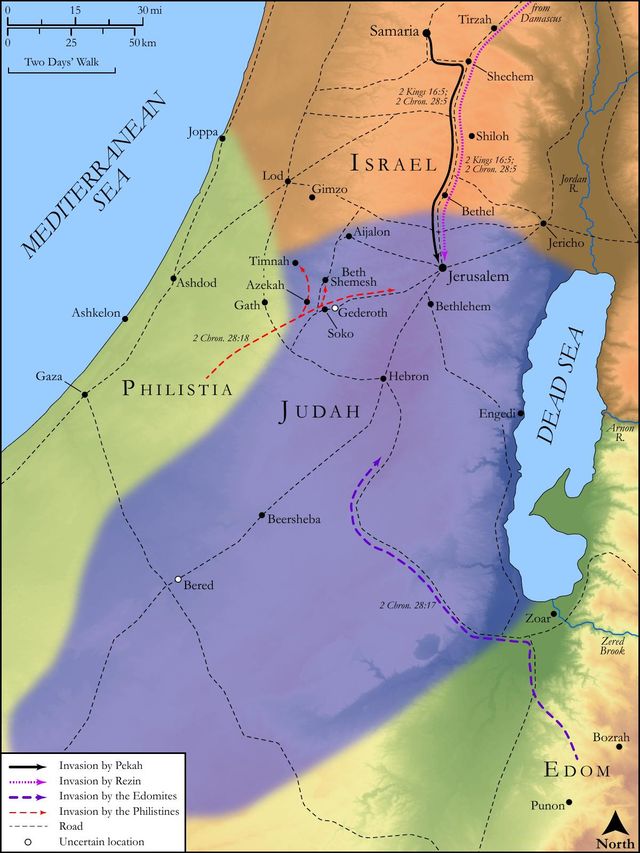
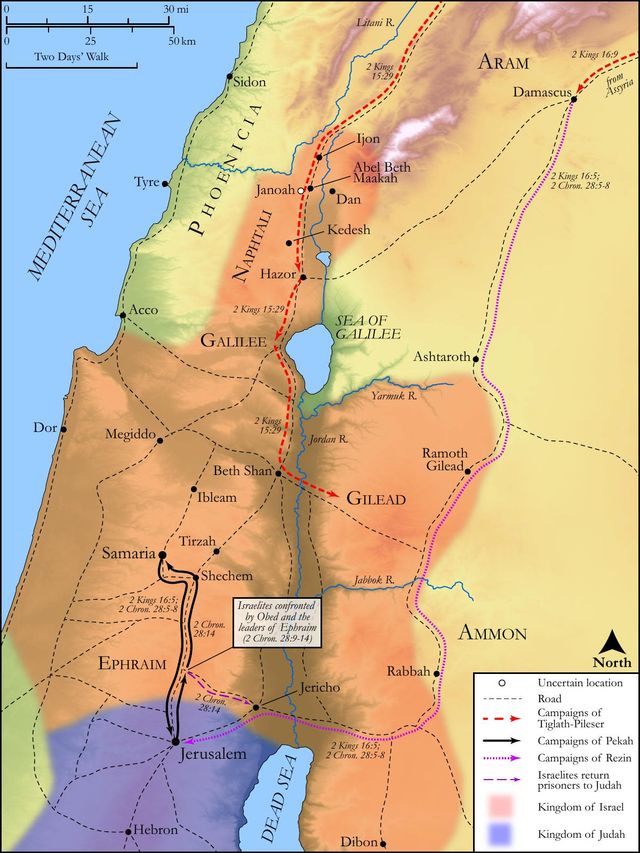
Study this verse
Public-domain commentary
Matthew Henry
From his Commentary on the Whole Bible. Henry comments on passages, not single verses — this entry covers 2 Chronicles 28:6–15. His four-level outline is real structure in the source text, so it is rendered as structure.
We have here,
I.Treacherous Judah under the rebukes of God's providence, and they are very severe.
Never was such bloody work made among them since they were a kingdom, and by Israelites too. Ahaz walked in the ways of the kings of Israel, and the king of Israel was the instrument God made use of for his punishment. It is just with God to make those our plagues whom we make our patterns or make ourselves partners with in sin. A war broke out between Judah and Israel, in which Judah was worsted. For,
1.There was a great slaughter of men in the field of battle. Vast numbers (120,000 men, and valiant men too at other times) were slain (Ch2 28:6) and some of the first rank, the king's son for one. He had sacrificed some of this sons to Moloch; justly therefore is this sacrificed to the divine vengeance. Here is another that was next the king, his friend, the prime-minister of state, or perhaps next him in the battle, so that the king himself had a narrow escape, Ch2 28:7. The kingdom of Israel was not strong at this time, and yet strong enough to bring this great destruction upon Judah. But certainly so many men, great men, stout men, could not have been cut off in one day if they had not been strangely dispirited both by the consciousness of their own guilt and by the righteous hand of God upon them. Even valiant men were numbered as sheep for the slaughter, and became an easy prey to the enemy because they had forsaken the Lord God of their fathers, and he had therefore forsaken them.
2.There was a great captivity of women and children, Ch2 28:8. When the army in the field was routed, the cities, and towns, and country villages, were all easily stripped, the inhabitants taken for slaves, and their wealth for a prey.
II.Even victorious Israel under the rebuke of God's word for the bad principle they had gone upon in making war with Judah and the bad use they had made of their success, and the good effect of this rebuke. Here is,
1.The message which God sent them by a prophet, who went out to meet them, not to applaud their valour or congratulate them on their victory, though they returned laden with spoils and triumphs, but in God's name to tell them of their faults and warn them of the judgments of God.
(1.)He told them how they came by this victory of which they were so proud. It was not because God favoured them, or that they had merited it at his hand, but because he was wroth with Judah, and made them the rod of his indignation. Not for your righteousness, be it known to you, but for their wickedness (Deu 9:5) they are broken off; therefore be not you high-minded, but fear lest God also spare not you, Rom 11:20, Rom 11:21.
(2.)He charged them with the abuse of the power God had given them over their brethren. Those understand not what victory is who think it gives them authority to do what they will, and that the longest sword is the clearest claim to lives and estates (Jusque datum sceleri - might is right); no, as it is impolitic not to use a victory, so it is impious to abuse it. The conquerors are here reproved,
[1.]For the cruelty of the slaughter they had made in the field. They had indeed shed the blood of war in war; we suppose that to be lawful, but it turned into sin to them, because they did it from a bad principle of enmity to their brethren and after a bad manner, with a barbarous fury, a rage reaching up to heaven, that is, that cried to God for vengeance against such bloody men, that delighted in military execution. Those that serve God's justice, if they do it with rage and a spirit of revenge, make themselves obnoxious to it, and forfeit the honour of acting for him; for the wrath of man worketh not the righteousness of God.
[2.]For the imperious treatment they gave their prisoners. "You now purpose to keep them under, to use them or sell them as slaves, though they are your brethren and free-born Israelites." God takes notice of what men purpose, as well as of what they say and do.
(3.)He reminded them of their own sins, by which they also were obnoxious to the wrath of God: Are there not with you, even with you, sins against the Lord your God? Ch2 28:10. He appeals to their own consciences, and to the notorious evidence of the thing. "Though you are now made the instruments of correcting Judah for sin, yet do not think that you are therefore innocent yourselves; no, you also are guilty before God." This is intended as a check, [1.] To their triumph in their success. "You are sinners, and it ill becomes sinners to be proud; you have carried the day now, but be not secure, the wheel may ere long return upon yourselves, for, if judgment begin thus with those that have the house of God among them, what shall be the end of such as worship the calves?" [2.] To their severity towards their brethren. "You have now got them under, but you ought to show mercy to them, for you yourselves are undone if you do not find mercy with God. It ill becomes sinners to be cruel. You have transgressions enough to answer for already, and need not add this to the rest."
(4.)He commanded them to release the prisoners, and to send them home again carefully (Ch2 28:11); "for you having sinned, the fierce wrath of God is upon you, and there is no other way of escaping it than by showing mercy."
2.The resolution of the princes thereupon not to detain the prisoners. They stood up against those that came from the war, though flushed with victory, and told them plainly that they should not bring their captives into Samaria, Ch2 28:12, Ch2 28:13. They had sin enough already to answer for, and would have nothing done to add to their trespass. In this they discovered an obedient regard to the word of God by his prophet and a tender compassion towards their brethren, which was wrought in them by the tender mercy of God; for he regarded the affliction of this poor people, and hears their cry, and made them to be pitied of all those that carried them captive, Psa 106:44, Psa 106:46.
3.The compliance of the soldiers with the resolutions of the princes in this matter, and the dismission of the captives thereupon.
(1.)The armed men, though being armed they might be force have maintained their title to what they got by the sword, acquiesced, and left their captives and the spoil to the disposal of the princes (Ch2 28:14), and herein they showed more truly heroic bravery than they did in taking them. It is a great honour for any man to yield to the authority of reason and religion against his interest.
(2.)The princes very generously sent home the poor captives well accommodated, Ch2 28:15. Those that hope to find mercy with God must learn hence with what tenderness to carry themselves towards those that lie at their mercy. It is strange that these princes, who in this instance discovered such a deference to the word of God, and such an influence upon the people, had not so much grace as, in obedience to the calls of God by so many prophets, to root idolatry out of their kingdom, which, soon after this, was the ruin of it.
Continue studying 2 Chronicles 28:6 across the web’s major study libraries — every link below opens this exact verse, chapter, or book on the destination site.
Read & Compare
 BibleGatewayThis verse in more than 200 translations and 70 languages.
 Bible.comThe YouVersion reader — hundreds of translations, reading plans, and highlights.
 ESV.orgCrossway's official English Standard Version reader.
 NET BibleThe NET translation with 60,000+ translators' notes on every rendering decision.
 STEP BibleTyndale House's free study tool — original text, vocabulary, and scholarly resources.
 BibliaLogos Bible Software's free web reader.
 USCCBThe New American Bible (Revised Edition) with the U.S. bishops' study notes.
Commentaries
 BibleHub CommentariesDozens of classic commentaries on this verse, gathered on one page.
 StudyLightMore than 100 commentary sets — the largest collection on the web.
 BibleRefPlain-English commentary on what this verse means, verse by verse.
 Enduring WordDavid Guzik's free commentary on this chapter, widely used by Bible teachers.
 Bible Study ToolsVerse commentary alongside Greek and Hebrew study aids.
Original Language & Research
- BibleHub InterlinearThe verse word by word — original language, transliteration, and English.
- BibleHub LexiconEvery word's original-language definition and Strong's entry.
 Blue Letter BibleDeep-study tools — Strong's numbers, concordance, and word studies.
 SefariaThe Hebrew text with Rashi and centuries of Jewish commentary.
Sermons, Hymns & Audio


TrulyRandomVerse is not affiliated with these sites and doesn’t control their content. They’re linked because they’re genuinely useful.
Summary
2 Chronicles 28:6 records a devastating military defeat for the kingdom of Judah at the hands of Pekah, king of Israel, during the apostate reign of King Ahaz. This verse details the catastrophic loss of 120,000 "valiant men" in a single day, a profound national tragedy explicitly attributed not to the superior strength of the enemy, but to Judah's profound spiritual unfaithfulness and their deliberate "forsaking the LORD God of their fathers." It stands as a stark testament to the severe and immediate consequences of covenant disobedience and idolatry within the Old Testament narrative.
Context
ShowHideLiterary Context
This verse is strategically placed within the Chronicler's account of King Ahaz's reign in 2 Chronicles 28, a chapter characterized by a relentless depiction of Ahaz's profound wickedness and its direct, devastating repercussions for Judah. Immediately preceding this calamitous event, the text meticulously details Ahaz's egregious idolatrous practices, including the abhorrent act of making molten images for Baal and offering his own sons as burnt sacrifices in the Valley of Hinnom, explicitly stating that he "transgressed grievously against the LORD" (2 Chronicles 28:2-4). The military defeat described in verse 6 serves as the immediate and severe divine judgment for this apostasy. Following this verse, the narrative continues to unfold the further calamities that befell Judah, including the taking of many women, sons, and daughters as captives by Israel, and their subsequent release due to the prophetic intervention of Oded (2 Chronicles 28:8-15). The Chronicler's consistent theological framework, which directly links Judah's spiritual fidelity to its national well-being or decline, makes this verse a pivotal illustration of immediate divine retribution for covenant unfaithfulness.
Historical & Cultural Context
The events of 2 Chronicles 28 and specifically verse 6, are set during the tumultuous Syro-Ephraimite War (c. 735-732 BC). During this period, Ahaz, king of Judah, faced a formidable coalition led by Pekah, king of Israel, and Rezin, king of Syria. Their objective was to coerce Judah into joining their anti-Assyrian alliance. Rather than heeding the prophet Isaiah's counsel to trust in the Lord (Isaiah 7:1-9), Ahaz chose to appeal to Tiglath-Pileser III of Assyria for military assistance, a decision that ultimately led to Judah's subjugation and tribute to Assyria (2 Kings 16:7-9). The "valiant men" (Hebrew: chayil) mentioned in the verse were the elite, most capable warriors of Judah, their loss representing an unparalleled blow to the kingdom's military strength and national security. The broader cultural context reveals a pervasive syncretism in Judah, where the worship of Yahweh was increasingly compromised by pagan practices, leading to the divine judgment expressed through military defeat—a common covenant curse explicitly outlined in the Mosaic Law (Deuteronomy 28:25).
Key Themes
ShowHideThis verse powerfully encapsulates several foundational themes that permeate the books of Chronicles and the broader Old Testament. Foremost is the consequences of disobedience, vividly illustrating that turning away from God's covenant results in severe judgment and national calamity. The staggering loss of life is presented as direct divine retribution for Judah's profound apostasy, aligning perfectly with the warnings articulated within the Mosaic covenant (Deuteronomy 28:15-68). Secondly, the theme of divine sovereignty and judgment is prominently displayed, as God actively uses Pekah and the northern kingdom of Israel as instruments of His righteous discipline against Judah, despite Israel's own unrighteousness. This underscores God's ultimate control over the destinies of nations and the course of history (Isaiah 10:5-6). Finally, the verse profoundly emphasizes the severity of spiritual apostasy, demonstrating that Judah's deliberate act of "forsaking the LORD God of their fathers" was not a minor transgression but a fundamental betrayal of their covenant relationship, warranting a devastating and inescapable response that no human strength or military might could possibly avert.
Exposition and Analysis
ShowHideKey Word Analysis
ShowHideThis primitive root signifies "to smite with deadly intent," encompassing actions such as destroying, killing, murdering, or making slaughter. In the context of 2 Chronicles 28:6, it underscores the violent, decisive, and lethal nature of the defeat inflicted by Pekah, resulting in the massive casualty count. It emphasizes the direct and fatal impact of the battle.
This term refers to a force, whether of men, means, or other resources, denoting strength, valor, and military prowess. When applied to men, it describes mighty warriors, heroes, or capable individuals. The fact that 120,000 chayil were slain in one day highlights the overwhelming nature of Judah's defeat and the profound loss of its most skilled and courageous defenders, demonstrating that even their greatest human strength was utterly ineffective against divine judgment.
This verb means "to loosen," "to relinquish," "to abandon," "to desert," or "to neglect." In a theological sense, it describes a deliberate and conscious act of turning away from a relationship, a duty, or a covenant. Here, it precisely captures Judah's willful breach of their covenant with Yahweh, choosing idolatry and unfaithfulness over loyalty to the God who had historically established, protected, and blessed them. It implies an active, conscious rejection rather than a passive drifting away.
Verse Breakdown
ShowHide"For Pekah the son of Remaliah slew in Judah"
This initial clause identifies the specific human agent of the calamity, Pekah, the king of Israel, and the geographical location where this devastating event transpired—within the territory of Judah. It establishes the immediate, visible cause of the disaster as a military invasion from the northern kingdom.
"an hundred and twenty thousand in one day, [which were] all valiant men"
This segment vividly conveys the shocking scale and intensity of the defeat. The figure of 120,000 represents an immense and catastrophic loss of life, made even more significant by the qualification that these were "all valiant men," indicating the decimation of Judah's most capable and courageous military personnel. The phrase "in one day" emphasizes the swiftness, totality, and overwhelming nature of the judgment, allowing no opportunity for prolonged resistance or strategic recovery.
"because they had forsaken the LORD God of their fathers."
This is the crucial theological explanation provided by the Chronicler for the preceding military catastrophe. It explicitly states that the devastating defeat was not merely a consequence of strategic miscalculation or superior enemy might, but a direct divine judgment upon Judah for their deliberate and profound apostasy. The appellation "the LORD God of their fathers" serves to underscore the depth of their covenant relationship, highlighting the immense severity of their betrayal against the God who had historically guided, delivered, and protected their ancestors through generations.
Literary Devices
ShowHideThe Chronicler masterfully employs several literary devices to underscore the profound gravity and theological significance of Judah's situation. The staggering figure of "an hundred and twenty thousand in one day" functions as Hyperbole or Exaggeration, not necessarily to imply numerical inaccuracy, but to powerfully convey the overwhelming, unprecedented, and utterly devastating nature of the defeat, thereby emphasizing the totality of God's judgment. The phrase "all valiant men" utilizes Emphasis to highlight that even Judah's strongest, most skilled, and courageous warriors were utterly powerless against the divine decree, thereby magnifying the severity of the judgment and demonstrating the futility of human strength when God's favor is withdrawn. Most significantly, the verse employs a clear Cause and Effect relationship, directly linking Judah's act of "forsaking the LORD God of their fathers" to the catastrophic military loss. This explicit causal statement is a hallmark of the Chronicler's theological perspective, where obedience invariably brings blessing and disobedience inevitably brings judgment, effectively serving as a Didactic Statement designed to instruct the reader on the immutable principles of divine justice and covenant fidelity.
Theological and Thematic Connections
ShowHide2 Chronicles 28:6 stands as a potent theological declaration concerning the dire consequences of covenant unfaithfulness. It powerfully reinforces the Deuteronomic principle that national prosperity, security, and well-being are inextricably linked to a nation's obedience to God's commands, while apostasy inevitably invites divine judgment and calamity. The Chronicler consistently articulates this retributive theology throughout his work, aiming to instruct the post-exilic community of Judah on the paramount importance of unwavering fidelity to Yahweh. This verse vividly demonstrates God's active and sovereign involvement in human history, illustrating His willingness to use even unrighteous nations as instruments of His righteous discipline for His covenant people. It underscores that God's justice is not arbitrary but a righteous and proportionate response to deliberate rebellion against His established covenant, thereby emphasizing the profound seriousness with which God views idolatry, spiritual abandonment, and the breaking of sacred vows.
Reflection and Application
ShowHideWhile the immediate context of 2 Chronicles 28:6 addresses national judgment under the Old Covenant, its underlying principles offer profound and enduring lessons for believers today. The verse serves as a sobering reminder that spiritual fidelity is of supreme importance, and that any turning away from God—whether through overt rebellion, subtle neglect, or the adoption of worldly values—carries significant consequences for our individual lives, our relationships, and our spiritual well-being. It challenges us to engage in honest introspection, examining our own hearts for any areas where we might be "forsaking the LORD," prioritizing temporal pursuits, personal desires, or cultural trends above our covenant relationship with Him. This passage calls for a proactive and unwavering commitment to diligently seeking God, earnestly repenting of sin, and intentionally aligning our lives with His revealed will, trusting that His ultimate desire is always for our good and spiritual flourishing, even when His discipline becomes necessary. Furthermore, it encourages a sober recognition that our personal choices and actions have far-reaching ripple effects, not only individually but within our families, communities, and spheres of influence, urging us to live lives that consistently honor God and lovingly draw others towards Him.
Questions for Reflection
ShowHideFAQ
ShowHideWas God unjust in allowing such a massive loss of life in 2 Chronicles 28:6?
ShowHideFrom the Chronicler's theological perspective, this devastating loss was not an act of injustice but a righteous and necessary act of divine judgment. The verse explicitly provides the rationale: "because they had forsaken the LORD God of their fathers." This refers to Judah's widespread and deliberate idolatry, which included the abhorrent practice of child sacrifice, during the wicked reign of King Ahaz (2 Chronicles 28:2-4). According to the terms of the Mosaic covenant, such profound unfaithfulness carried severe and pre-warned consequences, including military defeat and national calamity (Deuteronomy 28:15-68). Therefore, the judgment, though undeniably severe in its scope and impact, was understood as a just and proportionate consequence for their profound rebellion against the God who had graciously delivered, sustained, and covenanted with them.
How does "forsaking the LORD" manifest in our lives today, given that we do not experience literal military defeat for sin?
ShowHideWhile believers today no longer live under the Old Covenant's national retributive system that linked specific sins directly to military defeat, the underlying spiritual principle of "forsaking the LORD" remains profoundly relevant. In contemporary life, this can manifest as spiritual apathy, prioritizing worldly success, material possessions, or fleeting pleasures over a vibrant relationship with God, neglecting essential spiritual disciplines such as prayer, Bible study, and corporate worship, engaging in persistent sinful behaviors, or allowing modern "idols" (e.g., money, power, relationships, self-gratification, social media) to usurp God's rightful place of preeminence in our hearts. The consequences, though not necessarily military defeat, can include spiritual barrenness, fractured relationships, moral decay, a profound loss of inner peace, and a diminished sense of God's active presence and blessing in our lives (Galatians 6:7-8).
Christ-Centered Fulfillment
ShowHide2 Chronicles 28:6, with its stark portrayal of divine judgment meted out for "forsaking the LORD," powerfully illuminates humanity's desperate need for a new covenant and a fundamentally new way of relating to God—a need ultimately and perfectly fulfilled in the person and work of Jesus Christ. The Old Testament's recurring cycle of sin, judgment, and temporary restoration vividly reveals humanity's inherent inability to perfectly uphold the Law and consistently avoid the spiritual catastrophe of "forsaking the LORD." Jesus, however, stands as the unique and perfect fulfillment, having flawlessly upheld the Law and never once forsaken the Father, even to the ultimate point of obedient death on the cross (Philippians 2:8). He is the ultimate "valiant man," not in a battle against human adversaries, but in His decisive triumph over sin, death, and the powers of darkness through His atoning sacrifice (Colossians 2:15). Through saving faith in Him, believers are miraculously no longer subject to the curses of the Law for their inherent unfaithfulness, but are graciously brought into a new covenant of grace, where their sins are completely forgiven and God's Holy Spirit indwells them, empowering true obedience and preventing them from ever truly "forsaking" Him again (Hebrews 8:10-12). The severe judgment witnessed in 2 Chronicles 28:6 thus points forward to the infinitely greater judgment for sin that Christ bore on our behalf, offering us profound reconciliation with God and the promise of eternal life, ensuring that we, as His redeemed people, might never again be separated from "the LORD God of our fathers" (2 Corinthians 5:21).