


2 Kings 16:5
Bible text: King James Version (1769 Blayney text) · Public domain
Bible text: King James Version with Strong's numbers · Public domain
Bible text: Berean Standard Bible · Public domain
Bible text: American Standard Version (1901) · Public domain
Bible text: World English Bible, Messianic edition · Public domain
Bible text: Geneva Bible (1599) · Public domain
Bible text: Young's Literal Translation · Public domain
- אָז'azthenH227AdvAdverb
- יַעֲלֶהya·'a·Lehhe came upH5927V-Qal-Imperf-3msVerb Qal Imperfect 3rd Singular Masculine
- רְצִיןre·TzinRezinH7526N-proper-mNoun Proper Masculine
- מֶלֶךְMe·lekh[the] king ofH4428N-mscNoun Singular Masculine Construct
- אֲרָם'A·romAramH758N-properNoun Proper Location
- וּפֶקַחu·Fe·kachand PekahH6492Conj-w ¦ N-proper-mNoun Proper MasculineוּandפֶקַחPekah
- בֶּןben[the] son ofH1121N-mscNoun Singular Masculine Construct
- רְמַלְיָהוּre·mal·Ya·huRemaliahH7425N-proper-mNoun Proper Masculine
- מֶלֶךְMe·lekh[the] king ofH4428N-mscNoun Singular Masculine Construct
- יִשְׂרָאֵלYis·ra·'ElIsraelH3478N-properNoun Proper Location
- יְרוּשָׁלִַםye·ru·sha·LimJerusalemH3389N-properNoun Proper Location
- לַמִּלְחָמָהla·mil·cha·Mahfor <the> battleH4421Prep-l ¦ N-fsNoun Singular Feminine Absoluteלַfor <the>מִּלְחָמָהbattle
- וַיָּצֻרוּvai·ya·Tzu·ruand they laid siegeH6696Conj-w ¦ V-Qal-ConsecImperf-3mpVerb Qal Consecutive Imperfect 3rd Plural Masculineוַandיָּצֻרוּthey laid siege
- עַל'alonH5921PrepPreposition
- אָחָז'a·ChazAhazH271N-proper-mNoun Proper Masculine
- וְלֹאve·Lo'and notH3808Conj-w ¦ NegParticle Negativeוְandלֹאnot
- יָכְלוּya·khe·Luthey were ableH3201V-Qal-Perf-3cpVerb Qal Perfect 3rd Plural common gender
- לְהִלָּחֵםle·hi·la·Chemto do battleH3898Prep-l ¦ V-Niphal-InfVerb Niphal Infinitive Constructלְtoהִלָּחֵםdo battle
English is a literal word-by-word gloss of the Hebrew, not the KJV's wording. Why?
This is the original text the KJV's translators worked from — each Hebrew word with its own literal English meaning in this verse, prepared by scholars at Tyndale House, Cambridge. The KJV translates whole sentences, not word by word, so its wording differs: one Hebrew word can become several English words, and the KJV may choose “the LORD” where the gloss reads “Yahweh”. Both are faithful — they answer different questions. For the KJV's own rendering, switch to the KJV text.
Details
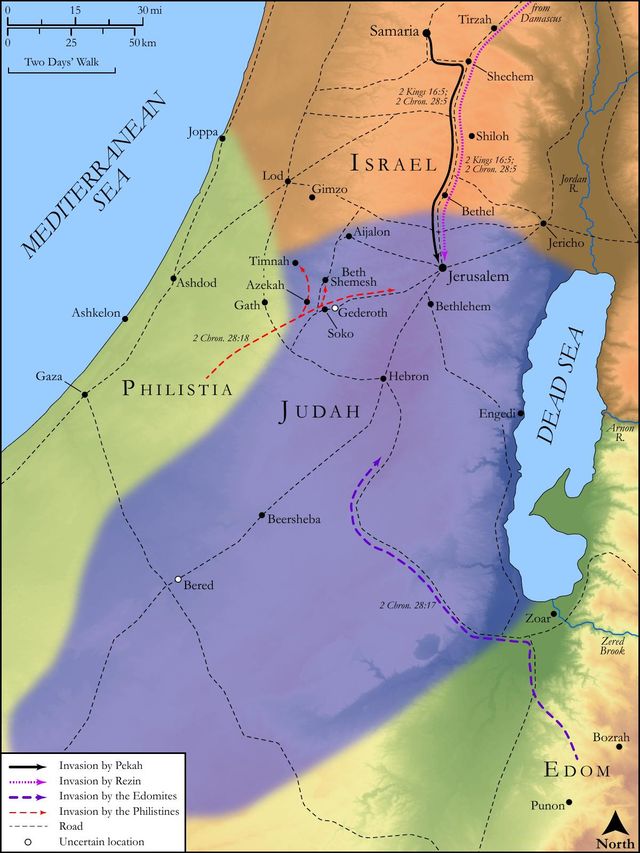
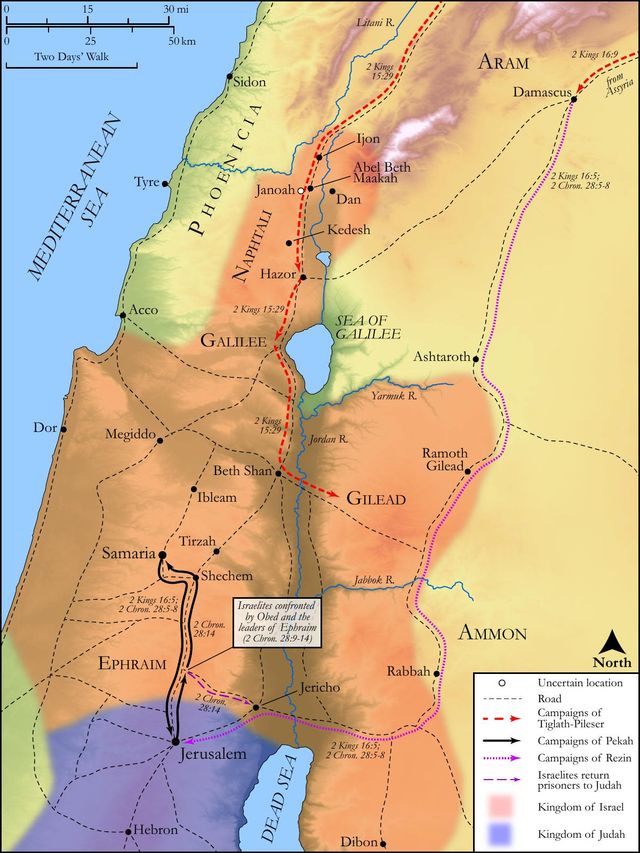
See on the biblical-era maps
Study this verse
Public-domain commentary
Matthew Henry
From his Commentary on the Whole Bible. Henry comments on passages, not single verses — this entry covers 2 Kings 16:5–9.
Here is, 1. The attempt of his confederate neighbours, the kings of Syria and Israel, upon him. They thought to make themselves masters of Jerusalem, and to set a king of their own in it, Isa 7:6. In this they fell short, but the king of Syria recovered Elath, a considerable port upon the Red Sea, which Amaziah had taken from the Syrians, Kg2 14:22. What can those keep that have lost their religion? Let them expect, thenceforward, to be always on the losing hand. 2. His project to get clear of them. Having forsaken God, he had neither courage nor strength to make head against his enemies, nor could he, with any boldness, ask help of God; but he made his court to the king of Assyria, and got him to come in for his relief. Those whose hearts condemn them will go any where in a day of distress rather than to God. Was it because there was not a God in Israel that he sent to the Assyrian for help? Was the rock of ages removed out of its place, that he stayed himself on this broken reed? The sin itself was its own punishment; for, though it is true that he gained his point (the king of Assyria hearkened to him, and, to serve his own turn, made a descent upon Damascus, whereby he gave a powerful diversion to the king of Syria, Kg2 16:9, and obliged him to let fall his design against Ahaz, carrying the Syrians captive to Kir, as Amos had expressly foretold, Amo 1:5), yet, considering all, he made but a bad bargain; for, to compass this, (1.) He enslaved himself (Kg2 16:7): I am thy servant and thy son, that is, "I will be as dutiful and obedient to thee as to a master or father, if thou wilt but do me this good turn." Had he thus humbled himself to God, and implored his favour, he might have been delivered upon easier terms; he might have saved his money, and needed only to have parted with his sins. But, if the prodigal forsake his father's house, he soon becomes a slave to the worst of masters, Luk 15:15. (2.) He impoverished himself; for he took the silver and gold that were laid up in the treasury both of the temple and of the kingdom, and sent it to the king of Assyria, Kg2 16:8. Both church and state must be squeezed and exhausted, to gratify this his new patron and guardian. I know not what authority he had thus to dispose of the public stock; but it is common for those that have brought themselves into straits by one sin to help themselves out by another; and those that have alienated themselves from God will make no difficulty of alienating any of his rights.
Continue studying 2 Kings 16:5 across the web’s major study libraries — every link below opens this exact verse, chapter, or book on the destination site.
Read & Compare
 BibleGatewayThis verse in more than 200 translations and 70 languages.
 Bible.comThe YouVersion reader — hundreds of translations, reading plans, and highlights.
 ESV.orgCrossway's official English Standard Version reader.
 NET BibleThe NET translation with 60,000+ translators' notes on every rendering decision.
 STEP BibleTyndale House's free study tool — original text, vocabulary, and scholarly resources.
 BibliaLogos Bible Software's free web reader.
 USCCBThe New American Bible (Revised Edition) with the U.S. bishops' study notes.
Commentaries
 BibleHub CommentariesDozens of classic commentaries on this verse, gathered on one page.
 StudyLightMore than 100 commentary sets — the largest collection on the web.
 BibleRefPlain-English commentary on what this verse means, verse by verse.
 Enduring WordDavid Guzik's free commentary on this chapter, widely used by Bible teachers.
 Bible Study ToolsVerse commentary alongside Greek and Hebrew study aids.
Original Language & Research
- BibleHub InterlinearThe verse word by word — original language, transliteration, and English.
- BibleHub LexiconEvery word's original-language definition and Strong's entry.
 Blue Letter BibleDeep-study tools — Strong's numbers, concordance, and word studies.
 SefariaThe Hebrew text with Rashi and centuries of Jewish commentary.
Sermons, Hymns & Audio


TrulyRandomVerse is not affiliated with these sites and doesn’t control their content. They’re linked because they’re genuinely useful.
Summary
2 Kings 16:5 vividly recounts the desperate geopolitical crisis faced by King Ahaz of Judah: the onset of the Syro-Ephraimite War. It details the formidable alliance between King Rezin of Syria and King Pekah of Israel, who launched a concerted military campaign against Jerusalem with the explicit aim of deposing Ahaz. Despite their overwhelming combined might and the strategic vulnerability of the besieged city, the verse concludes with a pivotal declaration: they "could not overcome" Ahaz, a statement that subtly yet profoundly points to a divine hand of restraint, preserving the Davidic dynasty and Jerusalem against all odds, even amidst Judah's escalating unfaithfulness.
Context
ShowHideLiterary Context
This verse is strategically placed early in the account of King Ahaz's reign in 2 Kings 16, immediately following a damning indictment of his character and widespread idolatry (compare 2 Kings 16:2-4). It serves as the narrative catalyst for the major crisis of his rule, the Syro-Ephraimite War. While 2 Kings 16:5-9 provides the historical account of the siege and its aftermath, the prophetic book of Isaiah, particularly chapters 7-9, offers God's direct word and theological interpretation of these very events, including the divine promise that the coalition's plan would not succeed (as seen in Isaiah 7:7). The failure of Rezin and Pekah to conquer Jerusalem, as declared in this verse, is a crucial turning point, directly preceding Ahaz's fateful and faithless decision to appeal to Tiglath-Pileser III of Assyria for help (2 Kings 16:7-9), a choice that would entangle Judah in servitude to Assyria and bring long-term spiritual and political detriment.
Historical & Cultural Context
The Syro-Ephraimite War (c. 734-732 BCE) was a direct consequence of the geopolitical landscape in the late 8th century BCE. The Neo-Assyrian Empire, under the formidable Tiglath-Pileser III, was aggressively expanding westward, threatening the sovereignty of the smaller kingdoms in the Levant. In response to this existential threat, King Rezin of Aram (Syria, with its capital at Damascus) and King Pekah of the Northern Kingdom of Israel formed an anti-Assyrian coalition. King Ahaz of Judah, however, refused to join this alliance, likely due to a combination of fear of Assyria's might and perhaps a misguided sense of security or a desire to remain neutral. To compel Judah's participation and to create a unified front against Assyria, Rezin and Pekah launched an invasion, intending to depose Ahaz and install a more compliant puppet ruler, "the son of Tabeal" (as specified in Isaiah 7:6), who would align with their anti-Assyrian agenda. The act of besieging a city involved encircling it, cutting off its vital supplies, launching repeated assaults against its fortifications, and attempting to breach its walls—a desperate and perilous situation for the inhabitants trapped within.
Key Themes
ShowHide2 Kings 16:5 contributes significantly to several overarching themes throughout the Books of Kings and the broader Old Testament narrative. Firstly, it powerfully illustrates Divine Sovereignty and Covenant Faithfulness. Despite Ahaz's profound unfaithfulness and the overwhelming military threat posed by the coalition, God, in His unwavering faithfulness to the Davidic covenant (2 Samuel 7:16), supernaturally restrains the enemies, preventing the overthrow of Jerusalem and the Davidic line. This preservation was crucial for the future messianic promise. Secondly, the verse underscores the Consequences of Unfaithfulness and the Test of Trust. The siege served as a critical test for Ahaz, an opportunity to demonstrate trust in the Lord's deliverance, as explicitly urged by the prophet Isaiah (Isaiah 7:4). Ahaz's subsequent failure to trust God, choosing instead to rely on the Assyrian king, would lead to Judah's increasing subjugation and spiritual decline, powerfully demonstrating the severe repercussions of misdirected faith and the importance of relying solely on God in times of crisis.
Exposition and Analysis
ShowHideKey Word Analysis
ShowHideThis verb (H6696) means "to cramp," "to confine," or "to bind," and in military contexts, "to lay siege to." It vividly conveys the act of surrounding a city, cutting off its access, and attempting to starve or assault its inhabitants into submission. The use of this word emphasizes the dire and immediate threat faced by Jerusalem and its king, Ahaz. It signifies a sustained, aggressive military operation designed to conquer and subjugate.
This crucial verb (H3201) means "to be able," "to prevail," "to be strong enough," or "to succeed." Its negation here, "could not overcome," is highly significant. Despite their combined military might, their clear strategic objective, and the successful initiation of the siege, Rezin and Pekah were ultimately unable to achieve their primary goal of conquering Jerusalem and replacing Ahaz. This inability points to a power greater than their own that limited their success, strongly implying divine intervention or restraint.
Verse Breakdown
ShowHide"Then Rezin king of Syria and Pekah son of Remaliah king of Israel came up to Jerusalem to war"
This clause precisely identifies the two formidable aggressors: King Rezin of Aram (Syria) and King Pekah of the Northern Kingdom of Israel. Their combined forces represented a significant military power. The phrase "came up to Jerusalem to war" clearly states their hostile intent and direct target: the capital city of Judah and its reigning monarch, Ahaz. This was not a minor border skirmish but a full-scale military campaign aimed at conquest and regime change.
"and they besieged Ahaz"
This specifies the immediate and direct military action taken by the allied kings. They laid siege to Jerusalem, the city where King Ahaz resided and from which he ruled. This act denotes a sustained military operation, encircling the city to cut off supplies, launch attacks, and ultimately force its surrender. The specific focus on "Ahaz" indicates that the siege was directly against the king and his reign, with the explicit goal of dethroning him.
"but could not overcome [him]."
This is the pivotal and surprising conclusion of the verse. Despite the strength of the coalition, their clear strategic objective, and the successful initiation of the siege, they failed to achieve their ultimate goal of conquering Jerusalem and deposing Ahaz. The phrase "could not overcome" (literally, "were not able") implies an external limitation on their power, strongly suggesting divine intervention or protection. Although God is not explicitly named as the agent, the broader narrative and prophetic context (especially Isaiah's contemporary prophecies) make it clear that it was God's sovereign hand that restrained Rezin and Pekah. This outcome is a powerful testament to God's faithfulness to His covenant promises regarding the Davidic line, regardless of Ahaz's personal unfaithfulness.
Literary Devices
ShowHideThe verse employs several literary devices that enhance its theological and narrative impact. Foreshadowing is evident in the unexpected failure of the powerful coalition to conquer Jerusalem; this hints at God's continued, though often hidden, preservation of the Davidic line, which is crucial for the future messianic promise. The Irony of the situation is palpable: two strong kings, with a clear objective and overwhelming force, are thwarted in their primary aim, creating a stark contrast between their perceived might and their ultimate inability. This highlights the limitations of human power when confronted by divine will. Furthermore, the phrase "could not overcome him" functions as a form of Divine Passive or Implied Divine Action. While God is not explicitly mentioned as the one preventing their success, the narrative context (especially when read alongside Isaiah's prophecies) strongly implies that it was God's sovereign hand that restrained Rezin and Pekah, demonstrating His control over the plans of nations without directly stating His intervention.
Theological and Thematic Connections
ShowHide2 Kings 16:5 powerfully illustrates God's unwavering faithfulness to His covenant promises, even in the face of profound human unfaithfulness. The preservation of Jerusalem and the Davidic throne, despite Ahaz's idolatry and the overwhelming military threat, underscores the truth that God's purposes are not contingent upon human righteousness but upon His own unchanging character and sworn word. This event is a testament to God's sovereign control over history and His commitment to the Davidic covenant, ensuring the lineage through which the Messiah would ultimately come. It serves as a stark reminder that while nations may rage and conspire, God's counsel alone will stand, frustrating the plans of the wicked when they run counter to His divine will, particularly concerning His redemptive plan.
Reflection and Application
ShowHideThe unexpected outcome in 2 Kings 16:5—that the powerful coalition "could not overcome" Ahaz—offers profound lessons on divine sovereignty and human trust. It reminds us that even when we face overwhelming opposition, seemingly insurmountable challenges, or are caught in difficult circumstances, God's providential hand can restrain the plans of the wicked and protect His ultimate purposes. This is a source of immense comfort and security, knowing that our ultimate hope and safety rest not in human alliances, military might, or political maneuvering, but in the Lord's unfailing faithfulness and sovereign control. However, the broader context of Ahaz's unfaithfulness also serves as a crucial cautionary tale. While God preserved Jerusalem, Ahaz's subsequent decision to trust Assyria rather than God led to further subjugation and spiritual compromise for Judah. This narrative prompts us to deeply examine where our trust truly lies when faced with crises. Do we instinctively seek human solutions and worldly alliances, or do we turn to God in prayer and obedience, even when His way seems less expedient or visible? This verse encourages us to cultivate a deep and abiding trust in God's ultimate control, knowing that His purposes will prevail, and His protection is sure for those who walk in His ways and depend on His strength.
Questions for Reflection
ShowHideFAQ
ShowHideWhat was the primary goal of Rezin and Pekah in besieging Jerusalem?
ShowHideTheir primary goal was to depose King Ahaz of Judah and replace him with a puppet king, "the son of Tabeal" (Isaiah 7:6). This was part of their larger strategy to force Judah into their anti-Assyrian coalition, thereby creating a unified front against the expanding Neo-Assyrian Empire. They sought to eliminate Ahaz's independent stance and ensure Judah's participation in their alliance.
Why were Rezin and Pekah unable to overcome Ahaz, despite their military strength and the successful initiation of the siege?
ShowHideWhile the text of 2 Kings 16:5 does not explicitly state "God prevented them," the immediate prophetic context, particularly in Isaiah 7, strongly implies divine intervention and restraint. God had made an unconditional covenant with David (2 Samuel 7) to establish his throne and kingdom forever. Despite Ahaz's profound unfaithfulness and idolatry, God remained faithful to this covenant, ensuring the preservation of the Davidic lineage and Jerusalem, which was essential for the future coming of the Messiah. Their inability to conquer Jerusalem was not due to a lack of military prowess on their part or strength on Ahaz's part, but rather a divine limitation on their power, demonstrating God's sovereign control over the affairs of nations.
Christ-Centered Fulfillment
ShowHideThe divine restraint evident in 2 Kings 16:5, where the powerful enemies "could not overcome" the Davidic king and Jerusalem, finds its ultimate and glorious fulfillment in Jesus Christ. God's faithfulness in preserving the Davidic line, despite the unfaithfulness of kings like Ahaz and the existential threats they faced, was not merely for the sake of Ahaz himself, but for the sake of His eternal covenant that promised a King from David's lineage whose kingdom would endure forever. This fragile preservation of the Davidic throne ultimately points to the unshakable reign of Jesus, the true Son of David (Matthew 1:1), whose kingdom "will have no end" (Luke 1:33). Just as the enemies of Judah could not prevail against God's immediate purpose to preserve the Davidic line, so too the powers of sin, death, and hell cannot prevail against Christ's church or His redemptive plan (Matthew 16:18). Jesus is the ultimate overcomer, having declared, "I have overcome the world" (John 16:33), triumphing over every spiritual foe through His cross and resurrection (Colossians 2:15). The temporary physical deliverance of Jerusalem foreshadows the eternal spiritual deliverance accomplished by Christ, who secured an everlasting victory and an unshakeable kingdom for all who trust in Him.