


Isaiah 8:10
- עֻצוּ'U·tzuplanH5779V-Qal-Imp-2mpVerb Qal Imperative 2nd Plural Masculine
- עֵצָה'e·Tzaha planH6098N-fsNoun Singular Feminine Absolute
- וְתֻפָרve·tu·Farso it may be frustratedH6565Conj-w ¦ V-Hophal-ConjImperf-3fsVerb Hophal Conjunction+Imperfect 3rd Singular Feminineוְsoתֻפָרit may be frustrated
- דַּבְּרוּda·be·RuspeakH1696V-Piel-Imp-2mpVerb Piel Imperative 2nd Plural Masculine
- דָבָרda·Vara wordH1697N-msNoun Singular Masculine Absolute
- וְלֹאve·Lo'and notH3808Conj-w ¦ NegParticle Negativeוְandלֹאnot
- יָקוּםya·Kumit will standH6965V-Qal-Imperf-3msVerb Qal Imperfect 3rd Singular Masculine
- כִּיkiforH3588PrtParticle Conditional
- עִמָּנוּ'i·Ma·nu[is] with usH5973Prep ¦ 1cpPrepositionעִמָּ[is] withנוּus
- אֵל'ElGodH410N-msNoun Singular Masculine Absolute
English is a literal word-by-word gloss of the Hebrew, not the KJV's wording. Why?
This is the original text the KJV's translators worked from — each Hebrew word with its own literal English meaning in this verse, prepared by scholars at Tyndale House, Cambridge. The KJV translates whole sentences, not word by word, so its wording differs: one Hebrew word can become several English words, and the KJV may choose “the LORD” where the gloss reads “Yahweh”. Both are faithful — they answer different questions. For the KJV's own rendering, switch to the KJV text.
Details
See on the biblical-era map
Study this verse
Public-domain commentary
Matthew Henry
From his Commentary on the Whole Bible. Henry comments on passages, not single verses — this entry covers Isaiah 8:9–15. His four-level outline is real structure in the source text, so it is rendered as structure.
The prophet here returns to speak of the present distress that Ahaz and his court and kingdom were in upon account of the threatening confederacy of the ten tribes and the Syrians against them. And in these verses,
I.He triumphs over the invading enemies, and, in effect, sets them at defiance, and bids them do their worst (Isa 8:9, Isa 8:10):
"O you people, you of far countries, give ear to what the prophet says to you in God's name." 1. "We doubt not but you will now make your utmost efforts against Judah and Jerusalem. You associate yourselves in a strict alliance. You gird yourselves, and again you gird yourselves; you prepare for action; you address yourselves to it with resolution; you gird on your swords; you gird up your loins. You animate and encourage yourselves and one another with all the considerations you can think of: you take counsel together, call councils of war, and all heads are at work about the proper methods for making yourselves masters of the land of Judah. You speak the word; you come to resolutions concerning it, and are not always deliberating; you determine what to do, and are very confident of the success of it, that the matter will be accomplished with a word's speaking." Note, It is with a great deal of policy, resolution, and assurance, that the church's enemies carry on their designs against it; and abundance of pains they take to roll a stone that will certainly return upon them. 2. "This is to let you know that all your efforts will be ineffectual. You cannot, you shall not, gain your point, nor carry the day: You shall be broken in pieces. Though you associate yourselves, though you gird yourselves, though you proceed with all the policy and precaution imaginable, yet, I tell you again and again, all your projects shall be baffled, you shall be broken in pieces. Nay, not only shall your attempts be ruined, but your attempts shall be your ruin; you shall be broken by those designs you have formed against Jerusalem: Your counsels shall come to nought; for there is no wisdom nor counsel against the Lord. Your resolves will not be put in execution; they shall not stand. You speak the word, but who is he that saith, and it cometh to pass, if the Lord commandeth it not? What sets up itself against God, and his cause and counsel, cannot stand, but must inevitably fall. For God is with us" (this refers to the name of Immanuel - God with us); "the Messiah is to be born among us, and a people designed for such an honour cannot be given up to utter ruin. We have now the special presence of God with us in his temple, his oracles, his promises, and these are our defence. God is with us; he is on our side, to take our part and fight for us; and, if God be for us, who can be against us?" Thus does the daughter of Zion despise them.
II.He comforts and encourages the people of God with the same comforts and encouragements which he himself had received.
The attempt made upon them was very formidable; the house of David, the court and royal family, were at their wits' end (Isa 7:2), and then no marvel if the people were in a consternation. Now,
1.The prophet tells us how he was himself taught of God not to give way to such amazing fears as the people were disturbed with, nor to run into the same measures with them (Isa 8:11): "The Lord spoke to me with a strong hand not to walk in the way of this people, not to say as they say nor do as they do, not to entertain the same frightful apprehensions of things nor to approve of their projects of making peace upon any terms, or calling in the help of the Assyrians." God instructed the prophet not to go down the stream. Note,
(1.)There is a proneness in the best of men to be frightened at threatening clouds, especially when fears are epidemic. We are all too apt to walk in the way of the people we live among, though it be not a good way.
(2.)Those whom God loves and owns he will instruct and enable to swim against the stream of common corruptions, particularly of common fears. He will find ways to teach his own people not to walk in the way of other people, but in a sober singularity.
(3.)Corruption is sometimes so active in the hearts even of good men that they have need to be taught their duty with a strong hand, and it is God's prerogative to teach so, for he only can give an understanding and overpower the contradiction of unbelief and prejudice. He can teach the heart; and herein none teaches like him.
(4.)Those that are to teach others have need to be themselves well instructed in their duty, and then they teach most powerfully when they teach experimentally. The word that comes from the heart is most likely to reach to the heart; and what we are ourselves by the grace of God instructed in we should, as we are able, teach others also.
2.Now what is it that he says to God's people?
(1.)He cautions them against a sinful fear, Isa 8:12. It seems it was the way of this people at this time, and fear is catching. He whose heart fails him makes his brethren's heart to fail, like his heart (Deu 20:8); therefore Say you not, A confederacy, to all those to whom this people shall say, A confederacy; that is, [1.] "Be not associated with them in the confederacies they are projecting and forecasting for. Do not join with those that, for the securing of themselves, are for making a league with the Assyrians, through unbelief, and distrust of God and their cause. Do not come into any such confederacy." Note, It concerns us, in time of trouble, to watch against all such fears as put us upon taking any indirect courses for our own security. [2.] "Be not afraid of the confederacies they frighten themselves and one another with. Do not distress yourselves with the apprehension of a confederacy upon every thing that stirs, nor, when any little thing is amiss, cry out presently, There is a plot, a plot. When they talk what dismal news there is, Syria is joined with Ephraim, what will become of us? must we fight, or must we flee, or must we yield? do not you fear their fear: Be not afraid of the signs of heaven, as the heathen are, Jer 10:2. Be not afraid of evil tidings on earth, but let your hearts be fixed. Fear not that which they fear, nor be afraid as they are. Be not put into such a fright as causes trembling and shaking;" so the word signifies. Note, When the church's enemies have sinful confederacies on foot the church's friends should watch against the sinful fears of those confederacies.
(2.)He advises them to a gracious religious fear: But sanctify the Lord of hosts himself, Isa 8:13. Note, The believing fear of God is a special preservative against the disquieting fear of man; see Pe1 3:14, Pe1 3:15, where this is quoted, and applied to suffering Christians.
[1.]We must look upon God as the Lord of hosts, that has all power in his hand and all creatures at his beck.
[2.]We must sanctify him accordingly, give him the glory due to that name, and behave towards him as those that believe him to be a holy God.
[3.]We must make him our fear, the object of our fear, and make him our dread, keep up a reverence of his providence and stand in awe of his sovereignty, be afraid of his displeasure and silently acquiesce in all his disposals. Were we but duly affected with the greatness and glory of God, we should see the pomp of our enemies eclipsed and clouded, and all their power restrained and under check; see Neh 4:14. Those that are afraid of the reproach of men forget the Lord their Maker, Isa 51:12, Isa 51:13. Compare Luk 12:4, Luk 12:5.
(3.)He assures them of a holy security and serenity of mind in so doing (Isa 8:14): "He shall be for a sanctuary; make him your fear, and you shall find him your hope, your help, your defence, and your mighty deliverer. He will sanctify and preserve you. He will be for a sanctuary," [1.] "To make you holy. He will be your sanctification;" so some read it. If we sanctify God by our praises, he will sanctify us by his grace. [2.] "To make you easy. He will be your sanctuary," to which you may flee for safety, and where you are privileged form all the arrests of fear; you shall find an inviolable refuge and security in him, and see yourselves our of the reach of danger. Those that truly fear God shall not need to fear any evil.
III.He threatens the ruin of the ungodly and unbelieving, both in Judah and Israel.
They have no part nor lot in the foregoing comforts; that God who will be a sanctuary to those who trust in him will be a stone of stumbling, and a rock of offence, to those who leave these waters of Shiloah, and rejoice in Rezin and Remaliah's son, (Isa 8:6), who make the creature their fear and their hope, Isa 8:14, Isa 8:15. The prophet foresees that the greatest part of both the houses of Israel would not sanctify the Lord of hosts, and to them he would be for a gin and a snare; he would be a terror to them, as he would be a support and stay to those that trusted in him. Instead of profiting by the word of God, they should be offended at it; and the providences of God, instead of leading them to him, would drive them from him. What was a savour of life unto life to others would be a savour of death unto death to them. "So that many among them shall stumble and fall; they shall fall both into sin and into ruin; they shall fall by the sword, shall be taken prisoners, and go into captivity." Note, If the things of God be an offence to us, they will be an undoing to us. Some apply this to the unbelieving Jews, who rejected Christ, and to whom he became a stone of stumbling; for the apostle quotes this scripture with application to all those who persisted in their unbelief of the gospel of Christ (Pe1 2:8); to them he is a rock of offence, because, being disobedient to the word, they stumble at it.
Historical interpretation
Historical reception
1 surviving comment on this verse from the historical church.
(Verse 9, 10.) Gather together, O people, and be conquered, and listen, all far away lands: be strengthened and be conquered. Gird yourselves, and be conquered: take counsel, and it shall be dissipated: speak a word, and it shall not be, because God is with us. Regarding the phrase 'gather together, or be weakened, and be broken,' as others have interpreted, the Septuagint translated it as 'know.' For the Hebrew word, Rou (), because of the resemblance of the letter Res () and Daleth (), they understood it as Dou (). Therefore, know that the people of Samaria and Syria are weak and feeble, and in the presence of Emmanuel, they are unable to do anything against the city of God, Jerusalem. And not only you, who are neighbors, but the whole distant land should know this. For even if you gather an army and prepare for battle, and the number of those besieging is greater than the number of those being besieged, I say to you again, you will be defeated. And whatever plan you make against Jerusalem will be destroyed. And although you have said above (Isaiah 7:6): Let us go up to Judah and harass it, and make a breach in it, and set a king over it, the son of Tabeel; you speak a word, but it will not stand, for God is with us, that is, Emmanuel. We can use this testimony against the nations in the time of persecution, that although they may seem strong and overcome us in those who have fallen, they will be defeated in those who have shed their blood for Christ, and that after the wars, peace will be restored to the Churches, and all their plans against Emmanuel will be scattered, for God is with us. They also listen beneficially to contradict the truth, so that they may ultimately be overcome by reason, and never desire to prevail in falsehood, because whatever they say, wickedness can never overcome what is right.
Continue studying Isaiah 8:10 across the web’s major study libraries — every link below opens this exact verse, chapter, or book on the destination site.
Read & Compare
 BibleGatewayThis verse in more than 200 translations and 70 languages.
 Bible.comThe YouVersion reader — hundreds of translations, reading plans, and highlights.
 ESV.orgCrossway's official English Standard Version reader.
 NET BibleThe NET translation with 60,000+ translators' notes on every rendering decision.
 STEP BibleTyndale House's free study tool — original text, vocabulary, and scholarly resources.
 BibliaLogos Bible Software's free web reader.
 USCCBThe New American Bible (Revised Edition) with the U.S. bishops' study notes.
Commentaries
 BibleHub CommentariesDozens of classic commentaries on this verse, gathered on one page.
 StudyLightMore than 100 commentary sets — the largest collection on the web.
 BibleRefPlain-English commentary on what this verse means, verse by verse.
 Enduring WordDavid Guzik's free commentary on this chapter, widely used by Bible teachers.
 Bible Study ToolsVerse commentary alongside Greek and Hebrew study aids.
Original Language & Research
- BibleHub InterlinearThe verse word by word — original language, transliteration, and English.
- BibleHub LexiconEvery word's original-language definition and Strong's entry.
 Blue Letter BibleDeep-study tools — Strong's numbers, concordance, and word studies.
 SefariaThe Hebrew text with Rashi and centuries of Jewish commentary.
Sermons, Hymns & Audio


TrulyRandomVerse is not affiliated with these sites and doesn’t control their content. They’re linked because they’re genuinely useful.
Summary
Isaiah 8:10 stands as a powerful divine declaration, asserting God's absolute sovereignty and unwavering presence amidst human opposition and geopolitical turmoil. This verse proclaims that any counsel or word spoken against the Lord's purposes, no matter how meticulously planned or forcefully uttered, will ultimately be rendered futile and fail to stand. Its profound certainty is rooted in the concluding affirmation: "for God is with us," highlighting the active, protective, and invincible presence of the Almighty with His people, thereby guaranteeing the ultimate triumph of His will over all earthly machinations.
Context
ShowHideLiterary Context
Isaiah 8:10 is strategically positioned within the broader prophetic tapestry of the Syro-Ephraimite War, primarily covered in Isaiah 7 through Isaiah 9. Following the pivotal prophecy of Immanuel in Isaiah 7:14, and the subsequent warnings about the impending Assyrian invasion in Isaiah 8:1-8, this verse functions as a divine counter-declaration. It directly confronts the hostile plans of the Syro-Ephraimite alliance, who sought to depose King Ahaz of Judah. While the preceding verses describe the overwhelming "waters of the River" (a metaphor for Assyria) sweeping through the land, Isaiah 8:9 and Isaiah 8:11-15 affirm God's protective presence for those who fear Him, setting the stage for verse 10. Thus, Isaiah 8:10 serves as a powerful theological summary, asserting God's ultimate authority over all human schemes and offering a bulwark of hope amidst the described chaos.
Historical & Cultural Context
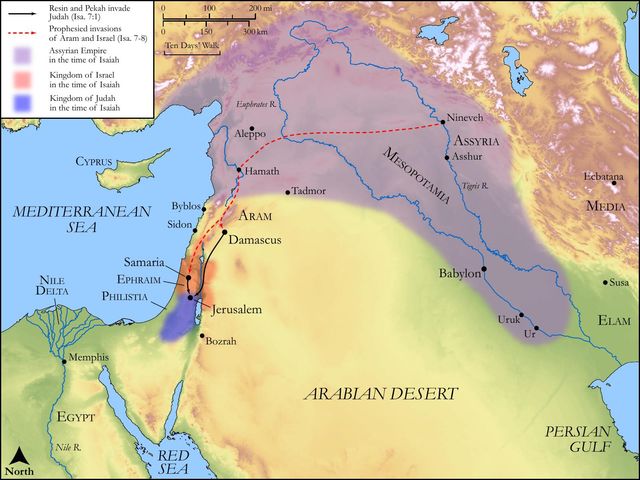
The historical backdrop for Isaiah 8:10 is the tumultuous late 8th century BCE, during the reign of King Ahaz in Judah. The Neo-Assyrian Empire was rapidly expanding, posing a significant threat to the smaller nations of the Levant. In response, Kings Rezin of Aram (Syria) and Pekah of Israel (Ephraim) formed an anti-Assyrian coalition and attempted to coerce Judah into joining them. When Ahaz refused, they invaded Judah with the explicit aim of replacing him with a more compliant ruler, likely "the son of Tabeel" (Isaiah 7:6). Culturally, the ancient Near East operated on principles of shifting alliances, military prowess, and the belief that national deities actively participated in the conflicts of their people. In this environment, Isaiah's prophetic message was revolutionary: Judah's true security did not lie in political maneuvering, military strength, or alliances with powerful nations like Assyria, but solely in unwavering trust in Yahweh, the true God who was "with us." This challenged the prevailing worldview by elevating divine power above all earthly might.
Key Themes
ShowHideThe paramount theme of Isaiah 8:10 is the Divine Sovereignty of Yahweh. It emphatically declares that no human counsel, plan, or military might, no matter how formidable, can ultimately thwart God's sovereign will. This underscores the profound futility of human opposition when it stands against the Almighty, a theme echoed throughout Isaiah's prophecies. Closely intertwined is the theme of God's Unwavering Presence (Immanuel). The concluding phrase, "for God is with us," directly echoes and reinforces the prophetic name "Immanuel" from Isaiah 7:14. This is not merely a passive proximity but an active, intervening, and protective presence, assuring Judah that they are not abandoned in their distress. Finally, the verse implicitly, yet powerfully, calls for Trust and Faith in God. In a time of immense fear and pressure to rely on human alliances or military solutions, Isaiah's message challenges Judah to abandon their reliance on worldly power and instead place their complete confidence in the Lord's ability to defend and deliver them, a consistent call throughout the book of Isaiah.
Exposition and Analysis
ShowHideKey Word Analysis
ShowHideThis primitive root (H5779) signifies "to consult" or "to take advice." In Isaiah 8:10, the repetition implied by "take counsel together" emphasizes the deliberate, concerted, and calculated plans and strategies devised by Judah's enemies. It speaks to the collective effort and collaborative nature of their plotting. Despite their careful deliberation and strategic efforts, the prophet declares with divine authority that their counsel will ultimately fail, rendered powerless before God's will.
Derived from a primitive root (H6565), this word means "to break up," "to violate," or "to frustrate." It powerfully conveys the idea of something being made ineffective, dissolved, annulled, or brought to complete nothingness. Here, it vividly describes the absolute and utter failure of the enemies' plans. Their meticulously constructed schemes and alliances will be dismantled, rendered void, and utterly without effect by divine intervention, demonstrating God's supreme authority.
This term (H410), a shortened form of a word meaning "strength" or "might," refers to the Almighty. While it can be used for any deity, in this context, it unequivocally denotes Yahweh, the covenant God of Israel. Its inclusion here is pivotal, emphasizing the incomparable divine power, inherent authority, and invincible might that stands in direct opposition to, and ultimately nullifies, the plans of human adversaries. It is the very nature and omnipotence of this God that guarantees the futility and ultimate collapse of any counsel or word set against Him.
Verse Breakdown
ShowHide"Take counsel together, and it shall come to nought"
This opening clause directly addresses the collective plotting and strategic planning of Judah's enemies, specifically the Syro-Ephraimite coalition. The phrase "take counsel together" highlights their deliberate, unified, and presumably well-thought-out efforts to devise a scheme against God's people and His appointed king. However, the immediate declaration "it shall come to nought" serves as a divine verdict, asserting with absolute certainty that despite their best efforts and cunning, their plans will be utterly frustrated, dissolved, and rendered completely ineffective.
"speak the word, and it shall not stand"
This second parallel clause reinforces the first, extending the futility from their internal deliberations ("counsel") to their external declarations, decrees, and threats ("word"). Whatever they pronounce, command, or threaten, whatever their stated intentions or military ultimatums, will lack the power, stability, or enduring force to achieve its purpose. It "shall not stand," meaning it will not be established, upheld, succeed, or endure in its intended effect, signifying a complete and public failure of their declared intentions.
"for God is with us"
This concluding phrase provides the definitive reason, theological foundation, and ultimate guarantee for the preceding declarations of futility. The Hebrew "Immanu El" (עִמָּנוּ אֵל) is a profound and powerful affirmation of God's active, protective, and sovereign presence with His people. It is not merely a statement of proximity but of divine alliance, intervention, and unwavering support. Because the Almighty God is actively on the side of Judah, no human opposition, no matter how strong or well-planned, can ultimately prevail against His will or His chosen people. This divine presence is the ultimate bulwark against all adversaries.
Literary Devices
ShowHideIsaiah 8:10 masterfully employs several potent literary devices to convey its message with emphatic certainty and theological depth. Parallelism is prominently displayed in the two initial clauses: "Take counsel together, and it shall come to nought; speak the word, and it shall not stand." This form of synonymous parallelism reinforces the central idea that both the secret plotting and the open declarations of the enemies are equally doomed to failure. The repetition emphasizes the absolute certainty of their defeat. There is also a strong element of Irony present; the enemies believe their counsel and words hold inherent power and authority, but the prophet, speaking for God, reveals their utter impotence and ultimate futility when confronted by God's omnipotent will. The concluding phrase, "for God is with us," functions as a powerful Antithesis to the enemies' plans, presenting God's unwavering and active presence as the ultimate, invincible counterforce to all human opposition. Furthermore, within its broader context, the verse contributes to a Chiasm surrounding the Immanuel prophecy, where the "God with us" theme frames and underscores the divine intervention and promises of protection, providing a theological anchor for the entire passage.
Theological and Thematic Connections
ShowHideIsaiah 8:10 is a foundational statement on divine sovereignty, asserting with absolute clarity that God's will is ultimately unthwartable by any human machination or counsel. It underscores the profound biblical truth that while humans may plot, scheme, and wage war, the Lord's eternal purposes will always prevail. This verse provides immense comfort and reassurance, reminding believers that even in the face of overwhelming opposition, geopolitical instability, or seemingly insurmountable personal challenges, God remains actively present and in supreme control, rendering futile any plan that opposes His divine agenda. It serves as a powerful call for profound trust in God's power and faithfulness, urging believers to resist succumbing to fear or relying on human strength, political alliances, or worldly wisdom. The declaration "God is with us" is the bedrock of this assurance, a promise that resonates throughout salvation history as the ultimate guarantee of God's protective and redemptive work.
Reflection and Application
ShowHideIn a world frequently characterized by political intrigue, economic instability, social unrest, and various forms of opposition to God's kingdom and His people, Isaiah 8:10 remains a timeless and indispensable anchor for the soul. It calls us, with compelling urgency, to shift our gaze from the apparent power of human systems, the anxieties they generate, and the fear they can instill, to the unshakeable, omnipotent sovereignty of God. When we face personal attacks, professional challenges, spiritual battles, or societal pressures that seem overwhelming and insurmountable, this verse reminds us that no counsel, no word, no scheme, no weapon devised against God's will for our lives or for His church can ultimately stand or succeed. Our true peace, security, and hope are not found in the absence of threats, nor in our own strength or cleverness, but in the unwavering, active, and protective presence of the Almighty God who is eternally "with us." This profound truth empowers us to live courageously, speak truth boldly, walk in unwavering faith, and persevere through adversity, knowing that our ultimate victory is secured not by our might, but by His invincible power and faithfulness.
Questions for Reflection
ShowHideFAQ
ShowHideWhat is the significance of the phrase "God is with us" in Isaiah 8:10?
ShowHideThe phrase "God is with us" (Hebrew: Immanu El) is the theological bedrock and climactic declaration of Isaiah 8:10. It is a direct and powerful echo of the prophetic name "Immanuel" given in Isaiah 7:14, signifying God's active, protective, and covenantal presence with His people. This is not merely a statement of God's proximity but a profound assurance that He is actively on their side, intervening on their behalf, and ensuring that no human plan, power, or opposition can ultimately thwart His divine purposes or bring lasting harm to those He protects. This divine presence is the ultimate guarantee of the futility of all opposing forces and the certainty of God's triumph.
How does Isaiah 8:10 relate to the broader theme of divine sovereignty in the Bible?
ShowHideIsaiah 8:10 is a powerful testament to the overarching biblical theme of divine sovereignty, which asserts that God is the supreme ruler of the universe, possessing absolute control over all creation, events, and human affairs. This verse specifically highlights God's sovereignty over human plans, political schemes, and military endeavors. It declares that even the most carefully devised and forcefully spoken human intentions are utterly powerless and will come to nothing if they run contrary to God's immutable will. This theme is consistently woven throughout Scripture, from the Lord's control over the nations in Psalm 33:10-11 to His overarching purpose prevailing over human plans in Proverbs 19:21. It assures believers that God's ultimate plan for redemption, justice, and the establishment of His kingdom will always come to fruition, regardless of earthly opposition.
Christ-Centered Fulfillment
ShowHideIsaiah 8:10, with its powerful and reassuring declaration "for God is with us," finds its ultimate and most profound fulfillment in the person and work of Jesus Christ. The prophetic name "Immanuel," meaning "God with us," first given in Isaiah 7:14 as a sign of God's presence with Judah, is directly applied to Jesus in the New Testament. Matthew 1:23 explicitly states, "Behold, the virgin shall conceive and bear a son, and they shall call his name Immanuel (which means, God with us)." Jesus is the physical, incarnate embodiment of God's active, saving presence among humanity. Through His incarnation, God did not merely stand by, but entered into human history, taking on flesh to dwell intimately among us (John 1:14). His life, sacrificial death on the cross, and glorious resurrection demonstrate conclusively that no counsel of evil, no power of sin or death, and no scheme of humanity could ultimately thwart God's eternal plan of redemption. Just as the counsel of Judah's enemies came to nought, so too did the powers of darkness fail to hold Christ in the grave. Through Christ, the promise "God is with us" is not just a historical assurance for ancient Israel, but a living, dynamic reality for all believers, securing their hope and guaranteeing the triumph of God's kingdom over all opposing forces, for He disarmed the principalities and powers (Colossians 2:15). He is the true Immanuel, forever with His people until the very end of the age (Matthew 28:20), ensuring that His church will prevail against the gates of hell.