


2 Samuel 15:31
Bible text: King James Version (1769 Blayney text) · Public domain
Bible text: King James Version with Strong's numbers · Public domain
Bible text: Berean Standard Bible · Public domain
Bible text: American Standard Version (1901) · Public domain
Bible text: World English Bible, Messianic edition · Public domain
Bible text: Geneva Bible (1599) · Public domain
Bible text: Young's Literal Translation · Public domain
- וְדָוִדve·da·Vidand DavidH1732Conj-w ¦ N-proper-mNoun Proper MasculineוְandדָוִדDavid
- הִגִּידhi·Gidsomeone toldH5046V-Hiphil-Perf-3msVerb Hiphil Perfect 3rd Singular Masculine
- לֵאמֹרle·Mor<to> sayingH559Prep-l ¦ V-Qal-InfVerb Qal Infinitive Constructלֵ<to>אמֹרsaying
- אֲחִיתֹפֶל'a·chi·To·felAhithophelH302N-proper-mNoun Proper Masculine
- בַּקֹּשְׁרִיםba·ko·she·Rim[is] among the conspiratorsH7194Prep-b ¦ V-Qal-Prtcpl-mpVerb Qal Participle Plural Masculine Absoluteבַּ[is] among theקֹּשְׁרִיםconspirators
- עִם'imwithH5973PrepPreposition
- אַבְשָׁלוֹם'av·sha·LomAbsalomH53N-proper-mNoun Proper Masculine
- וַיֹּאמֶרvai·Yo·merand he saidH559Conj-w ¦ V-Qal-ConsecImperf-3msVerb Qal Consecutive Imperfect 3rd Singular Masculineוַandיֹּאמֶרhe said
- דָּוִדda·VidDavidH1732N-proper-mNoun Proper Masculine
- סַכֶּלsa·kelmake foolishH5528V-Piel-Imp-2msVerb Piel Imperative 2nd Singular Masculine
- נָאna'pleaseH4994PrtParticle Interjection
- אֶת'et<obj.>H853DirObjMParticle Object Indicator
- עֲצַת'a·Tzat[the] counsel ofH6098N-fscNoun Singular Feminine Construct
- אֲחִיתֹפֶל'a·chi·To·felAhithophelH302N-proper-mNoun Proper Masculine
- יְהוָהYah·wehO YahwehH3068N-properNoun Proper Title
English is a literal word-by-word gloss of the Hebrew, not the KJV's wording. Why?
This is the original text the KJV's translators worked from — each Hebrew word with its own literal English meaning in this verse, prepared by scholars at Tyndale House, Cambridge. The KJV translates whole sentences, not word by word, so its wording differs: one Hebrew word can become several English words, and the KJV may choose “the LORD” where the gloss reads “Yahweh”. Both are faithful — they answer different questions. For the KJV's own rendering, switch to the KJV text.
Details
See on the biblical-era maps

Study this verse
Public-domain commentary
Matthew Henry
From his Commentary on the Whole Bible. Henry comments on passages, not single verses — this entry covers 2 Samuel 15:31–37.
Nothing, it seems, appeared to David more threatening in Absalom's plot than that Ahithophel was in it; for one good head, in such a design, is worth a thousand good hands. Absalom was himself no politician, but he had got one entirely in his interest that was, and would be the more dangerous because he had been all along acquainted with David's counsels and affairs; if therefore he can be baffled, Absalom is as good as routed and the head of the conspiracy cut off. This David endeavours to do.
I.By prayer.
When he heard that Ahithophel was in the plot he lifted up his heart to God in this short prayer: Lord, turn the counsel of Ahithophel into foolishness, Sa2 15:31. He had not opportunity for a long prayer, but he was not one of those that thought he should be heard for his much speaking. It was a fervent prayer: "Lord, I pray thee, do this." God is well pleased with the importunity of those that come to him with their petitions. David is particular in this prayer; he names the person whose counsels he prays against. God gives us leave, in prayer, to be humbly and reverently free with him, and to mention the particular care, and fear, and grief, that lies heavily upon us. David prayed not against Ahithophel's person, but against his counsel, that God would turn it into foolishness, that, though he was a wise man, he might at this time give foolish counsel, or, if he gave wise counsel, that it might be rejected as foolish, or, if it were followed, that by some providence or other it might be defeated, and not attain the end. David prayed this in a firm belief that God has all hearts in his hand, and tongues too, that, when he pleases, he can take away the understanding of the aged and make the judges fools, (Job 12:17; Isa 3:2, Isa 3:3), and in hope that God would own and plead his just and injured cause. Note, We may pray in faith, and should pray with fervency, that God will turn that counsel into foolishness which is taken against his people.
II.By policy.
We must second our prayer with our endeavours, else we tempt God. It is good service to countermine the policy of the church's enemies. When David came to the top of the mount, he worshipped God, Sa2 15:32. Note, Weeping must not hinder worshipping, but quicken it rather. Now he penned the third Psalm, as appears by the title; and some think that his singing this was the worship he now paid to God. Just now Providence brought Hushai to him. While he was yet speaking, God heard, and sent him the person that should be instrumental to befool Ahithophel. He came to condole with David on his present trouble, with his coat rent and earth upon his head; but David, having a great deal of confidence in his conduct and faithfulness, resolved to employ him as a spy upon Absalom. He would not take him with him (Sa2 15:33), for he had now more need of soldiers than counsellors, but sent him back to Jerusalem, to wait for Absalom's arrival, as a deserter from David, and to offer him his service, Sa2 15:34. Thus he might insinuate himself into his counsels, and defeat Ahithophel, either by dissuading Absalom from following his advice or by discovering it to David, that he might know where to stand upon his guard. How this gross dissimulation, which David put Hushai upon, can be justified, as a stratagem in war, I do not see. The best that can be made of it is that Absalom, if he rebel against his father, must stand upon his guard against all mankind, and, if he will be deceived, let him be deceived. David recommended Hushai to Zadok and Abiathar, as persons proper to be consulted with (Sa2 15:35), and to their two sons, as trusty men to be sent on errands to David, Sa2 15:36. Hushai, thus instructed, came to Jerusalem (Sa2 15:37), whither also Absalom soon after came with his forces. How soon do royal palaces and royal cities change their masters! But we look for a kingdom which cannot be thus shaken and in the possession of which we cannot be disturbed.
Historical interpretation
Historical reception
2 surviving comments on this verse. Each one is dated, so this reads as a timeline rather than a list.
Select a marker to jump to its quote. Markers stagger vertically where authors wrote within a few decades of each other.
Thus, then, the Lord knew how to bring to nothing the counsels of nations. We learned in the time of Ahithophel how he cast away the counsels of the princes, when David prayed, saying, “Infatuate the counsel of Ahithophel.” Therefore, when you hear someone making great threats and announcing that he will bring upon you all sorts of ill treatment, losses, blows or death, look up to the Lord who brings to nothing the counsels of nations and rejects the devices of the people.
Was it not by Absalom’s own will that he chose to follow advice that proved detrimental to him, though he only did so because the Lord had heard his father’s prayer to this effect?
Continue studying 2 Samuel 15:31 across the web’s major study libraries — every link below opens this exact verse, chapter, or book on the destination site.
Read & Compare
 BibleGatewayThis verse in more than 200 translations and 70 languages.
 Bible.comThe YouVersion reader — hundreds of translations, reading plans, and highlights.
 ESV.orgCrossway's official English Standard Version reader.
 NET BibleThe NET translation with 60,000+ translators' notes on every rendering decision.
 STEP BibleTyndale House's free study tool — original text, vocabulary, and scholarly resources.
 BibliaLogos Bible Software's free web reader.
 USCCBThe New American Bible (Revised Edition) with the U.S. bishops' study notes.
Commentaries
 BibleHub CommentariesDozens of classic commentaries on this verse, gathered on one page.
 StudyLightMore than 100 commentary sets — the largest collection on the web.
 BibleRefPlain-English commentary on what this verse means, verse by verse.
 Enduring WordDavid Guzik's free commentary on this chapter, widely used by Bible teachers.
 Bible Study ToolsVerse commentary alongside Greek and Hebrew study aids.
Original Language & Research
- BibleHub InterlinearThe verse word by word — original language, transliteration, and English.
- BibleHub LexiconEvery word's original-language definition and Strong's entry.
 Blue Letter BibleDeep-study tools — Strong's numbers, concordance, and word studies.
 SefariaThe Hebrew text with Rashi and centuries of Jewish commentary.
Sermons, Hymns & Audio


TrulyRandomVerse is not affiliated with these sites and doesn’t control their content. They’re linked because they’re genuinely useful.
Summary
Second Samuel 15:31 records a pivotal and deeply personal moment in King David's life during the treacherous rebellion led by his son, Absalom. Upon receiving the devastating news that Ahithophel, his most trusted and strategically brilliant counselor, had joined the conspirators, David's immediate and profound response was not to strategize militarily but to turn to God in fervent prayer. He implores the Lord to confound Ahithophel's counsel, recognizing that even the shrewdest human wisdom is ultimately subject to divine sovereignty. This verse powerfully illustrates David's unwavering faith and reliance on God in the face of overwhelming betrayal and an existential threat to his kingdom.
Context
ShowHideLiterary Context
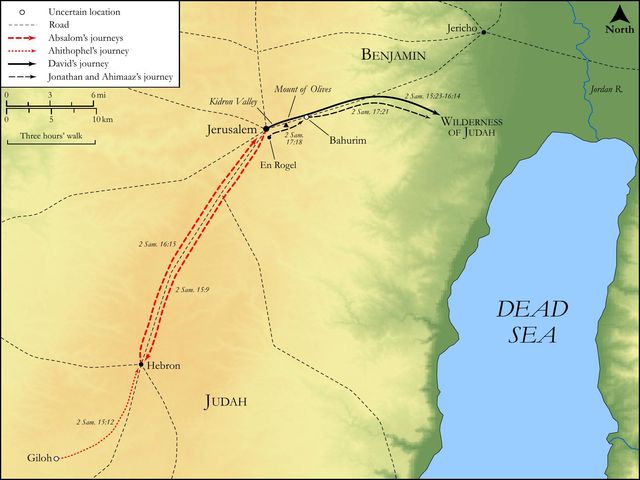
This verse is situated at a critical juncture in the unfolding tragedy of Absalom's rebellion, immediately following David's sorrowful departure from Jerusalem. David, barefoot and weeping, ascends the Mount of Olives, accompanied by loyal followers and the Ark of the Covenant, which he then instructs to be returned to the city, signifying his trust in God's presence there even as he flees (2 Samuel 15:30-32). The news of Ahithophel's defection arrives as David is already in a state of profound distress, amplifying the sense of crisis and highlighting the dire straits he finds himself in. This pivotal moment sets the stage for God's subsequent intervention through Hushai the Archite, whom David strategically sends back to Jerusalem to counter Ahithophel's advice, a plan detailed in the verses immediately following (2 Samuel 15:32-37).
Historical & Cultural Context
Ahithophel was not merely a counselor but a figure of immense prestige and influence in ancient Israel. His wisdom was so highly regarded that his counsel was considered "as if one had inquired at the oracle of God" (2 Samuel 16:23). For such a figure, intimately familiar with David's court, strategies, and even personal affairs, to defect to Absalom's side was not merely a loss of strategic insight but a profound blow to David's authority and a massive boon to Absalom's nascent rebellion. Among the kings of that day, trusted advisors held immense power, often shaping military campaigns and political policies. Ahithophel's betrayal was thus a deeply personal wound for David, echoing the pain of betrayal often lamented in the Psalms, as seen in David's own words in Psalm 55:12-14.
Key Themes
ShowHideThis verse powerfully encapsulates several overarching themes central to the narrative of David's reign and biblical theology. Firstly, it highlights the theme of betrayal and the fragility of human loyalty, as a close confidant turns against his king, underscoring the deep pain and vulnerability associated with such an act. Secondly, David's immediate recourse to prayer underscores the power and necessity of divine reliance, demonstrating that in moments of overwhelming human crisis, true strength is found not in human ingenuity alone, but in turning to God. This exemplifies a profound faith in God's active ability to intervene in human affairs and to orchestrate outcomes. Finally, David's specific prayer, "turn the counsel of Ahithophel into foolishness," introduces the profound theme of divine sovereignty over human wisdom. It asserts that no human plan, no matter how cunning or well-conceived, can ultimately thwart God's will, a concept echoed throughout the wisdom literature of the Old Testament, such as in Proverbs 21:30.
Exposition and Analysis
ShowHideKey Word Analysis
ShowHideMeaning "brother of folly," this name carries a profound irony given his reputation for exceptional wisdom. Ahithophel was David's trusted and highly esteemed counselor, whose advice was considered infallible, "as if one had inquired at the oracle of God" (2 Samuel 16:23). His defection to Absalom's side was therefore a catastrophic blow to David, representing not just a loss of strategic insight but a deep personal betrayal from someone intimately familiar with David's affairs and vulnerabilities.
This term refers to advice, strategy, or a well-thought-out plan. In Ahithophel's case, it denotes a level of shrewdness and strategic brilliance that made his guidance almost certainly effective and potentially devastating. David's prayer acknowledges the formidable nature of Ahithophel's strategic mind, recognizing that a direct confrontation with such wisdom would be disastrous without divine intervention.
This word, derived from a root meaning "to be silly" or "to act foolishly," signifies not merely that Ahithophel's counsel should be rendered ineffective or unsuccessful, but that it should be made utterly senseless, absurd, or self-defeating. David is not just asking for Ahithophel's plans to fail, but for them to actively become a source of confusion and error for Absalom and his conspirators, leading to their downfall. This implies a divine reversal where what was considered supremely wise becomes manifestly absurd and ultimately self-destructive.
Verse Breakdown
ShowHide"And one told David, saying, Ahithophel is among the conspirators with Absalom."
This clause delivers the shocking and devastating news to David. The anonymous "one" emphasizes the widespread and rapid nature of Absalom's rebellion, reaching David even in his flight from Jerusalem. The revelation of Ahithophel's involvement signifies a critical turning point, elevating the rebellion from a mere family dispute to a grave existential threat, given Ahithophel's strategic genius and intimate knowledge of David's operations and vulnerabilities.
"And David said, O LORD, I pray thee,"
David's immediate and instinctive response to this devastating news is not despair, panic, or immediate military planning, but fervent prayer. This demonstrates his profound spiritual discipline and deep reliance on God in moments of extreme crisis. The direct address "O LORD" (Yahweh, H3068) underscores the personal and covenantal nature of his plea, appealing to God as his sovereign protector and deliverer, the one who is self-existent and eternal.
"turn the counsel of Ahithophel into foolishness."
This is the core of David's petition and the heart of the verse. He recognizes the immense danger posed by Ahithophel's strategic mind and understands that human counter-strategy alone might not suffice. Instead, he appeals to God's omnipotence to supernaturally confound and nullify Ahithophel's plans, transforming what is considered supremely wise into something utterly ineffective and self-destructive. This prayer is a powerful testament to David's belief in God's absolute sovereignty over all human wisdom and affairs, and his trust that God can manipulate circumstances to achieve His divine purposes.
Literary Devices
ShowHideThe verse employs several potent literary devices. Irony is central, as the man whose counsel was considered divine wisdom is prayed against for his advice to be turned into foolishness, a direct contradiction of his renowned reputation. This sets up the dramatic plot device of God's direct intervention, which is fulfilled in 2 Samuel 17:14, where the Lord indeed frustrates Ahithophel's "good counsel" through Hushai's counter-advice. This foreshadowing highlights the power of prayer and divine sovereignty. The narrative also uses contrast between human wisdom (Ahithophel's counsel) and divine power (God's ability to render it foolish), emphasizing that God's plan ultimately transcends and overrules all human machinations. Furthermore, David's immediate, heartfelt prayer in the face of overwhelming odds serves as a powerful model for the reader, inviting emulation of his faith and dependence on God.
Theological and Thematic Connections
ShowHideDavid's prayer in 2 Samuel 15:31 is a profound theological statement about God's absolute sovereignty over human affairs, particularly over the wisdom and plans of humanity. It teaches that even the most brilliant and cunning human strategies are subject to God's ultimate will and can be confounded by divine intervention. This aligns with a consistent biblical theme that God delights in frustrating the proud and the wise of this world to demonstrate His own power and wisdom, often choosing the weak and foolish things of the world to shame the strong. David's immediate turning to prayer in a moment of existential crisis also underscores the vital role of prayer as the believer's primary recourse, not merely a last resort, demonstrating absolute dependence on God's active involvement in their circumstances and His ability to turn seemingly impossible situations to His glory.
Reflection and Application
ShowHideDavid's response to Ahithophel's betrayal offers a timeless and profound model for believers facing overwhelming challenges, cunning adversaries, or deep personal betrayals. Instead of succumbing to panic, despair, or immediate human strategizing, David's first and most profound action was to cast his burden upon the Lord in fervent prayer. This teaches us the supreme importance of prioritizing divine intervention over human ingenuity when confronted with seemingly insurmountable obstacles. It reminds us that God is actively involved in the affairs of His people and possesses the power to turn even the most formidable human wisdom into foolishness. Our faith is not to be placed in our ability to outwit our enemies or to control circumstances, but in God's omnipotence to confound their plans and work His purposes, often through unexpected means, as He did through Hushai. This encourages us to cultivate a deep, immediate, and unwavering reliance on God in every crisis, trusting that His wisdom and power far exceed any human machination and that He is truly sovereign over all things.
Questions for Reflection
ShowHideFAQ
ShowHideWho was Ahithophel and why was his betrayal so significant?
ShowHideAhithophel was King David's personal and highly esteemed counselor, renowned throughout Israel for his exceptional wisdom. His advice was considered so reliable that it was "as if one had inquired at the oracle of God" (2 Samuel 16:23). His betrayal was significant not only because it was a deep personal wound to David from a trusted confidant, but also because it lent immense strategic credibility and tactical advantage to Absalom's rebellion. Ahithophel knew David's strategies, weaknesses, and resources intimately, making him an incredibly dangerous adversary who could dismantle David's kingdom from within.
How did God answer David's prayer?
ShowHideGod answered David's prayer by frustrating Ahithophel's counsel through the counter-advice of Hushai the Archite. David had strategically sent Hushai back to Jerusalem specifically to infiltrate Absalom's court and counter Ahithophel's advice (2 Samuel 15:32-37). Ahithophel advised Absalom to immediately pursue David with a small, swift force to strike him down while he was vulnerable (2 Samuel 17:1-4). However, Hushai, divinely inspired, presented a more elaborate and seemingly grander plan that involved gathering a massive army, which appealed to Absalom's vanity and desire for widespread support (2 Samuel 17:7-13). The text explicitly states, "For the LORD had purposed to defeat the good counsel of Ahithophel, to the intent that the LORD might bring evil upon Absalom" (2 Samuel 17:14). This divinely orchestrated delay allowed David time to regroup, gather his forces, and prepare for battle, ultimately leading to Absalom's defeat and the preservation of David's throne.
Does this verse imply that God directly intervenes in all human plans?
ShowHideThis verse strongly affirms God's sovereign ability and willingness to intervene in human affairs, particularly when His purposes are at stake or when His people call upon Him in faith. It does not necessarily imply that God directly intervenes to frustrate all human plans, but it certainly demonstrates that no human wisdom or scheme, no matter how cunning, can ultimately thwart His divine will. God's intervention here is specific to David's prayer and His overarching plan for David's kingship and the Davidic covenant. It serves as a powerful example of God's active involvement in history, often working through seemingly natural circumstances (like Hushai's counter-advice) to achieve His supernatural ends, as also seen in Proverbs 19:21, which states, "Many are the plans in a person's heart, but it is the LORD's purpose that prevails."
Christ-Centered Fulfillment
ShowHideThe narrative of Ahithophel's betrayal and David's prayer finds profound Christ-centered fulfillment, echoing themes that culminate in Jesus Christ. David, as a type of Christ, experiences the bitter sting of betrayal from a trusted confidant, much like Jesus was betrayed by Judas Iscariot, a close disciple who ate bread with Him (Psalm 41:9 foreshadows this, and is directly quoted by Jesus in John 13:18). Furthermore, Ahithophel's "wise" counsel, intended to destroy David, was ultimately turned into foolishness by God, leading to Ahithophel's own demise. This powerfully prefigures how the "wisdom" of the world, which orchestrated the crucifixion of Christ—the ultimate act of apparent human triumph over God's anointed—was in fact God's ultimate plan for salvation, confounding the wise and demonstrating divine power (1 Corinthians 1:20-25). The cross, seemingly a sign of weakness and defeat, became the very means of God's triumph over sin and death, turning the counsel of the Sanhedrin and Pilate into foolishness. Jesus Himself is the true and ultimate Counselor, whose wisdom is never confounded and whose plans for redemption are eternally sure (Isaiah 9:6). Unlike Ahithophel, Christ's counsel always leads to life and truth, and His ultimate triumph over all earthly and spiritual adversaries is guaranteed, as He disarmed the powers and authorities and made a public spectacle of them, triumphing over them by the cross (Colossians 2:15).