


2 Samuel 17:23
- וַאֲחִיתֹפֶלva·'a·chi·To·feland AhithophelH302Conj-w ¦ N-proper-mNoun Proper MasculineוַandאֲחִיתֹפֶלAhithophel
- רָאָהra·'Ahhe sawH7200V-Qal-Perf-3msVerb Qal Perfect 3rd Singular Masculine
- כִּיkithatH3588PrtParticle Conditional
- לֹאlo'notH3808NegParticle Negative
- נֶעֶשְׂתָהne·'es·Tahit was doneH6213V-Niphal-Perf-3fsVerb Niphal Perfect 3rd Singular Feminine
- עֲצָתוֹa·tza·Tohis counselH6098N-fsc ¦ 3msNoun Singular Feminine Constructעֲצָתcounselוֹhis
- וַיַּחֲבֹשׁvai·ya·cha·Voshand he saddledH2280Conj-w ¦ V-Qal-ConsecImperf-3msVerb Qal Consecutive Imperfect 3rd Singular Masculineוַandיַּחֲבֹשׁhe saddled
- אֶת'et<obj.>H853DirObjMParticle Object Indicator
- הַחֲמוֹרha·cha·Morthe donkeyH2543Art ¦ N-csNoun Singular common gender Absoluteהַtheחֲמוֹרdonkey
- וַיָּקָםvai·Ya·komand he aroseH6965Conj-w ¦ V-Qal-ConsecImperf-3msVerb Qal Consecutive Imperfect 3rd Singular Masculineוַandיָּקָםhe arose
- וַיֵּלֶךְvai·Ye·lekhand he wentH1980Conj-w ¦ V-Qal-ConsecImperf-3msVerb Qal Consecutive Imperfect 3rd Singular Masculineוַandיֵּלֶךְhe went
- אֶל'eltoH413PrepPreposition
- בֵּיתוֹbei·Tohis houseH1004N-msc ¦ 3msNoun Singular Masculine Constructבֵּיתhouseוֹhis
- אֶל'eltoH413PrepPreposition
- עִירוֹi·Rohis cityH5892N-fsc ¦ 3msNoun Singular Feminine Constructעִירcityוֹhis
- וַיְצַוvay·Tzavand he commandedH6680Conj-w ¦ V-Piel-ConsecImperf-3msVerb Piel Consecutive Imperfect 3rd Singular Masculineוַandיְצַוhe commanded
- אֶל'elconcerningH413PrepPreposition
- בֵּיתוֹbei·Tohis householdH1004N-msc ¦ 3msNoun Singular Masculine Constructבֵּיתhouseholdוֹhis
- וַיֵּחָנַקvai·ye·cha·Nakand he hanged himselfH2614Conj-w ¦ V-Niphal-ConsecImperf-3msVerb Niphal Consecutive Imperfect 3rd Singular Masculineוַandיֵּחָנַקhe hanged himself
- וַיָּמָתvai·Ya·motand he diedH4191Conj-w ¦ V-Qal-ConsecImperf-3msVerb Qal Consecutive Imperfect 3rd Singular Masculineוַandיָּמָתhe died
- וַיִּקָּבֵרvai·yi·ka·Verand he was buriedH6912Conj-w ¦ V-Niphal-ConsecImperf-3msVerb Niphal Consecutive Imperfect 3rd Singular Masculineוַandיִּקָּבֵרhe was buried
- בְּקֶבֶרbe·Ke·verin [the] tomb ofH6913Prep-b ¦ N-mscNoun Singular Masculine Constructבְּinקֶבֶר[the] tomb of
- אָבִיו'a·Vivhis fatherH1N-msc ¦ 3msNoun Singular Masculine Constructאָבִיfatherוhis
English is a literal word-by-word gloss of the Hebrew, not the KJV's wording. Why?
This is the original text the KJV's translators worked from — each Hebrew word with its own literal English meaning in this verse, prepared by scholars at Tyndale House, Cambridge. The KJV translates whole sentences, not word by word, so its wording differs: one Hebrew word can become several English words, and the KJV may choose “the LORD” where the gloss reads “Yahweh”. Both are faithful — they answer different questions. For the KJV's own rendering, switch to the KJV text.
Details
See on the biblical-era map
Study this verse
Public-domain commentary
Matthew Henry
From his Commentary on the Whole Bible. Henry comments on passages, not single verses — this entry covers 2 Samuel 17:22–29. His three-level outline is real structure in the source text, so it is rendered as structure.
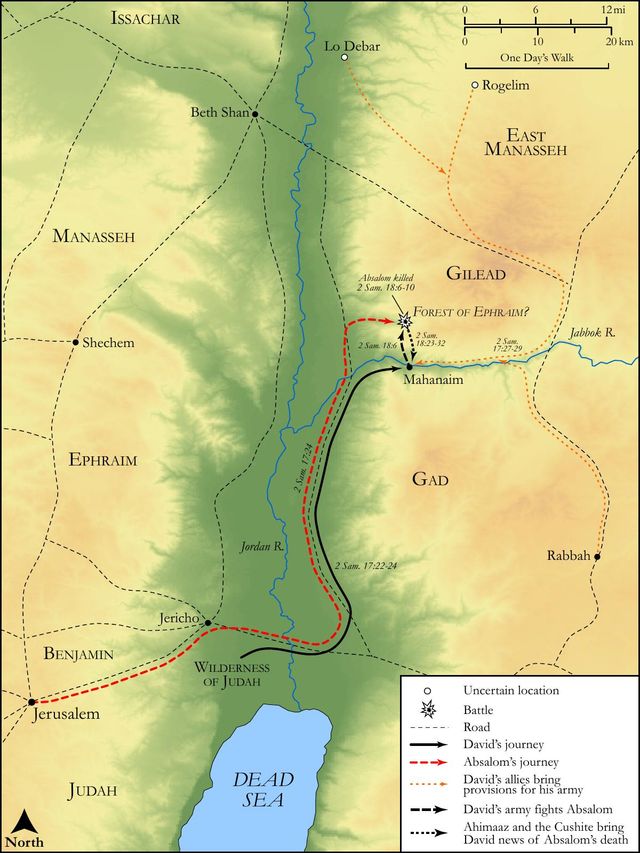
Here is, I. The transporting of David and his forces over Jordan, pursuant to the advice he had received from his friends at Jerusalem, Sa2 17:22. He, and all that were with him, went over in the night, whether in ferryboats, which probably always plied there, or through the fords, does not appear. But special notice is taken of this, that there lacked not one of them: none deserted him, though his distress was great, none staid behind sick or weary, nor were any lost or cast away in passing the river. Herein some make him a type of the Messiah, who said, in a difficult day, Of all that thou hast given me have I lost none. Having got over Jordan, he marched many miles forward to Mahanaim, a Levites' city in the tribe of Gad, in the utmost border of that tribe, and not far from Rabbah, the chief city of the Ammonites. This city, which Ishbosheth had made his royal city (Sa2 2:8), David now made his head-quarters, Sa2 17:24. And now he had time to raise an army wherewith to oppose the rebels and give them a warm reception.
II.The death of Ahithophel, Sa2 17:23.
He died by his own hands, felo de se - a suicide. He hanged himself for vexation that his counsel was not followed; for thereby,
1.He thought himself slighted, and an intolerable slur cast upon his reputation for wisdom. His judgment always used to sway at the counsel-board, but now another's opinion is thought wiser and better than his. His proud heart cannot bear the affront; it rises and swells, and the more he thinks of it the more violent his resentments grow, till they bring him at last to this desperate resolve not to live to see another preferred before him. All men think him a wise man, but he thinks himself the only wise man; and therefore to be avenged upon mankind for not thinking so too, he will die, that wisdom may die with him. The world is not worthy of such an oracle as he is, and therefore he will make them know the want of him. See what real enemies those are to themselves that think too well of themselves, and what mischiefs those run upon that are impatient of contempt. That will break a proud man's heart that will not break a humble man's sleep.
2.He thought himself endangered and his life exposed. He concluded that, because his counsel was not followed, Absalom's cause would certainly miscarry, and then, whoever would find David's mercy, he concluded that he, who was the greatest criminal, and had particularly advised him to lie with his father's concubines, must be sacrificed to justice. To prevent therefore the shame and terror of a public and solemn execution, he does justice upon himself, and, after his reputation for wisdom, by this last act puts a far greater disgrace upon himself than Absalom's privy-council had put upon him, and answers his name Ahithophel, which signifies, the brother of a fool. Nothing indicates so much folly as self-murder. Observe, How deliberately he did it, and of malice prepense against himself; not in a heat, but he went home to his city, to his house, to do it; and, which is strange, took time to consider of it, and yet did it. And, to prove himself compos mentis - in his senses, when he did it, he first put his household in order, made his will as a man of sane memory and understanding, settled his estate, balanced his accounts; yet he that had sense and prudence enough to do this had not consideration enough to revoke the sentence his pride and passion had passed upon his own neck, nor so much as to suspend the execution of it till he saw the event of Absalom's rebellion. Now herein we may see,
(1.)Contempt poured upon the wisdom of man. He that was more renowned for policy than any man played the fool with himself more abundantly. Let not the wise man glory in his wisdom, when he sees him that was so great an oracle dying as a fool dies.
(2.)Honour done to the justice of God. When the wicked are thus snared in the work of their own hands, and sunk in a pit of their own digging, the Lord is known by the judgment which he executeth, and we must say, Higgaion, Selah; it is a thing to be marked and meditated upon, Psa 7:15, Psa 7:16.
(3.)Prayer answered, and an honest cause served even by its enemies. Now, as David had prayed, Ahithophel's counsel was turned into foolishness to himself. Dr. Lightfoot supposes that David penned the 55th Psalm upon occasion of Ahithophel's being in the plot against him, and that he is the man complained of (Sa2 17:13) that had been his equal, his guide, and his acquaintance; and, if so, this was an immediate answer to his prayer there (Sa2 17:15): Let death seize upon them, and let them go down quickly into hell. Ahithophel's death was an advantage to David's interest; for had he digested that affront (as those must resolve often to do that will live in this world), and continued his post at Absalom's elbow, he might have given him counsel afterwards that might have been of pernicious consequence to David. It is well that that breath is stopped and that head laid from which nothing could be expected but mischief. It seems, it was not then usual to disgrace the dead bodies of self-murderers, for Ahithophel was buried, we may suppose honourably buried, in the sepulchre of his father, though he deserved no better than the burial of an ass. See Ecc 8:10.
III.Absalom's pursuit of his father.
He had now got all the men of Israel with him, as Hushai advised, and he himself, at the head of them, passed over Jordan, Sa2 17:24. Not content that he had driven his good father to the utmost corner of his kingdom, he resolved to chase him out of the world. He pitched in the land of Gilead with all his forces, ready to give David battle, Sa2 17:26. Absalom made one Amasa his general (Sa2 17:25), whose father was by birth Jether, an Ishmaelite (Ch1 2:17), but by religion Ithra (as he is here called), an Israelite; probably he was not only proselyted, but, having married a near relation of David's, was, by some act of the state, naturalized, and is therefore called an Israelite. His wife, Amasa's mother, was Abigail, David's sister, whose other sister, Zeruiah, was Joab's mother (Ch1 2:16), so that Amasa was in the same relation to David that Joab was. In honour to his family, even while he was in arms against his father, Absalom made him commander-in-chief of all his forces. Jesse is here called Nahash, for many had two names; or perhaps this was his wife's name.
IV.The friends David met with in this distant country.
Even Shobi, a younger brother of the royal family of the Ammonites, was kind to him, Sa2 17:27. It is probable that he had detested the indignity which his brother Hanun had done to David's ambassadors, and for that had received favours from David, which he now returned. Those that think their prosperity most confirmed know not but, some time or other, they may stand in need of the kindness of those that now lie at their mercy, and may be glad to be beholden to them, which is a reason why we should, as we have opportunity, do good to all men, for he that watereth shall be watered also himself, when there is occasion. Machir, the son of Ammiel, was he that maintained Mephibosheth (Sa2 9:4), till David eased him of that charge, and is now repaid for it by that generous man, who, it seems, was the common patron of distressed princes. Barzillai we shall hear of again. These, compassionating David and his men, now that they were weary with a long march, brought him furniture for his house, beds and basins, and provision for his table, wheat and barley, etc., Sa2 17:28, Sa2 17:29. He did not put them under contribution, did not compel them to supply him, much less plunder them; but in token of their dutiful affection to him, and their sincere concern for him in his present straits, of their own good will they brought in plenty of all that which he had occasion for. Let us learn hence to be generous and open-handed, according as our ability is, to all in distress, especially great men, to whom it is most grievous, and good men, who deserve better treatment; and see how God sometimes makes up to his people that comfort from strangers which they are disappointed of in their own families.
Continue studying 2 Samuel 17:23 across the web’s major study libraries — every link below opens this exact verse, chapter, or book on the destination site.
Read & Compare
 BibleGatewayThis verse in more than 200 translations and 70 languages.
 Bible.comThe YouVersion reader — hundreds of translations, reading plans, and highlights.
 ESV.orgCrossway's official English Standard Version reader.
 NET BibleThe NET translation with 60,000+ translators' notes on every rendering decision.
 STEP BibleTyndale House's free study tool — original text, vocabulary, and scholarly resources.
 BibliaLogos Bible Software's free web reader.
 USCCBThe New American Bible (Revised Edition) with the U.S. bishops' study notes.
Commentaries
 BibleHub CommentariesDozens of classic commentaries on this verse, gathered on one page.
 StudyLightMore than 100 commentary sets — the largest collection on the web.
 BibleRefPlain-English commentary on what this verse means, verse by verse.
 Enduring WordDavid Guzik's free commentary on this chapter, widely used by Bible teachers.
 Bible Study ToolsVerse commentary alongside Greek and Hebrew study aids.
Original Language & Research
- BibleHub InterlinearThe verse word by word — original language, transliteration, and English.
- BibleHub LexiconEvery word's original-language definition and Strong's entry.
 Blue Letter BibleDeep-study tools — Strong's numbers, concordance, and word studies.
 SefariaThe Hebrew text with Rashi and centuries of Jewish commentary.
Sermons, Hymns & Audio


TrulyRandomVerse is not affiliated with these sites and doesn’t control their content. They’re linked because they’re genuinely useful.
Summary
Ahithophel, King David's former trusted counselor, after his shrewd advice to Absalom was rejected in favor of Hushai's divinely orchestrated counter-counsel. This verse meticulously details Ahithophel's final, premeditated actions—returning home, settling his affairs, and taking his own life—culminating in his burial, serving as a stark testament to the devastating consequences of pride, thwarted ambition, and betrayal against God's sovereign plan.
Context
ShowHideLiterary Context
This verse serves as the grim climax to the narrative arc of Ahithophel within Absalom's rebellion, immediately following the pivotal moment where Hushai's deceptive counsel prevailed over Ahithophel's strategically superior advice. Ahithophel had urged Absalom to pursue David immediately, a plan that, if executed, would have almost certainly led to David's swift defeat and death, as detailed in 2 Samuel 17:1-3. However, David had sent Hushai as a double agent, and through divine intervention, Hushai's seemingly more cautious, yet ultimately disastrous, plan was adopted by Absalom and his elders, as recounted in 2 Samuel 17:7-14. Ahithophel's suicide underscores the profound impact of this decision, signaling not only his personal despair but also the inevitable failure of Absalom's entire rebellion, as Ahithophel, with his unparalleled wisdom, recognized the rebellion's doom once his counsel was disregarded.
Historical & Cultural Context
In ancient Near Eastern societies, the role of a royal counselor was one of immense prestige and influence. Counselors like Ahithophel, whose advice was considered "as if one had inquired at the oracle of God" (2 Samuel 16:23), held significant power and were often seen as indispensable to a ruler's success. For such a highly esteemed counselor to have his advice rejected was not merely a professional slight but a profound public humiliation and a direct challenge to his authority and wisdom. Furthermore, the act of suicide, while not explicitly condemned in the Old Testament, was generally viewed as a desperate and tragic act, often associated with deep shame or despair, as seen in the cases of Saul (1 Samuel 31:4) and Zimri (1 Kings 16:18). Ahithophel's meticulous "putting his household in order" before his death reflects a cultural expectation of preparing for one's demise, even when self-inflicted, ensuring family affairs were settled.
Key Themes
ShowHideThis verse powerfully illustrates several key themes within the broader narrative of 2 Samuel. Firstly, it highlights the consequences of pride and rejected counsel, showing how Ahithophel's immense pride in his wisdom, when thwarted, led to utter despair and self-destruction. His inability to accept the rejection of his "infallible" advice reveals a deep-seated arrogance. Secondly, it profoundly emphasizes divine sovereignty; the text explicitly states that "the Lord had appointed to defeat the good counsel of Ahithophel, to the intent that the Lord might bring evil upon Absalom" (2 Samuel 17:14). This demonstrates that even the most brilliant human plans are subject to God's ultimate will and purpose, underscoring His control over human events and the destinies of nations and individuals, as affirmed in Proverbs 19:21. Thirdly, the verse underscores the gravity and destructive power of betrayal, as Ahithophel's actions represent a profound act of treachery against King David, his former master and friend, culminating in a self-inflicted demise that serves as a stark warning against such disloyalty.
Exposition and Analysis
ShowHideKey Word Analysis
ShowHideThis word signifies "advice," "plan," or "purpose." In Ahithophel's context, it refers to his strategic counsel, which was highly esteemed for its wisdom and perceived as almost divinely inspired. The rejection of his ʻêtsâh was not merely a tactical disagreement but a profound personal and professional affront, signaling the complete collapse of his influence and the certain failure of the rebellion.
The phrase "put his household in order" uses tsâvâh (to constitute, enjoin, set in order) and bayith (house, family, household). This combination describes a deliberate act of arranging one's affairs, akin to making a will or giving final instructions to one's family and estate. It underscores the premeditated nature of Ahithophel's suicide, indicating a chillingly calm, calculated decision rather than an impulsive act of despair.
This verb means "to throttle" or "to choke oneself to death (by a rope)." It precisely describes the method of Ahithophel's suicide. The starkness of this word emphasizes the violent and self-inflicted nature of his end, a desperate act of self-annihilation that leaves no ambiguity about the cause of his death.
Verse Breakdown
ShowHide"And when Ahithophel saw that his counsel was not followed"
This opening clause establishes the immediate trigger for Ahithophel's drastic action. The rejection of his counsel, which he believed to be infallible and essential for Absalom's victory, was the ultimate blow to his pride and his strategic foresight. He recognized that this decision sealed the rebellion's fate and, by extension, his own.
"he saddled [his] ass, and arose, and gat him home to his house, to his city"
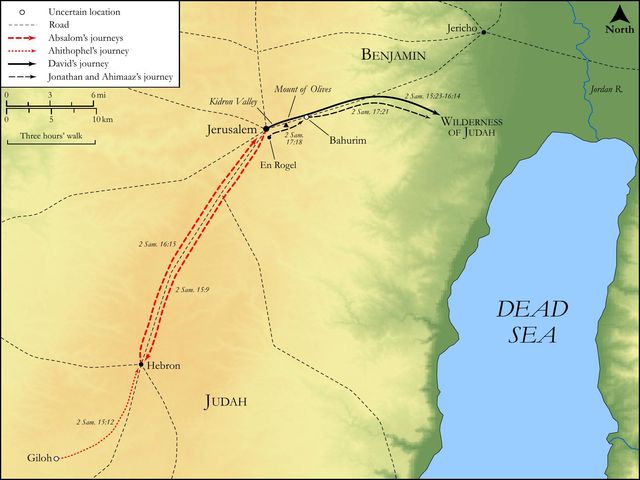
This sequence of actions emphasizes the swiftness and determination of Ahithophel's departure. He wasted no time, immediately leaving Absalom's court to return to his hometown, Giloh, as mentioned in 2 Samuel 15:12. This rapid retreat underscores his conviction that the rebellion was doomed and his own life was forfeit.
"and put his household in order"
This crucial detail reveals the premeditated nature of his suicide. Before taking his own life, Ahithophel meticulously arranged his domestic and financial affairs, ensuring his family would be cared for after his death. This act suggests a chilling rationality and control, even in the face of utter despair and impending self-destruction.
"and hanged himself, and died"
This is the stark and direct culmination of his actions. The method of death, hanging, is explicitly stated, leaving no doubt about the cause. It is a concise, unvarnished report of a self-inflicted end, emphasizing the finality of his choice and the tragic conclusion of his life.
"and was buried in the sepulchre of his father"
This final clause provides a sense of closure, noting that despite his betrayal and ignominious death, Ahithophel received a proper burial in his ancestral tomb. This detail might suggest a degree of respect from his family or community, or simply the fulfillment of a customary practice, even for a traitor, ensuring his place among his ancestors.
Literary Devices
ShowHideThe narrative of Ahithophel's demise is rich with literary devices that amplify its dramatic and theological impact. Irony is prominent, as Ahithophel, whose counsel was revered "as if one had inquired at the oracle of God" (2 Samuel 16:23), ultimately suffers death because his own counsel is rejected. This highlights the fallibility of even the most brilliant human wisdom when it opposes divine will. The rapid succession of verbs ("saddled," "arose," "gat him home," "put in order," "hanged," "died," "was buried") creates a sense of brevity and conciseness, emphasizing the swift and decisive nature of his final actions, almost like a summary judgment. Furthermore, the story employs foreshadowing and parallelism, particularly in its striking resemblance to the fate of Judas Iscariot, who also betrayed his master and died by hanging, suggesting a recurring biblical pattern regarding the consequences of betrayal and unrepentant pride.
Theological and Thematic Connections
ShowHideAhithophel's suicide serves as a profound theological statement on the limits of human wisdom and the absolute sovereignty of God. His downfall is not merely a consequence of rejected advice but a direct result of God's intervention to preserve David and thwart Absalom's rebellion. This narrative underscores the truth that God's purposes will prevail, even when confronted by the most astute human strategies or the most heinous acts of betrayal. It also highlights the destructive power of pride and the despair that can consume those who place their ultimate trust in their own intellect or power rather than in divine providence. Ahithophel's tragic end stands as a stark warning against aligning oneself against God's chosen, demonstrating that divine judgment can manifest even through the choices and actions of individuals.
Reflection and Application
ShowHideAhithophel's story offers sober lessons for contemporary believers. His tragic end reminds us of the profound danger of unchecked pride and the destructive consequences of allowing our self-worth to be tied solely to our perceived wisdom or success. When our plans are thwarted, or our counsel rejected, it can be tempting to succumb to despair, resentment, or even anger. However, Ahithophel's response—a complete surrender to self-destruction—serves as a powerful warning against such a path. Instead, we are called to cultivate humility, recognizing that true wisdom comes from God and that His plans, not ours, will ultimately prevail. His story also challenges us to examine our loyalties: are we truly serving God's purposes, or are we, like Ahithophel, driven by personal ambition and a willingness to betray for personal gain? Trusting in God's sovereignty, even when circumstances seem to defy our understanding or frustrate our best efforts, is essential for spiritual resilience and peace in a world where human plans often fail.
Questions for Reflection
ShowHideFAQ
ShowHideWhy was Ahithophel's counsel considered so valuable?
ShowHideAhithophel's counsel was renowned for its exceptional shrewdness and strategic brilliance. The Bible explicitly states that "the counsel of Ahithophel, which he counselled in those days, was as if a man had inquired at the oracle of God: so was all the counsel of Ahithophel both with David and with Absalom" (2 Samuel 16:23). This indicates that his advice was consistently accurate, insightful, and almost prophetic in its effectiveness, making him an invaluable asset to any ruler. His plan to immediately pursue David and his weary men was indeed the most strategically sound move for Absalom to secure his rebellion, as detailed in 2 Samuel 17:1-4.
Was Ahithophel's suicide an act of despair or a calculated decision?
ShowHideThe biblical account strongly suggests Ahithophel's suicide was a calculated and deliberate decision rather than an impulsive act of despair. The verse states he "put his household in order" (2 Samuel 17:23), which implies he meticulously settled his affairs and prepared his family for his impending death. This level of foresight and planning indicates a chilling composure and a clear understanding of the consequences of his rejected counsel. He likely recognized that with his advice disregarded, Absalom's rebellion was doomed, and David, upon his return to power, would undoubtedly execute him for his profound betrayal. His suicide was a way to choose his own end rather than face certain execution and disgrace.
What is the significance of Ahithophel being buried in his father's sepulchre?
ShowHideThe detail that Ahithophel "was buried in the sepulchre of his father" (2 Samuel 17:23) is significant. Despite his act of betrayal against King David and his ignominious death by suicide, he still received a proper burial in his family's ancestral tomb. In ancient Israel, burial was a crucial aspect of honoring the dead and ensuring their place among their ancestors. To be denied burial was a severe disgrace. This detail suggests that, despite his actions, his family or community still afforded him the customary respect of a proper burial, perhaps out of tradition or a desire to maintain family honor, even if his personal honor was lost. It provides a final, somewhat poignant, touch to his tragic end.
Christ-Centered Fulfillment
ShowHideThe tragic narrative of Ahithophel, particularly his betrayal of King David and his subsequent suicide, serves as a profound Old Testament foreshadowing of the ultimate betrayal of the Son of David, Jesus Christ. Ahithophel, a trusted counselor, turned against his king, just as Judas Iscariot, a trusted disciple, betrayed Jesus. Both acts of betrayal were motivated by complex factors, yet both led to the betrayer's self-inflicted death by hanging, as recorded in Matthew 27:5. This striking parallel highlights a consistent biblical pattern: the severe consequences of rejecting and betraying God's anointed. However, the contrast is even more significant. While Ahithophel's counsel was thwarted by divine intervention to save David, Jesus willingly laid down His life, allowing the betrayal to fulfill God's redemptive plan, as He Himself declared in John 10:18. The rejection of Ahithophel's counsel led to his despair and death, but the rejection of Jesus by humanity, culminating in His crucifixion, led not to despair but to the ultimate victory over sin and death through His resurrection (Romans 6:9-10). Ahithophel's story, therefore, underscores the depths of human depravity and the destructive power of pride and betrayal, while simultaneously pointing to the greater narrative of Christ's perfect faithfulness, His willingness to endure betrayal, and His ultimate triumph that secures eternal life for all who trust in Him, as He is the "author and perfecter of our faith" (Hebrews 12:2).