


2 Samuel 17:26
- וַיִּחַןvai·Yi·chanand it encampedH2583Conj-w ¦ V-Qal-ConsecImperf-3msVerb Qal Consecutive Imperfect 3rd Singular Masculineוַandיִּחַןit encamped
- יִשְׂרָאֵלYis·ra·'ElIsraelH3478N-properNoun Proper Location
- וְאַבְשָׁלֹםve·'av·sha·Lomand AbsalomH53Conj-w ¦ N-proper-mNoun Proper MasculineוְandאַבְשָׁלֹםAbsalom
- אֶרֶץ'E·retz[the] land ofH776N-fscNoun Singular Feminine Construct
- הַגִּלְעָדha·gil·'Ad<the> GileadH1568Art ¦ N-properNoun Proper Locationהַ<the>גִּלְעָדGilead
English is a literal word-by-word gloss of the Hebrew, not the KJV's wording. Why?
This is the original text the KJV's translators worked from — each Hebrew word with its own literal English meaning in this verse, prepared by scholars at Tyndale House, Cambridge. The KJV translates whole sentences, not word by word, so its wording differs: one Hebrew word can become several English words, and the KJV may choose “the LORD” where the gloss reads “Yahweh”. Both are faithful — they answer different questions. For the KJV's own rendering, switch to the KJV text.
Details
See on the biblical-era map

Study this verse
Public-domain commentary
Matthew Henry
From his Commentary on the Whole Bible. Henry comments on passages, not single verses — this entry covers 2 Samuel 17:22–29. His three-level outline is real structure in the source text, so it is rendered as structure.
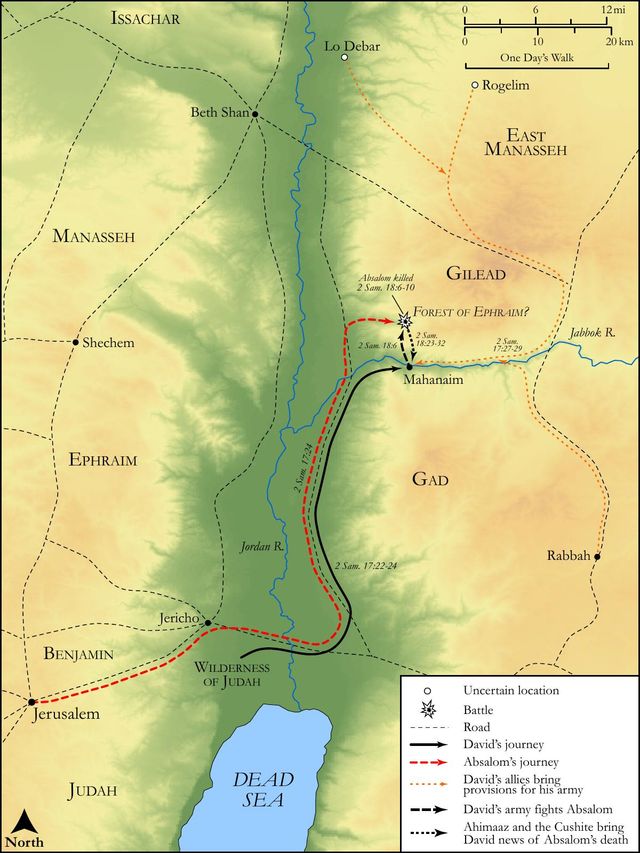
Here is, I. The transporting of David and his forces over Jordan, pursuant to the advice he had received from his friends at Jerusalem, Sa2 17:22. He, and all that were with him, went over in the night, whether in ferryboats, which probably always plied there, or through the fords, does not appear. But special notice is taken of this, that there lacked not one of them: none deserted him, though his distress was great, none staid behind sick or weary, nor were any lost or cast away in passing the river. Herein some make him a type of the Messiah, who said, in a difficult day, Of all that thou hast given me have I lost none. Having got over Jordan, he marched many miles forward to Mahanaim, a Levites' city in the tribe of Gad, in the utmost border of that tribe, and not far from Rabbah, the chief city of the Ammonites. This city, which Ishbosheth had made his royal city (Sa2 2:8), David now made his head-quarters, Sa2 17:24. And now he had time to raise an army wherewith to oppose the rebels and give them a warm reception.
II.The death of Ahithophel, Sa2 17:23.
He died by his own hands, felo de se - a suicide. He hanged himself for vexation that his counsel was not followed; for thereby,
1.He thought himself slighted, and an intolerable slur cast upon his reputation for wisdom. His judgment always used to sway at the counsel-board, but now another's opinion is thought wiser and better than his. His proud heart cannot bear the affront; it rises and swells, and the more he thinks of it the more violent his resentments grow, till they bring him at last to this desperate resolve not to live to see another preferred before him. All men think him a wise man, but he thinks himself the only wise man; and therefore to be avenged upon mankind for not thinking so too, he will die, that wisdom may die with him. The world is not worthy of such an oracle as he is, and therefore he will make them know the want of him. See what real enemies those are to themselves that think too well of themselves, and what mischiefs those run upon that are impatient of contempt. That will break a proud man's heart that will not break a humble man's sleep.
2.He thought himself endangered and his life exposed. He concluded that, because his counsel was not followed, Absalom's cause would certainly miscarry, and then, whoever would find David's mercy, he concluded that he, who was the greatest criminal, and had particularly advised him to lie with his father's concubines, must be sacrificed to justice. To prevent therefore the shame and terror of a public and solemn execution, he does justice upon himself, and, after his reputation for wisdom, by this last act puts a far greater disgrace upon himself than Absalom's privy-council had put upon him, and answers his name Ahithophel, which signifies, the brother of a fool. Nothing indicates so much folly as self-murder. Observe, How deliberately he did it, and of malice prepense against himself; not in a heat, but he went home to his city, to his house, to do it; and, which is strange, took time to consider of it, and yet did it. And, to prove himself compos mentis - in his senses, when he did it, he first put his household in order, made his will as a man of sane memory and understanding, settled his estate, balanced his accounts; yet he that had sense and prudence enough to do this had not consideration enough to revoke the sentence his pride and passion had passed upon his own neck, nor so much as to suspend the execution of it till he saw the event of Absalom's rebellion. Now herein we may see,
(1.)Contempt poured upon the wisdom of man. He that was more renowned for policy than any man played the fool with himself more abundantly. Let not the wise man glory in his wisdom, when he sees him that was so great an oracle dying as a fool dies.
(2.)Honour done to the justice of God. When the wicked are thus snared in the work of their own hands, and sunk in a pit of their own digging, the Lord is known by the judgment which he executeth, and we must say, Higgaion, Selah; it is a thing to be marked and meditated upon, Psa 7:15, Psa 7:16.
(3.)Prayer answered, and an honest cause served even by its enemies. Now, as David had prayed, Ahithophel's counsel was turned into foolishness to himself. Dr. Lightfoot supposes that David penned the 55th Psalm upon occasion of Ahithophel's being in the plot against him, and that he is the man complained of (Sa2 17:13) that had been his equal, his guide, and his acquaintance; and, if so, this was an immediate answer to his prayer there (Sa2 17:15): Let death seize upon them, and let them go down quickly into hell. Ahithophel's death was an advantage to David's interest; for had he digested that affront (as those must resolve often to do that will live in this world), and continued his post at Absalom's elbow, he might have given him counsel afterwards that might have been of pernicious consequence to David. It is well that that breath is stopped and that head laid from which nothing could be expected but mischief. It seems, it was not then usual to disgrace the dead bodies of self-murderers, for Ahithophel was buried, we may suppose honourably buried, in the sepulchre of his father, though he deserved no better than the burial of an ass. See Ecc 8:10.
III.Absalom's pursuit of his father.
He had now got all the men of Israel with him, as Hushai advised, and he himself, at the head of them, passed over Jordan, Sa2 17:24. Not content that he had driven his good father to the utmost corner of his kingdom, he resolved to chase him out of the world. He pitched in the land of Gilead with all his forces, ready to give David battle, Sa2 17:26. Absalom made one Amasa his general (Sa2 17:25), whose father was by birth Jether, an Ishmaelite (Ch1 2:17), but by religion Ithra (as he is here called), an Israelite; probably he was not only proselyted, but, having married a near relation of David's, was, by some act of the state, naturalized, and is therefore called an Israelite. His wife, Amasa's mother, was Abigail, David's sister, whose other sister, Zeruiah, was Joab's mother (Ch1 2:16), so that Amasa was in the same relation to David that Joab was. In honour to his family, even while he was in arms against his father, Absalom made him commander-in-chief of all his forces. Jesse is here called Nahash, for many had two names; or perhaps this was his wife's name.
IV.The friends David met with in this distant country.
Even Shobi, a younger brother of the royal family of the Ammonites, was kind to him, Sa2 17:27. It is probable that he had detested the indignity which his brother Hanun had done to David's ambassadors, and for that had received favours from David, which he now returned. Those that think their prosperity most confirmed know not but, some time or other, they may stand in need of the kindness of those that now lie at their mercy, and may be glad to be beholden to them, which is a reason why we should, as we have opportunity, do good to all men, for he that watereth shall be watered also himself, when there is occasion. Machir, the son of Ammiel, was he that maintained Mephibosheth (Sa2 9:4), till David eased him of that charge, and is now repaid for it by that generous man, who, it seems, was the common patron of distressed princes. Barzillai we shall hear of again. These, compassionating David and his men, now that they were weary with a long march, brought him furniture for his house, beds and basins, and provision for his table, wheat and barley, etc., Sa2 17:28, Sa2 17:29. He did not put them under contribution, did not compel them to supply him, much less plunder them; but in token of their dutiful affection to him, and their sincere concern for him in his present straits, of their own good will they brought in plenty of all that which he had occasion for. Let us learn hence to be generous and open-handed, according as our ability is, to all in distress, especially great men, to whom it is most grievous, and good men, who deserve better treatment; and see how God sometimes makes up to his people that comfort from strangers which they are disappointed of in their own families.
Continue studying 2 Samuel 17:26 across the web’s major study libraries — every link below opens this exact verse, chapter, or book on the destination site.
Read & Compare
 BibleGatewayThis verse in more than 200 translations and 70 languages.
 Bible.comThe YouVersion reader — hundreds of translations, reading plans, and highlights.
 ESV.orgCrossway's official English Standard Version reader.
 NET BibleThe NET translation with 60,000+ translators' notes on every rendering decision.
 STEP BibleTyndale House's free study tool — original text, vocabulary, and scholarly resources.
 BibliaLogos Bible Software's free web reader.
 USCCBThe New American Bible (Revised Edition) with the U.S. bishops' study notes.
Commentaries
 BibleHub CommentariesDozens of classic commentaries on this verse, gathered on one page.
 StudyLightMore than 100 commentary sets — the largest collection on the web.
 BibleRefPlain-English commentary on what this verse means, verse by verse.
 Enduring WordDavid Guzik's free commentary on this chapter, widely used by Bible teachers.
 Bible Study ToolsVerse commentary alongside Greek and Hebrew study aids.
Original Language & Research
- BibleHub InterlinearThe verse word by word — original language, transliteration, and English.
- BibleHub LexiconEvery word's original-language definition and Strong's entry.
 Blue Letter BibleDeep-study tools — Strong's numbers, concordance, and word studies.
 SefariaThe Hebrew text with Rashi and centuries of Jewish commentary.
Sermons, Hymns & Audio


TrulyRandomVerse is not affiliated with these sites and doesn’t control their content. They’re linked because they’re genuinely useful.
Summary
This verse marks a pivotal moment in Absalom's rebellion, confirming the strategic encampment of his forces, along with a significant portion of Israel, in the land of Gilead. This act of "pitching" camp signifies a deliberate and decisive pause following the acceptance of Hushai's divinely orchestrated counter-counsel, which successfully delayed an immediate pursuit of King David. The verse thus sets the stage for the climactic confrontation, highlighting God's sovereign hand in shaping the conflict and providing crucial time for David to prepare for the inevitable battle.
Context
ShowHideLiterary Context
This verse serves as the immediate culmination of the critical strategic debate detailed in 2 Samuel 17. Earlier in the chapter, Ahithophel, David's former trusted advisor who had defected to Absalom, proposed a swift and decisive pursuit of David, aiming for his immediate capture and death (2 Samuel 17:1-3). However, Hushai, David's loyal friend operating as a double agent within Absalom's camp, offered counter-counsel, advocating for a more comprehensive mobilization of all Israelite forces before engaging David (2 Samuel 17:7-13). Crucially, 2 Samuel 17:14 explicitly states that the Lord "had appointed to defeat the good counsel of Ahithophel, to the intent that the Lord might bring evil upon Absalom." This divine intervention led Absalom to accept Hushai's delayed strategy, granting David precious time to escape across the Jordan River to Mahanaim (2 Samuel 17:24). Verse 26 confirms Absalom's adherence to this delayed strategy, as his forces encamp in Gilead, directly preceding the decisive battle described in 2 Samuel 18.
Historical & Cultural Context
The setting is ancient Israel during the tumultuous period of the United Monarchy, specifically amidst a devastating civil war. Military campaigns in this era routinely involved armies "pitching" or encamping, a standard procedure for establishing a temporary base of operations. This allowed for troop rest, gathering of supplies, strategic planning, and preparation for impending battle or an extended stay. The act of pitching indicated a deliberate strategic halt rather than continuous movement. The "land of Gilead" was a geographically significant region located east of the Jordan River. Known for its rugged, often forested terrain, it served as both a natural barrier and a strategic refuge. For David, Mahanaim in Gilead became a sanctuary where he could regroup and rally loyalists. For Absalom, pitching camp in Gilead meant crossing the Jordan to confront David on his own ground, signaling a full and irreversible commitment to the conflict. Culturally, the widespread support of "Israel" for Absalom underscores the deep internal divisions within the kingdom, where tribal loyalties and political grievances could rapidly escalate into a full-scale rebellion against the anointed king.
Key Themes
ShowHideThis verse powerfully contributes to several overarching themes within the book of 2 Samuel. Firstly, it highlights Divine Providence and Intervention, demonstrating God's sovereign orchestration of human events, even through seemingly mundane decisions like accepting one piece of counsel over another, to achieve His ultimate purposes. Hushai's divinely inspired counsel directly led to this strategic delay, which ultimately saved David's life and secured his eventual victory. Secondly, it emphasizes the theme of the Consequences of Rebellion, showing how Absalom's ambition and pride led him to gather the nation against his own father, culminating in this direct confrontation. The act of "pitching" symbolizes the point of no return for Absalom's ill-fated coup. Thirdly, the verse underscores Strategic Preparation and Imminent Conflict. The encampment signifies the calm before the storm, a period of military readiness that directly foreshadows the bloody battle to come, where the fate of the monarchy would be decided. Finally, the mention of "Israel and Absalom" against David reinforces the painful reality of a Divided Kingdom, a civil war where the nation is tragically torn between two leaders.
Exposition and Analysis
ShowHideKey Word Analysis
ShowHideIn this context, "Israel" refers not merely to the geographical land but to the majority of the Israelite population and their tribal representatives who had declared allegiance to Absalom. This highlights the widespread nature of Absalom's rebellion, indicating that he commanded a significant portion of the nation's military strength and popular support, making this a true civil war rather than a localized uprising. It signifies a national division.
David's rebellious son, who had audaciously usurped the throne in Jerusalem. His name, meaning "father of peace," stands in stark ironic contrast to his actions, which brought war, division, and ultimately his own violent end. His presence alongside "Israel" signifies his direct leadership of the rebellious forces and his personal involvement in the military campaign against his father.
This verb means "to incline," "to decline," and by implication, "to pitch a tent" or "to encamp." In a military context, it specifically denotes the act of setting up a temporary military camp, indicating a strategic halt in movement. It implies a period of rest, organization, and preparation for an impending engagement or an extended stay. Here, it emphasizes the deliberate and decisive nature of Absalom's forces establishing their position in Gilead, signaling their readiness for the climactic battle.
Verse Breakdown
ShowHide"So Israel and Absalom"
This phrase identifies the two primary entities comprising the rebellious forces. "Absalom" is the charismatic figurehead and leader of the rebellion, while "Israel" represents the broad national support he had garnered. This indicates that a significant, representative portion of the Israelite tribes had aligned themselves with his cause against King David, underscoring the tragic reality of a nation deeply divided against itself.
"pitched"
This single word conveys the crucial action of the verse. It means they established their military camp. This was not a fleeting stop but a deliberate and strategic establishment of a base of operations. This act signifies a calculated pause, allowing for the consolidation of forces, detailed planning, and thorough preparation for the large-scale, decisive battle that was now inevitable. It directly follows Absalom's acceptance of Hushai's counsel to gather all Israel for battle, rather than Ahithophel's counsel for immediate pursuit.
"in the land of Gilead"
This specifies the precise geographical location of their encampment. Gilead, a rugged region situated east of the Jordan River, held significant strategic importance. It was defensible terrain and, crucially, the very region where King David and his loyalists had sought refuge in Mahanaim. By pitching camp here, Absalom's forces had crossed the Jordan, signaling their full commitment to confronting David on his chosen ground, thereby setting the stage for the final, bloody confrontation.
Literary Devices
ShowHideThe verse, though concise, employs several potent literary devices. Foreshadowing is prominently featured, as the act of "pitching" camp explicitly signals the imminent and unavoidable military confrontation between Absalom's forces and David's loyalists. It creates a palpable sense of the calm before the storm, building narrative tension towards the climax. There is also a strong element of Irony in the choice of location; Gilead, which had served as a place of refuge and safety for David, now becomes the staging ground for the very forces seeking to destroy him. This reversal of roles underscores the pervasive and destructive nature of the civil war. Furthermore, the simple declarative statement acts as a Narrative Fulcrum, marking the decisive transition from strategic planning and pursuit to direct military engagement, propelling the plot towards its violent and tragic climax. The mention of "Israel and Absalom" also serves as a form of Synecdoche, where "Israel" represents the majority of the nation's military and political will, now tragically aligned under Absalom's rebellious leadership.
Theological and Thematic Connections
ShowHideThis verse, seemingly a simple geographical and military update, is profoundly infused with theological significance. It stands as a powerful testament to God's sovereign control over human affairs, even amidst the chaos and tragedy of civil war. The strategic delay caused by Absalom's decision to accept Hushai's counsel, leading to this encampment, was explicitly stated in 2 Samuel 17:14 to be God's direct doing, designed to bring about Absalom's downfall and providentially preserve David. This demonstrates that human plans, no matter how cunning or powerful, are ultimately subject to the divine will. It powerfully reinforces the biblical truth that "The king's heart is in the hand of the Lord, like the rivers of water; He turns it wherever He wishes" (Proverbs 21:1). The encampment in Gilead, therefore, is not merely a military maneuver but a divinely orchestrated pause, providing David with crucial time to organize, gather resources, and prepare for the battle that would ultimately secure his throne and fulfill God's covenant promises.
Reflection and Application
ShowHideThe strategic pause and encampment described in 2 Samuel 17:26 offer profound and enduring lessons for our own lives. Just as God intervened to create a delay that ultimately benefited David, so too does He often work through seemingly ordinary circumstances, frustrating one plan and advancing another, to achieve His ultimate and perfect purposes for us. This verse encourages us to cultivate a posture of profound trust, recognizing that even in moments of intense conflict, uncertainty, or perceived setbacks, there may be divinely orchestrated "pauses" or "delays" that are not hindrances but rather opportunities for preparation, regrouping, spiritual growth, or even deliverance. It reminds us that God's timing is perfect, and His providence is actively at work even when we cannot fully discern its intricate movements. Furthermore, it underscores the grave consequences of rebellion against established authority, whether civil or spiritual, and the inevitable confrontation that arises when pride and unchecked ambition lead to division. We are called to discern God's hand in our circumstances, to prepare diligently for the spiritual battles we face, and to trust implicitly in His sovereign timing for our ultimate victory and flourishing.
Questions for Reflection
ShowHideFAQ
ShowHideWhy is "Israel" mentioned alongside Absalom, rather than just Absalom's army?
ShowHideThe mention of "Israel" alongside Absalom is crucial for highlighting the true nature of the conflict: it was a full-blown civil war, not merely a rebellion by a small, isolated faction. Absalom had successfully swayed the allegiance of the majority of the nation, or at least a significant and representative portion of the tribes, away from King David. This indicates the widespread popular support Absalom had garnered and the deep, painful division within the kingdom. It underscores the tragic reality that the nation itself was now fighting against its anointed king, making the impending battle a national crisis rather than a localized uprising. This national alignment under Absalom is further emphasized in 2 Samuel 17:11.
What was the strategic significance of Gilead for both Absalom and David?
ShowHideGilead, a rugged region east of the Jordan River, held immense strategic importance for both sides in this civil war. For David, it served as a vital refuge after fleeing Jerusalem. Mahanaim, a city in Gilead, had historical significance as a place of safety and was where David could gather loyalists, resources, and support from those who remained faithful to him (2 Samuel 17:24). For Absalom, pitching camp in Gilead meant crossing the Jordan, signifying his full commitment to pursuing David and confronting him on his chosen ground. It provided a suitable staging area for his large army, allowing them to consolidate and prepare for the decisive battle. Its challenging terrain also offered defensive advantages, making it a logical place for both armies to prepare for engagement.
How did this encampment ultimately benefit King David, despite being Absalom's move?
ShowHideThis encampment, a direct result of Absalom accepting Hushai's counsel, was a divinely orchestrated delay that proved absolutely crucial for David's survival and eventual victory. Ahithophel's original counsel was to pursue David immediately with a small, swift force, which likely would have led to David's swift capture and death (2 Samuel 17:1-3). However, by accepting Hushai's counter-counsel to gather a larger, more comprehensive army before attacking, Absalom inadvertently granted David precious time. During this delay, David was able to organize his loyalists, gather supplies, establish a command structure, and prepare his forces for the inevitable confrontation. This strategic pause, though initiated by Absalom, was God's providential hand at work, ensuring David's preparedness and ultimate triumph over his rebellious son, as explicitly stated in 2 Samuel 17:14.
Christ-Centered Fulfillment
ShowHideThe narrative of Absalom's rebellion, culminating in this strategic encampment in Gilead, offers profound foreshadowing of Christ's ultimate victory over rebellion and sin. Absalom's audacious usurpation of David's throne and his gathering of "Israel" against the anointed king mirrors humanity's pervasive rebellion against God's rightful reign. Just as David, the anointed king, was forced to flee and endure a period of exile across the Jordan, so too did Christ, the true King, enter into a world hostile to His reign, experiencing profound rejection and suffering (John 1:11). The divine intervention that frustrated Absalom's immediate pursuit and led to this strategic delay in Gilead powerfully points to God's sovereign plan for salvation. God's timing is always perfect, allowing for the full unfolding of His redemptive purposes. The ultimate "battle" is not fought with human armies but on the cross, where the Lamb of God, who takes away the sin of the world, offered Himself as the perfect sacrifice. Christ, through His death and resurrection, disarmed the spiritual forces of rebellion and darkness, triumphing over them decisively (Colossians 2:15). The victory secured by David, a type of Christ, in the face of overwhelming odds, points to the infinitely greater victory of Jesus, who through His suffering conquered death and the devil (Hebrews 2:14-15). Thus, 2 Samuel 17:26, with its focus on strategic positioning and divine timing in the face of rebellion, ultimately directs our gaze to the cross and empty tomb, where the true King secured eternal peace and victory for His people.