


2 Samuel 17:24
Bible text: King James Version (1769 Blayney text) · Public domain
Bible text: Berean Standard Bible · Public domain
Bible text: American Standard Version (1901) · Public domain
Bible text: World English Bible, Messianic edition · Public domain
Bible text: Geneva Bible (1599) · Public domain
Bible text: Young's Literal Translation · Public domain
- וְדָוִדve·da·Vidand DavidH1732Conj-w ¦ N-proper-mNoun Proper MasculineוְandדָוִדDavid
- בָּאba'he had goneH935V-Qal-Perf-3msVerb Qal Perfect 3rd Singular Masculine
- מַחֲנָיְמָהma·cha·Na·ye·mahMahanaim towardsH4266N-proper ¦ SfxNoun Proper LocationמַחֲנָיְמָMahanaimהtowards
- וְאַבְשָׁלֹםve·'av·sha·Lomand AbsalomH53Conj-w ¦ N-proper-mNoun Proper MasculineוְandאַבְשָׁלֹםAbsalom
- עָבַר'a·Varhe had passed overH5674V-Qal-Perf-3msVerb Qal Perfect 3rd Singular Masculine
- אֶת'et<obj.>H853DirObjMParticle Object Indicator
- הַיַּרְדֵּןhai·yar·Denthe JordanH3383Art ¦ N-properNoun Proper LocationהַtheיַּרְדֵּןJordan
- הוּאhu'heH1931Pro-3msPronoun Personal 3rd Singular Masculine
- וְכָלve·kholand everyH3605Conj-w ¦ N-mscNoun Singular Masculine Constructוְandכָלevery
- אִישׁ'ish<the> man ofH376N-mscNoun Singular Masculine Construct
- יִשְׂרָאֵלYis·ra·'ElIsraelH3478N-properNoun Proper Location
- עִמּוֹi·Mowith himH5973Prep ¦ 3msPreposition Definiteעִמּwithוֹhim
English is a literal word-by-word gloss of the Hebrew, not the KJV's wording. Why?
This is the original text the KJV's translators worked from — each Hebrew word with its own literal English meaning in this verse, prepared by scholars at Tyndale House, Cambridge. The KJV translates whole sentences, not word by word, so its wording differs: one Hebrew word can become several English words, and the KJV may choose “the LORD” where the gloss reads “Yahweh”. Both are faithful — they answer different questions. For the KJV's own rendering, switch to the KJV text.
Details
See on the biblical-era maps

Study this verse
Public-domain commentary
Matthew Henry
From his Commentary on the Whole Bible. Henry comments on passages, not single verses — this entry covers 2 Samuel 17:22–29. His three-level outline is real structure in the source text, so it is rendered as structure.
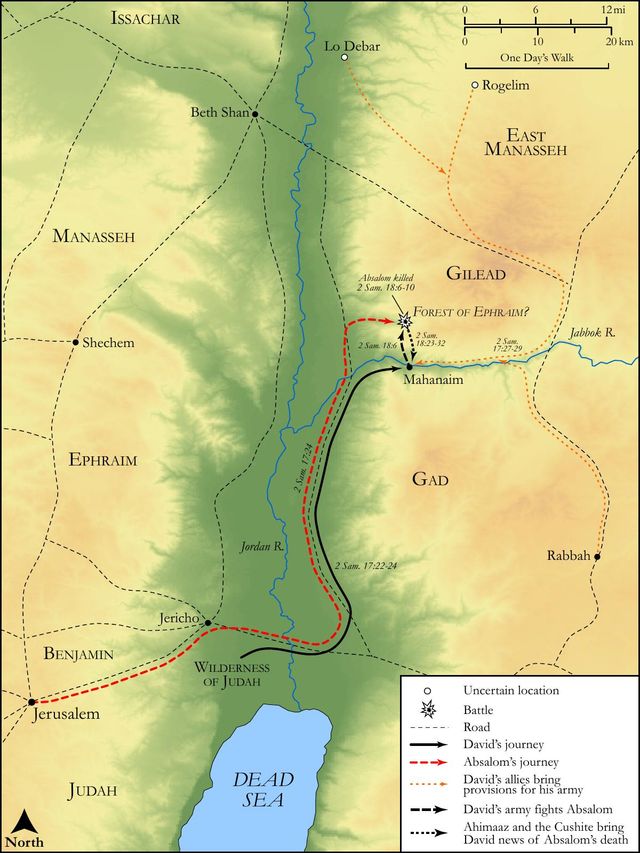
Here is, I. The transporting of David and his forces over Jordan, pursuant to the advice he had received from his friends at Jerusalem, Sa2 17:22. He, and all that were with him, went over in the night, whether in ferryboats, which probably always plied there, or through the fords, does not appear. But special notice is taken of this, that there lacked not one of them: none deserted him, though his distress was great, none staid behind sick or weary, nor were any lost or cast away in passing the river. Herein some make him a type of the Messiah, who said, in a difficult day, Of all that thou hast given me have I lost none. Having got over Jordan, he marched many miles forward to Mahanaim, a Levites' city in the tribe of Gad, in the utmost border of that tribe, and not far from Rabbah, the chief city of the Ammonites. This city, which Ishbosheth had made his royal city (Sa2 2:8), David now made his head-quarters, Sa2 17:24. And now he had time to raise an army wherewith to oppose the rebels and give them a warm reception.
II.The death of Ahithophel, Sa2 17:23.
He died by his own hands, felo de se - a suicide. He hanged himself for vexation that his counsel was not followed; for thereby,
1.He thought himself slighted, and an intolerable slur cast upon his reputation for wisdom. His judgment always used to sway at the counsel-board, but now another's opinion is thought wiser and better than his. His proud heart cannot bear the affront; it rises and swells, and the more he thinks of it the more violent his resentments grow, till they bring him at last to this desperate resolve not to live to see another preferred before him. All men think him a wise man, but he thinks himself the only wise man; and therefore to be avenged upon mankind for not thinking so too, he will die, that wisdom may die with him. The world is not worthy of such an oracle as he is, and therefore he will make them know the want of him. See what real enemies those are to themselves that think too well of themselves, and what mischiefs those run upon that are impatient of contempt. That will break a proud man's heart that will not break a humble man's sleep.
2.He thought himself endangered and his life exposed. He concluded that, because his counsel was not followed, Absalom's cause would certainly miscarry, and then, whoever would find David's mercy, he concluded that he, who was the greatest criminal, and had particularly advised him to lie with his father's concubines, must be sacrificed to justice. To prevent therefore the shame and terror of a public and solemn execution, he does justice upon himself, and, after his reputation for wisdom, by this last act puts a far greater disgrace upon himself than Absalom's privy-council had put upon him, and answers his name Ahithophel, which signifies, the brother of a fool. Nothing indicates so much folly as self-murder. Observe, How deliberately he did it, and of malice prepense against himself; not in a heat, but he went home to his city, to his house, to do it; and, which is strange, took time to consider of it, and yet did it. And, to prove himself compos mentis - in his senses, when he did it, he first put his household in order, made his will as a man of sane memory and understanding, settled his estate, balanced his accounts; yet he that had sense and prudence enough to do this had not consideration enough to revoke the sentence his pride and passion had passed upon his own neck, nor so much as to suspend the execution of it till he saw the event of Absalom's rebellion. Now herein we may see,
(1.)Contempt poured upon the wisdom of man. He that was more renowned for policy than any man played the fool with himself more abundantly. Let not the wise man glory in his wisdom, when he sees him that was so great an oracle dying as a fool dies.
(2.)Honour done to the justice of God. When the wicked are thus snared in the work of their own hands, and sunk in a pit of their own digging, the Lord is known by the judgment which he executeth, and we must say, Higgaion, Selah; it is a thing to be marked and meditated upon, Psa 7:15, Psa 7:16.
(3.)Prayer answered, and an honest cause served even by its enemies. Now, as David had prayed, Ahithophel's counsel was turned into foolishness to himself. Dr. Lightfoot supposes that David penned the 55th Psalm upon occasion of Ahithophel's being in the plot against him, and that he is the man complained of (Sa2 17:13) that had been his equal, his guide, and his acquaintance; and, if so, this was an immediate answer to his prayer there (Sa2 17:15): Let death seize upon them, and let them go down quickly into hell. Ahithophel's death was an advantage to David's interest; for had he digested that affront (as those must resolve often to do that will live in this world), and continued his post at Absalom's elbow, he might have given him counsel afterwards that might have been of pernicious consequence to David. It is well that that breath is stopped and that head laid from which nothing could be expected but mischief. It seems, it was not then usual to disgrace the dead bodies of self-murderers, for Ahithophel was buried, we may suppose honourably buried, in the sepulchre of his father, though he deserved no better than the burial of an ass. See Ecc 8:10.
III.Absalom's pursuit of his father.
He had now got all the men of Israel with him, as Hushai advised, and he himself, at the head of them, passed over Jordan, Sa2 17:24. Not content that he had driven his good father to the utmost corner of his kingdom, he resolved to chase him out of the world. He pitched in the land of Gilead with all his forces, ready to give David battle, Sa2 17:26. Absalom made one Amasa his general (Sa2 17:25), whose father was by birth Jether, an Ishmaelite (Ch1 2:17), but by religion Ithra (as he is here called), an Israelite; probably he was not only proselyted, but, having married a near relation of David's, was, by some act of the state, naturalized, and is therefore called an Israelite. His wife, Amasa's mother, was Abigail, David's sister, whose other sister, Zeruiah, was Joab's mother (Ch1 2:16), so that Amasa was in the same relation to David that Joab was. In honour to his family, even while he was in arms against his father, Absalom made him commander-in-chief of all his forces. Jesse is here called Nahash, for many had two names; or perhaps this was his wife's name.
IV.The friends David met with in this distant country.
Even Shobi, a younger brother of the royal family of the Ammonites, was kind to him, Sa2 17:27. It is probable that he had detested the indignity which his brother Hanun had done to David's ambassadors, and for that had received favours from David, which he now returned. Those that think their prosperity most confirmed know not but, some time or other, they may stand in need of the kindness of those that now lie at their mercy, and may be glad to be beholden to them, which is a reason why we should, as we have opportunity, do good to all men, for he that watereth shall be watered also himself, when there is occasion. Machir, the son of Ammiel, was he that maintained Mephibosheth (Sa2 9:4), till David eased him of that charge, and is now repaid for it by that generous man, who, it seems, was the common patron of distressed princes. Barzillai we shall hear of again. These, compassionating David and his men, now that they were weary with a long march, brought him furniture for his house, beds and basins, and provision for his table, wheat and barley, etc., Sa2 17:28, Sa2 17:29. He did not put them under contribution, did not compel them to supply him, much less plunder them; but in token of their dutiful affection to him, and their sincere concern for him in his present straits, of their own good will they brought in plenty of all that which he had occasion for. Let us learn hence to be generous and open-handed, according as our ability is, to all in distress, especially great men, to whom it is most grievous, and good men, who deserve better treatment; and see how God sometimes makes up to his people that comfort from strangers which they are disappointed of in their own families.
Continue studying 2 Samuel 17:24 across the web’s major study libraries — every link below opens this exact verse, chapter, or book on the destination site.
Read & Compare
 BibleGatewayThis verse in more than 200 translations and 70 languages.
 Bible.comThe YouVersion reader — hundreds of translations, reading plans, and highlights.
 ESV.orgCrossway's official English Standard Version reader.
 NET BibleThe NET translation with 60,000+ translators' notes on every rendering decision.
 STEP BibleTyndale House's free study tool — original text, vocabulary, and scholarly resources.
 BibliaLogos Bible Software's free web reader.
 USCCBThe New American Bible (Revised Edition) with the U.S. bishops' study notes.
Commentaries
 BibleHub CommentariesDozens of classic commentaries on this verse, gathered on one page.
 StudyLightMore than 100 commentary sets — the largest collection on the web.
 BibleRefPlain-English commentary on what this verse means, verse by verse.
 Enduring WordDavid Guzik's free commentary on this chapter, widely used by Bible teachers.
 Bible Study ToolsVerse commentary alongside Greek and Hebrew study aids.
Original Language & Research
- BibleHub InterlinearThe verse word by word — original language, transliteration, and English.
- BibleHub LexiconEvery word's original-language definition and Strong's entry.
 Blue Letter BibleDeep-study tools — Strong's numbers, concordance, and word studies.
 SefariaThe Hebrew text with Rashi and centuries of Jewish commentary.
Sermons, Hymns & Audio


TrulyRandomVerse is not affiliated with these sites and doesn’t control their content. They’re linked because they’re genuinely useful.
Summary
2 Samuel 17:24 marks a critical juncture in Absalom's rebellion, detailing the strategic movements of both King David and his rebellious son. David, having gained precious time through the divinely orchestrated counter-counsel of Hushai, successfully reached the fortified city of Mahanaim, located east of the Jordan River. Simultaneously, Absalom, having consolidated his power in Jerusalem and gathered a vast army, led the forces of Israel across the Jordan in determined pursuit, thereby setting the stage for the inevitable and tragic confrontation that would decide the fate of the kingdom.
Context
ShowHideLiterary Context
This verse immediately follows the dramatic council scene in 2 Samuel 17, where Hushai's divinely inspired counter-counsel successfully thwarted Ahithophel's shrewd but ultimately destructive advice. Ahithophel, realizing his counsel was rejected and foreseeing the rebellion's failure, tragically committed suicide, as recorded in 2 Samuel 17:23. Hushai's counsel, which advocated for a delay to gather a larger army, was accepted by Absalom because "the Lord had purposed to defeat the good counsel of Ahithophel, so that the Lord might bring disaster on Absalom" (2 Samuel 17:14). This crucial delay provided David with the critical window of opportunity to escape Jerusalem and establish a defensive position. Following this verse, 2 Samuel 17:25-26 introduces Amasa as Absalom's new commander, and 2 Samuel 17:27-29 details the loyal supporters who brought essential provisions to David in Mahanaim, highlighting the intensive preparation for the impending battle described in 2 Samuel 18.
Historical & Cultural Context
David's flight from Jerusalem (2 Samuel 15:14) was a desperate and strategic measure, undertaken to avoid bloodshed within his capital. His destination, Mahanaim, was of immense strategic significance. Located in Gilead, east of the Jordan River, it offered a natural defensive advantage due to the river barrier and the rugged terrain of the Transjordan region. Historically, Mahanaim was a place of refuge and divine encounter, famously associated with Jacob's vision of angels (Genesis 32:2). For David, this location likely offered not only physical security but also deep spiritual comfort and a sense of divine protection. Absalom's crossing of the Jordan signified a full and irreversible commitment to the pursuit, removing the last major geographical barrier between the two forces and indicating that a decisive battle was imminent. The phrase "all the men of Israel" following Absalom underscores the tragic reality of a kingdom deeply divided by civil war, with a significant portion of the nation siding with the usurper.
Key Themes
ShowHideThis verse vividly illustrates several key themes within the broader narrative of 2 Samuel. Firstly, Divine Providence Amidst Crisis is paramount; the Lord's direct intervention through Hushai's counsel (2 Samuel 17:14) directly facilitated David's escape and preparation, demonstrating God's sovereign hand guiding events even when His anointed king is in dire straits. Secondly, Strategic Movement and Preparation highlights David's wisdom and resilience in seeking a defensible position and gathering resources, contrasting sharply with Absalom's impulsive and overconfident pursuit. David's arrival in Mahanaim, a place of historical divine encounters, reinforces the idea of God's protective presence and blessing upon his chosen king. Thirdly, the verse underscores the Tragic Reality and Devastating Cost of Civil War. The phrase "all the men of Israel with him" following Absalom starkly depicts the deep schism within the nation, setting the stage for a fratricidal conflict that would bring immense sorrow and loss, particularly for David, as seen in his profound lament over Absalom's death in 2 Samuel 18:33.
Exposition and Analysis
ShowHideKey Word Analysis
ShowHideThis name literally means "two camps" or "two companies." Its significance dates back to Jacob's encounter with angels there, where he declared, "This is God's host" (Genesis 32:2). For David, arriving at a place with such a name, especially when fleeing from a vast opposing army, would have carried profound symbolic weight, perhaps offering a sense of divine presence and reassurance that God's "camps" were with him, even as he faced the "camps" of his rebellious son. It suggests a place of divine protection and strategic refuge, implying that David was not alone but divinely guarded.
The Jordan River served as a significant geographical and symbolic barrier in ancient Israel, often marking a decisive point in narratives, as seen with Israel entering the Promised Land (Joshua 3:17). For Absalom, crossing the Jordan signified a point of no return, a full commitment to confront David directly and eliminate the last natural obstacle to his pursuit. It marked the transition from strategic maneuvering to imminent, decisive battle, indicating his unwavering resolve to usurp the throne.
Verse Breakdown
ShowHide"Then David came to Mahanaim."
This clause emphasizes David's successful and strategic retreat. Following the crucial delay secured by Hushai's counsel, David was able to put significant distance between himself and Absalom's forces. His arrival in Mahanaim signifies a secure, prepared position, allowing him to gather loyalists, assess the situation, and ready his forces for the inevitable confrontation. This movement is not merely a flight but a deliberate re-establishment of his base, demonstrating his resilience, strategic acumen, and reliance on divine aid.
"And Absalom passed over Jordan, he and all the men of Israel with him."
This clause highlights Absalom's determined pursuit and the widespread nature of the rebellion against David. His crossing of the Jordan River symbolizes his full commitment to overthrowing his father, removing the last major geographical barrier and signaling the imminence of a decisive conflict. The phrase "all the men of Israel" (or a significant portion representing the nation's military might) underscores the tragic division within the kingdom and the immense popular support Absalom initially garnered, setting the stage for a devastating internal conflict.
Literary Devices
ShowHideThe verse effectively employs Juxtaposition to highlight the opposing movements and states of David and Absalom. David's arrival at a place of refuge and preparation (Mahanaim) is set against Absalom's aggressive pursuit and crossing of a significant geographical barrier (the Jordan River). This contrast emphasizes David's defensive posture and Absalom's offensive determination, underscoring the shift from flight to impending confrontation. Symbolism is also profoundly present: Mahanaim, with its historical association with divine camps and angelic encounters, symbolizes God's protective presence and refuge for David, while the Jordan River symbolizes a point of no return and the final, irrevocable commitment to conflict. The verse also serves as a strong element of Foreshadowing, clearly indicating that the decisive and tragic battle between father and son is now imminent and unavoidable, preparing the reader for the climax in the subsequent chapter.
Theological and Thematic Connections
ShowHide2 Samuel 17:24 powerfully illustrates the interplay of divine sovereignty and human agency amidst profound crisis. Even as David is forced to flee his throne and kingdom by his own son, God's hand is evident in orchestrating circumstances—like the successful counsel of Hushai—to provide David with a strategic refuge and time to prepare. This narrative reminds us that God's purposes are not thwarted by human rebellion or betrayal, but rather, He works through and even within such turmoil to uphold His covenant and protect His anointed. The tragic division within Israel, with "all the men of Israel" following Absalom, underscores the devastating consequences of sin and rebellion, particularly within the very fabric of God's chosen nation. Yet, David's journey to Mahanaim, a place of historical divine encounter, serves as a testament to God's enduring faithfulness to His promises, even when His people are in the crucible of suffering and seemingly abandoned.
Reflection and Application
ShowHideIn times of profound adversity, betrayal, or when facing overwhelming opposition, 2 Samuel 17:24 offers profound spiritual lessons. David's forced retreat to Mahanaim is not a sign of defeat but a strategic, divinely enabled movement towards ultimate deliverance. It teaches us the wisdom of seeking refuge, not merely physically, but spiritually—finding our "Mahanaim" in God's presence and promises when the world seems to be against us. Just as God worked through Hushai to give David time, we are reminded that divine intervention often operates through seemingly ordinary circumstances or the wise counsel of others, providing us with the grace and time needed to prepare for challenges. This verse encourages us to trust in God's sovereign hand, even when circumstances are chaotic and uncertain, knowing that He can provide a safe haven and ultimately bring about His purposes, even through the crucible of suffering. It challenges us to prepare ourselves, not just physically, but spiritually, for the battles we face, resting in the assurance that God is our ultimate stronghold and refuge.
Questions for Reflection
ShowHideFAQ
ShowHideWhy was Mahanaim a significant choice for David's refuge?
ShowHideMahanaim was significant for several reasons. Geographically, it was located east of the Jordan River, providing a natural barrier against Absalom's forces and offering a more defensible position in the rugged terrain of Gilead. Historically, it was known as the place where Jacob encountered angels and named it "Mahanaim," meaning "two camps" or "two companies" (Genesis 32:2). This historical association likely offered David spiritual comfort and a profound sense of divine presence and protection during his desperate flight. Furthermore, Mahanaim was likely a place where David had existing loyalists and support, allowing him to gather provisions and prepare his forces, as indicated by the support he received from Shobi, Machir, and Barzillai in 2 Samuel 17:27-29.
What was the immediate consequence of Absalom crossing the Jordan?
ShowHideAbsalom's crossing of the Jordan River was a decisive act that removed the last major geographical barrier between his forces and David's. Its immediate consequence was the direct and inevitable confrontation that followed. By crossing the Jordan, Absalom signaled his full commitment to pursuing David and engaging him in battle, leaving no room for negotiation or retreat. This action led directly to the climactic battle in the forest of Ephraim, where Absalom's forces were decisively defeated and Absalom himself met his tragic end, as detailed in 2 Samuel 18:6-15.
Christ-Centered Fulfillment
ShowHideThe narrative of David's flight to Mahanaim and Absalom's determined pursuit, as encapsulated in 2 Samuel 17:24, profoundly foreshadows aspects of Christ's life and ultimate triumph. David, the anointed king, is rejected and pursued by his own people, echoing how Jesus "came to his own, and his own people did not receive him" (John 1:11). David's reliance on divine counsel through Hushai, which ultimately saved him, points to Christ as the ultimate wisdom of God, through whom all divine purposes are accomplished (1 Corinthians 1:24). Mahanaim, a place of refuge and divine presence for David, symbolizes Christ Himself as our ultimate refuge and stronghold, a safe haven in times of trouble where God's "camps" are with us (Psalm 46:1; Hebrews 6:18). Absalom's rebellion, though seemingly successful for a time, ultimately collapses, demonstrating the futility of any rebellion against God's anointed king. This prefigures the final and complete triumph of Christ over all His enemies, whose kingdom is eternal and unshakable (Psalm 2:1-6; Revelation 19:11-16). Just as David, despite his suffering, was restored to his throne, Christ, through His suffering, death, and resurrection, is eternally enthroned as King of kings and Lord of lords, establishing a kingdom that will never end (Philippians 2:9-11).