


2 Samuel 15:14
Bible text: King James Version (1769 Blayney text) · Public domain
Bible text: King James Version with Strong's numbers · Public domain
Bible text: Berean Standard Bible · Public domain
Bible text: American Standard Version (1901) · Public domain
Bible text: World English Bible, Messianic edition · Public domain
Bible text: Geneva Bible (1599) · Public domain
Bible text: Young's Literal Translation · Public domain
- וַיֹּאמֶרvai·Yo·merand he saidH559Conj-w ¦ V-Qal-ConsecImperf-3msVerb Qal Consecutive Imperfect 3rd Singular Masculineוַandיֹּאמֶרhe said
- דָּוִדDa·vidDavidH1732N-proper-mNoun Proper Masculine
- לְכָלle·kholto allH3605Prep-l ¦ N-mscNoun Singular Masculine Constructלְtoכָלall
- עֲבָדָיו'a·va·Davhis servantsH5650N-mpc ¦ 3msNoun Plural Masculine Constructעֲבָדָיservantsוhis
- אֲשֶׁר'a·SherwhoH834RelParticle Relative
- אִתּוֹ'i·To[were] with himH854Prep ¦ 3msPreposition Definiteאִתּ[were] withוֹhim
- בִירוּשָׁלִַםvi·ru·sha·Limin JerusalemH3389Prep-b ¦ N-properNoun Proper LocationבִinירוּשָׁלִַםJerusalem
- קוּמוּKu·muariseH6965V-Qal-Imp-2mpVerb Qal Imperative 2nd Plural Masculine
- וְנִבְרָחָהve·niv·Ra·chahso let us fleeH1272Conj-w ¦ V-Qal-Imperf-1cpVerb Qal Imperfect 1st Plural common genderוְsoנִבְרָחָהlet us flee
- כִּיkiforH3588PrtParticle Conditional
- לֹאlo'notH3808NegParticle Negative
- תִהְיֶהtih·yehit will belongH1961V-Qal-Imperf-3fsVerb Qal Imperfect 3rd Singular Feminine
- לָּנוּLa·nuto <the> usPrep-l ¦ 1cpSuffix Personal 1st Plural common genderלָּto <the>נוּus
- פְלֵיטָהfe·lei·Tahan escapeH6413N-fsNoun Singular Feminine Absolute
- מִפְּנֵיmi·pe·Neifrom beforeH6440Prep-m ¦ N-mpcNoun Plural Masculine Constructמִfromפְּנֵיbefore
- אַבְשָׁלוֹם'av·sha·LomAbsalomH53N-proper-mNoun Proper Masculine
- מַהֲרוּma·ha·RuhurryH4116V-Piel-Imp-2mpVerb Piel Imperative 2nd Plural Masculine
- לָלֶכֶתla·Le·khetto goH1980Prep-l ¦ V-Qal-InfVerb Qal Infinitive Constructלָtoלֶכֶתgo
- פֶּןpenlestH6435PrtParticle Conditional
- יְמַהֵרye·ma·Herhe should hurryH4116V-Piel-Imperf-3msVerb Piel Imperfect 3rd Singular Masculine
- וְהִשִּׂגָנוּve·hi·si·Ga·nuand he will overtake usH5381Conj-w ¦ V-Hiphil-ConsecPerf-3ms ¦ 1cpVerb Hiphil Consecutive Perfect 3rd Singular Masculineוְandהִשִּׂגָhe will overtakeנוּus
- וְהִדִּיחַve·hi·Di·achand he will thrustH5080Conj-w ¦ V-Hiphil-ConsecPerf-3msVerb Hiphil Consecutive Perfect 3rd Singular Masculineוְandהִדִּיחַhe will thrust
- עָלֵינוּ'a·Lei·nuon usH5921Prep ¦ 1cpPreposition Definiteעָלֵיonנוּus
- אֶת'et<obj.>H853DirObjMParticle Object Indicator
- הָרָעָהha·ra·'Ah<the> calamityH7451Art ¦ N-fsNoun Singular Feminine Absoluteהָ<the>רָעָהcalamity
- וְהִכָּהve·hi·Kahand he will strikeH5221Conj-w ¦ V-Hiphil-ConsecPerf-3msVerb Hiphil Consecutive Perfect 3rd Singular Masculineוְandהִכָּהhe will strike
- הָעִירha·'Irthe cityH5892Art ¦ N-fsNoun Singular Feminine Absoluteהָtheעִירcity
- לְפִיle·fito [the] mouth ofH6310Prep-l ¦ N-mscNoun Singular Masculine Constructלְtoפִי[the] mouth of
- חָרֶבCha·rev[the] swordH2719N-fsNoun Singular Feminine Absolute
English is a literal word-by-word gloss of the Hebrew, not the KJV's wording. Why?
This is the original text the KJV's translators worked from — each Hebrew word with its own literal English meaning in this verse, prepared by scholars at Tyndale House, Cambridge. The KJV translates whole sentences, not word by word, so its wording differs: one Hebrew word can become several English words, and the KJV may choose “the LORD” where the gloss reads “Yahweh”. Both are faithful — they answer different questions. For the KJV's own rendering, switch to the KJV text.
Details
See on the biblical-era maps

Study this verse
Public-domain commentary
Matthew Henry
From his Commentary on the Whole Bible. Henry comments on passages, not single verses — this entry covers 2 Samuel 15:13–23. His three-level outline is real structure in the source text, so it is rendered as structure.
Here is, I. The notice brought to David of Absalom's rebellion, Sa2 15:13. The matter was bad enough, and yet it seems to have been made worse to him (as such things commonly are) than really it was; for he was told that the hearts of the men of Israel (that is, the generality of them, at least the leading men) were after Absalom. But David was the more apt to believe it because now he could call to mind the arts that Absalom had used to inveigle them, and perhaps reflected upon it with regret that he had not done more to counterwork him, and secure his own interest, which he had been too confident of. Note, It is the wisdom of princes to make sure of their subjects; for, if they have them, they have their purses, and arms, and all, at their service.
II.The alarm this gave to David, and the resolutions he came to thereupon.
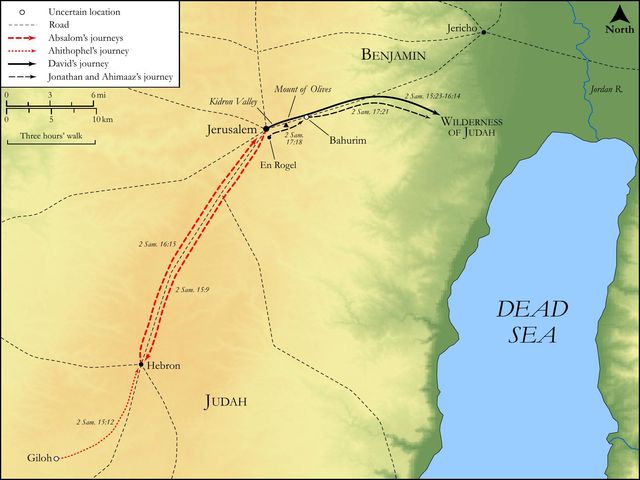
We may well imagine him in a manner thunderstruck, when he heard that the son he loved so dearly, and had been so indulgent to, was so unnaturally and ungratefully in arms against him. Well might he say with Caesar, Kai su teknon - What, thou my son? Let not parents raise their hopes too high from their children, lest they be disappointed. David did not call a council, but, consulting only with God and his own heart, determined immediately to quit Jerusalem, Sa2 15:14. He took up this strange resolve, so disagreeable to his character as a man of courage, either,
1.As a penitent, submitting to the rod, and lying down under God's correcting hand. Conscience now reminded him of his sin in the matter of Uriah, and the sentence he was under for it, which was that evil should arise against him out of his own house. "Now," thinks he, "the word of God begins to be fulfilled, and it is not for me to contend with it or fight against it; God is righteous and I submit." Before unrighteous Absalom he could justify himself and stand it out; but before the righteous God he must condemn himself and yield to his judgments. Thus he accepts the punishment of his iniquity. Or,
2.As a politician. Jerusalem was a great city, but not tenable; it should seem, by David's prayer (Psa 51:18), that the walls of it were not built up, much less was it regularly fortified. It was too large to be garrisoned by so small a force as David had now with him, He had reason to fear that the generality of the inhabitants were too well affected to Absalom to be true to him. Should he fortify himself here, he might lose the country, in which, especially among those that lay furthest from Absalom's tampering, he hoped to have the most friends. And he had such a kindness for Jerusalem that he was loth to make it the seat of war, and expose it to the calamities of a siege; he will rather quit it tamely to the rebels. Note, Good men, when they suffer themselves, care not how few are involved with them in suffering.
III.His hasty flight from Jerusalem.
His servants agreed to the measures he took, faithfully adhered to him (Sa2 15:15), and assured him of their inviolable allegiance, whereupon,
1.He went out of Jerusalem himself on foot, while his son Absalom had chariots and horses. It is not always the best man, nor the best cause, that makes the best figure. See here, not only the servant, but the traitor, on horseback, while the prince, the rightful prince, walks as a servant upon the earth, Ecc 10:7. Thus he chose to do, to abase himself so much the more under God's hand, and in condescension to his friends and followers, with whom he would walk, in token that he would live and die with them.
2.He took his household with him, his wives and children, that he might protect them in this day of danger, and that they might be a comfort to him in this day of grief. Masters of families, in their greatest frights, must not neglect their households. Ten women, that were concubines, he left behind, to keep the house, thinking that the weakness of their sex would secure them from murder, and their age and relation to him would secure them from rape; but God overruled this for the fulfilling of his word.
3.He took his life-guard with him, or band of pensioners, the Cherethites and Pelethites, who were under the command of Benaiah, and the Gittites, who were under the command of Ittai, Sa2 15:18. These Gittites seem to have been, by birth, Philistines of Gath, who came, a regiment of them, 600 in all, to enter themselves in David's service, having known him at Gath, and being greatly in love with him for his virtue and piety, and having embraced the Jews' religion. David made them of his garde du corps - his body-guard, and they adhered to him in his distress. The Son of David found not such great faith in Israel as in a Roman centurion and a woman of Canaan.
4.As many as would, of the people of Jerusalem, he took with him, and made a halt at some distance from the city, to draw them up, Sa2 15:17. He compelled none. Those whose hearts were with Absalom, to Absalom let them go, and so shall their doom be: they will soon have enough of him. Christ enlists none but volunteers.
IV.His discourse with Ittai the Gittite, who commanded the Philistine-proselytes.
1.David dissuaded him from going along with him, Sa2 15:19, Sa2 15:20. Though he and his men might be greatly serviceable to him yet,
(1.)He would try whether he was hearty for him, and not inclined to Absalom. He therefore bids him return to his post in Jerusalem, and serve the new king. If he was no more than a soldier of fortune (as we say), he would be for that side which would pay and prefer him best; and to that side let him go.
(2.)If he was faithful to David, yet David would not have him exposed to the fatigues and perils he now counted upon. David's tender spirit cannot bear to think that a stranger and an exile, a proselyte and a new convert, who ought, by all means possible, to be encouraged and made easy, should, at his first coming, meet with such hard usage: "Should I make thee go up and down with us? No, return with thy brethren." Generous souls are more concerned at the share others have in their troubles than at their own. Ittai shall therefore be dismissed with a blessing: Mercy and truth be with thee, that is, God's mercy and truth, mercy according to promise, the promise made to those who renounce other gods and put themselves under the wings off the divine Majesty. This is a very proper pious farewell, when we part with a friend, "Mercy and truth be with thee, and then thou art safe, and mayest be easy, wherever thou art." David's dependence was upon the mercy and truth of God for comfort and happiness, both for himself and his friends; see Psa 61:7.
2.Ittai bravely resolved not to leave him, Sa2 15:21. Where David is, whether in life or death, safe or in peril, there will this faithful friend of his be; and he confirms this resolution with an oath, that he might not be tempted to break it. Such a value has he for David, not for the sake of his wealth and greatness (for then he would have deserted him now that he saw him thus reduced), but for the sake of his wisdom and goodness, which were still the same, that, whatever comes of it, he will never leave him. Note, That is a friend indeed who loves at all times, and will adhere to us in adversity. Thus should we cleave to the Son of David with full purpose of heart that neither life nor death shall separate us from his love.
V.The common people's sympathy with David in his affliction.
When he and his attendants passed over the brook Kidron (the very same brook that Christ passed over when he entered upon his sufferings, Joh 18:1), towards the way of the wilderness, which lay between Jerusalem and Jericho, all the country wept with a loud voice, Sa2 15:23. Cause enough there was for weeping,
1.To see a prince thus reduced, one that had lived so great forced from his palace and in fear of his life, with a small retinue seeking shelter in a desert, to see the city of David, which he himself won, built, and fortified, made an unsafe abode for David himself. It would move the compassion even of strangers to see a man fallen thus low from such a height, and this by the wickedness of his own son; a piteous case it was. Parents that are abused and ruined by their own children merit the tender sympathy of their friends as much as any of the sons or daughters of affliction. Especially,
2.To see their own prince thus wronged, who had been so great a blessing to their land, and had not done any thing to forfeit the affections of his people; to see him in this distress, and themselves unable to help him, might well draw floods of tears from their eyes.
Continue studying 2 Samuel 15:14 across the web’s major study libraries — every link below opens this exact verse, chapter, or book on the destination site.
Read & Compare
 BibleGatewayThis verse in more than 200 translations and 70 languages.
 Bible.comThe YouVersion reader — hundreds of translations, reading plans, and highlights.
 ESV.orgCrossway's official English Standard Version reader.
 NET BibleThe NET translation with 60,000+ translators' notes on every rendering decision.
 STEP BibleTyndale House's free study tool — original text, vocabulary, and scholarly resources.
 BibliaLogos Bible Software's free web reader.
 USCCBThe New American Bible (Revised Edition) with the U.S. bishops' study notes.
Commentaries
 BibleHub CommentariesDozens of classic commentaries on this verse, gathered on one page.
 StudyLightMore than 100 commentary sets — the largest collection on the web.
 BibleRefPlain-English commentary on what this verse means, verse by verse.
 Enduring WordDavid Guzik's free commentary on this chapter, widely used by Bible teachers.
 Bible Study ToolsVerse commentary alongside Greek and Hebrew study aids.
Original Language & Research
- BibleHub InterlinearThe verse word by word — original language, transliteration, and English.
- BibleHub LexiconEvery word's original-language definition and Strong's entry.
 Blue Letter BibleDeep-study tools — Strong's numbers, concordance, and word studies.
 SefariaThe Hebrew text with Rashi and centuries of Jewish commentary.
Sermons, Hymns & Audio


TrulyRandomVerse is not affiliated with these sites and doesn’t control their content. They’re linked because they’re genuinely useful.
Summary
2 Samuel 15:14 records King David's urgent and pivotal command to his loyal retinue in Jerusalem: to immediately evacuate the city and flee from the rapidly advancing forces of his rebellious son, Absalom. This desperate directive was not an act of cowardice but a strategic and deeply compassionate decision aimed at averting a devastating civil war within the capital, which would inevitably lead to widespread bloodshed, the indiscriminate slaughter of its inhabitants, and the utter destruction of Jerusalem itself. David's profound concern for the lives of his people and the sanctity of the holy city superseded any personal pride or desire to defend his throne by force, powerfully highlighting his leadership in a moment of profound crisis, personal betrayal, and divine judgment.
Context
ShowHideLiterary Context
This verse marks a critical turning point in the narrative of Absalom's rebellion, which forms the dramatic core of the latter half of the book of 2 Samuel. Immediately preceding this command, Absalom has meticulously orchestrated a long-term conspiracy, subtly winning the hearts of the people and undermining David's authority over several years, as detailed in 2 Samuel 15:1-6. His coup culminates in a swift and unexpected move to Hebron, where he publicly declares himself king, gaining significant popular support (see 2 Samuel 15:7-12). The dire news of Absalom's successful seizure of power and the widespread defection of the people reaches David in Jerusalem in 2 Samuel 15:13. David's command in 2 Samuel 15:14 is his immediate, crisis-driven response, setting in motion his flight from Jerusalem, the strategic return of the Ark of the Covenant, and the deployment of loyalists like Hushai to counter Absalom's plans. This forced exodus marks a significant downturn in David's reign, bringing to fruition the prophetic judgment pronounced by Nathan.
Historical & Cultural Context
David's reign, with Jerusalem as its established capital, was a period of national consolidation and prosperity, yet it was also marked by deep internal strife and the painful consequences of his personal sins. Among the kings of that day, the king's presence in the capital was paramount for maintaining stability, legitimacy, and the perception of divine favor. A king fleeing his capital was an extraordinary and profoundly humiliating event, signifying a catastrophic loss of control and a severe blow to his authority. Absalom's rebellion was not merely a political challenge but a deeply personal and familial betrayal, reflecting the turbulent and often violent nature of succession and power dynamics in that era. The phrase "smite the city with the edge of the sword" (KJV) or "put the city to the sword" (modern translations) is a common biblical idiom signifying total annihilation, often associated with the brutal realities of ancient warfare, where entire populations could be massacred if a city resisted capture. David's decision reflects a keen understanding of these brutal realities and a compassionate desire to spare his people from such an horrific fate, demonstrating a kingly responsibility that transcended his own immediate political survival.
Key Themes
ShowHide2 Samuel 15:14 powerfully illustrates several profound biblical themes. Firstly, it highlights leadership in crisis, demonstrating David's difficult but ultimately compassionate choice to prioritize the lives of his people and the preservation of Jerusalem over his own pride or the immediate defense of his throne. This decision reveals a shepherd's heart, echoing the divine concern for humanity. Secondly, it underscores the consequences of sin, particularly serving as a painful fulfillment of Nathan's prophecy in 2 Samuel 12:11, where "evil" would indeed rise against David from within his own household. David's flight is a bitter fruit of his past transgressions, forcing him to confront the painful reality of divine judgment and the ripple effects of his actions. Thirdly, the verse subtly points to divine sovereignty even amidst human chaos and betrayal. While the situation appears disastrous and out of control, the unfolding narrative reveals God's continued working in David's life, ultimately leading to restoration, albeit through significant suffering and a period of profound vulnerability. Finally, the theme of preservation of life is paramount, as David's primary concern is to avoid the "smite the city with the edge of the sword," showcasing a deep, almost paternal, care for his flock.
Exposition and Analysis
ShowHideKey Word Analysis
ShowHideThis primitive root (H1272) denotes a rapid, urgent departure, often from danger or an enemy. It conveys a sense of desperation and necessity, indicating not merely a strategic withdrawal but an immediate escape from an overwhelming threat. David's command to "flee" underscores the immediate and overwhelming peril posed by Absalom, implying that remaining in Jerusalem would be suicidal for his loyalists and catastrophic for the city's inhabitants. The word suggests a sudden, swift movement to avoid capture or destruction.
This primitive root (H5221) means to strike, hit, or kill. When combined with "with the edge of the sword" (Hebrew, peh-ḥereb'), it forms a powerful and terrifying idiom signifying a complete and ruthless slaughter, a massacre without mercy. It evokes images of total destruction, leaving no survivors, and highlights the extreme violence David anticipates if Absalom's forces are forced to fight their way into the city. The word emphasizes the devastating, fatal impact of such an encounter.
While "evil" (H7451) can denote moral wickedness, in this context, it primarily refers to calamity, disaster, harm, or misfortune. David fears that Absalom will "bring evil upon us," meaning he will inflict immense suffering, widespread destruction, and indiscriminate death upon David's household and the innocent inhabitants of Jerusalem. This "evil" is the direct, devastating consequence of Absalom's rebellion and the brutal violence it portends, encompassing physical harm, destruction, and profound distress.
Verse Breakdown
ShowHide"And David said unto all his servants that [were] with him at Jerusalem, Arise, and let us flee;"
This opening clause establishes David's immediate, authoritative, and decisive response to the dire news of Absalom's successful coup. Addressing his loyal inner circle and those still with him in the capital, David demonstrates leadership in a moment of extreme peril. The imperative "Arise, and let us flee" conveys both the urgency and the communal nature of the impending flight, signaling a call to immediate, collective action without hesitation.
"for we shall not [else] escape from Absalom:"
This explanatory clause provides the compelling rationale for David's drastic command. It reveals the king's stark and pragmatic assessment of the situation: Absalom's forces are too strong, too swift, or too numerous to be resisted effectively within the confines of the city. Staying would mean certain capture, defeat, or annihilation for David and his loyalists. This is a sober acknowledgment of their vulnerability and the overwhelming nature of the immediate threat.
"make speed to depart, lest he overtake us suddenly, and bring evil upon us, and smite the city with the edge of the sword."
This final clause intensifies the urgency of David's command and articulates the horrific consequences he seeks to avert. "Make speed to depart" reiterates the absolute necessity of haste. The fear of being "overtake[n] suddenly" speaks to Absalom's rapid advance and the element of strategic surprise he has achieved. The ultimate terror is that Absalom will "bring evil upon us" (calamity, death, and suffering) and "smite the city with the edge of the sword," signifying a merciless, total massacre of Jerusalem's inhabitants. This desperate warning vividly conveys David's profound concern for the lives of his people and the preservation of the holy city from utter devastation.
Literary Devices
ShowHideThe passage employs several potent literary devices to convey its dramatic intensity and the gravity of the situation. Urgency is palpable through David's rapid-fire, imperative commands: "Arise," "let us flee," and "make speed to depart." This creates a sense of immediate danger and the desperate need for swift action. The phrase "lest he overtake us suddenly" functions as foreshadowing, hinting at the destructive potential of Absalom's forces and the brutal violence that will indeed characterize parts of the rebellion. There is a clear contrast established between David's compassionate concern for the lives of his people and the city's preservation, and Absalom's ruthless ambition that threatens to bring "evil" and total destruction. Finally, the idiom "smite the city with the edge of the sword" functions as hyperbole to emphasize the extreme, devastating nature of the anticipated attack, painting a vivid and terrifying picture of utter annihilation and indiscriminate slaughter.
Theological and Thematic Connections
ShowHide2 Samuel 15:14 is deeply interwoven with the broader tapestry of biblical theology, particularly concerning divine judgment, the nature of godly leadership, and God's enduring covenant faithfulness even amidst human failure. David's desperate flight from Jerusalem, though a moment of profound personal humiliation and national crisis, is understood within the biblical narrative as a direct consequence of his grievous sin with Bathsheba and Uriah, serving as a painful fulfillment of Nathan's prophecy that "evil will rise against you from your own household" (see 2 Samuel 12:11). Yet, even in this season of suffering and divine discipline, David's actions demonstrate a remarkable blend of pragmatic leadership and a continued, albeit tested, reliance on God. His decision to retreat to preserve life, rather than engage in a futile and destructive civil war, reflects a shepherd's heart that aligns with God's profound value for human life. This period of exile and vulnerability also serves to refine David's character, pushing him deeper into dependence on God, as evidenced by his many psalms written during this tumultuous time. This episode reminds us that God's justice is real, but so is His preserving grace, even for His flawed servants.
Reflection and Application
ShowHideDavid's desperate flight in 2 Samuel 15:14 offers profound lessons for believers today, particularly regarding the nature of leadership, the painful consequences of sin, and the wisdom of strategic retreat. In a world that often equates strength with aggression, victory with confrontation, and success with unwavering forward momentum, David's decision to flee is a powerful counter-narrative. It teaches us that true wisdom, and often the most courageous act, can be knowing when to step back, to yield, or to retreat, not out of fear or cowardice, but out of a higher principle—the preservation of life, the prevention of greater harm, or the humble acceptance of divine discipline. This narrative reminds us that even those greatly favored by God are not exempt from the painful consequences of their actions, and spiritual maturity often involves humbly navigating seasons of difficulty, loss, and public humiliation. Furthermore, David's priority for the well-being of his people over his personal pride or position challenges us to consider whose interests we truly serve in our own spheres of influence, whether in family, church, or community.
Questions for Reflection
ShowHideFAQ
ShowHideWhy did David choose to flee Jerusalem instead of defending it against Absalom?
ShowHideDavid's decision to flee was a multi-faceted choice driven by both strategic wisdom and compassionate concern. Firstly, it was a pragmatic strategic move to prevent a devastating civil war within the city walls. Absalom's support was widespread, and his advance was swift and unexpected; defending Jerusalem would have inevitably led to immense bloodshed, widespread destruction of the city, and a high probability of David's defeat and capture. Secondly, David's primary concern was for the lives of his loyal servants and the innocent inhabitants of Jerusalem. He explicitly states his fear that Absalom would "smite the city with the edge of the sword," indicating a merciless and indiscriminate slaughter. By fleeing, David aimed to spare the city and its people from this horrific fate. Lastly, it can also be seen as an act of humility and a recognition of divine judgment, as David accepted the painful consequences of his past sins as prophesied by Nathan in 2 Samuel 12:11.
Was David's flight a sign of weakness or a demonstration of strong leadership?
ShowHideWhile on the surface it might appear as weakness or cowardice, David's flight was, in fact, a profound demonstration of strong, wise, and compassionate leadership. A weak or prideful leader might have stubbornly stayed to defend his pride and throne, regardless of the catastrophic cost to his people. David, however, prioritized the lives of his subjects and the preservation of Jerusalem over his own immediate position and reputation. His decision required immense humility to abandon his capital and face public humiliation. Furthermore, it was a strategic masterstroke that allowed him to regroup, assess the loyalty of his people, and ultimately orchestrate a counter-insurgency that would lead to his restoration. This act of "retreat" was a testament to his character as a shepherd-king, willing to endure personal suffering for the greater good of his flock, echoing the sentiment of Psalm 46:1 that God is our refuge and strength, even when circumstances demand difficult choices.
Christ-Centered Fulfillment
ShowHideDavid's desperate flight from Jerusalem in 2 Samuel 15:14, driven by the bitter betrayal of his own son and the imminent threat of utter destruction, serves as a poignant, albeit imperfect, foreshadowing of the ultimate King, Jesus Christ. While David fled to save his people from physical destruction and to avoid a bloody civil war, Jesus, the true Son of David, did not flee from the "evil" that threatened humanity. Instead, He willingly entered Jerusalem, knowing full well it would lead to His betrayal, arrest, and death, not to escape suffering but to embrace it for the eternal salvation of His people. David's profound concern to prevent the city from being "smite[n] with the edge of the sword" finds its ultimate expression in Christ's own weeping over Jerusalem, lamenting its impending destruction due to its rejection of Him and His peace (see Luke 19:41-44). Unlike David, who temporarily lost his throne and was exiled from his capital, Jesus, though "exiled" from heavenly glory to take on human flesh, never relinquished His divine authority. He faced the ultimate "evil"—the power of sin and death—not by retreating, but by confronting and conquering it through His sacrificial death on the cross and glorious resurrection (see Hebrews 2:14-15). David's eventual return to Jerusalem and restoration to his throne prefigures Christ's triumphant return as the King of kings and Lord of lords, who will establish His eternal kingdom and reign in perfect justice and peace (see Revelation 19:11-16). Thus, David's flight, a moment of profound human weakness and divine judgment, ultimately points forward to the perfect strength, redemptive work, and sovereign reign of the Messiah.