


2 Samuel 15:13
Bible text: King James Version (1769 Blayney text) · Public domain
Bible text: Berean Standard Bible · Public domain
Bible text: American Standard Version (1901) · Public domain
Bible text: World English Bible, Messianic edition · Public domain
Bible text: Geneva Bible (1599) · Public domain
Bible text: Young's Literal Translation · Public domain
- וַיָּבֹאvai·ya·Vo'and he cameH935Conj-w ¦ V-Qal-ConsecImperf-3msVerb Qal Consecutive Imperfect 3rd Singular Masculineוַandיָּבֹאhe came
- הַמַּגִּידha·ma·Gidthe messengerH5046Art ¦ V-Hiphil-Prtcpl-msVerb Hiphil Participle Singular Masculine Absoluteהַtheמַּגִּידmessenger
- אֶל'eltoH413PrepPreposition
- דָּוִדda·VidDavidH1732N-proper-mNoun Proper Masculine
- לֵאמֹרle·Mor<to> sayingH559Prep-l ¦ V-Qal-InfVerb Qal Infinitive Constructלֵ<to>אמֹרsaying
- הָיָהha·Yahit isH1961V-Qal-Perf-3msVerb Qal Perfect 3rd Singular Masculine
- לֶבlev[the] heart ofH3820N-mscNoun Singular Masculine Construct
- אִישׁ'ish[the] man ofH376N-mscNoun Singular Masculine Construct
- יִשְׂרָאֵלYis·ra·'ElIsraelH3478N-properNoun Proper Location
- אַחֲרֵי'a·cha·ReiafterH310Adj-mpcAdjective Numerical Plural Masculine Construct
- אַבְשָׁלוֹם'av·sha·LomAbsalomH53N-proper-mNoun Proper Masculine
English is a literal word-by-word gloss of the Hebrew, not the KJV's wording. Why?
This is the original text the KJV's translators worked from — each Hebrew word with its own literal English meaning in this verse, prepared by scholars at Tyndale House, Cambridge. The KJV translates whole sentences, not word by word, so its wording differs: one Hebrew word can become several English words, and the KJV may choose “the LORD” where the gloss reads “Yahweh”. Both are faithful — they answer different questions. For the KJV's own rendering, switch to the KJV text.
Details
See on the biblical-era maps

Study this verse
Public-domain commentary
Matthew Henry
From his Commentary on the Whole Bible. Henry comments on passages, not single verses — this entry covers 2 Samuel 15:13–23. His three-level outline is real structure in the source text, so it is rendered as structure.
Here is, I. The notice brought to David of Absalom's rebellion, Sa2 15:13. The matter was bad enough, and yet it seems to have been made worse to him (as such things commonly are) than really it was; for he was told that the hearts of the men of Israel (that is, the generality of them, at least the leading men) were after Absalom. But David was the more apt to believe it because now he could call to mind the arts that Absalom had used to inveigle them, and perhaps reflected upon it with regret that he had not done more to counterwork him, and secure his own interest, which he had been too confident of. Note, It is the wisdom of princes to make sure of their subjects; for, if they have them, they have their purses, and arms, and all, at their service.
II.The alarm this gave to David, and the resolutions he came to thereupon.
We may well imagine him in a manner thunderstruck, when he heard that the son he loved so dearly, and had been so indulgent to, was so unnaturally and ungratefully in arms against him. Well might he say with Caesar, Kai su teknon - What, thou my son? Let not parents raise their hopes too high from their children, lest they be disappointed. David did not call a council, but, consulting only with God and his own heart, determined immediately to quit Jerusalem, Sa2 15:14. He took up this strange resolve, so disagreeable to his character as a man of courage, either,
1.As a penitent, submitting to the rod, and lying down under God's correcting hand. Conscience now reminded him of his sin in the matter of Uriah, and the sentence he was under for it, which was that evil should arise against him out of his own house. "Now," thinks he, "the word of God begins to be fulfilled, and it is not for me to contend with it or fight against it; God is righteous and I submit." Before unrighteous Absalom he could justify himself and stand it out; but before the righteous God he must condemn himself and yield to his judgments. Thus he accepts the punishment of his iniquity. Or,
2.As a politician. Jerusalem was a great city, but not tenable; it should seem, by David's prayer (Psa 51:18), that the walls of it were not built up, much less was it regularly fortified. It was too large to be garrisoned by so small a force as David had now with him, He had reason to fear that the generality of the inhabitants were too well affected to Absalom to be true to him. Should he fortify himself here, he might lose the country, in which, especially among those that lay furthest from Absalom's tampering, he hoped to have the most friends. And he had such a kindness for Jerusalem that he was loth to make it the seat of war, and expose it to the calamities of a siege; he will rather quit it tamely to the rebels. Note, Good men, when they suffer themselves, care not how few are involved with them in suffering.
III.His hasty flight from Jerusalem.
His servants agreed to the measures he took, faithfully adhered to him (Sa2 15:15), and assured him of their inviolable allegiance, whereupon,
1.He went out of Jerusalem himself on foot, while his son Absalom had chariots and horses. It is not always the best man, nor the best cause, that makes the best figure. See here, not only the servant, but the traitor, on horseback, while the prince, the rightful prince, walks as a servant upon the earth, Ecc 10:7. Thus he chose to do, to abase himself so much the more under God's hand, and in condescension to his friends and followers, with whom he would walk, in token that he would live and die with them.
2.He took his household with him, his wives and children, that he might protect them in this day of danger, and that they might be a comfort to him in this day of grief. Masters of families, in their greatest frights, must not neglect their households. Ten women, that were concubines, he left behind, to keep the house, thinking that the weakness of their sex would secure them from murder, and their age and relation to him would secure them from rape; but God overruled this for the fulfilling of his word.
3.He took his life-guard with him, or band of pensioners, the Cherethites and Pelethites, who were under the command of Benaiah, and the Gittites, who were under the command of Ittai, Sa2 15:18. These Gittites seem to have been, by birth, Philistines of Gath, who came, a regiment of them, 600 in all, to enter themselves in David's service, having known him at Gath, and being greatly in love with him for his virtue and piety, and having embraced the Jews' religion. David made them of his garde du corps - his body-guard, and they adhered to him in his distress. The Son of David found not such great faith in Israel as in a Roman centurion and a woman of Canaan.
4.As many as would, of the people of Jerusalem, he took with him, and made a halt at some distance from the city, to draw them up, Sa2 15:17. He compelled none. Those whose hearts were with Absalom, to Absalom let them go, and so shall their doom be: they will soon have enough of him. Christ enlists none but volunteers.
IV.His discourse with Ittai the Gittite, who commanded the Philistine-proselytes.
1.David dissuaded him from going along with him, Sa2 15:19, Sa2 15:20. Though he and his men might be greatly serviceable to him yet,
(1.)He would try whether he was hearty for him, and not inclined to Absalom. He therefore bids him return to his post in Jerusalem, and serve the new king. If he was no more than a soldier of fortune (as we say), he would be for that side which would pay and prefer him best; and to that side let him go.
(2.)If he was faithful to David, yet David would not have him exposed to the fatigues and perils he now counted upon. David's tender spirit cannot bear to think that a stranger and an exile, a proselyte and a new convert, who ought, by all means possible, to be encouraged and made easy, should, at his first coming, meet with such hard usage: "Should I make thee go up and down with us? No, return with thy brethren." Generous souls are more concerned at the share others have in their troubles than at their own. Ittai shall therefore be dismissed with a blessing: Mercy and truth be with thee, that is, God's mercy and truth, mercy according to promise, the promise made to those who renounce other gods and put themselves under the wings off the divine Majesty. This is a very proper pious farewell, when we part with a friend, "Mercy and truth be with thee, and then thou art safe, and mayest be easy, wherever thou art." David's dependence was upon the mercy and truth of God for comfort and happiness, both for himself and his friends; see Psa 61:7.
2.Ittai bravely resolved not to leave him, Sa2 15:21. Where David is, whether in life or death, safe or in peril, there will this faithful friend of his be; and he confirms this resolution with an oath, that he might not be tempted to break it. Such a value has he for David, not for the sake of his wealth and greatness (for then he would have deserted him now that he saw him thus reduced), but for the sake of his wisdom and goodness, which were still the same, that, whatever comes of it, he will never leave him. Note, That is a friend indeed who loves at all times, and will adhere to us in adversity. Thus should we cleave to the Son of David with full purpose of heart that neither life nor death shall separate us from his love.
V.The common people's sympathy with David in his affliction.
When he and his attendants passed over the brook Kidron (the very same brook that Christ passed over when he entered upon his sufferings, Joh 18:1), towards the way of the wilderness, which lay between Jerusalem and Jericho, all the country wept with a loud voice, Sa2 15:23. Cause enough there was for weeping,
1.To see a prince thus reduced, one that had lived so great forced from his palace and in fear of his life, with a small retinue seeking shelter in a desert, to see the city of David, which he himself won, built, and fortified, made an unsafe abode for David himself. It would move the compassion even of strangers to see a man fallen thus low from such a height, and this by the wickedness of his own son; a piteous case it was. Parents that are abused and ruined by their own children merit the tender sympathy of their friends as much as any of the sons or daughters of affliction. Especially,
2.To see their own prince thus wronged, who had been so great a blessing to their land, and had not done any thing to forfeit the affections of his people; to see him in this distress, and themselves unable to help him, might well draw floods of tears from their eyes.
Continue studying 2 Samuel 15:13 across the web’s major study libraries — every link below opens this exact verse, chapter, or book on the destination site.
Read & Compare
 BibleGatewayThis verse in more than 200 translations and 70 languages.
 Bible.comThe YouVersion reader — hundreds of translations, reading plans, and highlights.
 ESV.orgCrossway's official English Standard Version reader.
 NET BibleThe NET translation with 60,000+ translators' notes on every rendering decision.
 STEP BibleTyndale House's free study tool — original text, vocabulary, and scholarly resources.
 BibliaLogos Bible Software's free web reader.
 USCCBThe New American Bible (Revised Edition) with the U.S. bishops' study notes.
Commentaries
 BibleHub CommentariesDozens of classic commentaries on this verse, gathered on one page.
 StudyLightMore than 100 commentary sets — the largest collection on the web.
 BibleRefPlain-English commentary on what this verse means, verse by verse.
 Enduring WordDavid Guzik's free commentary on this chapter, widely used by Bible teachers.
 Bible Study ToolsVerse commentary alongside Greek and Hebrew study aids.
Original Language & Research
- BibleHub InterlinearThe verse word by word — original language, transliteration, and English.
- BibleHub LexiconEvery word's original-language definition and Strong's entry.
 Blue Letter BibleDeep-study tools — Strong's numbers, concordance, and word studies.
 SefariaThe Hebrew text with Rashi and centuries of Jewish commentary.
Sermons, Hymns & Audio


TrulyRandomVerse is not affiliated with these sites and doesn’t control their content. They’re linked because they’re genuinely useful.
Summary
A concise yet devastating report to King David: the collective allegiance of the entire nation of Israel has decisively shifted to his rebellious son, Absalom. This stark message marks the critical and immediate turning point of Absalom's meticulously orchestrated coup, revealing the widespread success of his deceptive machinations and forcing David into a desperate and immediate flight from his capital, Jerusalem, to avoid a bloody civil conflict within the city walls.
Context
ShowHideLiterary Context
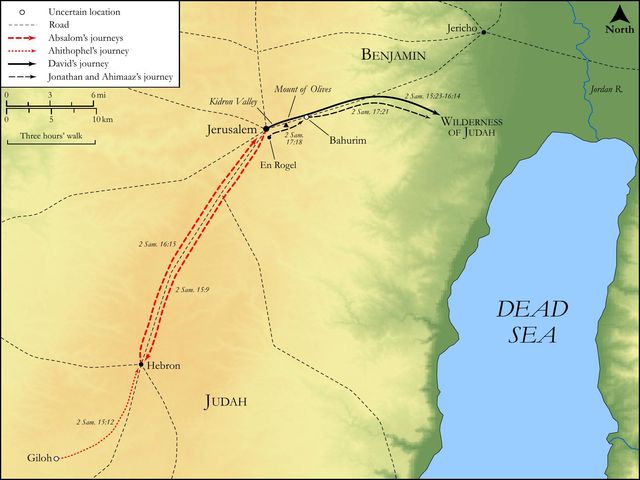
This verse serves as the climactic revelation of Absalom's meticulously planned rebellion, which is detailed in the opening verses of 2 Samuel 15. Absalom had spent four years strategically positioning himself at the city gate, a crucial public forum, where he intercepted those seeking the king's justice. Through subtle undermining of David's administration and charming the populace with promises of more accessible governance if he were judge (2 Samuel 15:1-6), he cultivated widespread discontent. He then requested permission to go to Hebron under the false pretense of fulfilling a vow to the Lord, a sacred act that lent legitimacy to his departure (2 Samuel 15:7-8). Once in Hebron, a significant city with historical ties to David's early reign, Absalom declared himself king, sending out spies throughout Israel to rally support. The defection of David's trusted counselor, Ahithophel, to Absalom's side (2 Samuel 15:12) further intensified the gravity of the situation. The messenger's report in 2 Samuel 15:13 confirms the success of Absalom's widespread conspiracy, directly leading to David's urgent decision to flee Jerusalem to avoid a bloody confrontation within the city walls (2 Samuel 15:14).
Historical & Cultural Context
In ancient Israel, the king's authority was understood as divinely sanctioned, yet it also depended heavily on popular allegiance, especially in the absence of a strong standing army or centralized bureaucracy. The city gate was a crucial public space where legal disputes were heard, business was conducted, and public opinion was swayed. Absalom's consistent presence there, offering a sympathetic ear and criticizing the king's administration, was a direct challenge to David's authority and a shrewd manipulation of public sentiment. The concept of a "vow" was deeply religious and provided a culturally acceptable cover for Absalom's true intentions, demonstrating his cunning. Furthermore, the mention of "the men of Israel" indicates a national, rather than merely a localized, rebellion. This was not just a palace coup but a widespread popular uprising, reflecting the volatile nature of the monarchies of that day and the constant struggle for power within royal families. The speed and scale of the defection underscore the fragility of even a divinely appointed king's position when faced with internal dissent and charismatic manipulation.
Key Themes
ShowHideThis verse powerfully contributes to several overarching themes in the Books of Samuel and David's narrative. Firstly, it highlights the theme of widespread betrayal and the fragility of popular loyalty. David, once the beloved hero and king, experiences how quickly public sentiment can shift, especially when manipulated by charismatic figures like Absalom. This underscores the transient nature of human praise and allegiance. Secondly, it serves as a stark illustration of the consequences of sin, particularly in the context of Nathan's prophecy to David following his sin with Bathsheba and Uriah. Nathan declared that "the sword shall never depart from your house" (2 Samuel 12:10) and that David's wives would be taken publicly (2 Samuel 12:11-12). Absalom's rebellion, marked by the public seizure of the kingdom and later the defilement of David's concubines (2 Samuel 16:21-22), is a direct fulfillment of these prophecies, demonstrating the long-reaching and painful ripple effects of sin, even for a repentant king. Finally, the verse exemplifies the cunning and destructive power of deception. Absalom achieved his widespread popularity through manipulation, false promises, and a carefully crafted image, revealing how easily public opinion can be swayed by charisma devoid of integrity. The suddenness of the news in 2 Samuel 15:13 underscores the effectiveness of Absalom's strategy.
Exposition and Analysis
ShowHideKey Word Analysis
ShowHideThis term is far more comprehensive than merely the emotional organ. In Hebrew thought, the "heart" (lēḇ') is the seat of intellect, will, emotion, and moral character—the entire inner being. When the messenger reports that "the hearts of the men of Israel are after Absalom," it signifies not just passive support or superficial preference, but a deep-seated, active desire, allegiance, and a fundamental shift in loyalty. It implies a conscious decision and a profound commitment of their inner selves to Absalom's cause, indicating a complete turning away from David's legitimate rule.
This preposition, derived from ʾaḥar' (properly, "the hind part"), often translated "after," implies a following, a pursuit, or a devotion. When combined with "hearts," it denotes active allegiance and a determined movement towards Absalom. It's not merely that their hearts are with Absalom, but that they are going after him, actively pursuing his leadership and cause. This conveys a dynamic and dangerous shift in national loyalty, indicating a popular movement rather than a mere conspiracy.
Verse Breakdown
ShowHide"And there came a messenger to David, saying,"
This opening clause establishes the urgency and gravity of the situation. The arrival of a messenger, typically a bearer of critical news, immediately signals a significant event that demands the king's attention. The direct address to David underscores the personal nature of the impending crisis, as the rebellion is against his very kingship and person. The immediacy of the report highlights the swiftness with which Absalom's plot had unfolded and gained widespread traction, leaving David little time to react.
"The hearts of the men of Israel are after Absalom."
This is the devastating core of the message, delivered with stark clarity and without embellishment. The phrase "the hearts of the men of Israel" signifies a widespread, national defection, encompassing the collective will, loyalty, and inner commitment of the entire populace, not just a faction or a few conspirators. The use of "hearts" emphasizes the depth of this shift—it's a change in fundamental allegiance and inner devotion. Their loyalty has actively turned from David, their anointed king, to Absalom, the usurper, indicating a profound crisis of legitimacy and a national rejection of David's reign.
Literary Devices
ShowHideThe verse employs several powerful literary devices to convey its profound impact. Dramatic Irony is evident, as the reader is aware of Absalom's long-standing, deceptive machinations (from 2 Samuel 15:1-6), while David is suddenly confronted with the overwhelming outcome of these efforts. The full extent of the betrayal is revealed to David in this terse statement. Metonymy is used in the phrase "the hearts of the men of Israel," where "hearts" stands for the entire person, encompassing their will, loyalty, and allegiance. This emphasizes the internal, fundamental nature of the defection, indicating a complete turning of the inner being. The verse also functions as a powerful moment of Anagnorisis (recognition or discovery) for David, as the full scale of the threat becomes terrifyingly clear, forcing him to confront the reality of his son's widespread success. Furthermore, the abruptness of the messenger's report creates a sense of Foreshadowing, signaling the impending chaos, civil war, and personal anguish that will define the subsequent chapters of David's life.
Theological and Thematic Connections
ShowHideThis verse serves as a profound theological statement on the fickle nature of human loyalty and the devastating consequences of sin, both personal and generational. It illustrates how quickly popular acclaim can turn to rejection, reminding us that human praise is transient and unreliable, in stark contrast to the steadfast faithfulness of God. Theologically, it underscores the principle that actions have ripple effects, as David's past moral failures, particularly with Bathsheba and Uriah, are seen by many as directly contributing to the divine judgment manifested in the rebellion of his own son, fulfilling Nathan's prophecy. It also highlights the constant spiritual battle for the "hearts" of people, which can be swayed by charismatic but unrighteous leaders, rather than remaining steadfast in their allegiance to God's anointed. The narrative implicitly calls for discernment, urging readers to place their trust not in human leaders or popular movements, but in the unwavering character and promises of God.
Reflection and Application
ShowHideThe stark reality presented in 2 Samuel 15:13 offers timeless lessons for contemporary life. It reminds us of the critical importance of discernment, especially when evaluating leaders or movements that promise much but may operate with ulterior motives. We are cautioned against being easily swayed by charisma or popular opinion, urging us instead to anchor our allegiances in truth and integrity, rather than fleeting sentiment. David's experience underscores the profound pain of betrayal, whether in personal relationships, professional settings, or within communities, highlighting the destructive power of disloyalty and the deep wounds it inflicts. Furthermore, it serves as a sobering reminder that our past actions, particularly our moral failures, can have long-lasting, painful consequences that extend beyond ourselves, affecting our families, communities, and even our spiritual well-being. Yet, David's subsequent actions in fleeing and seeking divine counsel also demonstrate the necessity of resilience, swift and decisive action, and continued reliance on God even in the face of overwhelming adversity and widespread rejection. This passage challenges us to examine where our own "hearts" truly lie and to whom we give our deepest allegiance.
Questions for Reflection
ShowHideFAQ
ShowHideWhat does "the hearts of the men of Israel are after Absalom" truly mean?
ShowHideThis phrase signifies a complete and profound shift in national allegiance. The Hebrew word for "hearts" (לֵב, lēḇ', H3820) encompasses the entire inner being—intellect, will, emotion, and moral character. Therefore, it means that the people of Israel had not merely given passive support or superficial approval to Absalom, but their deepest loyalties, their conscious decisions, and their emotional devotion had actively turned away from King David and were now fully committed to Absalom's cause. It indicates a widespread, genuine, and dangerous popular uprising, not just a conspiracy among a few elites, reflecting a fundamental change in national sentiment.
Why was Absalom able to gain such widespread support so quickly?
ShowHideAbsalom's success was the result of a deliberate and calculated strategy executed over several years. 2 Samuel 15:1-6 details his tactics: he presented himself as a sympathetic figure at the city gate, listening to grievances, criticizing the king's administration for not providing justice, and subtly suggesting he could do better. He cultivated a charismatic image, even having a chariot and fifty men run before him, a display of royal pomp designed to impress and attract followers. By offering a direct, accessible alternative to David's seemingly distant rule, and by skillfully tapping into any existing discontent or perceived neglect among the populace, Absalom skillfully manipulated public sentiment. His popular appeal was built on a foundation of political opportunism and deceptive charm, rather than true integrity or legitimate claim to the throne, as evidenced by the sudden revelation in 2 Samuel 15:13.
Christ-Centered Fulfillment
ShowHideThe agonizing betrayal of King David by the "hearts of the men of Israel" in 2 Samuel 15:13 finds a profound and poignant Christ-centered fulfillment in the New Testament. David, the anointed king, experiences the agonizing pain of a people turning their allegiance from him, a powerful foreshadowing of the ultimate rejection faced by the true King of Israel, Jesus Christ. Just as Absalom cunningly won the hearts of the people through deceptive charm and false promises, so too did the religious leaders of Jesus' day manipulate the crowds, leading them to reject their rightful Messiah. The very people who hailed Jesus as King on Palm Sunday, shouting "Hosanna to the Son of David!" (Matthew 21:8-9), swiftly turned their "hearts" against Him, crying out "Crucify him!" just days later (Luke 23:21). This illustrates the inherent fickleness of human allegiance and the profound truth that even a divinely appointed king, whether David or Christ, can be rejected by those they came to save. However, unlike David, who fled Jerusalem to preserve his life, Jesus willingly entered Jerusalem to face His betrayal and crucifixion, ultimately conquering death and securing an eternal kingdom where those who truly follow Him will have their "hearts" forever devoted to Him, the Lamb of God who takes away the sin of the world, and the King of kings and Lord of lords. His kingdom is not built on fleeting human loyalty but on the steadfast love and eternal covenant of God.