


Matthew 27:22
Bible text: King James Version (1769 Blayney text) · Public domain
Bible text: Berean Standard Bible · Public domain
Bible text: American Standard Version (1901) · Public domain
Bible text: World English Bible, Messianic edition · Public domain
Bible text: Geneva Bible (1599) · Public domain
Bible text: Young's Literal Translation · Public domain
- λέγειlegeiSaysG3004V-PAI-3SVerb Present Active Indicative 3rd Singular
- αὐτοῖςautoisto themG846P-DPMPersonal pronoun Dative Plural Masculine
- ὁho<the>G3588T-NSMDefinite article Nominative Singular Masculine
- Πιλᾶτος·PilatosPilateG4091N-NSM-PNoun Nominative Singular Masculine Individual
- τίtiWhatG5101I-ASNInterrogative pronoun Accusative Singular Neuter
- οὖνounthenG3767CONJConjunction
- ποιήσωpoiēsōshall I do withG4160V-AAS-1SVerb Aorist Active Subjunctive 1st Singular
- ἸησοῦνIēsounJesusG2424N-ASM-PNoun Accusative Singular Masculine Individual
- τὸνtonwhoG3588T-ASMDefinite article Accusative Singular Masculine
- λεγόμενονlegomenonis calledG3004V-PPP-ASMVerb Present Passive Participle Accusative Singular Masculine
- χριστόν;christonChrist?G5547N-ASM-TNoun Accusative Singular Masculine Title
- λέγουσινlegousinThey sayG3004V-PAI-3PVerb Present Active Indicative 3rd Plural
- αὐτῷautōto himG846P-DSMPersonal pronoun Dative Singular Masculine
- πάντες·pantesallG3956A-NPMAdjective Nominative Plural Masculine
- σταυρωθήτωstaurōthētōhe should be crucifiedG4717V-APM-3SVerb Aorist Passive Imperative 3rd Singular
English is a literal word-by-word gloss of the Greek, not the KJV's wording. Why?
This is the original text the KJV's translators worked from — each Greek word with its own literal English meaning in this verse, prepared by scholars at Tyndale House, Cambridge. The KJV translates whole sentences, not word by word, so its wording differs: one Greek word can become several English words, and the KJV may choose “charity” where the gloss reads “love”. Both are faithful — they answer different questions. For the KJV's own rendering, switch to the KJV text.
Details
See on the biblical-era maps
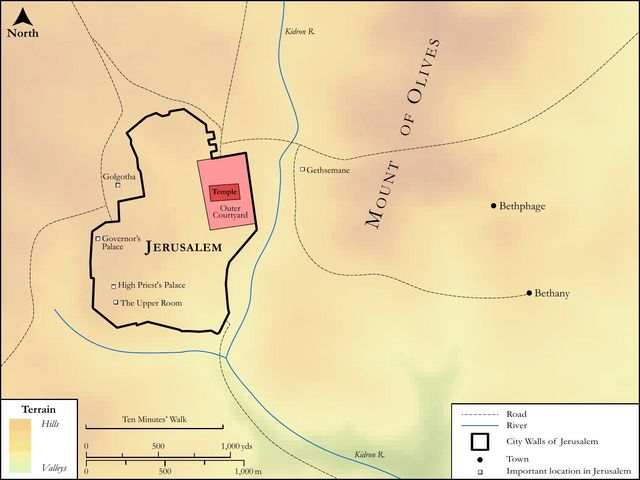
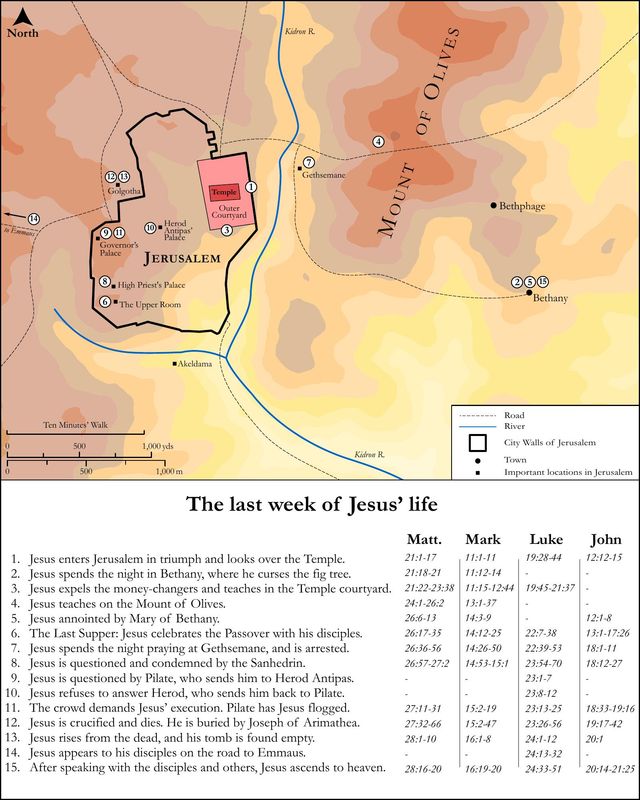
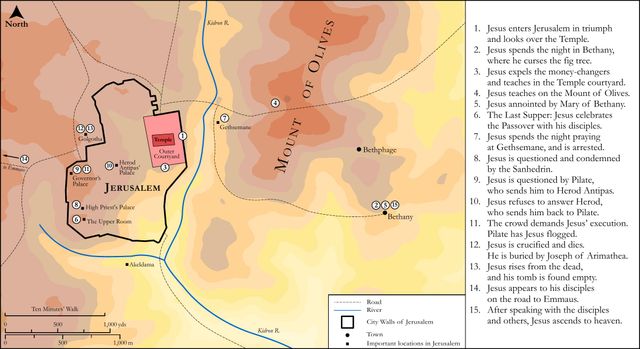
Study this verse
Historical interpretation
Ten Centuries of Reception
11 surviving comments on this verse. Each one is dated, so this reads as a timeline rather than a list.
Select a marker to jump to its quote. Markers stagger vertically where authors wrote within a few decades of each other.
But the populace, like wild beasts that rage the open plains, would have Barabbas released to them. For this people had seditions, murders, robberies, practised by some of their own nation in act, and nourished by all of them who believe not in Jesus, inwardly in their mind. Where Jesus is not, there are strifes and fightings; where He is, there is peace and all good things. All those who are like the Jews either in doctrine or life desire Barabbas to be loosed to them; for whoso does evil, Barabbas is loosed in his body, and Jesus bound; but he that does good has Christ loosed, and Barabbas bound. Pilate sought to strike them with shame for so great injustice, What shall I do then with Jesus that is called Christ? And not that only, but desiring to fill up the measure of their guilt. But neither do they blush that Pilate confessed Jesus to be the Christ, nor set any bounds to their impiety, They all say unto him, Let him be crucified. Thus they multiplied the sum of their wickedness, not only asking the life of a murderer, but the death of a righteous man, and that the shameful death of the cross.
When Pilate offered to release Jesus, following the customary practice wherein the people were granted the privilege of gaining the freedom of one prisoner per solemn feast day, they were persuaded by their priests to choose Barabbas instead. Here already the mystery of their future infidelity is contained in Barabbas’s very name, which means “son of the father.” They preferred this “son of the father” to Christ. At the instigation of their leaders, they chose the Antichrist, a man of sin and son of the devil. They chose the one elected for damnation over the author of life.
At the desire of the Priests the populace chose Barabbas, which is interpreted 'the son of a Father,' thus shadowing forth the unbelief to come when Antichrist the son of sin should be preferred to Christ.
Since therefore they ask for the other, He saith, "What shall I do then with the Christ," in this way desiring to put them to the blush, by giving them the power to choose, that at least out of shame they might ask for Him, and the whole should be of their bountifulness. For though to say, He had not done wrong, made them more contentious, yet to require that He should be saved out of humanity, carries with it persuasion and entreaty that cannot be gainsaid.
But even then they said, "Crucify Him. But he said, why, what evil hath He done? but they cried out exceedingly, let Him be crucified. But he, when he saw that he profited nothing, washed his hands, saying, I am innocent." Why then didst thou deliver Him up? Why didst thou not rescue Him, as the centurion did Paul. For that man too was aware that he would please the Jews; and a sedition had taken place on his account, and a tumult, nevertheless he stood firm against all. But not so this man, but he was extremely unmanly and weak, and all were corrupt together. For neither did this man stand firm against the multitude, nor the multitude against the Jews, and in every way their excuse was taken away. For they "cried out exceedingly," that is, cried out the more, "Let Him be crucified." For they desired not only to put Him to death, but also that it should be on a charge of wickedness, and though the judge was contradicting them, they continued to cry out the same thing.
Seest thou how many things Christ did in order to recover them? For like as He often times checked Judas, so likewise did He restrain these men too, both throughout all His Gospel, and at the very time of His condemnation. For surely when they saw the ruler and the judge washing his hands of it, and saying, "I am innocent of this blood," they should have been moved to compunction both by what was said, and by what was done, as well when they saw Judas had hanged himself, as when they saw Pilate himself entreating them to take another in the place of Him. For when the accuser and traitor condemns himself, and he who gives sentence puts off from himself the guilt, and such a vision appears the very night, and even as condemned he begs Him off, what kind of plea will they have? For if they were not willing that He should be innocent, yet they should not have preferred to him even a robber, one that was acknowledged to be such, and very notorious.
Because Christ had answered nothing to the accusations of the Jews, by which Pilate could acquit Him of what was alleged against Him, he contrives other means of saving Him. Now on the feast day the governor we as wont to release unto the people a prisoner whom they would.
And he sought to rescue Christ by means of this practice, that the Jews might not have the shadow of an excuse left them. A convicted murderer is put in comparison with Christ, Barabbas, whom he calls not merely a robber, but a notable one, that is, renowned for crime.
Whom will ye that I release unto you? &c. As much as to say, If ye will not let him go as innocent, at least, yield Him, as convicted, to this holy day. For if you would have released one of whose guilt there was no doubt, much more should you do so in doubtful cases. Observe how circumstances are reversed. It is the populace who are wont to petition for the condemned, and the prince to grant, but here it is the reverse, the prince asks of the people, and renders them thereby more violent.
Then is added something else which alone was enough to deter all from putting Him to death; When we he as set on the judgment seat, his wife sent unto him, saying, Have thou nothing to do with that just man. For joined with the proof afforded by the events themselves, a dream was no light confirmation.
But why did Pilate himself not see this vision? Because his wife was more worthy; or because if Pilate had seen it, he would not have had equal credit, or perhaps would not have told it; wherefore it is provided by God that his wife should see it, and thus it be made manifest to all. And she not merely sees it, but suffers many things because of him, so that sympathy with his wife would make the husband more slack to put Him to death. And the time agreed well, for it was the same night that she saw it.
(Hom. iii. in Cæn. Dom.) Thus then the judge is terrified through his wife, and that he might not consent in the judgment to the accusation of the Jews, himself endured judgment in the affliction of his wife; the judge is judged, and tortured before he tortures.
But none of the foregoing things moved Christ's enemies, because envy had altogether blinded them, and of their own wickedness they corrupt the people, for they persuaded the people that they should ask Barabbas, and destroy Jesus.
Observe here the infatuation of the Jews; their headlong haste, and destructive passions will not let them see what they ought to see, and they curse themselves, saying, His blood be upon us, and even entail the curse upon their children. Yet a merciful God did not ratify this sentence, but accepted such of them and of their children as repented; for Paul was of them, and many thousands of those who in Jerusalem believed.
(Hom. iii. in Cæna Dom.) See the Lord is made ready for the scourge, see now it descends upon Him! That sacred skin is torn by the fury of the rods; the cruel might of repeated blows lacerates His shoulders. Ah me! God is stretched out before man, and He, in whom not one trace of sin can be discerned, suffers punishment as a malefactor.
(Verse 22, 23.) Pilate said to them: What then shall I do with Jesus, who is called Christ? They all said: Let him be crucified. The governor asked: What evil has he done? But they shouted even louder, saying: Let him be crucified. Pilate gave many opportunities to release the Savior. First, he compared him to a just thief. Then he asked: What then shall I do with Jesus, who is called Christ? That is, who is your king. When they replied, Let him be crucified, he did not immediately agree; but according to the suggestion of his wife, who had said: Have nothing to do with that righteous man, he also replied: What evil has he done? By saying this, Pilate absolved Jesus. But they shouted even more, saying: Crucify him. So that what was said in the twenty-first psalm would be fulfilled: Many dogs have surrounded me; A congregation of evildoers have encircled me. And that which Jeremiah said: My inheritance has become like a lion in the forest; They have raised their voices against me. Isaiah also agrees with this statement: I waited for them to do justice, but they did iniquity, not righteousness; they made a loud cry.
In the Gospel entitled 'according to the Hebrews,' Barabbas is interpreted, 'The son of their master,' who had been condemned for sedition and murder. Pilate gives them the choice between Jesus and the robber, not doubting but that Jesus would be the rather chosen.
Observe also that visions are often vouchsafed by God to the Gentiles, and that the confession of Pilate and his wife that the Lord was innocent is a testimony of the Gentile people.
Yet even after this answer of theirs, Pilate did not at once assent, but in accordance with his wife's suggestion, Have thou nothing to do with that just man, he answered, Why, what evil hath he done? This speech of Pilate's acquits Jesus. But they cried out the more, saying, Let him be crucified; that it might be fulfilled which is said in the Psalm, Many dogs have compassed me, the congregation of the wicked hath inclosed me; (Ps. 22:16.) and also that of Hieremias, Mine heritage is unto me as a lion in the forest, they have given forth their voice against me. (Jer. 12:8.)
Pilate took water in accordance with that, I will wash my hands in innocency, (Ps. 26:6.) in a manner testifying and saying, I indeed have sought to deliver this innocent man, but since a tumult is rising, and the charge of treason to Cæsar is urged against me, I am innocent of the blood of this just man. The judge then who is thus compelled to give sentence against the Lord, does not convict the accused, but the accusers, pronouncing innocent Him who is to be crucified. See ye to it, as though he had said, I am the law's minister, it is your voice that has shed this blood. Then answered all the people and said, His blood be on us and on our children. This imprecation rests at the present day upon the Jews, the Lord's blood is not removed from them.
It should be known that Pilate administered the Roman law, which enacted that every one who was crucified should first be scourged. Jesus then is given up to the soldiers to be beaten, and they tore with whips that most holy body and capacious bosom of God.
This was done that we might be delivered from those stripes of which it is said, Many stripes shall be to the wicked. (Ps. 32:10.) Also in the washing of Pilate's hands all the works of the Gentiles are cleansed, and we are acquitted of all share in the impiety of the Jews.
(Serm. lix. 2.) The impiety of the Jews then exceeded the fault of Pilate; but he was not guiltless, seeing he resigned his own jurisdiction, and acquiesced in the injustice of others.
John explains what their envy was, when he says, Behold, the world is gone after him; (John 12:19.) and, If we let him thus alone, all men will believe on him. (John 11:48.) Observe also that in place of what Matthew says, Jesus, who is called Christ, Mark says, Will ye that I release unto you the King of the Jews? (Mark 15:9.) For the kings of the Jews alone were anointed, and from that anointing were called Christs.
It was customary among the ancients, when one would refuse to participate in any crime, to take water and wash his hands before the people.
It is to be noted, that the bench (tribunal) is the seat of the judge, the throne (solium) of the king, the chair (cathedra) of the master. In visions and dreams the wife of a Gentile understood what the Jews when awake would neither believe nor understand.
Or otherwise; The devil now at last understanding that he should lose his trophies through Christ, as he had at the first brought in death by a woman, so by a woman he would deliver Christ out of the hands of His enemies, lest through His death he should lose the sovereignty of death.
Those who were crucified being suspended on a cross, by nails driven into the wood through their hands and feet, perished by a lingering death, and lived long on the cross, not that they sought longer life, but that death was deferred to prolong their sufferings. The Jews indeed contrived this as the worst of deaths, but it had been chosen by the Lord without their privity, thereafter to place upon the foreheads of the faithful the same cross as a trophy of His victory over the Devil.
Barabbas also, who headed a sedition among the people, is released to the Jews, that is the Devil, who to this day reigns among them, so that they cannot have peace.
(non occ.) The Evangelist adds the reason why Pilate sought to deliver Christ, For he knew that for envy they had delivered him.
(non occ.) Pilate is said to make this answer, Whether of the twain will ye that I release unto you? either to the message of his wife, or the petition of the people, with whom it was a custom to ask such release on the feast-day.
Continue studying Matthew 27:22 across the web’s major study libraries — every link below opens this exact verse, chapter, or book on the destination site.
Read & Compare
 BibleGatewayThis verse in more than 200 translations and 70 languages.
 Bible.comThe YouVersion reader — hundreds of translations, reading plans, and highlights.
 ESV.orgCrossway's official English Standard Version reader.
 NET BibleThe NET translation with 60,000+ translators' notes on every rendering decision.
 STEP BibleTyndale House's free study tool — original text, vocabulary, and scholarly resources.
 BibliaLogos Bible Software's free web reader.
 USCCBThe New American Bible (Revised Edition) with the U.S. bishops' study notes.
Commentaries
 BibleHub CommentariesDozens of classic commentaries on this verse, gathered on one page.
 StudyLightMore than 100 commentary sets — the largest collection on the web.
 BibleRefPlain-English commentary on what this verse means, verse by verse.
 Enduring WordDavid Guzik's free commentary on this chapter, widely used by Bible teachers.
 Bible Study ToolsVerse commentary alongside Greek and Hebrew study aids.
Original Language & Research
- BibleHub InterlinearThe verse word by word — original language, transliteration, and English.
- BibleHub LexiconEvery word's original-language definition and Strong's entry.
 Blue Letter BibleDeep-study tools — Strong's numbers, concordance, and word studies.
 CNTR CollationThe earliest Greek manuscripts of this verse, collated letter by letter.
Sermons, Hymns & Audio


TrulyRandomVerse is not affiliated with these sites and doesn’t control their content. They’re linked because they’re genuinely useful.
Summary
Matthew 27:22 captures the dramatic climax of Jesus' trial before Pontius Pilate, where the Roman governor, seeking to release Jesus whom he found innocent, directly asks the agitated crowd what he should do with "Jesus which is called Christ." The unified and vehement response from the multitude, incited by the religious leaders, is the chilling demand: "Let him be crucified." This pivotal moment reveals the profound rejection of the Messiah by His own people, the immense pressure on Pilate, and the unfolding of God's sovereign plan for salvation through the cross.
Context
ShowHideLiterary Context
This verse is situated within the broader Passion narrative in Matthew's Gospel, immediately following Pilate's offer to release either Jesus or Barabbas, a notorious prisoner. The chief priests and elders have successfully persuaded the crowds to demand Barabbas' release and Jesus' execution (Matthew 27:20-21). Pilate's question in Matthew 27:22 represents his final, desperate attempt to avoid condemning an innocent man, highlighting the escalating tension and the irreversible momentum towards Jesus' crucifixion. The subsequent verses detail Pilate's symbolic hand-washing and his ultimate capitulation to the crowd's will (Matthew 27:24-26).
Historical & Cultural Context
The setting is Jerusalem during the Passover feast, a time when Roman authorities were particularly wary of unrest due to the heightened nationalistic fervor among the Jewish populace. It was a custom, perhaps unique to Judea, for the Roman governor to release a prisoner at Passover (Matthew 27:15). Pilate, as the Roman prefect, held ultimate judicial authority, but he also had to maintain Roman order and avoid provoking a rebellion. The Jewish religious leaders, particularly the chief priests and elders, wielded significant influence over the populace, especially during religious festivals, and were deeply motivated to eliminate Jesus, whom they perceived as a threat to their authority and a blasphemer (John 19:7). The crowd's demand for crucifixion, a brutal Roman method of execution, underscores the depth of their animosity, as stoning was the traditional Jewish method for blasphemy.
Key Themes
ShowHideThis verse powerfully contributes to several overarching themes in Matthew and the broader biblical narrative. It underscores the Rejection of the Messiah, as the very people to whom Jesus came, and among whom He performed miracles and taught, vehemently reject His messianic claims and demand His death. This rejection, however, is paradoxically intertwined with Divine Sovereignty and Human Culpability, illustrating that while human sin and choice undeniably led to Jesus' condemnation, it was also part of God's predetermined plan for salvation (Acts 2:23). The scene also highlights Pilate's Moral Dilemma and Political Expediency, as he struggles between his conviction of Jesus' innocence and his fear of a riot, ultimately prioritizing political stability over justice. Finally, the verse vividly portrays the dangerous power of Mob Mentality, where individual reason and conscience are overridden by collective, inflamed passion, leading to a profound miscarriage of justice.
Exposition and Analysis
ShowHideKey Word Analysis
ShowHideThis refers to Pontius Pilate, the Roman governor of Judea from 26-36 AD. His name, "close-pressed, i.e. firm," ironically contrasts with his indecisiveness and capitulation in this pivotal moment, highlighting the human instrument through whom divine will was accomplished.
This primary verb means "to lay forth" or "relate (in words), usually of systematic or set discourse." Here, it describes Pilate's deliberate and formal question, and the crowd's equally deliberate and unified response, emphasizing the weight and finality of their declarations.
Meaning "anointed" or "the Messiah," this title is an epithet of Jesus. Pilate's use of "which is called Christ" acknowledges Jesus' public identity and the controversial claim He embodied, forcing the crowd to directly confront His messianic status.
Derived from the word for "cross," this verb means "to impale on the cross." The crowd's demand for this specific, brutal Roman execution method underscores their desire for Jesus' complete humiliation and eradication, rather than a mere death.
Verse Breakdown
ShowHide"Pilate saith unto them, What shall I do then with Jesus which is called Christ?"
This clause sets the scene, revealing Pilate's final attempt to shift responsibility and gauge the crowd's true intent. His question is a direct challenge, forcing a choice between Jesus, explicitly identified by His controversial title "Christ" (Messiah), and Barabbas. Pilate's query underscores his recognition of Jesus' innocence and his reluctance to condemn Him, yet it also exposes his weakness in the face of public pressure.
"They all say unto him, Let him be crucified."
This clause delivers the chilling, unanimous verdict of the crowd. The "all" emphasizes the collective, overwhelming nature of their demand, indicating that the incitement by the chief priests and elders had been devastatingly effective. Their cry for crucifixion, the most agonizing and shameful form of execution, reveals the depth of their rejection and hatred, sealing Jesus' fate.
Literary Devices
ShowHideMatthew 27:22 is rich with literary devices that amplify its dramatic and theological impact. Irony pervades the scene: Pilate, the Roman authority, seeks to release an innocent man, while the Jewish people, awaiting their Messiah, demand His execution. The title "Christ" (Anointed One), meant to signify a deliverer, is used in the context of His condemnation. There is also profound Foreshadowing in the crowd's demand; their cry for crucifixion explicitly names the method of death that will become the central act of Christian redemption. The verse also employs Contrast between Pilate's hesitant question and the crowd's decisive, unified roar, highlighting the clash between individual conscience and mob mentality. The collective "They all" serves as a form of Hyperbole to emphasize the overwhelming, unified voice of rejection, creating a powerful sense of an unstoppable force.
Theological and Thematic Connections
ShowHideThis verse stands as a stark testament to humanity's capacity for rejecting divine truth and righteousness. The crowd's demand for crucifixion, despite Jesus' blameless life and miraculous works, highlights the depths of human sin and rebellion against God's chosen King. Theologically, it underscores the paradox of the cross: the greatest act of human injustice becomes the means of God's ultimate justice and mercy. While the crowd's actions demonstrate human culpability, they also unwittingly fulfill divine prophecy, revealing God's sovereign plan to bring salvation through the suffering and death of His Son. This moment is a crucial step in the unfolding of God's redemptive narrative, demonstrating that even the most heinous acts of human sin are ultimately woven into the tapestry of His saving purposes.
Reflection and Application
ShowHideMatthew 27:22 serves as a powerful mirror, inviting us to examine our own hearts and allegiances. It challenges us to consider whether we, like the crowd, are susceptible to popular opinion, societal pressure, or the influence of those who reject Christ, even when we know the truth. Are there areas in our lives where we might implicitly or explicitly "crucify" Jesus by denying His Lordship, compromising His truth, or prioritizing our comfort or reputation over His call? This verse calls believers to courageous conviction, urging us to stand firm for Christ even when it is unpopular or costly. It reminds us that true discipleship often involves embracing the one whom the world rejects and being willing to bear the reproach of Christ. Our response to Jesus, the "Christ," defines our eternal destiny, and this passage compels us to affirm Him as Lord, not just with our lips, but with our lives.
Questions for Reflection
ShowHideFAQ
ShowHideWhy did the crowd, who once welcomed Jesus, suddenly turn against Him and demand His crucifixion?
ShowHideThe crowd's swift turn from acclaiming Jesus on Palm Sunday (Matthew 21:8-9) to demanding His crucifixion in Matthew 27:22 can be attributed to several factors. Firstly, the chief priests and elders actively incited the crowd, manipulating their emotions and opinions (Matthew 27:20). Secondly, many in the crowd likely harbored a misunderstanding of Jesus' messianic mission, expecting a political liberator who would overthrow Roman rule, not a suffering servant (John 6:15). When Jesus did not fulfill their nationalistic expectations and was instead arrested and presented as a common criminal, their disillusionment, coupled with the religious leaders' propaganda, turned their admiration into scorn and rage. The volatile atmosphere of Passover and the desire for a dramatic release (Barabbas) also contributed to their inflamed passions.
Christ-Centered Fulfillment
ShowHideMatthew 27:22, with its chilling demand for crucifixion, stands as a profound testament to the Christ-centered fulfillment of Old Testament prophecy and the very heart of the Gospel. The crowd's cry, "Let him be crucified," though born of human sin and rejection, was paradoxically the means by which God's eternal plan of redemption would be accomplished. Jesus, the "Christ" (Messiah), was not merely a victim of circumstance, but the willing Lamb of God, whose death was predetermined "before the foundation of the world" (1 Peter 1:19-20). His crucifixion, demanded by the very people He came to save, fulfilled the prophecies of the suffering servant in Isaiah 53, who would be "despised and rejected by men" (Isaiah 53:3). This moment of ultimate human rejection paved the way for the ultimate divine embrace, as Jesus' death on the cross became the atoning sacrifice for the sins of humanity, offering reconciliation with God to all who believe (2 Corinthians 5:21). Thus, the world's condemnation of Jesus was God's chosen path to bring salvation, transforming the instrument of shame into the symbol of triumph and eternal life.