


Matthew 27:15
Bible text: King James Version (1769 Blayney text) · Public domain
Bible text: Berean Standard Bible · Public domain
Bible text: American Standard Version (1901) · Public domain
Bible text: World English Bible, Messianic edition · Public domain
Bible text: Geneva Bible (1599) · Public domain
Bible text: Young's Literal Translation · Public domain
- ΚατὰKataAtG2596PREPPreposition
- δὲdenowG1161CONJConjunction
- ἑορτὴνhe'ortēn[the] feastG1859N-ASFNoun Accusative Singular Feminine
- εἰώθειeiōtheihad been accustomedG1486V-LAI-3SVerb Pluperfect Active Indicative 3rd Singular
- ὁhotheG3588T-NSMDefinite article Nominative Singular Masculine
- ἡγεμὼνhēgemōngovernorG2232N-NSMNoun Nominative Singular Masculine
- ἀπολύεινapolueinto releaseG630V-PANVerb Present Active Infinitive
- ἕναhenaoneG1520A-ASMAdjective Accusative Singular Masculine
- τῷtōto theG3588T-DSMDefinite article Dative Singular Masculine
- ὄχλῳochlōmultitudeG3793N-DSMNoun Dative Singular Masculine
- δέσμιονdesmionprisonerG1198N-ASMNoun Accusative Singular Masculine
- ὃνhonwhomG3739R-ASMRelative pronoun Accusative Singular Masculine
- ἤθελονēthelonthey were wishingG2309V-IAI-3PVerb Imperfect Active Indicative 3rd Plural
English is a literal word-by-word gloss of the Greek, not the KJV's wording. Why?
This is the original text the KJV's translators worked from — each Greek word with its own literal English meaning in this verse, prepared by scholars at Tyndale House, Cambridge. The KJV translates whole sentences, not word by word, so its wording differs: one Greek word can become several English words, and the KJV may choose “charity” where the gloss reads “love”. Both are faithful — they answer different questions. For the KJV's own rendering, switch to the KJV text.
Details
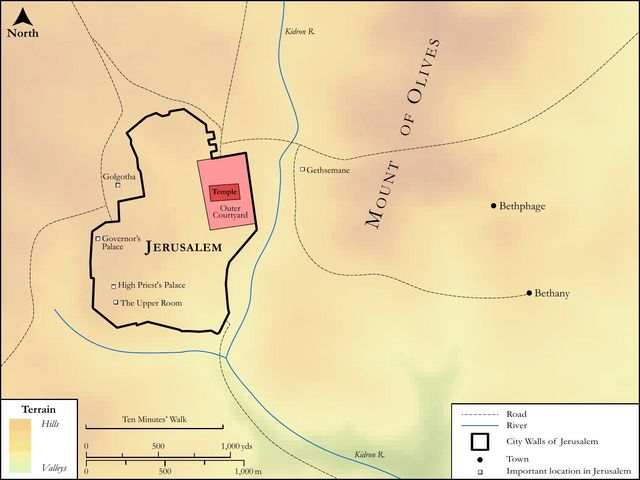
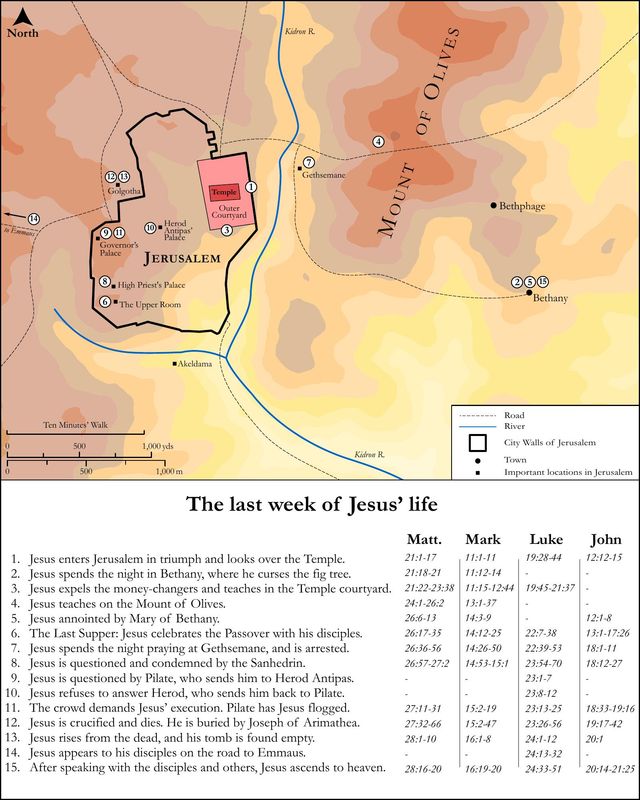
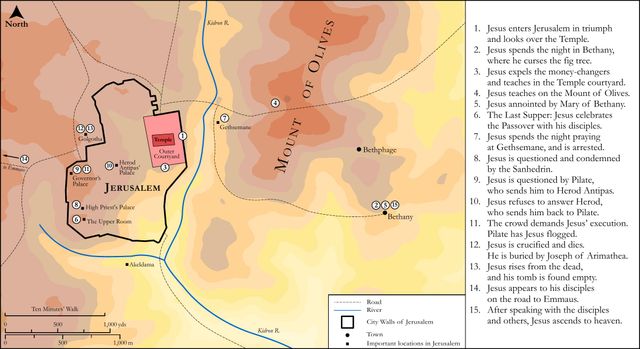
See on the biblical-era maps
Study this verse
Historical interpretation
Ten Centuries of Reception
10 surviving comments on this verse. Each one is dated, so this reads as a timeline rather than a list.
Select a marker to jump to its quote. Markers stagger vertically where authors wrote within a few decades of each other.
You should not be surprised that shortly after Roman rule had begun [in Palestine], the Jews who came under their yoke were granted the priviledge of asking for [the release of] "one [prisoner] whom they wanted," even though he appeared to be guilty of a thousand murders; the pagan nations granted a certain amount of leniency to their subjects until the yoke had been firmly secured around them.
Thus do the Gentiles show favours to those whom they subject to themselves, until their yoke is riveted. Yet did this practice obtain also among the Jews, Saul did not put Jonathan to death, because all the people sought his life. (1 Sam. 14.)
At the desire of the Priests the populace chose Barabbas, which is interpreted 'the son of a Father,' thus shadowing forth the unbelief to come when Antichrist the son of sin should be preferred to Christ.
Because Christ had answered nothing to the accusations of the Jews, by which Pilate could acquit Him of what was alleged against Him, he contrives other means of saving Him. Now on the feast day the governor we as wont to release unto the people a prisoner whom they would.
And he sought to rescue Christ by means of this practice, that the Jews might not have the shadow of an excuse left them. A convicted murderer is put in comparison with Christ, Barabbas, whom he calls not merely a robber, but a notable one, that is, renowned for crime.
Whom will ye that I release unto you? &c. As much as to say, If ye will not let him go as innocent, at least, yield Him, as convicted, to this holy day. For if you would have released one of whose guilt there was no doubt, much more should you do so in doubtful cases. Observe how circumstances are reversed. It is the populace who are wont to petition for the condemned, and the prince to grant, but here it is the reverse, the prince asks of the people, and renders them thereby more violent.
Then is added something else which alone was enough to deter all from putting Him to death; When we he as set on the judgment seat, his wife sent unto him, saying, Have thou nothing to do with that just man. For joined with the proof afforded by the events themselves, a dream was no light confirmation.
But why did Pilate himself not see this vision? Because his wife was more worthy; or because if Pilate had seen it, he would not have had equal credit, or perhaps would not have told it; wherefore it is provided by God that his wife should see it, and thus it be made manifest to all. And she not merely sees it, but suffers many things because of him, so that sympathy with his wife would make the husband more slack to put Him to death. And the time agreed well, for it was the same night that she saw it.
(Hom. iii. in Cæn. Dom.) Thus then the judge is terrified through his wife, and that he might not consent in the judgment to the accusation of the Jews, himself endured judgment in the affliction of his wife; the judge is judged, and tortured before he tortures.
But none of the foregoing things moved Christ's enemies, because envy had altogether blinded them, and of their own wickedness they corrupt the people, for they persuaded the people that they should ask Barabbas, and destroy Jesus.
Observe here the infatuation of the Jews; their headlong haste, and destructive passions will not let them see what they ought to see, and they curse themselves, saying, His blood be upon us, and even entail the curse upon their children. Yet a merciful God did not ratify this sentence, but accepted such of them and of their children as repented; for Paul was of them, and many thousands of those who in Jerusalem believed.
(Hom. iii. in Cæna Dom.) See the Lord is made ready for the scourge, see now it descends upon Him! That sacred skin is torn by the fury of the rods; the cruel might of repeated blows lacerates His shoulders. Ah me! God is stretched out before man, and He, in whom not one trace of sin can be discerned, suffers punishment as a malefactor.
(Verse 13 and following) Then Pilate said to him: Do you not hear how many testimonies they speak against you? And he did not respond to him with any word, so that the governor wondered greatly. Now it was customary for the governor to release one prisoner to the people on the solemn day, whom they desired. Indeed, it is a Gentile who condemns Jesus, but he refers the matter to the Jewish people. Do you not hear how many testimonies they speak against you? But Jesus refused to respond, in order to not diminish the accusation from the governor, and to prevent the delay of the usefulness of the cross.
In the Gospel entitled 'according to the Hebrews,' Barabbas is interpreted, 'The son of their master,' who had been condemned for sedition and murder. Pilate gives them the choice between Jesus and the robber, not doubting but that Jesus would be the rather chosen.
Observe also that visions are often vouchsafed by God to the Gentiles, and that the confession of Pilate and his wife that the Lord was innocent is a testimony of the Gentile people.
Yet even after this answer of theirs, Pilate did not at once assent, but in accordance with his wife's suggestion, Have thou nothing to do with that just man, he answered, Why, what evil hath he done? This speech of Pilate's acquits Jesus. But they cried out the more, saying, Let him be crucified; that it might be fulfilled which is said in the Psalm, Many dogs have compassed me, the congregation of the wicked hath inclosed me; (Ps. 22:16.) and also that of Hieremias, Mine heritage is unto me as a lion in the forest, they have given forth their voice against me. (Jer. 12:8.)
Pilate took water in accordance with that, I will wash my hands in innocency, (Ps. 26:6.) in a manner testifying and saying, I indeed have sought to deliver this innocent man, but since a tumult is rising, and the charge of treason to Cæsar is urged against me, I am innocent of the blood of this just man. The judge then who is thus compelled to give sentence against the Lord, does not convict the accused, but the accusers, pronouncing innocent Him who is to be crucified. See ye to it, as though he had said, I am the law's minister, it is your voice that has shed this blood. Then answered all the people and said, His blood be on us and on our children. This imprecation rests at the present day upon the Jews, the Lord's blood is not removed from them.
It should be known that Pilate administered the Roman law, which enacted that every one who was crucified should first be scourged. Jesus then is given up to the soldiers to be beaten, and they tore with whips that most holy body and capacious bosom of God.
This was done that we might be delivered from those stripes of which it is said, Many stripes shall be to the wicked. (Ps. 32:10.) Also in the washing of Pilate's hands all the works of the Gentiles are cleansed, and we are acquitted of all share in the impiety of the Jews.
(Serm. lix. 2.) The impiety of the Jews then exceeded the fault of Pilate; but he was not guiltless, seeing he resigned his own jurisdiction, and acquiesced in the injustice of others.
John explains what their envy was, when he says, Behold, the world is gone after him; (John 12:19.) and, If we let him thus alone, all men will believe on him. (John 11:48.) Observe also that in place of what Matthew says, Jesus, who is called Christ, Mark says, Will ye that I release unto you the King of the Jews? (Mark 15:9.) For the kings of the Jews alone were anointed, and from that anointing were called Christs.
It was customary among the ancients, when one would refuse to participate in any crime, to take water and wash his hands before the people.
It is to be noted, that the bench (tribunal) is the seat of the judge, the throne (solium) of the king, the chair (cathedra) of the master. In visions and dreams the wife of a Gentile understood what the Jews when awake would neither believe nor understand.
Or otherwise; The devil now at last understanding that he should lose his trophies through Christ, as he had at the first brought in death by a woman, so by a woman he would deliver Christ out of the hands of His enemies, lest through His death he should lose the sovereignty of death.
Those who were crucified being suspended on a cross, by nails driven into the wood through their hands and feet, perished by a lingering death, and lived long on the cross, not that they sought longer life, but that death was deferred to prolong their sufferings. The Jews indeed contrived this as the worst of deaths, but it had been chosen by the Lord without their privity, thereafter to place upon the foreheads of the faithful the same cross as a trophy of His victory over the Devil.
Barabbas also, who headed a sedition among the people, is released to the Jews, that is the Devil, who to this day reigns among them, so that they cannot have peace.
(non occ.) The Evangelist adds the reason why Pilate sought to deliver Christ, For he knew that for envy they had delivered him.
(non occ.) Pilate is said to make this answer, Whether of the twain will ye that I release unto you? either to the message of his wife, or the petition of the people, with whom it was a custom to ask such release on the feast-day.
Continue studying Matthew 27:15 across the web’s major study libraries — every link below opens this exact verse, chapter, or book on the destination site.
Read & Compare
 BibleGatewayThis verse in more than 200 translations and 70 languages.
 Bible.comThe YouVersion reader — hundreds of translations, reading plans, and highlights.
 ESV.orgCrossway's official English Standard Version reader.
 NET BibleThe NET translation with 60,000+ translators' notes on every rendering decision.
 STEP BibleTyndale House's free study tool — original text, vocabulary, and scholarly resources.
 BibliaLogos Bible Software's free web reader.
 USCCBThe New American Bible (Revised Edition) with the U.S. bishops' study notes.
Commentaries
 BibleHub CommentariesDozens of classic commentaries on this verse, gathered on one page.
 StudyLightMore than 100 commentary sets — the largest collection on the web.
 BibleRefPlain-English commentary on what this verse means, verse by verse.
 Enduring WordDavid Guzik's free commentary on this chapter, widely used by Bible teachers.
 Bible Study ToolsVerse commentary alongside Greek and Hebrew study aids.
Original Language & Research
- BibleHub InterlinearThe verse word by word — original language, transliteration, and English.
- BibleHub LexiconEvery word's original-language definition and Strong's entry.
 Blue Letter BibleDeep-study tools — Strong's numbers, concordance, and word studies.
 CNTR CollationThe earliest Greek manuscripts of this verse, collated letter by letter.
Sermons, Hymns & Audio


TrulyRandomVerse is not affiliated with these sites and doesn’t control their content. They’re linked because they’re genuinely useful.
Summary
Matthew 27:15 introduces a significant custom practiced during the Passover feast in Jerusalem, where the Roman governor would release a prisoner chosen by the people. This verse sets the immediate stage for the pivotal choice the crowd would soon make between Jesus and Barabbas, highlighting the unique interplay of Roman governance and Jewish tradition that ultimately contributed to Jesus's condemnation.
Context
ShowHideLiterary Context
This verse immediately follows Pilate's initial questioning of Jesus and the chief priests' and elders' incitement of the crowd (Matthew 27:11-14). It precedes the explicit presentation of the choice between Jesus and Barabbas (Matthew 27:16-17) and the subsequent demand for Jesus's crucifixion. The custom described in Matthew 27:15 thus serves as the narrative mechanism through which Pilate attempts, and ultimately fails, to release Jesus, directly leading to the events of Matthew 27:18-26. It is a crucial pivot point in the Passion narrative, moving from interrogation to condemnation.
Historical & Cultural Context
The Passover (Pesach) was one of the most important annual festivals for the Jewish people, commemorating their liberation from slavery in Egypt (as recounted in Exodus 12). Jerusalem would swell with pilgrims, creating a volatile atmosphere. Roman governors, such as Pontius Pilate (who served from AD 26-36), were acutely aware of the potential for unrest during such festivals. While extra-biblical evidence for a widespread "Paschal amnesty" custom is scarce, the Gospels present it as a recognized practice. It likely served as a gesture of Roman goodwill, a means to appease the populace, or a way to assert authority while appearing benevolent, aiming to maintain peace and order in a province prone to rebellion. This custom underscores the complex political and religious dynamics of Judea under Roman occupation.
Key Themes
ShowHideMatthew 27:15 contributes to several overarching themes within Matthew's Gospel and the broader Passion narrative. Firstly, it highlights the Sovereignty of God working through human systems and decisions, even seemingly arbitrary customs, to fulfill divine prophecy concerning the suffering servant (e.g., Isaiah 53). Secondly, it underscores the theme of Injustice and Human Culpability, as the custom, intended for mercy, is twisted by the crowd's manipulation and Pilate's moral cowardice, leading to the condemnation of an innocent man. Finally, it sets the stage for the dramatic Choice of the People, illustrating the profound spiritual blindness and rejection of the Messiah by many of his own people, a theme prominent throughout Matthew's Gospel.
Exposition and Analysis
ShowHideKey Word Analysis
ShowHideRefers to a festival or holyday. In this context, it unequivocally denotes the Passover, a pivotal annual celebration for the Jewish people commemorating their deliverance from slavery in Egypt. The atmosphere of such a feast, filled with religious and nationalistic fervor, profoundly influenced the events unfolding.
From a word meaning "to lead," this term describes a leader or chief person of a province, accurately identifying Pontius Pilate's official position as the Roman prefect or procurator of Judea. His role was to maintain order and administer justice, though often with a pragmatic eye toward political stability.
Meaning "to free fully," this verb can imply relieving, dismissing, or setting at liberty. Here, it refers to the act of pardoning a prisoner, a significant exercise of the governor's authority, which Pilate intended to use to free Jesus.
Verse Breakdown
ShowHide"Now at that feast"
This phrase firmly situates the events within the context of the Passover, a time of heightened religious and nationalistic sentiment in Jerusalem. The "feast" is not merely a temporal marker but signals a period of intense spiritual and political significance, where large crowds and deep-seated emotions could easily lead to unrest.
"the governor was wont to release unto the people a prisoner"
This describes a customary practice of the Roman governor, Pontius Pilate. The phrase "was wont to release" indicates an established tradition, implying that this act of clemency was expected by the populace. It highlights the governor's authority to grant amnesty, a power he intended to leverage in the case of Jesus.
"whom they would"
This crucial clause emphasizes the people's agency in the custom. The choice of which prisoner to release rested with the crowd, not solely with the governor. This democratic element, ironically, becomes the very mechanism through which the innocent Jesus is condemned and the notorious Barabbas is set free, revealing the volatile power of popular opinion.
Literary Devices
ShowHideThe verse employs several literary devices. Foreshadowing is prominent, as the establishment of this custom immediately sets the stage for the dramatic and unjust choice that will follow, leading directly to Jesus's condemnation. There is also a strong element of Irony: a custom designed to demonstrate Roman benevolence and foster goodwill ultimately becomes the instrument of the gravest injustice. The governor's attempt to use this tradition for a just outcome is subverted by the crowd's manipulated will. Furthermore, the scene subtly uses Contrast between Pilate's initial inclination towards releasing Jesus and the overwhelming, manipulated will of the crowd, highlighting the moral dilemma and the tragic outcome.
Theological and Thematic Connections
ShowHideMatthew 27:15, while describing a historical custom, carries profound theological weight. It underscores the theme of divine sovereignty operating even amidst human sin and political maneuvering. God's plan for redemption through Christ's sacrifice was not thwarted by human injustice but unfolded precisely through it. The "release" of a prisoner, a gesture of earthly mercy, is tragically misapplied by human will, yet it paradoxically paves the way for the ultimate spiritual release offered by Christ's atoning death. This moment highlights the profound responsibility of human choice and the often-corrupting influence of mob mentality and political expediency, contrasting sharply with the perfect justice and self-sacrifice of God.
Reflection and Application
ShowHideMatthew 27:15, though seemingly a simple statement of fact, invites deep reflection on the nature of justice, power, and human will. It serves as a stark reminder that even well-intentioned customs or legal frameworks can be twisted and corrupted by external pressures, popular opinion, and moral cowardice. Pilate's attempt to use this tradition to release Jesus ultimately failed because of the crowd's manipulated desires, demonstrating the profound dangers of mob mentality and the ease with which truth can be suppressed for political expediency. For us today, this verse challenges us to consider where our allegiances lie: do we succumb to the loudest voices, or do we stand for truth and righteousness, even when it is unpopular or costly? It also implicitly points to the sovereign hand of God, who can orchestrate even the most unjust human acts to fulfill His redemptive purposes, reminding us that His plan is never truly derailed. We are called to discern truth, resist manipulation, and seek justice, even when the tide of public opinion flows against it.
Questions for Reflection
ShowHideFAQ
ShowHideWas this custom of releasing a prisoner at Passover historically common or unique to Jesus's trial?
ShowHideWhile the Gospels (Matthew 27:15, Mark 15:6, Luke 23:17, John 18:39) present this custom as well-established ("was wont to release"), extra-biblical historical evidence for a widespread, formal "Paschal amnesty" is limited. Some scholars suggest it might have been a specific, ad hoc practice of Pilate's, or a localized tradition in Judea, rather than a universal Roman custom. However, the silence of other sources does not necessarily negate its existence, especially given the Roman practice of occasional clemency (indulgentia) and the need for governors to manage volatile provinces during festivals. The Gospel accounts remain the primary historical record for this specific custom during Jesus's trial.
Christ-Centered Fulfillment
ShowHideMatthew 27:15, with its description of the governor's custom to release a prisoner, powerfully foreshadows the ultimate act of release and substitution found in Christ. In this earthly custom, a choice was presented between two prisoners: Barabbas, a notorious rebel and murderer, and Jesus, the innocent Son of God. The crowd, swayed by the chief priests, chose Barabbas to be released and Jesus to be crucified. This tragic exchange, however, points to the profound spiritual reality of the gospel: Jesus, the truly innocent one, became the ultimate "prisoner" condemned in our place, so that we, who are truly guilty, might be set free. His death on the cross was not a miscarriage of justice in God's eternal plan, but the very means by which God's justice and mercy converged. As 2 Corinthians 5:21 declares, "For our sake he made him to be sin who knew no sin, so that in him we might become the righteousness of God." Jesus was the Lamb of God, led like a sheep to the slaughter (Isaiah 53:7), taking upon himself the penalty for our sins, so that we might experience true liberation from sin's bondage and the condemnation of the law. His condemnation was our release; His death, our life. This is the heart of the gospel, where the innocent one is sacrificed for the guilty, fulfilling God's perfect plan of redemption.