


Mark 15:15
Bible text: King James Version (1769 Blayney text) · Public domain
Bible text: King James Version with Strong's numbers · Public domain
Bible text: Berean Standard Bible · Public domain
Bible text: American Standard Version (1901) · Public domain
Bible text: World English Bible, Messianic edition · Public domain
Bible text: Geneva Bible (1599) · Public domain
Bible text: Young's Literal Translation · Public domain
- ὁho<the>G3588T-NSMDefinite article Nominative Singular Masculine
- δὲdeAndG1161CONJConjunction
- ΠιλᾶτοςPilatosPilateG4091N-NSM-PNoun Nominative Singular Masculine Individual
- βουλόμενοςboulomenosdesiringG1014V-PNP-NSMVerb Present Middle Or Passive Deponent Participle Nominative Singular Masculine
- τῷtōto theG3588T-DSMDefinite article Dative Singular Masculine
- ὄχλῳochlōcrowdG3793N-DSMNoun Dative Singular Masculine
- τὸtothat which [was]G3588T-ASNDefinite article Accusative Singular Neuter
- ἱκανὸνhikanonsatisfactoryG2425A-ASNAdjective Accusative Singular Neuter
- ποιῆσαιpoiēsaito doG4160V-AANVerb Aorist Active Infinitive
- ἀπέλυσενapelusenhe releasedG630V-AAI-3SVerb Aorist Active Indicative 3rd Singular
- αὐτοῖςautoisto themG846P-DPMPersonal pronoun Dative Plural Masculine
- τὸνton<the>G3588T-ASMDefinite article Accusative Singular Masculine
- ΒαραββᾶνBarabbanBarabbasG912N-ASM-PNoun Accusative Singular Masculine Individual
- καὶkaiandG2532CONJConjunction
- παρέδωκενparedōkenhe deliveredG3860V-AAI-3SVerb Aorist Active Indicative 3rd Singular
- τὸνton<the>G3588T-ASMDefinite article Accusative Singular Masculine
- ἸησοῦνIēsounJesusG2424N-ASM-PNoun Accusative Singular Masculine Individual
- φραγελλώσαςphragellōsashaving flogged [him]G5417V-AAP-NSMVerb Aorist Active Participle Nominative Singular Masculine
- ἵναinathatG2443CONJConjunction
- σταυρωθῇstaurōthēaHe may be crucifiedG4717V-APS-3SVerb Aorist Passive Subjunctive 3rd Singular
English is a literal word-by-word gloss of the Greek, not the KJV's wording. Why?
This is the original text the KJV's translators worked from — each Greek word with its own literal English meaning in this verse, prepared by scholars at Tyndale House, Cambridge. The KJV translates whole sentences, not word by word, so its wording differs: one Greek word can become several English words, and the KJV may choose “charity” where the gloss reads “love”. Both are faithful — they answer different questions. For the KJV's own rendering, switch to the KJV text.
Details
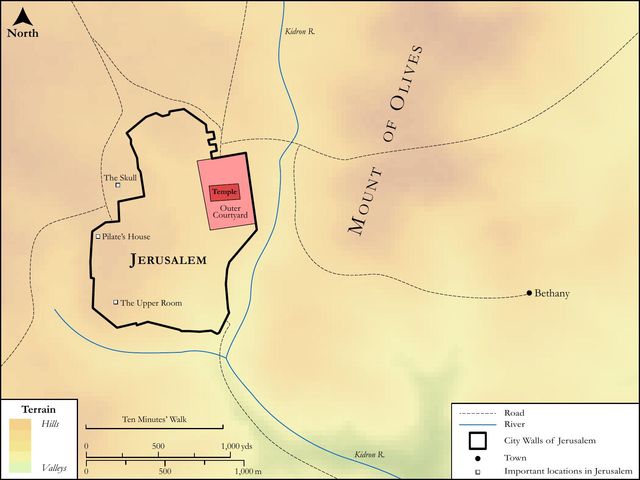
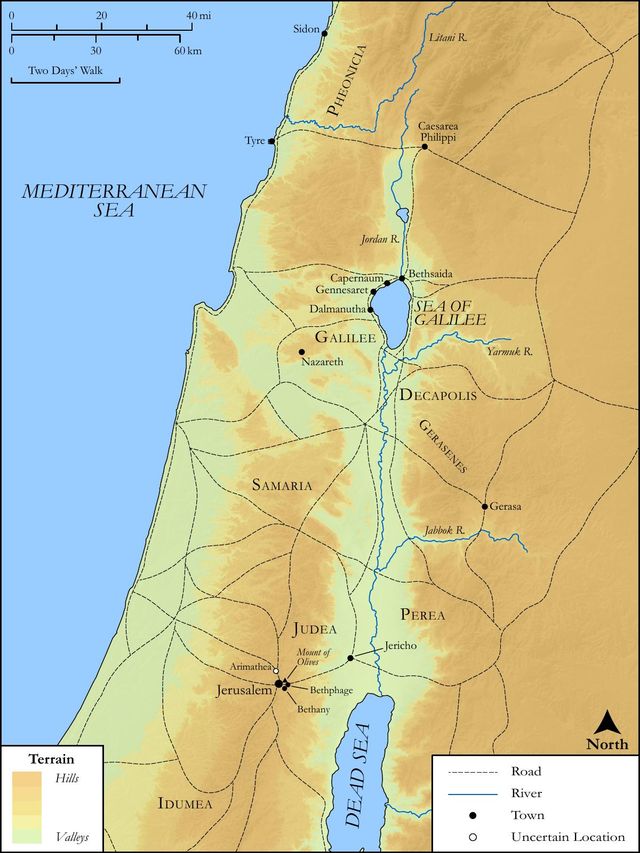
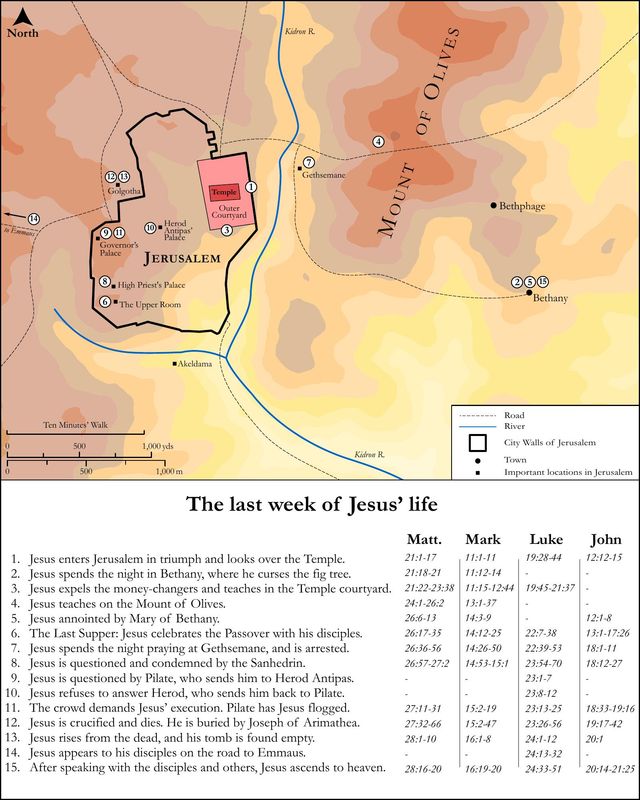
See on the biblical-era maps
Study this verse
Public-domain commentary
Matthew Henry
From his Commentary on the Whole Bible. Henry comments on passages, not single verses — this entry covers Mark 15:15–21. His two-level outline is real structure in the source text, so it is rendered as structure.
Here, I. Pilate, to gratify the Jews' malice, delivers Christ to be crucified, Mar 15:15. Willing to content the people, to do enough for them (so the word is), and make them easy, that he might keep them quiet, he released Barabbas unto them, who was the scandal and plague of their nation, and delivered Jesus to be crucified, who was the glory and blessing of their nation. Though he had scourged him before, hoping that would content them, and then not designing to crucify him, yet he went on to that; for no wonder that he who could persuade himself to chastise one that was innocent (Luk 23:16), could by degrees persuade himself to crucify him.
Christ was crucified, for that was, 1. A bloody death, and without blood no remission, Heb 9:22. The blood is the life (Gen 9:4); it is the vehicle of the animal spirits, which connect the soul and body, so that the exhausting of the blood is the exhausting of the life. Christ was to lay down his life for us, and therefore shed his blood. Blood made atonement for the soul (Lev 17:11), and therefore in every sacrifice of propitiation special order was given for the pouring out of the blood, and the sprinkling of that before the Lord. Now, that Christ might answer all these types, he shed his blood. 2. It was a painful death; the pains were exquisite and acute, for death made its assaults upon the vitals by the exterior parts, which are quickest of sense. Christ died, so as that he might feel himself die, because he was to be both the priest and the sacrifice; so that he might be active in dying; because he was to make his soul an offering for sin. Tully calls crucifixion, Teterrimum supplicium - A most tremendous punishment: Christ would meet death in its greatest terror, and so conquer it. 3. It was a shameful death, the death of slaves, and the vilest malefactors; so it was accounted among the Romans. The cross and the shame are put together. God having been injured in his honour by the sin of man, it is in his honour that Christ makes him satisfaction, not only by denying himself in, and divesting himself of, the honours due to his divine nature, for a time, but by submitting the greatest reproach and ignominy the human nature was capable of being loaded with. Yet this was not the worst. 4. It was a cursed death; thus it was branded by the Jewish law (Deu 21:23); He that is hanged, is accursed of God, is under a particular mark of God's displeasure. It was the death that Saul's sons were put to, when the guilt of their father' bloody house was to be expiated, Sa2 21:6. Haman and his sons were hanged, Est 7:10; Est 9:13. We do not read any of the prophets of the Old Testament that were hanged; but now that Christ has submitted to be hanged upon a tree, the reproach and curse of that kind of death are quite rolled away, so that it ought to be any hindrance to the comfort of those who die either innocently or penitently, nor any diminution fRom. but rather an addition to, the glory of those who die martyrs for Christ, to be as he was, hanged upon a tree.
II.Pilate, to gratify the gay humour of the Roman soldiers, delivered him to them, to be abused and spitefully treated, while they were preparing for the execution. They called together the whole regiment that was then in waiting, and they went into an inner hall, where they ignominiously abused our Lord Jesus, as a king, just as in the high priest's hall his servants had ignominiously abused him as a Prophet and Saviour.
1.Do kings wear robes of purple or scarlet? They clothed him with purple. This abuse done to Christ in his apparel should be an intimation to Christians, not to make the putting on of apparel their adorning, Pe1 3:4. Shall a purple or scarlet robe be matter of pride to a Christian, which was matter of reproach and shame to Christ.
2.Do kings wear crowns? They platted a crown of thorns, and put it on his head. A crown of straw, or rushes, would have been banter enough; but this was pain also. He wore the crown of thorns which we had deserved, that we might wear the crown of glory which he merited. Let us be taught by these thorns, as Gideon taught the men of Succoth, to hate sin, and be uneasy under it, and to be in love with Jesus Christ, who is here a lily among thorns. If we be at any time afflicted with a thorn in the flesh, let it be our comfort, that our high priest is touched with the feelings of our infirmities, having himself known what thorns in the flesh meant.
3.Are kings attended with the acclamations of their subjects, O king, live for ever? That also is mimicked; they saluted him with "Hail, King of the Jews; such a prince, and such a people, even good enough for one another." 4. Kings have sceptres put into their hand, marks of dominion, as the crown is of dignity; to imitate this, they put a reed in his right hand. Those that despise the authority of Jesus Christ, as not to be observed and obeyed, who regard not either the precepts of his word, or the threatenings of his wrath, do, in effect, put a reed in his hand; nay, and, as these here, smite him on the head with it, such is the indignity they do him. 5. Subjects, when they swear allegiance, were wont to kiss their sovereign; and this they offered to do, but, instead of that, spit upon him. 6. Kings used to be addressed upon the knee; and this also they brought into the jest, they bowed the knee, and worshipped him; this they did in scorn, to make themselves and one another laugh. We were by sin become liable to everlasting shame and contempt, to deliver us from which, our Lord Jesus submitted to this shame and contempt for us. He was thus mocked, not in his own clothes, but in another's, to signify that he suffered not for his own sin; the crime was ours, the shame his. Those who pretend subjection to Christ, but at the same time give themselves up to the service of the world and the flesh, do, in effect, the same that they did, who bowed the knee to him in mockery, and abused him with, Hail, king of the Jews, when they said, We have no king but Caesar. Those that bow the knee to Christ, but do not bow the soul, that draw nigh to him with their mouths, and honour him with their lips, but their hearts are far from him, put the same affront upon him that these here did.
III.The soldiers, at the hour appointed, led him away from Pilate's judgment-hall to the place of execution (Mar 15:20), as a sheep to the slaughter; he was led forth with the workers of iniquity, though he did no sin. But lest his death, under the load of his cross, which he was to carry, should prevent the further cruelties they intended, they compelled one Simon of Cyrene to carry his cross for him. He passed by, coming out of the country or out of the fields, not thinking of any such matter. Note, We must not think it strange, if crosses come upon us suddenly, and we be surprised by them. The cross was a very troublesome unwieldy load: but he that carried it a few minutes, had the honour to have his name upon the record in the book of God, though otherwise an obscure person; so that, wherever this gospel is preached; so that, wherever this gospel is preached, there shall this be told for a memorial to him: in like manner, though no affliction, no cross, for the present, be joyous, but grievous, yet afterward it yields a crown of glory to them that are exercised thereby.
Historical interpretation
Ten Centuries of Reception
9 surviving comments on this verse. Each one is dated, so this reads as a timeline rather than a list.
Select a marker to jump to its quote. Markers stagger vertically where authors wrote within a few decades of each other.
Here are two goats; one is the scape goat, that is, one loosed and sent out into the wilderness of hell with the sin of the people; the other is slain, as a lamb, for the sins of those who are forgiven. The Lord's portion is always slain; the devil's part, (for he is the master of those men, which is the meaning of Barabbas,) when freed, is cast headlong into hell.
He himself suffered the lash, in whose name his servants now scourge the devil and his angels. He who now crowns the martyrs with eternal garlands was himself crowned with thorns.
[The daughter of Zion] repaid him with evil for the immensity of his grace. The Father had washed her from her blood, but she defiled his Son with her spitting. The Father had clothed her with fine linen and purple, but she clothed him with garments of mockery. He had placed a crown of glory on her head, but she plaited a crown of thorns for him. He had nourished her with choicest food and honey, but she gave him gall. He had given her pure wine, but she offered him vinegar in a sponge. The One who had introduced her into cities, she drove out into the desert. The One who had put shoes on her feet, she made hasten barefoot towards Golgotha. The One who had girded her loins with sapphire, she pierced in the side with a lance. When she had outraged the servants [of God] and killed the prophets, she was led into captivity to Babylon, and when the time of her punishment was completed, her return [from captivity] took place.
For Christ was not separated from the ungodly, but was judged with the ungodly; for it was said about him, “He was counted among the wicked.”
The criminal escaped; Christ was condemned. The one guilty of many crimes received a pardon; he who had remitted the crimes of all who confess was condemned. And yet the cross itself also, if you reflect upon it, was a courtroom. In the middle of it stood the final judge.
(ubi sup.) Pilate furnished many opportunities of releasing Jesus, in the first place contrasting a robber with the Just One. Wherefore it is said, Now at that feast he released unto them one prisoner, whomsoever they desired.
(ubi sup.) This demand which the Jews made with such toil to themselves still sticks to them. Because, when the choice was given to them, they chose a robber instead of Christ, a murderer instead of the Saviour, they deservedly lost their salvation and their life, and they subjected themselves to such a degree to robbery and sedition, that they lost their country and their kingdom which they preferred to Christ, and never regained their liberty, body or soul. Then Pilate gives another opportunity of releasing the Saviour, when there follows, And Pilate answered and said again unto them, What will ye then that I should do unto the King of the Jews?
(ubi sup.) But the Jews giving loose to their madness do not answer the question of the judge. Wherefore it goes on, And they cried out the more exceedingly, Crucify him, that those words of the Prophet Jeremiah might be fulfilled, Mine heritage is unto me as a lion in the forest, it crieth out against me. (Jer. 12:8) There follows, And so Pilate, willing to content the people, released Barabbas unto them, and delivered Jesus, when he had scourged him, to be crucified.
(ubi sup.) We must understand that Jesus was scourged by no other than Pilate himself. For John writes, Pilate took Jesus, and scourged him, (John 13:1) which we must suppose that he did, that the Jews might be satisfied with His pains and insults, and cease from thirsting for His blood.
But Pilate, willing to satisfy the people, released Barabbas to them and delivered Jesus, after having him scourged, to be crucified. Jesus, however, is understood to have been scourged not by another, but by Pilate himself. For John writes openly: They all cried again, saying: Not this man, but Barabbas. Now Barabbas was a robber. Then Pilate took Jesus and scourged him (John XVIII). And then he adds: And the soldiers, weaving a crown of thorns, placed it on his head, etc. (John XIX). Indeed, he is believed to have done this and to have delivered him to the soldiers to be mocked, so that, satisfied with his pains and insults, they might willingly stop desiring his death. This was done, for it was written: Many are the stripes of the wicked (Psalm XXXI), he was scourged so that we might be freed from beatings, the Scripture saying: The scourge shall not approach your tabernacle (Psalm XC).
Now see the wickedness of the Jews, and the moderation of Pilate, though he too was worthy of condemnation for not resisting the people. For they cried out, Crucify; he faintly tries to save Jesus from their determined sentence, and again puts a question to them. Wherefore there follows, Then Pilate said unto them, Why, what evil hath he done? For he wished in this way to find an opportunity for releasing Christ, who was innocent.
He wished indeed to satisfy the people, that is, to do their will, not what was agreeable to justice and to God.
(non occ.) Which indeed he was accustomed to do, to obtain favour with the people, and above all, on the feast day, when the people of the whole province of the Jews flocked to Jerusalem. And that the wickedness of the Jews might appear the greater, the enormity of the sin of the robber, whom they preferred to Christ, is next described. Wherefore there follows: And there was one Barabbas, who lay bound with them that had made insurrection with him, who had committed murder in the insurrection. In which words their wickedness is shown both from the heinousness of his signal crime, in that he had committed murder, and from the way in which he did it, because he had in doing it raised a sedition and disturbed the city, and also because his crime was notorious, for he was bound with seditious persons. It goes on: And the multitude, when it had come up, began to desire him to do as he had ever done unto them.
Continue studying Mark 15:15 across the web’s major study libraries — every link below opens this exact verse, chapter, or book on the destination site.
Read & Compare
 BibleGatewayThis verse in more than 200 translations and 70 languages.
 Bible.comThe YouVersion reader — hundreds of translations, reading plans, and highlights.
 ESV.orgCrossway's official English Standard Version reader.
 NET BibleThe NET translation with 60,000+ translators' notes on every rendering decision.
 STEP BibleTyndale House's free study tool — original text, vocabulary, and scholarly resources.
 BibliaLogos Bible Software's free web reader.
 USCCBThe New American Bible (Revised Edition) with the U.S. bishops' study notes.
Commentaries
 BibleHub CommentariesDozens of classic commentaries on this verse, gathered on one page.
 StudyLightMore than 100 commentary sets — the largest collection on the web.
 BibleRefPlain-English commentary on what this verse means, verse by verse.
 Enduring WordDavid Guzik's free commentary on this chapter, widely used by Bible teachers.
 Bible Study ToolsVerse commentary alongside Greek and Hebrew study aids.
Original Language & Research
- BibleHub InterlinearThe verse word by word — original language, transliteration, and English.
- BibleHub LexiconEvery word's original-language definition and Strong's entry.
 Blue Letter BibleDeep-study tools — Strong's numbers, concordance, and word studies.
 CNTR CollationThe earliest Greek manuscripts of this verse, collated letter by letter.
Sermons, Hymns & Audio


TrulyRandomVerse is not affiliated with these sites and doesn’t control their content. They’re linked because they’re genuinely useful.
Summary
Mark 15:15 encapsulates the tragic culmination of Jesus' trial before Pontius Pilate, where political expediency overshadowed justice. Despite finding no fault in Jesus, Pilate, yielding to the insistent demands of the agitated crowd and his desire to maintain public order, made the fateful decision to release Barabbas, a notorious insurrectionist and murderer, and subsequently delivered Jesus to be brutally scourged and then executed by crucifixion. This pivotal moment underscores the profound human rejection of divine righteousness and the unjust suffering of the innocent Son of God, setting the stage for the ultimate act of atonement.
Context
ShowHideLiterary Context
This verse is situated at the climax of Jesus' Passion narrative in Mark's Gospel, immediately following Pilate's repeated attempts to release Jesus and the crowd's escalating demands for His crucifixion. Mark 15 opens with Jesus being delivered to Pilate by the chief priests, elders, and scribes after His condemnation by the Sanhedrin. Pilate's interrogation of Jesus (Mark 15:2-5) reveals Jesus' silent dignity and Pilate's own recognition of His innocence, as implied by his question, "Are you the King of the Jews?" and his subsequent offer to release Jesus. The custom of releasing a prisoner at Passover (Mark 15:6-8) provides the mechanism through which the crowd, incited by the religious leaders, chooses Barabbas over Jesus. Mark 15:15 thus marks the point of no return, where Pilate definitively cedes to the mob, sealing Jesus' fate and setting in motion the events leading directly to the crucifixion described in the subsequent verses.
Historical & Cultural Context
The scene unfolds in Jerusalem during the Passover festival, a time of heightened religious and political tension. Pontius Pilate, the Roman governor of Judea (26-36 AD), held ultimate judicial authority, including the power of capital punishment, which the Jewish Sanhedrin lacked under Roman rule. The "custom" of releasing a prisoner at Passover, though not explicitly mentioned in other historical sources, is affirmed by all four Gospels (Matthew 27:15; Luke 23:17; John 18:39) and likely served as a Roman gesture of goodwill to appease the Jewish populace during their most significant national holiday. Scourging (Latin: flagellatio) was a common, brutal Roman punishment, often a prelude to crucifixion, designed to weaken the victim and hasten death. It involved a whip (flagrum) with bone or metal pieces, inflicting severe lacerations and often leading to death from blood loss or shock. Pilate's "willingness to content the people" reflects the precarious position of a Roman governor, who needed to maintain peace and order to avoid reports of unrest reaching Rome, which could jeopardize his career or even his life.
Key Themes
ShowHideMark 15:15 powerfully contributes to several overarching themes within Mark's Gospel and the broader biblical narrative. It highlights the theme of Injustice and Political Expediency, as Pilate, despite recognizing Jesus' innocence (compare Luke 23:4), sacrifices justice for political stability and popular appeasement. The verse also underscores Human Rejection of God's Anointed, as the crowd, swayed by the religious leaders, chooses a violent rebel over the Prince of Peace, a choice that tragically mirrors humanity's fallen nature. Furthermore, it foreshadows Jesus' Voluntary Suffering and Substitutionary Sacrifice, emphasizing that Jesus' brutal scourging and delivery to crucifixion, though a result of human sin, were part of God's sovereign plan for redemption, fulfilling prophecies of a suffering servant (see Isaiah 53:5-6). Finally, the narrative showcases Divine Sovereignty Amidst Human Sin, demonstrating that even the most heinous acts of human injustice cannot thwart God's ultimate redemptive purposes.
Exposition and Analysis
ShowHideKey Word Analysis
ShowHideThis word signifies Pilate's internal disposition or intent. It suggests that his decision was not coerced in the sense of physical force, but rather stemmed from a desire or inclination to satisfy the crowd. It highlights his agency and moral culpability in prioritizing public appeasement over righteous judgment, indicating a deliberate choice rather than a reluctant submission.
This term refers to a "throng" or "multitude," often implying an unruly, easily swayed crowd or "rabble." In this context, it emphasizes the collective, agitated nature of those demanding Jesus' crucifixion. It underscores the immense public pressure Pilate faced and the volatile atmosphere of the Passover festival in Jerusalem, where a riot could quickly erupt.
This verb means "to surrender," "yield up," or "intrust." It precisely describes Pilate's action of formally handing Jesus over to the Roman soldiers for the prescribed punishment and execution. This act of "delivery" is significant, echoing the earlier betrayal of Jesus by Judas (who also "delivered" Him) and fulfilling prophetic themes of the Messiah being "given over" for the sins of many.
Verse Breakdown
ShowHide"And so Pilate, willing to content the people,"
This opening clause establishes Pilate's motivation for his decision. The phrase "willing to content the people" (from G1014 boúlomai and G2425 hikanós with G4160 poiéō) reveals Pilate's primary concern was not justice or truth, but rather appeasing the agitated crowd and preventing further unrest. He prioritized political expediency and maintaining social order over the life of an innocent man, highlighting a profound moral compromise.
"released Barabbas unto them,"
This action is the direct consequence of Pilate's desire to "content the people." Barabbas, identified in Mark 15:7 as a murderer and insurrectionist, represents the antithesis of Jesus. Pilate's choice to release a known criminal and rebel instead of the innocent "King of the Jews" starkly illustrates the crowd's perverse judgment and Pilate's capitulation to their demands, setting a powerful contrast between the one chosen for freedom and the one chosen for death.
"and delivered Jesus, when he had scourged him, to be crucified."
This final clause describes the horrific fate decreed for Jesus. "Delivered" (G3860 paradídōmi) signifies the formal handing over of Jesus to the Roman authorities for execution. The act of "scourging" (G5417 phragellóō) was a brutal Roman flogging, often with a whip designed to tear flesh, intended to inflict extreme pain and weaken the condemned before crucifixion. "To be crucified" (G4717 stauróō) indicates the ultimate, agonizing form of Roman capital punishment, reserved for the worst criminals and rebels. This entire phrase encapsulates the profound injustice and immense suffering Jesus was about to endure for humanity.
Literary Devices
ShowHideMark 15:15 is rich in literary devices that amplify its theological significance. Irony is profoundly present, as the Roman governor, whose duty was to uphold justice, instead condemns an innocent man while releasing a guilty insurrectionist. The crowd's choice of Barabbas, whose name possibly means "son of the father," over Jesus, the true Son of the Father, creates a stark Contrast, highlighting humanity's rejection of divine truth and preference for rebellion. The verse also employs Foreshadowing, as Pilate's act of "delivering" Jesus for scourging and crucifixion explicitly points toward the ultimate suffering and death of Christ, which is the central event of the Christian faith. The brutal details of scourging and crucifixion, though concisely stated, evoke a powerful sense of Pathos, inviting the reader to contemplate the immense physical and emotional suffering Jesus endured.
Theological and Thematic Connections
ShowHideMark 15:15 stands as a stark testament to the depth of human sin and the profound injustice that led to the cross, yet paradoxically, it also highlights the unfolding of God's sovereign plan of redemption. Pilate's act of delivering Jesus, though born of human weakness and political maneuvering, was a necessary step in God's eternal design for salvation. This moment underscores the concept of substitutionary atonement: an innocent man, Jesus, was condemned and suffered in the place of the guilty (represented by Barabbas and, by extension, all humanity). The scourging and crucifixion were not merely acts of human cruelty but integral parts of the divine sacrifice, through which Jesus bore the penalty for sin, offering reconciliation between God and humanity.
Reflection and Application
ShowHideMark 15:15 serves as a profound mirror, reflecting not only the historical injustice against Jesus but also timeless truths about human nature, leadership, and divine love. Pilate's compromise, driven by a desire to "content the people," is a sobering reminder of the dangers of prioritizing popularity or political expediency over truth and righteousness. For believers, this challenges us to examine our own lives: are we willing to stand for what is right, even when it is unpopular or costly? Do we compromise our convictions to avoid conflict or gain approval? Furthermore, the verse vividly portrays the immense cost of sin, which necessitated the brutal suffering and death of the innocent Son of God. This should deepen our appreciation for God's immeasurable love, demonstrated in His willingness to allow His Son to endure such agony for our redemption. It calls us to respond with gratitude, repentance, and a commitment to live lives that honor His sacrifice, extending compassion to those who suffer unjustly and courageously advocating for truth in a world that often prefers convenience over conviction.
Questions for Reflection
ShowHideFAQ
ShowHideWhy did Pilate release Barabbas instead of Jesus?
ShowHidePilate released Barabbas primarily to "content the people" (Mark 15:15) and avoid a riot or further unrest, which could have jeopardized his standing with Caesar. It was a custom during the Passover festival for the Roman governor to release a prisoner chosen by the crowd (Mark 15:6). Although Pilate recognized Jesus' innocence and attempted to release Him (Luke 23:4), the Jewish chief priests incited the crowd to demand Barabbas, a notorious rebel and murderer, be released instead. Pilate, fearing the volatile crowd and prioritizing political stability, succumbed to their demands, sacrificing justice for expediency.
What was "scourging," and why was it done to Jesus?
ShowHideScourging (Greek, phragellóō) was a brutal form of Roman flogging, typically administered with a whip (flagellum) embedded with pieces of bone, metal, or lead. It was designed to inflict extreme pain, tear the flesh, and often resulted in severe blood loss, shock, and even death. It was a common preliminary punishment before crucifixion, intended to weaken the condemned and hasten their death on the cross. Jesus was scourged as part of His condemnation to crucifixion, intensifying His suffering and fulfilling prophecies of the suffering servant (Isaiah 53:5).
Christ-Centered Fulfillment
ShowHideMark 15:15, though depicting an act of profound human injustice, is a pivotal moment in the unfolding of God's redemptive plan, finding its ultimate fulfillment in the person and work of Jesus Christ. Pilate's act of "delivering" Jesus to be scourged and crucified, while a human decision, was simultaneously part of God's sovereign will, "the determinate counsel and foreknowledge of God" (Acts 2:23). In this verse, we witness the innocent Lamb of God being led to slaughter, a direct fulfillment of Old Testament prophecies concerning the Suffering Servant who would bear the sins of many (Isaiah 53:7). The choice of Barabbas, a murderer and insurrectionist, to be released in place of Jesus, the innocent Messiah, powerfully illustrates the doctrine of substitutionary atonement: Jesus, the sinless one, took the place of the guilty, bearing the penalty that humanity deserved (2 Corinthians 5:21). His scourging and crucifixion, though horrific, were the means by which He purchased our salvation, shedding His blood as the perfect sacrifice to atone for sin (Hebrews 9:22). Thus, Mark 15:15 is not merely a historical account of injustice but a foundational stone in the narrative of Christ's redemptive work, demonstrating the depth of God's love and the triumph of grace over sin.