


John 19:15
Bible text: King James Version (1769 Blayney text) · Public domain
Bible text: King James Version with Strong's numbers · Public domain
Bible text: Berean Standard Bible · Public domain
Bible text: American Standard Version (1901) · Public domain
Bible text: World English Bible, Messianic edition · Public domain
Bible text: Geneva Bible (1599) · Public domain
Bible text: Young's Literal Translation · Public domain
- οἱhoi<the>G3588T-NPMDefinite article Nominative Plural Masculine
- δὲdenowG1161CONJConjunction
- ἐκραύγασανekraugasanThey cried outG2905V-AAI-3PVerb Aorist Active Indicative 3rd Plural
- ἆρονaronawayG142V-AAM-2SVerb Aorist Active Imperative 2nd Singular
- ἆρονaronaway!G142V-AAM-2SVerb Aorist Active Imperative 2nd Singular
- σταύρωσονstaurōsondo crucifyG4717V-AAM-2SVerb Aorist Active Imperative 2nd Singular
- αὐτόνautonHim!G846P-ASMPersonal pronoun Accusative Singular Masculine
- λέγειlegeiSaysG3004V-PAI-3SVerb Present Active Indicative 3rd Singular
- αὐτοῖςautoisto themG846P-DPMPersonal pronoun Dative Plural Masculine
- ὁho<the>G3588T-NSMDefinite article Nominative Singular Masculine
- Πιλᾶτος·PilatosPilateG4091N-NSM-PNoun Nominative Singular Masculine Individual
- τὸνtonTheG3588T-ASMDefinite article Accusative Singular Masculine
- βασιλέαbasileaKingG935N-ASM-TNoun Accusative Singular Masculine Title
- ὑμῶνhumōnof youG4771P-2GPPersonal pronoun Genitive 2nd Plural
- σταυρώσω;staurōsōshall I crucify?G4717V-AAS-1SVerb Aorist Active Subjunctive 1st Singular
- ἀπεκρίθησανapekrithēsanAnsweredG611V-ADI-3PVerb Aorist Middle Deponent Indicative 3rd Plural
- οἱhoitheG3588T-NPMDefinite article Nominative Plural Masculine
- ἀρχιερεῖς·archiereischief priestsG749N-NPMNoun Nominative Plural Masculine
- οὐκoukNotG3756PRT-NNegative Particle Negative
- ἔχομενechomenwe haveG2192V-PAI-1PVerb Present Active Indicative 1st Plural
- βασιλέαbasileaa kingG935N-ASMNoun Accusative Singular Masculine
- εἰeionlyG1487CONDConjunction
- μὴmēexceptG3361PRT-NNegative Particle Negative
- ΚαίσαραKaisaraCaesarG2541N-ASM-TNoun Accusative Singular Masculine Title
English is a literal word-by-word gloss of the Greek, not the KJV's wording. Why?
This is the original text the KJV's translators worked from — each Greek word with its own literal English meaning in this verse, prepared by scholars at Tyndale House, Cambridge. The KJV translates whole sentences, not word by word, so its wording differs: one Greek word can become several English words, and the KJV may choose “charity” where the gloss reads “love”. Both are faithful — they answer different questions. For the KJV's own rendering, switch to the KJV text.
Details
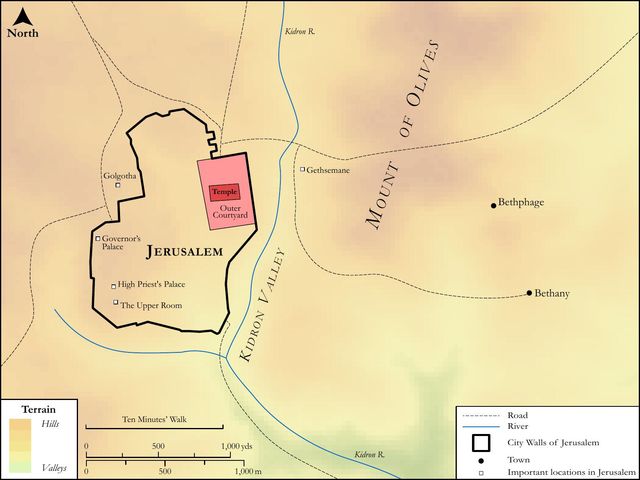
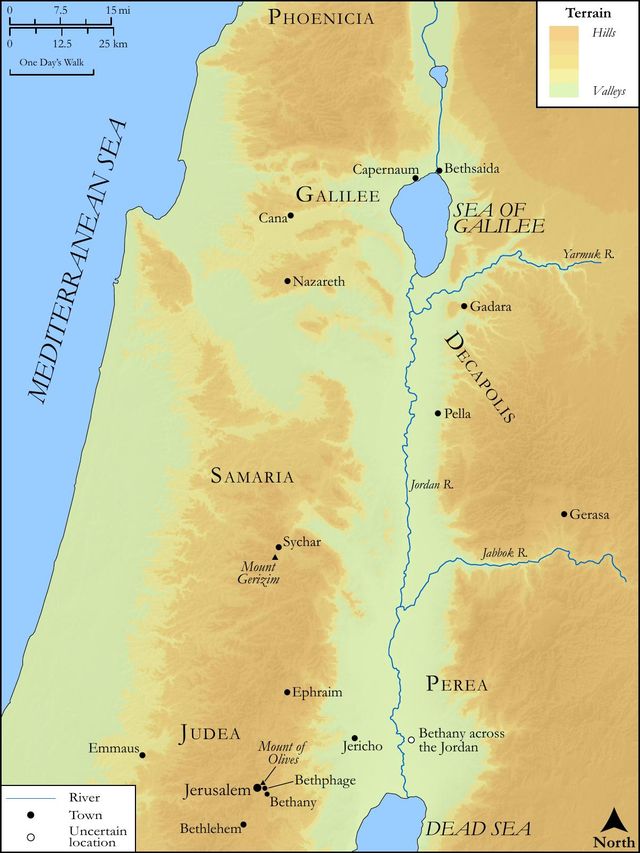
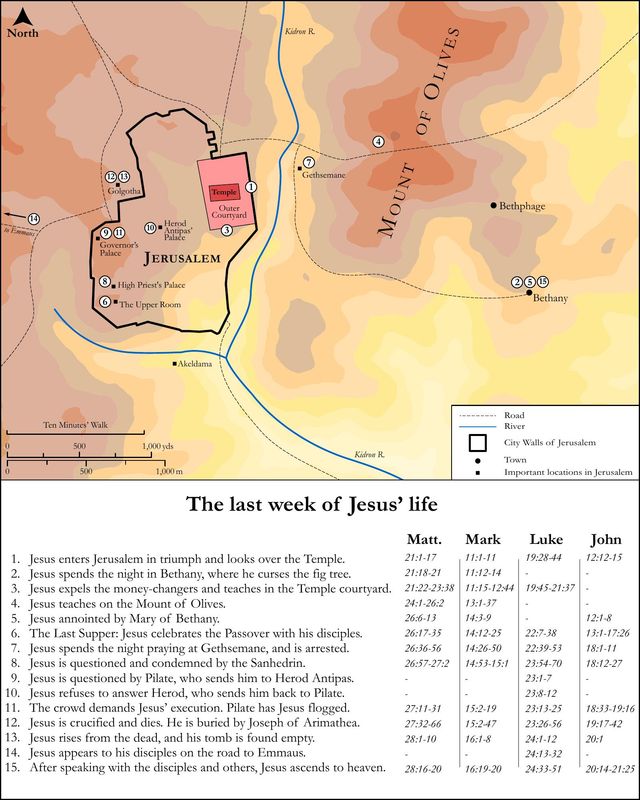
See on the biblical-era maps
Study this verse
Public-domain commentary
Matthew Henry
From his Commentary on the Whole Bible. Henry comments on passages, not single verses — this entry covers John 19:1–15. His four-level outline is real structure in the source text, so it is rendered as structure.
Here is a further account of the unfair trial which they gave to our Lord Jesus. The prosecutors carrying it on with great confusion among the people, and the judge with great confusion in his own breast, between both the narrative is such as is not easily reduced to method; we must therefore take the parts of it as they lie.
I.The judge abuses the prisoner, though he declares him innocent, and hopes therewith to pacify the prosecutors; wherein his intention, if indeed it was good, will by no means justify his proceedings, which were palpably unjust.
1.He ordered him to be whipped as a criminal, v. 1. Pilate, seeing the people so outrageous, and being disappointed in his project of releasing him upon the people's choice, took Jesus, and scourged him, that is, appointed the lictors that attended him to do it. Bede is of opinion that Pilate scourged Jesus himself with his own hands, because it is said, He took him and scourged him, that it might be done favourably. Matthew and Mark mention his scourging after his condemnation, but here it appears to have been before. Luke speaks of Pilate's offering to chastise him, and let him go, which must be before sentence. This scourging of him was designed only to pacify the Jews, and in it Pilate put a compliment upon them, that he would take their word against his own sentiments so far. The Roman scourgings were ordinarily very severe, not limited, as among the Jews, to forty stripes; yet this pain and shame Christ submitted to for our sakes.
(1.)That the scripture might be fulfilled, which spoke of his being stricken, smitten, and afflicted, and the chastisement of our peace being upon him (Isa. liii. 5), of his giving his back to the smiters (Isa. l. 6), of the ploughers ploughing upon his back, Ps. cxxix. 3. He himself likewise had foretold it, Matt. xx. 19; Mark x. 34; Luke xviii. 33.
(2.)That by his stripes we might be healed, 1 Pet. ii. 4. We deserved to have been chastised with whips and scorpions, and beaten with many stripes, having known our Lord's will and not done it; but Christ underwent the stripes for us, bearing the rod of his Father's wrath, Lam. iii. 1. Pilate's design in scourging him was that he might not be condemned, which did not take effect, but intimated what was God's design, that his being scourged might prevent our being condemned, we having fellowship in his sufferings, and this did take effect: the physician scourged, and so the patient healed.
(3.)That stripes, for his sake, might be sanctified and made easy to his followers; and they might, as they did, rejoice in that shame (Acts v. 41; xvi. 22, 25), as Paul did, who was in stripes above measure, 2 Cor. xi. 23. Christ's stripes take out the sting of theirs, and alter the property of them. We are chastened of the Lord, that we may not be condemned with the world, 1 Cor. xi. 32.
2.He turned him over to his soldiers, to be ridiculed and made sport with as a fool (v. 2, 3): The soldiers, who were the governor's life-guard, put a crown of thorns upon his head; such a crown they thought fittest for such a king; they put on him a purple robe, some old threadbare coat of that colour, which they thought good enough to be the badge of his royalty; and they complimented him with, Hail, king of the Jews (like people like king), and then smote him with their hands.
(1.)See here the baseness and injustice of Pilate, that he would suffer one whom he believed an innocent person, and if so an excellent person, to be thus abused and trampled on by his own servants. Those who are under the arrest of the law ought to be under the protection of it; and their being secured is to be their security. But Pilate did this,
[1.]To oblige his soldiers' merry humour, and perhaps his own too, notwithstanding the gravity one might have expected in a judge. Herod, as well as his men of war, had just before done the same, Luke xxiii. 11. It was as good as a stage-play to them, now that it was a festival time; as the Philistines made sport with Samson.
[2.]To oblige the Jews' malicious humour, and to gratify them, who desired that all possible disgrace might be done to Christ, and the utmost indignities put upon him.
(2.)See here the rudeness and insolence of the soldiers, how perfectly lost they were to all justice and humanity, who could thus triumph over a man in misery, and one that had been in reputation for wisdom and honour, and never did any thing to forfeit it. But thus hath Christ's holy religion been basely misrepresented, dressed up by bad men at their pleasure, and so exposed to contempt and ridicule, as Christ was here.
[1.]They clothe him with a mock-robe, as if it were a sham and a jest, and nothing but the product of a heated fancy and a crazed imagination. And as Christ is here represented as a king in conceit only, so is his religion as a concern in conceit only, and God and the soul, sin and duty, heaven and hell, are with many all chimeras.
[2.]They crown him with thorns; as if the religion of Christ were a perfect penance, and the greatest pain and hardship in the world; as if to submit to the control of God and conscience were to thrust one's head into a thicket of thorns; but this is an unjust imputation; thorns and snares are in the way of the froward, but roses and laurels in religion's ways.
(3.)See here the wonderful condescension of our Lord Jesus in his sufferings for us. Great and generous minds can bear any thing better than ignominy, any toil, any pain, any loss, rather than reproach; yet this the great and holy Jesus submitted to for us. See and admire,
[1.]The invincible patience of a sufferer, leaving us an example of contentment and courage, evenness, and easiness of spirit, under the greatest hardships we may meet with in the way of duty.
[2.]The invincible love and kindness of a Saviour, who not only cheerfully and resolutely went through all this, but voluntarily undertook it for us and for our salvation. Herein he commended his love, that he would not only die for us, but die as a fool dies. First, He endured the pain; not the pangs of death only, though in the death of the cross these were most exquisite; but, as if these were too little, he submitted to those previous pains. Shall we complain of a thorn in the flesh, and of being buffeted by affliction, because we need it to hide pride from us, when Christ humbled himself to bear those thorns in the head, and those buffetings, to save and teach us? 2 Cor. xii. 7. Secondly, He despised the shame, the shame of a fool's coat, and the mock-respect paid him, with, Hail, king of the Jews. If we be at any time ridiculed for well-doing, let us not be ashamed, but glorify God, for thus we are partakers of Christ's sufferings. He that bore these sham honours was recompensed with real honours, and so shall we, if we patiently suffer shame for him.
II.Pilate, having thus abused the prisoner, presents him to the prosecutors, in hope that they would now be satisfied, and drop the prosecution, v. 4, 5. Here he proposes two things to their consideration:—
1.That he had not found any thing in him which made him obnoxious to the Roman government (v. 4): I find no fault in him; oudemian aitian heurisko—I do not find in him the least fault, or cause of accusation. Upon further enquiry, he repeats the declaration he had made, ch. xviii. 38. Hereby he condemns himself; if he found no fault in him, why did he scourge him, why did he suffer him to be abused? None ought to suffer ill but those that do ill; yet thus many banter and abuse religion, who yet, if they be serious, cannot but own they find no fault in it. If he found no fault in him, why did he bring him out to his prosecutors, and not immediately release him, as he ought to have done? If Pilate had consulted his own conscience only, he would neither have scourged Christ nor crucified him; but, thinking to trim the matter, to please the people by scourging Christ, and save his conscience by not crucifying him, behold he does both; whereas, if he had at first resolved to crucify him, he need not have scourged him. It is common for those who think to keep themselves from greater sins by venturing upon less sins to run into both.
2.That he had done that to him which would make him the less dangerous to them and to their government, v. 5. He brought him out to them, wearing the crown of thorns, his head and face all bloody, and said, "Behold the man whom you are so jealous of," intimating that though his having been so popular might have given them some cause to fear that his interest in the country would lessen theirs, yet he had taken an effectual course to prevent it, by treating him as a slave, and exposing him to contempt, after which he supposed the people would never look upon him with any respect, nor could he ever retrieve his reputation again. Little did Pilate think with what veneration even these sufferings of Christ would in after ages be commemorated by the best and greatest of men, who would glory in that cross and those stripes which he thought would have been to him and his followers a perpetual and indelible reproach.
(1.)Observe here our Lord Jesus shows himself dressed up in all the marks of ignominy. He came forth, willing to be made a spectacle, and to be hooted at, as no doubt he was when he came forth in this garb, knowing that he was set for a sign that should be spoken against, Luke ii. 34. Did he go forth thus bearing our reproach? Let us go forth to him bearing his reproach, Heb. xiii. 13.
(2.)How Pilate shows him: Pilate saith unto them, Behold the man. He saith unto them: so the original is; and, the immediate antecedent being Jesus, I see no inconvenience in supposing these to be Christ's own words; he said, "Behold the man against whom you are so exasperated." But some of the Greek copies, and the generality of the translators, supply it as we do, Pilate saith unto them, with a design to appease them, Behold the man; not so much to move their pity, Behold a man worthy your compassion, as to silence their jealousies, Behold a man not worthy your suspicion, a man from whom you can henceforth fear no danger; his crown is profaned, and cast to the ground, and now all mankind will make a jest of him. The word however is very affecting: Behold the man. It is good for every one of us, with an eye of faith, to behold the man Christ Jesus in his sufferings. Behold this king with the crown wherewith his mother crowned him, the crown of thorns, Cant. iii. 11. "Behold him, and be suitably affected with the sight. Behold him, and mourn because of him. Behold him, and love him; be still looking unto Jesus."
III.The prosecutors, instead of being pacified, were but the more exasperated, v. 6, 7.
1.Observe here their clamour and outrage. The chief priests, who headed the mob, cried out with fury and indignation, and their officers, or servants, who must say as they said, joined with them in crying, Crucify him, crucify him. The common people perhaps would have acquiesced in Pilate's declaration of his innocency, but their leaders, the priests, caused them to err. Now by this it appears that their malice against Christ was,
(1.)Unreasonable and most absurd, in that they offer not to make good their charges against him, nor to object against the judgment of Pilate concerning him; but, though he be innocent, he must be crucified.
(2.)It was insatiable and very cruel. Neither the extremity of his scourging, nor his patience under it, nor the tender expostulations of the judge, could mollify them in the least; no, nor could the jest into which Pilate had turned the cause, put them into a pleasant humour.
(3.)It was violent and exceedingly resolute; they will have it their own way, and hazard the governor's favour, the peace of the city, and their own safety, rather than abate of the utmost of their demands. Were they so violent in running down our Lord Jesus, and in crying, Crucify him, crucify him? and shall not we be vigorous and zealous in advancing his name, and in crying, Crown him, Crown him? Did their hatred of him sharpen their endeavours against him? and shall not our love to him quicken our endeavours for him and his kingdom?
2.The check Pilate gave to their fury, still insisting upon the prisoner's innocency: "Take you him and crucify him, if he must be crucified." This is spoken ironically; he knew they could not, they durst not, crucify him; but it is as if he should say, "You shall not make me a drudge to your malice; I cannot with a safe conscience crucify him." A good resolve, if he would but have stuck to it. He found no fault in him, and therefore should not have continued to parley with the prosecutors. Those that would be safe from sin should be deaf to temptation. Nay, he should have secured the prisoner from their insults. What was he armed with power for, but to protect the injured? The guards of governors ought to be the guards of justice. But Pilate had not courage enough to act according to his conscience; and his cowardice betrayed him into a snare.
3.The further colour which the prosecutors gave to their demand (v. 7): We have a law, and by our law, if it were but in our power to execute it, he ought to die, because he made himself the Son of God. Now here observe,
(1.)They made their boast of the law, even when through breaking the law they dishonoured God, as is charged upon the Jews, Rom. ii. 23. They had indeed an excellent law, far exceeding the statutes and judgments of other nations; but in vain did they boast of their law, when they abused it to such bad purposes.
(2.)They discover a restless and inveterate malice against our Lord Jesus. When they could not incense Pilate against him by alleging that he pretended himself a king, they urged this, that he pretended himself a God. Thus they turn every stone to take him off.
(3.)They pervert the law, and make that the instrument of their malice. Some think they refer to a law made particularly against Christ, as if, being a law, it must be executed, right or wrong; whereas there is a woe to them that decree unrighteous decrees, and that write the grievousness which they have prescribed, Isa. x. 1. See Mic. vi. 16. But it should seem they rather refer to the law of Moses; and if so,
[1.]It was true that blasphemers, idolaters, and false prophets, were to be put to death by that law. Whoever falsely pretended to be the Son of God was guilty of blasphemy, Lev. xxiv. 16. But then,
[2.]It was false that Christ pretended to be the Son of God, for he really was so; and they ought to have enquired into the proofs he produced of his being so. If he said that he was the Son of God, and the scope and tendency of his doctrine were not to draw people from God, but to bring them to him, and if he confirmed his mission and doctrine by miracles, as undoubtedly he did, beyond contradiction, by their law they ought to hearken to him (Deut. xviii. 18, 19), and, if they did not, they were to be cut off. That which was his honour, and might have been their happiness, if they had not stood in their own light, they impute to him as a crime, for which he ought not to be crucified, for this was no death inflicted by their law.
IV.The judge brings the prisoner again to his trial, upon this new suggestion. Observe,
1.The concern Pilate was in, when he heard this alleged (v. 8): When he heard that his prisoner pretended not to royalty only, but to deity, he was the more afraid. This embarrassed him more than ever, and made the case more difficult both ways; for, (1.) There was the more danger of offending the people if he should acquit him, for he knew how jealous that people were for the unity of the Godhead, and what aversion they now had to other gods; and therefore, though he might hope to pacify their rage against a pretended king, he could never reconcile them to a pretended God. "If this be at the bottom of the tumult," thinks Pilate, "it will not be turned off with a jest." (2.) There was the more danger of offending his own conscience if he should condemn him. "Is he one" (thinks Pilate) "that makes himself the Son of God? and what if it should prove that he is so? What will become of me then?" Even natural conscience makes men afraid of being found fighting against God. The heathen had some fabulous traditions of incarnate deities appearing sometimes in mean circumstances, and treated ill by some that paid dearly for their so doing. Pilate fears lest he should thus run himself into a premunire.
2.His further examination of our Lord Jesus thereupon, v. 9. That he might give the prosecutors all the fair play they could desire, he resumed the debate, went into the judgment-hall, and asked Christ, Whence art thou? Observe,
(1.)The place he chose for this examination: He went into the judgment-hall for privacy, that he might be out of the noise and clamour of the crowd, and might examine the thing the more closely. Those that would find out the truth as it is in Jesus must get out of the noise of prejudice, and retire as it were into the judgment-hall, to converse with Christ alone.
(2.)The question he put to him: Whence art thou? Art thou from men or from heaven? From beneath or from above? He had before asked directly, Art thou a King? But here he does not directly ask, Art thou the Son of God? lest he should seem to meddle with divine things too boldly. But in general, "Whence art thou? Where wast thou, and in what world hadst thou a being, before thy coming into this world?"
(3.)The silence of our Lord Jesus when he was examined upon this head; but Jesus gave him no answer. This was not a sullen silence, in contempt of the court, nor was it because he knew not what to say; but,
[1.]It was a patient silence, that the scripture might be fulfilled, as a sheep before the shearers is dumb, so he opened not his mouth, Isa. liii. 7. This silence loudly bespoke his submission to his Father's will in his present sufferings, which he thus accommodated himself to, and composed himself to bear. He was silent, because he would say nothing to hinder his sufferings. If Christ had avowed himself a God as plainly as he avowed himself a king, it is probable that Pilate would not have condemned him (for he was afraid at the mention of it by the prosecutors); and the Romans, though they triumphed over the kings of the nations they conquered, yet stood in awe of their gods. See 1 Cor. ii. 8. If they had known him to be the Lord of glory, they would not have crucified him; and how then could we have been saved?
[2.]It was a prudent silence. When the chief priests asked him, Art thou the Son of the Blessed? he answered, I am, for he knew they went upon the scriptures of the Old Testament which spoke of the Messiah; but when Pilate asked him he knew he did not understand his own question, having no notion of the Messiah, and of his being the Son of God, and therefore to what purpose should he reply to him whose head was filled with the pagan theology, to which he would have turned his answer?
(4.)The haughty check which Pilate gave him for his silence (v. 10): "Speakest thou not unto me? Dost thou put such an affront upon me as to stand mute? What knowest thou not that, as president of the province, I have power, if I think fit, to crucify thee, and have power, if I think fit, to release thee?" Observe here,
[1.]How Pilate magnified himself, and boasts of his own authority, as not inferior to that of Nebuchadnezzar, of whom it is said that whom he would he slew, and whom he would he kept alive. Dan. v. 19. Men in power are apt to be puffed up with their power, and the more absolute and arbitrary it is the more it gratifies and humours their pride. But he magnifies his power to an exorbitant degree when he boasts that he has power to crucify one whom he had declared innocent, for no prince or potentate has authority to do wrong. Id possumus, quod jure possumus—We can do that only which we can do justly.
[2.]How he tramples upon our blessed Saviour: Speakest thou not unto me? He reflects upon him, First, As if he were undutiful and disrespectful to those in authority, not speaking when he was spoken to. Secondly, As if he were ungrateful to one that had been tender of him: "Speakest thou not to me who have laboured to secure thy release?" Thirdly, As if he were unwise for himself: "Wilt thou not speak to clear thyself to one that is willing to clear thee?" If Christ had indeed sought to save his life, now had been his time to have spoken; but that which he had to do was to lay down his life.
(5.)Christ's pertinent answer to this check, v. 11, where,
[1.]He boldly rebukes his arrogance, and rectifies his mistake: "Big as thou lookest and talkest, thou couldest have no power at all against me, no power to scourge, no power to crucify, except it were given thee from above." Though Christ did not think fit to answer him when he was impertinent (then answer not a fool according to his folly, lest thou also be like him), yet he did think fit to answer him when he was imperious; then answer a fool according to his folly, lest he be wise in his own conceit, Prov. xxvi. 4, 5. When Pilate used his power, Christ silently submitted to it; but, when he grew proud of it, he made him know himself: "All the power thou hast is given thee from above," which may be taken two ways:—First, As reminding him that his power in general, as a magistrate, was a limited power, and he could do no more than God would suffer him to do. God is the fountain of power; and the powers that are, as they are ordained by him and derived from him, so they are subject to him. They ought to go no further than his law directs them; they can go no further than his providence permits them. They are God's hand and his sword, Ps. xvii. 13, 14. Though the axe may boast itself against him that heweth therewith, yet still it is but a tool, Isa. x. 5, 15. Let the proud oppressors know that there is a higher than they, to whom they are accountable, Eccl. v. 8. And let this silence the murmurings of the oppressed, It is the Lord. God has bidden Shimei curse David; and let it comfort them that their persecutors can do no more than God will let them. See Isa. li. 12, 13. Secondly, As informing him that his power against him in particular, and all the efforts of that power, were by the determinate counsel and foreknowledge of God, Acts ii. 23. Pilate never fancied himself to look so great as now, when he sat in judgment upon such a prisoner as this, who was looked upon by many as the Son of God and king of Israel, and had the fate of so great a man at his disposal; but Christ lets him know that he was herein but an instrument in God's hand, and could no nothing against him, but by the appointment of Heaven, Acts iv. 27, 28.
[2.]He mildly excuses and extenuates his sin, in comparison with the sin of the ringleaders: "Therefore he that delivered me unto thee lies under greater guilt; for thou as a magistrate hast power from above, and art in thy place, thy sin is less than theirs who, from envy and malice, urge thee to abuse thy power."
First, It is plainly intimated that what Pilate did was sin, a great sin, and that the force which the Jews put upon him, and which he put upon himself in it, would not justify him. Christ hereby intended a hint for the awakening of his conscience and the increase of the fear he was now under. The guilt of others will not acquit us, nor will it avail in the great day to say that others were worse than we, for we are not to be judged by comparison, but must bear our own burden.
Secondly, Yet theirs that delivered him to Pilate was the greater sin. By this it appears that all sins are not equal, but some more heinous than others; some comparatively as gnats, others as camels; some as motes in the eyes, others as beams; some as pence, others as pounds. He that delivered Christ to Pilate was either, 1. The people of the Jews, who cried out, Crucify him, crucify him. They had seen Christ's miracles, which Pilate had not; to them the Messiah was first sent; they were his own; and to them, who were now enslaved, a Redeemer should have been most welcome, and therefore it was much worse in them to appear against him than in Pilate. 2. Or rather he means Caiaphas in particular, who was at the head of the conspiracy against Christ, and first advised his death, ch. xi. 49, 50. The sin of Caiaphas was abundantly greater than the sin of Pilate. Caiaphas prosecuted Christ from pure enmity to him and his doctrine, deliberately and of malice prepense. Pilate condemned him purely for fear of the people, and it was a hasty resolution which he had not time to cool upon. 3. Some think Christ means Judas; for, though he did not immediately deliver him into the hands of Pilate, yet he betrayed him to those that did. The sin of Judas was, upon many accounts, greater than the sin of Pilate. Pilate was a stranger to Christ; Judas was his friend and follower. Pilate found no fault in him, but Judas knew a great deal of good of him. Pilate, though biassed, was not bribed, but Judas took a reward against the innocent; the sin of Judas was a leading sin, and let in all that followed. He was a guide to them that took Jesus. So great was the sin of Judas that vengeance suffered him not to live; but when Christ said this, or soon after, he was gone to his own place.
V.Pilate struggles with the Jews to deliver Jesus out of their hands, but in vain.
We hear no more after this of any thing that passed between Pilate and the prisoner; what remains lay between him and the prosecutors.
1.Pilate seems more zealous than before to get Jesus discharged (v. 12): Thenceforth, from this time, and for this reason, because Christ had given him that answer (v. 11), which, though it had a rebuke in it, yet he took kindly; and, though Christ found fault with him, he still continued to find no fault in Christ, but sought to release him, desired it, endeavoured it. He sought to release him; he contrived how to do it handsomely and safely, and so as not to disoblige the priests. It never does well when our resolutions to do our duty are swallowed up in projects how to do it plausibly and conveniently. If Pilate's policy had not prevailed above his justice, he would not have been long seeking to release him, but would have done it. Fiat justitia, ruat cœlum—Let justice be done, though heaven itself should fall.
2.The Jews were more furious than ever, and more violent to get Jesus crucified. Still they carry on their design with noise and clamour as before; so now they cried out. They would have it thought that the commonalty was against him, and therefore laboured to get him cried down by a multitude, and it is no hard matter to pack a mob; whereas, if a fair poll had been granted, I doubt not but it would have been carried by a great majority for the releasing of him. A few madmen may out-shout many wise men, and then fancy themselves to speak the sense (when it is but the nonsense) of a nation, or of all mankind; but it is not so easy a thing to change the sense of the people as it is to misrepresent it, and to change their cry. Now that Christ was in the hands of his enemies his friends were shy and silent, and disappeared, and those that were against him were forward to show themselves so; and this gave the chief priests an opportunity to represent it as the concurring vote of all the Jews that he should be crucified. In this outcry they sought two things:—(1.) To blacken the prisoner as an enemy to Cæsar. He had refused the kingdoms of this world and the glory of them, had declared his kingdom not to be of this world, and yet they will have it that he speaks against Cæsar; antilegei—he opposes Cæsar, invades his dignity and sovereignty. It has always been the artifice of the enemies of religion to represent it as hurtful to kings and provinces, when it would be highly beneficial to both. (2.) To frighten the judge, as no friend to Cæsar: "If thou let this man go unpunished, and let him go on, thou art not Cæsar's friend, and therefore false to thy trust and the duty of thy place, obnoxious to the emperor's displeasure, and liable to be turned out." They intimate a threatening that they would inform against him, and get him displaced; and here they touched him in a sensible and very tender part. But, of all people, these Jews should not have pretended a concern for Cæsar, who were themselves so ill affected to him and his government. They should not talk of being friends to Cæsar, who were themselves such back friends to him; yet thus a pretended zeal for that which is good often serves to cover a real malice against that which is better.
3.When other expedients had been tried in vain, Pilate slightly endeavoured to banter them out of their fury, and yet, in doing this, betrayed himself to them, and yielded to the rapid stream, v. 13-15. After he had stood it out a great while, and seemed now as if he would have made a vigorous resistance upon this attack (v. 12), he basely surrendered. Observe here,
(1.)What it was that shocked Pilate (v. 13): When he heard that saying, that he could not be true to Cæsar's honour, nor sure of Cæsar's favour, if he did not put Jesus to death, then he thought it was time to look about him. All they had said to prove Christ a malefactor, and that therefore it was Pilate's duty to condemn him, did not move him, but he still kept to his conviction of Christ's innocency; but, when they urged that it was his interest to condemn him, then he began to yield. Note, Those that bind up their happiness in the favour of men make themselves an easy prey to the temptations of Satan.
(2.)What preparation was made for a definitive sentence upon this matter: Pilate brought Jesus forth, and he himself in great state took the chair. We may suppose that he called for his robes, that he might look big, and then sat down in the judgment-seat.
[1.]Christ was condemned with all the ceremony that could be. First, To bring us off at God's bar, and that all believers through Christ, being judged here, might be acquitted in the court of heaven. Secondly, To take off the terror of pompous trials, which his followers would be brought to for his sake. Paul might the better stand at Cæsar's judgment-seat when his Master had stood there before him.
[2.]Notice is here taken of the place and time.
First, The place where Christ was condemned: in a place called the Pavement, but in Hebrew, Gabbatha, probably the place where he used to sit to try causes or criminals. Some make Gabbatha to signify an enclosed place, fenced against the insults of the people, whom therefore he did the less need to fear; others an elevated place, raised that all might see him.
Secondly, The time, v. 14. It was the preparation of the passover, and about the sixth hour. Observe, 1. The day: It was the preparation of the passover, that is, for the passover-sabbath, and the solemnities of that and the rest of the days of the feast of unleavened bread. This is plain from Luke xxiii. 54, It was the preparation, and the sabbath drew on. So that this preparation was for the sabbath. Note, Before the passover there ought to be preparation. This is mentioned as an aggravation of their sin, in persecuting Christ with so much malice and fury, that it was when they should have been purging out the old leaven, to get ready for the passover; but the better the day the worse the deed. 2. The hour: It was about the sixth hour. Some ancient Greek and Latin manuscripts read it about the third hour, which agrees with Mark xv. 25. And it appears by Matt. xxvii. 45 that he was upon the cross before the sixth hour. But it should seem to come in here, not as a precise determination of the time, but as an additional aggravation of the sin of his prosecutors, that they were pushing on the prosecution, not only on a solemn day, the day of the preparation, but, from the third to the sixth hour (which was, as we call it, church-time) on that day, they were employed in this wickedness; so that for this day, though they were priests, they dropped the temple-service, for they did not leave Christ till the sixth hour, when the darkness began, which frightened them away. Some think that the sixth hour, with this evangelist, is, according to the Roman reckoning and ours, six of the clock in the morning, answering to the Jews' first hour of the day; this is very probable, that Christ's trial before Pilate was at the height about six in the morning, which was then a little after sun-rising.
(3.)The rencounter Pilate had with the Jews, both priests and people, before he proceeded to give judgment, endeavouring in vain to stem the tide of their rage.
[1.]He saith unto the Jews, Behold your king. This is a reproof to them for the absurdity and malice of their insinuating that this Jesus made himself a king: "Behold your king, that is, him whom you accuse as a pretender to the crown. Is this a man likely to be dangerous to the government? I am satisfied he is not, and you may be so too, and let him alone." Some think he hereby upbraids them with their secret disaffection to Cæsar: "You would have this man to be your king, if he would but have headed a rebellion against Cæsar." But Pilate, though he was far from meaning so, seems as if he were the voice of God to them. Christ, now crowned with thorns, is, as a king at his coronation, offered to the people: "Behold your king, the king whom God hath set upon his holy hill of Zion;" but they, instead of entering into it with acclamations of joyful consent, protest against him; they will not have a king of God's choosing.
[2.]They cried out with the greatest indignation, Away with him, away with him, which speaks disdain as well as malice, aron, aron—"Take him, he is none of ours; we disown him for our kinsman, much more for our king; we have not only no veneration for him, but no compassion; away with him out of our sight:" for so it was written of him, he is one whom the nation abhors (Isa. xlix. 7), and they hid as it were their faces from him Isa. liii. 2, 3. Away with him from the earth, Acts xxii. 22. This shows, First, How we deserved to have been treated at God's tribunal. We were by sin become odious to God's holiness, which cried, Away with them, away with them, for God is of purer eyes than to behold iniquity. We were also become obnoxious to God's justice, which cried against us, "Crucify them, crucify them, let the sentence of the law be executed." Had not Christ interposed, and been thus rejected of men, we had been for ever rejected of God. Secondly, It shows how we ought to treat our sins. We are often in scripture said to crucify sin, in conformity to Christ's death. Now they that crucified Christ did it with detestation. With a pious indignation we should run down sin in us, as they with an impious indignation ran him down who was made sin for us. The true penitent casts away from him his transgressions, Away with them, away with them (Isa. ii. 20; xxx. 22), crucify them, crucify them; it is not fit that they should live in my soul, Hos. xiv. 8.
[3.]Pilate, willing to have Jesus released, and yet that it should be their doing, asks them, Shall I crucify your king? In saying this, he designed either, First, To stop their mouths, by showing them how absurd it was for them to reject one who offered himself to them to be their king at a time when they needed one more than ever. Have they no sense of slavery? No desire of liberty? No value for a deliverer? Though he saw no cause to fear him, they might see cause to hope for something from him; since crushed and sinking interests are ready to catch at any thing. Or, Secondly, To stop the mouth of his own conscience. "If this Jesus be a king" (thinks Pilate), "he is only kin of the Jews, and therefore I have nothing to do but to make a fair tender of him to them; if they refuse him, and will have their king crucified, what is that to me?" He banters them for their folly in expecting a Messiah, and yet running down one that bade so fair to be he.
Historical interpretation
Two Centuries of Reception
11 surviving comments on this verse. Each one is dated, so this reads as a timeline rather than a list.
Select a marker to jump to its quote. Markers stagger vertically where authors wrote within a few decades of each other.
[Jacob] received the rights of the firstborn when his brother looked on them with contempt. In the same way, the younger nation [i.e., the Christians] received Christ, the first-begotten, when the elder nation [i.e., the Jews] rejected him, saying, “We have no king but Caesar.” But in Christ every blessing [is summed up], and therefore the latter people has snatched away the blessings of the former from the Father, just as Jacob took away the blessing of this Esau. This is why his brother suffered the plots and persecutions of a brother, just as the church suffers this self-same thing from the Jews.
And when Pilate said, "Shall I crucify your king? they cried out, We have no king but Caesar: crucify Him, crucify Him; for every, one that maketh himself a king speaketh against Caesar. "And, "If thou let this man go, thou art not Caesar's friend.".
Because, indeed, they drew servitude upon themselves voluntarily, when they said, "We have no king but Caesar; "
(Hom. lxxxiv. 2) But how can ye prove this? By His purple, His diadem, His chariot, His guards? Did He not walk about with His twelve disciples only, and every thing mean about Him, food, dress, and habitation?
(Hom. lxxxiv. 2) He went out to examine into the matter: his sitting down on the judgment seat shows this.
(Hom. lxxxiv) Pilate, despairing of moving them, did not examine Him, as he intended, but delivered Him up. And he saith unto the Jews, Behold your King!
(Hom. lxxxiv. 2) A speech that should have softened their rage; but they were afraid of letting Him go, lest He might draw away the multitude again. For the love of rule is a heavy crime, and sufficient to condemn a man. They cried out, Away with Him, away with Him. And they resolved upon the most disgraceful kind of death, Crucify Him, in order to prevent all memorial of Him afterwards.
(Hom. lxxxiv. 2) They voluntarily brought themselves under punishment, and God gave them up to it. With one accord they denied the kingdom of God, and God suffered them to fall into their own condemnation; for they rejected the kingdom of Christ, and called down upon their own heads that of Cæsar.
Still what had been said should have been sufficient to calm their passion, but they feared, lest, being let go, He should again draw the multitudes, and they did all they could to prevent this. For a dreadful thing is love of rule, dreadful and able to destroy the soul; it was on account of this that they had never heard Him.
And yet Pilate, in consequence of a few words, desired to let Him go, but they pressed on, saying, "Crucify him." And why did they strive to kill Him in this manner? It was a shameful death. Fearing therefore lest there should afterwards be any remembrance of Him, they desired to bring Him to the accursed punishment, not knowing that truth is exalted by hindrances.
But they again cried out, saying, "If thou let this man go, thou art not Caesar's friend." For when they profited nothing by bringing charges drawn from their own law, they wickedly betook themselves to external laws, saying, "Every one that maketh himself a king speaketh against Caesar."
And where hath this Man appeared as a tyrant? Whence can ye prove it? By the purple robe? By the diadem? By the dress? By the soldiers? Did not He ever walk unattended, save by His twelve disciples, following in every point a humble mode of living, both as to food, and clothing, and habitation? But O what shamelessness and ill-time cowardice! For Pilate, deeming that he should now incur some danger were he to overlook these words, comes forth as though to enquire into the matter, (for the "sitting down" showed this,) but without making any enquiry, he gave Him up to them, thinking to shame them. For to prove that he did it for this purpose, hear what he saith.
"Behold your king!" But when they said, "Crucify him," he added again, "Shall I crucify your king?" But they cried out, "We have no king but Caesar."
Of their own will they subjected themselves to punishment; therefore also God gave them up, because they were the first to cast themselves out from His providence and superintendence; and since with one voice they rejected His sovereignty, He allowed them to fall by their own suffrages.
[Daniel 13:60] "And the whole congregration (Vulgate: assembly) cried out with a great voice and blessed God, who saveth those who trust in Him..." If the whole congregation put them to death, the view which we mentioned earlier is apparently refuted, namely that these were the elders Ahab and Zedekiah, in conformity with Jeremiah's statement (Jeremiah 29:22). The only other possibility is that instead of taking the statement, "They killed them," literally, we interpret it as meaning that they gave them over to the king of Babylon to be put to death. That would be just like when we say that the Jews put the Savior to death; not that they smote Him themselves, but they gave Him over to be slain and cried out, "Crucify Him! Crucify Him!" (John 19:15).
As yet, however, the evangelist proceeds to say: "But when Pilate heard these sayings, he brought Jesus forth, and sat down before the tribunal, in a place that is called the Pavement, but in the Hebrew, Gabbatha. And it was the preparation of the passover, and about the sixth hour." When Pilate, therefore, had sat down before the tribunal, "he saith unto the Jews, Behold your king! But they cried out, Away with him, away with him, crucify him. Pilate said unto them, Shall I crucify your king?" As yet he tries to overcome the terror with which they had inspired him about Caesar, by seeking to break them from their purpose on the ground of the ignominy it brought on themselves, with the words, "Shall I crucify your king?" when he failed to soften them on the ground of the ignominy done to Christ; but by and by he is overcome by fear.
(Tr. cxvi. 8) Pilate still tries to overcome their apprehensions on Caesar's account; Pilate saith unto them, Shall I crucify your King? He tries to shame them into doing what he had not been able to soften them into by putting Christ to shame.
The chief priests answered, We have no king but Caesar.
For "the chief priests answered, We have no king but Caesar. Then delivered he Him therefore unto them to be crucified." For he would have every appearance of acting against Caesar if, on their declaration that they had no king but Caesar, he were wishing to impose on them another king by releasing without punishment one whom for these very attempts they had delivered unto him to be put to death. "Therefore he delivered Him unto them to be crucified." But was it, then, anything different that he had previously desired when he said, "Take ye him, and crucify him;" or even earlier still, "Take ye him, and judge him according to your law?" And why did they show so great reluctance, when they said, "It is not lawful for us to put any man to death," and were in every way urgent to have Him slain not by themselves, but by the governor, and therefore refused to receive Him for the purpose of putting Him to death, if now for the same purpose they actually do receive Him? Or if such be not the case, why was it said, "Then delivered he Him therefore unto them to be crucified?" Or is it of any importance? Plainly it is. For it was not said, "Then delivered he Him therefore unto them" that they might crucify Him, but "that He might be crucified," that is, that He might be crucified by the judicial sentence and power of the governor. But it is for this reason that the evangelist has said that He was delivered to them, that he might show that they were implicated in the crime from which they tried to hold themselves aloof; for Pilate would have done no such thing, save to implement what he perceived to be their fixed desire.
They reiterate their old cry with the same fury, and desisted not from their lust for blood, and were not softened at all by the insults He had endured, nor inclined to clemency by the outrages inflicted upon Him; but were rather goaded to a greater pitch of fury, and intreat that He Who had raised the dead in their midst, and shown Himself the worker of such marvels, should be crucified; at which Pilate was sore amazed, seeing that they declared with such vehemence, that He, Who had acquired such eminence among them as to be deemed the Son of God, and King, was not merely worthy of death, but that He deserved so cruel a fate, for crucifixion is the worst of deaths. The judge, therefore, makes their outcry a charge and reproach against them, that they should be desirous that He should be crucified, Who had excited so great admiration by deeds which were so pre-eminent as to transcend anything on earth. For what is there that is equal to what does not fall short of the Son of God, and King?
The chief priests answered, We have no king but Caesar.
Hereupon the well-beloved Israel spurned his God, and started aside from his allegiance, and, as Moses said, abandoned the God that was his Father, and remembered not the Lord his helper. For see how he turned his eyes upon an harlot, according to the Scripture, refused to be ashamed, disowned his own glory, and denied his Lord. Of this very charge God accused Israel of old, speaking by the mouth of Jeremiah: For pass over the isles of Chittim, and send unto Kedar, and see whether the nations change their gods, who are yet no gods; but My people have changed their glory. And again: The heavens were astonished thereat, and were horribly afraid, saith the Lord; for My people have committed two evils: they have forsaken Me the fountain of living waters, and have hewed them out cisterns, broken cisterns, that hold no water. For while other nations throughout the whole world clung fast to the deceitfulness of their idols, and steadfastly adhered to the gods whom they so deemed, and did not readily undergo a change of faith, nor easily alter their form of worship, the Israelites started aside, and joined themselves to the empire of Caesar, and cast off the rule of God. Therefore, very justly, were they given over into Caesar's hands, and, having at first welcomed his rule, afterwards brought themselves to grievous ruin, and underwent expulsion from their country, and the sufferings of war, and those irremediable calamities that befell them.
Observe, too, here the minuteness of the writer. For he does not say that the people started the impious cry, but rather their rulers. For he says: the chief priests cried out, everywhere pointing out, that it was through their submissively following their leaders that the multitude was carried down the precipice, and fell into the abyss of perdition. The chief priests incur the penalty, not merely as losing their own souls, but also as having been leaders and responsible guides of the people subject unto them, in the fatal shedding of blood; just as also the prophet rebuked them, saying: Because ye have been a snare unto the watch-tower, and as a net stretched out upon Tabor, which they who catch the prey have spread. The Prophet here means by the watch-tower the multitude, who were subject unto them, who were arrayed, as it were, to observe the conduct of their rulers, and to conform their own to it. And, therefore, the leading men of the people are called watchmen in Holy Writ. The chief priests themselves, then, were a snare and a net unto the watch-tower; for they both started this denial, and also induced all the rest to cry: We have no king but Caesar. These miserable men presumed so to say, though God the Father, by the mouth of the Prophet, predicted the coming of the Saviour, and cried out: Rejoice greatly, O daughter of Zion; shout, O daughter of Jerusalem: behold, thy King cometh unto thee: He is just, and having salvation; lowly, and riding upon an ass, and upon a colt, the foal of an ass. These men, who had once brought Jesus into Jerusalem riding upon an ass, and honoured Him as a God with blind praises, with one accord, for they cried: Blessed is He that cometh in the Name of the Lord! now make an outcry against Him, accusing Him only of attacking the Roman rule, and shaking off, as it were, the yoke of the Kingdom of God from their necks. For this was the plain meaning of the cry: We have no king but Caesar. But we shall find that then, too, it was the people that raised the shout for the Saviour Christ, and that it was the chief priests who presumed in their madness to make this exclamation, just as the others had proceeded from them.
Continue studying John 19:15 across the web’s major study libraries — every link below opens this exact verse, chapter, or book on the destination site.
Read & Compare
 BibleGatewayThis verse in more than 200 translations and 70 languages.
 Bible.comThe YouVersion reader — hundreds of translations, reading plans, and highlights.
 ESV.orgCrossway's official English Standard Version reader.
 NET BibleThe NET translation with 60,000+ translators' notes on every rendering decision.
 STEP BibleTyndale House's free study tool — original text, vocabulary, and scholarly resources.
 BibliaLogos Bible Software's free web reader.
 USCCBThe New American Bible (Revised Edition) with the U.S. bishops' study notes.
Commentaries
 BibleHub CommentariesDozens of classic commentaries on this verse, gathered on one page.
 StudyLightMore than 100 commentary sets — the largest collection on the web.
 BibleRefPlain-English commentary on what this verse means, verse by verse.
 Enduring WordDavid Guzik's free commentary on this chapter, widely used by Bible teachers.
 Bible Study ToolsVerse commentary alongside Greek and Hebrew study aids.
Original Language & Research
- BibleHub InterlinearThe verse word by word — original language, transliteration, and English.
- BibleHub LexiconEvery word's original-language definition and Strong's entry.
 Blue Letter BibleDeep-study tools — Strong's numbers, concordance, and word studies.
 CNTR CollationThe earliest Greek manuscripts of this verse, collated letter by letter.
Sermons, Hymns & Audio


TrulyRandomVerse is not affiliated with these sites and doesn’t control their content. They’re linked because they’re genuinely useful.
Summary
John 19:15 presents the climactic and chilling moment of Jesus' trial before Pilate, where the Jewish chief priests, driven by intense animosity and political expediency, vehemently demand Jesus' crucifixion. In a profound act of rejection of their Messiah and a shocking declaration of allegiance, they assert, "We have no king but Caesar," thereby sealing Jesus' fate and revealing the depth of their spiritual and national apostasy.
Context
ShowHideLiterary Context
This verse is situated at the very end of Jesus' Roman trial, following Pilate's repeated attempts to release Jesus, whom he found innocent of any capital crime. Earlier in the chapter, Pilate had presented Jesus, scourged and crowned with thorns, to the crowd with the words, "Behold the Man!" (John 19:5). Despite Pilate's efforts to appeal to their pity or reason, the chief priests and their officers persisted in their demand for crucifixion, escalating their cries. Pilate's question, "Shall I crucify your King?", is a final, ironic challenge, met with the ultimate renunciation of Jesus' kingship, leading directly to Pilate's concession and the handing over of Jesus for crucifixion (John 19:16).
Historical & Cultural Context
First-century Judea was under Roman occupation, a reality deeply resented by many Jews who longed for a Messiah to liberate them from foreign rule. The chief priests, members of the Sanhedrin, held significant religious and political power under Roman oversight. Their declaration, "We have no king but Caesar," was a calculated political maneuver. While they chafed under Roman authority, publicly disavowing any other king (especially one accused of sedition against Rome, like Jesus) was a strategic move to pressure Pilate. Pilate, as the Roman governor, was acutely aware of the need to maintain order and avoid any semblance of rebellion, especially during Passover, a time prone to unrest. Accusations of treason against Caesar were taken very seriously by Rome, making the priests' statement a potent threat that Pilate could not easily ignore without risking his own position.
Key Themes
ShowHideJohn 19:15 powerfully illustrates several key themes prevalent in John's Gospel and the broader biblical narrative. The most prominent is The Rejection of Jesus' Kingship. Despite Jesus' clear claims to kingship, albeit a kingdom "not of this world" (John 18:36), the Jewish religious leaders explicitly deny Him as their King, choosing instead the pagan Roman emperor. This act fulfills prophecies of the Messiah being despised and rejected by His own people (Isaiah 53:3). Another theme is Political Expediency Over Truth. The chief priests prioritize their earthly power and standing with Rome over acknowledging divine truth, demonstrating a willingness to compromise their spiritual heritage for worldly gain. Finally, the verse highlights Profound Irony, as those who should have been the first to recognize and welcome their King instead condemn Him, declaring allegiance to the very power that oppressed them, echoing the fickle nature of human loyalty seen earlier in the triumphal entry (John 12:13).
Exposition and Analysis
ShowHideKey Word Analysis
ShowHideFrom Strong's G2905, meaning "to clamor." This word signifies a loud, insistent, and often tumultuous shouting. It conveys not merely a request but a vehement, demanding outcry, indicative of the crowd's intense and aggressive disposition, fueled by the chief priests. It suggests a mob mentality, a collective roar demanding a specific outcome, overriding any semblance of judicial process or reason.
From Strong's G4717, meaning "to impale on the cross; figuratively, to extinguish (subdue) passion or selfishness." This term refers to the brutal Roman method of execution. The repeated demand to "crucify him" underscores the extreme and violent nature of their desire for Jesus' death, a death reserved for the worst criminals and rebels, thereby seeking to utterly disgrace and annihilate Him.
From Strong's G935, meaning "a sovereign (abstractly, relatively, or figuratively)." This word is central to the conflict. Pilate's question, "Shall I crucify your King?", directly challenges their national and religious identity. The chief priests' denial of Jesus as King and their affirmation of Caesar is a pivotal moment, revealing their rejection of God's anointed ruler in favor of an earthly, pagan authority, effectively disavowing their Messianic hope.
Verse Breakdown
ShowHide"But they cried out, Away with [him], away with [him], crucify him."
This clause captures the escalating intensity of the crowd's demand, orchestrated by the religious leaders. The repetition of "Away with him" (Greek, Airon! Airon!) emphasizes their fervent and violent desire for Jesus' removal and execution. This is not a reasoned argument but a passionate, unified clamor for His death by crucifixion, the most humiliating and painful form of Roman capital punishment.
"Pilate saith unto them, Shall I crucify your King?"
Pilate's question is laden with irony and a final attempt to appeal to the Jewish leaders' national identity and perhaps to provoke a moment of reflection. He highlights the absurdity of their demand to crucify one who, by their own traditions, could be their rightful King, implicitly challenging their loyalty and their understanding of the Messiah. It is a desperate probe, testing the limits of their animosity.
"The chief priests answered, We have no king but Caesar."
This is the shocking and definitive declaration that seals Jesus' fate. Coming from the religious leaders of the Jewish people, it represents a profound theological and political capitulation. They explicitly reject their Messianic hope and their unique covenantal relationship with God, who was truly their King, in favor of allegiance to the Roman emperor. This statement is a calculated political maneuver, designed to force Pilate's hand by framing Jesus as a seditious threat to Roman authority, thus making His release an act of treason.
Literary Devices
ShowHideThe passage is rich with Irony, particularly Dramatic Irony. Pilate's question, "Shall I crucify your King?", is deeply ironic, as he unknowingly points to Jesus' true identity as the King of Kings, even as the Jewish leaders reject Him. The chief priests' declaration, "We have no king but Caesar," is a profound Verbal Irony, as these religious leaders, who longed for liberation from Roman rule, publicly pledge ultimate allegiance to their oppressor, denying their heritage and their true Messiah. The Repetition of "Away with him, away with him" serves to emphasize the vehemence and unified hatred of the crowd, building dramatic tension. There is also a strong Contrast between Pilate's attempt to release Jesus and the chief priests' relentless demand for His death, and between the spiritual kingship of Jesus and the earthly, political kingship of Caesar.
Theological and Thematic Connections
ShowHideJohn 19:15 stands as a stark testament to humanity's capacity to reject divine truth and choose worldly power. The chief priests' declaration, "We have no king but Caesar," is a profound act of apostasy, a renunciation of their covenantal relationship with God, who had always been Israel's true King. This moment highlights the core conflict between God's kingdom and the kingdoms of this world, and the tragic consequences when religious authority prioritizes political expediency over spiritual fidelity. It underscores the theme of rejection that permeates Jesus' ministry, culminating in His crucifixion, yet paradoxically paving the way for His ultimate enthronement as the true King.
Reflection and Application
ShowHideThis pivotal scene in John 19:15 serves as a powerful mirror, challenging us to honestly examine the allegiances of our own hearts. The chief priests, despite their religious position, chose worldly power and political security over acknowledging and submitting to their rightful King. Their declaration, "We have no king but Caesar," is a chilling reminder of how easily we can substitute earthly authorities, personal ambitions, or cultural pressures for the supreme authority of Jesus Christ. True discipleship calls for an unwavering confession of Jesus as Lord and King, not merely in word but in the daily priorities and decisions of our lives. When faced with choices that pit the values of the world against the commands of Christ, where do our loyalties truly lie? This passage compels us to consider whether our actions consistently reflect the truth that Jesus alone reigns as King in our lives, even when such allegiance is unpopular, inconvenient, or costly.
Questions for Reflection
ShowHideFAQ
ShowHideWhy did the chief priests say, "We have no king but Caesar," when they longed for freedom from Roman rule?
ShowHideThe chief priests' declaration was a calculated political maneuver rather than a genuine expression of loyalty to Caesar. They deeply resented Roman occupation and longed for a Messiah who would liberate them. However, at this moment, their primary goal was to secure Jesus' execution. By declaring "We have no king but Caesar," they were strategically framing Jesus as a rival king to the Roman emperor, thereby accusing Him of sedition and treason. This put immense pressure on Pilate, as releasing someone accused of such a crime would be seen as an act of disloyalty to Rome, potentially jeopardizing Pilate's own position. Their statement was a cynical sacrifice of their national and spiritual identity for the sake of maintaining their own power and eliminating Jesus, whom they perceived as a threat to their authority and traditions. This desperate act revealed the depth of their spiritual blindness and their willingness to compromise truth for political expediency.
Christ-Centered Fulfillment
ShowHideThe profound rejection of Jesus' kingship in John 19:15 paradoxically sets the stage for the ultimate demonstration of His true reign. Though humanity, represented by the chief priests, denied Him and demanded His crucifixion, Jesus' death was not a defeat but a sovereign act of God's redemptive plan. The very cross upon which He was impaled became His throne, from which He conquered sin and death. His kingdom, as He told Pilate, was "not of this world" (John 18:36), yet it is a kingdom that transcends all earthly powers and will endure forever. The chief priests' declaration that they had "no king but Caesar" highlights the tragic irony that they rejected the very One who would ultimately be revealed as the "King of kings, and Lord of lords" (Revelation 19:16). Through His resurrection and ascension, Jesus was enthroned at the right hand of God, receiving "a name which is above every name" (Philippians 2:9-11), proving that His kingship, though rejected by men, is eternal, universal, and utterly supreme.