


Ezekiel 21:27
Bible text: King James Version (1769 Blayney text) · Public domain
Bible text: Berean Standard Bible · Public domain
Bible text: American Standard Version (1901) · Public domain
Bible text: World English Bible, Messianic edition · Public domain
Bible text: Geneva Bible (1599) · Public domain
Bible text: Young's Literal Translation · Public domain
- עַוָּה'a·Vaha ruinH5754N-fsNoun Singular Feminine Absolute
- עַוָּה'a·Vaha ruinH5754N-fsNoun Singular Feminine Absolute
- עַוָּה'a·Vaha ruinH5754N-fsNoun Singular Feminine Absolute
- אֲשִׂימֶנָּה'a·si·Me·nahI will make itH7760V-Qal-Imperf-1cs ¦ 3fsVerb Qal Imperfect 1st Singular common genderאֲשִׂימֶI will makeנָּהit
- גַּםgamalsoH1571AdvAdverb
- זֹאתzoTthisH2063PrtParticle Demonstrative
- לֹאlo'notH3808NegParticle Negative
- הָיָהha·Yahit will beH1961V-Qal-Perf-3msVerb Qal Perfect 3rd Singular Masculine
- עַד'aduntilH5704PrepPreposition
- בֹּאbo'comesH935V-Qal-InfVerb Qal Infinitive Construct
- אֲשֶׁר'a·Sher[the one] whomH834RelParticle Relative
- לוֹlo[belongs] to himPrep-l ¦ 3msSuffix Personal 3rd Singular Masculineל[belongs] toוֹhim
- הַמִּשְׁפָּטha·mish·Patthe judgmentH4941Art ¦ N-msNoun Singular Masculine Absoluteהַtheמִּשְׁפָּטjudgment
- וּנְתַתִּיוu·ne·ta·Tivand I will give itH5414Conj-w ¦ V-Qal-ConsecPerf-1cs ¦ 3msVerb Qal Consecutive Perfect 1st Singular common genderוּandנְתַתִּיI will giveוit
English is a literal word-by-word gloss of the Hebrew, not the KJV's wording. Why?
This is the original text the KJV's translators worked from — each Hebrew word with its own literal English meaning in this verse, prepared by scholars at Tyndale House, Cambridge. The KJV translates whole sentences, not word by word, so its wording differs: one Hebrew word can become several English words, and the KJV may choose “the LORD” where the gloss reads “Yahweh”. Both are faithful — they answer different questions. For the KJV's own rendering, switch to the KJV text.
Details
See on the biblical-era map
Study this verse
Public-domain commentary
Matthew Henry
From his Commentary on the Whole Bible. Henry comments on passages, not single verses — this entry covers Ezekiel 21:18–27. His four-level outline is real structure in the source text, so it is rendered as structure.
The prophet, in the verses before, had shown them the sword coming; he here shows them that sword coming against them, that they might not flatter themselves that by some means or other it should be diverted a contrary way.
I.He must see and show the Chaldean army coming against Jerusalem and determined by a supreme power so to do.
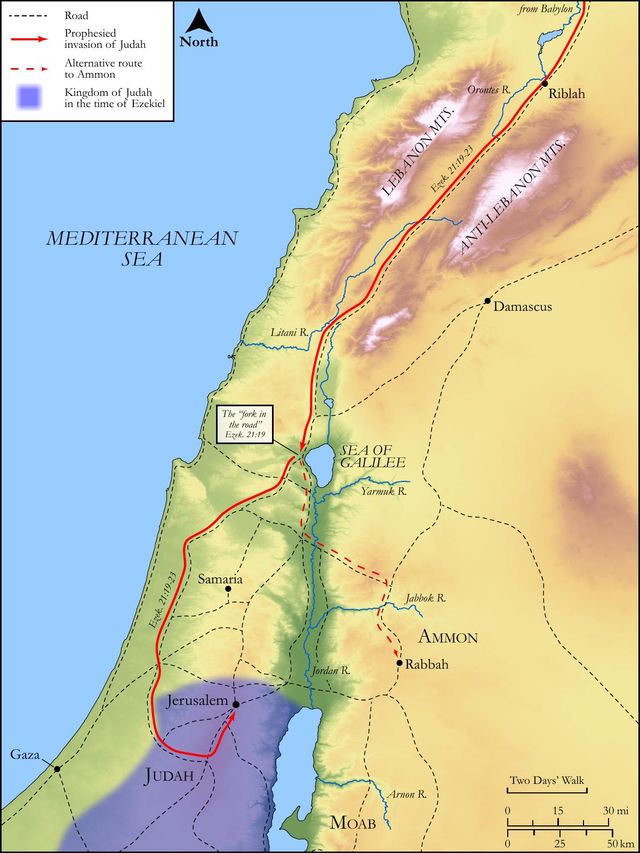
The prophet must appoint him two ways, that is, he must upon a paper draw out two roads (Eze 21:19), as sometimes is done in maps; and he must bring the king of Babylon's army to the place where the roads part, for there they will make a stand. They both come out of the same land; but when they come to the place where one road leads to Rabbath, the head city of the Ammonites, and the other to Jerusalem, he makes a pause; for, though he is resolved to be the ruin of both, yet he is not determined which to attack first; here his politics and his politicians leave him at a loss. The sword must go either to Rabbath or to Judah in Jerusalem. Many of the inhabitants of Judah had now taken shelter in Jerusalem, and all the interests of the country were bound up in the safety of the city, and therefore it is called Judah in Jerusalem the defenced; so strongly fortified was it, both by nature and art, that it was thought impregnable, Lam 4:12. The prophet must describe this dilemma that the king of Babylon is at (Eze 21:21); for the king of Babylon stood (that is, he shall stand considering what course to take) at the head of the two ways. Though he was a prince of great foresight and great resolution, yet, it seems, he knew neither his own interest nor his own mind. Let not the wise man then glory in his wisdom nor the mighty man in his arbitrary power, for even those that may do what they will seldom know what to do for the best. Now observe,
1.The method he took to come to a resolution; he used divination, applied to a higher and invisible power, perhaps to the determination of Providence by a lot, in order to which he made his arrows bright, that were to be drawn for the lots, in honour of the solemnity. Perhaps Jerusalem was written on one arrow and Rabbath on the other, and that which was first drawn out of the quiver he determined to attack first. Or he applied to the direction of some pretended oracle: he consulted with images or teraphim, expecting to receive audible answers from them. Or to the observations which the augurs made upon the entrails of the sacrifices: he looked in the liver, whether the position of that portended good or ill luck. Note, It is a mortification to the pride of the wise men of the earth that in difficult cases they have been glad to make their court to heaven for direction; as it is an instance of their folly that they have taken such ridiculous ways of doing it, when in cases proper for an appeal to Providence it is sufficient that the lot be cast into the lap, with that prayer, Give a perfect lot, and a firm belief that the disposal thereof is not fortuitous, but of the Lord, Pro 16:33.
2.The resolution he was hereby brought to. Even by these sinful practices God served his own purposes and directed him to go to Jerusalem, Eze 21:22. The divination for Jerusalem happened to be at his right hand, which, according to the rules of divination, determined him that way. Note, What services God designs men for he will be sure in his providence to lead them to, though perhaps they themselves are not aware what guidance they are under. Well, Jerusalem being the mark set up, the campaign is presently opened with the siege of that important place. Captains are appointed for the command of the forces to be employed in the siege, who must open the mouth in the slaughter, must give directions to the soldiers what to do and make speeches to animate them. Orders are given to provide every thing necessary for carrying on the siege with vigour; battering rams must be prepared and forts built. O what pains, what cost, are men at to destroy one another!
II.He must show both the people and the prince that they bring this destruction upon themselves by their own sin.
1.The people do so, Eze 21:23, Eze 21:24. They slight the notices that are given them of the judgment coming. Ezekiel's prophecy is to them a false divination; they are not moved or awakened to repentance by it. When they hear that Nebuchadnezzar by his divination is directed to Jerusalem, and assured of success in that enterprise, they laugh at it and continue secure, calling it a false divination; because they have sworn oaths, that is, they have joined in a solemn league with the Egyptians, and they depend upon the promise they have made them to raise the siege, or upon the assurances which the false prophets have given them that it shall be raised. Or it may refer to the oaths of allegiance they had sworn to the king of Babylon, but had violated, for which treachery of theirs God had given them up to a judicial blindness, so that the fairest warnings given them were slighted by them as false divinations. Note, It is not strange if those who make a jest of the most sacred oaths can make a jest likewise of the most sacred oracles; for where will a profane mind stop? But shall their unbelief invalidate the counsel of God? Are they safe because they are secure? By no means; nay, the contempt they put upon divine warnings is a sin that brings to remembrance their other sins, and they may thank themselves if they be now remembered against them.
(1.)Their present wickedness is discovered. Now that God is contending with them so perverse and obstinate are they that whatever they offer in their own defence does but add to their offence; they never conducted themselves so ill as they did now that they had the loudest call given them to repent and reform: "So that in all your doings your sins do appear. Turn yourselves which way you will, you show a black side." This is too true of every one of us; for not only there is none that lives and sins not, but there is not a must man upon earth that does good and sins not. Our best services have such allays of weakness, and folly, and imperfection, and so much evil is present with us even when we would do good, that we may say, with sorrow and shame, In all our doings, and in all our sayings too, our sins do appear, and witness against us, so that if we were under the law we were undone.
(2.)This brings to mind their former wickedness: "You have made your iniquity to be remembered, not by yourselves that it might be repented of, but by the justice of God that it might be reckoned for. Your own sins make the sins of your fathers to be remembered against you, which otherwise you should never have smarted for." Note, God remembers former iniquities against those only who by the present discoveries of their wickedness show that they do not repent of them.
(3.)That they may suffer for all together, they are turned over to the destroyed, that they may be taken (v. 23): "You shall be taken with the hand that God had appointed to seize you and to hold you and out of which you cannot escape." Men are said to be God's hand when they are made use of as the ministers of his justice, Psa 17:14. Note, Those who will not be taken with the word of God's grace shall at last be taken by the hand of his wrath.
2.The prince likewise brings his ruin upon himself. Zedekiah is the prince of Israel, to whom the prophet here, in God's name, addresses himself; and, if he had not spoken in God's name, he would not have spoken so boldly, so bluntly; for is it fit to say to a king, Thou art wicked?
(1.)He gives him his character, Eze 21:25. Thou profane and wicked prince of Israel! He was not so bad as some of his predecessors, and yet bad enough to merit his character. He was himself profane, lost to every thing that is virtuous and sacred. And he was wicked, as he promoted sin among his people; he sinned, and made Israel to sin. Note, Profaneness and wickedness are bad in any, but worst of all in a prince, a prince of Israel, who as an Israelite should know better himself, and as a prince should set a better example and have a better influence on those about him.
(2.)He reads him his doom. His iniquity has an end; the measure of it is full, and therefore his day has come, the day of his punishment, the day of divine vengeance. Note, Though those who are wicked and profane may flourish awhile, yet their day will come to fall. The sentence here passed is,
[1.]That Zedekiah shall be deposed. He has forfeited his crown, and he shall no longer wear it; he has by his profaneness profaned his crown, and it shall be cast to the ground (Eze 21:26): Remove the diadem. Crowns and diadems are losable things; it is only in the other world that there is a crown of glory that fades not away, a kingdom that cannot be moved. The Chaldee paraphrase expounds it thus: Take away the diadem from Seraiah the chief priest, and I will take away the crown from Zedekiah the king; neither this nor that shall abide in his place, but shall be removed. This shall not be the same, not the same that he has been; this not this (so the word is); profane and wicked perhaps he is as he has been. Note, Men lose their dignity by their iniquity. Their profaneness and wickedness remove their diadem, and take off their crown, and make them the reverse of what they were.
[2.]That great confusion and disorder in the state shall follow hereupon. Every thing shall be turned upside down. The conqueror shall take a pride in exalting him that is low and abasing him that is high, preferring some and degrading others, at his pleasure, without any regard either to right or merit.
[3.]Attempts to re-establish the government shall be blasted and come to nothing, Gedaliah's particularly, and Ishmael's who was of the seed-royal (to which the Chaldee paraphrase refers this); neither of them shall be able to make any thing of it. I will overturn, overturn, overturn, first one project and then another; for who can build up what God will throw down?
[4.]This monarchy shall never be restored till it is fixed for perpetuity in the hands of the Messiah. There shall be no more kings of the house of David after Zedekiah, till Christ comes, whose right the kingdom is, who is that seed of David in whom the promise was to have its full accomplishment, and I will give it to him. He shall have the throne of his father David, Luk 1:32. Immediately before the coming of Christ there was a long eclipse of the royal dignity, as there was also a failing of the spirit of prophecy, that his shining forth in the fulness of time both as king and prophet might appear the more illustrious. Note, Christ has an incontestable title to the dominion and sovereignty both in the church and in the world; the kingdom is his right. And, having the right, he shall in due time have the possession: I will give it to him; and there shall be a general overturning of all rather than he shall come short of his right, and a certain overturning of all the opposition that stands in his way to make room for him, Dan 2:45; Co1 15:25. This is mentioned here for the comfort of those who feared that the promise made in David would fail for evermore. "No," says God, "that promise is sure, for the Messiah's kingdom shall last for ever."
Historical interpretation
Historical reception
4 surviving comments on this verse. Each one is dated, so this reads as a timeline rather than a list.
(Verse 35, 36, and following) And I will bring you into a desert of peoples, and there I will judge you face to face. Just as I contended with your fathers in the desert of the land of Egypt, so I will judge you, says the Lord. And I will subject you to my scepter, and I will bring you into the bonds of the covenant, and I will choose from among you the transgressors and the wicked: from their place of residence I will bring them out, and they will not enter the land of Israel, and you will know that I am the Lord. Thus says the Lord: I will do for you who are in Babylon, and now serve idols, what I did for your ancestors in Egypt. I will lead you into the desert of the peoples, and there I will judge you face to face, just as I contended with them in judgment when they came out of Egypt. And after I have judged you, I will subject you to my scepter and rule, and I will make a covenant with you and bring you into your land with the bonds of love, so that bound by my love, you will never be able to depart from me. But I will choose from among you the transgressors and the wicked, who persist in the hardness of their hearts in evil deeds, not for possession, but for rejection. And I will indeed bring them out of the land of their dwelling, so that when they are brought out, they will not enter the land of Israel; but they will perish in various regions. And by the distinction between good and evil, you shall know that I am the Lord, who judges all things. The rest of the discourse hastens, and we briefly go through each point, in order to provide only the meaning to the readers.
(Ver. 23, 24 onwards) Again, I raised my hand against them in the wilderness, to scatter them among the nations and disperse them in the lands, because they had not performed my judgments, and had rejected my commandments, and had violated my Sabbaths, and their eyes had been after the idols (or thoughts) of their fathers. Therefore, I also gave them statutes that were not good, and judgments in which they would not live, and I defiled them in their offerings (or transgressions), as they offered (or led astray) everything that opens the womb because of their sins (for which the Septuagint translated, to destroy them and what they had overlooked): and they will know that I am the Lord. Where in the Old Testament, against their children, who fell in the wilderness, the Lord lifted up His hand to scatter them among the nations, Scripture does not say; but it is to be believed that this was done in accordance with what is reported here. Or he signifies by this, that after they entered the promised land, they were given over at various times, for many sins, to different nations and kings, and at that time the commandments of the Lord, which were good according to their nature, and the judgments by which believers could live, were made not good for them, since they were in no way able to keep the precepts of the law in captivity, and to do what the divine word commanded. He did not say, 'I gave them evil commandments,' but, 'not good commandments.' For it does not immediately follow that what is not good is evil, as the Apostle teaches, it is good for a man not to touch a woman; but because of incontinence, let each possess his own vessel in sanctification and honor (I Cor. VII). And if he does not do this, it is neither good nor evil. Therefore, God gave them, dispersed among the nations, not good commandments, that is, he allowed them to follow their own thoughts and desires, to do what is not appropriate. And he defiled them in his gifts: just as a Priest separates lepers from the people, and shows that they are defiled; while they offer to idols what they should offer to God. And they pass everything that opens the womb through the fire of Baal, that is, the firstborn; so that after they have deserted God and been handed over to the worship of idols, then they may understand that He is the Lord whom they have provoked to anger by their own fault. Symmachus interpreted this passage more explicitly, treating the future as past. Therefore, I will also give them bad precepts and judgments for which they will not live, and I will defile them because of their gifts, as they consecrate and offer everything that opens the womb, so that I may destroy them, and they will know that I am the Lord. And the meaning is this: because I have seen the sons of the fathers equaling the wickedness of their ancestors and doing the same things for which they offended God, I wanted to divide them into nations and disperse them throughout the whole world, and give them bad precepts and judgments in which they would not live, so that I may defile them with their gifts, for they consecrated everything that opens the womb to idols, and I may destroy them forever, and they will know that I am the Lord. Through which he showed that he had not given them good commandments who dwelt in the wilderness, but to those whom he wanted to scatter among the nations, and to make foreigners in the whole world, he gave them a desire for things that he did not give: so that there they would do good commandments of God, not good because of their own fault, while they exhibited to idols what God had commanded to be exhibited. This can also be said, that before the offense, they received only the Ten Commandments; but after idolatry and blasphemy, they received multiple ceremonies of the law, so that they would offer victims to God rather than to demons, and by comparison with sacrilege, what was not good in itself became lighter, and by no means evil, because it was offered to God, and yet not good, because they offended the author of good.
(Verse 25 onwards) But you, profane and wicked ruler of Israel, whose day has come at the appointed time of iniquity. Thus says the Lord God: Remove the turban and take off the crown. Is this not the one who exalted the lowly and humiliated the proud? I will bring upon it injustice, injustice, injustice, and this will not cease until the one comes to whom judgment belongs, and I will give it to him. Septuagint: And you, profane and unjust ruler of Israel, whose day has come, at the end of the time of iniquity. Thus says the Lord God: You have removed the diadem and placed the crown. This will not be the same. You have humbled the high and exalted the lowly. I will bring upon her iniquity, iniquity will I bring upon her: and she will not be like this until the one to whom it is due comes: and I will give it to him. Symmachus interpreted this passage as follows: But you, profane and unjust ruler of Israel, whose day comes at the appointed time of iniquity: Thus says the Lord God: She has removed the diadem and taken the crown: neither this nor that: she will raise up the lowly and humble the exalted. I will commit iniquity, iniquity, iniquity upon it. And this was not that one, whose judgment is, whom I am about to give. After the destruction of the city of Jerusalem and the captivity of the people, the speech is directed to the leader of Israel, whom no one doubts is signified by Zedekiah, in whom the reign of the kings of Israel from the lineage of David ended. The day, says he, has come upon you, which has been predetermined for a long time in you, and because of you the priesthood and kingdom of the people of Judah have come to an end. For indeed the cidaris is the distinguishing mark of the pontiff: the crown, that is, the diadem, the sign of the king. Is this not the cidaris, and this crown that did nothing by judgment; but for the imitation of the Babylonian king, whom he wanted to exalt, and whom he wanted to humble? Therefore, not once, nor twice according to the Septuagint, but three times I will put iniquity before you forever, which was not immediately taken into account by you, but until Christ comes, whose judgment it is, and the Father gives him the kingdom and the priesthood, or the Church gathered from the Gentiles: For the Father judges no one; but he has given all judgment to the Son (John 5:22). And in another place: God, he said, give your judgment to the king, and your justice to the son of the king (Ps. 72:1). This is the one to whom the power and eternal priesthood have been entrusted, of whom Jacob also spoke: The ruler will not fail from Judah, nor the leader from his thighs, until the one to whom it has been entrusted comes; and he will be the expectation of the nations (Gen. 49:10). In the place where we have interpreted: Is not this, beautifully translated by Symmachus, neither this, nor that. For he had said: Take away the crown, remove the diadem, he added, neither this nor that, that is, the kingdom will cease, and the priesthood. Hence those who were kings and priests until the coming of Christ, among whom one high priest Hyrcanus placed a diadem on his head, wanted in vain to claim both this and that, since the kingdom was not owed to him after Zedekiah, but to the one to whom it was entrusted, and who was the expectation of the Gentiles, about whom Malachi speaks: You, priests, who defile my name (Mal. 1, 6). And a little while later: My will is not in you, and I will not accept sacrifices from your hands. For from the rising of the sun to its setting, my name is great among the nations, and in every place a clean offering is sacrificed and offered to my name. This clean offering, without the blood of goats, rams, and bulls (Ps. 49), is fulfilled in the coming of Christ, when he came as the desired one of the nations, and the sun of righteousness rose, in whose wings there is healing (Hagg. 2).
(Verse 27, 29 onwards) Therefore speak to the house of Israel, son of man, and tell them: Thus says the Lord God: Moreover, your fathers have blasphemed against me and have treated me with contempt, even as they spurned me. And I brought them into the land that I had lifted my hand to give them ((Vulgate adds: that land)): they saw every high hill and every leafy tree, and there they offered their sacrifices and presented there the irritation of their offerings, and they placed there the fragrance of their sweetness, and they poured out their ((Vulgate is silent on this)) libations there. And I said to them, 'What is the high place to which you are going?' And its name was called the High Place until this day. Therefore speak to the house of Israel, son of man, and say to them, 'Thus says the Lord God: As for your fathers, they have provoked Me to anger by their iniquities, by the fact that they have fallen away from Me. So I brought them into the land that I had lifted My hand in an oath to give them.' They saw every high hill and every leafy tree, and there they offered their sacrifices. They also presented there the provocation of their gifts, and they set there their pleasing aroma, and they poured out there their drink offerings. And I said to them: What is abbana, because you enter there? And they called its name abbana until this day. I wanted, he said, to scatter them in the wilderness, and to give them not good precepts, so that they would sacrifice to idols what they should have offered to me, and consecrate all their first-fruits to them by fire, so that I might kill them and destroy them. But when he says, I wanted, he shows that he did not do what he wanted. And that which follows: 'And they shall know that I am the Lord,' is not found in the Septuagint. For it did not seem fitting to them to know after their destruction that he himself is the Lord. But you, son of man, speak again to them, that is, to the elders of the house of Israel, who have come to inquire of you: Your fathers, from whom you have descended, have also blasphemed against me and held me in contempt; after I brought them into the land which I had given them to possess, they turned against me to provoke me. For when they saw every high hill and leafy tree, they would sacrifice on the mountains and in the groves and thickets, and offer victims to the idols, and pour out libations. And when I saw this, I said to them: What is this, Bama? for it is called high: or why do you enter into such a place which you have chosen for yourselves in all the hills, so that even today these places are called Bamoth, and the ancient error retains its original name? Regarding Bama, which we translate as excelsum, there is an error in the Septuagint edition, where it is written as ἀββανὰ, which does not resonate in the Hebrew language. Bama can mean 'in which' if the two syllables are divided into two words, but in the present context, that sense does not fit. However, wherever it is written in the Books of Kings and Chronicles: 'The people still sacrificed and offered incense on the high places,' Bama in the singular and Bamoth in the plural mean 'high places.'
Continue studying Ezekiel 21:27 across the web’s major study libraries — every link below opens this exact verse, chapter, or book on the destination site.
Read & Compare
 BibleGatewayThis verse in more than 200 translations and 70 languages.
 Bible.comThe YouVersion reader — hundreds of translations, reading plans, and highlights.
 ESV.orgCrossway's official English Standard Version reader.
 NET BibleThe NET translation with 60,000+ translators' notes on every rendering decision.
 STEP BibleTyndale House's free study tool — original text, vocabulary, and scholarly resources.
 BibliaLogos Bible Software's free web reader.
 USCCBThe New American Bible (Revised Edition) with the U.S. bishops' study notes.
Commentaries
 BibleHub CommentariesDozens of classic commentaries on this verse, gathered on one page.
 StudyLightMore than 100 commentary sets — the largest collection on the web.
 BibleRefPlain-English commentary on what this verse means, verse by verse.
 Enduring WordDavid Guzik's free commentary on this chapter, widely used by Bible teachers.
 Bible Study ToolsVerse commentary alongside Greek and Hebrew study aids.
Original Language & Research
- BibleHub InterlinearThe verse word by word — original language, transliteration, and English.
- BibleHub LexiconEvery word's original-language definition and Strong's entry.
 Blue Letter BibleDeep-study tools — Strong's numbers, concordance, and word studies.
 SefariaThe Hebrew text with Rashi and centuries of Jewish commentary.
Sermons, Hymns & Audio


TrulyRandomVerse is not affiliated with these sites and doesn’t control their content. They’re linked because they’re genuinely useful.
Summary
Ezekiel 21:27 stands as a profound prophetic declaration announcing the imminent and complete overthrow of the Davidic monarchy in Judah, symbolized by the removal of the crown and diadem. This divine judgment, expressed through a powerful threefold repetition, signifies the temporary cessation of the earthly Davidic kingship due to the nation's and its leaders' unfaithfulness. However, amidst this pronouncement of judgment, the verse pivots to a glorious future hope, promising that the royal authority will remain "no more, until he come whose right it is," pointing unequivocally to the ultimate, rightful King—the Messiah—to whom God Himself will bestow the kingdom.
Context
ShowHideLiterary Context
This verse is situated within a series of prophecies in Ezekiel 21, often referred to as the "sword song" or "prophecy against Jerusalem." The chapter opens with a vivid metaphor of God's drawn sword being unsheathed against Israel and Judah, signifying impending judgment and destruction. Specifically, Ezekiel 21:25-27 directly addresses Zedekiah, the last king of Judah, as the "profane and wicked prince of Israel," whose day of final punishment has arrived. The command to "remove the diadem, and take off the crown" in Ezekiel 21:26 directly precedes and is foundational to the "overturn" motif in verse 27, emphasizing the stripping away of royal authority from Zedekiah and, by extension, the entire Davidic line for a period. This passage serves as a climactic declaration of the end of an era, preparing the ground for the subsequent narrative of Jerusalem's fall and the Babylonian exile.
Historical & Cultural Context
The prophecy of Ezekiel 21:27 was delivered during the Babylonian exile, likely in the period leading up to or shortly after the final destruction of Jerusalem in 586 BC. The people of Judah had already experienced two deportations, and King Zedekiah, a puppet king installed by Babylon, had rebelled, leading to Nebuchadnezzar's final siege. For the people of Judah, the Davidic monarchy was not merely a political institution but a cornerstone of their national and theological identity, rooted in God's eternal covenant with David (2 Samuel 7:12-16). The idea of the Davidic throne being overturned was therefore a catastrophic blow, signaling the collapse of their world order and challenging their understanding of God's faithfulness. The cultural understanding of kingship as divinely ordained made this pronouncement of divine removal particularly potent and terrifying, as it implied God Himself was dismantling what He had established.
Key Themes
ShowHideEzekiel 21:27 powerfully contributes to several key themes prevalent in the book of Ezekiel and broader prophetic literature. Firstly, it underscores Divine Sovereignty and Judgment, demonstrating God's absolute control over earthly rulers and nations, even His chosen people, when they defy His covenant. The triple "overturn" emphasizes the certainty and completeness of this divine intervention. Secondly, it highlights the Suspension of the Davidic Monarchy, a dramatic and unprecedented event that shattered the immediate expectations of an unbroken kingly line, serving as a stark consequence of Judah's idolatry and unrighteousness, as seen in the judgment against the "profane and wicked prince" in Ezekiel 21:25. Lastly, and most significantly, the verse introduces a profound theme of Messianic Hope. Despite the immediate despair, the promise of a future ruler "whose right it is" transforms the judgment into a forward-looking prophecy, assuring the ultimate fulfillment of God's covenant promises through a legitimate, divinely appointed King. This theme of future restoration and righteous leadership is central to Ezekiel's broader message of hope beyond exile, echoing similar prophecies found in Isaiah 9:6-7 and Jeremiah 23:5-6.
Exposition and Analysis
ShowHideKey Word Analysis
ShowHideThis intensive form of the root implies an act of perversion, twisting, or overturning. Its threefold repetition ("overturn, overturn, overturn") in the verse dramatically emphasizes the absolute certainty, completeness, and perhaps successive nature of the divine judgment. It signifies a radical reversal and dismantling of the existing order, specifically the Davidic monarchy, indicating that its current state was so corrupt or "perverted" that it necessitated a total divine upheaval.
This term is rich with meaning, encompassing "judgment," "justice," "right," "ordinance," and "privilege." In the context of "whose right it is," it refers to the legitimate, inherent, and divinely sanctioned claim to the throne. It's not merely a legal entitlement but a moral and theological one, indicating that the coming ruler will possess true justice and divine authority, unlike the corrupt kings who preceded him. This word highlights the legitimacy and righteousness of the future King, to whom the "verdict" or "right" belongs.
This primitive root is broadly used for "to give," "to put," "to make," or "to bestow." In this verse, "and I will give it [him]," it signifies God's active and sovereign act of bestowing the overturned kingdom and its rightful authority upon the one who has the legitimate claim. This emphasizes that the future king's reign will not be established by human effort or political maneuvering, but by direct divine appointment and transfer of power, as God "gives" or "assigns" the kingdom.
Verse Breakdown
ShowHide"I will overturn, overturn, overturn, it:"
This opening clause is a powerful declaration of God's absolute sovereignty and His active intervention in human affairs. The triple repetition of "overturn" (Hebrew: ʻavvâh) is a rhetorical device emphasizing the certainty, totality, and perhaps the successive nature of the judgment. It signifies a complete reversal and dismantling of the existing political and royal order in Judah, specifically the removal of the Davidic crown and diadem mentioned in the preceding verse. This is a divine act of judgment against the corrupt leadership and the unfaithful nation, highlighting God's determination to bring about a radical change.
"and it shall be no [more],"
This phrase indicates the temporary cessation or suspension of the Davidic monarchy in its current form. Following the overturning, the earthly kingship from David's line would cease to function, signifying the end of an era and the devastating consequence of Judah's rebellion. This was a shocking pronouncement for a people who believed in the eternal nature of the Davidic covenant, implying a period of significant discontinuity in their national identity.
"until he come whose right it is;"
This pivotal clause introduces a profound element of hope and future expectation. Despite the immediate judgment and cessation of the monarchy, it is not an absolute end. The phrase "until he come" points to a specific future individual. "Whose right it is" (Hebrew: asher lo ha-mishpâṭ) literally means "to whom the judgment/right belongs," highlighting the legitimate, inherent, and divinely appointed claim of this coming figure to the throne. This is a clear messianic prophecy, looking beyond the immediate desolation to a future, righteous King who will embody true justice and authority.
"and I will give it [him]."
This concluding declaration reaffirms God's active role in the establishment of the future king's reign. It is God Himself who will bestow the kingdom and its authority upon the rightful heir. This emphasizes that the coming of the Messiah and the establishment of His kingdom will be a divine act, not a human achievement, ensuring its legitimacy, power, and permanence. God's sovereign "giving" underscores His ultimate control over the destiny of nations and the fulfillment of His promises.
Literary Devices
ShowHideEzekiel 21:27 is rich with literary artistry that enhances its prophetic message. The most striking device is Repetition, specifically the threefold reiteration of "overturn, overturn, overturn." This emphatic repetition (known as epizeuxis) serves to underscore the absolute certainty, thoroughness, and irreversible nature of God's impending judgment on the Davidic monarchy. It creates a sense of divine resolve and an overwhelming force that will dismantle the existing order. Furthermore, the verse employs Symbolism, where the "crown" and "diadem" (mentioned in the preceding verse, Ezekiel 21:26) symbolize the royal authority and kingship itself. The overturning of "it" (referring to the crown/kingdom) is a symbolic act of dethronement and the suspension of the Davidic line. The entire verse functions as a powerful Prophecy, foretelling both immediate historical events (the fall of Zedekiah and the end of the monarchy) and a distant future event (the coming of the Messiah). The abrupt shift from judgment to hope, marked by the word "until," creates a profound sense of Antithesis or contrast, highlighting God's dual nature as both judge and covenant-keeper.
Theological and Thematic Connections
ShowHideEzekiel 21:27 stands as a powerful testament to God's unwavering sovereignty over all earthly powers and His faithfulness to His covenant promises, even amidst judgment. The overturning of the Davidic monarchy, a seemingly devastating blow to God's covenant with David (2 Samuel 7:16), is revealed not as a revocation but a temporary suspension, paving the way for a greater, more perfect fulfillment. This verse highlights that human unfaithfulness can temporarily hinder the earthly manifestation of God's promises, but it cannot ultimately thwart His divine plan. The promise of "he whose right it is" underscores the biblical theme of a coming Messiah who will embody perfect justice and rightful authority, ultimately establishing an eternal kingdom that will supersede all earthly dominions. This divine intervention ensures that God's ultimate purpose for a righteous king will be realized, not through human succession, but through divine appointment.
Reflection and Application
ShowHideEzekiel 21:27 offers profound comfort and challenge to believers today. In a world where political systems rise and fall, and human leaders often disappoint or fail, this verse reminds us that God remains utterly sovereign over all earthly affairs. No human power, however strong or entrenched, can ultimately stand against His will or thwart His eternal purposes. For us, this means placing our ultimate hope and trust not in fleeting political ideologies or fallible human leaders, but in the steadfast and righteous reign of God. The promise that the kingdom will be given to "him whose right it is" directs our gaze firmly to Jesus Christ, the true and eternal King. This truth should inspire us to live with confident hope, knowing that even in times of chaos or perceived decline, God is working out His perfect plan, culminating in the full establishment of His just and everlasting kingdom. It also calls us to humility, recognizing that God's judgment is real and that He holds all, including those in authority, accountable for their actions, urging us to pursue righteousness and justice in our own spheres of influence.
Questions for Reflection
ShowHideFAQ
ShowHideWhy does God say "overturn, overturn, overturn" three times?
ShowHideThe triple repetition of "overturn" (Hebrew: ʻavvâh) is a powerful literary device used to emphasize the absolute certainty, completeness, and thoroughness of God's judgment. It signifies that the overturning of the Davidic monarchy and the existing order will be undeniable and irreversible in its immediate context. This emphatic declaration underscores divine resolve and the devastating nature of the judgment, leaving no doubt about the finality of the current king's dethronement and the suspension of the Davidic line.
Who is "he whose right it is"?
ShowHideThis phrase is a clear messianic prophecy, referring to the future, legitimate, and divinely appointed King who will inherit the throne of David. While the immediate Davidic line was being overturned due to unfaithfulness, God promised that the kingship would not cease forever, but would be restored in a righteous ruler. Christian theology universally identifies this figure as Jesus Christ, the Messiah, who is the rightful heir to David's throne and whose kingdom is eternal and just. The phrase "whose right it is" (Hebrew: asher lo ha-mishpâṭ) emphasizes His inherent and divine claim to kingship, based on justice and righteousness, unlike the corrupt kings who preceded Him.
How does this verse relate to the Davidic covenant?
ShowHideEzekiel 21:27 addresses the Davidic covenant (2 Samuel 7:12-16) in a nuanced way. While the covenant promised an eternal dynasty for David, the unfaithfulness of his descendants, particularly King Zedekiah, led to a temporary suspension of the earthly monarchy. This verse clarifies that God's promise was not revoked, but its immediate manifestation was interrupted. The "overturning" is a judgment on the corrupt expression of the covenant, not on the covenant itself. The promise of "he whose right it is" demonstrates God's faithfulness to ultimately fulfill His covenant through a righteous descendant of David, ensuring the eternal nature of the kingship through the Messiah, who will perfectly embody the "right" (mishpâṭ) to rule.
Christ-Centered Fulfillment
ShowHideEzekiel 21:27 finds its ultimate and glorious fulfillment in the person and work of Jesus Christ. The "one whose right it is" is none other than the Messiah, the true and eternal King. While the earthly Davidic monarchy was overturned due to human sin and unfaithfulness, God's promise to David for an everlasting throne was not abrogated but suspended, awaiting the arrival of the perfect King. Jesus, born of the lineage of David (Matthew 1:1), fully embodies the "right" (mishpâṭ) to the throne. He is the one to whom all justice and rightful authority belong, not by human election or conquest, but by divine decree and inherent righteousness. The angel Gabriel's prophecy to Mary explicitly declares that God "will give unto him the throne of his father David: And he shall reign over the house of Jacob for ever; and of his kingdom there shall be no end" (Luke 1:32-33). Thus, the overturning in Ezekiel points forward to the ultimate establishment of Christ's kingdom, which is not of this world yet reigns over it, a kingdom that will never be overturned but will endure eternally, as prophesied in Revelation 11:15 where "The kingdoms of this world are become the kingdoms of our Lord, and of his Christ; and he shall reign for ever and ever." Jesus, the King of kings and Lord of lords, is the one to whom all authority in heaven and on earth has been given (Matthew 28:18), fulfilling Ezekiel's ancient prophecy with divine power and grace.