


2 Samuel 15:6
Bible text: King James Version (1769 Blayney text) · Public domain
Bible text: Berean Standard Bible · Public domain
Bible text: American Standard Version (1901) · Public domain
Bible text: World English Bible, Messianic edition · Public domain
Bible text: Geneva Bible (1599) · Public domain
Bible text: Young's Literal Translation · Public domain
- וַיַּעַשׂvai·Ya·'asand he didH6213Conj-w ¦ V-Qal-ConsecImperf-3msVerb Qal Consecutive Imperfect 3rd Singular Masculineוַandיַּעַשׂhe did
- אַבְשָׁלוֹם'av·sha·LomAbsalomH53N-proper-mNoun Proper Masculine
- כַּדָּבָרka·da·Varaccording to the mannerH1697Prep-k ¦ N-msNoun Singular Masculine Absoluteכַּaccording to theדָּבָרmanner
- הַזֶּהha·Zeh<the> thisH2088Art ¦ PrtParticle Demonstrativeהַ<the>זֶּהthis
- לְכָלle·kholto allH3605Prep-l ¦ N-mscNoun Singular Masculine Constructלְtoכָלall
- יִשְׂרָאֵלYis·ra·'ElIsraelH3478N-properNoun Proper Location
- אֲשֶׁר'a·SherwhoH834RelParticle Relative
- יָבֹאוּya·Vo·'uthey cameH935V-Qal-Imperf-3mpVerb Qal Imperfect 3rd Plural Masculine
- לַמִּשְׁפָּטla·mish·Patfor <the> judgmentH4941Prep-l ¦ N-msNoun Singular Masculine Absoluteלַfor <the>מִּשְׁפָּטjudgment
- אֶל'eltoH413PrepPreposition
- הַמֶּלֶךְha·Me·lekhthe kingH4428Art ¦ N-msNoun Singular Masculine Absoluteהַtheמֶּלֶךְking
- וַיְגַנֵּבvay·ga·Nevand he stoleH1589Conj-w ¦ V-Piel-ConsecImperf-3msVerb Piel Consecutive Imperfect 3rd Singular Masculineוַandיְגַנֵּבhe stole
- אַבְשָׁלוֹם'av·sha·LomAbsalomH53N-proper-mNoun Proper Masculine
- אֶת'et<obj.>H853DirObjMParticle Object Indicator
- לֵבlev[the] heart ofH3820N-mscNoun Singular Masculine Construct
- אַנְשֵׁי'an·Shei[the] men ofH582N-mpcNoun Plural Masculine Construct
- יִשְׂרָאֵלYis·ra·'ElIsraelH3478N-properNoun Proper Location
English is a literal word-by-word gloss of the Hebrew, not the KJV's wording. Why?
This is the original text the KJV's translators worked from — each Hebrew word with its own literal English meaning in this verse, prepared by scholars at Tyndale House, Cambridge. The KJV translates whole sentences, not word by word, so its wording differs: one Hebrew word can become several English words, and the KJV may choose “the LORD” where the gloss reads “Yahweh”. Both are faithful — they answer different questions. For the KJV's own rendering, switch to the KJV text.
Details
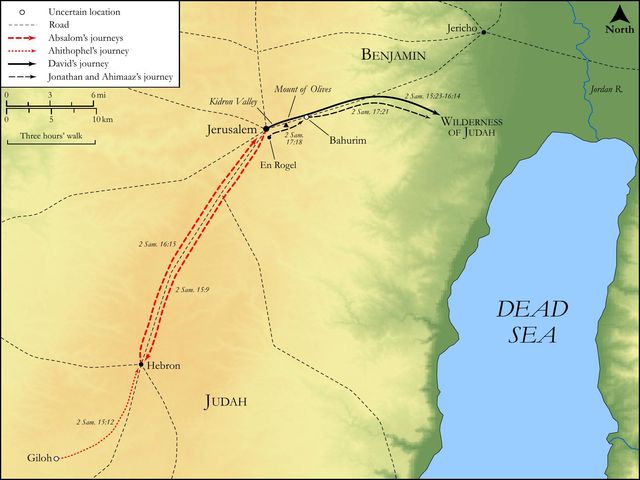
See on the biblical-era maps

Study this verse
Public-domain commentary
Matthew Henry
From his Commentary on the Whole Bible. Henry comments on passages, not single verses — this entry covers 2 Samuel 15:1–6. His four-level outline is real structure in the source text, so it is rendered as structure.
Absalom is no sooner restored to his place at court than he aims to be in the throne. He that was unhumbled under his troubles became insufferably proud when they were over; and he cannot be content with the honour of being the king's son, and the prospect of being his successor, but he must be king now. His mother was a king's daughter; on that perhaps he valued himself, and despised his father, who was but the son of Jesse. She was the daughter of a heathen king, which made him the less concerned for the peace of Israel. David, in this unhappy issue of that marriage, smarted for his being unequally yoked with an unbeliever. When Absalom was restored to the king's favour, if he had had any sense of gratitude, he would have studied how to oblige his father, and make him easy; but, on the contrary, he meditates how to undermine him, by stealing the hearts of the people from him. Two things recommend a man to popular esteem - greatness and goodness.
I.Absalom looks great, Sa2 15:1.
He had learned of the king of Geshur (what was not allowed to the kings of Israel) to multiply horses, which made him look desirable, while his father, on his mule, looked despicable. The people desired a king like the nations; and such a one Absalom will be, appearing in pomp and magnificence, above what had been seen in Jerusalem. Samuel had foretold that this would be the manner of the king: He shall have chariots and horsemen, and some shall run before his chariots (Sa1 8:11); and this is Absalom's manner. Fifty footmen (in rich liveries we may suppose) running before him, to give notice of his approach, would highly gratify his pride and the people's foolish fancy. David thinks that this parade is designed only to grace his court, and connives at it. Those parents know not what they do who indulge a proud humour in their children; for I have seen more young people ruined by pride than by any one lust whatsoever.
II.Absalom will seem very good too, but with a very bad design.
Had he proved himself a good son and a good subject, and set himself to serve his father's interest, he would have done his present duty, and shown himself worthy of future honours, after his father's death. Those that know how to obey well know how to rule. But to show how good a judge and how good a king he will be is but to deceive himself and others. Those are good indeed that are good in their own place, not that pretend how good they would be in other people's places. But this is all the goodness we find in Absalom.
1.He wishes that he were a judge in Israel, Sa2 15:4. He had all the pomp and all the pleasure he could wish, lived as great and in as much ease as any man could; yet this will not content him, unless he have power too: O that I were a judge in Israel! He that should himself have been judged to death for murder has the impudence to aim at being a judge of others. We read not of Absalom's wisdom, virtue, or learning in the laws, nor had he given any proofs of his love to justice, but the contrary; yet he wishes he were judge. Note, Those are commonly most ambitious of preferment that are least fit for it; the best qualified are the most modest and self-diffident, while it is no better than the spirit of an Absalom that says, O that I were a judge in Israel!
2.He takes a very bad course for the accomplishing of his wish. Had he humbly petitioned his father to employ him in the administration of justice, and studied to qualify himself for it (according to the rule, Exo 18:21), no doubt he would have been sure of the next judge's place that fell; but this is too mean a post for his proud spirit. It is below him to be subordinate, though to the king his father; he must be supreme or nothing. He wants to be such a judge that every man who has any cause shall come to him: in all causes, and over all persons, he must preside, little thinking what a fatigue this would be to have every man come to him. Moses himself could not bear it. Those know not what power is that grasp at so much, so very much. To gain the power he aims at, he endeavours to instil into the people's minds,
(1.)A bad opinion of the present administration, as if the affairs of the kingdom were altogether neglected, and no care taken about them. He got round him all he could that had business at the council-board, enquired what their business was; and,
[1.]Upon a slight and general enquiry into their cause, he pronounced it good: Thy matters are right. A fit man indeed to be a judge, who would give judgment upon hearing one side only! For he has a bad cause indeed that cannot put a good colour upon it, when he himself has the telling of the story. But,
[2.]He told them that it was to no purpose to appeal to the throne: "There is no man deputed of the king to hear thee. The king is himself old, and past business, or so taken up with his devotions that he never minds business; his sons are so addicted to their pleasures that, though they have the name of chief rulers, they take no care of the affairs committed to them." He further seems to insinuate what a great want there was of him while he was banished and confined, and how much the public suffered by his exile; what his father said truly in Saul's reign (Psa 75:3) he says falsely: The land and all the inhabitants of it are dissolved, all will go to wreck and ruin, unless I bear up the pillars of it. Every appellant shall be made to believe that he will never have justice done him, unless Absalom be viceroy or lord-justice. It is the way of turbulent, factious, aspiring men, to reproach the government they are under. Presumptuous are they, self-willed, and not afraid to speak evil of dignities, Pe2 2:10. Even David himself, the best of kings, and his administration, could not escape the worst of censures. Those that aim to usurp cry out of grievances, and pretend to design nothing but the redress of them: as Absalom here.
(2.)A good opinion of his own fitness to rule. That the people might say, "O that Absalom were a judge!" (and they are apt enough to desire changes), he recommends himself to them,
[1.]As very diligent. He rose up early, and appeared in public before the rest of the king's sons were stirring, and he stood beside the way of the gate, where the courts of judgment sat, as one mightily concerned to see justice done and public business despatched.
[2.]As very inquisitive and prying, and desirous to be acquainted with every one's case. He would know of what city every one was that came for judgment, that he might inform himself concerning every part of the kingdom and the state of it, Sa2 15:2.
[3.]As very familiar and humble. If any Israelite offered to do obeisance to him he took him and embraced him as a friend. No man's conduct could be more condescending, while his heart was as proud as Lucifer's. Ambitious projects are often carried on by a show of humility, Col 2:23. He knew what a grace it puts upon greatness to be affable and courteous, and how much it wins upon common people: had he been sincere in it, it would have been his praise; but to fawn upon the people that he might betray them was abominable hypocrisy. He croucheth, and humbleth himself, to draw them into his net, Psa 10:9, Psa 10:10.
Historical interpretation
Historical reception
2 surviving comments on this verse. Each one is dated, so this reads as a timeline rather than a list.
Select a marker to jump to its quote. Markers stagger vertically where authors wrote within a few decades of each other.
Moreover, due measure befits even our words and instructions, that it may not seem as though there was either too great mildness or too much harshness. Many prefer to be too mild, so as to appear to be good. But it is certain that nothing feigned or false can bear the form of true virtue; no, it cannot even last. At first it flourishes; then, as time goes on, like a flower it fades and passes away, but what is true and sincere has a deep root.…Absalom was king David’s son, known for his beauty, of splendid appearance and in the heyday of youth; so that no other man like him was found in Israel. He was without a blemish from the sole of his foot to the crown of his head. He had his own chariot and horses and fifty men to run before him. He rose at early dawn and stood before the gate in the way, and whoever he knew to be seeking the judgment of the king, he called to himself, saying … “Is there no one given to you by the king to hear you? Who will make me a judge? And whosoever will come to me, that has need of judgment, I will give him justice.” With such words he cajoled them. And when they came to make obeisance to him, stretching forth his hand he took hold of them and kissed them. So he turned the hearts of all to himself. For flattery of this sort quickly finds its way to touch the very depths of the heart.
For nothing is so necessary for the proper conduct of affairs as prudence; and there is no greater hindrance to prudence than wickedness and malice and hollowness. Look at people suffering from a liver ailment. How unsightly they are, with all their bloom withered away. How weak they are, and puny, and unfit for anything. So also are souls of this nature. What else is wickedness but a jaundice of the soul? Wickedness then has no strength in it. Indeed, it has none whatever. Will you mind that I again make what I am saying plain to you … by setting before you the portraits of a treacherous and a guileless man? Absalom was a treacherous man and “stole all the people’s hearts.” And observe how great was his treachery. “He went about,” it says, “and said, ‘Have you no justice?’ ” wishing to conciliate every one to himself. But David was guileless. What then? Look at the end of them both, look, how full of utter madness was the former! For inasmuch as he looked solely to the hurt of his father, in all other things he was blinded.
Continue studying 2 Samuel 15:6 across the web’s major study libraries — every link below opens this exact verse, chapter, or book on the destination site.
Read & Compare
 BibleGatewayThis verse in more than 200 translations and 70 languages.
 Bible.comThe YouVersion reader — hundreds of translations, reading plans, and highlights.
 ESV.orgCrossway's official English Standard Version reader.
 NET BibleThe NET translation with 60,000+ translators' notes on every rendering decision.
 STEP BibleTyndale House's free study tool — original text, vocabulary, and scholarly resources.
 BibliaLogos Bible Software's free web reader.
 USCCBThe New American Bible (Revised Edition) with the U.S. bishops' study notes.
Commentaries
 BibleHub CommentariesDozens of classic commentaries on this verse, gathered on one page.
 StudyLightMore than 100 commentary sets — the largest collection on the web.
 BibleRefPlain-English commentary on what this verse means, verse by verse.
 Enduring WordDavid Guzik's free commentary on this chapter, widely used by Bible teachers.
 Bible Study ToolsVerse commentary alongside Greek and Hebrew study aids.
Original Language & Research
- BibleHub InterlinearThe verse word by word — original language, transliteration, and English.
- BibleHub LexiconEvery word's original-language definition and Strong's entry.
 Blue Letter BibleDeep-study tools — Strong's numbers, concordance, and word studies.
 SefariaThe Hebrew text with Rashi and centuries of Jewish commentary.
Sermons, Hymns & Audio


TrulyRandomVerse is not affiliated with these sites and doesn’t control their content. They’re linked because they’re genuinely useful.
Summary
Second Samuel 15:6 masterfully encapsulates Absalom's cunning and insidious strategy to undermine his father King David's authority and usurp the throne. Through a meticulously planned campaign of public relations, Absalom systematically intercepted citizens seeking royal judgment, offering false sympathy and subtly criticizing the king's administration. This calculated display of accessibility and implied grievance effectively diverted the people's loyalty and affection from David to himself, culminating in the profound act of "stealing the hearts of the men of Israel," thereby setting the stage for a devastating civil war rooted in manipulation and betrayal.
Context
ShowHideLiterary Context
This verse serves as the climactic summary of Absalom's initial phase of rebellion, a pivotal moment within the broader narrative of his usurpation that spans from 2 Samuel 15 through 2 Samuel 18. Following his return to Jerusalem after the murder of Amnon and a period of strained reconciliation with David, Absalom begins to consolidate power. The preceding verses, specifically 2 Samuel 15:1-5, detail his elaborate preparations: acquiring chariots and horses, surrounding himself with fifty men, and, most crucially, strategically positioning himself at the city gate. 2 Samuel 15:6 distills the essence of his daily, methodical work of psychological manipulation, demonstrating the profound effectiveness of his charm and deceit in winning over the populace before the open revolt described in 2 Samuel 15:7-12. It highlights the transition from subtle subversion to overt rebellion.
Historical & Cultural Context
In ancient Israel, the king was not merely a political leader but also the supreme judicial authority. Citizens from across the kingdom would travel to the capital, Jerusalem, to present their legal disputes and grievances directly to the king for judgment, reflecting the king's role as the earthly embodiment of divine justice, as exemplified by David's own righteous reign in 2 Samuel 8:15. The city gate was the traditional public forum for legal proceedings, official announcements, and community gatherings, as seen in the legal transaction at the gate in Ruth 4:1-12. Absalom's choice to position himself at this critical juncture was highly strategic. By intercepting petitioners, he not only feigned accessibility but also subtly implied that David was either too busy, too old, or too indifferent to provide timely and fair justice. This exploited any potential administrative weaknesses or delays in David's later reign, creating fertile ground for Absalom's manipulative tactics and eroding public trust.
Key Themes
ShowHideThis verse significantly contributes to several key themes within 2 Samuel and the broader Deuteronomistic History. Firstly, it underscores the theme of political manipulation and usurpation, showcasing how charisma and deceit can be used to undermine legitimate authority more effectively than direct military confrontation. Absalom's actions highlight the dangers of unchecked ambition and the seductive power of flattery. Secondly, it speaks to the erosion of justice and trust in leadership. By portraying David's court as inefficient or uncaring, Absalom attacked the very foundation of the king's covenantal role as a righteous judge, leading to a breakdown of social order. Finally, the verse vividly illustrates the theme of betrayal and deception within David's own household, a recurring motif that traces back to the consequences of David's sin with Bathsheba, as prophesied by Nathan in 2 Samuel 12:11-12. Absalom's "stealing of hearts" is a profound act of familial and national treachery, foreshadowing the devastating civil war that would tear Israel apart.
Exposition and Analysis
ShowHideKey Word Analysis
ShowHideA primitive root meaning "to thieve (literally or figuratively); by implication, to deceive; carry away, [idiom] indeed, secretly bring, steal (away), get by stealth." In this context, the verb is used figuratively, emphasizing that Absalom did not openly seize the people's loyalty but rather acquired it through underhanded, deceptive, and surreptitious means. It highlights the illicit and unlawful nature of his acquisition of public favor, akin to a thief pilfering valuables.
Referring to "the heart; also used (figuratively) very widely for the feelings, the will and even the intellect; likewise for the centre of anything." Here, "hearts" represents the core of a person's being—their affections, loyalty, will, and inner convictions. Absalom's "stealing" of these hearts signifies a profound psychological and emotional manipulation, a subversion of the people's deepest allegiances from their rightful king to himself. It points to a shift in their fundamental disposition and allegiance.
A word meaning "a word; by implication, a matter (as spoken of) or thing; adverbially, a cause; act, advice, affair... manner." This word emphasizes the systematic and consistent nature of Absalom's actions. It wasn't a one-time event but a sustained, calculated campaign of interaction and manipulation, indicating a deliberate and methodical approach to winning over the populace.
Verse Breakdown
ShowHide"And on this manner did Absalom to all Israel that came to the king for judgment"
This opening clause establishes the consistent, pervasive nature of Absalom's deceptive campaign. It highlights that his efforts were not isolated incidents but a regular, systematic practice directed at a specific, vulnerable demographic: those who sought justice from the king. By intercepting these petitioners, Absalom positioned himself as an alternative source of authority and empathy, exploiting any perceived inefficiencies or delays in David's judicial system. The phrase "all Israel" underscores the widespread reach of his influence, indicating that his manipulative efforts extended broadly across the kingdom.
"so Absalom stole the hearts of the men of Israel"
This second clause reveals the devastating outcome and the core of Absalom's success. The "stealing of hearts" is presented as the direct and inevitable consequence of his calculated actions described in the first clause and the preceding verses. This powerful idiom signifies a profound shift in allegiance and affection, a psychological coup where the people's loyalty was subtly but effectively transferred from their rightful king to the ambitious prince. This "theft" of loyalty was not achieved through overt force but through cunning subversion, preparing the ground for the open rebellion that would soon follow.
Literary Devices
ShowHideThe verse employs several potent literary devices to convey Absalom's cunning and the depth of his betrayal. The most prominent is Idiom, specifically the phrase "stole the hearts." This is not literal theft but a powerful metaphorical expression for winning over allegiance and affection through deceptive and underhanded means. It underscores the insidious and illicit nature of Absalom's actions, highlighting that he did not earn loyalty but rather purloined it. This idiom also functions as a form of Metaphor, comparing the intangible shift of loyalty to the act of stealing a physical object, thereby emphasizing the illicit and damaging nature of his influence on the populace. Furthermore, the verse uses Foreshadowing, as Absalom's systematic "stealing of hearts" clearly predicts the widespread defection and civil war that will soon engulf Israel. His successful manipulation of public sentiment is the direct precursor to the full-scale rebellion, indicating that the seeds of discord have been effectively sown. Finally, there is a subtle Irony in Absalom's actions: he presents himself as a champion of justice and a compassionate alternative to David, yet his means of gaining power are inherently unjust, deceptive, and ultimately lead to chaos and bloodshed rather than true equity or peace.
Theological and Thematic Connections
ShowHideThe narrative of Absalom's rebellion, culminating in the "stealing of hearts," serves as a profound theological commentary on the nature of leadership, loyalty, and the devastating consequences of sin, both personal and pervasive. It reveals how even a divinely appointed king like David could face internal challenges when perceived administrative weaknesses or personal failings create a vacuum for ambitious and deceptive individuals to exploit. The verse underscores the fragility of human allegiance and the constant need for discernment in evaluating those who seek influence. It reminds us that true leadership is built on integrity, service, and righteous judgment, not on flattery or manipulation. The "stolen hearts" represent a spiritual and political apostasy, a turning away from legitimate authority, which ultimately leads to societal breakdown and divine judgment. This account serves as a cautionary tale against the allure of charismatic but corrupt leadership and the dangers of misplaced trust.
Reflection and Application
ShowHideThe story of Absalom's cunning manipulation and the "stealing of hearts" offers timeless lessons for believers today, prompting deep self-examination and spiritual vigilance. It challenges us to cultivate a discerning spirit, recognizing that not all who present themselves as champions of the people are truly motivated by integrity or the common good. We are called to look beyond charismatic appearances and smooth words to examine the fruit of a person's character and the true intentions behind their actions, as taught by Jesus in Matthew 7:15-20. Just as Absalom exploited a perceived lack of justice, we are reminded of the importance of fair and accessible systems, whether in government, church, or community, as a safeguard against those who would sow discord for personal gain. Furthermore, this narrative serves as a powerful call to guard our own hearts diligently, as emphasized in Proverbs 4:23, ensuring that our allegiances are rooted in truth and righteousness, not swayed by flattery, dissatisfaction, or deceptive promises. Our ultimate loyalty belongs to God and His truth, which empowers us to resist the subtle allure of worldly ambition and manipulation.
Questions for Reflection
ShowHideFAQ
ShowHideWhat was the significance of Absalom's positioning at the city gate, and why was it so effective?
ShowHideAbsalom's strategic positioning at the city gate was immensely significant because the gate was the primary public square and judicial center in ancient Israelite towns. It was where elders convened, legal disputes were heard, and public announcements were made, making it the central hub for justice and governance. By intercepting citizens who were on their way to present their cases to King David, Absalom inserted himself directly into the judicial process. He would express sympathy for their grievances, lament the perceived lack of access to the king, and subtly suggest that if he were king, justice would be swift and certain, as detailed in 2 Samuel 15:3-4. This tactic was highly effective because it tapped into the frustrations of those who felt unheard or neglected by the established authority. By offering a seemingly compassionate ear and a promise of better governance, Absalom skillfully cultivated a personal following, bypassing David's legitimate authority and effectively "stealing" the people's loyalty right at the very doorstep of justice.
Christ-Centered Fulfillment
ShowHideThe insidious "stealing of hearts" by Absalom, a false shepherd and a rebellious son, stands in stark contrast to the true King, Jesus Christ, who genuinely wins hearts through love, truth, and self-sacrifice. Absalom's ambition led to division and death, a tragic foreshadowing of all human attempts to seize power apart from God's will. However, Christ, the Son of David, did not come to steal hearts through flattery or manipulation but to transform them through the power of the Gospel. He declared, "And I, when I am lifted up from the earth, will draw all people to myself" (John 12:32). Unlike Absalom, who undermined the king's justice, Jesus perfectly embodies divine justice and mercy on the cross, becoming the ultimate arbiter and reconciler, demonstrating God's righteousness through faith in Him (Romans 3:25-26). His kingdom is not built on deception but on truth, and those who follow Him do so not out of manipulation but out of a genuine, Spirit-wrought conviction that He alone has the "words of eternal life" (John 6:68). Absalom's failed kingship and the chaos it wrought ultimately point to the necessity and glory of Christ's perfect, eternal reign, where hearts are not stolen but freely given in worship and obedience to the One who laid down His life for His sheep, the Good Shepherd (John 10:11).