


2 Samuel 15:7
Bible text: King James Version (1769 Blayney text) · Public domain
Bible text: King James Version with Strong's numbers · Public domain
Bible text: Berean Standard Bible · Public domain
Bible text: American Standard Version (1901) · Public domain
Bible text: World English Bible, Messianic edition · Public domain
Bible text: Geneva Bible (1599) · Public domain
Bible text: Young's Literal Translation · Public domain
- וַיְהִיvay·Hiand it wasH1961Conj-w ¦ V-Qal-ConsecImperf-3msVerb Qal Consecutive Imperfect 3rd Singular Masculineוַandיְהִיit was
- מִקֵּץmi·Ketzfrom [the] end ofH7093Prep-m ¦ N-mscNoun Singular Masculine Constructמִfromקֵּץ[the] end of
- אַרְבָּעִים'ar·ba·'ImfortyH705N-mpNoun Plural Masculine Absolute
- שָׁנָהsha·Nahyear[s]H8141N-fsNoun Singular Feminine Absolute
- וַיֹּאמֶרvai·Yo·merand he saidH559Conj-w ¦ V-Qal-ConsecImperf-3msVerb Qal Consecutive Imperfect 3rd Singular Masculineוַandיֹּאמֶרhe said
- אַבְשָׁלוֹם'av·sha·lOmAbsalomH53N-proper-mNoun Proper Masculine
- אֶל'eltoH413PrepPreposition
- הַמֶּלֶךְha·Me·lekhthe kingH4428Art ¦ N-msNoun Singular Masculine Absoluteהַtheמֶּלֶךְking
- אֵלֲכָה'E·la·khahlet me goH1980V-Qal-Imperf-1csVerb Qal Imperfect 1st Singular common gender
- נָּאNa'pleaseH4994PrtParticle Interjection
- וַאֲשַׁלֵּםva·'a·sha·Lemso I may payH7999Conj-w ¦ V-Piel-ConjImperf-1csVerb Piel Conjunction+Imperfect 1st Singular common genderוַsoאֲשַׁלֵּםI may pay
- אֶת'et<obj.>H853DirObjMParticle Object Indicator
- נִדְרִיnid·Rimy vowH5088N-msc ¦ 1csNoun Singular Masculine Constructנִדְרִvowיmy
- אֲשֶׁר'a·SherwhichH834RelParticle Relative
- נָדַרְתִּיna·Dar·tiI vowedH5087V-Qal-Perf-1csVerb Qal Perfect 1st Singular common gender
- לַיהוָהla·Yah·wehto YahwehH3068Prep-l ¦ N-properNoun Proper TitleלַtoיהוָהYahweh
- בְּחֶבְרוֹןbe·chev·Ronin HebronH2275Prep-b ¦ N-properNoun Proper LocationבְּinחֶבְרוֹןHebron
English is a literal word-by-word gloss of the Hebrew, not the KJV's wording. Why?
This is the original text the KJV's translators worked from — each Hebrew word with its own literal English meaning in this verse, prepared by scholars at Tyndale House, Cambridge. The KJV translates whole sentences, not word by word, so its wording differs: one Hebrew word can become several English words, and the KJV may choose “the LORD” where the gloss reads “Yahweh”. Both are faithful — they answer different questions. For the KJV's own rendering, switch to the KJV text.
Details
See on the biblical-era maps

Study this verse
Public-domain commentary
Matthew Henry
From his Commentary on the Whole Bible. Henry comments on passages, not single verses — this entry covers 2 Samuel 15:7–12. His two-level outline is real structure in the source text, so it is rendered as structure.
We have here the breaking out of Absalom's rebellion, which he had long been contriving. It is said to be after forty years, Sa2 15:7. But whence it is to be dated we are not told; not from David's beginning his reign, for then it would fall in the last year of his life, which is not probable; but either from his first anointing by Samuel seven years before, or rather (I think) from the people's desiring a king, and the first change of the government into a monarchy, which might be about ten years before David began to reign; it is fitly dated thence, to show that the same restless spirit was still working, and still they were given to change: as fond now of a new man as then of a new model. So it fell about the thirtieth year of David's reign. Absalom's plot being now ripe for execution,
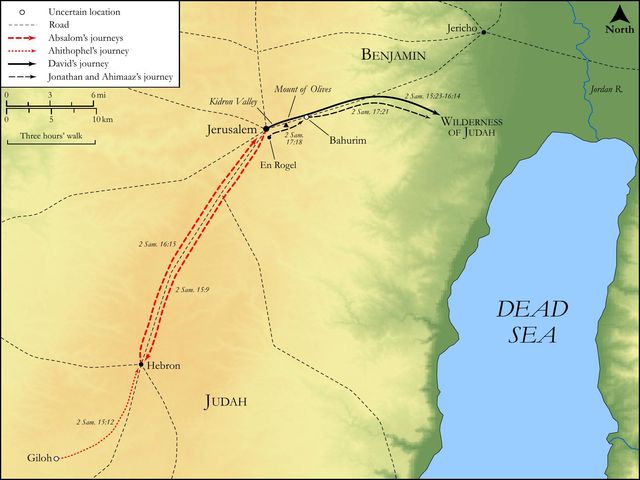
I.The place he chose for the rendezvous of his party was Hebron, the place where he was born and where his father began his reign and continued it several years, which would give some advantage to his pretensions. Every one knew Hebron to be a royal city; and it lay in the heart of Judah's lot, in which tribe, probably, he thought his interest strong.
II.The pretence he had both to go thither and to invite his friends to him there was to offer a sacrifice to God, in performance of a vow he had made during his banishment, Sa2 15:7, Sa2 15:8. We have cause enough to suspect that he had not made any such vow; it does not appear that he was so religiously inclined. But he that stuck not at murder and treason would not make conscience of a lie to serve his purpose. If he said he had made such a vow, nobody could disprove him. Under this pretence,
1.He got leave of his father to go to Hebron. David would be well pleased to hear that his son, in his exile, was so desirous to return to Jerusalem, not only his father's city, but the city of the living God, - that he looked up to God, to bring him back, - that he had vowed, if he were brought back, to serve the Lord, whose service he had hitherto neglected, - and that now, being brought back, he remembered his vow, and resolved to perform it. If he think fit to do it in Hebron, rather than in Sion or Gibeon, the good king is so well pleased with the thing itself that he will not object against his choice of the place. See how willing tender parents are to believe the best concerning their children, and, upon the least indication of good, to hope, even concerning those that have been untoward, that they will repent and reform. But how easy is it for children to take advantage of their good parents' credulity, and to impose upon them with the show of religion, while still they are what they were! David was overjoyed to hear that Absalom inclined to serve the Lord, and therefore readily gave him leave to go to Hebron, and to go thither with solemnity.
2.He got a good number of sober substantial citizens to go along with him, Sa2 15:11. There went 200 men, probably of the principal men of Jerusalem, whom he invited to join with him in his feast upon his sacrifice; and they went in their simplicity, not in the least suspecting that Absalom had any bad design in this journey. He knew that it was to no purpose to tempt them into his plot: they were inviolably firm to David. But he drew them in to accompany him, that the common people might think that they were in his interest, and that David was deserted by some of his best friends. Note, It is no new thing for very good men, and very good things, to be made use of by designing men to put a colour upon bad practices. When religion is made a stalking-horse, and sacrifice a shoeing-horn, to sedition and usurpation it is not to be wondered at if some that were well affected to religion, as these followers of Absalom here, are imposed upon by the fallacy, and drawn in to give countenance to that, with their names, which in their heart they abhor, not having known the depths of Satan.
III.The project he laid was to get himself proclaimed king throughout all the tribes of Israel upon a signal given, Sa2 15:10.
Spies were sent abroad, to be ready in every country to receive the notice with satisfaction and acclamations of joy, and to make the people believe that the news was both very true and very good, and that they were all concerned to take up arms for their new king. Upon the sudden spreading of this proclamation, "Absalom reigns in Hebron," some would conclude that David was dead, others that he had resigned: and thus those that were in the secret would draw in many to appear for Absalom, and to come into his assistance, who, if they had rightly understood the matter, would have abhorred the thought of it, but, being drawn in, would adhere to him. See what artifices ambitious men use for the compassing of their ends; and in matters of state, as well as in matters of religion, let us not be forward to believe every spirit, but try the spirits.
IV.The person he especially courted and relied upon in this affair was Ahithophel, a politic thinking man, and one that had a clear head and a great compass of thought, that had been David's counsellor, his guide and his acquaintance (Psa 55:13), his familiar friend, in whom he trusted, who did eat of his bread, Psa 41:9. But, upon some disgust of David's against him, or his against David, he was banished, or retired from public business, and lived privately in the country. How should a man of such good principles as David, and a man of such corrupt principles as Ahithophel, long agree? A fitter tool Absalom could not find in all the kingdom than one that was so great a statesman, and yet was disaffected to the present ministry. While Absalom was offering his sacrifices, in performance of his pretended vow, he sent for this man. So much was his heart on the projects of his ambition that he could not stay to make an end of his devotion, which showed what his eye was upon in all, and that it was but for a pretence that he made long offerings.
V.The party that joined with him proved at last very considerable.
The people increased continually with Absalom, which made the conspiracy strong and formidable. Every one whom he had complimented and caressed (pronouncing his matters right and good, especially if afterwards the cause went against him) not only came himself, but made all the interest he could for him, so that he wanted not for numbers. The majority is no certain rule to judge of equity by. All the world wondered after the beast. Whether Absalom formed this design merely in the height of his ambition and fondness to rule, or whether there was not in it also malice against his father and revenge for his banishment and confinement, though this punishment was so much less than he deserved, does not appear. But, generally, that which aims at the crown aims at the head that wears it.
Continue studying 2 Samuel 15:7 across the web’s major study libraries — every link below opens this exact verse, chapter, or book on the destination site.
Read & Compare
 BibleGatewayThis verse in more than 200 translations and 70 languages.
 Bible.comThe YouVersion reader — hundreds of translations, reading plans, and highlights.
 ESV.orgCrossway's official English Standard Version reader.
 NET BibleThe NET translation with 60,000+ translators' notes on every rendering decision.
 STEP BibleTyndale House's free study tool — original text, vocabulary, and scholarly resources.
 BibliaLogos Bible Software's free web reader.
 USCCBThe New American Bible (Revised Edition) with the U.S. bishops' study notes.
Commentaries
 BibleHub CommentariesDozens of classic commentaries on this verse, gathered on one page.
 StudyLightMore than 100 commentary sets — the largest collection on the web.
 BibleRefPlain-English commentary on what this verse means, verse by verse.
 Enduring WordDavid Guzik's free commentary on this chapter, widely used by Bible teachers.
 Bible Study ToolsVerse commentary alongside Greek and Hebrew study aids.
Original Language & Research
- BibleHub InterlinearThe verse word by word — original language, transliteration, and English.
- BibleHub LexiconEvery word's original-language definition and Strong's entry.
 Blue Letter BibleDeep-study tools — Strong's numbers, concordance, and word studies.
 SefariaThe Hebrew text with Rashi and centuries of Jewish commentary.
Sermons, Hymns & Audio


TrulyRandomVerse is not affiliated with these sites and doesn’t control their content. They’re linked because they’re genuinely useful.
Summary
2 Samuel 15:7 marks the cunning initiation of Absalom's rebellion against King David. Cloaked in a pretense of religious devotion, Absalom requests permission to travel to Hebron to fulfill a vow to the Lord. This seemingly pious act is, in reality, a meticulously planned deception designed to establish a base of operations for his coup, exploiting David's trust and laying the groundwork for a devastating civil war that would tear the kingdom apart.
Context
ShowHideLiterary Context
This verse serves as the critical turning point in the narrative of Absalom's rebellion, immediately following his systematic efforts to undermine King David's authority. Chapters 13 and 14 detail the events leading to Absalom's estrangement from David, including Amnon's rape of Tamar and Absalom's retaliatory murder of Amnon, which resulted in his three-year exile. Upon his return to Jerusalem and eventual, albeit strained, reconciliation with David, Absalom began a deliberate campaign to win the hearts of the people. He strategically positioned himself at the city gate, offering counsel and justice to those who felt unheard by the king, thereby actively "stealing the hearts of the men of Israel" (2 Samuel 15:1-6). Verse 7, therefore, is not an isolated incident but the culmination of this preparatory work, where Absalom presents a seemingly innocent and devout request to David, which is, in reality, a carefully orchestrated move to launch his revolt from a strategically significant location.
Historical & Cultural Context
The setting is King David's reign, likely in Jerusalem, which he had established as his capital. Hebron, Absalom's chosen destination, held immense historical and cultural significance. It was David's first capital city, where he was anointed king over Judah (2 Samuel 2:4) and reigned for seven and a half years before conquering Jerusalem (2 Samuel 5:5). The practice of making and fulfilling vows to the LORD was a common and respected religious obligation in ancient Israel (Numbers 30:2). Such vows were serious commitments, often made in times of distress or as expressions of gratitude, and their fulfillment was seen as a mark of piety. Absalom's shrewd use of this sacred custom as a cover for his political ambitions highlights his cunning manipulation of religious piety for personal gain. The political climate was ripe for unrest, possibly due to lingering discontent from David's past sins (e.g., the Bathsheba and Uriah affair in 2 Samuel 11) and the subsequent turmoil within his own family, which may have weakened public trust in his administration and made the populace susceptible to Absalom's deceptive charm.
Key Themes
ShowHideThis verse powerfully contributes to several major themes within 2 Samuel and the broader biblical narrative. Deception and Hypocrisy are central, as Absalom uses a sacred religious obligation—paying a vow to the LORD—as a cunning cover for his treacherous political agenda. This highlights the danger of using spiritual acts for unholy purposes, a theme echoed in prophetic condemnations of outward religiosity without inward righteousness (e.g., Isaiah 1:10-17). The theme of Usurpation and Rebellion is overtly introduced, as Absalom's request to go to Hebron is not merely about fulfilling a vow but about establishing a base for his rebellion against David's legitimate, God-ordained rule. His Strategic Planning is evident in the choice of Hebron, a city with historical and symbolic importance that could garner support from those loyal to older traditions or dissatisfied with David's current administration in Jerusalem. Finally, the verse tragically illustrates the Exploitation of Parental Trust, as King David, likely still hoping for a full reconciliation with his son after the events of 2 Samuel 14, grants Absalom's request, unaware of the deep betrayal brewing beneath the surface.
Exposition and Analysis
ShowHideKey Word Analysis
ShowHideFrom the root nâdar (H5087), meaning "to promise (pos., to do or give something to God)," neder (H5088) refers to a promise made to God, or concretely, a thing promised. In ancient Israel, vows were solemn commitments, often made in exchange for divine favor or as expressions of devotion (e.g., the Nazirite vow in Numbers 6:2). Fulfilling a vow was considered a religious obligation and a mark of piety, while failure to do so was a serious offense (Deuteronomy 23:21). Absalom's claim to be fulfilling a vow to the LORD is a calculated act of hypocrisy, using a sacred religious duty as a deceptive cover for his treasonous intentions. This perversion of a holy act underscores his manipulative character and deep spiritual corruption.
A primitive root (H7999) meaning "to be safe (in mind, body or estate); figuratively, to be (causatively, make) completed; by implication, to be friendly; by extension, to reciprocate (in various applications)." In the context of a vow, "to pay" signifies the completion or fulfillment of a promise made to God, often involving an offering or sacrifice. Absalom's use of this term suggests he is completing a sacred obligation, lending an air of legitimacy and piety to his request. However, his true intention is not to "pay" or complete a spiritual commitment, but to initiate a rebellion, thereby perverting the very meaning of the word for his own treacherous purposes.
From the root cheber (H2275), meaning "seat of association," Hebron was a significant city in Palestine. It held immense historical and symbolic importance for David and Israel. It was where David was first anointed king over Judah (2 Samuel 2:4) and reigned for seven and a half years before establishing Jerusalem as his capital (2 Samuel 5:5). By choosing Hebron as the site for his supposed vow-payment, Absalom strategically tapped into residual loyalties to the old capital and potentially appealed to those who felt overlooked by David's move to Jerusalem or were discontent with his rule. Its distance from Jerusalem also provided a measure of operational security for the initial stages of his rebellion, allowing him to gather support before David could react.
Verse Breakdown
ShowHide"And it came to pass after forty years,"
This phrase presents a significant textual challenge. While the Masoretic Text (MT) reads "forty years," the Septuagint (LXX), Syriac Peshitta, and the writings of Josephus consistently read "four years." Given that David's entire reign lasted forty years (2 Samuel 5:4), and Absalom's rebellion clearly occurs well within that period, "four years" is widely considered by biblical scholars to be the more historically plausible reading. This period likely refers to the time since Absalom's return from Geshur (2 Samuel 14:28) or his full reconciliation with David (2 Samuel 14:33), during which he meticulously built his popular support and planned his coup. It highlights the deliberate, long-term nature of his conspiracy, indicating that his rebellion was not a sudden impulse but a meticulously planned and executed scheme.
"that Absalom said unto the king,"
This simple statement underscores the direct interaction between father and son, yet it is laden with dramatic irony. Absalom approaches David with a seemingly innocent and respectful request, masking his true, treacherous intentions. David, still hoping for genuine reconciliation and perhaps blinded by paternal affection, is susceptible to this deception, demonstrating the tragic vulnerability of a trusting parent. This interaction sets the stage for the profound betrayal that is about to unfold.
"I pray thee, let me go and pay my vow,"
Absalom presents his request as a matter of religious duty and personal piety. The phrase "I pray thee" (Hebrew, na'), often translated as "please," adds a veneer of humility and respect to his appeal, making it difficult for the king to refuse without appearing to hinder religious observance. By framing his journey as the fulfillment of a sacred vow to the LORD, Absalom cleverly exploits David's own piety and reverence for divine obligations. This manipulation of spiritual language for worldly gain is a hallmark of Absalom's character, revealing his deep-seated hypocrisy.
"which I have vowed unto the LORD, in Hebron."
This specifies the nature and location of the supposed vow. The mention of "the LORD" lends an air of spiritual legitimacy to his request, making it appear unassailable and beyond question. The choice of "Hebron" is strategically brilliant and deeply symbolic. It was David's first capital, a place of historical significance and potential lingering support for a new regime, especially among those who might have felt dispossessed by David's move to Jerusalem. This location provides Absalom with a secure base to launch his coup, away from the immediate oversight of David's court, leveraging its historical gravitas for his rebellious cause.
Literary Devices
ShowHideThis verse is rich with literary devices that amplify its dramatic tension and thematic significance. Irony is paramount, as Absalom's outwardly pious request to fulfill a vow to the LORD is a complete façade for his rebellious and ungodly intentions. The very act of seeking divine approval serves as a cover for profound human treachery. This also exemplifies Deception, as Absalom masterfully manipulates his father's trust and religious sensibilities to achieve his nefarious political aims. The choice of Hebron is a powerful instance of Symbolism; it is not merely a geographical location but a place steeped in Davidic history and legitimacy, which Absalom seeks to usurp and redefine for his own rebellious narrative. Furthermore, the entire interaction serves as potent Foreshadowing, signaling the imminent and devastating civil war that will erupt from this seemingly innocuous request, leading to widespread suffering and the tragic downfall of Absalom himself. The king's unsuspecting agreement underscores the dramatic Pathos of the situation, as David unknowingly grants permission for the very act that will shatter his kingdom and family.
Theological and Thematic Connections
ShowHideThis pivotal verse powerfully illustrates the profound dangers of hypocrisy and the insidious nature of sin cloaked in religious garb. Absalom's actions reveal a heart utterly devoid of integrity, willing to pervert sacred obligations for personal gain and political ambition. The narrative underscores that outward displays of piety, such as making or fulfilling vows, are meaningless—and indeed, are an abomination—when they are not rooted in genuine devotion to God but are used as tools for manipulation and rebellion. This serves as a timeless warning against using spiritual acts for unholy purposes, reminding us that God sees beyond the outward appearance to the true intentions of the heart, for "the Lord sees not as man sees: man looks on the outward appearance, but the Lord looks on the heart" (1 Samuel 16:7). The tragic consequences that follow Absalom's deception highlight the destructive power of betrayal, both against human authority and against divine order, echoing the broader biblical theme that "what a man sows, that he will also reap" (Galatians 6:7).
Reflection and Application
ShowHideAbsalom's deceptive request in 2 Samuel 15:7 serves as a poignant mirror for self-examination, compelling us to consider the authenticity of our own religious practices and motivations. It challenges us to ask: Are our acts of worship, service, or commitment truly expressions of a heart devoted to God, or are they sometimes tainted by ulterior motives—seeking approval, gaining influence, or masking personal agendas? This verse calls us to cultivate a radical integrity where our inner life aligns with our outward expressions, understanding that true piety is not a performance but a posture of the heart before God. It also calls us to discernment, reminding us that not every seemingly pious request or action is pure. We are to be "wise as serpents and innocent as doves" (Matthew 10:16), understanding that spiritual language can be twisted for unholy ends, and that even seemingly good intentions can mask deep-seated sin. Ultimately, Absalom's tragic end, born from this deceptive beginning, underscores the futility and destructiveness of rebellion against God-ordained authority and the importance of genuine humility and submission to both divine and human authorities.
Questions for Reflection
ShowHideFAQ
ShowHideWhy does the KJV say "forty years" when many scholars believe it should be "four years"?
ShowHideThe discrepancy between "forty years" in the Masoretic Text (MT), which is the basis for the King James Version (KJV) and many other modern translations, and "four years" found in the Septuagint (LXX), Syriac Peshitta, and the writings of the Jewish historian Josephus, is a classic example of a textual variant. Scholars generally favor "four years" because David's entire reign was forty years (2 Samuel 5:4), and Absalom's rebellion clearly occurs within that timeframe. "Four years" likely refers to the period since Absalom's return from Geshur or his full reconciliation with David (2 Samuel 14:28-33), during which he systematically built his support among the people. The "forty years" reading is considered by most to be a scribal error, possibly due to a misreading of similar-looking Hebrew letters or a copyist's mistake. Textual criticism helps us understand these variations and reconstruct the most probable original reading, providing a more accurate historical timeline for Absalom's plotting.
What was the significance of Absalom choosing Hebron for his "vow"?
ShowHideAbsalom's choice of Hebron was highly strategic and symbolic, not merely a convenient location. Hebron was David's first capital city, where he reigned over Judah for seven and a half years before conquering Jerusalem and establishing it as the capital for all Israel (2 Samuel 2:4 and 2 Samuel 5:5). By going to Hebron, Absalom was tapping into its historical legitimacy and potentially appealing to lingering tribal loyalties or discontent among those who might have felt overlooked by David's shift to Jerusalem. It provided him with a base of operations away from David's immediate oversight in Jerusalem, allowing him to gather support and launch his rebellion from a place with significant historical weight. This move was a calculated attempt to legitimize his usurpation in the eyes of the people by associating his coup with David's own beginnings as king, thus drawing on the city's symbolic power to bolster his claim to the throne.
Christ-Centered Fulfillment
ShowHideAbsalom's deceptive vow in Hebron, cloaked in piety but fueled by rebellion, stands in stark contrast to the perfect obedience and genuine sacrifice of Jesus Christ, the true Son of David. Absalom sought to usurp a throne through manipulation and a false display of devotion, ultimately leading to death and division for himself and the nation. In contrast, Jesus, though rightfully King of Kings and Lord of Lords (Revelation 19:16), did not cling to His divine prerogatives but "emptied himself, by taking the form of a servant" (Philippians 2:7). His "vow" was not a deceitful pretense but a solemn, unwavering commitment to do the Father's will, even to the point of death on a cross (John 6:38). While Absalom's actions brought a curse upon his house and the nation, Christ's perfect obedience and ultimate sacrifice in Jerusalem—the city David established as his capital—resulted in the forgiveness of sins and the establishment of an eternal kingdom of peace and righteousness (Hebrews 10:10). Jesus is the true Lamb of God, who genuinely takes away the sin of the world (John 1:29), fulfilling the true spirit of devotion that Absalom merely feigned. His reign is not built on deception or human ambition, but on truth, grace, and an everlasting covenant, bringing true justice and peace to all who believe (Isaiah 9:7).