


2 Peter 2:3
Bible text: King James Version (1769 Blayney text) · Public domain
Bible text: King James Version with Strong's numbers · Public domain
Bible text: Berean Standard Bible · Public domain
Bible text: American Standard Version (1901) · Public domain
Bible text: World English Bible, Messianic edition · Public domain
Bible text: Geneva Bible (1599) · Public domain
Bible text: Young's Literal Translation · Public domain
- καὶkaiAndG2532CONJConjunction
- ἐνenthroughG1722PREPPreposition
- πλεονεξίᾳpleonexiacovetousnessG4124N-DSFNoun Dative Singular Feminine
- πλαστοῖςplastoiswith fabricatedG4112A-DPMAdjective Dative Plural Masculine
- λόγοιςlogoiswordsG3056N-DPMNoun Dative Plural Masculine
- ὑμᾶςhumasyouG4771P-2APPersonal pronoun Accusative 2nd Plural
- ἐμπορεύσονταιemporeusontaithey will exploitG1710V-FDI-3PVerb Future Middle Deponent Indicative 3rd Plural
- οἷςhoisfor whomG3739R-DPMRelative pronoun Dative Plural Masculine
- τὸtotheG3588T-NSNDefinite article Nominative Singular Neuter
- κρίμαkrimajudgmentG2917N-NSNNoun Nominative Singular Neuter
- ἔκπαλαιekpalaiof long agoG1597ADVAdverb
- οὐκouknotG3756PRT-NNegative Particle Negative
- ἀργεῖargeiis idleG691V-PAI-3SVerb Present Active Indicative 3rd Singular
- καὶkaiandG2532CONJConjunction
- ἡhētheG3588T-NSFDefinite article Nominative Singular Feminine
- ἀπώλειαapōleiadestructionG684N-NSFNoun Nominative Singular Feminine
- αὐτῶνautōnof themG846P-GPMPersonal pronoun Genitive Plural Masculine
- οὐounotG3756PRT-NNegative Particle Negative
- νυστάζειnustazeislumbersG3573V-PAI-3SVerb Present Active Indicative 3rd Singular
English is a literal word-by-word gloss of the Greek, not the KJV's wording. Why?
This is the original text the KJV's translators worked from — each Greek word with its own literal English meaning in this verse, prepared by scholars at Tyndale House, Cambridge. The KJV translates whole sentences, not word by word, so its wording differs: one Greek word can become several English words, and the KJV may choose “charity” where the gloss reads “love”. Both are faithful — they answer different questions. For the KJV's own rendering, switch to the KJV text.
Details
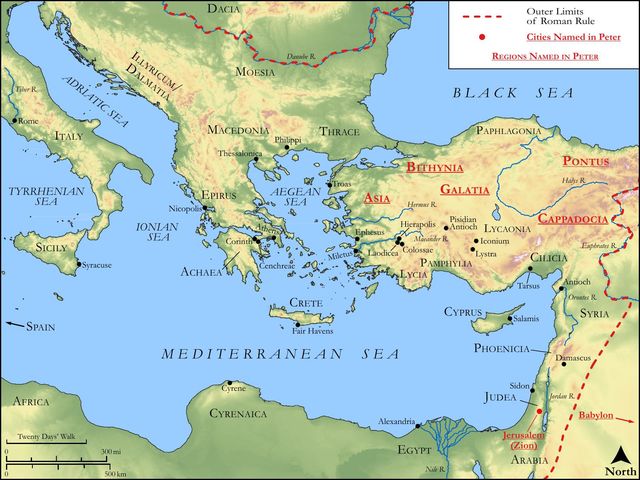
See on the biblical-era maps

Study this verse
Public-domain commentary
Matthew Henry
From his Commentary on the Whole Bible. Henry comments on passages, not single verses — this entry covers 2 Peter 2:3–6. His two-level outline is real structure in the source text, so it is rendered as structure.
Men are apt to think that a reprieve is the forerunner of a pardon, and that if judgment be not speedily executed it is, or will be, certainly reversed. But the apostle tells us that how successful and prosperous soever false teachers may be, and that for a time, yet their judgment lingereth not. God has determined long ago how he will deal with them. Such unbelievers, who endeavour to turn others from the faith, are condemned already, and the wrath of God abideth on them. The righteous Judge will speedily take vengeance; the day of their calamity is at hand, and the things that shall come upon them make haste. To prove this assertion, here are several examples of the righteous judgment of God, in taking vengeance on sinners, proposed to our serious consideration.
I.See how God dealt with the angels who sinned. Observe,
1.No excellency will exempt a sinner from punishment. If the angels, who excel us vastly in strength and knowledge, violate the law of God, the sentence which that law awards shall be executed upon them, and that without mercy or mitigation, for God did not spare them. Hence observe,
2.By how much the more excellent the offender, by so much the more severe the punishment. These angels, who had the advantage of men as to the dignity of their nature, are immediately punished. There is no sparing them for a few days, no favour at all shown them.
3.Sin debases and degrades the persons who commit it. The angels of heaven are cast down from the height of their excellency, and divested of all their glory and dignity, upon their disobedience. Whoever sins against God does a manifest hurt to himself.
4.Those who rebel against the God of heaven shall all be sent down to hell. There is no place nor state between the height of glory and the depth of misery in which they shall be allowed to rest. If creatures sin in heaven, they must suffer in hell.
5.Sin is the work of darkness, and darkness is the wages of sin. The darkness of misery and torment follows the darkness of sin. Those who will not walk according to the light and direction of God's law shall be deprived of the light of God's countenance and the comforts of his presence.
6.As sin binds men over to punishment, so misery and torment hold men under punishment. The darkness which is their misery keeps them so that they cannot get away from their torment.
7.The last degree of torment is not till the day of judgment. The sinning angels, though in hell already, are yet reserved to the judgment of the great day.
II.See how God dealt with the old world, even in much the same way that he dealt with the angels. He spared not the old world. Here observe,
1.The number of offenders signifies no more to procure any favour than the quality. If the sin be universal, the punishment shall likewise extend to all. But,
2.If there be but a few righteous, they shall be preserved. God does not destroy the good with the bad. In wrath he remembers mercy.
3.Those who are preachers of righteousness in an age of universal corruption and degeneracy, holding forth the word of life in an unblamable and exemplary conversation, shall be preserved in a time of general destruction.
4.God can make use of those creatures as the instruments of his vengeance in punishing sinners which he at first made and appointed for their service and benefit. He destroyed the whole world by water; but observe,
5.What was the procuring cause of this: it was a world of ungodly men. Ungodliness puts men out of the divine protection, and exposes them to utter destruction.
III.See how God dealt with Sodom and Gomorrah; though they were situated in a country like the garden of the Lord, yet, if in such a fruitful soil they abound in sin, God can soon turn a fruitful land into barrenness and a well-watered country into dust and ashes. Observe,
1.No political union or confederacy can keep off judgments from a sinful people. Sodom and the neighbouring cities were no more secured by their regular government than the angels by the dignity of their nature or the old world by their vast number.
2.God can make use of contrary creatures to punish incorrigible sinners. He destroys the old world by water, and Sodom by fire. He who keeps fire and water from hurting his people (Isa 43:2) can make either to destroy his enemies; therefore they are never safe.
3.Most heinous sins bring most grievous judgments. Those who were abominable in their vices were remarkable for their plagues. Those who are sinners exceedingly before the Lord must expect the most dreadful vengeance.
4.The punishment of sinners in former ages is designed for the example of those who come after. "Follow them, not only in the time of living, but in their course and way of living." Men who live ungodly must see what they are to expect if they go on still in a course of impiety. Let us take warning by all the instances of God's taking vengeance, which are recorded for our admonition, and to prevent our promising ourselves impunity, though we go on in a course of sin.
Historical interpretation
Five Centuries of Reception
4 surviving comments on this verse. Each one is dated, so this reads as a timeline rather than a list.
Select a marker to jump to its quote. Markers stagger vertically where authors wrote within a few decades of each other.
The destruction of these people comes from none other than the God of Israel, who is never idle or asleep.
They were doing this for money. Excess is sometimes geared toward wickedness and sometimes toward profit, but here the addition of the word exploit makes the meaning clear. They will indeed have their reward, which is death. The phrase “of old” indicates God’s foreknowledge of what they would do. For just as God foresaw who would be good and prepared good things for them in heaven, so he also foresaw who would be evil and prepared the other place for them.
Their judgment has not ceased long ago. When 'long ago' signifies a past time and 'has not ceased' is a word in the present tense, it seems to mean nothing else but that the judgment of the perdition of the impious, which has already long begun, continually torments them presently and will never cease with any end.
But there were also false prophets among the people, just as there will be false teachers among you, who secretly bring in destructive heresies, even denying the Lord who bought them, bringing upon themselves swift destruction. And many will follow their obscene ways, and because of them the way of truth will be blasphemed. And in their greed they will exploit you with false words. Their judgment from long ago is not idle, and their destruction is not asleep.
Since prophecy is a common name that refers to both prophets and false prophets, it confirms that false prophets should not be regarded. And Paul differs slightly from this, as he teaches that no one says Jesus is Lord except by the Holy Spirit. (1 Cor. 12:3) Therefore, he begins to oppose the heresy against the Nicolaitans, saying that their wickedness is twofold. For they are indeed most impious in doctrine, as their blasphemy against the Lord Christ demonstrates; however, their life is especially obscene. And this he now signifies through shameful gain; however, having progressed a little, he will state it more openly. For now he refers to πλεονεξίαν, that is, greed, signifying shameful gain. For πλαονεξία sometimes signifies injustice, but at other times simply gain. Hence, showing that he speaks more particularly, he added:
"they will exploit you." Completely alienating them from divine doctrine, he said they would use false words. But they will have, he says, the wages of impiety, namely death. Moreover, it is already an indication of the foreknowledge of God. For just as through foreknowledge He prepared good things for the good, so also a fitting place for the wicked.
"who secretly," etc. The order: Those who, summoning swift destruction upon themselves, will secretly lead destructive sects; and denying the Lord who bought them, and through greed negotiating with false words about you.
"is not asleep." He does not cease, nor will he be idle, sluggish, or ineffective.
Continue studying 2 Peter 2:3 across the web’s major study libraries — every link below opens this exact verse, chapter, or book on the destination site.
Read & Compare
 BibleGatewayThis verse in more than 200 translations and 70 languages.
 Bible.comThe YouVersion reader — hundreds of translations, reading plans, and highlights.
 ESV.orgCrossway's official English Standard Version reader.
 NET BibleThe NET translation with 60,000+ translators' notes on every rendering decision.
 STEP BibleTyndale House's free study tool — original text, vocabulary, and scholarly resources.
 BibliaLogos Bible Software's free web reader.
 USCCBThe New American Bible (Revised Edition) with the U.S. bishops' study notes.
Commentaries
 BibleHub CommentariesDozens of classic commentaries on this verse, gathered on one page.
 StudyLightMore than 100 commentary sets — the largest collection on the web.
 BibleRefPlain-English commentary on what this verse means, verse by verse.
 Enduring WordDavid Guzik's free commentary on this chapter, widely used by Bible teachers.
 Bible Study ToolsVerse commentary alongside Greek and Hebrew study aids.
Original Language & Research
- BibleHub InterlinearThe verse word by word — original language, transliteration, and English.
- BibleHub LexiconEvery word's original-language definition and Strong's entry.
 Blue Letter BibleDeep-study tools — Strong's numbers, concordance, and word studies.
 CNTR CollationThe earliest Greek manuscripts of this verse, collated letter by letter.
Sermons, Hymns & Audio


TrulyRandomVerse is not affiliated with these sites and doesn’t control their content. They’re linked because they’re genuinely useful.
Summary
Second Peter 2:3 serves as a stark and urgent warning against false teachers, exposing their core motivation and method: an insatiable greed that drives them to exploit believers through carefully crafted deceptions. The verse simultaneously delivers a powerful reassurance, asserting the absolute certainty and immediacy of God's righteous judgment and ultimate destruction upon those who engage in such spiritual predation.
Context
ShowHideLiterary Context
This verse is embedded within a comprehensive denunciation of false prophets and teachers that begins in 2 Peter 2:1. Peter immediately introduces the threat of "destructive heresies" and those who secretly introduce them, leading many astray and bringing "the way of truth into disrepute" (2 Peter 2:2). Verse 3 then sharpens the focus, revealing the underlying economic exploitation and the cynical manipulation at the heart of these deceivers' ministry. It acts as a bridge, setting the stage for the subsequent detailed examples of God's past judgments on the unrighteous, such as the angels who sinned, the ancient world in Noah's day, and Sodom and Gomorrah (2 Peter 2:4-9). This structure underscores the inevitability of divine retribution for those who corrupt the faith for personal gain.
Historical & Cultural Context
In the Greco-Roman world, various philosophical schools and religious cults competed for adherents, often with teachers or leaders who charged fees for their instruction or services. While some genuine teachers existed, there was also a prevalence of sophists and charlatans who used rhetoric and persuasive speech for personal profit, often preying on the gullible. Early Christian communities, being relatively new and often composed of vulnerable converts, were susceptible to such figures who would infiltrate their ranks. Peter's warning echoes similar concerns found in other New Testament letters, reflecting a common challenge faced by the nascent church. The emphasis on "covetousness" and "making merchandise" points to a specific problem where spiritual authority was being leveraged for material gain, a perversion of the selfless service exemplified by Christ and His apostles.
Key Themes
ShowHide2 Peter 2 is saturated with themes critical for the church's spiritual health. Discernment is paramount, as believers are urged to recognize the subtle and overt tactics of those who would lead them astray. The theme of Divine Justice is powerfully asserted, with Peter emphasizing that God is not slow to act against wickedness, even if it appears delayed from a human perspective. This provides comfort and reassurance to those who might feel exploited or disheartened by the presence of false teachers. Furthermore, the passage highlights the Integrity of True Ministry by contrasting it sharply with the self-serving motives of the deceivers. While genuine shepherds care for the flock, these false teachers treat people as commodities to be exploited, revealing their true nature as "wells without water" and "mists driven by a tempest" (2 Peter 2:17). The overarching theme is the Purity of the Gospel, which is constantly under assault by those who would distort it for their own ends, making vigilance a perpetual necessity for the faithful.
Exposition and Analysis
ShowHideKey Word Analysis
ShowHideFrom the Strong's data, this term signifies "avarice, i.e. (by implication) fraudulency, extortion." It describes an insatiable desire for more, particularly material possessions or gain, often at the expense of others. In this context, it reveals the deep-seated, selfish motivation behind the false teachers' actions, indicating that their spiritual pretense is merely a facade for their financial exploitation.
Derived from the Strong's definition "moulded, i.e. (by implication) artificial or (figuratively) fictitious (false)," this word describes words that are carefully crafted, fabricated, or artificial. It implies a deliberate lack of sincerity and an intention to deceive. These are not genuine words of truth or spiritual edification, but rather cunningly designed rhetoric intended to manipulate and mislead.
According to Strong's, this means "to travel in (a country as a pedlar), i.e. (by implication) to trade." It vividly portrays the false teachers' view of their followers: not as souls to be nurtured or disciples to be taught, but as commodities or customers from whom to extract profit. They treat people as a means to an end, turning spiritual relationships into commercial transactions.
This term, as per Strong's, refers to "ruin or loss (physical, spiritual or eternal)." It is a strong word denoting complete destruction or perdition. Peter uses it here to emphasize the ultimate and irreversible fate awaiting these false teachers, highlighting the severity of God's judgment against their deceptive and exploitative practices.
Verse Breakdown
ShowHide"And through covetousness"
This opening phrase immediately identifies the root cause and primary motivation of the false teachers. Their actions are not driven by a genuine desire to serve God or teach truth, but by an insatiable desire for more, particularly wealth and material gain. This greed corrupts their entire ministry and informs their deceptive practices.
"shall they with feigned words make merchandise of you"
This clause reveals the method and target of their exploitation. "Feigned words" implies carefully constructed, artificial, and insincere speech designed to manipulate. They use persuasive rhetoric, flattery, or distorted doctrines to achieve their ends. "Make merchandise of you" means they treat believers as commodities to be bought and sold, or as resources from which to extract profit. Their goal is not the spiritual welfare of the flock, but their own financial enrichment.
"whose judgment now of a long time lingereth not"
This part shifts focus from the false teachers' actions to God's response. The phrase "of a long time" (Greek ékpalai) suggests that God's righteous judgment against such evil has been active or determined for a long time, perhaps since creation or the beginning of their wicked ways. "Lingereth not" (Greek argéō from "to be idle") conveys that this judgment is not idle, delayed, or inactive. It is already in motion, certain, and will not be held back.
"and their damnation slumbereth not."
This final clause reinforces the certainty and immediacy of their impending doom through powerful parallelism. "Damnation" (Greek apṓleia) denotes ruin or destruction. "Slumbereth not" (Greek nystázō from "to nod, fall asleep") vividly portrays that their destruction is not dormant, sleepy, or inactive. Like a watchful sentinel, God's justice is awake, alert, and ready to be executed, ensuring that their inevitable ruin will come swiftly and decisively.
Literary Devices
ShowHidePeter employs several powerful literary devices to convey his urgent warning and the certainty of divine retribution. The most prominent is Metaphor, particularly in the phrase "make merchandise of you." This creates a vivid image of treating human beings, specifically believers, as mere commodities or goods to be traded for profit, stripping them of their inherent dignity and spiritual value. This stark commercial metaphor underscores the profound perversion of ministry by these false teachers. Furthermore, Peter uses striking Personification when he states that judgment "lingereth not" and damnation "slumbereth not." By attributing human actions (lingering, slumbering) to abstract concepts (judgment, damnation), he imbues them with an active, watchful, and unstoppable quality. This serves to emphasize the absolute certainty and the active, unceasing nature of God's justice. The Parallelism between "lingereth not" and "slumbereth not" further amplifies this message, creating a rhythmic and emphatic declaration of the inevitability of their doom. The use of Contrast is also evident, implicitly setting the self-serving, deceptive actions of the false teachers against the righteous, vigilant, and unwavering nature of God's judgment.
Theological and Thematic Connections
ShowHideThe warning in 2 Peter 2:3 resonates deeply with core biblical truths about divine justice, the nature of true ministry, and the importance of spiritual discernment. The passage underscores God's unwavering commitment to righteousness and His active opposition to those who exploit His people and distort His truth. It reveals that the motivation of greed (covetousness) is antithetical to the spirit of Christ and the sacrificial nature of the gospel. The certainty of judgment for such practices provides both a stern warning to potential deceivers and profound comfort to those who might be vulnerable to their schemes, affirming that God sees and will act. This passage reminds us that God's patience is not indifference, and His justice, though sometimes appearing delayed from a human perspective, is always active and perfectly timed.
Reflection and Application
ShowHide2 Peter 2:3 serves as a timeless and urgent call for spiritual vigilance within the Christian community. In an age of abundant information and diverse voices, the believer must cultivate a profound sense of discernment, not merely accepting every teaching at face value. This verse challenges us to look beyond eloquent words and charismatic personalities, probing instead the underlying motivations of those who claim to speak for God. Are they truly seeking to build up the body of Christ, or are they subtly, or even overtly, seeking personal gain? True spiritual leadership is characterized by selfless service, humility, and a genuine concern for the flock, not by a desire to "make merchandise" of them. We are called to be deeply rooted in the Scriptures, allowing God's unchanging Word to be the plumb line against which all teaching is measured. Furthermore, this passage offers immense comfort and reassurance. Even when false teachers seem to prosper and their deceptions appear to go unpunished, we are reminded that God's justice is neither blind nor slow. His judgment is active, certain, and will not slumber. This truth should embolden believers to stand firm in the faith, trusting in the Lord's perfect timing and His ultimate vindication of His truth and His people.
Questions for Reflection
ShowHideFAQ
ShowHideWhat does it mean for false teachers to "make merchandise of you"?
ShowHideTo "make merchandise of you" means that these false teachers treat believers not as individuals to be discipled and nurtured, but as commodities or resources from which they can extract personal gain, typically financial. They view their followers as a means to an end, exploiting their faith, trust, and resources for their own selfish enrichment. This is a profound perversion of genuine ministry, which is characterized by selfless service and a desire for the spiritual well-being of others, as seen in the example of Christ and His apostles. It implies a cynical, commercial approach to spiritual matters.
How can believers identify "feigned words" and avoid deception?
ShowHideIdentifying "feigned words" requires spiritual maturity and consistent discernment. Firstly, know the genuine Word of God thoroughly. Immerse yourself in the Scriptures so that you can recognize distortions or deviations from sound doctrine (Acts 17:11). Secondly, examine the character and fruits of the teacher, not just their words (Matthew 7:15-20). Do their lives align with their teachings? Do they exhibit humility, integrity, and genuine love, or do they seem driven by greed, pride, or a desire for power? Thirdly, seek confirmation from the Holy Spirit and wise counsel from mature believers. Pray for discernment and be open to the warnings of others in the body of Christ. Finally, be wary of teachings that promise quick riches, easy solutions, or excessive personal benefit, especially if they demand significant financial contributions.
Does God's judgment truly "linger not," even when it seems delayed in our human perception?
ShowHideYes, absolutely. Peter's assertion that God's judgment "lingereth not" and "slumbereth not" emphasizes its absolute certainty and active nature from God's perspective, regardless of human perception of time. From an eternal viewpoint, God's judgment is always imminent and perfectly timed. What may appear as delay to us is often God's patience, allowing time for repentance (2 Peter 3:9). However, for those who stubbornly persist in wickedness, especially those who exploit others in the name of God, their condemnation is already determined and actively awaiting its full manifestation. God is not indifferent or inactive; His justice is ever-watchful and will be executed with perfect precision and timing.
Christ-Centered Fulfillment
ShowHideThe stark warning in 2 Peter 2:3 finds its profound Christ-centered fulfillment in the person and work of Jesus, who stands in absolute antithesis to the false teachers described. While they operate "through covetousness" and "make merchandise" of people, Jesus, though rich, "for your sakes became poor, that ye through his poverty might be rich" (2 Corinthians 8:9). He came not to be served, but to serve, and to give His life as a ransom for many (Mark 10:45). He is the ultimate Good Shepherd who lays down His life for the sheep, in contrast to the hirelings who abandon or exploit the flock (John 10:11-13). Furthermore, the "feigned words" of the false teachers stand in stark opposition to Jesus, who is the very "Word" of God, full of grace and truth (John 1:14). His words are spirit and life, not crafted for deceit but for eternal salvation (John 6:63). Finally, the certainty of judgment for these deceivers points to Christ as the ultimate Judge, to whom all authority has been given by the Father (John 5:22). He will execute righteous judgment, ensuring that those who lead others astray for selfish gain will face the full weight of divine justice, while those who follow Him will find eternal life and true freedom from exploitation.