


2 Peter 2:4
Bible text: King James Version (1769 Blayney text) · Public domain
Bible text: King James Version with Strong's numbers · Public domain
Bible text: Berean Standard Bible · Public domain
Bible text: American Standard Version (1901) · Public domain
Bible text: World English Bible, Messianic edition · Public domain
Bible text: Geneva Bible (1599) · Public domain
Bible text: Young's Literal Translation · Public domain
- ΕἰEiIfG1487CONDConjunction
- γὰρgarforG1063CONJConjunction
- ὁhotheG3588T-NSMDefinite article Nominative Singular Masculine
- θεὸςtheosGodG2316N-NSM-TNoun Nominative Singular Masculine Title
- ἀγγέλωνangelōnof [the] angelsG32N-GPMNoun Genitive Plural Masculine
- ἁμαρτησάντωνhamartēsantōn[who] having sinnedG264V-AAP-GPMVerb Aorist Active Participle Genitive Plural Masculine
- οὐκouknotG3756PRT-NNegative Particle Negative
- ἐφείσατοepheisatosparedG5339V-ADI-3SVerb Aorist Middle Deponent Indicative 3rd Singular
- ἀλλὰallabutG235CONJConjunction
- σειραῖςseiraisin chainsG4577N-DPFNoun Dative Plural Feminine
- ζόφουzophouof gloomy darknessG2217N-GSMNoun Genitive Singular Masculine
- ταρταρώσαςtartarōsasto TartarusG5020V-AAP-NSMVerb Aorist Active Participle Nominative Singular Masculine
- παρέδωκενparedōkenHe delivered [them]G3860V-AAI-3SVerb Aorist Active Indicative 3rd Singular
- εἰςeisforG1519PREPPreposition
- κρίσινkrisinjudgmentG2920N-ASFNoun Accusative Singular Feminine
- τηρουμένουςtēroumenousbeing keptG5083V-PPP-APMVerb Present Passive Participle Accusative Plural Masculine
English is a literal word-by-word gloss of the Greek, not the KJV's wording. Why?
This is the original text the KJV's translators worked from — each Greek word with its own literal English meaning in this verse, prepared by scholars at Tyndale House, Cambridge. The KJV translates whole sentences, not word by word, so its wording differs: one Greek word can become several English words, and the KJV may choose “charity” where the gloss reads “love”. Both are faithful — they answer different questions. For the KJV's own rendering, switch to the KJV text.
Details
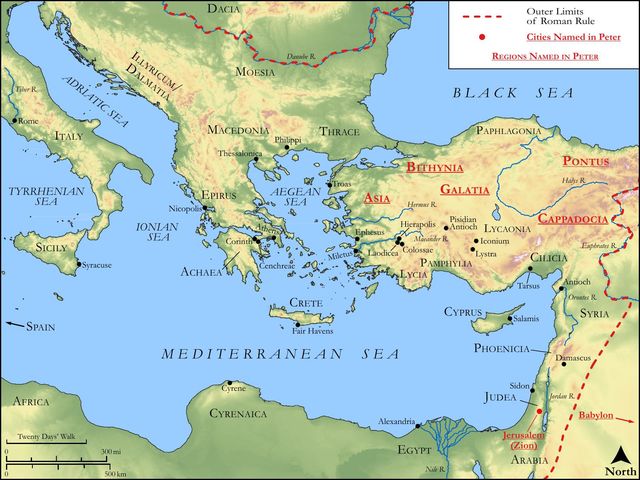
See on the biblical-era maps

Study this verse
Public-domain commentary
Matthew Henry
From his Commentary on the Whole Bible. Henry comments on passages, not single verses — this entry covers 2 Peter 2:3–6. His two-level outline is real structure in the source text, so it is rendered as structure.
Men are apt to think that a reprieve is the forerunner of a pardon, and that if judgment be not speedily executed it is, or will be, certainly reversed. But the apostle tells us that how successful and prosperous soever false teachers may be, and that for a time, yet their judgment lingereth not. God has determined long ago how he will deal with them. Such unbelievers, who endeavour to turn others from the faith, are condemned already, and the wrath of God abideth on them. The righteous Judge will speedily take vengeance; the day of their calamity is at hand, and the things that shall come upon them make haste. To prove this assertion, here are several examples of the righteous judgment of God, in taking vengeance on sinners, proposed to our serious consideration.
I.See how God dealt with the angels who sinned. Observe,
1.No excellency will exempt a sinner from punishment. If the angels, who excel us vastly in strength and knowledge, violate the law of God, the sentence which that law awards shall be executed upon them, and that without mercy or mitigation, for God did not spare them. Hence observe,
2.By how much the more excellent the offender, by so much the more severe the punishment. These angels, who had the advantage of men as to the dignity of their nature, are immediately punished. There is no sparing them for a few days, no favour at all shown them.
3.Sin debases and degrades the persons who commit it. The angels of heaven are cast down from the height of their excellency, and divested of all their glory and dignity, upon their disobedience. Whoever sins against God does a manifest hurt to himself.
4.Those who rebel against the God of heaven shall all be sent down to hell. There is no place nor state between the height of glory and the depth of misery in which they shall be allowed to rest. If creatures sin in heaven, they must suffer in hell.
5.Sin is the work of darkness, and darkness is the wages of sin. The darkness of misery and torment follows the darkness of sin. Those who will not walk according to the light and direction of God's law shall be deprived of the light of God's countenance and the comforts of his presence.
6.As sin binds men over to punishment, so misery and torment hold men under punishment. The darkness which is their misery keeps them so that they cannot get away from their torment.
7.The last degree of torment is not till the day of judgment. The sinning angels, though in hell already, are yet reserved to the judgment of the great day.
II.See how God dealt with the old world, even in much the same way that he dealt with the angels. He spared not the old world. Here observe,
1.The number of offenders signifies no more to procure any favour than the quality. If the sin be universal, the punishment shall likewise extend to all. But,
2.If there be but a few righteous, they shall be preserved. God does not destroy the good with the bad. In wrath he remembers mercy.
3.Those who are preachers of righteousness in an age of universal corruption and degeneracy, holding forth the word of life in an unblamable and exemplary conversation, shall be preserved in a time of general destruction.
4.God can make use of those creatures as the instruments of his vengeance in punishing sinners which he at first made and appointed for their service and benefit. He destroyed the whole world by water; but observe,
5.What was the procuring cause of this: it was a world of ungodly men. Ungodliness puts men out of the divine protection, and exposes them to utter destruction.
III.See how God dealt with Sodom and Gomorrah; though they were situated in a country like the garden of the Lord, yet, if in such a fruitful soil they abound in sin, God can soon turn a fruitful land into barrenness and a well-watered country into dust and ashes. Observe,
1.No political union or confederacy can keep off judgments from a sinful people. Sodom and the neighbouring cities were no more secured by their regular government than the angels by the dignity of their nature or the old world by their vast number.
2.God can make use of contrary creatures to punish incorrigible sinners. He destroys the old world by water, and Sodom by fire. He who keeps fire and water from hurting his people (Isa 43:2) can make either to destroy his enemies; therefore they are never safe.
3.Most heinous sins bring most grievous judgments. Those who were abominable in their vices were remarkable for their plagues. Those who are sinners exceedingly before the Lord must expect the most dreadful vengeance.
4.The punishment of sinners in former ages is designed for the example of those who come after. "Follow them, not only in the time of living, but in their course and way of living." Men who live ungodly must see what they are to expect if they go on still in a course of impiety. Let us take warning by all the instances of God's taking vengeance, which are recorded for our admonition, and to prevent our promising ourselves impunity, though we go on in a course of sin.
Historical interpretation
Eight Centuries of Reception
10 surviving comments on this verse. Each one is dated, so this reads as a timeline rather than a list.
Select a marker to jump to its quote. Markers stagger vertically where authors wrote within a few decades of each other.
Fire of judgment, and the rayless scenery of gloomy Tartarus.
Wherefore, in order to teach us this, he uses the examples of Sheol (Hades), and the love of women, and hell
And the nature of all these deceits is obscure to those who are without the truth. For they think that those demons profit them when they cease to injure, whereas they have no power except to injure. Some one may perchance say that they are therefore to be worshipped, that they may not injure, since they have the power to injure. They do indeed injure, but those only by whom they are feared, whom the powerful and lofty hand of God does not protect, who are uninitiated in the mystery of truth. But they fear the righteous, that is, the worshippers of God, adjured by whose name they depart from the bodies of the possessed: for, being lashed by their words as though by scourges, they not only confess themselves to be demons, but even utter their own names-those which are adored in the temples-which they generally do in the presence of their own worshippers; not, it is plain, to the disgrace of religion, but to the disgrace of their own honour, because they cannot speak falsely to God, by whom they are adjured, nor to the righteous, by whose voice they are tortured. Therefore ofttimes having uttered the greatest howlings, they cry out that they are beaten, and are on fire, and that they are just on the point of coming forth: so much power has the knowledge of God, and righteousness! Whom, therefore, can they injure, except those whom they have in their own power?
In short, Hermes affirms that those who have known God are not only safe from the attacks of demons, but that they are not even bound by fate. "The only protection," he says, "is piety, for over a pious man neither evil demon nor fate has any power: for God rescues the pious man from all evil; for the one and only good thing among men is piety."
The angels were in heaven and were thrown into the abyss. But on the other hand, Elijah and Enoch were raised into the kingdom of heaven.
In the third book of this work we made a passing reference to this question, but did not decide whether angels, inasmuch as they are spirits, could have bodily intercourse with women. For it is written, "Who makes His angels spirits," that is, He makes those who are by nature spirits His angels by appointing them to the duty of bearing His messages. For the Greek word ἄγγελος, which in Latin appears as "angelus," means a messenger. But whether the Psalmist speaks of their bodies when he adds, "and His ministers a flaming fire," or means that God's ministers ought to blaze with love as with a spiritual fire, is doubtful. However, the same trustworthy Scripture testifies that angels have appeared to men in such bodies as could not only be seen, but also touched. There is, too, a very general rumor, which many have verified by their own experience, or which trustworthy persons who have heard the experience of others corroborate, that sylvans and fauns, who are commonly called "incubi," had often made wicked assaults upon women, and satisfied their lust upon them; and that certain devils, called Duses by the Gauls, are constantly attempting and effecting this impurity is so generally affirmed, that it were impudent to deny it. From these assertions, indeed, I dare not determine whether there be some spirits embodied in an aerial substance (for this element, even when agitated by a fan, is sensibly felt by the body), and who are capable of lust and of mingling sensibly with women; but certainly I could by no means believe that God's holy angels could at that time have so fallen, nor can I think that it is of them the Apostle Peter said, "For if God spared not the angels that sinned, but cast them down to hell, and delivered them into chains of darkness, to be reserved unto judgment." [2 Peter 2:4] I think he rather speaks of these who first apostatized from God, along with their chief the devil, who enviously deceived the first man under the form of a serpent. But the same holy Scripture affords the most ample testimony that even godly men have been called angels; for of John it is written: "Behold, I send my messenger (angel) before Your face, who shall prepare Your way." [Mark 1:2] And the prophet Malachi, by a peculiar grace specially communicated to him, was called an angel. [Malachi 2:7]
But some are moved by the fact that we have read that the fruit of the connection between those who are called angels of God and the women they loved were not men like our own breed, but giants; just as if there were not born even in our own time (as I have mentioned above) men of much greater size than the ordinary stature. Was there not at Rome a few years ago, when the destruction of the city now accomplished by the Goths was drawing near, a woman, with her father and mother, who by her gigantic size over-topped all others? Surprising crowds from all quarters came to see her, and that which struck them most was the circumstance that neither of her parents were quite up to the tallest ordinary stature. Giants therefore might well be born, even before the sons of God, who are also called angels of God, formed a connection with the daughters of men, or of those living according to men, that is to say, before the sons of Seth formed a connection with the daughters of Cain. For thus speaks even the canonical Scripture itself in the book in which we read of this; its words are: "And it came to pass, when men began to multiply on the face of the earth, and daughters were born unto them, that the sons of God saw the daughters of men that they were fair [good]; and they took them wives of all which they chose. And the Lord God said, My Spirit shall not always strive with man, for that he also is flesh: yet his days shall be an hundred and twenty years. There were giants in the earth in those days; and also after that, when the sons of God came in unto the daughters of men, and they bare children to them, the same became the giants, men of renown." These words of the divine book sufficiently indicate that already there were giants in the earth in those days, in which the sons of God took wives of the children of men, when they loved them because they were good, that is, fair. For it is the custom of this Scripture to call those who are beautiful in appearance "good." But after this connection had been formed, then too were giants born. For the words are: "There were giants in the earth in those days, and also after that, when the sons of God came in unto the daughters of men." Therefore there were giants both before, "in those days," and "also after that." And the words, "they bare children to them," show plainly enough that before the sons of God fell in this fashion they begot children to God, not to themselves — that is to say, not moved by the lust of sexual intercourse, but discharging the duty of propagation, intending to produce not a family to gratify their own pride, but citizens to people the city of God; and to these they as God's angels would bear the message, that they should place their hope in God, like him who was born of Seth, the son of resurrection, and who hoped to call on the name of the Lord God, in which hope they and their offspring would be co-heirs of eternal blessings, and brethren in the family of which God is the Father.
But that those angels were not angels in the sense of not being men, as some suppose, Scripture itself decides, which unambiguously declares that they were men. For when it had first been stated that "the angels of God saw the daughters of men that they were fair, and they took them wives of all which they chose," it was immediately added, "And the Lord God said, My Spirit shall not always strive with these men, for that they also are flesh." For by the Spirit of God they had been made angels of God, and sons of God; but declining towards lower things, they are called men, a name of nature, not of grace; and they are called flesh, as deserters of the Spirit, and by their desertion deserted [by Him]. The Septuagint indeed calls them both angels of God and sons of God, though all the copies do not show this, some having only the name sons of God. And Aquila, whom the Jews prefer to the other interpreters, has translated neither angels of God nor sons of God, but sons of gods. But both are correct. For they were both sons of God, and thus brothers of their own fathers, who were children of the same God; and they were sons of gods, because begotten by gods, together with whom they themselves also were gods, according to that expression of the psalm: "I have said, You are gods, and all of you are children of the Most High." For the Septuagint translators are justly believed to have received the Spirit of prophecy; so that, if they made any alterations under His authority, and did not adhere to a strict translation, we could not doubt that this was divinely dictated. However, the Hebrew word may be said to be ambiguous, and to be susceptible of either translation, "sons of God," or "sons of gods."
Let us omit, then, the fables of those scriptures which are called apocryphal, because their obscure origin was unknown to the fathers from whom the authority of the true Scriptures has been transmitted to us by a most certain and well-ascertained succession. For though there is some truth in these apocryphal writings, yet they contain so many false statements, that they have no canonical authority. We cannot deny that Enoch, the seventh from Adam, left some divine writings, for this is asserted by the Apostle Jude in his canonical epistle. But it is not without reason that these writings have no place in that canon of Scripture which was preserved in the temple of the Hebrew people by the diligence of successive priests; for their antiquity brought them under suspicion, and it was impossible to ascertain whether these were his genuine writings, and they were not brought forward as genuine by the persons who were found to have carefully preserved the canonical books by a successive transmission. So that the writings which are produced under his name, and which contain these fables about the giants, saying that their fathers were not men, are properly judged by prudent men to be not genuine; just as many writings are produced by heretics under the names both of other prophets, and more recently, under the names of the apostles, all of which, after careful examination, have been set apart from canonical authority under the title of Apocrypha. There is therefore no doubt that, according to the Hebrew and Christian canonical Scriptures, there were many giants before the deluge, and that these were citizens of the earthly society of men, and that the sons of God, who were according to the flesh the sons of Seth, sunk into this community when they forsook righteousness. Nor need we wonder that giants should be born even from these. For all of their children were not giants; but there were more then than in the remaining periods since the deluge. And it pleased the Creator to produce them, that it might thus be demonstrated that neither beauty, nor yet size and strength, are of much moment to the wise man, whose blessedness lies in spiritual and immortal blessings, in far better and more enduring gifts, in the good things that are the peculiar property of the good, and are not shared by good and bad alike. It is this which another prophet confirms when he says, "These were the giants, famous from the beginning, that were of so great stature, and so expert in war. Those did not the Lord choose, neither gave He the way of knowledge unto them; but they were destroyed because they had no wisdom, and perished through their own foolishness."
It is a fixed and unchanging religious truth that the devil and his angels are never to return to the life and holiness of the saints. From Scripture we know that God’s sentence implies that he dragged them down by infernal ropes to Tartarus and delivered them to be tortured and kept in custody for judgment. They will be received into everlasting fire and there tortured forever and ever.
When Christ came from heaven, he bound the leaders of the demons in hell. This is clear from the way in which he commanded the spirits, lest they be thrown into the abyss. For he bound some and ordered others to depart, as we can see from sayings like “Look, I have given you power over unclean spirits”; “Cast out demons,” and so on. Afterwards, in order to perfect the punishment of those whom he had earlier bound, he cast them into eternal fire.
The angels sinned in three ways, by their pride, by their envy and by their lust. In this verse it is made clear that sin can occur even if it is not done overtly in the flesh. It is obvious that the essence of sin is consent to do evil.
But He handed over those dragged down by the howls of hell into Tartarus, etc. Another translation has this verse as: But pushing back into the prisons of the darkness of hell, He handed them over to be reserved for punishment in judgment. Therefore, it shows that the punishment of the final judgment is still owed to the apostate angels, about which the Lord says: Go into the eternal fire which is prepared for the devil and his angels (Matthew XXV), even though they have already accepted this hell, that is, the lower murky air, as a prison. For as much as the sublimity of heaven is concerned, the space of this air can already be called hell, so also regarding the height of this same air, the earth which lies below can be understood as deep hell. But He calls the howls of hell the very prideful boastfulness by which the angels of His spirit swelled in arrogance against their Creator. For ropes are called howls, by which sailors hang sails so that, with the wind blowing, they leave the tranquility of the port and always trust themselves to the uncertain waves of the sea. To these appropriately howling ropes are compared the efforts of unclean spirits, who, as soon as they were raised up against the Creator, impelled by the winds of pride, were dragged into the depths of the abyss by their very efforts of elevation. Some codices have: But dragged down by the howls of hell, He handed them over into Tartarus, which signifies the voice either of utmost exaltation or of wailing in punishment. For they howl when they suffer either hunger or something else, unable to bear the excess of haughtiness, if any adversity occurs to them.
For if God did not spare the angels who sinned. For many verses here conclude with one ending: The Lord knows how to rescue the godly from trials. For if, he says, God did not spare the angels who sinned, but consigned them to hell to be kept in chains of darkness until judgment; if, destroying the ancient world for its crimes by the flood, He saved righteous Noah; if, punishing the enormities of Sodom, He delivered Lot, a worshiper of justice, from the unjust; it is certainly known that the Lord knows how to rescue the godly from temptation and to reserve the wicked for torment on the day of judgment. And it should be noted in what he says, that God did not spare the angels who sinned, because those evil angels were not created evil by God, but became evil by sinning.
For if God did not spare the angels who sinned, but cast them into chains of gloomy Tartarus10, delivering them to be kept for judgment; and did not spare the ancient world, but preserved Noah, the eighth person, a preacher of righteousness, when he brought a flood upon the world of the ungodly; and condemned the cities of Sodom and Gomorrah to destruction, reducing them to ashes, making them an example to those who afterward would live ungodly; and delivered righteous Lot, who was oppressed by the filthy conduct of the wicked—for that righteous man, dwelling among them, tormented his righteous soul from day to day by seeing and hearing their lawless deeds.
For if God did not spare the angels who sinned, nor the ancient world, but condemned the cities of Sodom and Gomorrah to destruction, reducing them to ashes, and made them an example of what is going to happen to the ungodly; indeed, He preserved Noah, the preacher of righteousness, when He brought the flood upon the world of the ungodly; and likewise Lot, who was oppressed by the wicked, when the Sodomites were seeking to abuse the angels who had been received as guests (Gen. 19), and who was daily admonished to emulate their wicked deeds, then tormented his own soul through soberness, and by abstaining from them, He rescued him: will He not much more deliver at this time those who are destined for destruction, just as He did the transgressing angels and those who were in the time of the flood, and furthermore the Sodomites? But you who dwell in the world along with them, will He not preserve you, just as He did Noah and Lot who then lived among the ungodly? No one doubts that He will indeed do so. For He knows how to rescue the godly from temptations and to keep the unrighteous under punishment for the day of judgment. Note, however, that when he previously presented the example of the wicked, he now ordains that which is about the righteous: by this, he also consoles the imitators of the righteous, who are considered superior to the impious. Therefore, Christ also gives the reward first to the just sheep who are on the right, and then to the goats who are on the left, punishments. (Matt. 25:34-41) Since delightful things are preferred over sad ones.
"God did not spare the angels who sinned." He attacks those who were first cut off and says: If the angels who were in honor with God because of the immortality of their substance, when they had shaken off the yoke, sinned, they did not obtain forgiveness: much less will God spare men who cling to their own creation if they have sinned,
Therefore, since a single response of speech was not sufficient to fulfill the proposed matter, it remained in another way in phrasing, and completed what was necessary through an interjection. But why he mixed examples of good with bad ones will be explained in a suitable place.
"But the eighth person," etc. As we have previously stated, it follows not only from what is evident in the discourse, but also from their understanding of what is proposed. For the response of the discourse is not one that usually follows such arrangements, but is a simple persuasive example, concerning those who are punished for their sins, and those who are honored for their righteousness: as if to say; The Lord knows how to punish sinners without sparing them, just as He did the angels who sinned, as well as those who were in the time of the flood, like the cities of Sodom and Gomorrah; again, to honor those who practice righteousness, such as Noah and Lot. And this is the arrangement: Having said that false teachers are to be punished for their blasphemies and their lustful lives, he adds examples.
For God did not spare the angels who sinned, nor the ancient world, nor did He spare the cities of Sodom and Gomorrah from destruction, but they are reduced to ashes, serving as a punishment for the ungodly. Again, God knows how to honor those who exercise justice, just as He did with Noah and Lot: and for the righteousness of each, it is narrated that both Noah and Lot were preserved from the destruction of the men who lived during their time because of their soberness and chastity. For they were not taken away from the impiety of those who were before the flood.
Lot also did not follow the carnality of those who lived in Sodom, but as if provoked daily by the sight of those who acted impolitely, he was stirred to the same boldness, yet he did not succumb in any way. For this means, "with seeing and hearing," (2 Peter 2:8) that he had many things that could provoke him to boldness, sight, hearing, conversation among the wicked; but he neither delivered the angels, his guests, in the appearance of men, to those who sought them because of their impudence, although he suffered violence from them in countless ways. For this is indicated by saying that he was oppressed. And as figure of speech, Peter adds: " The Lord knows how to rescue the godly," etc. (2 Peter 2:9) However, since he had not forewarned anything about the righteous, but only about the wicked and their punishment, he also scatters examples of the righteous in this place: first, indeed, because the history simultaneously mentions both the destruction of the wicked and the salvation of the righteous; then, moreover, from this comparison, he amplifies the malice of those who sinned, and makes the good works of those who conducted themselves excellently clear. Furthermore, Peter persuades the listeners to indeed hate the shamelessness of those, but to embrace the noble work of these for the sake of salvation. Hence, he also mentions in a figure of speech, both the pious and the impious, and salvation and punishment. Moreover, what he wants from this has already been stated, namely that he desires for them to hate the wickedness of those, but to emulate the salvation of these. "For the just is with sight and hearing." Although he had many things that inflamed, stimulated, and invited to shamelessness—eyes, ears, and conversation among the wicked—he was not, he says, led to the imitation of them.
Continue studying 2 Peter 2:4 across the web’s major study libraries — every link below opens this exact verse, chapter, or book on the destination site.
Read & Compare
 BibleGatewayThis verse in more than 200 translations and 70 languages.
 Bible.comThe YouVersion reader — hundreds of translations, reading plans, and highlights.
 ESV.orgCrossway's official English Standard Version reader.
 NET BibleThe NET translation with 60,000+ translators' notes on every rendering decision.
 STEP BibleTyndale House's free study tool — original text, vocabulary, and scholarly resources.
 BibliaLogos Bible Software's free web reader.
 USCCBThe New American Bible (Revised Edition) with the U.S. bishops' study notes.
Commentaries
 BibleHub CommentariesDozens of classic commentaries on this verse, gathered on one page.
 StudyLightMore than 100 commentary sets — the largest collection on the web.
 BibleRefPlain-English commentary on what this verse means, verse by verse.
 Enduring WordDavid Guzik's free commentary on this chapter, widely used by Bible teachers.
 Bible Study ToolsVerse commentary alongside Greek and Hebrew study aids.
Original Language & Research
- BibleHub InterlinearThe verse word by word — original language, transliteration, and English.
- BibleHub LexiconEvery word's original-language definition and Strong's entry.
 Blue Letter BibleDeep-study tools — Strong's numbers, concordance, and word studies.
 CNTR CollationThe earliest Greek manuscripts of this verse, collated letter by letter.
Sermons, Hymns & Audio


TrulyRandomVerse is not affiliated with these sites and doesn’t control their content. They’re linked because they’re genuinely useful.
Summary
Second Peter 2:4 stands as a solemn declaration of God's unwavering justice and the certainty of His judgment, even against celestial beings who rebelled. This verse introduces a series of historical examples Peter employs to establish the divine precedent for retribution, underscoring that no creature, regardless of power or origin, is exempt from God's righteous wrath when they defy His authority and purposes. It serves as a foundational warning against the destructive path of wickedness and a powerful assurance of divine accountability.
Context
ShowHideLiterary Context
This verse initiates Peter's robust argument in 2 Peter chapter 2, where he vehemently warns against the insidious threat of false teachers and their destructive heresies. Peter strategically employs three historical precedents of divine judgment—the fallen angels (v. 4), the global flood in Noah's time (v. 5), and the destruction of Sodom and Gomorrah (v. 6)—to build an irrefutable case for God's consistent character in punishing the wicked while simultaneously preserving the righteous. The mention of "angels that sinned" immediately establishes the unparalleled severity and impartiality of God's justice, demonstrating that even powerful, heavenly beings are not immune to His wrath when they rebel. This sets a formidable stage for the equally certain and inescapable judgment awaiting the false teachers Peter is confronting, emphasizing that if God did not spare angels, He certainly will not spare human deceivers.
Historical & Cultural Context
While the specific "sin" of these angels is not detailed in 2 Peter 2:4, the reference likely draws upon a common understanding within Second Temple Judaism regarding angelic rebellion. This understanding is found in various Jewish texts, including the Book of Enoch and Jude 1:6, which speaks of angels who "kept not their first estate, but left their own habitation." This event is often associated with the "sons of God" in Genesis 6:1-4, who corrupted humanity before the Flood. Peter's audience, familiar with such narratives, would immediately grasp the profound implications of divine judgment upon such powerful, pre-human entities. The concept of "Tartarus" (translated "hell" in KJV) also resonates with Greek mythological ideas of a deep abyss for divine punishment, though Peter recontextualizes it within a biblical framework of God's sovereign justice, distinct from pagan notions.
Key Themes
ShowHideThe primary themes interwoven throughout 2 Peter 2 and highlighted by this verse include Divine Justice and Impartiality. God's justice is absolute and unyielding; if He did not spare powerful angelic beings who sinned, He certainly will not spare humans who lead others astray with destructive heresies. This underscores God's holy nature and His unwavering commitment to righteousness, as seen in passages like Romans 2:11. Another key theme is the Consequences of Rebellion. The vivid portrayal of the angels' fate—being "cast down to hell" and "delivered into chains of darkness"—serves as a grave warning about the severe and inescapable outcome for those who defy divine order and truth. Finally, the phrase "to be reserved unto judgment" emphasizes the Certainty of Future Judgment. This assures believers that while divine judgment may not always be immediate, it is absolutely certain and unavoidable for the ungodly, a truth echoed in Hebrews 9:27.
Exposition and Analysis
ShowHideKey Word Analysis
ShowHideThis verb means "to be chary of," "to abstain," or "to treat leniently." When combined with the negative particle "not" (G3756, ou), it powerfully conveys that God showed no leniency, no mercy, and no forbearance toward the angels who sinned. This emphasizes the absolute and impartial nature of His justice, even for beings of great power and former privilege.
This unique verb, found only here in the New Testament, is derived from "Tartarus," a mythological deep abyss or dungeon of divine punishment in Greek thought, distinct from Hades (the general realm of the dead) or Gehenna (the final place of eternal punishment for humans). Peter's deliberate use of tartaróō signifies a specific, severe, and unique confinement for these particular fallen angels, highlighting the extreme nature of their condemnation. It implies a specialized, inescapable prison reserved for their unique transgression.
This noun refers to a "chain" or "cord," implying something that binds or draws. In conjunction with "darkness," it paints a vivid picture of an inescapable prison. These "chains" are not necessarily literal physical restraints but metaphorically represent an unbreakable, spiritual binding that holds the angels securely in their place of confinement. The imagery underscores their utter lack of freedom and their complete subjugation to divine power.
Verse Breakdown
ShowHide"For if God spared not the angels that sinned,"
This opening clause establishes a conditional premise, setting up a logical argument. It asserts that God, in His absolute justice, did not show leniency or hold back His judgment from a specific group of angels who committed sin. The implication is that if God did not spare even these powerful, celestial beings, then His judgment upon human wickedness is equally, if not more, certain.
"but cast [them] down to hell,"
This clause describes the immediate and severe consequence of the angels' sin. The Greek verb tartaróō (translated "cast down to hell") denotes a specific, profound act of divine incarceration, consigning them to a unique and deep abyss of punishment, distinct from other realms of the dead. This emphasizes the radical nature of their fall and the specific, severe nature of their initial judgment.
"and delivered [them] into chains of darkness,"
This phrase further elaborates on the nature of their confinement. "Chains" (G4577, seirá) are metaphorical, signifying an unbreakable binding or inescapable restraint, while "darkness" (G2217, zóphos) refers to a thick, impenetrable gloom or blackness. Together, they depict a state of utter isolation, hopelessness, and spiritual imprisonment, emphasizing the severity and inescapable nature of their current condition.
"to be reserved unto judgment;"
This concluding phrase clarifies the purpose and future of their confinement. The angels are not merely punished and forgotten; they are held in this state of "chains of darkness" specifically "to be reserved" (G5083, tēréō, meaning "to guard" or "to keep") for a future, definitive "judgment" (G2920, krísis). This points to a final, ultimate reckoning, assuring the reader that their ultimate condemnation is certain and unavoidable, serving as a powerful warning to all who rebel against God.
Literary Devices
ShowHidePeter employs several potent literary devices in this verse to convey his message with maximum impact. The most prominent is Argument from the Greater to the Lesser (A Fortiori Argument), where he argues that if God did not spare angels, who are superior beings, then He certainly will not spare human false teachers. This logical progression powerfully reinforces the certainty of divine judgment. Metaphor is evident in "chains of darkness," where "chains" represent an inescapable spiritual or divine binding, and "darkness" symbolizes the utter hopelessness, spiritual blindness, and isolation of their confinement, rather than literal physical chains or absence of light. The use of the unique verb tartaróō also functions as a form of Allusion, drawing on a concept familiar from Jewish and Hellenistic thought to describe a specific and severe form of divine punishment, thereby enhancing the gravity of the angels' fate.
Theological and Thematic Connections
ShowHideThe theological implications of 2 Peter 2:4 are profound, establishing a bedrock principle of divine justice: God's holiness demands that sin, even among His highest creatures, cannot go unpunished. This verse underscores God's absolute sovereignty and His unwavering commitment to righteousness, demonstrating that His moral order extends to all realms of existence. It reveals that judgment is not arbitrary but a just consequence of rebellion, pre-ordained and certain for those who defy Him. This serves as a powerful assurance to believers that God is ultimately in control, that evil will not prevail indefinitely, and that justice will be served, providing comfort amidst the apparent triumph of wickedness in the world.
Reflection and Application
ShowHideFor the believer, 2 Peter 2:4 offers both a solemn warning and profound comfort. It warns us against underestimating the seriousness of sin and the certainty of God's judgment, reminding us that even the most powerful beings are accountable to Him. This should cultivate a healthy fear of God and a commitment to living in obedience and truth. Conversely, it provides immense comfort and assurance, especially when we observe rampant injustice or the apparent success of those who promote deception and wickedness. This verse reinforces the truth that God is just and faithful; He sees all sin and will ultimately bring every evil deed to account. This knowledge provides hope that justice will prevail, encouraging steadfastness in faith and discernment against deceptive doctrines. For those who might be tempted to stray or follow false teachings, it serves as a solemn warning: no one is above God's law, and His judgment is certain for all who rebel against His truth and righteousness. It calls us to live with integrity, knowing that our actions, whether good or evil, are seen by a righteous God who will ultimately judge all.
Questions for Reflection
ShowHideFAQ
ShowHideWhat was the sin of the angels mentioned in 2 Peter 2:4?
ShowHideThe specific sin of these angels is not explicitly detailed in 2 Peter 2:4. However, biblical scholars and ancient Jewish traditions often link this reference to the "sons of God" mentioned in Genesis 6:1-4 who left their proper heavenly abode to cohabit with human women, resulting in corrupted offspring. This interpretation is supported by Jude 1:6, which speaks of "angels who did not keep their own domain, but abandoned their proper dwelling." The sin appears to be a profound act of rebellion against God's established order, involving a departure from their assigned spiritual sphere and an illicit intrusion into the human realm, leading to their unique and severe punishment.
Christ-Centered Fulfillment
ShowHideWhile 2 Peter 2:4 speaks of judgment and confinement for rebellious angels, its Christ-centered fulfillment lies in how it underscores the absolute necessity and efficacy of Christ's redemptive work. The inability of even powerful angels to escape God's judgment highlights the depth of human sin and the utter impossibility of self-salvation. It magnifies the grace of God extended through Christ, who, unlike the fallen angels, perfectly obeyed the Father, even to the point of death on a cross (Philippians 2:8). Jesus Christ is the only one who could "take away the sin of the world" (John 1:29), offering a path to deliverance that the angels, once fallen, were never afforded. Moreover, Christ's triumph over sin, death, and the powers of darkness (Colossians 2:15) demonstrates His ultimate authority over all creation, including those angels "reserved unto judgment." His resurrection and ascension confirm His power to execute final judgment, as He is the one appointed by the Father to judge the living and the dead (Acts 10:42). Thus, this verse, by demonstrating God's unsparing justice, implicitly points to the unparalleled mercy and power found only in Jesus Christ, who delivers His people from the very judgment that awaits the ungodly.