


Revelation 20:3
Bible text: King James Version (1769 Blayney text) · Public domain
Bible text: King James Version with Strong's numbers · Public domain
Bible text: Berean Standard Bible · Public domain
Bible text: American Standard Version (1901) · Public domain
Bible text: World English Bible, Messianic edition · Public domain
Bible text: Geneva Bible (1599) · Public domain
Bible text: Young's Literal Translation · Public domain
- καὶkaiAndG2532CONJConjunction
- ἔβαλενebalenhe castG906V-2AAI-3SVerb 2nd Aorist Active Indicative 3rd Singular
- αὐτὸνautonhimG846P-ASMPersonal pronoun Accusative Singular Masculine
- εἰςeisintoG1519PREPPreposition
- τὴνtēntheG3588T-ASFDefinite article Accusative Singular Feminine
- ἄβυσσονabussonAbyssG12N-ASFNoun Accusative Singular Feminine
- καὶkaiandG2532CONJConjunction
- ἔκλεισενekleisenshutG2808V-AAI-3SVerb Aorist Active Indicative 3rd Singular
- αὐτὸνautonhimG846P-ASMPersonal pronoun Accusative Singular Masculine
- καὶkaiandG2532CONJConjunction
- ἐσφράγισενesphragisensealed [it]G4972V-AAI-3SVerb Aorist Active Indicative 3rd Singular
- ἐπάνωepanōoverG1883PREPPreposition
- αὐτοῦautouhimG846P-GSMPersonal pronoun Genitive Singular Masculine
- ἵναinaso thatG2443CONJConjunction
- μὴmēnotG3361PRT-NNegative Particle Negative
- πλανήσῃplanēsēhe may deceiveG4105V-AAS-3SVerb Aorist Active Subjunctive 3rd Singular
- ἔτιetiany longerG2089ADVAdverb
- τὰtatheG3588T-APNDefinite article Accusative Plural Neuter
- ἔθνηethnēnationsG1484N-APNNoun Accusative Plural Neuter
- ἄχριachriuntilG891PREPPreposition
- τελεσθῇtelesthēamay be completedG5055V-APS-3SVerb Aorist Passive Subjunctive 3rd Singular
- τὰtatheG3588T-NPNDefinite article Nominative Plural Neuter
- χίλιαchiliathousandG5507A-NPNAdjective Nominative Plural Neuter
- ἔτηetēyearsG2094N-NPNNoun Nominative Plural Neuter
- καὶkaiandG2532CONJConjunction
- μετὰmetaAfter theseG3326PREPPreposition
- ταῦταtautathingsG3778D-APNDemonstrative pronoun Accusative Plural Neuter
- δεῖdeiit is necessary forG1163V-PAI-3SVerb Present Active Indicative 3rd Singular
- λυθῆναιluthēnaito be releasedG3089V-APNVerb Aorist Passive Infinitive
- αὐτὸνautonhimG846P-ASMPersonal pronoun Accusative Singular Masculine
- μικρὸνmikronfor a littleG3398A-ASMAdjective Accusative Singular Masculine
- χρόνονchronontimeG5550N-ASMNoun Accusative Singular Masculine
English is a literal word-by-word gloss of the Greek, not the KJV's wording. Why?
This is the original text the KJV's translators worked from — each Greek word with its own literal English meaning in this verse, prepared by scholars at Tyndale House, Cambridge. The KJV translates whole sentences, not word by word, so its wording differs: one Greek word can become several English words, and the KJV may choose “charity” where the gloss reads “love”. Both are faithful — they answer different questions. For the KJV's own rendering, switch to the KJV text.
Details
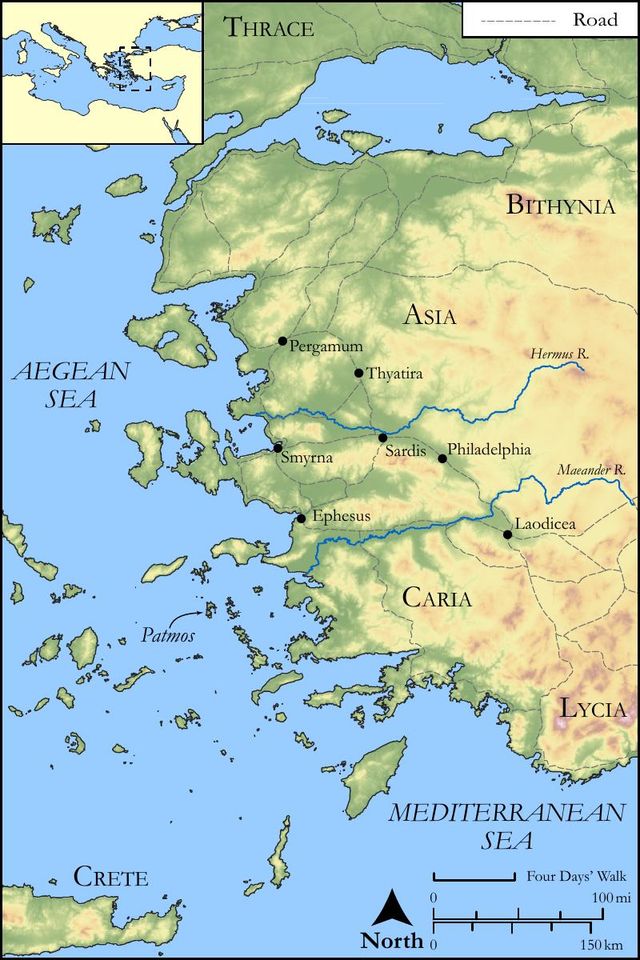
See on the biblical-era maps

Study this verse
Public-domain commentary
Matthew Henry
From his Commentary on the Whole Bible. Henry comments on passages, not single verses — this entry covers Revelation 20:1–10. His three-level outline is real structure in the source text, so it is rendered as structure.
We have here, I. A prophecy of the binding of Satan for a certain term of time, in which he should have much less power and the church much more peace than before. The power of Satan was broken in part by the setting up of the gospel kingdom in the world; it was further reduced by the empire's becoming Christian; it was yet further broken by the downfall of the mystical Babylon; but still this serpent had many heads, and, when one is wounded, another has life remaining in it. Here we have a further limitation and diminution of his power. Observe, 1. To whom this work of binding Satan is committed - to an angel from heaven. It is very probable that this angel is no other than the Lord Jesus Christ; the description of him will hardly agree with any other. He is one who has power to bind the strong man armed, to cast him out, and to spoil his goods; and therefore must be stronger than he. 2. The means he makes use of in this work: he has a chain and a key, a great chain to bind Satan, and the key of the prison in which he was to be confined. Christ never wants proper powers and instruments to break the power of Satan, for he has the powers of heaven and the keys of hell. 3. The execution of this work, Rev 20:2, Rev 20:3. (1.) He laid hold on the dragon, that old serpent, which is the devil, and Satan. Neither the strength of the dragon, nor the subtlety of the serpent, was sufficient to rescue him out of the hands of Christ; he caught hold, and kept his hold. And, (2.) He cast him into the bottomless pit, cast him down with force, and with a just vengeance, to his own place and prison, from which he had been permitted to break out, and disturb the churches, and deceive the nations; now he is brought back to that prison, and there laid in chains. (3.) He is shut up, and a seal set upon him. Christ shuts, and none can open; he shuts by his power, seals by his authority; and his lock and seal even the devils themselves cannot break open. (4.) We have the term of this confinement of Satan - a thousand years, after which he was to be loosed again for a little season. The church should have a considerable time of peace and prosperity, but all her trials were not yet over.
II.An account of the reign of the saints for the same space of time in which Satan continued bound (Rev 20:4-6), and here observe,
1.Who those were that received such honour - those who had suffered for Christ, and all who had faithfully adhered to him, not receiving the mark of the beast, nor worshipping his image; all who had kept themselves clear of pagan and papal idolatry.
2.The honour bestowed upon them.
(1.)They were raised from the dead, and restored to life. This may be taken either literally or figuratively; they were in a civil and political sense dead, and had a political resurrection; their liberties and privileges were revived and restored.
(2.)Thrones, and power of judgment, were given to them; they were possessed of great honour, and interest, and authority, I suppose rather of a spiritual than of a secular nature.
(3.)They reigned with Christ a thousand years. Those who suffer with Christ shall reign with Christ; they shall reign with him in his spiritual and heavenly kingdom, in a glorious conformity to him in wisdom, righteousness, and holiness, beyond what had been known before in the world. This is called the first resurrection, which none but those who have served Christ and suffered for him shall be favoured with. As for the wicked, they shall not be raised up and restored to their power again, till Satan be let loose; this may be called a resurrection, as the conversion of the Jews is said to be life from the dead.
3.The happiness of these servants of God is declared.
(1.)They are blessed and holy, Rev 20:6. None can be blessed but those that are holy; and all that are holy shall be blessed. These were holy as a sort of first-fruits to God in this spiritual resurrection, and as such blessed by him.
(2.)They are secured from the power of the second death. We know something of what the first death is, and it is awful; but we know not what this second death is. It must be much more dreadful; it is the death of the soul, eternal separation from God. The Lord grant we may never know what it is by experience. Those who have had experience of a spiritual resurrection are saved from the power of the second death.
III.An account of the return of the church's troubles, and another mighty conflict, very sharp, but short and decisive. Observe,
1.The restraints laid for a long time on Satan are at length taken off. While this world lasts, Satan's power in it will not be wholly destroyed; it may be limited and lessened, but he will have something still to do for the disturbance of the people of God.
2.No sooner is Satan let loose than he falls to his old work, deceiving the nations, and so stirring them up to make a war with the saints and servants of God, which they would never do if he had not first deceived them. They are deceived both as to the cause they engage in (they believe it to be a good cause when it is indeed a very bad one), and as to the issue: they expect to be successful, but are sure to lose the day.
3.His last efforts seem to be the greatest. The power now permitted to him seems to be more unlimited than before. He had now liberty to beat up for his volunteers in all the four quarters of the earth, and he raised a mighty army, the number of which was as the sand of the sea, Rev 20:8.
4.We have the names of the principal commanders in this army under the dragon - Gog and Magog. We need not be too inquisitive as to what particular powers are meant by these names, since the army was gathered from all parts of the world. These names are found in other parts of scripture. Magog we read of in Gen 10:2. He was one of the sons of Japheth, and peopled the country called Syria, from which his descendants spread into many other parts. Of Gog and Magog together we only read in Eze 38:2, a prophecy whence this in Revelation borrows many of its images.
5.We have the march and military disposition of this formidable army (Rev 20:9.): They went up on the breadth of the earth, and compassed the camp of the saints about, and the beloved city, that is, the spiritual Jerusalem, in which the most precious interests of the people of God are lodged, and therefore to them a beloved city. The army of the saints is described as drawn forth out of the city, and lying under the walls of it, to defend it; they were encamped about Jerusalem: but the army of the enemy was so much superior to that of the church that they compassed them and their city about.
6.You have an account of the battle, and the issue of this war: Fire came down from God out of heaven, and devoured the enemy. Thus the ruin of Gog and Magog is foretold (Eze 38:22), I will rain upon him and upon his bands an overflowing rain, and great hailstones, and fire and brimstone. God would, in an extraordinary and more immediate manner, fight this last and decisive battle for his people, that the victory might be complete and the glory redound to himself.
7.The doom and punishment of the grand enemy, the devil: he is now cast into hell, with his two great officers, the beast and the false prophet, tyranny and idolatry, and that not for any term of time, but to be there tormented night and day, for ever and ever.
Historical interpretation
Eleven Centuries of Reception
16 surviving comments on this verse. Each one is dated, so this reads as a timeline rather than a list.
Select a marker to jump to its quote. Markers stagger vertically where authors wrote within a few decades of each other.
But if, on the other hand, there is to be an end of evil, when the chief thereof, the devil, shall "go away into the fire which God hath prepared for him and his angels" -having been first "cast into the bottomless pit; " when likewise "the manifestation of the children of God" shall have "delivered the creature" from evil, which had been "made subject to vanity; " when the cattle restored in the innocence and integrity of their nature shall be at peace with the beasts of the field, when also little children shall play with serpents; when the Father shall have put beneath the feet of His Son His enemies, as being the workers of evil,-if in this way an end is compatible with evil, it must follow of necessary that a beginning is also compatible with it; and Matter will turn out to have a beginning, by virtue of its having also an end.
On this Caius the heretic objected : that Satan is bound here, according to that which is written, that Christ went up into the strong man's house and bound him, and spoiled his goods for us [St. Matth. xii. 29].
Hippolytus answered this and said : If the Devil has been bound, how does he deceive the faithful and persecute and plunder men ? And if you say that he has been bound as regards the faithful, how did he draw near against Christ, Him who aid no sin? according to the text, The Prince cometh and findeth no sin in me [St. John, xiv. 30 4]. And if then he has been bound, how did the Lord teach us to pray, that we should be delivered front the evil one [St. Matth. vi. 13] ? and why did he desire to tempt Simon and the Apostles [St. Luke, xxii. 31]? And how was one who had been bound able to sift and trouble the disciples [ib.]?
And truly for us the conflict is not against flesh and blood, but against principalities, and against the rulers of the darkness of this world [Eph. vi. 12]. If he had been bound, he would not maintain the conflict, or catch away the word which was sown [St. Matth. xiii. 19], as is said in the Parable of the Seed. That He has bound the strong man; the meaning of it is this : that He has rebuked and cast scorn on those who did not come unto Him when He went against the Devil in order to purify them from his bondage and make them sons unto the Father.
And this is proved by what He said just after, that he that is not with me is against me, and he that gathereth not with me, scattereth abroad [St. Matth. xii. 30]. Accordingly, in the end of times, the Devil is to be bound and to be flung into the bottomless pit, when the Lord comes ; even as Esaias hath said, that the wicked shall be taken away in order that he see not the glory of the Lord [Isai. xxvi. 10----LXX. (Syr. Hex.)].
And the number of the years is not the number of days, but it represents the space of one day, glorious and perfect; in which, when the King comes in glory with His slain, the creation is to shine : according to the text, The sun shall shine twofold [marg., |404 sevenfold; Isai. xxx. 26]; while the righteous eat with Him and drink of His vine. This is the day which the Lord hath made [Ps. cxviii. 24], which David spoke of.
Accordingly, when with the eye of the spirit John saw the glory of that day, he likened it to the space of a thousand years ; according to the saying, One day in the world of the righteous is as a thousand years [2 Pet. iii. 8 ?]. And by the number he shows that day to be perfect, for those that are faithful.
But as for what he has said, that after the thousand years he shall be loosed, and shall deceive the nations [Rev. xx. 7, 8], it is this: that justly he is to be loosed, and to be cast into the burning, and to be judged [ib. 10, 12] ; with those who from old time were gathered together with him, when he gathered the strangers of the kingdom, and Gog and Magog [ib. 8].'
"And I saw an angel come down from heaven, having the key of the abyss, and a chain in his hand. And he held the dragon, that old serpent, which is called the Devil and Satan, and bound him for a thousand years, and cast him into the abyss, and shut him up, and set a seal upon him, that he should deceive the nations no more, till the thousand years should be finished: after this he must be loosed a little season." Those years wherein Satan is bound are in the first advent of Christ, even to the end of the age; and they are called a thousand, according to that mode of speaking, wherein a part is signified by the whole, just as is that passage, "the word which He commanded for a thousand generations," although they are not a thousand. Moreover that he says, "and he cast him into the abyss," he says this, because the devil, excluded from the hearts of believers, began to take possession of the wicked, in whose hearts, blinded day by day, he is shut up as if in a profound abyss. And he shut him up, says he, and put a seal upon him, that he should not deceive the nations until the thousand years should be finished. "He shut the door upon him," it is said, that is, he forbade and restrained his seducing those who belong to Christ. Moreover, he put a seal upon him, because it is hidden who belong to the side of the devil, and who to that of Christ. For we know not of those who seem to stand whether they shall not fall, and of those who are down it is uncertain whether they may rise. Moreover, that he says that he is bound and shut up, that he may not seduce the nations, the nations signify the Church, seeing that of them it itself is formed, and which being seduced, he previously held until, he says, the thousand years should be completed, that is, what is left of the sixth day, to wit, of the sixth age, which subsists for a thousand years; after this he must be loosed for a little season. The little season signifies three years and six months, in which with all his power the devil will avenge himself trader Antichrist against the Church. Finally, he says, after that the devil shall be loosed, and will seduce the nations in the whole world, and will entice war against the Church, the number of whose foes shall be as the sand of the sea.
set a seal upon him. that it was designed to keep it a secret who belonged to the devil's party and who did not. For in this world this is a secret, for we cannot tell whether even the man who seems to stand shall fall, or whether he who seems to lie shall rise again.
no more suduce the nations. The devil, then, is bound and shut up in the abyss that he may not seduce the nations from which the Church is gathered, and which he formerly seduced before the Church existed. For it is not said that he should not seduce any man, but that he should not seduce the nations— meaning, no doubt, those among which the Church exists.
When he is let loose at last, there will be little time left, since, as we read, he and his [followers] will rage with the fullness of strength only for three years and six months. Moreover, the people upon whom he will make war are to be such people as will be beyond overpowering by his open attacks or hidden ambush. If he were never set free, the full measure of his malevolent power would never be known, nor would the full measure of the holy city’s staunchness under fire be put to the test. Likewise, we would not have a full view of the good use to which almighty God puts the devil’s great wickedness. For example, [we would not see] how God allows him, even though driven from the saints’ inmost hearts which cling to God in faith, to tempt the saints somewhat so that they may profit by these external assaults. We would not see how God, further, has bound him in those who belong to his camp, to make it impossible for him to spill out and set to work such quantities of his evil power as would topple down countless weak souls destined to increase and fill the church. These include already believing people whose constancy the devil would smash, and people destined to believe whom he would frighten from the faith. At last, God will loose him to the end that all people may see how mighty a foe God’s city had overcome—all to the immense glory of its Liberator, Helper, Redeemer.… However, it may be asked whether, during the last three years and a half in which the unleashed devil will stage his all-out offensive, any one of these haters [of Christians] is to turn at last to the faith he formerly spurned? Think of the text: “How can anyone enter the strong man’s house and plunder his goods, unless he first binds the strong man?” How can these words remain true if the devil can be dispossessed just as well when he is loosed? The text seems to compel us to believe that the brief interval in question will witness no new conversions to Christianity, but that the devil will do battle only with those who are already Christians at the time of his unleashing—and, of course, any whom he may win over to his side will not have been numbered among the predestined sons of God.
The devil was cast into the “abyss,” taken in the sense of the countless number of godless people whose bitter hatred of God’s church comes from the abysmal depths of their hearts. The devil was cast into those hearts, not in the sense that he was not there before, but because in proportion as he has been more and more shut out from believing hearts, he has taken still deeper hold upon unbelievers. It is bad enough to be a stranger to God, but gratuitously to hate God’s servants is to have the devil’s hold take even deeper root.… The words “closed it over him” mean that the angel rendered him powerless to escape, that is, forbade him to go beyond bounds. The further verb, “sealed,” means, I think, that the angel wants no one to know the secret of who is on the devil’s side and who is not. For to be sure, this secret division is absolutely unknowable in this world of time, inasmuch as we have no certainty whether the one who is now upright is going to fall, and the one who is now lying flat is going to rise to righteousness. The nations or people freed from the devil’s seductions, in virtue of this restraining and disabling chaining and imprisonment, are those whom he used to lead astray and hold captive but who now belong to Christ. For God chose, before the world was made, to rescue these from the power of darkness and to transfer them into the kingdom of his beloved Son, as Paul says. With respect to others not predestined to eternal life, the devil continues to this very day to lead these people astray and to drag them down into eternal damnation, as every believer knows. And these assertions are not shaken by the fact that the devil often seduces those people, too, who have been reborn in Christ and walk in the ways of God. For “the Lord knows who are his.” Of these chosen ones the devil seduces no one to the point of eternal damnation. For the Lord’s knowledge of his elect is a divine knowledge and perfect knowledge, wholly unlike the knowledge a person has of his fellow man. Even at the moment of looking, a man can hardly see another man, since he does not see his heart, and he has no foresight at all of how anyone, including himself, is going to turn out in the future.
These thousand years are reckoned from the passion of Christ. During them it is not permitted to the devil to do whatever he wishes, for God does not permit his servants to be tempted beyond that which they are able to endure.
“And sealed it over him,” that is, placed upon it the bolt of the cross so that he might never regain his strength, nor any more seduce the nations, whom the resurrection will restore and make better. Nonetheless, to this explanation the following seems in opposition. “Until the thousand years shall be ended. After that he must be loosed for a little while.” However, one can understand this to mean to the extent that the will of our Lord, Jesus Christ, and his command allow. “For a little while,” that is, in a moment of time and by the power of the one who commands, [Satan] is dissolved into nothing and at the same time disappears. For if he is loosed so that he might be free, how then does he say, “I saw thrones?” This is similar to the most holy Daniel who speaks in the same sense as follows: “In that day your people shall be saved, every one whose [name] shall be found written in the book. And many of those who sleep in the dust of the earth shall awake, some to eternal life, and some to disgrace, that they might eternally see.” For, how is he released from chains, if the resurrection is already celebrated and if the seats of judgment are seen?
After this, the antichrist will put the whole world into confusion, bearing in himself the activity of the evil one and pouring out upon humankind the wine of his venomous wickedness, since he knows that his torment is without end. Redeeming us from his works, the all-merciful God will save us from the punishment that has been “prepared for him and his angels,” and he will manifest those who partake of the eternal blessings that are being made ready for those who opposed him [antichrist] even to the shedding of blood. For it is proper to ascribe to him mercy for those who trusted him, and he is worthy of thanksgiving and worship from every holy power, together with the Father and the life-giving Spirit forever and ever. Amen.
And he shut him up and sealed it over him so that he might not deceive the nations any longer. He forbade and, as if with a royal seal, closed him off, so that he might not deceive the nations, but those destined for life, whom he previously seduced, might not be reconciled to God.
After that, he must be released for a little while. Then he will be released, as Saint Augustine says, when there will also be a short time (for it is read that he will rage with all his might for three and a half years), and there will be those with whom he will wage war, who cannot be overcome by his great force and tricks. If he were never released, his malignant power would appear less, the faithful patience of the holy city would be less tested, and it would be less evident how God, the Almighty, has used his great evil so well.
And he threw him into the abyss. Into the hearts of the persecuting people. Not because the devil was not there before, but because, excluded from the believers, he began to possess the wicked more abundantly, who are not only alienated from God but also more bitterly hate those who serve God. The Lord also visibly showed this when He expelled him from humans into pigs.
QUESTION: After having been bound for a thousand years, he must be loosed a little time. ANSWER: He will be loosed, as Saint Augustine says, when there is only a short time left. We read indeed that it is during three years and a half that he will rage with all his and his people's might, and those against whom he will have to wage war will be such that they cannot be overcome by his force and snares, great though they be. On the other hand, if he were never loosed, his evil power would be less apparent, the most faithful patience of the holy city would be less well proven, and, finally, it would be less well perceived how great the Devil's evil was that God Almighty had made so good use of; because the more powerful the Devil's evilness is, the better and more pleasant will God's power appear.
He says, that he should deceive the nations no more, until the thousand years should be fulfilled; for it was necessary that the Lord's abiding on earth should have some further element of providential oversight and guardianship, in order by this to prevent the unclean demons from working against men as they had done in the times before the Incarnation.
And after these things, he says, that he must be released for a little while. What does he mean by little while? The interval between the Lord's incarnation and the end of the present age; for this is a little while, even if it may seem great, being measured and compared with both the past and the future. For if in the "last" and on the "eleventh" hour (Matt. 20:6, 9.) the Lord our God appeared bodily according to the faith of the sacred writings, rightly is the time up to the end called a little while, after which once more the eternal and unending bond will be bound. But even when he is released, bind again, O Lord, his plotting against us; for you are our King and to you belongs the glory forever. Amen.
he must be loosed for a little while. This they (Peter Auriol and Alexander Minorita) explain with regards to the time of the Antichrist when the power of the Devil will be released to deceive the nations.
Continue studying Revelation 20:3 across the web’s major study libraries — every link below opens this exact verse, chapter, or book on the destination site.
Read & Compare
 BibleGatewayThis verse in more than 200 translations and 70 languages.
 Bible.comThe YouVersion reader — hundreds of translations, reading plans, and highlights.
 ESV.orgCrossway's official English Standard Version reader.
 NET BibleThe NET translation with 60,000+ translators' notes on every rendering decision.
 STEP BibleTyndale House's free study tool — original text, vocabulary, and scholarly resources.
 BibliaLogos Bible Software's free web reader.
 USCCBThe New American Bible (Revised Edition) with the U.S. bishops' study notes.
Commentaries
 BibleHub CommentariesDozens of classic commentaries on this verse, gathered on one page.
 StudyLightMore than 100 commentary sets — the largest collection on the web.
 BibleRefPlain-English commentary on what this verse means, verse by verse.
 Enduring WordDavid Guzik's free commentary on this chapter, widely used by Bible teachers.
 Bible Study ToolsVerse commentary alongside Greek and Hebrew study aids.
Original Language & Research
- BibleHub InterlinearThe verse word by word — original language, transliteration, and English.
- BibleHub LexiconEvery word's original-language definition and Strong's entry.
 Blue Letter BibleDeep-study tools — Strong's numbers, concordance, and word studies.
 CNTR CollationThe earliest Greek manuscripts of this verse, collated letter by letter.
Sermons, Hymns & Audio


TrulyRandomVerse is not affiliated with these sites and doesn’t control their content. They’re linked because they’re genuinely useful.
Summary
Revelation 20:3 describes a pivotal moment in eschatological prophecy, detailing the angelic agent's forceful apprehension and imprisonment of Satan in the "bottomless pit" for a period of one thousand years. This confinement is secured by a divine seal, specifically purposed to prevent Satan from continuing his pervasive deception of the nations until the completion of this millennial era. The verse concludes by revealing that, at the end of this period, Satan's release is divinely ordained for a brief, final season.
Context
ShowHideLiterary Context
This verse stands at the threshold of Revelation chapter 20, immediately following the dramatic defeat of the Beast and the False Prophet, who are cast into the lake of fire in Revelation 19:20. With these two primary agents of rebellion removed, the narrative logically shifts to the ultimate source of evil, Satan himself. Chapter 20 then proceeds to describe the millennial reign of Christ and His saints (Revelation 20:4-6), which is made possible by Satan's binding. The temporary nature of this binding, as stated in this verse, sets the stage for Satan's final, albeit brief, resurgence and ultimate defeat at the chapter's conclusion (Revelation 20:7-10).
Historical & Cultural Context
The concept of a "pit" or "abyss" as a place of confinement for evil spirits or rebellious entities was present in ancient Jewish apocalyptic literature and even among the Greeks and Romans. The Greek term ábyssos (bottomless pit) resonates with the idea of a primordial, chaotic deep, or a dungeon for the imprisoned. The act of "setting a seal" upon a prison or tomb was a common ancient practice to signify security, authority, and the inviolability of the confinement, as seen with the tomb of Jesus in Matthew 27:66. The "nations" (éthnos) in biblical prophecy often refer to the gentile world, emphasizing the global scope of Satan's deceptive influence and the universal impact of his temporary cessation.
Key Themes
ShowHideRevelation 20:3 powerfully contributes to several overarching themes within the book of Revelation and biblical theology. Foremost is the theme of God's absolute sovereignty over evil, demonstrating that even the most powerful spiritual adversary, Satan, operates entirely within the confines of God's divine decree and timing. The cessation of deception is another critical theme, highlighting the profound impact of Satan's binding on global affairs and the ushering in of a period of unparalleled peace and righteousness under Christ's reign. Furthermore, the verse introduces the millennial period as a distinct phase in God's redemptive plan, a thousand-year era during which Satan's influence is completely neutralized. Finally, the temporary nature of Satan's confinement foreshadows his final, desperate rebellion and ultimate, eternal judgment, underscoring the certainty of evil's ultimate defeat, as described in Revelation 20:10.
Exposition and Analysis
ShowHideKey Word Analysis
ShowHideFrom the Greek G12, meaning "depthless," specifically referring to an "abyss" or "deep." In biblical contexts, it often signifies a place of confinement for demonic forces or the realm of the dead, emphasizing a profound, immeasurable depth, and a secure, inescapable prison.
From the Greek G4105, meaning "to roam" or "cause to roam from safety, truth, or virtue." It signifies leading astray, misleading, or seducing. This highlights Satan's primary modus operandi throughout history, which is to mislead humanity away from God's truth and into sin and rebellion.
From the Greek G4972, meaning "to stamp with a signet or private mark for security or preservation." It implies an act of authentication, ownership, and, crucially here, inviolable security. The setting of a seal upon the pit signifies that Satan's imprisonment is divinely authorized, absolutely secure, and cannot be broken until the appointed time.
Verse Breakdown
ShowHide"And cast him into the bottomless pit,"
This clause describes the forceful and decisive action taken against Satan. The agent, an angel from Revelation 20:1, exercises divine authority to seize Satan and confine him to the ábyssos, a place of deep, secure imprisonment, signifying the end of his unhindered activity on earth.
"and shut him up, and set a seal upon him,"
These actions emphasize the absolute security and divine authority of Satan's confinement. "Shut him up" (Greek kleíō) denotes a complete closure, preventing escape. "Set a seal upon him" (Greek sphragízō) adds an extra layer of security, making the imprisonment official and inviolable, ensuring that no one, including Satan himself, can break free until God's appointed time.
"that he should deceive the nations no more, till the thousand years should be fulfilled:"
This clause reveals the primary purpose and duration of Satan's imprisonment. His global deception of humanity, a consistent theme throughout Scripture, is completely halted. This cessation of deception is explicitly tied to the "thousand years" (chílioi étos), a specific and significant period of time that defines the millennial reign of Christ.
"and after that he must be loosed a little season."
This final clause provides a crucial prophetic detail: Satan's imprisonment is not eternal at this point. Following the completion of the thousand years, there is a divinely ordained necessity ("must be loosed," Greek deî lýō) for his release, albeit for a "little season" (mikrós chrónos), a brief and limited duration, setting the stage for his final, ultimate defeat.
Literary Devices
ShowHideRevelation 20:3 employs several powerful literary devices. Symbolism is prominent with the "bottomless pit" and the "seal." The "bottomless pit" (ábyssos) symbolizes a place of absolute, inescapable confinement for spiritual evil, not merely a physical location but a realm of divine restraint. The "seal" (sphragízō) symbolizes the inviolable authority and security of God's decree, ensuring Satan's imprisonment is complete and temporary only by divine will. The phrase "deceive the nations" highlights personification by attributing active, malicious intent to Satan, portraying him as a strategic adversary. Furthermore, the entire verse functions as prophecy, detailing future events, and specifically employs foreshadowing by explicitly stating Satan's temporary release, which anticipates the final battle described later in the chapter.
Theological and Thematic Connections
ShowHideThis verse underscores God's ultimate and unchallengeable sovereignty over all creation, including the forces of evil. It reveals that Satan, despite his power and influence, is utterly subject to God's will and timing. His binding signifies a period when humanity will experience a world free from his direct, global deception, allowing for a reign of righteousness under Christ. This temporary cessation of Satan's influence highlights the profound impact of evil on human history and anticipates a future where God's perfect will is fully realized on earth. The verse also implicitly points to the ongoing spiritual warfare, but with the assurance that God has a definitive plan for the defeat of His enemies.
Reflection and Application
ShowHideRevelation 20:3 offers profound comfort and a powerful call to perseverance for believers. It reminds us that no matter how pervasive or powerful evil may seem in the present age, God remains in absolute control. Satan's activity, though real and often devastating, is not without limit; it is ultimately circumscribed by divine decree. This truth should instill a deep sense of peace and confidence in God's ultimate victory. For those who feel overwhelmed by the deception and chaos in the world, this verse promises a future era of peace and truth, a time when the primary source of global evil is restrained. It encourages us to live with an eternal perspective, knowing that the present struggles are temporary and that God's plan for justice and righteousness will prevail. We are called to resist deception in our own lives and to stand firm in the truth of God's Word, knowing that the deceiver's days are numbered.
Questions for Reflection
ShowHideFAQ
ShowHideWhat is the "bottomless pit" mentioned in this verse?
ShowHideThe "bottomless pit" translates the Greek word ábyssos (G12), which literally means "depthless" or "abyss." In the New Testament, it is consistently depicted as a place of temporary confinement for demonic spirits. For example, in Luke 8:31, the legion of demons begs Jesus not to send them into the abyss. It is distinct from the "lake of fire," which is the final, eternal punishment for Satan, the Beast, the False Prophet, and the unsaved (Revelation 20:10). Thus, the bottomless pit serves as a secure, temporary prison for Satan during the millennial period.
Why is Satan bound for only a thousand years, and then loosed again?
ShowHideThe binding of Satan for "the thousand years" (Revelation 20:2) is to prevent him from deceiving the nations during Christ's millennial reign. This period allows for a demonstration of Christ's perfect rule on earth without Satan's direct influence, fulfilling many Old Testament prophecies about a time of global peace and righteousness. His subsequent release for a "little season" (Revelation 20:3) serves a crucial purpose: it allows humanity, at the end of the millennium, to make a final, uncoerced choice for or against God. It demonstrates that even after a thousand years of perfect governance and peace, the human heart, left to its own devices, is still capable of rebellion when tempted, highlighting the necessity of God's grace and ultimate judgment. This final rebellion, led by Satan, is swiftly crushed, leading to his eternal doom (Revelation 20:7-10).
Christ-Centered Fulfillment
ShowHideRevelation 20:3, while focusing on the restraint of Satan, profoundly underscores the triumph and ultimate sovereignty of Jesus Christ. The very act of binding Satan is a direct consequence and manifestation of Christ's decisive victory over the powers of darkness achieved through His death, resurrection, and ascension. When Jesus declared, "Now is the judgment of this world; now will the ruler of this world be cast out" in John 12:31, He foreshadowed this ultimate subjugation. His work on the cross disarmed principalities and powers, triumphing over them (Colossians 2:15), and through His death, He rendered powerless him who had the power of death, that is, the devil (Hebrews 2:14). The binding of Satan in Revelation 20:3 is the eschatological outworking of this accomplished victory, demonstrating Christ's authority to establish His kingdom free from the deceiver's global influence. It is a testament to the fact that Christ, as the King of Kings and Lord of Lords, will ultimately bring all His enemies under His feet (1 Corinthians 15:25), ushering in an era of peace and righteousness that only His perfect rule can provide.