


Revelation 20:2
Bible text: King James Version (1769 Blayney text) · Public domain
Bible text: Berean Standard Bible · Public domain
Bible text: American Standard Version (1901) · Public domain
Bible text: World English Bible, Messianic edition · Public domain
Bible text: Geneva Bible (1599) · Public domain
Bible text: Young's Literal Translation · Public domain
- καὶkaiAndG2532CONJConjunction
- ἐκράτησενekratēsenhe seizedG2902V-AAI-3SVerb Aorist Active Indicative 3rd Singular
- τὸνtontheG3588T-ASMDefinite article Accusative Singular Masculine
- δράκονταdrakontadragonG1404N-ASMNoun Accusative Singular Masculine
- ὁhotheG3588T-NSMDefinite article Nominative Singular Masculine
- ὄφιςophisserpentG3789N-NSMNoun Nominative Singular Masculine
- ὁho<the>G3588T-NSMDefinite article Nominative Singular Masculine
- ἀρχαῖοςarchaiosancientG744A-NSMAdjective Nominative Singular Masculine
- ὅςhoswhoG3739R-NSMRelative pronoun Nominative Singular Masculine
- ἐστινestinisG1510V-PAI-3SVerb Present Active Indicative 3rd Singular
- διάβολοςdiabolos[the] devilG1228A-NSM-TAdjective Nominative Singular Masculine Title
- καὶkaiandG2532CONJConjunction
- ΣατανᾶςSatanasSatanG4567N-NSM-TNoun Nominative Singular Masculine Title
- καὶkaiandG2532CONJConjunction
- ἔδησενedēsenboundG1210V-AAI-3SVerb Aorist Active Indicative 3rd Singular
- αὐτὸνautonhimG846P-ASMPersonal pronoun Accusative Singular Masculine
- χίλιαchiliafor a thousandG5507A-APNAdjective Accusative Plural Neuter
- ἔτηetēyearsG2094N-APNNoun Accusative Plural Neuter
English is a literal word-by-word gloss of the Greek, not the KJV's wording. Why?
This is the original text the KJV's translators worked from — each Greek word with its own literal English meaning in this verse, prepared by scholars at Tyndale House, Cambridge. The KJV translates whole sentences, not word by word, so its wording differs: one Greek word can become several English words, and the KJV may choose “charity” where the gloss reads “love”. Both are faithful — they answer different questions. For the KJV's own rendering, switch to the KJV text.
Details
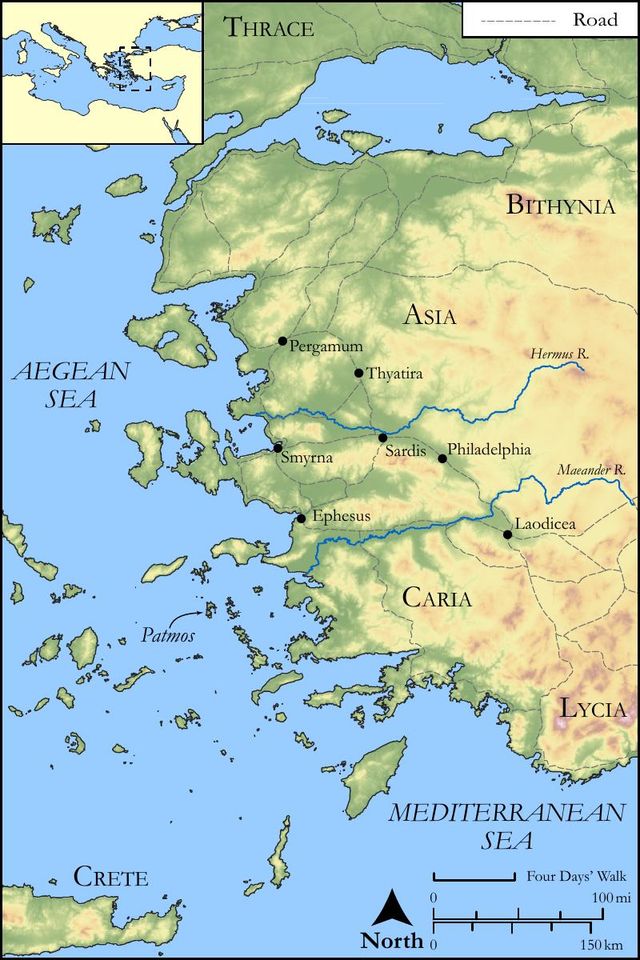
See on the biblical-era maps

Study this verse
Public-domain commentary
Matthew Henry
From his Commentary on the Whole Bible. Henry comments on passages, not single verses — this entry covers Revelation 20:1–10. His three-level outline is real structure in the source text, so it is rendered as structure.
We have here, I. A prophecy of the binding of Satan for a certain term of time, in which he should have much less power and the church much more peace than before. The power of Satan was broken in part by the setting up of the gospel kingdom in the world; it was further reduced by the empire's becoming Christian; it was yet further broken by the downfall of the mystical Babylon; but still this serpent had many heads, and, when one is wounded, another has life remaining in it. Here we have a further limitation and diminution of his power. Observe, 1. To whom this work of binding Satan is committed - to an angel from heaven. It is very probable that this angel is no other than the Lord Jesus Christ; the description of him will hardly agree with any other. He is one who has power to bind the strong man armed, to cast him out, and to spoil his goods; and therefore must be stronger than he. 2. The means he makes use of in this work: he has a chain and a key, a great chain to bind Satan, and the key of the prison in which he was to be confined. Christ never wants proper powers and instruments to break the power of Satan, for he has the powers of heaven and the keys of hell. 3. The execution of this work, Rev 20:2, Rev 20:3. (1.) He laid hold on the dragon, that old serpent, which is the devil, and Satan. Neither the strength of the dragon, nor the subtlety of the serpent, was sufficient to rescue him out of the hands of Christ; he caught hold, and kept his hold. And, (2.) He cast him into the bottomless pit, cast him down with force, and with a just vengeance, to his own place and prison, from which he had been permitted to break out, and disturb the churches, and deceive the nations; now he is brought back to that prison, and there laid in chains. (3.) He is shut up, and a seal set upon him. Christ shuts, and none can open; he shuts by his power, seals by his authority; and his lock and seal even the devils themselves cannot break open. (4.) We have the term of this confinement of Satan - a thousand years, after which he was to be loosed again for a little season. The church should have a considerable time of peace and prosperity, but all her trials were not yet over.
II.An account of the reign of the saints for the same space of time in which Satan continued bound (Rev 20:4-6), and here observe,
1.Who those were that received such honour - those who had suffered for Christ, and all who had faithfully adhered to him, not receiving the mark of the beast, nor worshipping his image; all who had kept themselves clear of pagan and papal idolatry.
2.The honour bestowed upon them.
(1.)They were raised from the dead, and restored to life. This may be taken either literally or figuratively; they were in a civil and political sense dead, and had a political resurrection; their liberties and privileges were revived and restored.
(2.)Thrones, and power of judgment, were given to them; they were possessed of great honour, and interest, and authority, I suppose rather of a spiritual than of a secular nature.
(3.)They reigned with Christ a thousand years. Those who suffer with Christ shall reign with Christ; they shall reign with him in his spiritual and heavenly kingdom, in a glorious conformity to him in wisdom, righteousness, and holiness, beyond what had been known before in the world. This is called the first resurrection, which none but those who have served Christ and suffered for him shall be favoured with. As for the wicked, they shall not be raised up and restored to their power again, till Satan be let loose; this may be called a resurrection, as the conversion of the Jews is said to be life from the dead.
3.The happiness of these servants of God is declared.
(1.)They are blessed and holy, Rev 20:6. None can be blessed but those that are holy; and all that are holy shall be blessed. These were holy as a sort of first-fruits to God in this spiritual resurrection, and as such blessed by him.
(2.)They are secured from the power of the second death. We know something of what the first death is, and it is awful; but we know not what this second death is. It must be much more dreadful; it is the death of the soul, eternal separation from God. The Lord grant we may never know what it is by experience. Those who have had experience of a spiritual resurrection are saved from the power of the second death.
III.An account of the return of the church's troubles, and another mighty conflict, very sharp, but short and decisive. Observe,
1.The restraints laid for a long time on Satan are at length taken off. While this world lasts, Satan's power in it will not be wholly destroyed; it may be limited and lessened, but he will have something still to do for the disturbance of the people of God.
2.No sooner is Satan let loose than he falls to his old work, deceiving the nations, and so stirring them up to make a war with the saints and servants of God, which they would never do if he had not first deceived them. They are deceived both as to the cause they engage in (they believe it to be a good cause when it is indeed a very bad one), and as to the issue: they expect to be successful, but are sure to lose the day.
3.His last efforts seem to be the greatest. The power now permitted to him seems to be more unlimited than before. He had now liberty to beat up for his volunteers in all the four quarters of the earth, and he raised a mighty army, the number of which was as the sand of the sea, Rev 20:8.
4.We have the names of the principal commanders in this army under the dragon - Gog and Magog. We need not be too inquisitive as to what particular powers are meant by these names, since the army was gathered from all parts of the world. These names are found in other parts of scripture. Magog we read of in Gen 10:2. He was one of the sons of Japheth, and peopled the country called Syria, from which his descendants spread into many other parts. Of Gog and Magog together we only read in Eze 38:2, a prophecy whence this in Revelation borrows many of its images.
5.We have the march and military disposition of this formidable army (Rev 20:9.): They went up on the breadth of the earth, and compassed the camp of the saints about, and the beloved city, that is, the spiritual Jerusalem, in which the most precious interests of the people of God are lodged, and therefore to them a beloved city. The army of the saints is described as drawn forth out of the city, and lying under the walls of it, to defend it; they were encamped about Jerusalem: but the army of the enemy was so much superior to that of the church that they compassed them and their city about.
6.You have an account of the battle, and the issue of this war: Fire came down from God out of heaven, and devoured the enemy. Thus the ruin of Gog and Magog is foretold (Eze 38:22), I will rain upon him and upon his bands an overflowing rain, and great hailstones, and fire and brimstone. God would, in an extraordinary and more immediate manner, fight this last and decisive battle for his people, that the victory might be complete and the glory redound to himself.
7.The doom and punishment of the grand enemy, the devil: he is now cast into hell, with his two great officers, the beast and the false prophet, tyranny and idolatry, and that not for any term of time, but to be there tormented night and day, for ever and ever.
Historical interpretation
Eleven Centuries of Reception
26 surviving comments on this verse. Each one is dated, so this reads as a timeline rather than a list.
Select a marker to jump to its quote. Markers stagger vertically where authors wrote within a few decades of each other.
-indicating that sin, which was set up and spread out against man, and which rendered him subject to death, should be deprived of its power, along with death, which rules
The Antichrist, rampant against mankind in the latter days, should be trampled down by Him (Jesus); and that He should bind “the dragon, that old serpent” and subject him to the power of man, who had been conquered so that all his might should be trodden down. (Against Heresies 3.23.7)
In the Revelation of John, again, the order of these times is spread out to view, which "the souls of the martyrs" are taught to wait for beneath the altar, whilst they earnestly pray to be avenged and judged: (taught, I say, to wait), in order that the world may first drink to the dregs the plagues that await it out of the vials of the angels, and that the city of fornication may receive from the ten kings its deserved doom, and that the beast Antichrist with his false prophet may wage war on the Church of God; and that, after the casting of the devil into the bottomless pit for a while, the blessed prerogative of the first resurrection may be ordained from the thrones; and then again, after the consignment of him to the fire, that the judgment of the final and universal resurrection may be determined out of the books.
On this Caius the heretic objected : that Satan is bound here, according to that which is written, that Christ went up into the strong man's house and bound him, and spoiled his goods for us [St. Matth. xii. 29].
Hippolytus answered this and said : If the Devil has been bound, how does he deceive the faithful and persecute and plunder men ? And if you say that he has been bound as regards the faithful, how did he draw near against Christ, Him who aid no sin? according to the text, The Prince cometh and findeth no sin in me [St. John, xiv. 30 4]. And if then he has been bound, how did the Lord teach us to pray, that we should be delivered front the evil one [St. Matth. vi. 13] ? and why did he desire to tempt Simon and the Apostles [St. Luke, xxii. 31]? And how was one who had been bound able to sift and trouble the disciples [ib.]?
And truly for us the conflict is not against flesh and blood, but against principalities, and against the rulers of the darkness of this world [Eph. vi. 12]. If he had been bound, he would not maintain the conflict, or catch away the word which was sown [St. Matth. xiii. 19], as is said in the Parable of the Seed. That He has bound the strong man; the meaning of it is this : that He has rebuked and cast scorn on those who did not come unto Him when He went against the Devil in order to purify them from his bondage and make them sons unto the Father.
And this is proved by what He said just after, that he that is not with me is against me, and he that gathereth not with me, scattereth abroad [St. Matth. xii. 30]. Accordingly, in the end of times, the Devil is to be bound and to be flung into the bottomless pit, when the Lord comes ; even as Esaias hath said, that the wicked shall be taken away in order that he see not the glory of the Lord [Isai. xxvi. 10----LXX. (Syr. Hex.)].
And the number of the years is not the number of days, but it represents the space of one day, glorious and perfect; in which, when the King comes in glory with His slain, the creation is to shine : according to the text, The sun shall shine twofold [marg., |404 sevenfold; Isai. xxx. 26]; while the righteous eat with Him and drink of His vine. This is the day which the Lord hath made [Ps. cxviii. 24], which David spoke of.
Accordingly, when with the eye of the spirit John saw the glory of that day, he likened it to the space of a thousand years ; according to the saying, One day in the world of the righteous is as a thousand years [2 Pet. iii. 8 ?]. And by the number he shows that day to be perfect, for those that are faithful.
But as for what he has said, that after the thousand years he shall be loosed, and shall deceive the nations [Rev. xx. 7, 8], it is this: that justly he is to be loosed, and to be cast into the burning, and to be judged [ib. 10, 12] ; with those who from old time were gathered together with him, when he gathered the strangers of the kingdom, and Gog and Magog [ib. 8].'
For as the times are noted from the foundation of the world, and reckoned from Adam, they set clearly before us the matter with which our inquiry deals. For the first appearance of our Lord in the flesh took place in Bethlehem, under Augustus, in the year 5500; and He suffered in the thirty-third year. And 6,000 years must needs be accomplished, in order that the Sabbath may come, the rest, the holy day "on which God rested from all His works." For the Sabbath is the type and emblem of the future kingdom of the saints, when they "shall reign with Christ," when He comes from heaven, as John says in his Apocalypse: for "a day with the Lord is as a thousand years." Since, then, in six days God made all things, it follows that 6,000 years must be fulfilled. And they are not yet fulfilled, as John says: "five are fallen; one is," that is, the sixth; "the other is not yet come."
In mentioning the "other," moreover, he specifies the seventh, in which there is rest. But some one may be ready to say, How will you prove to me that the Saviour was born in the year 5500? Learn that easily, O man; for the things that took place of old in the wilderness, under Moses, in the case of the tabernacle, were constituted types and emblems of spiritual mysteries, in order that, when the truth came in Christ in these last days, you might be able to perceive that these things were fulfilled. For He says to him, "And thou shalt make the ark of imperishable wood, and shalt overlay it with pure gold within and without; and thou shalt make the length of it two cubits and a half, and the breadth thereof one cubit and a half, and a cubit and a half the height; " which measures, when summed up together, make five cubits and a half, so that the 5500 years might be signified thereby.
At that time, then, the Saviour appeared and showed His own body to the world, (born) of the Virgin, who was the "ark overlaid with pure gold," with the Word within and the Holy Spirit without; so that the truth is demonstrated, and the "ark" made manifest. From the birth of Christ, then, we must reckon the 500 years that remain to make up the 6000, and thus the end shall be. And that the Saviour appeared in the world, bearing the imperishable ark, His own body, at a time which was the fifth and half, John declares: "Now it was the sixth hour," he says, intimating by that, one-half of the day. But a day with the Lord is 10000 years; and the half of that, therefore, is 500 years. For it was not meet that He should appear earlier, for the burden of the law still endured, nor yet when the sixth day was fulfilled (for the baptism is changed), but on the fifth and half, in order that in the remaining half time the gospel might be preached to the whole world, and that when the sixth day was completed He might end the present life.
Since, then, the Persians held the mastery for 330 years, and after them the Greeks, who were yet more glorious, held it for 300 years, of necessity the fourth beast, as being strong and mightier than all that were before it, will reign 500 years. When the times are fulfilled, and the ten horns spring from the beast in the last (times), then Antichrist will appear among them. When he makes war against the saints, and persecutes them, then may we expect the manifestation of the Lord from heaven.
"And I saw an angel come down from heaven, having the key of the abyss, and a chain in his hand. And he held the dragon, that old serpent, which is called the Devil and Satan, and bound him for a thousand years, and cast him into the abyss, and shut him up, and set a seal upon him, that he should deceive the nations no more, till the thousand years should be finished: after this he must be loosed a little season." Those years wherein Satan is bound are in the first advent of Christ, even to the end of the age; and they are called a thousand, according to that mode of speaking, wherein a part is signified by the whole, just as is that passage, "the word which He commanded for a thousand generations," although they are not a thousand. Moreover that he says, "and he cast him into the abyss," he says this, because the devil, excluded from the hearts of believers, began to take possession of the wicked, in whose hearts, blinded day by day, he is shut up as if in a profound abyss. And he shut him up, says he, and put a seal upon him, that he should not deceive the nations until the thousand years should be finished. "He shut the door upon him," it is said, that is, he forbade and restrained his seducing those who belong to Christ. Moreover, he put a seal upon him, because it is hidden who belong to the side of the devil, and who to that of Christ. For we know not of those who seem to stand whether they shall not fall, and of those who are down it is uncertain whether they may rise. Moreover, that he says that he is bound and shut up, that he may not seduce the nations, the nations signify the Church, seeing that of them it itself is formed, and which being seduced, he previously held until, he says, the thousand years should be completed, that is, what is left of the sixth day, to wit, of the sixth age, which subsists for a thousand years; after this he must be loosed for a little season. The little season signifies three years and six months, in which with all his power the devil will avenge himself trader Antichrist against the Church. Finally, he says, after that the devil shall be loosed, and will seduce the nations in the whole world, and will entice war against the Church, the number of whose foes shall be as the sand of the sea.
But He, when He shall have destroyed unrighteousness, and executed His great judgment, and shall have recalled to life the righteous, who have lived from the beginning, will be engaged among men a thousand years, and will rule them with most just command. Then they who shall be alive in their bodies shall not die, but during those thousand years shall produce an infinite multitude, and their offspring shall be holy, and beloved by God; but they who shall be raised from the dead shall preside over the living as judges. But the nations shall not be entirely extinguished, but some shall be left as a victory for God, that they may be the occasion of triumph to the righteous, and may be subjected to perpetual slavery. About the same time also the prince of the devils, who is the contriver of all evils, shall be bound with chains, and shall be imprisoned during the thousand years of the heavenly rule in which righteousness shall reign in the world, so that he may contrive no evil against the people of God. After His coming the righteous shall be collected from all the earth, and the judgment being completed, the sacred city shall be planted in the middle of the earth, in which God Himself the builder may dwell together with the righteous, bearing rule in it.
St. Papias gives accounts which he says came to him through unwritten tradition...To these belong his statement that there will be a period of some thousand years after the resurrection of the dead, and that the kingdom of Christ will be set up in material form on this very earth. I suppose he got these ideas through a misunderstanding of the apostolic accounts, not perceiving that the things said by them were spoken mystically in figures. For he appears to have been of very limited understanding, as one can see from his discourses. But it was due to him that so many of the Church Fathers after him adopted a like opinion, urging in their own support the antiquity of the man; as for instance Irenæus and any one else that may have proclaimed similar views. (Church History 3.39.13)
The devil was hooked by the Lord, like a dragon, by the hook of the Cross; and was taken in a drag-net, and was bound like a fugitive slave, and his lips were perforated by a ring and a bracelet, and he is not permitted to devour any of the faithful. Now, like a wretched sparrow, he is made sport of by Christ; now he groans at his companions, being trodden like serpents and scorpions under the heels of Christians. (Life of Antony 24)
Do we promise the gluttony of the Millennium? Do we declare that the Jewish animal-sacrifices shall be restored? Do we lower men’s hopes again to the Jerusalem below, imagining its rebuilding with stones of a more brilliant material? (Letter 17)
Now, as is evident, the thousand-year period is written about in the Revelation of John, and most people, including Origen, believe in the book. But most people, including the reverent, when they read the book, since they are familiar with spiritual realities and take the things that have a spiritual meaning in it in a spiritual way, believe indeed that they are true, but that their explanation lies deep beneath the surface of the text. For this is not the only passage whose meaning lies deep; there are many others.
and bound him. The Lord Jesus Christ Himself says, No man can enter into a strong man's house, and spoil his goods, except he first bind the strong man (Matt. 12:29) — meaning by the strong man the devil, because he had power to take captive the human race; and meaning by his goods which he was to take, those who had been held by the devil in various sins and iniquities, but were to become believers in Himself. It was then for the binding of this strong one that the apostle saw here. bound him: But the binding of the devil is his being prevented from the exercise of his whole power to seduce men, either by violently forcing or fraudulently deceiving them into taking part with him. If he were during so long a period permitted to assail the weakness of men, very many persons, such as God would not wish to expose to such temptation, would have their faith overthrown, or would be prevented from believing; and that this might not happen, he is bound. For the Almighty does not absolutely seclude the saints from his temptation, but shelters only their inner man, where faith resides, that by outward temptation they may grow in grace. And He binds him that he may not, in the free and eager exercise of his malice, hinder or destroy the faith of those countless weak persons, already believing or yet to believe, from whom the Church must be increased and completed;
Now the devil was thus bound not only when the Church began to be more and more widely extended among the nations beyond Judea, but is now and shall be bound till the end of the world, when he is to be loosed. Because even now men are, and doubtless to the end of the world shall be, converted to the faith from the unbelief in which he held them. (City of God 20.7)
Our Lord Jesus Christ himself said, “No one can enter the strong man’s house and plunder his goods, unless he first binds the strong man.” By “strong man” he means the devil, who was able to hold the human race in bondage. By his “goods” that Christ was to “plunder,” he means God’s future faithful ones whom the devil was keeping for himself because of their ungodliness and various sins. It was for the purpose of binding this strong man that John, in the Apocalypse, saw “an angel coming down from heaven … who bound [the ancient serpent] for a thousand years.” The angel, that is, checked and repressed his power to seduce and possess those destined to be set free.Now, the “thousand years” can, so far as I can see, be interpreted in one of two ways. One interpretation is that this event is to take place in the sixth and last millennium (the sixth “day”), the latter span of which is now passing, and that when John spoke of the last part of this millennium as a “thousand years” he was using, figuratively, the whole to indicate a part. (After this “sixth day” will come the “sabbath” that has no evening, namely, the endless repose of the blessed.)
The other interpretation makes the “thousand years” stand for all the years of the Christian era, a perfect number being used to indicate the “fullness of time.” For the number one thousand is the cube of ten. Ten times ten equals one hundred, which is already a square, but still a plane figure. To give it depth and make it a cube, one hundred is further multiplied by ten to make a thousand. Now it is true that the number one hundred is sometimes made to stand for “all.” Thus, the Lord promised to anyone leaving all things to follow him, “he shall receive a hundredfold.” … How much more properly, then, does the number one thousand stand for the whole, since it is the cube, whereas one hundred is only the square of ten? In the same way there is no better interpretation of the text, “he has remembered his covenant forever: the word that he commanded to a thousand generations,” than to take “a thousand” as meaning “all” generations.
In Greek letters, one thousand is designated with an “alpha.” In the alpha we have the beginning, which is Christ; in the name [of Christ] we have the cross, which is our victory and the destruction of the evil enemy. Therefore, both by the cross of Christ and by the authority of the cross he bound the enemy of the world who deceived those who dwell upon the earth. For to that eternity no time is added, and the eternity of his time will be enclosed by no end, nor will there ever be an end to the number of years. And so by the sovereignty of the Lord through the power of the cross he bound him in the abyss.
For by the number of a thousand he denoted not the quantity of time but the universality, with which the Church exercises dominion. Now the old serpent is bound with a chain and cast into the bottomless pit, because being tied up from the hearts of the good, while he is shut up in the minds of lost sinners, he rules over them with worse cruelty. (Morals 18.42)
Also the great Justin says that at the coming of Christ the devil will first learn that he is condemned to the abyss, that is, to the Gehenna of fire. It is, therefore, possible also to understand the sentence of Christ against the devil in the words just spoken. The seer says that the angel administers this sentence, thereby revealing that [the devil] is weaker in power than the ministering powers and showing the vanity of one who insolently opposes him who has rule over all things. For our understanding, he speaks of a “chain,” meaning the work of restraining [the devil’s] evil. It is in no way good to understand the “thousand years” as referring to a thousand years as such. For when David says “of the word that he commanded for a thousand generations,” we ought not to understand this to mean a hundred years times ten. Rather, David means many [generations] taken as a whole. So also in this case, we regard the number “thousand” to signify either many or that which is complete. If we take it to mean “many,” then it refers to the preaching of the gospel into all the world and the sowing of the seeds of piety in the world. [Or] should it mean “complete,” then it signifies that during this time, having been released from the life learned from the law, we have been called to the “perfect man,” to the measure of the maturity of the fullness of Christ. Therefore, the “thousand years” are the time from the incarnation of the Lord until the arrival of the antichrist. Whether the matter is as we have interpreted it, or the thousand years are one hundred times ten, as some believe, or the thousand years are less than this, this is known to God alone, who knows how long his patience is beneficial to us, and he determines the continuance of the present life.
The thousand years refers to when the church of God which, by the diffusion of its faith and works, is spread out as a kingdom of faith from the time of the Incarnation until the time of the coming judgment.
And he bound him for a thousand years. That is, restraining and curbing his power from seducing those who were to be freed. If he were allowed to exercise his full power with force or deceit, he would deceive many of the weak in such a long time. He said a thousand years, meaning a part, that is, the remainder of the thousand years of the sixth day in which the Lord was born and suffered.
And he seized the dragon, that ancient serpent, etc. The devil is interpreted as flowing downward. In Greek, he is called the accuser. Satan means adversary or transgressor. He is called a dragon because of the malice of harming; a serpent because of the cunning of deceiving; the devil because of his fall from his status; and Satan because of his obstinacy in opposing the Lord.
QUESTION: After having been bound for a thousand years, he must be loosed a little time. ANSWER: He will be loosed, as Saint Augustine says, when there is only a short time left. We read indeed that it is during three years and a half that he will rage with all his and his people's might, and those against whom he will have to wage war will be such that they cannot be overcome by his force and snares, great though they be. On the other hand, if he were never loosed, his evil power would be less apparent, the most faithful patience of the holy city would be less well proven, and, finally, it would be less well perceived how great the Devil's evil was that God Almighty had made so good use of; because the more powerful the Devil's evilness is, the better and more pleasant will God's power appear.
old serpent. The Devil is rightly called serpent because he decieved the first man through the serpent, and also rightly called old on account of the antiquity of the time, because at the beginning of created things he was created by God.
Could it not be that the thousand years of the atheistic Greeks and the transmigrations of souls and the water of Lethe, and I do not know what foolish confusions the Revelation hands over to us, saying that the Devil will be bound for a thousand years and then will be released and will deceive the nations? Away with such destructive doctrines and with the silliness fitting for the Greeks. What then does it say has been spoken to the prophet? "That a thousand years are in your sight, O Lord, as yesterday that is past, and as a watch in the night." (Ps. 90:4) Therefore the thousand years are reckoned as one day in the sight of God. The same is said in the second epistle of Peter the inspired, who wrote: "But, beloved, be not ignorant of this one thing, that one day is with the Lord as a thousand years, and a thousand years as one day." (2 Peter 3:8)
Moreover the inspired Isaiah says that all the human life of the Lord is one day, saying: "In a favorable time I listened to you, and in a day of salvation I helped you." (Isa. 49:8) Not only that, but the Psalmist also calls that day both "day" and "morning," saying on the one hand, "This is the day which the Lord has made; let us rejoice and be glad in it," (Ps. 118:24) the joy of our salvation; and on the other hand singing, "In the morning you will hear my voice; in the morning I will present myself to you," (Ps. 5:4) and I will look upon you; for our prayers are well-received when deemed worthy of the vision of God and the Father, through the Lord's mediation and reconciliation. And again concerning Jerusalem he says: "God will help her with the dawn of the morning." (Ps. 46:5) And the day and the morning became the indicator of the Lord's incarnation, as "the Sun of righteousness" shone upon us. For therefore Malachi speaks of him, (Mal. 4:2) and bringing us "the light of knowledge," (Hos. 10:12) concerning which the divine light Zachariah preannounced, saying: "a rising to us from on high has visited those who sit in darkness and in the shadow of death"; (Luke 1:78-79; see Zech. 14:6-7) to which the prophet also added, "God said, the Lord, and he appeared to us to appoint a feast among those who burn incense up to the horns of the altar." (Ps. 117:27)
Having therefore prefaced these matters, proceed to the point in hand. Since it has been said that a day is reckoned by God as a thousand years, and conversely the day is called the Lord's sojourn on earth, he declares this day to be a thousand years, as if there is no distinction before God between a single day and a thousand years; in which day, that of the Lord's incarnation, the Devil was bound, being unable to resist the Savior's divine signs.
Wherefore, perceiving this bondage of the spiritual realm, the true demons cried out, "What have we to do with you and with us, Son of the living God? Have you come before the appointed time to torment us?" (Matt. 8:29) But the Lord, while loosing their bonds, said: "Or how can one enter the house of the strong man and plunder his goods, unless he first bind the strong man? and then he will plunder his house." (Matt. 12:29) Since, therefore, as has been said, we have conceived of the Incarnation of the Lord and his sojourn on earth as lasting one day and a thousand years, this same number being mystically called in the divine Scripture without distinction, see what the Revelation says.
'On this Caius the heretic objected : that Satan is bound here, according to that which is written, that Christ went up into the strong man's house and bound him, and spoiled his goods for us [St. Matth. xii. 29].
Hippolytus answered this and said : If the Devil has been bound, how does he deceive the faithful and persecute and plunder men ? And if you say that he has been bound as regards the faithful, how did he draw near against Christ, Him who aid no sin? according to the text, The Prince cometh and findeth no sin in me [St. John, xiv. 30 4]. And if then he has been bound, how did the Lord teach us to pray, that we should be delivered front the evil one [St. Matth. vi. 13] ? and why did he desire to tempt Simon and the Apostles [St. Luke, xxii. 31]? And how was one who had been bound able to sift and trouble the disciples [ib.]?
And truly for us the conflict is not against flesh and blood, but against principalities, and against the rulers of the darkness of this world [Eph. vi. 12]. If he had been bound, he would not maintain the conflict, or catch away the word which was sown [St. Matth. xiii. 19], as is said in the Parable of the Seed. That He has bound the strong man; the meaning of it is this : that He has rebuked and cast scorn on those who did not come unto Him when He went against the Devil in order to purify them from his bondage and make them sons unto the Father.
And this is proved by what He said just after, that he that is not with me is against me, and he that gathereth not with me, scattereth abroad [St. Matth. xii. 30]. Accordingly, in the end of times, the Devil is to be bound and to be flung into the bottomless pit, when the Lord comes ; even as Esaias hath said, that the wicked shall be taken away in order that he see not the glory of the Lord [Isai. xxvi. 10----LXX. (Syr. Hex.)]
And the number of the years is not the number of days, but it represents the space of one day, glorious and perfect; in which, when the King comes in glory with His slain, the creation is to shine : according to the text, The sun shall shine twofold [marg., sevenfold; Isai. xxx. 26]; while the righteous eat with Him and drink of His vine. This is the day which the Lord hath made [Ps. cxviii. 24], which David spoke of.
Accordingly, when with the eye of the spirit John saw the glory of that day, he likened it to the space of a thousand years ; according to the saying, One day in the world of the righteous is as a thousand years [2 Pet. iii. 8 ?]. And by the number he shows that day to be perfect, for those that are faithful.
But as for what he has said, that after the thousand years he shall be loosed, and shall deceive the nations [Rev. xx. 7, 8], it is this: that justly he is to be loosed, and to be cast into the burning, and to be judged [ib. 10, 12] ; with those who from old time were gathered together with him, when he gathered the strangers of the kingdom, and Gog and Magog [ib. 8].'
bound. Satan was then bound when he was mocked on the Cross, and mankind received authority from Christ to walk on that same serpent as on one bound, those whom he was unable to harm.
Certain heretics asserted that there will be a first resurrection of the dead that they may reign with Christ on earth for a thousand years; whence they were called "chiliasts" or "millenarians."
Moreover, if you begin the unloosing of Satan in connection with the time of the great Antichrist from the time when, under the fifth trumpet, the star falling from heaven took the key to the bottomless pit and opened it, then from Christ's resurrection to that time there are around one thousand years during which the saints reign with Christ.
Continue studying Revelation 20:2 across the web’s major study libraries — every link below opens this exact verse, chapter, or book on the destination site.
Read & Compare
 BibleGatewayThis verse in more than 200 translations and 70 languages.
 Bible.comThe YouVersion reader — hundreds of translations, reading plans, and highlights.
 ESV.orgCrossway's official English Standard Version reader.
 NET BibleThe NET translation with 60,000+ translators' notes on every rendering decision.
 STEP BibleTyndale House's free study tool — original text, vocabulary, and scholarly resources.
 BibliaLogos Bible Software's free web reader.
 USCCBThe New American Bible (Revised Edition) with the U.S. bishops' study notes.
Commentaries
 BibleHub CommentariesDozens of classic commentaries on this verse, gathered on one page.
 StudyLightMore than 100 commentary sets — the largest collection on the web.
 BibleRefPlain-English commentary on what this verse means, verse by verse.
 Enduring WordDavid Guzik's free commentary on this chapter, widely used by Bible teachers.
 Bible Study ToolsVerse commentary alongside Greek and Hebrew study aids.
Original Language & Research
- BibleHub InterlinearThe verse word by word — original language, transliteration, and English.
- BibleHub LexiconEvery word's original-language definition and Strong's entry.
 Blue Letter BibleDeep-study tools — Strong's numbers, concordance, and word studies.
 CNTR CollationThe earliest Greek manuscripts of this verse, collated letter by letter.
Sermons, Hymns & Audio


TrulyRandomVerse is not affiliated with these sites and doesn’t control their content. They’re linked because they’re genuinely useful.
Summary
Revelation 20:2 vividly portrays a powerful angelic being seizing and restraining humanity's ancient adversary, identified comprehensively as "the dragon, that old serpent, which is the Devil, and Satan." This pivotal act initiates a thousand-year period during which this malevolent entity is bound, signifying a profound curtailment of his deceptive influence over the nations and underscoring God's absolute sovereignty over all spiritual forces of evil in the unfolding of His redemptive plan.
Context
ShowHideLiterary Context
This verse is situated within the climactic apocalyptic visions granted to the Apostle John, immediately following the triumphant return of Christ as the Rider on the white horse and the defeat of the Beast and False Prophet in Revelation 19. Revelation 20:1 sets the stage, describing a mighty angel descending from heaven, holding the key to the bottomless pit and a great chain. The binding of Satan in Revelation 20:2 is the direct consequence of this angelic action, ushering in the millennial reign described in the subsequent verses of Revelation 20 before the final judgment and the new heavens and new earth.
Historical & Cultural Context
John's visions were given to a church facing intense persecution under the Roman Empire, often forced to worship the emperor or face severe consequences. In this context, the imagery of God's decisive action against evil, particularly the binding of Satan, would have offered immense comfort and hope. The concept of an "adversary" (Satan) was deeply rooted in Jewish tradition, evolving from a divine prosecutor in books like Job and Zechariah to the embodiment of evil in later intertestamental and New Testament writings. The "dragon" and "serpent" imagery would immediately evoke the ancient foe from Genesis 3, reinforcing the idea that God's ultimate victory would address the root of all sin and suffering.
Key Themes
ShowHideRevelation 20:2 contributes significantly to several major themes within Revelation and broader biblical theology. Firstly, it powerfully asserts God's absolute sovereignty over evil, demonstrating that even the most formidable spiritual adversary operates under divine constraint and timing. Secondly, the verse provides a comprehensive identification of the adversary, leaving no doubt that the "dragon, that old serpent, which is the Devil, and Satan" is the same entity responsible for deception from the beginning, as seen in Genesis 3:1 and further elaborated in Revelation 12:9. Thirdly, the temporary restraint of Satan for "a thousand years" introduces the pivotal concept of the millennium, emphasizing a future period where Satan's global deception is curtailed, allowing for a time of peace and righteousness before his final, brief release in Revelation 20:7.
Exposition and Analysis
ShowHideKey Word Analysis
ShowHideThis term (G1404) refers to a fabulous kind of serpent, often associated with fascination or a terrifying, powerful creature. In Revelation, it is consistently used as a symbol for Satan, emphasizing his destructive power and ancient, primeval evil, linking him to the primordial chaos and the ultimate enemy of God.
Derived from G1228, this word means "a traducer," "false accuser," or "slanderer." It highlights Satan's primary characteristic as one who maligns God's character and humanity, constantly bringing charges against believers before God, as seen in Job 1 and Zechariah 3.
This primary verb signifies "to bind" in various applications, literally or figuratively. Here, it denotes a literal and effective restraint, indicating that Satan's power to deceive the nations is physically and supernaturally curtailed, not merely metaphorically limited, during the specified period.
Verse Breakdown
ShowHide"And he laid hold on the dragon"
This phrase describes a decisive and forceful action taken by the angel introduced in Revelation 20:1. "He laid hold on" (Greek: kratéō) implies seizing with strength and retaining control, indicating that the angel's power is superior to that of the dragon. This immediately establishes God's ultimate authority over evil.
"that old serpent, which is the Devil, and Satan"
This is a crucial four-fold identification of the adversary, leaving no ambiguity about his identity. "That old serpent" directly links back to the deceiver in Genesis 3, emphasizing his ancient nature and cunning. "The Devil" (Greek: diábolos) highlights his character as a slanderer and accuser. "Satan" (Hebrew: Satanâs) means "adversary" or "opponent," underscoring his role as God's primary antagonist. This comprehensive naming ensures the reader understands the full scope of this entity's malevolence and history.
"and bound him a thousand years"
This specifies the duration of the adversary's restraint. The angel's action is not merely to seize but to "bind" (Greek: déō), rendering him inactive in his primary role of deceiving the nations. The "thousand years" (Greek: chílioi étos) denotes a specific, extended period, during which Satan's global influence is effectively neutralized, preparing the way for the millennial reign of Christ and His saints.
Literary Devices
ShowHideRevelation 20:2 employs several potent literary devices to convey its profound theological message. Apposition is prominently used in the multi-faceted identification of the adversary: "the dragon, that old serpent, which is the Devil, and Satan." This layering of names ensures a comprehensive understanding of the enemy, linking him to his ancient origins as the deceiver in Eden and his ongoing role as accuser and adversary. Symbolism is central, with "the dragon" representing the embodiment of evil and supernatural power, consistent with its use throughout Revelation. The "thousand years" is also a symbolic, yet specific, duration, representing a complete and divinely appointed period of time. Furthermore, Personification is evident in the depiction of Satan as a tangible entity who can be "laid hold on" and "bound" with a chain, making his defeat concrete and comprehensible, despite his spiritual nature.
Theological and Thematic Connections
ShowHideRevelation 20:2 is a profound declaration of God's ultimate triumph over evil. It assures believers that the long struggle against the dragon, that old serpent, though intense, has a divinely ordained end. Satan, the seemingly invincible foe, is not beyond God's reach; his power is limited, his time is set, and his ultimate defeat is certain. This verse underscores the truth that God's sovereignty extends even to the darkest spiritual forces, offering immense comfort and hope to those who suffer under the influence of evil. The temporary binding of Satan signifies a future era of unparalleled peace and righteousness, a direct result of Christ's victory.
Reflection and Application
ShowHideThe binding of Satan in Revelation 20:2 offers a powerful perspective on spiritual warfare and God's unwavering control. For believers living in a world still marked by evil and deception, this verse is a beacon of hope. It reminds us that while Satan may rage, his power is always subordinate to God's authority. We are not fighting an unchecked enemy, but one whose fate is sealed and whose activities are ultimately limited by divine decree. This truth should empower us to stand firm in our faith, resist temptation, and proclaim the gospel with confidence, knowing that the "prince of this world" is already judged and will be fully incapacitated. It calls us to trust in God's perfect timing and His just resolution of all things, even when the present reality seems overwhelming.
Questions for Reflection
ShowHideFAQ
ShowHideWho is "he" who lays hold of the dragon?
ShowHideThe "he" refers to the angel described in Revelation 20:1, who descends from heaven with the key to the bottomless pit and a great chain. While not named, this angel is clearly invested with immense divine authority and power to execute God's judgment upon Satan. This emphasizes that even the most powerful spiritual adversary is subject to God's appointed agents and ultimate control.
What is the significance of "a thousand years"?
ShowHideThe "thousand years" (Greek: chílioi étos) refers to the period during which Satan is bound, often called the Millennium. While interpretations vary (pre-millennialists typically see it as a literal 1000-year reign of Christ on Earth, amillennialists see it as a symbolic representation of the entire church age, and post-millennialists see it as a golden age brought about by the church before Christ's return), the consistent theological point is that it represents a divinely appointed, significant period where Satan's ability to deceive the nations is curtailed. This allows for a time of profound peace and righteousness, whether literal or spiritual, before his brief release in Revelation 20:7.
Why is Satan identified with so many titles in this single verse?
ShowHideThe multiple titles—"the dragon, that old serpent, which is the Devil, and Satan"—serve to comprehensively identify and characterize humanity's ultimate adversary, leaving no doubt as to his nature and history. "Dragon" (Greek: drákōn) highlights his fearsome power and destructive nature. "That old serpent" (Greek: óphis archaîos) directly links him to the deceiver in Genesis 3, emphasizing his ancient, cunning, and deceptive origins. "The Devil" (Greek: diábolos) means "slanderer" or "accuser," pointing to his role in maligning God and accusing humanity. "Satan" (Hebrew: Satanâs) means "adversary" or "opponent," signifying his constant opposition to God's will and people. This cumulative identification reinforces the gravity of his defeat and the completeness of God's victory over all forms of evil.
Christ-Centered Fulfillment
ShowHideRevelation 20:2, depicting the binding of Satan, finds its ultimate Christ-centered fulfillment in the finished work of Jesus on the cross and His glorious resurrection. While the full, visible manifestation of Satan's binding awaits future eschatological events, the decisive victory over him was secured by Christ. Jesus Himself declared, "Now is the judgment of this world; now will the ruler of this world be cast out" (John 12:31). Through His death, Christ disarmed the powers and authorities, making a public spectacle of them, triumphing over them by the cross (Colossians 2:15). The author of Hebrews states that Christ shared in our humanity "that through death he might destroy the one who has the power of death, that is, the devil" (Hebrews 2:14). The binding described in Revelation is the logical and inevitable consequence of Christ's triumph, a future display of the authority He already possesses. It is because Jesus came to "destroy the works of the devil" (1 John 3:8) that Satan can and will be bound, ushering in a time when his deceptive influence is fully curtailed, pointing to Christ's ultimate and unchallenged reign.