


Revelation 20:4
Bible text: King James Version (1769 Blayney text) · Public domain
Bible text: King James Version with Strong's numbers · Public domain
Bible text: Berean Standard Bible · Public domain
Bible text: American Standard Version (1901) · Public domain
Bible text: World English Bible, Messianic edition · Public domain
Bible text: Geneva Bible (1599) · Public domain
Bible text: Young's Literal Translation · Public domain
- ΚαὶKaiAndG2532CONJConjunction
- εἶδονeidonI sawG1492V-2AAI-1SVerb 2nd Aorist Active Indicative 1st Singular
- θρόνουςthronousthronesG2362N-APMNoun Accusative Plural Masculine
- καὶkaiandG2532CONJConjunction
- ἐκάθισανekathisanthey satG2523V-AAI-3PVerb Aorist Active Indicative 3rd Plural
- ἐπ᾽ep᾽uponG1909PREPPreposition
- αὐτούςautousthemG846P-APMPersonal pronoun Accusative Plural Masculine
- καὶkaiandG2532CONJConjunction
- κρίμαkrimajudgmentG2917N-NSNNoun Nominative Singular Neuter
- ἐδόθηedothēwas givenG1325V-API-3SVerb Aorist Passive Indicative 3rd Singular
- αὐτοῖςautoisto themG846P-DPMPersonal pronoun Dative Plural Masculine
- καὶkaiandG2532CONJConjunction
- τὰςtastheG3588T-APFDefinite article Accusative Plural Feminine
- ψυχὰςpsuchassoulsG5590N-APFNoun Accusative Plural Feminine
- τῶνtōnof thoseG3588T-GPMDefinite article Genitive Plural Masculine
- πεπελεκισμένωνpepelekismenōnbeheadedG3990V-RPP-GPMVerb Perfect Passive Participle Genitive Plural Masculine
- διὰdiabecause ofG1223PREPPreposition
- τὴνtēntheG3588T-ASFDefinite article Accusative Singular Feminine
- μαρτυρίανmarturiantestimonyG3141N-ASFNoun Accusative Singular Feminine
- ἸησοῦIēsouof JesusG2424N-GSM-PNoun Genitive Singular Masculine Individual
- καὶkaiandG2532CONJConjunction
- διὰdiabecause ofG1223PREPPreposition
- τὸνtontheG3588T-ASMDefinite article Accusative Singular Masculine
- λόγονlogonwordG3056N-ASMNoun Accusative Singular Masculine
- τοῦtou<the>G3588T-GSMDefinite article Genitive Singular Masculine
- θεοῦtheouof GodG2316N-GSM-TNoun Genitive Singular Masculine Title
- καὶkaiandG2532CONJConjunction
- οἵτινεςoitinesthose whoG3748R-NPMRelative pronoun Nominative Plural Masculine
- οὐounotG3756PRT-NNegative Particle Negative
- προσεκύνησανprosekunēsandid worshipG4352V-AAI-3PVerb Aorist Active Indicative 3rd Plural
- τὸtotheG3588T-ASNDefinite article Accusative Singular Neuter
- θηρίονthērionbeastG2342N-ASNNoun Accusative Singular Neuter
- οὐδὲoudenorG3761CONJ-NConjunction Negative
- τὴνtēntheG3588T-ASFDefinite article Accusative Singular Feminine
- εἰκόναeikonaimageG1504N-ASFNoun Accusative Singular Feminine
- αὐτοῦautouof himG846P-GSNPersonal pronoun Genitive Singular Neuter
- καὶkaiandG2532CONJConjunction
- οὐκouknotG3756PRT-NNegative Particle Negative
- ἔλαβονelabondid takeG2983V-2AAI-3PVerb 2nd Aorist Active Indicative 3rd Plural
- τὸtotheG3588T-ASNDefinite article Accusative Singular Neuter
- χάραγμαcharagmamarkG5480N-ASNNoun Accusative Singular Neuter
- ἐπὶepiuponG1909PREPPreposition
- τὸtotheG3588T-ASNDefinite article Accusative Singular Neuter
- μέτωπονmetōponforeheadG3359N-ASNNoun Accusative Singular Neuter
- αὐτῶνautōnof themG846P-GPMPersonal pronoun Genitive Plural Masculine
- καὶkaiandG2532CONJConjunction
- ἐπὶepiuponG1909PREPPreposition
- τὴνtēntheG3588T-ASFDefinite article Accusative Singular Feminine
- χεῖραcheirahandG5495N-ASFNoun Accusative Singular Feminine
- αὐτῶνautōnof themG846P-GPMPersonal pronoun Genitive Plural Masculine
- καὶkaiAndG2532CONJConjunction
- ἔζησανezēsanthey livedG2198V-AAI-3PVerb Aorist Active Indicative 3rd Plural
- καὶkaiandG2532CONJConjunction
- ἐβασίλευσανebasileusanthey reignedG936V-AAI-3PVerb Aorist Active Indicative 3rd Plural
- μετὰmetawithG3326PREPPreposition
- τοῦtou<the>G3588T-GSMDefinite article Genitive Singular Masculine
- ΧριστοῦChristouChristG5547N-GSM-TNoun Genitive Singular Masculine Title
- τὰtatheG3588T-APNDefinite article Accusative Plural Neuter
- χίλιαchiliathousandG5507A-APNAdjective Accusative Plural Neuter
- ἔτηetēyearsG2094N-APNNoun Accusative Plural Neuter
English is a literal word-by-word gloss of the Greek, not the KJV's wording. Why?
This is the original text the KJV's translators worked from — each Greek word with its own literal English meaning in this verse, prepared by scholars at Tyndale House, Cambridge. The KJV translates whole sentences, not word by word, so its wording differs: one Greek word can become several English words, and the KJV may choose “charity” where the gloss reads “love”. Both are faithful — they answer different questions. For the KJV's own rendering, switch to the KJV text.
Details
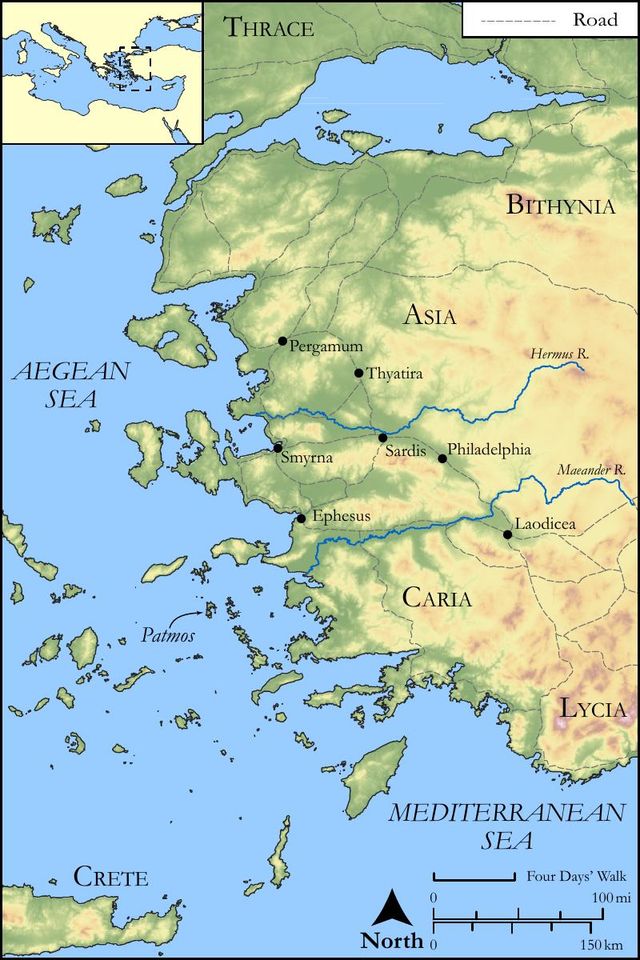
See on the biblical-era maps

Study this verse
Public-domain commentary
Matthew Henry
From his Commentary on the Whole Bible. Henry comments on passages, not single verses — this entry covers Revelation 20:1–10. His three-level outline is real structure in the source text, so it is rendered as structure.
We have here, I. A prophecy of the binding of Satan for a certain term of time, in which he should have much less power and the church much more peace than before. The power of Satan was broken in part by the setting up of the gospel kingdom in the world; it was further reduced by the empire's becoming Christian; it was yet further broken by the downfall of the mystical Babylon; but still this serpent had many heads, and, when one is wounded, another has life remaining in it. Here we have a further limitation and diminution of his power. Observe, 1. To whom this work of binding Satan is committed - to an angel from heaven. It is very probable that this angel is no other than the Lord Jesus Christ; the description of him will hardly agree with any other. He is one who has power to bind the strong man armed, to cast him out, and to spoil his goods; and therefore must be stronger than he. 2. The means he makes use of in this work: he has a chain and a key, a great chain to bind Satan, and the key of the prison in which he was to be confined. Christ never wants proper powers and instruments to break the power of Satan, for he has the powers of heaven and the keys of hell. 3. The execution of this work, Rev 20:2, Rev 20:3. (1.) He laid hold on the dragon, that old serpent, which is the devil, and Satan. Neither the strength of the dragon, nor the subtlety of the serpent, was sufficient to rescue him out of the hands of Christ; he caught hold, and kept his hold. And, (2.) He cast him into the bottomless pit, cast him down with force, and with a just vengeance, to his own place and prison, from which he had been permitted to break out, and disturb the churches, and deceive the nations; now he is brought back to that prison, and there laid in chains. (3.) He is shut up, and a seal set upon him. Christ shuts, and none can open; he shuts by his power, seals by his authority; and his lock and seal even the devils themselves cannot break open. (4.) We have the term of this confinement of Satan - a thousand years, after which he was to be loosed again for a little season. The church should have a considerable time of peace and prosperity, but all her trials were not yet over.
II.An account of the reign of the saints for the same space of time in which Satan continued bound (Rev 20:4-6), and here observe,
1.Who those were that received such honour - those who had suffered for Christ, and all who had faithfully adhered to him, not receiving the mark of the beast, nor worshipping his image; all who had kept themselves clear of pagan and papal idolatry.
2.The honour bestowed upon them.
(1.)They were raised from the dead, and restored to life. This may be taken either literally or figuratively; they were in a civil and political sense dead, and had a political resurrection; their liberties and privileges were revived and restored.
(2.)Thrones, and power of judgment, were given to them; they were possessed of great honour, and interest, and authority, I suppose rather of a spiritual than of a secular nature.
(3.)They reigned with Christ a thousand years. Those who suffer with Christ shall reign with Christ; they shall reign with him in his spiritual and heavenly kingdom, in a glorious conformity to him in wisdom, righteousness, and holiness, beyond what had been known before in the world. This is called the first resurrection, which none but those who have served Christ and suffered for him shall be favoured with. As for the wicked, they shall not be raised up and restored to their power again, till Satan be let loose; this may be called a resurrection, as the conversion of the Jews is said to be life from the dead.
3.The happiness of these servants of God is declared.
(1.)They are blessed and holy, Rev 20:6. None can be blessed but those that are holy; and all that are holy shall be blessed. These were holy as a sort of first-fruits to God in this spiritual resurrection, and as such blessed by him.
(2.)They are secured from the power of the second death. We know something of what the first death is, and it is awful; but we know not what this second death is. It must be much more dreadful; it is the death of the soul, eternal separation from God. The Lord grant we may never know what it is by experience. Those who have had experience of a spiritual resurrection are saved from the power of the second death.
III.An account of the return of the church's troubles, and another mighty conflict, very sharp, but short and decisive. Observe,
1.The restraints laid for a long time on Satan are at length taken off. While this world lasts, Satan's power in it will not be wholly destroyed; it may be limited and lessened, but he will have something still to do for the disturbance of the people of God.
2.No sooner is Satan let loose than he falls to his old work, deceiving the nations, and so stirring them up to make a war with the saints and servants of God, which they would never do if he had not first deceived them. They are deceived both as to the cause they engage in (they believe it to be a good cause when it is indeed a very bad one), and as to the issue: they expect to be successful, but are sure to lose the day.
3.His last efforts seem to be the greatest. The power now permitted to him seems to be more unlimited than before. He had now liberty to beat up for his volunteers in all the four quarters of the earth, and he raised a mighty army, the number of which was as the sand of the sea, Rev 20:8.
4.We have the names of the principal commanders in this army under the dragon - Gog and Magog. We need not be too inquisitive as to what particular powers are meant by these names, since the army was gathered from all parts of the world. These names are found in other parts of scripture. Magog we read of in Gen 10:2. He was one of the sons of Japheth, and peopled the country called Syria, from which his descendants spread into many other parts. Of Gog and Magog together we only read in Eze 38:2, a prophecy whence this in Revelation borrows many of its images.
5.We have the march and military disposition of this formidable army (Rev 20:9.): They went up on the breadth of the earth, and compassed the camp of the saints about, and the beloved city, that is, the spiritual Jerusalem, in which the most precious interests of the people of God are lodged, and therefore to them a beloved city. The army of the saints is described as drawn forth out of the city, and lying under the walls of it, to defend it; they were encamped about Jerusalem: but the army of the enemy was so much superior to that of the church that they compassed them and their city about.
6.You have an account of the battle, and the issue of this war: Fire came down from God out of heaven, and devoured the enemy. Thus the ruin of Gog and Magog is foretold (Eze 38:22), I will rain upon him and upon his bands an overflowing rain, and great hailstones, and fire and brimstone. God would, in an extraordinary and more immediate manner, fight this last and decisive battle for his people, that the victory might be complete and the glory redound to himself.
7.The doom and punishment of the grand enemy, the devil: he is now cast into hell, with his two great officers, the beast and the false prophet, tyranny and idolatry, and that not for any term of time, but to be there tormented night and day, for ever and ever.
Historical interpretation
Ten Centuries of Reception
24 surviving comments on this verse. Each one is dated, so this reads as a timeline rather than a list.
Select a marker to jump to its quote. Markers stagger vertically where authors wrote within a few decades of each other.
There will be a period of some thousand years after the resurrection of the dead, and... the kingdom of Christ will be set up in material form on this very earth.
But I and others, who are right-minded Christians on all points, are assured that there will be a resurrection of the dead, and a thousand years in Jerusalem, which will then be built, adorned, and enlarged, [as] the prophets Ezekiel and Isaiah and others declare.
And further, there was a certain man with us, whose name was John, one of the apostles of Christ, who prophesied, by a revelation that was made to him, that those who believed in our Christ would dwell a thousand years in Jerusalem; and that thereafter the general, and, in short, the eternal resurrection and judgment of all men would likewise take place.
What hope and reward remains for the righteous and for martyrs after the conflicts and sufferings of this present time, The Holy Spirit shows and predicts by Solomon, saying: "And although in the sight of men they suffered torments, yet their hope is full of immortality. And having been troubled in a few things, they shall be in many happily ordered, because God has tried them, and has found them worthy of Himself. As gold in the furnace, He hath tried them; and as whole burnt-offerings of sacrifice, He hath received them, and in its season there will be respect of them. They will shine and run about as sparks in a place set with reeds. They shall judge the nations, and have dominion over the peoples; and their Lord shall reign for ever." In the same also our vengeance is described, and the repentance of those who persecute and molest us is announced. "Then," saith he," shall the righteous stand in great constancy before such as have afflicted them, and who have taken away their labours; when they see it, they shall be troubled with a horrible fear: and they shall marvel at the suddenness of their unexpected salvation, saying among themselves, repenting and groaning for anguish of spirit, These are they whom we had sometime in derision and as a proverb of reproach. We fools counted their life madness, and their end to be without honour. How are they numbered among the children of God, and their lot is among the saints! Therefore have we erred from the way of truth, and the light of righteousness hath not shined unto us, and the sun hath not risen upon us. We have been wearied in the way of unrighteousness and perdition, and have walked through hard deserts, but have not known the way of the Lord. What hath pride profited us, or what hath the boasting of riches brought to us? All these things have passed away like a shadow." Likewise in the cxvth Psalm is shown the price and the reward of suffering: "Precious," it says, "in the sight of the Lord is the death of His saints. In the cxxvth Psalm also is expressed the sadness of the struggle, and the joy of the retribution: "They who sow," it says. "in tears, shall reap in joy. As they walked, they walked and wept, casting their seeds; but as they come again, they shall come in exultation, bearing their sheaves." And again, in the cxviiith Psalm: "Blessed are those that are undefiled in the way, who walk in the law of the Lord. Blessed are they who search His testimonies, and seek Him out with their whole heart." Moreover, the Lord in the Gospel, Himself the avenger of our persecution and the rewarder of our suffering, says: "Blessed are they who suffer persecution for righteousness' sake, for theirs is the kingdom of heaven." And again: "Blessed shall ye be when men shall hate you, and shall separate you, and shall expel you, and shall revile your name as evil, for the Son of man's sake. Rejoice ye in that day, and leap for joy; for, behold, your reward is great in heaven." And once more: "Whosoever shall lose his life for my sake, the same shall save it." Nor do the rewards of the divine promise attend those alone who are reproached and slain; but if the passion itself, be wanting to the faithful, while their faith has remained sound and unconquered, and having forsaken and contemned all his possessions, the Christian has shown that he is following Christ, even be also is honoured by Christ among the martyrs, as He Himself promises and says: "There is no man that leaveth house, or land, or parents, or brethren, or wife, or children, for the kingdom of God's sake, but shall receive seven times as much in this present time, and in the world to come eternal life." In the Apocalypse also He says the same thing: "And I saw," saith he, "the souls of them that were slain for the name of Jesus and the word of God." And when he had placed those who were slain in the first place, he added, saying: "And whosoever had not worshipped the image of the beast, neither had received his mark upon their forehead or in their hand; "all these he joins together, as seen by him at one time in the same place, and says, "And they lived and reigned with Christ." He says that all live and reign with Christ, not only who have been slain; but even whosoever, standing in firmness of the faith and in the fear of God, have not worshipped the image of the beast, and have not consented to his deadly and sacrilegious edicts.
Therefore they are not to be heard who assure themselves that there is to be an earthly reign of a thousand years; who think, that is to say, with the heretic Cerinthus. For the kingdom of Christ is now eternal in the saints, although the glory of the saints shall be manifested after the resurrection.
"And I saw thrones, and them that sate upon them, and judgment was given unto them; and I saw the souls of them that were slain on account of the testimony of Jesus, and for the word of God, and which had not worshipped the beast nor his image, nor have received his writing on their forehead or in their hand; and they reigned with Christ for a thousand years: the rest of them lived not again until the thousand years were finished. This is the first resurrection." There are two resurrections. But the first resurrection is now of the souls that are by the faith, which does not permit men to pass over to the second death. Of this resurrection the apostle says: "If ye have risen with Christ, seek those things which are above."
To these belong his [Papias] statement that there will be a period of some thousand years after the resurrection of the dead, and that the kingdom of Christ will be set up in material form on this very earth. I suppose he got these ideas through a misunderstanding of the apostolic accounts, not perceiving that the things said by them were spoken mystically in figures.
For he appears to have been of very limited understanding, as one can see from his discourses. But it was due to him that so many of the Church Fathers after him adopted a like opinion, urging in their own support the antiquity of the man; as for instance Irenæus and any one else that may have proclaimed similar views.
He [Papias] is said to have published a 'Second coming of Our Lord or Millennium'. Irenæus and Apollinaris and others who say that after the resurrection the Lord will reign in the flesh with the saints, follow him. Tertullian also in his work 'On the hope of the faithful', Victorinus of Petau and Lactantius follow this view.
[Daniel 7:17-18] "These four great beasts are the four kingdoms which shall arise from the earth. But the saints of the Most High God shall take the kingdom." The four kingdoms of which we have spoken above were earthly in character. "For everything which is of the earth shall return to earth" (Ecclesiastes 3:20). But the saints shall never possess an earthly kingdom, but only a heavenly. Away, then, with the fable about a millennium! (Revelation 20:4-6)
"...And they shall possess the kingdom unto eternity, even forever and ever..." If this be taken to refer to the Maccabees, the advocate of this position should explain how the kingdom of the Maccabees is of a perpetual character.
This verse should be applied to both the living and the dead.… As to the identity of the beast in question, there is need of very careful study. Nevertheless, consistently with sound faith, one may take it to be the godless city as opposed to the city of God, men and women without faith as opposed to those who believe. The beast’s “image,” I think, is his deception as found, for example, in such people as profess the faith yet live like pagans. For they pretend to be what, in fact, they are not, and are called Christians, not because of full faith but of false face. The beast possesses, in addition to the openly avowed enemies of Christ’s name and of his glorious city, the “weeds” that are marked for uprooting from his kingdom, the church, at the end of the world. Those who do not follow the beast or his image are surely those who follow Paul’s admonition: “Do not bear the yoke with unbelievers.” Their not worshiping means their not agreeing with, their not becoming subjects to, unbelievers. Their not accepting his “mark” upon their “foreheads” and “hands” means that they refuse the stigma of false faith and bad morals. Such people, alive or dead, keep themselves aloof from such evils and so reign with Christ, even now, in a fashion befitting the passage of time, throughout this whole era indicated by the “thousand years.”
We are to understand as implied by the words that come further on that these souls of the martyrs “reigned with Christ a thousand years”—of course, not yet reunited with their bodies. For the souls of the faithful departed are not divorced from Christ’s kingdom, which is the temporal church. If they were, we should not be mindful of them at God’s altar in the communion of the body of Christ; nor would there be any point in hastening one’s baptism in time of danger, lest one die unbaptized; nor in seeking reconciliation, when one has been cut off from Christ’s body by a sinful conscience or by the church’s penitential discipline. Why do we go to all this trouble if the faithful departed are not still Christ’s members? We may be sure, then, that their souls reign with him, just as their bodies will in time to come, even while the thousand years are rolling on.… We conclude, therefore, that even now, in time, the church reigns with Christ both in its living and departed members. “For to this end Christ died,” says Paul, “and rose again, that he might be Lord both of the dead and of the living.” If John mentions only the souls of the martyrs, that is because they who have battled for the truth unto death reign in death with a special splendor. But as the part is here used for the whole, we know that the words apply to the remaining faithful who belong to the same church, which is Christ’s kingdom.
And I saw the seats... For, after saying that the devil is bound a thousand years and is afterwards loosed for a short season, it goes on to give a sketch of what the Church does or of what is done in the Church in those days. It is not to be supposed that this refers to the last judgment, but to the seats of the rulers and to the rulers themselves by whom the Church is now governed. And no better interpretation of judgment being given can be produced than that which we have in the words, What ye bind on earth shall be bound in heaven; and what ye loose on earth shall be loosed in heaven. Matthew 18:18 Whence the apostle says, What have I to do with judging them that are without? do not ye judge them that are within? 1 Corinthians 5:12
image. seems to me to mean his simulation, to wit, in those men who profess to believe, but live as unbelievers. ; For they pretend to be what they are not, and are called Christians, not from a true likeness but from a deceitful image. For to this beast belong not only the avowed enemies of the name of Christ and His most glorious city, but also the tares which are to be gathered out of His kingdom, the Church, in the end of the world. And who are they who do not worship the beast and his image, if not those who do what the apostle says, Be not yoked with unbelievers? 2 Corinthians 6:14 For such do not worship, i.e., do not consent, are not subjected; neither do they receive the inscription, the brand of crime, on their forehead by their profession, on their hand by their practice.
During the “thousand years” when the devil is bound, the saints also reign for a “thousand years” and, doubtless, the two periods are identical and mean the span between Christ’s first and second coming. For not only in that future kingdom to which Christ referred in the words, “Come, blessed of my Father, take possession of the kingdom prepared for you,” but even now those saints reign with him in some authentic though vastly inferior fashion. To them he said, “Behold, I am with you all days, even to the consummation of the world.” … This, to be sure, is the period in which the scribe instructed in the kingdom of heaven brings forth from his storeroom things new and old, as I mentioned above. So, too, the reapers are to gather up out of the church the weeds, which he allows to grow intermixed with the wheat up to the time of harvest.… This certainly cannot be the kingdom that is to be utterly without scandals. The kingdom from which scandals are gathered out, then, must be the church on earth.… The mixed kingdom must be the church, such as she exists in her temporal stage, while the unmixed kingdom is the church such as she will be when she is to contain no evildoer. Consequently the church, even in this world, here and now, is the kingdom of Christ and the kingdom of heaven. Here and now Christ’s saints reign with him, although not in the way they are destined to reign hereafter; but the “weeds” do not reign with him, even now, though they grow along with the “wheat” in the church.… Those alone reign with Christ whose presence in his kingdom is such that they themselves are his kingdom.… Now it is of this militant stage of the kingdom, during which there is still war with our enemy, alternating victory over, and defeat before, our evil inclinations, that the Apocalypse speaks. The “thousand years” are to last until we come to that kingdom, free of the foe, where the saints reign in fullest peace.… After mentioning the devil’s chaining for a thousand years and his brief interval of freedom to follow, John sums up the activity of and in the church during the “thousand years”: “And I saw thrones, and men sat upon them and judgment was given to them.” Now there is no question of the last judgment in this verse. The thrones and the enthroned people are the prelates who govern the church here and now. And the judgment is best interpreted as the one contained in the words, “Whatever you bind on earth shall be bound also in heaven, and whatever you loose on earth shall be loosed also in heaven.”
that is, the souls of the martyrs not yet restored to their bodies. For the souls of the pious dead are not separated from the Church, which even now is the kingdom of Christ; otherwise there would be no remembrance made of them at the altar of God in the partaking of the body of Christ, nor would it do any good in danger to run to His baptism, that we might not pass from this life without it; nor to reconciliation, if by penitence or a bad conscience any one may be severed from His body. For why are these things practised, if not because the faithful, even though dead, are His members? Therefore, while these thousand years run on, their souls reign with Him, though not as yet in conjunction with their bodies.
The souls of all the martyrs and of all the Christian faithful who rise again and awaken from the dust of the earth shall reign, it says, with Christ for a thousand years. That is, they will reign by the sign of the cross and by the pre-eminence of the Lord’s passion.
And I saw the seats. Already teaching thrones have been given to the holy apostles through whom the nations have been enlightened. They will be given, according to the divine promise also in the future for judging those who rejected the gospel preaching. And the souls of them.... they will judge the demons, until the consummation the present age, (the saints) being venerated by pious kings and faithful rulers, and manifesting God-given power against every bodily ailment and demonic activity.
Those liberated from them by Christ, according to the manner mentioned above, will co-reign until his second coming, afterwards enjoying these divine promises to an even greater degree.
Indeed, the teaching thrones had already been given to the holy apostles through whom the nations have been enlightened. However, thrones will also be given according to the purpose of God in the age to come for the condemnation of those who rejected the preaching of the gospel. As David said, “For there the tribes went up, the tribes of the Lord, as a testimony for Israel,” and again, “For there are set thrones for judgment.”
Judgment, that is, the authority to judge, was given to the rest of the saints, namely, to the martyrs who suffered for Christ and did not receive the mark of that spiritual beast, the devil, that is, the image of his apostasy. And as we can see, even to the present time they judge the demons by this authority, for they reign with Christ until the consummation of the present age and are honored by pious kings and faithful rulers and demonstrate their God-given power against every bodily weakness and demonic activity. It is clear that the devil, the antichrist and the false prophet share with one another both their deeds and their names, since each of them is called “beast,” and the dragon, clearly Satan, is shown with seven heads and ten horns with as many diadems. Moreover, the beast that comes up out of the sea, clearly the antichrist, appears in a similar form and testifies to the same will and activity for the destruction of those who have been deceived. Those who have been freed from this will reign with Christ in the manner just mentioned until his second coming, and after that they will enjoy more abundantly the promises of God.
And I saw thrones, and they sat on them, etc. He indicates what will be done during these thousand years in which the devil is bound. The Church, which will sit in Christ on the twelve thrones to judge, already sits, judging, as it has merited to hear from its King: Whatever you bind on earth will be bound in heaven (Matt. 16).
And the souls of those who had been beheaded for the testimony of Jesus, etc. It is understood what he will say later: They reigned with Christ for a thousand years. The Church, therefore, reigns with Christ among the living and the dead. For this reason, as the Apostle says, Christ died so that he might be Lord of both the living and the dead (Rom. 14). But he mentions only the souls of the martyrs because they particularly reign after death, having fought for the truth to the point of death. What follows:
And those who did not worship the beast, etc. We must understand this as referring to both the living and the dead, who, whether still living in this mortal flesh or having passed away, reign with Christ already now in a way appropriate to this time, throughout this entire interval signified by the number of a thousand years.
For he says, And I saw thrones, and they sat upon them, and judgment was given to them. He beholds the holy apostles, according to the promise made to them, "seated upon twelve thrones and judging the twelve tribes of Israel." (Matt. 19:28) Which indeed will be fulfilled more perfectly in the age to come but also occurred to a degree at the time of the Incarnation. For those who had believed in the Lord and been transformed into countless good things judged those who did not willingly run to the faith, nor, having been led by the grace given to the apostles into devotion toward unity, did they ascend, but rather wove for him a cross and death.
And he says, that the souls of those crowned were slain because of the testimony of Jesus and because of the word of God. He saw them sitting together on thrones and judging the rest of mankind.
He says that those who had been beheaded means those who were killed with axes. He speaks metaphorically about the dead who lost their limbs because of faith in Christ, and most of them endured this for that reason. For they were made outcasts, were subjected to countless insults, and had their possessions seized by theft, as the wise apostle testifies (see Heb. 10:34), since they wholly believed in Christ.
Concerning these the Lord also said, "Blessed are you when they revile and persecute you and utter every evil word against you falsely on my account." (Matt. 5:11)
If you follow the continuity of the argument and taking every thought captive to the obedience of the divine Scripture, you will understand that those who do not worship the beast nor receive his mark and his image, as not like-minded with the rest of the Jews in plots against the Lord, nor willing to submit to the suggestions of the God-hating Devil; for this is to worship him and his image. For he calls an image the impressing of his will upon the hearts of the Jews. And he calls it a mark, encompassing their ruling and practical parts; for the form of the ruling part is the head, of which the forehead is a part, and the hand is of the practical part.
And they lived and reigned with Christ for a thousand years. A thousand years again he calls, according to what was said before, the Lord's reign upon earth, by which they lived the spiritual life, and they reigned together with Christ, commanding demons, rebuking passions, and working countless miracles. Not that even the mere thought that he should share the kingship of the glory with Christ is granted to him alone. (see 2 Tim. 2:10-12) Therefore it is also said concerning them by the prophet in the phrase "the heavenly kings upon it shall be whitened in Selmon." (Ps. 68:14)
judgment was given. those who persevere in Divine contemplation, who read every day the book of wisdom, transcribe, so to speak, in their hearts whatever they grasp by their clear insight of the truth. What else are the hearts of those who judge, divinely instructed in all truth, but a codex of the law? the judges to open the books of their decree in the presence of those who are to be judged signifies that they open their hearts to the gaze of all those who are below them, and that they reveal their knowledge in whatever pertains to the judgment.
Continue studying Revelation 20:4 across the web’s major study libraries — every link below opens this exact verse, chapter, or book on the destination site.
Read & Compare
 BibleGatewayThis verse in more than 200 translations and 70 languages.
 Bible.comThe YouVersion reader — hundreds of translations, reading plans, and highlights.
 ESV.orgCrossway's official English Standard Version reader.
 NET BibleThe NET translation with 60,000+ translators' notes on every rendering decision.
 STEP BibleTyndale House's free study tool — original text, vocabulary, and scholarly resources.
 BibliaLogos Bible Software's free web reader.
 USCCBThe New American Bible (Revised Edition) with the U.S. bishops' study notes.
Commentaries
 BibleHub CommentariesDozens of classic commentaries on this verse, gathered on one page.
 StudyLightMore than 100 commentary sets — the largest collection on the web.
 BibleRefPlain-English commentary on what this verse means, verse by verse.
 Enduring WordDavid Guzik's free commentary on this chapter, widely used by Bible teachers.
 Bible Study ToolsVerse commentary alongside Greek and Hebrew study aids.
Original Language & Research
- BibleHub InterlinearThe verse word by word — original language, transliteration, and English.
- BibleHub LexiconEvery word's original-language definition and Strong's entry.
 Blue Letter BibleDeep-study tools — Strong's numbers, concordance, and word studies.
 CNTR CollationThe earliest Greek manuscripts of this verse, collated letter by letter.
Sermons, Hymns & Audio


TrulyRandomVerse is not affiliated with these sites and doesn’t control their content. They’re linked because they’re genuinely useful.
Summary
Revelation 20:4 presents a profound vision of divine justice and the vindication of God's faithful servants, particularly those martyred for their allegiance to Christ. It describes a scene where thrones are occupied by those to whom judgment is given, specifically identifying the souls of those who were beheaded for their unwavering testimony to Jesus and the Word of God, and those who steadfastly refused to worship the Beast or receive its mark. These victorious saints are then depicted as living and reigning with Christ for a period of a thousand years, signifying a glorious era of Christ's kingdom on earth and the ultimate reward for their perseverance.
Context
ShowHideLiterary Context
Revelation 20:4 is situated at a crucial juncture in John's apocalyptic vision, immediately following the binding of Satan for a thousand years in Revelation 20:1-3. This verse initiates the description of the millennial reign, a period of Christ's rule on earth with His resurrected saints, which precedes the final release of Satan, the ultimate battle, the Great White Throne Judgment, and the establishment of the new heavens and new earth. It serves as a direct consequence and counterpoint to the preceding chapters that detail the rise of the Beast, the persecution of saints, and the outpouring of God's wrath, highlighting God's ultimate triumph and the vindication of His suffering people.
Historical & Cultural Context
The audience of Revelation, primarily first-century Christians in Asia Minor, faced intense persecution under the Roman Empire, which demanded emperor worship and conformity to its pagan cults. The "Beast" (likely symbolizing the oppressive Roman imperial power, particularly its anti-Christian aspects) and its "mark" would have resonated deeply with their lived experience of economic and social coercion to participate in idolatrous practices. The imagery of being "beheaded" (a common Roman method of execution) and suffering "for the witness of Jesus" directly addresses the brutal realities faced by believers. This context underscores the verse's powerful message of hope, assurance of divine justice, and the ultimate reward for those who remained faithful amidst severe tribulation, offering encouragement to persevere.
Key Themes
ShowHideThis verse is central to several major theological and narrative themes within Revelation and broader biblical eschatology. It vividly portrays the theme of Divine Justice and Vindication, demonstrating that God's faithful will ultimately be rewarded and their persecutors judged. It highlights the Sovereignty of Christ and His coming kingdom, where He will reign directly with His saints, fulfilling Old Testament prophecies of a righteous ruler (e.g., Isaiah 9:6-7). The verse also underscores the Cost of Discipleship and the Value of Martyrdom, emphasizing that those who suffer and even die for their faith are not forgotten but are elevated to a position of honor and authority. Furthermore, it introduces the concept of the Millennial Reign, a thousand-year period of peace and righteousness on earth, and implicitly, the First Resurrection, where these faithful saints are raised to participate in this reign, distinct from the general resurrection of the wicked described later in Revelation 20:5.
Exposition and Analysis
ShowHideKey Word Analysis
ShowHideThis primary verb (G1492) means "to see (literally or figuratively); by implication, (in the perfect tense only) to know." John's repeated use of "I saw" throughout Revelation (e.g., Revelation 1:12) emphasizes that he is recounting a direct, divinely granted vision, not a human interpretation or speculation. This ensures the authoritative nature of the revelation.
Derived from a word meaning "an axe," this verb (G3990) literally means "to chop off (the head), i.e. truncate." It vividly and graphically describes the specific, brutal method of execution faced by many early Christian martyrs under Roman rule. This precise term underscores the immense suffering and ultimate sacrifice of these individuals, making their subsequent vindication and reign all the more poignant.
This verb (G936) means "to rule (literally or figuratively)" and is derived from the word for "king." Its use here signifies a literal, active participation in Christ's royal authority and governance during the thousand-year period. It is not merely a passive state of blessedness but an active role in the administration of God's kingdom, contrasting sharply with their previous suffering and subjugation.
Verse Breakdown
ShowHide"And I saw thrones, and they sat upon them, and judgment was given unto them:"
John's vision begins with the appearance of thrones, symbolic of authority and rule. The identity of "they" who sat upon them is immediately clarified as those who receive "judgment," implying not only the right to judge but also the authority to rule. This sets the stage for the just administration of God's kingdom.
"and [I saw] the souls of them that were beheaded for the witness of Jesus, and for the word of God,"
This clause identifies a specific group among those who reign: martyrs who suffered violent death ("beheaded") because of their unwavering "witness of Jesus" (their testimony to Christ's identity and saving work) and their faithfulness to "the word of God" (the divine revelation and truth). Their suffering is explicitly linked to their fidelity to Christ and His message.
"and which had not worshipped the beast, neither his image, neither had received [his] mark upon their foreheads, or in their hands;"
This further defines the reigning saints by what they refused to do. They resisted the ultimate idolatry and allegiance to the anti-Christian world system, symbolized by "the beast" and its "image." Their refusal to receive the "mark" (a symbol of economic and social allegiance to the Beast, as seen in Revelation 13:16-17) on their "foreheads" (symbolizing intellectual and volitional commitment) or "hands" (symbolizing active participation and labor) highlights their total and uncompromising devotion to God.
"and they lived and reigned with Christ a thousand years."
This climactic phrase describes the glorious outcome for these faithful ones. "They lived" implies a resurrection or restoration to life, specifically a bodily resurrection for this group, often referred to as the "first resurrection" in contrast to the general resurrection later in the chapter. Their living is immediately followed by their active participation in ruling "with Christ" for a literal "thousand years," establishing a period of righteous co-regency and divine vindication.
Literary Devices
ShowHideRevelation 20:4 masterfully employs several literary devices to convey its powerful message. Symbolism is paramount, with "thrones" representing divine authority and righteous rule, and "the beast," "his image," and "his mark" symbolizing oppressive, anti-God powers and their coercive systems. The "foreheads" and "hands" are symbolic of one's inner convictions and outward actions, respectively. Vivid Imagery is evident in the stark description of those "beheaded," which graphically portrays the brutal reality of martyrdom and evokes a strong emotional response, underscoring the immense sacrifice made by these saints. There is also a strong element of Contrast, juxtaposing the suffering and death endured by the faithful with their ultimate vindication and glorious reign, and contrasting their steadfast refusal to worship the Beast with the world's widespread capitulation. This contrast highlights the moral and spiritual victory of the martyrs and the justice of God.
Theological and Thematic Connections
ShowHideRevelation 20:4 is a cornerstone for understanding the intermediate phase of God's kingdom on earth, emphasizing divine justice and the ultimate vindication of the faithful. It powerfully asserts that suffering for Christ is not in vain but leads to glorious participation in His reign. The theological implications extend to the nature of God's sovereignty, His faithfulness to His covenant people, and the certainty of His eschatological plan. It underscores that God's kingdom will indeed come in power and that those who endure to the end will share in Christ's victory and authority, demonstrating that true power belongs not to earthly oppressors but to God and His redeemed.
Reflection and Application
ShowHideRevelation 20:4 offers profound comfort and a challenging call to faithfulness for believers in every generation. It assures us that God sees and remembers every act of devotion, especially those that involve suffering or sacrifice for His name. For those facing any form of persecution, social pressure, or spiritual compromise, this verse serves as a powerful reminder that their steadfastness is not in vain. It paints a vivid picture of ultimate vindication, where the tables are turned, and those who were oppressed for their faith are elevated to positions of authority, reigning with Christ. This should inspire courage to stand firm against worldly pressures, to prioritize allegiance to Christ above all else, and to live with an eternal perspective, knowing that our present sufferings are incomparable to the future glory that awaits us. It calls us to live lives of uncompromising witness, confident that our faithfulness, even unto death, will be richly rewarded in God's perfect timing and plan.
Questions for Reflection
ShowHideFAQ
ShowHideWho are "they" who sit on the thrones and reign with Christ?
ShowHideThe verse explicitly identifies "they" as "the souls of them that were beheaded for the witness of Jesus, and for the word of God," and those "which had not worshipped the beast, neither his image, neither had received [his] mark upon their foreheads, or in their hands." This primarily refers to martyrs and those who faithfully resisted the anti-Christian world system, enduring severe persecution without compromise. While some interpretations broaden this to include all faithful believers who participate in the "first resurrection" (implied by "they lived"), the immediate context strongly emphasizes those who suffered for their unwavering allegiance to Christ and God's Word in the face of the Beast's tyranny.
What is the significance of "a thousand years" in this verse?
ShowHideThe "thousand years" (Greek, chílioi étos - G5507 G2094) refers to a literal period during which Christ and His resurrected saints will reign on earth. This period is commonly known as the Millennium. While some interpret it symbolically as a long, indefinite period, the consistent numerical precision in Revelation, particularly in this chapter, suggests a literal duration. This specific timeframe marks a distinct era between the binding of Satan and his final release, during which Christ's kingdom will be fully established on earth in a way not yet seen, fulfilling many Old Testament prophecies about a future golden age of peace and righteousness (e.g., Isaiah 11:6-9).
Christ-Centered Fulfillment
ShowHideRevelation 20:4 finds its ultimate Christ-centered fulfillment in the person and work of Jesus, who is the King of kings and Lord of lords, and through whom all authority and judgment are exercised. It is because Christ Himself conquered death and rose again, becoming the "firstborn from the dead" (Revelation 1:5), that His faithful followers can also "live and reign with Him." The "witness of Jesus" for which these saints were martyred is the very testimony of Christ's victory over sin and death, a victory secured by His atoning sacrifice and resurrection. Their refusal to worship the Beast or receive its mark is a direct reflection of their singular allegiance to Christ, who alone is worthy of worship (Revelation 5:12). Thus, the saints' reign is not an independent achievement but a participation in Christ's own established kingdom, a sharing in His royal authority that He promised to His disciples (Luke 22:29-30). The millennial reign, therefore, is the tangible manifestation of Christ's universal dominion, where His redeemed people, having suffered with Him, are now glorified and reign alongside Him, demonstrating the full extent of His redemptive power and judicial authority.