


2 Peter 2:2
- καὶkaiAndG2532CONJConjunction
- πολλοὶpolloimanyG4183A-NPMAdjective Nominative Plural Masculine
- ἐξακολουθήσουσινexakolouthēsousinwill follow afterG1811V-FAI-3PVerb Future Active Indicative 3rd Plural
- αὐτῶνautōntheirG846P-GPMPersonal pronoun Genitive Plural Masculine
- ταῖςtais<the>G3588T-DPFDefinite article Dative Plural Feminine
- ἀσελγείαιςaselgeiaissensualityG766N-DPFNoun Dative Plural Feminine
- δι᾽di᾽throughG1223PREPPreposition
- οὓςhouswhomG3739R-APMRelative pronoun Accusative Plural Masculine
- ἡhētheG3588T-NSFDefinite article Nominative Singular Feminine
- ὁδὸςhodoswayG3598N-NSFNoun Nominative Singular Feminine
- τῆςtēsof theG3588T-GSFDefinite article Genitive Singular Feminine
- ἀληθείαςalētheiastruthG225N-GSFNoun Genitive Singular Feminine
- βλασφημηθήσεται·blasphēmēthēsetaiwill be denigratedG987V-FPI-3SVerb Future Passive Indicative 3rd Singular
English is a literal word-by-word gloss of the Greek, not the KJV's wording. Why?
This is the original text the KJV's translators worked from — each Greek word with its own literal English meaning in this verse, prepared by scholars at Tyndale House, Cambridge. The KJV translates whole sentences, not word by word, so its wording differs: one Greek word can become several English words, and the KJV may choose “charity” where the gloss reads “love”. Both are faithful — they answer different questions. For the KJV's own rendering, switch to the KJV text.
Details
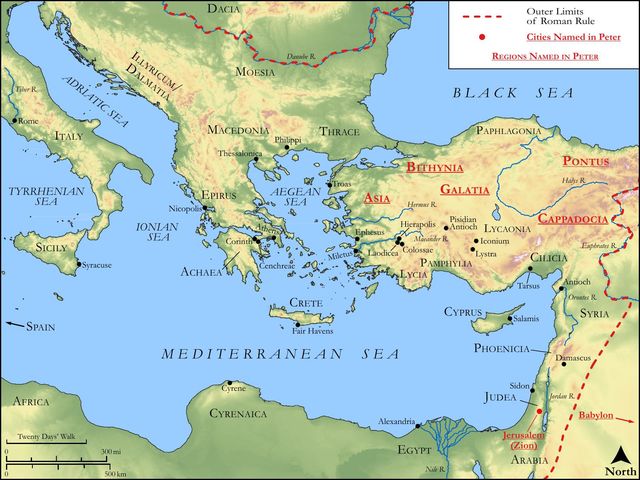
See on the biblical-era map

Study this verse
Public-domain commentary
Matthew Henry
From his Commentary on the Whole Bible. Henry comments on passages, not single verses — this entry covers 2 Peter 2:1–2. His two-level outline is real structure in the source text, so it is rendered as structure.
I.In the end of the former chapter there is mention made of holy men of God, who lived in the times of the Old Testament, and were used as the amanuenses of the Holy Ghost, in writing the sacred oracles; but in the beginning of this he tells us they had, even at that time, false prophets in the church as well as true. In all ages of the church, and under all dispensations, when God sends true prophets, the devil sends some to seduce and deceive, false prophets in the Old Testament, and false Christs, false apostles, and seducing teachers, in the New. Concerning these observe,
1.Their business is to bring in destructive errors, even damnable heresies, as the business of teachers sent of God is to show the way of truth, even the true way to everlasting life. There are damnable heresies as well as damnable practices; and false teachers are industrious to spread pernicious errors.
2.Damnable heresies are commonly brought in privily, under the cloak and colour of truth. Those who introduce destructive heresies deny the Lord that bought them. They reject and refuse to hear and learn of the great teacher sent from God, though he is the only Saviour and Redeemer of men, who paid a price sufficient to redeem as many worlds of sinners as there are sinners in the world. 4. Those who bring in errors destructive to others bring swift (and therefore sure) destruction upon themselves. Self-destroyers are soon destroyed; and those who are so hardened as to propagate errors destructive to others shall surely and suddenly be destroyed, and that without remedy.
II.He proceeds, in the second verse, to tell us the consequence with respect to others; and here we may learn,
1.Corrupt leaders seldom fail of many to follow them; though the way of error is a pernicious way, yet many are ready to walk therein. Men drink in iniquity like water, and are pleased to live in error. The prophets prophesy falsely, and the people love to have it so.
2.The spreading of error will bring up an evil report on the way of truth; that is, the way of salvation by Jesus Christ, who is the way, the truth, and the life. The Christian religion is from the God of truth as the author, leads to true happiness in the enjoyment of the true God as the end, and works truth in the inward part as the means of acceptably serving God. And yet this way of truth is traduced and blasphemed by those who embrace and advance destructive errors. This the apostle has foretold as what should certainly come to pass. Let us not be offended at any thing of this in our day, but take care that we give no occasion to the enemy to blaspheme the holy name whereby we are called, or speak evil of that way whereby we hope to be saved.
III.Observe, in the next place, the method seducers take to draw disciples after them:
they use feigned words; they flatter, and by good words and fair speeches deceive the hearts of the simple, inducing them to yield entirely to the opinions which these seducers endeavour to propagate, and sell and deliver themselves over to the instruction and government of these false teacher, who make a gain of those whom they make their proselytes, serving themselves and making some advantage of them; for all this is through covetousness, with a desire and design to get more wealth, or credit, or commendation, by increasing the number of their followers. The faithful ministers of Christ, who show men the way of truth, desire the profit and advantage of their followers, that they may be saved; but these seducing teachers desire and design only their own temporal advantage and worldly grandeur.
Historical interpretation
Five Centuries of Reception
4 surviving comments on this verse. Each one is dated, so this reads as a timeline rather than a list.
Select a marker to jump to its quote. Markers stagger vertically where authors wrote within a few decades of each other.
They revile the way of truth because they have turned orthodox doctrine into heresy, or because they have rejected the rule given to them at their baptism, or because they have abandoned the way of truth.
The heresy of the Nicolaitans had already appeared at that time. Peter says that it was evil in two ways. The Nicolaitans were wrong in their doctrine, and they were also wicked in their behavior. It reminds us of what was said about the Jews: “Because of you my name is blasphemed among the Gentiles.”
And many will follow their debaucheries, etc. The way of truth will be blasphemed by heretics not only in those whom they draw out to associate with their heresy, but also in those whom by their most impure deeds and sacrifices, or the execrable mysteries they perform, they provoke to hatred of the Christian name, those who are unskilled thinking all Christians to be entangled in such wickedness. To whom Scripture says: "Through you My name is blasphemed among the nations" (Isaiah 52).
But there were also false prophets among the people, just as there will be false teachers among you, who secretly bring in destructive heresies, even denying the Lord who bought them, bringing upon themselves swift destruction. And many will follow their obscene ways, and because of them the way of truth will be blasphemed. And in their greed they will exploit you with false words. Their judgment from long ago is not idle, and their destruction is not asleep.
Since prophecy is a common name that refers to both prophets and false prophets, it confirms that false prophets should not be regarded. And Paul differs slightly from this, as he teaches that no one says Jesus is Lord except by the Holy Spirit. (1 Cor. 12:3) Therefore, he begins to oppose the heresy against the Nicolaitans, saying that their wickedness is twofold. For they are indeed most impious in doctrine, as their blasphemy against the Lord Christ demonstrates; however, their life is especially obscene. And this he now signifies through shameful gain; however, having progressed a little, he will state it more openly. For now he refers to πλεονεξίαν, that is, greed, signifying shameful gain. For πλαονεξία sometimes signifies injustice, but at other times simply gain. Hence, showing that he speaks more particularly, he added:
"they will exploit you." Completely alienating them from divine doctrine, he said they would use false words. But they will have, he says, the wages of impiety, namely death. Moreover, it is already an indication of the foreknowledge of God. For just as through foreknowledge He prepared good things for the good, so also a fitting place for the wicked.
"who secretly," etc. The order: Those who, summoning swift destruction upon themselves, will secretly lead destructive sects; and denying the Lord who bought them, and through greed negotiating with false words about you.
"is not asleep." He does not cease, nor will he be idle, sluggish, or ineffective.
Continue studying 2 Peter 2:2 across the web’s major study libraries — every link below opens this exact verse, chapter, or book on the destination site.
Read & Compare
 BibleGatewayThis verse in more than 200 translations and 70 languages.
 Bible.comThe YouVersion reader — hundreds of translations, reading plans, and highlights.
 ESV.orgCrossway's official English Standard Version reader.
 NET BibleThe NET translation with 60,000+ translators' notes on every rendering decision.
 STEP BibleTyndale House's free study tool — original text, vocabulary, and scholarly resources.
 BibliaLogos Bible Software's free web reader.
 USCCBThe New American Bible (Revised Edition) with the U.S. bishops' study notes.
Commentaries
 BibleHub CommentariesDozens of classic commentaries on this verse, gathered on one page.
 StudyLightMore than 100 commentary sets — the largest collection on the web.
 BibleRefPlain-English commentary on what this verse means, verse by verse.
 Enduring WordDavid Guzik's free commentary on this chapter, widely used by Bible teachers.
 Bible Study ToolsVerse commentary alongside Greek and Hebrew study aids.
Original Language & Research
- BibleHub InterlinearThe verse word by word — original language, transliteration, and English.
- BibleHub LexiconEvery word's original-language definition and Strong's entry.
 Blue Letter BibleDeep-study tools — Strong's numbers, concordance, and word studies.
 CNTR CollationThe earliest Greek manuscripts of this verse, collated letter by letter.
Sermons, Hymns & Audio


TrulyRandomVerse is not affiliated with these sites and doesn’t control their content. They’re linked because they’re genuinely useful.
Summary
Second Peter 2:2 serves as a stark warning regarding the pervasive and damaging influence of false teachers within the Christian community. It predicts that a significant number of people will be led astray by their destructive doctrines and immoral practices, resulting in the defamation and discrediting of the genuine "way of truth" in the eyes of the world. This verse underscores the severe consequences of spiritual deception, not only for those who follow but also for the reputation of the Gospel itself.
Context
ShowHideLiterary Context
This verse is situated at the very beginning of a chapter almost entirely dedicated to exposing and condemning false teachers. In 2 Peter 2:1, Peter introduces the threat, stating that "there shall be false teachers among you, who privily shall bring in damnable heresies, even denying the Lord that bought them." Verse 2 immediately follows, detailing the consequence of these false teachers' presence: their "pernicious ways" will attract "many" followers, and this widespread adoption of error will, in turn, cause the "way of truth" to be "evil spoken of." The chapter then proceeds to describe the characteristics, motives, and inevitable judgment of these deceivers, drawing parallels to historical examples of divine judgment (e.g., the flood, Sodom and Gomorrah) to underscore their certain doom.
Historical & Cultural Context
Peter's epistle was written to believers facing internal threats from within the church, likely in Asia Minor, where various forms of proto-Gnosticism and antinomianism were emerging. These false teachers often promoted a libertine lifestyle, claiming spiritual freedom excused immoral behavior, or denied the bodily resurrection and the second coming of Christ. Such teachings would have been particularly appealing in a Greco-Roman world where philosophical debates and various cults offered alternative spiritual paths. The early church, a relatively new and often misunderstood movement, was vulnerable to internal corruption that could easily be exploited by external critics. The "way of truth" being "evil spoken of" would have been a significant concern, as the nascent Christian faith was already subject to widespread misunderstanding, slander, and persecution from the pagan Roman society.
Key Themes
ShowHide2 Peter 2 is dominated by several crucial themes. Firstly, the Pervasiveness of Deception is evident, as the verse warns that "many" will be led astray, highlighting the widespread appeal and danger of false teachings. Secondly, the Slander of Truth is a central concern; the actions of these false teachers and their followers directly bring disrepute and scorn upon the true Christian faith and the Gospel message itself. This theme underscores the importance of Christian conduct as a witness. Thirdly, the chapter implicitly emphasizes the Importance of Discernment for believers, urging them to distinguish between genuine doctrine and destructive heresies, a theme also echoed in passages like 1 John 4:1. Finally, the broader theme of Divine Judgment looms large, as Peter consistently reminds his readers that God will not spare those who lead His people astray, drawing on examples from biblical history to affirm God's justice against unrighteousness.
Exposition and Analysis
ShowHideKey Word Analysis
ShowHideThis word signifies a large number, indicating that the influence of these false teachers will not be marginal but will attract a significant following. It emphasizes the widespread nature of the deception and the unfortunate reality that a considerable portion of those claiming faith will deviate from sound doctrine.
Derived from "out of" and "to follow," this verb implies a deliberate and full adherence to the ways of these false teachers. It suggests not merely a casual acquaintance but a commitment to their teachings and practices, leading to imitation and obedience to their destructive paths.
This term, often translated as "destruction," "ruin," or "perdition," highlights the utterly ruinous nature of the paths advocated by false teachers. It signifies not just error, but a course of action that leads to spiritual and ultimately eternal loss, emphasizing the gravity of the false doctrines and immoral lifestyles.
This word means "to vilify," "to speak impiously," "to slander," or "to blaspheme." It conveys the idea that the "way of truth" will be subjected to scorn, ridicule, and outright defamation. The actions of the false teachers and their followers will cause the very name of Christ and the Gospel to be reviled by outsiders.
Verse Breakdown
ShowHide"And many shall follow their pernicious ways"
This clause predicts a widespread apostasy or deviation from true faith. The "many" refers to a significant number of individuals who will be enticed by the deceptive teachings and immoral practices of the false teachers introduced in the previous verse. Their "pernicious ways" are not merely incorrect doctrines but paths that lead to spiritual ruin and destruction, characterized by moral corruption and a denial of foundational truths.
"by reason of whom"
This phrase establishes a direct causal link. It indicates that the reason for the subsequent negative consequence is the existence and influence of these false teachers, specifically the fact that "many" are following them. Their presence and the visible adoption of their destructive ways by a multitude of supposed believers are the direct cause of the slander that follows.
"the way of truth shall be evil spoken of"
This is the grievous consequence. "The way of truth" refers to the Gospel, the Christian faith, and the righteous path that believers are called to walk. Because of the scandalous behavior and false teachings of those who claim to be Christians but follow "pernicious ways," the genuine Christian message and lifestyle will be maligned, slandered, and blasphemed by those outside the faith. This brings disrepute to the name of Christ and hinders the spread of the Gospel.
Literary Devices
ShowHidePeter employs several potent literary devices in this verse to convey his urgent warning. Contrast is central, pitting the "pernicious ways" of the false teachers against "the way of truth," starkly highlighting the opposing natures and outcomes of each path. The use of "many" (polýs) serves as a form of generalization or even hyperbole, emphasizing the widespread and alarming extent of the deception, thereby intensifying the warning. Furthermore, "the way of truth" functions as a metonymy, where "way" (Greek: hodós) represents the entire Christian faith, its doctrines, and its ethical demands. The actions of the false teachers and their followers are presented in a clear cause-and-effect relationship: their destructive behavior directly leads to the slandering of the Gospel, underscoring the profound impact of individual conduct on the reputation of the collective faith.
Theological and Thematic Connections
ShowHideThis verse powerfully articulates the enduring theological reality of spiritual warfare within the church itself. It highlights that the integrity of the Gospel and the witness of the Christian community are constantly under threat, not only from external persecution but also from internal corruption. The "way of truth" is God's revealed path to salvation and righteous living, and its defamation directly assaults God's character and His redemptive plan. This concern for God's name and the purity of His truth resonates throughout Scripture, emphasizing that the actions of His people have profound implications for how the world perceives Him. The verse underscores the divine concern for the reputation of the Gospel, which is inextricably linked to the purity of its doctrine and the integrity of its adherents.
Reflection and Application
ShowHideSecond Peter 2:2 serves as a timeless and sobering call to vigilance for every believer and every church community. It compels us to critically examine not only the doctrines we embrace but also the lifestyles we observe, both in ourselves and in those who claim to lead. The warning that "many" will follow "pernicious ways" should humble us, reminding us that spiritual deception is a pervasive and seductive force, capable of swaying even those within the visible church. Our conduct, individually and corporately, profoundly impacts how the world perceives the Gospel. When those claiming Christ live in contradiction to His truth, it provides ammunition for critics and causes genuine seekers to stumble. Therefore, it is imperative that we diligently pursue biblical literacy, cultivate spiritual discernment, and strive for lives of integrity that adorn, rather than detract from, the "way of truth." Our faithfulness is a testament to God's character and the power of His transforming grace, ensuring that His name is glorified, not maligned.
Questions for Reflection
ShowHideFAQ
ShowHideWho are these "false teachers" Peter is warning about?
ShowHidePeter describes these false teachers throughout 2 Peter 2 as individuals who secretly introduce "destructive heresies," even denying the Lord who bought them (2 Peter 2:1). They are characterized by greed, exploitation, sensuality, arrogance, and a disregard for authority. They promise freedom but are themselves slaves of corruption, enticing unstable souls with their deceptive words and immoral lifestyles. Their motives are often financial gain, and their end is certain destruction, as God's judgment awaits them.
What does "pernicious ways" mean in this context?
ShowHideThe phrase "pernicious ways" translates the Greek word apṓleia, which means "destruction," "ruin," or "perdition." In this context, it refers to the doctrines and practices of the false teachers that lead to spiritual and moral decay, ultimately resulting in eternal ruin for those who follow them. These are not merely mistaken beliefs but actively harmful and soul-destroying paths that deviate from God's truth and righteous standards, leading to a state of spiritual loss and condemnation.
Christ-Centered Fulfillment
ShowHideThe "way of truth" that is "evil spoken of" in 2 Peter 2:2 finds its ultimate fulfillment and embodiment in Jesus Christ Himself. He declared, "I am the way, the truth, and the life; no one comes to the Father except through Me." Therefore, when the "way of truth" is maligned, it is ultimately Christ Himself who is blasphemed and His redemptive work that is scorned. False teachers, by leading people away from sound doctrine and into "pernicious ways," are fundamentally drawing them away from Christ, who is the sole source of truth and life. Their deceptive teachings undermine the sufficiency of His atoning sacrifice and the authority of His Word, replacing divine revelation with human error and moral corruption. The Christian's defense against such deception, and the means by which the "way of truth" is vindicated, is a steadfast adherence to Christ, who is the cornerstone of all truth (Ephesians 2:20). By living lives consistent with the Gospel, believers reflect the character of Christ, ensuring that His name is honored and His truth shines brightly, even amidst the darkness of false teaching (Philippians 2:15).