


1 Timothy 4:1
Bible text: King James Version (1769 Blayney text) · Public domain
Bible text: King James Version with Strong's numbers · Public domain
Bible text: Berean Standard Bible · Public domain
Bible text: American Standard Version (1901) · Public domain
Bible text: World English Bible, Messianic edition · Public domain
Bible text: Geneva Bible (1599) · Public domain
Bible text: Young's Literal Translation · Public domain
- ΤὸTo<the>G3588T-NSNDefinite article Nominative Singular Neuter
- δὲdeButG1161CONJConjunction
- πνεῦμαpneumathe SpiritG4151N-NSNNoun Nominative Singular Neuter
- ῥητῶςrhētōsexpresslyG4490ADVAdverb
- λέγειlegeistatesG3004V-PAI-3SVerb Present Active Indicative 3rd Singular
- ὅτιhotithatG3754CONJConjunction
- ἐνeninG1722PREPPreposition
- ὑστέροιςhusteroislaterG5306A-DPM-CAdjective Dative Plural Masculine Comparative
- καιροῖςkairoistimesG2540N-DPMNoun Dative Plural Masculine
- ἀποστήσονταίapostēsontaiwill depart fromG868V-FDI-3PVerb Future Middle Deponent Indicative 3rd Plural
- τινεςtinessomeG5100X-NPMIndefinite pronoun Nominative Plural Masculine
- τῆςtēsfrom theG3588T-GSFDefinite article Genitive Singular Feminine
- πίστεωςpisteōsfaithG4102N-GSFNoun Genitive Singular Feminine
- προσέχοντεςprosechontesgiving heedG4337V-PAP-NPMVerb Present Active Participle Nominative Plural Masculine
- πνεύμασινpneumasinto spiritsG4151N-DPNNoun Dative Plural Neuter
- πλάνοιςplanoisdeceitfulG4108A-DPNAdjective Dative Plural Neuter
- καὶkaiandG2532CONJConjunction
- διδασκαλίαιςdidaskaliaisto teachingsG1319N-DPFNoun Dative Plural Feminine
- δαιμονίωνdaimoniōnof demonsG1140N-GPNNoun Genitive Plural Neuter
English is a literal word-by-word gloss of the Greek, not the KJV's wording. Why?
This is the original text the KJV's translators worked from — each Greek word with its own literal English meaning in this verse, prepared by scholars at Tyndale House, Cambridge. The KJV translates whole sentences, not word by word, so its wording differs: one Greek word can become several English words, and the KJV may choose “charity” where the gloss reads “love”. Both are faithful — they answer different questions. For the KJV's own rendering, switch to the KJV text.
Details
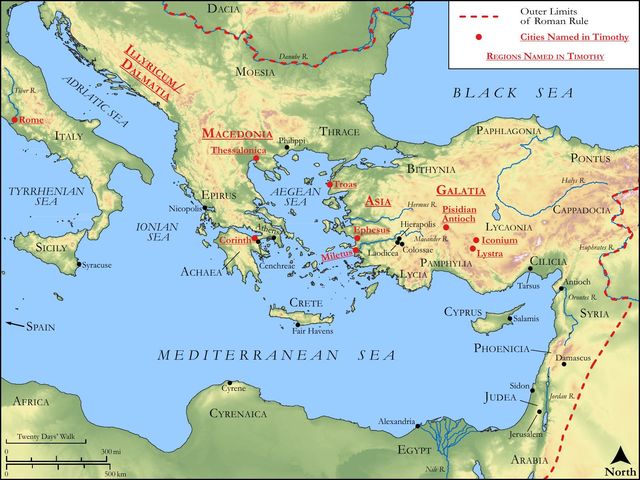
See on the biblical-era maps

Study this verse
Public-domain commentary
Matthew Henry
From his Commentary on the Whole Bible. Henry comments on passages, not single verses — this entry covers 1 Timothy 4:1–5. His four-level outline is real structure in the source text, so it is rendered as structure.
We have here a prophecy of the apostasy of the latter times, which he had spoken of as a thing expected and taken for granted among Christians, 2 Th. 2.
I.In the close of the foregoing chapter, we had the mystery of godliness summed up; and therefore very fitly, in the beginning of this chapter, we have the mystery of iniquity summed up: The Spirit speaks expressly that in the latter times some shall depart from the faith; whether he means the Spirit in the Old Testament, or the Spirit in the prophets of the New Testament, or both. The prophecies concerning antichrist, as well as the prophecies concerning Christ, came from the Spirit. The Spirit in both spoke expressly of a general apostasy from the faith of Christ and the pure worship of God. This should come in the latter times, during the Christian dispensation, for these are called the latter days; in the following ages of the church, for the mystery of iniquity now began to work. Some shall depart from the faith, or there shall be an apostasy from the faith. Some, not all; for in the worst of times God will have a remnant, according to the election of grace. They shall depart from the faith, the faith delivered to the saints (Jde 1:3), which was delivered at once, the sound doctrine of the gospel. Giving heed to seducing spirits, men who pretended to the Spirit, but were not really guided by the Spirit, Jo1 4:1. Beloved, believe not every spirit, every one who pretends to the Spirit. Now here observe,
1.One of the great instances of the apostasy, namely, giving heed to doctrines of demons, or concerning demons; that is, those doctrines which teach the worship of saints and angels, as a middle sort of deities, between the immortal God and mortal men, such as the heathen called demons, and worshipped under that notion. Now this plainly agrees to the church of Rome, and it was one of the first steps towards that great apostasy, the enshrining of the relics of martyrs, paying divine honours to them, erecting altars, burning incense, consecrating images and temples, and making prayers and praises to the honour of saints departed. This demon-worship is paganism revived, the image of the first beast.
2.The instruments of promoting and propagating this apostasy and delusion.
(1.)It will be done by hypocrisy of those that speak lies, the agents and emissaries of Satan, who promote these delusions by lies and forgeries and pretended miracles, Ti1 4:2. It is done by their hypocrisy, professing honour to Christ, and yet at the same time fighting against all his anointed offices, and corrupting or profaning all his ordinances. This respects also the hypocrisy of those who have their consciences seared with a red-hot iron, who are perfectly lost to the very first principles of virtue and moral honesty. If men had not their consciences seared as with a hot iron, they could never maintain a power to dispense with oaths for the good of the catholic cause, could never maintain that no faith is to be kept with heretics, could never divest themselves of all remains of humanity and compassion, and clothe themselves with the most barbarous cruelty, under pretence of promoting the interest of the church.
(2.)Another part of their character is that they forbid to marry, forbid their clergy to marry, and speak very reproachfully of marriage, though an ordinance of God; and that they command to abstain from meats, and place religion in such abstinence at certain times and seasons, only to exercise a tyranny over the consciences of men.
3.On the whole observe,
(1.)The apostasy of the latter times should not surprise us, because it was expressly foretold by the Spirit.
(2.)The Spirit is God, otherwise he could not certainly foresee such distant events, which as to us are uncertain and contingent, depending on the tempers, humours, and lusts of men.
(3.)The difference between the predictions of the Spirit and the oracles of the heathen is remarkable; the Spirit speaks expressly, but the oracles of the heathen were always doubtful and uncertain.
(4.)It is comfortable to think that in such general apostasies all are not carried away, but only some.
(5.)It is common for seducers and deceivers to pretend to the Spirit, which is a strong presumption that all are convinced that this is the most likely to work in us an approbation of what pretends to come from the Spirit.
(6.)Men must be hardened, and their consciences seared, before they can depart from the faith, and draw in others to side with them.
(7.)It is a sign that men have departed from the faith when they will command what God has forbidden, such as saint and angel or demon-worship; and forbid what God has allowed or commanded, such as marriage and meats.
II.Having mentioned their hypocritical fastings, the apostle takes occasion to lay down the doctrine of the Christian liberty, which we enjoy under the gospel, of using God's good creatures, - that, whereas under the law there was a distinction of meats between clean and unclean (such sorts of flesh they might eat, and such they might not eat), all this is now taken away; and we are to call nothing common or unclean, Act 10:15. Here observe,
1.We are to look upon our food as that which God has created; we have it from him, and therefore must use it for him.
2.God, in making those things, had a special regard to those who believe and know the truth, to good Christians, who have a covenant right to the creatures, whereas others have only a common right.
3.What God has created is to be received with thanksgiving. We must not refuse the gifts of God's bounty, nor be scrupulous in making differences where God has made none; but receive them, and be thankful, acknowledging the power of God the Maker of them, and the bounty of God the giver of them: Every creature of God is good, and nothing to be refused, Ti1 4:4. This plainly sets us at liberty from all the distinctions of meats appointed by the ceremonial law, as particularly that of swine's flesh, which the Jews were forbidden to eat, but which is allowed to us Christians, by this rule, Every creature of God is good, etc. Observe, God's good creatures are then good, and doubly sweet to us, when they are received with thanksgiving. - For it is sanctified by the word of God and prayer, Ti1 4:5. It is a desirable thing to have a sanctified use of our creature-comforts. Now they are sanctified to us,
(1.)By the word of God; not only his permission, allowing us the liberty of the use of these things, but his promise to feed us with food convenient for us. This gives us a sanctified use of our creature-comforts.
(2.)By prayer, which blesses our meat to us. The word of God and prayer must be brought to our common actions and affairs, and then we do all in faith. Here observe,
[1.]Every creature is God's, for he made all. Every beast in the forest is mine (says God), and the cattle upon a thousand hills. I know all the fowls of the mountains, and the wild beasts of the field are mine, Psa 50:10, Psa 50:11.
[2.]Every creature of God is good: when the blessed God took a survey of all his works, God saw all that was made, and, behold, it was very good, Gen 1:31.
[3.]The blessing of God makes every creature nourishing to us; man lives not by bread alone, but by every word that proceeds out of the mouth of God (Mat 4:4), and therefore nothing ought to be refused.
[4.]We ought therefore to ask his blessing by prayer, and so to sanctify the creatures we receive by prayer.
Historical interpretation
Eight Centuries of Reception
16 surviving comments on this verse. Each one is dated, so this reads as a timeline rather than a list.
Select a marker to jump to its quote. Markers stagger vertically where authors wrote within a few decades of each other.
There existed, long before this time, certain men more ancient than all those who are esteemed philosophers, both righteous and beloved by God, who spoke by the Divine Spirit, and foretold events which would take place, and which are now taking place. They are called prophets. These alone both saw and announced the truth to men, neither reverencing nor fearing any man, not influenced by a desire for glory, but speaking those things alone which they saw and which they heard, being filled with the Holy Spirit. Their writings are still extant, and he who has read them is very much helped in his knowledge of the beginning and end of things, and of those matters which the philosopher ought to know, provided he has believed them. For they did not use demonstration in their treatises, seeing that they were witnesses to the truth above all demonstration, and worthy of belief; and those events which have happened, and those which are happening, compel you to assent to the utterances made by them, although, indeed, they were entitled to credit on account of the miracles which they performed, since they both glorified the Creator, the God and Father of all things, and proclaimed His Son, the Christ [sent] by Him: which, indeed, the false prophets, who are filled with the lying unclean spirit, neither have done nor do, but venture to work certain wonderful deeds for the purpose of astonishing men, and glorify the spirits and demons of error.
And no doubt of such people it is reasonable when, "the Spirit says expressly that in the last times some shall depart from the faith, giving heed to spirits of error and the teaching inspired by daemons, through hypocritical sophists who are seated in conscience and forbid marriage, and demand abstinence from foods which God created to be eaten with thanksgiving by believers who know the truth. Everything created by God is good, and none is to be rejected but accepted with thanksgiving. For it is sanctified by the Word of God and by prayer." It necessarily follows, then, that it is wrong to forbid marriage and indeed eating meat or drinking wine.
These are “the doctrines” of men and “of demons” that produce for itching ears of the spirit this world’s wisdom. This is what the Lord called “foolishness.” God “chose the foolish things of the world” to confound even philosophy itself. For philosophy is the material of the world’s wisdom, the rash interpreter of the nature and the providence (dispensations) of God.
What harshness, therefore, is here on our part, if we renounce (communion with) such as do not the will of God? What heresy, if we judge second marriage, as being unlawful, akin to adultery? For what is adultery but unlawful marriage? The apostle sets a brand upon those who were wont entirely to forbid marriage, who were wont at the same time to lay an interdict on meats which God has created. We, however, no more do away with marriage if we abjure its repetition, than we reprobate meats if we fast oftener (than others).
And accordingly (they think) us to have been even then prenoted as "in the latest times departing from the faith, giving heed to spirits which seduce the world, having a conscience inburnt with doctrines of liars." (Inburnt?) With what fires, prithee? The fires, I ween, which lead us to repeated contracting of nuptials and daily cooking of dinners! Thus, too, they affirm that we share with the Galatians the piercing rebuke (of the apostle), as "observers of days, and of months, and of years.
The character of the times in which we live is such as to call forth from us even this admonition, that we ought not to be astonished at the heresies (which abound) neither ought their existence to surprise us, for it was foretold that they should come to pass; nor the fact that they subvert the faith of some, for their final cause is, by affording a trial to faith, to give it also the opportunity of being "approved.
Others, however, styling themselves Encratites, acknowledge some things concerning God and Christ in like manner with the Church. In respect, however, of their mode of life, they pass their days inflated with pride. They suppose, that by meats they magnify themselves, while abstaining from animal food, (and) being water-drinkers, and forbidding to marry, and devoting themselves during the remainder of life to habits of asceticism. But persons of this description are estimated Cynics rather than Christians, inasmuch as they do not attend unto the words spoken against them through the Apostle Paul. Now he, predicting the novelties that were to be hereafter introduced ineffectually by certain (heretics), made a statement thus: "The Spirit speaketh expressly, In the latter times certain will depart from sound doctrine, giving heed to seducing spirits and doctrines of devils, uttering falsehoods in hypocrisy, having their own conscience seared with a hot iron, forbidding to marry, to abstain from meats, which God has created to be partaken of with thanksgiving by the faithful, and those who know the truth; because every creature of God is good, and nothing to be rejected which is received with thanksgiving; for it is sanctified by the word of God and prayer." This voice, then, of the blessed Paul, is sufficient for the refutation of those who live in this manner, and plume themselves on being just; (and) for the purpose of proving that also, this (tenet of the Encratites) constitutes a heresy. But even though there have been denominated certain other heresies-I mean those of the Cainites, Ophites, or Noachites, and of others of this description-I have not deemed it requisite to explain the things said or done by these, test on this account they may consider themselves somebody, or deserving of consideration. Since, however, the statements concerning these appear to be sufficient, let us pass on to the cause of evils to all, (viz.,) the heresy of the Noetians. Now, after we have laid bare the root of this (heresy), and stigmatized openly the venom, as it were, lurking within it, let us seek to deter from an error of this description those who have been impelled into it by a violent spirit, as it were by a swollen torrent.
Paul, too, having learnt these things from the Saviour, wrote, "In the latter times some shall depart from the faith, giving heed to seducing spirits, and doctrines of devils which turn away from the truth."
Therefore it becomes us to watch, lest some deception be conveyed under the clothing of their phrases and they lead some away from the true faith. And if they venture to advance the opinions of Arius, when they see themselves proceeding in a prosperous course, nothing remains for us but to use great boldness of speech. For we are to remember the predictions of the apostle, which he wrote to forewarn us of such heresies and which it becomes us to repeat. For we know that, as it is written, “in the latter times some shall depart from the true faith, giving heed to seducing spirits and doctrines of devils, that turn from the truth.”
That the Holy Spirit subsists, lives, speaks and foretells I have told you repeatedly on former occasions. Paul writes clearly to Timothy, “Now the Spirit expressly says that in later times some will depart from the faith.” This we see in the factions of former times and in our own day. How diverse and multiform are the errors of the heretics.
As for me, indeed, would that they might have a will to hear, that they might believe—to hear with true love and meekness, as men seeking what is true and not assailing all truth. For it is written that we pay no heed to “endless fables and genealogies, which do rather raise disputes than set forward the godly edification, which is in faith. But the aim of the charge is love from a pure heart, and a good conscience, and faith unfeigned, whence some have erred and betaken themselves to empty babbling. For they are desirous of being teachers of the law, without understanding the words they say, nor the things whereof they speak with assurance.” In another place also the same apostle says, “Avoid foolish and ignorant questionings.” Such men, who sow disputes—that is to say, heretics—the apostle bids us leave alone. Of them he says in yet another place that “certain shall depart from the faith, giving heed to deceitful spirits and the doctrines of devils.”
As those who adhere to the faith are fixed on a safe anchor, so those who fall from the faith can nowhere rest; but after many wanderings to and fro, they are borne at last into the very gulf of perdition. And this he had shown before, saying, that some had "already made shipwreck concerning the faith," and now he says, "Now the Spirit speaketh expressly, that in the latter times some shall depart from the faith, giving heed to seducing spirits." This is said of the Manichaeans, the Encratites, and the Marcionites, and the whole of their tribe, that they should hereafter depart from the faith. Seest thou that this departure from the faith is the cause of all the evils that follow!
But what is "expressly"? Plainly, clearly, and beyond doubt. Marvel not, he says, if some having departed from the faith still adhere to Judaism. There will be a time, when even those who have partaken of the faith will fall into a worse error, not only with respect to meats, but to marriages, and other such things, introducing the most pernicious notions. This refers not to the Jews, (for "the latter times," and a "departure from the faith," is not applicable to them;) but to the Manichees, and the founders of these sects. And he calls them very justly, "seducing spirits," since it was by these they were actuated in speaking such things.
How could anyone be silent in regard to the divine authority of the Holy Spirit? The ancient prophets cried out, “These things say the Lord.” When Christ came, he also used this word “say” in his own person, “But I say unto you.” Listen now to what the prophets of the New Testament proclaim. Take the prophet Agabus in the Acts of the Apostles, “Thus says the Holy Spirit.” So, too, Paul to Timothy, “Now the Spirit expressly says …”
The fulfillment of these predictions in the Manichaeans is as clear as day to all that know them and has already been proved as fully as time permits.
Considering the signs mentioned by Gospel and prophecy which we see happening, would anyone deny that we ought to hope for the coming of the Lord? Manifestly, it is nearer and nearer every day. But the exact span of the nearness, that, as we said, “is not for you to know.” Notice when the apostle said this, “For our salvation is nearer than when we believed. The night is past and the day is at hand,” and look how many years have passed! Yet, what he said was not untrue. How much more probable is it to say now that the coming of the Lord is near when there has been such an increase of time toward the end! Certainly the apostle said, “The Spirit manifestly says that in the last times some shall depart from the faith.” Obviously, those were not yet the times of heretics such as he describes them in the same sentence, but they have now come. According to this, we seem to be in the last times, and the heretics seem to be a warning of the end of the world.
But the Spirit openly says that in later times some will abandon the faith, paying attention to deceitful spirits and teachings of demons, through the hypocrisy of liars whose consciences are seared.
But the Spirit openly says. That is, clearly and obviously. Do not be amazed, Paul says, if some now, having fallen away from the faith, Judaize. For a time will come, he says, when the faith will be more broadly extended, in which they will do even worse things, not only in the observance of foods, but also in marriages and other matters.
paying attention to deceitful spirits. For if anyone departs from faith, everything else becomes dangerous. For it is necessary from then on that the mind be attentive to impure spirits, and to demons leading man away from the right path.
and teachings of demons. Through these he revealed every wickedness, especially the Manichaeans, the Encratites, the Marcionites.
through the hypocrisy. That is, deceitful work. However, it stands that since they know the falseness of their dogmas, they strive to speak falsely. And Paul says that liars are those whose conscience has been seared by an evil life, that is, a depraved life: and because they are aware of much filth within themselves, therefore their conscience bears stubborn marks of a sleazy life. Truly, those who are such, through fear of retribution, pervert true dogmas, persuading themselves of anything rather than that only God is the just judge, the resurrection, and the retribution of good and evil.
Continue studying 1 Timothy 4:1 across the web’s major study libraries — every link below opens this exact verse, chapter, or book on the destination site.
Read & Compare
 BibleGatewayThis verse in more than 200 translations and 70 languages.
 Bible.comThe YouVersion reader — hundreds of translations, reading plans, and highlights.
 ESV.orgCrossway's official English Standard Version reader.
 NET BibleThe NET translation with 60,000+ translators' notes on every rendering decision.
 STEP BibleTyndale House's free study tool — original text, vocabulary, and scholarly resources.
 BibliaLogos Bible Software's free web reader.
 USCCBThe New American Bible (Revised Edition) with the U.S. bishops' study notes.
Commentaries
 BibleHub CommentariesDozens of classic commentaries on this verse, gathered on one page.
 StudyLightMore than 100 commentary sets — the largest collection on the web.
 BibleRefPlain-English commentary on what this verse means, verse by verse.
 Enduring WordDavid Guzik's free commentary on this chapter, widely used by Bible teachers.
 Bible Study ToolsVerse commentary alongside Greek and Hebrew study aids.
Original Language & Research
- BibleHub InterlinearThe verse word by word — original language, transliteration, and English.
- BibleHub LexiconEvery word's original-language definition and Strong's entry.
 Blue Letter BibleDeep-study tools — Strong's numbers, concordance, and word studies.
 CNTR CollationThe earliest Greek manuscripts of this verse, collated letter by letter.
Sermons, Hymns & Audio


TrulyRandomVerse is not affiliated with these sites and doesn’t control their content. They’re linked because they’re genuinely useful.
Summary
First Timothy 4:1 presents a solemn, divinely revealed prophecy concerning a future apostasy within the church. The Holy Spirit explicitly declares that in the "latter times," a period initiated by Christ's first advent and continuing until His return, some individuals will abandon the core tenets of the Christian faith. This departure is attributed to their susceptibility to deceptive spiritual influences and the acceptance of teachings that originate from demonic sources, underscoring the spiritual battle inherent in the preservation of sound doctrine.
Context
ShowHideLiterary Context
This verse marks a significant transition in Paul's first letter to Timothy. Having established the foundational principles for church order, leadership qualifications, and proper conduct within the household of God in 1 Timothy 2-3, Paul now shifts his focus to the internal threats that will challenge the integrity of the church. The preceding chapters emphasize the importance of sound doctrine and godly living as safeguards against error. 1 Timothy 3:15 notably describes the church as "the pillar and ground of the truth," setting the stage for the warning in 1 Timothy 4:1 about those who would undermine this truth. This prophetic warning serves as a crucial pastoral instruction, equipping Timothy to anticipate and combat the spiritual dangers that lie ahead.
Historical & Cultural Context
Paul wrote 1 Timothy to his young protégé, Timothy, who was leading the church in Ephesus, a city known for its diverse religious landscape, including pagan worship, magic, and burgeoning philosophical schools that often blended with religious ideas. The early church faced constant pressure from both external persecution and internal doctrinal deviations. Early forms of Gnosticism, which emphasized secret knowledge and often promoted ascetic practices (like forbidding marriage or certain foods, as mentioned in 1 Timothy 4:3), were beginning to emerge, posing a significant threat to the simplicity and truth of the gospel. Paul's warning here is not merely abstract but addresses the very real spiritual and intellectual challenges confronting believers in a syncretistic and spiritually volatile environment.
Key Themes
ShowHideThe primary themes interwoven throughout 1 Timothy and highlighted in this verse include the critical importance of sound doctrine (e.g., 1 Timothy 1:3-4), the reality of spiritual warfare (as seen in the opposition from "seducing spirits" and "doctrines of devils"), the danger of apostasy or "departing from the faith," and the necessity of pastoral vigilance in safeguarding the truth. This verse also introduces the concept of "the latter times," a biblical eschatological theme that denotes the entire period between Christ's first and second comings, characterized by spiritual deception and increasing opposition to God's truth, as further explored in passages like 2 Timothy 3:1-5.
Exposition and Analysis
ShowHideKey Word Analysis
ShowHideThis term refers to a current of air, breath, or breeze, but in this context, it specifically denotes the Holy Spirit. The Holy Spirit is the divine author of prophecy, the one who illuminates truth, and the source of divine revelation. His "speaking expressly" indicates a clear, undeniable, and authoritative declaration.
This verb means to remove oneself, to desist, or to desert. It carries the strong connotation of a deliberate falling away or defection from a previously held position or allegiance. In the context of "the faith," it signifies apostasy—a conscious abandonment of Christian belief and commitment, not merely a momentary lapse or doubt.
Derived from the word for "teacher," this term refers to instruction, teaching, or doctrine itself. Here, it emphasizes that the deceptive influences are not just vague spiritual feelings but concrete, articulated systems of belief or teaching. The nature of these teachings is further specified as originating from "devils," highlighting their malevolent and anti-God source.
Verse Breakdown
ShowHide"Now the Spirit speaketh expressly"
This opening phrase underscores the divine authority and clarity of the impending warning. It is not Paul's personal speculation but a direct, unambiguous revelation from the Holy Spirit, emphasizing the certainty and gravity of the prophecy. The Holy Spirit, as the Spirit of Truth, reveals future deceptions to prepare the church.
"that in the latter times some shall depart from the faith"
This clause reveals the core prophecy: a falling away from Christian truth. "The latter times" refers to the entire period of the New Covenant, from Christ's first coming until His return, indicating that spiritual deception and apostasy are ongoing realities throughout this era. The word "some" indicates that this departure will not be universal but will affect a portion of those who once professed faith. "The faith" here refers to the body of Christian truth, the objective content of belief.
"giving heed to seducing spirits"
This explains the mechanism of departure. Individuals will actively "give heed" or pay attention to "seducing spirits." These are spiritual entities (demonic powers) that lead astray, deceive, and cause people to wander from the truth. This highlights the spiritual warfare dimension behind false teaching, where unseen forces actively work to mislead believers.
"and doctrines of devils"
This further clarifies the nature of the deception. The "seducing spirits" manifest their influence through "doctrines of devils," meaning teachings that originate from or are inspired by demons. These are not merely human errors or philosophical mistakes but are malevolent teachings designed to undermine God's truth, lead people into error, and ultimately away from salvation in Christ.
Literary Devices
ShowHideThe verse primarily employs Prophecy, serving as a divine foretelling of future events. This prophecy functions as a Warning, alerting Timothy and the church to the dangers of spiritual deception and apostasy. The phrase "the Spirit speaketh expressly" uses a form of Personification, attributing the act of speaking to the Holy Spirit, emphasizing the direct and authoritative nature of the revelation. Furthermore, the mention of "seducing spirits" and "doctrines of devils" vividly portrays the reality of Spiritual Warfare, illustrating the unseen, malevolent forces that actively seek to corrupt and lead believers astray from sound doctrine. This imagery underscores the profound spiritual battle for truth and faith.
Theological and Thematic Connections
ShowHideThis verse is a foundational text for understanding the biblical concept of apostasy and the ongoing spiritual battle for truth. It reveals that spiritual deception is not merely a human phenomenon but is orchestrated by malevolent spiritual forces. The "latter times" are characterized by this spiritual warfare, where false teachings, inspired by demons, actively seek to draw people away from the genuine faith. This necessitates constant vigilance, discernment, and a firm adherence to the revealed truth of God's Word. The warning serves to equip believers to recognize and resist these deceptions, emphasizing that true faith is not just intellectual assent but a steadfast commitment to Christ and His teachings, preserved against the onslaught of error.
Reflection and Application
ShowHideFirst Timothy 4:1 serves as a timeless warning for every generation of believers, urging us to cultivate a robust spiritual discernment. In an age saturated with information and competing worldviews, the call to "give heed" to truth, rather than "seducing spirits," is more critical than ever. We are challenged to examine the sources of our beliefs, to test every teaching against the unchanging standard of Scripture, and to remain anchored in the core doctrines of the Christian faith. This verse compels us not to be naive about the spiritual forces at work in the world, recognizing that deception is often subtle and can even masquerade as spiritual enlightenment. Our steadfastness in faith is not passive but requires active engagement with God's Word, prayer, and fellowship with other believers who uphold sound doctrine, ensuring we are not easily swayed by the "doctrines of devils" that seek to undermine our trust in Christ.
Questions for Reflection
ShowHideFAQ
ShowHideWhat does "the latter times" mean in this context?
ShowHide"The latter times" (Greek: hýsteros kairós) refers to the entire period inaugurated by Christ's first coming and extending until His second advent. It is synonymous with "the last days" or "the end of the ages" as used in other New Testament passages. This period is characterized by the fulfillment of God's redemptive plan through Christ, but also by increasing spiritual opposition, deception, and moral decline, as described in Hebrews 1:2 and Acts 2:17. Therefore, the warning in 1 Timothy 4:1 is not limited to a specific future moment but applies throughout the church age, indicating that spiritual deception is an ongoing reality.
Who are "seducing spirits" and "devils" and what are their "doctrines"?
ShowHide"Seducing spirits" (Greek: pneumasin planois) are demonic entities, fallen angels who serve Satan and actively seek to mislead humanity. They are "seducing" because they entice and deceive, often presenting falsehoods in an appealing or seemingly spiritual guise. "Devils" (Greek: daimónion) are also demonic beings, often translated as "demons." Their "doctrines" (Greek: didaskaliais daimoniōn) are specific teachings, beliefs, or systems of thought that originate from these demonic sources. These doctrines are designed to contradict God's truth, undermine faith in Christ, and lead people away from salvation. Examples of such doctrines might include asceticism that denies God's good creation (1 Timothy 4:3), or teachings that deny the deity or humanity of Christ (1 John 4:2-3).
Christ-Centered Fulfillment
ShowHideFirst Timothy 4:1, while a stark warning about apostasy and demonic deception, finds its ultimate fulfillment and antidote in the person and work of Jesus Christ. He is the very embodiment of truth, the "way, the truth, and the life" (John 14:6), and the one who exposes and defeats the lies of the enemy. The "seducing spirits" and "doctrines of devils" are ultimately powerless against the authority of Christ, who "disarmed the powers and authorities" through His cross (Colossians 2:15). Believers are called to "depart from the faith," but Christ Himself is the "author and perfecter of our faith" (Hebrews 12:2), ensuring that those who truly belong to Him will not be snatched from His hand (John 10:28-29). The Holy Spirit, who "speaketh expressly" this warning, is the same Spirit of Christ who guides believers into all truth (John 16:13) and equips them to discern and resist every demonic lie, empowering them to stand firm in the gospel of Jesus Christ.