


2 Timothy 3:9
Bible text: King James Version (1769 Blayney text) · Public domain
Bible text: Berean Standard Bible · Public domain
Bible text: American Standard Version (1901) · Public domain
Bible text: World English Bible, Messianic edition · Public domain
Bible text: Geneva Bible (1599) · Public domain
Bible text: Young's Literal Translation · Public domain
- ἀλλ᾽all᾽ButG235CONJConjunction
- οὐounotG3756PRT-NNegative Particle Negative
- προκόψουσινprokopsousinthey will advanceG4298V-FAI-3PVerb Future Active Indicative 3rd Plural
- ἐπὶepifurtherG1909PREPPreposition
- πλεῖον·pleionmuchG4119A-ASN-CAdjective Accusative Singular Neuter Comparative
- ἡhē<the>G3588T-NSFDefinite article Nominative Singular Feminine
- γὰρgarforG1063CONJConjunction
- ἄνοιαanoiathe follyG454N-NSFNoun Nominative Singular Feminine
- αὐτῶνautōnof themG846P-GPMPersonal pronoun Genitive Plural Masculine
- ἔκδηλοςekdēlosplainG1552A-NSFAdjective Nominative Singular Feminine
- ἔσταιestaiwill beG1510V-FDI-3SVerb Future Middle Deponent Indicative 3rd Singular
- πᾶσινpasinto allG3956A-DPMAdjective Dative Plural Masculine
- ὡςhōsasG5613PRTParticle or Disjunctive
- καὶkaialsoG2532CONJConjunction
- ἡhēthatG3588T-NSFDefinite article Nominative Singular Feminine
- ἐκείνωνekeinōnof those [two]G1565D-GPMDemonstrative pronoun Genitive Plural Masculine
- ἐγένετοegenetobecameG1096V-2ADI-3SVerb 2nd Aorist Middle Deponent Indicative 3rd Singular
English is a literal word-by-word gloss of the Greek, not the KJV's wording. Why?
This is the original text the KJV's translators worked from — each Greek word with its own literal English meaning in this verse, prepared by scholars at Tyndale House, Cambridge. The KJV translates whole sentences, not word by word, so its wording differs: one Greek word can become several English words, and the KJV may choose “charity” where the gloss reads “love”. Both are faithful — they answer different questions. For the KJV's own rendering, switch to the KJV text.
Details
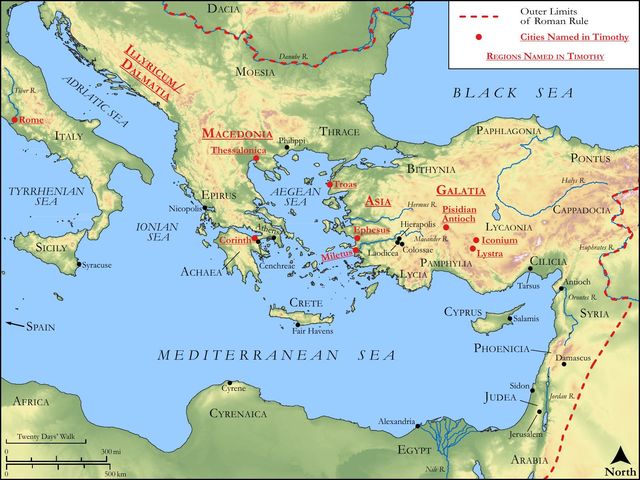
See on the biblical-era maps

Study this verse
Public-domain commentary
Matthew Henry
From his Commentary on the Whole Bible. Henry comments on passages, not single verses — this entry covers 2 Timothy 3:1–9. His three-level outline is real structure in the source text, so it is rendered as structure.
Timothy must not think it strange if there were in the church bad men; for the net of the gospel was to enclose both good fish and bad, Mat 13:47, Mat 13:48. Jesus Christ had foretold (Mt. 24) that there would come seducers, and therefore we must not be offended at it, nor think the worse of religion or the church for it. Even in gold ore there will be dross, and a great deal of chaff among the wheat when it lies on the floor.
I.Timothy must know that in the last days (Ti2 3:1), in gospel times, there would come perilous times.
Though gospel times were times of reformation in many respects, let him know that even in gospel times there would be perilous times; not so much on account of persecution from without as on account of corruptions within. These would be difficult times, wherein it would be difficult for a man to keep a good conscience. He does not say, "Perilous times shall come, for both Jews and Gentiles shall be combined to root out Christianity;" but "perilous times shall come, for such as have the form of godliness (Ti2 3:5) shall be corrupt and wicked, and do a great deal of damage to the church." Two traitors within the garrison may do more hurt to it than two thousand besiegers without. Perilous times shall come, for men shall be wicked. Note,
1.Sin makes the times perilous. When there is a general corruption of manners, and of the tempers of men, this makes the times dangerous to live in; for it is hard to keep our integrity in the midst of general corruption.
2.The coming of perilous times is an evidence of the truth of scripture-predictions; if the event in this respect did not answer to the prophecy, we might be tempted to question the divinity of the Bible.
3.We are all concerned to know this, to believe and consider it, that we may not be surprised when we see the times perilous: This know also.
II.Paul tells Timothy what would be the occasion of making these times perilous, or what shall be the marks and signs whereby these times may be known, Ti2 3:2, etc.
1.Self-love will make the times perilous. Who is there who does not love himself? But this is meant of an irregular sinful self-love. Men love their carnal selves better than their spiritual selves. Men love to gratify their own lusts, and make provision for them, more than to please God and do their duty. Instead of Christian charity, which takes care for the good of others, they will mind themselves only, and prefer their own gratification before the church's edification.
2.Covetousness. Observe, Self-love brings in a long train of sins and mischiefs. When men are lovers of themselves, no good can be expected from them, as all good may be expected from those who love God with all their hearts. When covetousness generally prevails, when every man is for what he can get and for keeping what he has, this makes men dangerous to one another, and obliges every man to stand on his guard against his neighbour.
3.Pride and vain-glory. The times are perilous when men, being proud of themselves, are boasters and blasphemers, boasters before men whom they despise and look upon with scorn, and blasphemers of God and of his name. When men do not fear God they will not regard man, and so vice vers.
4.When children are disobedient to their parents, and break through the obligations which they lie under to them both in duty and gratitude, and frequently in interest, having their dependence upon them and their expectation from them, they make the times perilous; for what wickedness will those stick at who will be abusive to their own parents and rebel against them?
5.Unthankfulness and unholiness make the times perilous, and these two commonly go together. What is the reason that men are unholy and without the fear of God, but that they are unthankful for the mercies of God? Ingratitude and impiety go together; for call a man ungrateful, and you can call him by no worse name. Unthankful, and impure, defiled with fleshly lusts, which is an instance of great ingratitude to that God who has provided so well for the support of the body; we abuse his gifts, if we make them the food and fuel of our lusts.
6.The times are perilous when men will not be held by the bonds either of nature or common honesty, when they are without natural affection, and truce-breakers, Ti2 3:3. There is a natural affection due to all. Wherever there is the human nature, there should be humanity towards those of the same nature, but especially between relations. Times are perilous when children are disobedient to their parents (Ti2 3:2) and when parents are without natural affection to their children, Ti2 3:3. See what a corruption of nature sin is, how it deprives men even of that which nature has implanted in them for the support of their own kind; for the natural affection of parents to their children is that which contributes very much to the keeping up of mankind upon the earth. And those who will not be bound by natural affection, no marvel that they will not be bound by the most solemn leagues and covenants. They are truce-breakers, that make no conscience of the engagements they have laid themselves under.
7.The times are perilous when men are false accusers one of another, diaboloi - devils one to another, having no regard to the good name of others, or to the religious obligations of an oath, but thinking themselves at liberty to say and do what they please, Psa 12:4.
8.When men have no government of themselves and their own appetites: not of their own appetites, for they are incontinent; not of their own passions, for they are fierce; when they have no rule over their own spirits, and therefore are like a city that is broken down, and has no walls; they are soon fired, upon the least provocation.
9.When that which is good and ought to be honoured is generally despised and looked upon with contempt. It is the pride of persecutors that they look with contempt upon good people, though they are more excellent than their neighbours.
10.When men are generally treacherous, wilful, and haughty, the times are perilous (Ti2 3:4) - when men are traitors, heady, high-minded. Our Saviour has foretold that the brother shall betray the brother to death and the father the child (Mat 10:21), and those are the worst sort of traitors: those who delivered up their Bibles to persecutors were called traditores, for they betrayed the trust committed to them. When men are petulant and puffed up, behaving scornfully to all about them, and when this temper generally prevails, then the times are perilous.
11.When men are generally lovers of pleasure more than lovers of God. When there are more epicures than true Christians, then the times are bad indeed. God is to be loved above all. That is a carnal mind, and is full of enmity against him, which prefers any thing before him, especially such a sordid thing as carnal pleasure is.
12.When, notwithstanding all this, they have the form of godliness (Ti2 3:5), are called by the Christian name, baptized into the Christian faith, and make a show of religion; but, how plausible soever their form of godliness is, they deny the power of it. When they take upon them the form which should and would bring along with it the power thereof, they will put asunder what God hath joined together: they will assume the form of godliness, to take away their reproach; but they will not submit to the power of it, to take away their sin. Observe here,
(1.)Men may be very bad and wicked under a profession of religion; they may be lovers of themselves, etc., yet have a form of godliness.
(2.)A form of godliness is a very different thing from the power of it; men may have the one and be wholly destitute of the other; yea, they deny it, at least practically in their lives.
(3.)From such good Christians must withdraw themselves.
III.Here Paul warns Timothy to take heed of certain seducers, not only that he might not be drawn away by them himself, but that he might arm those who were under his charge against their seduction.
1.He shows how industrious they were to make proselytes (Ti2 3:6): they applied themselves to particular persons, visited them in their houses, not daring to appear openly; for those that do evil hate the light, Joh 3:20. They were not forced into houses, as good Christians often were by persecution; but they of choice crept into houses, to insinuate themselves into the affections and good opinion of people, and so to draw them over to their party. And see what sort of people those were that they gained, and made proselytes of; they were such as were weak, silly women; and such as were wicked, laden with sins, and led away with divers lusts. A foolish head and a filthy heart make persons, especially women, an easy prey to seducers.
2.He shows how far they were from coming to the knowledge of the truth, though they pretended to be ever learning, Ti2 3:7. In one sense we must all be ever learning, that is, growing in knowledge, following on to know the Lord, pressing forward; but these were sceptics, giddy and unstable, who were forward to imbibe every new notion, under pretence of advancement in knowledge, but never came to a right understanding of the truth as it is in Jesus.
3.He foretels the certain stop that should be put to their progress (Ti2 3:8, Ti2 3:9), comparing them to the Egyptian magicians who withstood Moses, and who are here named, Jannes and Jambres; though the names are not to be met with in the story of the Old Testament, yet they are found in some old Jewish writers. When Moses came with a divine command to fetch Israel out of Egypt, these magicians opposed him. Thus those heretics resisted the truth and like them were men of corrupt minds, men who had their understandings perverted, biassed and prejudiced against the truth, and reprobate concerning the faith, or very far from being true Christians; but they shall proceed no further, or not much further, as some read it. Observe,
(1.)Seducers seek for corners, and love obscurity; for they are afraid to appear in public, and therefore creep into houses. Further, They attack those who are the least able to defend themselves, silly and wicked women.
(2.)Seducers in all ages are much alike. Their characters are the same - namely, Men of corrupt minds, etc.; their conduct is much the same - they resist the truth, as Jannes and Jambres withstood Moses; and they will be alike in their disappointment.
(3.)Those who resist the truth are guilty of folly, yea, of egregious folly; for magna est veritas, et praevalebit - Great is the truth, and shall prevail.
(4.)Though the spirit of error may be let loose for a time, God has it in a chain. Satan can deceive the nations and the churches no further and no longer than God will permit him: Their folly shall be manifest, it shall appear that they are imposters, and every man shall abandon them.
Historical interpretation
Six Centuries of Reception
5 surviving comments on this verse. Each one is dated, so this reads as a timeline rather than a list.
Select a marker to jump to its quote. Markers stagger vertically where authors wrote within a few decades of each other.
"Now as Jannes and Jambres withstood Moses, so do these also resist the truth." Who are these? The magicians in the time of Moses. But how is it their names are nowhere else introduced? Either they were handed down by tradition, or it is probable that Paul knew them by inspiration. "Men of corrupt minds," he says, "reprobate concerning the faith. But they shall proceed no further; for their folly shall be manifested unto all men, as theirs also was." "They shall proceed no further"; how then does he say elsewhere, "They will increase unto more ungodliness"? (2 Tim. ii. 16.) He there means, that beginning to innovate and to deceive, they will not pause in their error, but will always invent new deceits and corrupt doctrines, for error is never stationary. But here he says, that they shall not be able to deceive, nor carry men away with them, for however at first they may seem to impose upon them, they will soon and easily be detected. For that he is speaking to this effect appears from what follows. "For their folly shall be manifest unto all." Whence? Every way-"as theirs also was." For if errors flourish at first, they do not continue to the end, for so it is with things that are not fair by nature, but fair in appearance; they flourish for a time, and then are detected, and come to nought. But not such are our doctrines, and of these thou art a witness, for in our doctrines there is no deceit, for who would choose to die for a deceit?
The growth that the heretics enjoy will only be in numbers, not in depth or substance.
For those whom the Manichaeans lead astray are Christians who have already been born of the gospel, whose profession has been misled by the heretics. They make riches with inconsiderate haste but without good judgment. They do not consider that the followers whom they gather as their riches are taken from the genuine original Christian society and deprived of its benefits.… This recalls what the prophet said of the partridge, which gathers what it has not brought forth, “In the midst of his days they shall leave him, and in the end he shall be a fool.” In other words, he who at first misled people by a promising display of superior wisdom shall be a fool, that is, shall be seen to be a fool. He will be seen when his folly is manifest to all, and those to whom he was at first a wise man he will then be a fool.
The only progress which heretics will make is in impiety, for they cannot simulate genuine piety for very long.
Just as Jannes and Jambres resisted Moses, so do these also resist the truth, men corrupted in mind, reprobate concerning the faith, but they will progress no further. For their folly will be evident to all, as was that of those men.
Jannes and Jambres. These were the magicians of Pharaoh. But how does one know their names when Scripture does not say? We say that it was from unwritten tradition; it was likely from the Holy Spirit that Paul knew.
so do these also resist the truth. To the true faith.
men corrupted in mind, reprobate concerning the faith, but they will progress no further. When someone's mind is corrupted by passions, then they become unreliable regarding faith. How could they advance in wickedness without saying "they will advance"? Here it says, "they will progress no further." There it says that once they begin to wander, they will not stand anywhere, but will always devise something worse; here, however, it says that they will neither deceive nor seize many of the prudent.
— [OECUMENIUS] For Paul said beforehand, "Wandering and being led astray." (2 Tim. 3:13) Therefore, the power lies with those who are not easily deceived. [end of the excerpt by Oecumenius A f. 181r; B f. 219r; G f. 308r] —
For their folly will be evident to all. Where does this come from? "From ancient times," Paul says, "be assured. For wickedness is easily exposed."
In another way. If you are unbelieving, learn from what happened to those magicians (Jannes and Jambres). For even they were exposed as performing illusions and deceiving, when Moses truly performed wonders, so that all things of deceit flourish only for a time.
Encouragement to imitate them in opposition to the wicked, in the patience of God.
Continue studying 2 Timothy 3:9 across the web’s major study libraries — every link below opens this exact verse, chapter, or book on the destination site.
Read & Compare
 BibleGatewayThis verse in more than 200 translations and 70 languages.
 Bible.comThe YouVersion reader — hundreds of translations, reading plans, and highlights.
 ESV.orgCrossway's official English Standard Version reader.
 NET BibleThe NET translation with 60,000+ translators' notes on every rendering decision.
 STEP BibleTyndale House's free study tool — original text, vocabulary, and scholarly resources.
 BibliaLogos Bible Software's free web reader.
 USCCBThe New American Bible (Revised Edition) with the U.S. bishops' study notes.
Commentaries
 BibleHub CommentariesDozens of classic commentaries on this verse, gathered on one page.
 StudyLightMore than 100 commentary sets — the largest collection on the web.
 BibleRefPlain-English commentary on what this verse means, verse by verse.
 Enduring WordDavid Guzik's free commentary on this chapter, widely used by Bible teachers.
 Bible Study ToolsVerse commentary alongside Greek and Hebrew study aids.
Original Language & Research
- BibleHub InterlinearThe verse word by word — original language, transliteration, and English.
- BibleHub LexiconEvery word's original-language definition and Strong's entry.
 Blue Letter BibleDeep-study tools — Strong's numbers, concordance, and word studies.
 CNTR CollationThe earliest Greek manuscripts of this verse, collated letter by letter.
Sermons, Hymns & Audio


TrulyRandomVerse is not affiliated with these sites and doesn’t control their content. They’re linked because they’re genuinely useful.
Summary
Second Timothy 3:9 provides a powerful assurance to Timothy and all believers that the deceptive influence and destructive progress of those who oppose the truth will ultimately be halted and their true nature exposed. Despite their initial appearance of strength or persuasive power, their inherent foolishness and moral depravity will become undeniably evident to everyone, mirroring the historical failure of those who resisted God's truth in the past. This verse serves as both a warning against false teachers and a profound encouragement regarding God's sovereign control over the spread of error.
Context
ShowHideLiterary Context
This verse serves as a crucial counterpoint and hopeful conclusion to Paul's somber description of the "perilous times" that will come in the last days, detailed in 2 Timothy 3:1-8. Paul meticulously outlines the characteristics of people in these times, describing them as lovers of self, money, and pleasure rather than lovers of God, marked by hypocrisy and a form of godliness that denies its power. He specifically warns Timothy to "turn away from such people" (2 Timothy 3:5). The immediate preceding verses (2 Timothy 3:6-8) describe how these individuals "creep into households and capture weak women" and "resist the truth," just as Jannes and Jambres resisted Moses. Thus, 2 Timothy 3:9 functions as a divine promise that the destructive trajectory of these false teachers will be cut short, preventing them from achieving lasting success.
Historical & Cultural Context
Paul's letter to Timothy, likely written from prison in Rome, addresses the challenges faced by the early church in maintaining doctrinal purity and moral integrity amidst growing external pressures and internal heresies. Timothy, serving in Ephesus, a city known for its diverse religious practices and philosophical schools, would have encountered various forms of false teaching that threatened to corrupt the nascent Christian community. The reference to "Jannes and Jambres" (2 Timothy 3:8) is a specific historical and cultural allusion to the Egyptian magicians who opposed Moses before Pharaoh, as recorded in Exodus 7:11-12. Although not named in the Old Testament, their names were preserved in Jewish tradition, signifying archetypal opponents of God's truth whose power was ultimately revealed as limited and fraudulent. This cultural understanding of public exposure and divine vindication would have resonated strongly with Timothy and his audience, providing a concrete historical parallel to the inevitable failure of contemporary false teachers.
Key Themes
ShowHideSecond Timothy 3:9 contributes significantly to several overarching themes within the book and the broader Pauline corpus. A primary theme is the Limitation of Error and Deception. Despite the apparent success and influence of false teachers, their progress is divinely constrained, ensuring they cannot permanently undermine the truth or fully corrupt the church. This ties into the theme of Divine Sovereignty and the Preservation of Truth, where God actively works to expose falsehood and uphold His word, providing assurance to believers that truth will ultimately prevail. Furthermore, the verse highlights the Nature of Folly and Wickedness, revealing that the resistance to truth stems from a fundamental moral and intellectual depravity, not merely a difference of opinion. Finally, the Call to Discernment and Steadfastness is implicitly present, as the promise of exposure encourages believers to patiently endure and stand firm in sound doctrine, knowing that the true character of those who oppose them will eventually be revealed, just as it was for the magicians who resisted Moses in Egypt.
Exposition and Analysis
ShowHideKey Word Analysis
ShowHideMeaning "to drive forward (as if by beating), i.e. (figuratively and intransitively) to advance (in amount, to grow; in time, to be well along)." In this context, it signifies the advancement or progress of the false teachers in spreading their influence and doctrine. The phrase "no further" indicates a definitive halt to this progression, implying a divinely imposed limit on their ability to deceive and corrupt.
Meaning "stupidity; by implication, rage." This word describes more than simple foolishness or error; it denotes a lack of mind, senselessness, or even madness. It points to the irrational, morally depraved, and spiritually misguided nature of their opposition to God's truth, suggesting that their actions are driven by a fundamental intellectual and spiritual bankruptcy.
Meaning "wholly evident." This term emphasizes the clarity and undeniable nature of the exposure. It implies that their true character, the emptiness of their teachings, and the depravity of their motives will become conspicuously clear and plain for all to see, leaving no room for doubt or misinterpretation.
Verse Breakdown
ShowHide"But they shall proceed no further:"
This opening clause introduces a strong contrast ("But") to the preceding description of the false teachers' deceptive activities. It delivers a definitive declaration that their advancement and influence will be arrested. The Greek word for "proceed" (prokóptō) implies a cutting forward or making headway, suggesting that while they may have had some initial success, their progress will be decisively halted, indicating a divine limitation on their destructive power.
"for their folly shall be manifest unto all [men],"
This clause provides the reason ("for") why their progress will be stopped: their inherent "folly" will be exposed. "Folly" (ánoia) here is not mere intellectual error but a deep-seated spiritual and moral irrationality, a senseless opposition to divine truth. The phrase "shall be manifest unto all [men]" emphasizes the public and undeniable nature of this revelation. Their true character and the emptiness of their teaching will become plainly evident to everyone, not just a select few.
"as theirs also was."
This concluding phrase draws a direct parallel to a historical precedent, specifically referencing Jannes and Jambres, the Egyptian magicians who opposed Moses. Just as their resistance to God's power was ultimately revealed as ineffective and their true limitations became clear to all, so too will the false teachers of Timothy's day—and indeed, of all ages—be exposed. This historical analogy serves as an assurance that God's truth will always prevail over deception.
Literary Devices
ShowHideThe verse employs several potent literary devices to convey its message of assurance and warning. Contrast is evident in the opening "But," which sharply shifts the tone from the description of the false teachers' insidious activities in the preceding verses to the certainty of their failure. This sets up a clear opposition between their temporary influence and their ultimate, inevitable exposure. The phrase "no further" functions as a form of Understatement or Litotes, subtly emphasizing the absolute cessation of their progress by stating what they will not do. Furthermore, the verse utilizes Allusion by referencing a historical event ("as theirs also was") without explicitly naming the individuals (Jannes and Jambres). This allusion to a well-known biblical narrative (Exodus 7:11-12) serves as a powerful Analogy, providing a concrete example of how God's truth prevails over deceptive opposition, thereby reinforcing the certainty of the promise for Timothy's context. Finally, the declaration that their folly "shall be manifest unto all" functions as a Prophecy or Assurance, a divine guarantee that truth will ultimately triumph and deception will be unmasked.
Theological and Thematic Connections
ShowHideThis verse underscores a profound theological truth: while evil and deception may appear to flourish for a season, their power is ultimately limited by God's sovereign will. The exposure of the false teachers' folly is not merely a natural consequence of their errors but an act of divine intervention, ensuring that the integrity of the gospel and the purity of the church are preserved. This divine limitation on evil's progress provides immense comfort and confidence to believers facing spiritual opposition, reminding them that God is actively at work to vindicate His truth and protect His people. It speaks to the inherent self-destructive nature of ungodliness and the ultimate triumph of light over darkness, reinforcing the principle that anything not rooted in divine truth cannot stand the test of time or scrutiny.
Reflection and Application
ShowHideIn a world increasingly saturated with competing narratives and spiritual counterfeits, 2 Timothy 3:9 offers profound comfort and a clear call to discernment. It reminds us that while deceptive teachings and morally corrupt leaders may gain temporary traction and even significant followings, their inherent emptiness and spiritual bankruptcy will inevitably be revealed. This should encourage believers not to be dismayed by the apparent success of those who oppose the truth, but rather to stand firm in the sound doctrine they have received. Our task is to patiently endure, to continue to live out the truth, and to trust that God will, in His perfect timing, expose all that is false. This verse calls us to cultivate a discerning spirit, testing all things against the unchanging standard of God's Word, knowing that the fruits of false teaching will eventually become evident for all to see, just as the folly of Jannes and Jambres was laid bare before Moses and Pharaoh.
Questions for Reflection
ShowHideFAQ
ShowHideWho are "they" in this verse, and what does it mean that their progress will be halted?
ShowHide"They" refers to the false teachers and morally depraved individuals described in the preceding verses of 2 Timothy 3:1-8. These are people who have a "form of godliness but deny its power" (2 Timothy 3:5), who "resist the truth" (2 Timothy 3:8), and who seek to deceive others. The phrase "they shall proceed no further" signifies that their destructive influence and deceptive progress will be divinely limited and ultimately stopped. While they may experience temporary success or gain followers, their ability to permanently corrupt the church or undermine the truth is curtailed by God's sovereign hand, preventing them from achieving their ultimate destructive aims.
What does "folly" (ánoia) imply about the nature of these false teachers?
ShowHideThe Greek word translated "folly" is ánoia, which is stronger than mere foolishness. It denotes a lack of mind, senselessness, or even madness. In this context, it implies a profound intellectual and spiritual depravity, a state of irrationality and moral corruption that underpins their opposition to God's truth. It suggests that their errors are not simply intellectual mistakes but stem from a fundamental spiritual blindness and a perverted understanding of reality. Their "folly" is not just about what they teach, but about who they are at their core: senseless and morally bankrupt individuals whose resistance to truth is rooted in a deep-seated rebellion against God.
Christ-Centered Fulfillment
ShowHideSecond Timothy 3:9, while warning about the inevitable exposure of human folly, finds its ultimate Christ-centered fulfillment in the person and work of Jesus Christ. He is the very embodiment of truth, the "light that shines in the darkness, and the darkness has not overcome it" (John 1:5). The "folly" of those who resist the truth is ultimately exposed by the illuminating power of Christ's gospel. Just as the magicians' power was revealed as limited before Moses, so too is every false teaching and deceptive spirit rendered powerless and ultimately exposed before the supreme authority and truth of Christ. His life, death, and resurrection are the ultimate manifestation of God's wisdom and power, revealing the bankruptcy of all human wisdom that opposes Him (1 Corinthians 1:20-25). Furthermore, Christ's triumph over "principalities and powers" on the cross (Colossians 2:15) ensures that no spiritual deception can ultimately prevail against His church. The promise that their folly "shall be manifest unto all" points forward to the day when Christ will return, "bring to light the things now hidden in darkness and will disclose the purposes of the heart" (1 Corinthians 4:5), establishing His truth and righteousness for all eternity.