


Jeremiah 28:15
Bible text: King James Version (1769 Blayney text) · Public domain
Bible text: King James Version with Strong's numbers · Public domain
Bible text: Berean Standard Bible · Public domain
Bible text: American Standard Version (1901) · Public domain
Bible text: World English Bible, Messianic edition · Public domain
Bible text: Geneva Bible (1599) · Public domain
Bible text: Young's Literal Translation · Public domain
- וַיֹּאמֶרvai·Yo·merand he saidH559Conj-w ¦ V-Qal-ConsecImperf-3msVerb Qal Consecutive Imperfect 3rd Singular Masculineוַandיֹּאמֶרhe said
- יִרְמְיָהyir·me·YahJeremiahH3414N-proper-mNoun Proper Masculine
- הַנָּבִיאha·na·Vi'the prophetH5030Art ¦ N-msNoun Singular Masculine Absoluteהַtheנָּבִיאprophet
- אֶל'eltoH413PrepPreposition
- חֲנַנְיָהcha·nan·YahHananiahH2608N-proper-mNoun Proper Masculine
- הַנָּבִיאha·na·Vi'the prophetH5030Art ¦ N-msNoun Singular Masculine Absoluteהַtheנָּבִיאprophet
- שְׁמַעshe·ma'listenH8085V-Qal-Imp-2msVerb Qal Imperative 2nd Singular Masculine
- נָאna'pleaseH4994PrtParticle Interjection
- חֲנַנְיָהcha·nan·YahO HananiahH2608N-proper-mNoun Proper Masculine
- לֹאlo'notH3808NegParticle Negative
- שְׁלָחֲךָshe·la·cha·Khahe sent youH7971V-Qal-Perf-3ms ¦ 2msVerb Qal Perfect 3rd Singular Masculineשְׁלָחֲhe sentךָyou
- יְהוָהYah·wehYahwehH3068N-properNoun Proper Title
- וְאַתָּהve·'a·Tahand youH859Conj-w ¦ Pro-2msPronoun Personal 2nd Singular Masculineוְandאַתָּהyou
- הִבְטַחְתָּhiv·Tach·tayou have made relyH982V-Hiphil-Perf-2msVerb Hiphil Perfect 2nd Singular Masculine
- אֶת'et<obj.>H853DirObjMParticle Object Indicator
- הָעָםha·'Amthe peopleH5971Art ¦ N-msNoun Singular Masculine Absoluteהָtheעָםpeople
- הַזֶּהha·Zeh<the> thisH2088Art ¦ PrtParticle Demonstrativeהַ<the>זֶּהthis
- עַל'alonH5921PrepPreposition
- שָׁקֶרSha·kerfalsehoodH8267N-msNoun Singular Masculine Absolute
English is a literal word-by-word gloss of the Hebrew, not the KJV's wording. Why?
This is the original text the KJV's translators worked from — each Hebrew word with its own literal English meaning in this verse, prepared by scholars at Tyndale House, Cambridge. The KJV translates whole sentences, not word by word, so its wording differs: one Hebrew word can become several English words, and the KJV may choose “the LORD” where the gloss reads “Yahweh”. Both are faithful — they answer different questions. For the KJV's own rendering, switch to the KJV text.
Details
See on the biblical-era map
Study this verse
Public-domain commentary
Matthew Henry
From his Commentary on the Whole Bible. Henry comments on passages, not single verses — this entry covers Jeremiah 28:10–17. His three-level outline is real structure in the source text, so it is rendered as structure.
We have here an instance,
I.Of the insolence of the false prophet.
To complete the affront he designed Jeremiah, he took the yoke from off his neck which he carried as a memorial of what he had prophesied concerning the enslaving of the nations to Nebuchadnezzar, and he broke it, that he might give a sign of the accomplishment of this prophecy, as Jeremiah had given of his, and might seem to have conquered him, and to have defeated the intention of his prophecy. See how the lying spirit, in the mouth of this false prophet, mimics the language of the Spirit of truth: Thus saith the Lord, So will I break the yoke of the king of Babylon, not only from the neck of this nation, but from the neck of all nations, within two full years. Whether by the force of a heated imagination Hananiah had persuaded himself to believe this, or whether he knew it to be false, and only persuaded them to believe it, does not appear; but it is plain that he speaks with abundance of assurance. It is no new thing for lies to be fathered upon the God of truth.
II.Of the patience of the true prophet.
Jeremiah quietly went his way, and when he was reviled he reviled not again, and would not contend with one that was in the height of his fury and in the midst of the priests and people that were violently set against him. The reason why he went his way was not because he had nothing to answer, but because he was willing to stay till God was pleased to furnish him with a direct and immediate answer, which as yet he had not received. He expected that God would send a special message to Hananiah, and he would say nothing till he had received that. I, as a deaf man, heard not, for thou wilt hear, and thou shalt answer, Lord, for me. It may sometimes be our wisdom rather to retreat than to contend. Currenti cede furori - Give place unto wrath.
III.Of the justice of God in giving judgment between Jeremiah and his adversary.
Jeremiah went his way, as a man in whose mouth there was no rebuke, but God soon put a word into his mouth; for he will appear for those who silently commit their cause to him.
1.The word of God, in the mouth of Jeremiah, is ratified and confirmed. Let not Jeremiah himself distrust the truth of what he had delivered in God's name because it met with such a daring opposition and contradiction. If what we have spoken be the truth of God, we must not unsay it because men gainsay it; for great is the truth and will prevail. It will stand, therefore let us stand to it, and not fear that men's unbelief or blasphemy will make it of no effect. Hananiah has broken the yokes of wood, but Jeremiah must make for them yokes of iron, which cannot be broken (Jer 28:13), for (says God) "I have put a yoke of iron upon the neck of all these nations, which shall lie heavier, and bind harder, upon them (Jer 28:14), that they may serve the king of Babylon, and not be able to shake off the yoke however they may struggle, for they shall serve him whether they will or no;" and who is he that can contend with God's counsel? What was said before is repeated again: I have given him the beasts of the field also, as if there were something significant in that. Men had by their wickedness made themselves like the beasts that perish, and therefore deserved to be ruled by an arbitrary power, as beasts are ruled, and such a power Nebuchadnezzar ruled with; for whom he would he slew and whom he would he kept alive.
2.Hananiah is sentenced to die for contradicting it, and Jeremiah, when he has received commission from God, boldly tells him so to his face, though before he received that commission he went away and said nothing.
(1.)The crimes of which Hananiah stands convicted are cheating the people and affronting God: Thou makest this people to trust in a lie, encouraging them to hope that they shall have peace, which will make their destruction the more terrible to them when it comes; yet this was not the worst: Thou hast taught rebellion against the Lord; thou hast taught them to despise all the good counsel given them in God's name by the true prophets, and hast rendered it ineffectual. Those have a great deal to answer for who, by telling sinners that they shall have peace though they go on, harden their hearts in a contempt of the reproofs and admonitions of the word, and the means and methods God takes to bring them to repentance.
(2.)The judgment given against him is, "I will cast thee off from the face of the earth, as unworthy to live upon it; thou shalt be buried in it. This year thou shalt die, and die as a rebel against the Lord, to whom death will come with a sting and a curse." This sentence was executed, Jer 28:17. Hananiah died the same year, within two months; for his prophecy is dated the fifth month (Jer 28:1) and his death the seventh. Good men may perhaps be suddenly taken off by death in the midst of their days, and in mercy to them, as Josiah was; but this being foretold as the punishment of his sin, and coming to pass accordingly, it may safely be construed as a testimony from Heaven against him and a confirmation of Jeremiah's mission. And, if the people's hearts had not been wretchedly hardened by the deceitfulness of sin, it would have prevented their being further hardened by the deceitfulness of their prophets.
Historical interpretation
Historical reception
2 surviving comments on this verse. Each one is dated, so this reads as a timeline rather than a list.
(Verse 5 onwards) And Jeremiah the prophet said to the prophet Hananiah: Listen, Hananiah: The Lord did not send you, and yet you have made this people trust in a lie. Therefore, thus says the Lord: Behold, I will send (or cast) you away from the face of the earth, you will die this year. And what follows: Because you have spoken against the Lord. And Hananiah the prophet died in that year, in the seventh month, which is not mentioned in the Septuagint. For as much as they have set him forth above: He died in the seventh month. And this Ananias is not spoken of in the Septuagint as a prophet, though the Holy Scripture of the Hebrews calls him a prophet, even though Jeremiah accuses him, saying: Hear, Ananias, the Lord has not sent you, yet thou have prophesied. For how could he call him a prophet, whom he denied to be sent by the Lord? But the truth and order of the history is preserved, as we have said, not according to what it was, but according to what it was thought to be at that time. You deceived, he says, the people with a lie, so that they would not submit to the judgments of God. Therefore, you know that you will die this year. When we die, we are released from the prisons of the body, according to that testimony, which heretics interpret wrongly: Bring my soul out of prison (Ps. 141:8): so how is death now imposed as a punishment on false prophets? But in this place it should be noted that Jeremiah, after suffering injury from a false prophet, and before receiving a direct message from the Lord, remains silent; later, however, sent by the Lord, he boldly accuses the liar and announces his impending death. And that he who usually translates the seventh month is said to rest under this number, perhaps they falsely claim that he died in the seventh month so that he may be freed from the evils of the body, according to what they quote from the writing. Death is rest for a man. But we know that the bodies of believers are temples of God, if indeed the Holy Spirit dwells in them (Sirach 22:11).
When Jeremiah admonishes him, saying, “Listen, Hananiah, the Lord did not send you,” he omits the title “prophet,” for how could he call him a prophet who refused to be sent by the Lord? But the truth and order of history is preserved, as we said above, not according to what was but according to what was thought to be at the time. He says, in effect, “You have deceived the people with a falsehood, to prevent them from agreeing with the judgment of God. Hence, you know that this will be the year you die.” But if, when we die, we are liberated from the prison of the body, according to that testimony that has been badly misinterpreted by heretics, “Free my soul from this prison,” how is the death of a pseudo-prophet now imposed as a punishment? It also must be observed, however, that Jeremiah suffered injury from the false prophet and remained silent, the word of the Lord not yet having come to him. Afterwards, however, when sent by the Lord, he boldly convicted him of lying and announced his imminent death. And because he died in the seventh month, which was always customarily understood to represent “rest,” due to the significance of the number, perhaps they were deceived that he died in the seventh month, so that he would be liberated from the evils of the body according to that passage they proffer from Scripture: “Death gives rest to a person.” But we know that the bodies of believers are temples of God, if the Holy Spirit still dwells within them.
Continue studying Jeremiah 28:15 across the web’s major study libraries — every link below opens this exact verse, chapter, or book on the destination site.
Read & Compare
 BibleGatewayThis verse in more than 200 translations and 70 languages.
 Bible.comThe YouVersion reader — hundreds of translations, reading plans, and highlights.
 ESV.orgCrossway's official English Standard Version reader.
 NET BibleThe NET translation with 60,000+ translators' notes on every rendering decision.
 STEP BibleTyndale House's free study tool — original text, vocabulary, and scholarly resources.
 BibliaLogos Bible Software's free web reader.
 USCCBThe New American Bible (Revised Edition) with the U.S. bishops' study notes.
Commentaries
 BibleHub CommentariesDozens of classic commentaries on this verse, gathered on one page.
 StudyLightMore than 100 commentary sets — the largest collection on the web.
 BibleRefPlain-English commentary on what this verse means, verse by verse.
 Enduring WordDavid Guzik's free commentary on this chapter, widely used by Bible teachers.
 Bible Study ToolsVerse commentary alongside Greek and Hebrew study aids.
Original Language & Research
- BibleHub InterlinearThe verse word by word — original language, transliteration, and English.
- BibleHub LexiconEvery word's original-language definition and Strong's entry.
 Blue Letter BibleDeep-study tools — Strong's numbers, concordance, and word studies.
 SefariaThe Hebrew text with Rashi and centuries of Jewish commentary.
Sermons, Hymns & Audio


TrulyRandomVerse is not affiliated with these sites and doesn’t control their content. They’re linked because they’re genuinely useful.
Summary
Jeremiah 28:15 captures the climactic confrontation between the true prophet Jeremiah and the false prophet Hananiah, serving as a profound theological declaration of divine truth against human deception. In this pivotal moment, Jeremiah, speaking with the unequivocal authority of Yahweh, directly refutes Hananiah's popular but baseless prophecy of imminent peace and deliverance, unmasking it as a dangerous fabrication. This verse not only exposes Hananiah's lack of divine commission but also condemns his act of misleading the people of Judah into a false sense of security, thereby underscoring the singular origin of authentic prophetic revelation and the perilous nature of comforting falsehoods.
Context
ShowHideLiterary Context
This verse marks the decisive moment in the dramatic confrontation between Jeremiah and Hananiah, which unfolds throughout Jeremiah 28. The chapter begins with Hananiah publicly contradicting Jeremiah's long-standing prophecies of extended Babylonian subjugation and a seventy-year exile (Jeremiah 25:11). Hananiah boldly proclaims a swift end to the Babylonian yoke within two years, promising the return of the temple vessels and exiles (Jeremiah 28:2-4). Jeremiah initially responds with a cautious, conditional affirmation, expressing a desire for peace but emphasizing that only the fulfillment of a prophecy, especially one of peace, validates its divine origin (Jeremiah 28:5-9). The conflict escalates when Hananiah dramatically breaks the wooden yoke Jeremiah wore as a powerful symbol of Babylonian dominion (Jeremiah 28:10-11). Following a period of silence, Jeremiah returns with a stronger, divinely inspired word, replacing the broken wooden yoke with an iron one, symbolizing an even heavier, unbreakable subjugation (Jeremiah 28:12-14). Verse 15 then delivers Jeremiah's direct, personal, and divinely sanctioned indictment of Hananiah's false prophecy, setting the stage for Hananiah's swift divine judgment in the subsequent verses.
Historical & Cultural Context
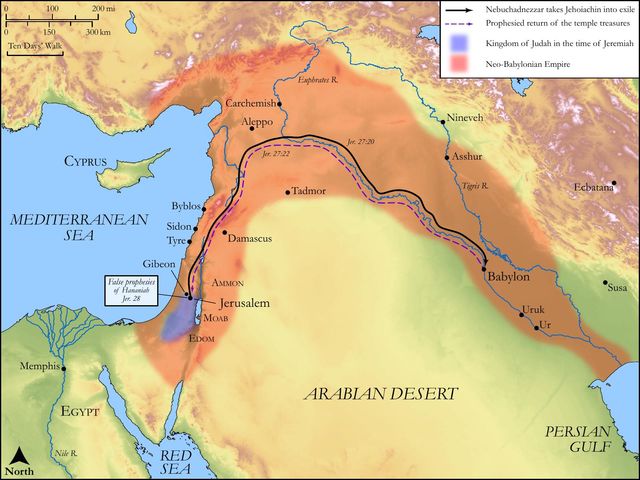
The events of Jeremiah 28 are set around 593 BC, during the tumultuous reign of King Zedekiah in Judah. Jerusalem had already been reduced to servitude under Babylonian rule, and a significant portion of its population, including King Jehoiachin and many prominent citizens, had been exiled to Babylon during the first deportation in 597 BC (2 Kings 24:10-17). The people of Judah were desperate for hope, liberation, and a return to their former glory. In this volatile environment, prophets held immense cultural and spiritual sway, often seen as direct conduits of divine will. There was a strong societal expectation for prophets to deliver messages of comfort, national prosperity, and immediate deliverance, especially during times of crisis. False prophets frequently capitalized on these popular desires, offering soothing but deceptive promises that resonated more favorably with the populace than Jeremiah's consistent and difficult message of submission to Babylon and long-term exile. The confrontation between Jeremiah and Hananiah thus vividly illustrates a broader spiritual struggle within Judah concerning the nature of true prophecy and the people's willingness to embrace God's challenging truth over comforting falsehoods.
Key Themes
ShowHideJeremiah 28:15 powerfully encapsulates several enduring theological and narrative themes. Preeminent among these is the Discernment of True vs. False Prophecy, a critical and recurring motif throughout the prophetic literature. Jeremiah's declaration unequivocally exposes Hananiah as a purveyor of deceit, starkly contrasting with the authentic, albeit often unpopular, word of God. This highlights the essential criteria for discerning true prophets, as articulated in Deuteronomy 18:22, where the fulfillment of a prophecy serves as the ultimate litmus test. Another crucial theme is Divine Authority and Commission. Jeremiah's explicit statement, "The LORD hath not sent thee," underscores that genuine prophetic ministry flows solely from God's sovereign initiative and authorization. Without this divine "sending," any claim to speak for God is fundamentally illegitimate and presumptuous. Finally, the verse profoundly emphasizes the Danger of Deception and False Hope. Hananiah's lie caused the people to "trust in a lie," preventing them from confronting the harsh reality of their situation and accepting God's disciplinary hand. This false sense of security ultimately led to greater spiritual and national peril, demonstrating the destructive power of untruth, especially when cloaked in religious language, a danger Jeremiah consistently warned against, as seen in his broader condemnations of false prophets in Jeremiah 14:14.
Exposition and Analysis
ShowHideKey Word Analysis
ShowHideThis primitive root means "to send away, for, or out," implying a divine commission, dispatch, or authorization. When Jeremiah declares, "The LORD hath not sent thee," he is directly challenging the very foundation of Hananiah's claim to prophetic authority. The word emphasizes that true prophets are not self-appointed but are specifically dispatched by God with His message and authority. Hananiah's lack of this divine "sending" renders his entire ministry illegitimate and presumptuous, highlighting that prophetic authenticity is rooted in God's initiative, not human ambition.
Properly, "to hide for refuge," but figuratively, "to trust, be confident or sure." In this context, it describes the misplaced confidence and reliance the people placed in Hananiah's false prophecy. Instead of trusting in the Lord's difficult but true word delivered by Jeremiah, they put their hope and security in a comforting but deceptive message. This word highlights the profound spiritual danger of relying on human assurances and falsehoods rather than divine truth, leading to a false sense of security that ultimately proves destructive.
This term denotes "an untruth," "falsehood," or "deceit," often carrying the implication of a sham, something empty, or a vain thing. In a religious context, it refers to false gods, false oaths, or, as here, false prophecies. Jeremiah's use of "lie" is not merely descriptive of an error; it is a profound moral and theological condemnation of Hananiah's message as fundamentally deceptive, baseless, and contrary to the very nature of God, who is truth. It directly contrasts with the reliability and inherent truthfulness of God's own word.
Verse Breakdown
ShowHide"Then said the prophet Jeremiah unto Hananiah the prophet,"
This opening clause immediately establishes the setting for a direct, personal, and highly significant confrontation between two individuals, both identified by the same esteemed title, "prophet." This shared title, despite their opposing messages, immediately frames the central conflict: a profound dispute over who genuinely speaks for God and who merely claims to.
"Hear now, Hananiah;"
Jeremiah's direct address is a solemn, urgent, and imperative command for Hananiah to listen intently. The Hebrew phrase, often translated as "listen carefully" or "pay attention," emphasizes the critical nature of the divine verdict about to be delivered. It demands Hananiah's full and undivided attention to the profound truth that will expose his deception.
"The LORD hath not sent thee;"
This is the unequivocal core of Jeremiah's indictment and the theological crux of the verse. It is a categorical denial of Hananiah's divine commission and legitimacy. Jeremiah asserts that Hananiah's prophetic activity does not originate from Yahweh, the covenant God of Israel. This statement directly challenges Hananiah's authority, revealing the source of his message to be something other than God, thereby nullifying any claim to speak for the divine.
"but thou makest this people to trust in a lie."
This concluding clause reveals the devastating consequence and moral culpability of Hananiah's false prophecy. His message is not merely a personal error but an active and dangerous deception that leads the entire nation astray. The phrase "trust in a lie" highlights the profound spiritual danger: the people are encouraged to place their hope, security, and faith in a falsehood, which will ultimately lead to bitter disappointment, disillusionment, and further suffering, as it diverts them from God's true path of repentance and submission.
Literary Devices
ShowHideJeremiah 28:15 is powerfully constructed through several literary devices that amplify its profound message. The most prominent is Contrast, which is central to the entire chapter and culminates here. Jeremiah, the true prophet, is sharply contrasted with Hananiah, the false prophet, and God's undeniable truth is set against Hananiah's destructive lie. This opposition is subtly highlighted by the repeated use of the title "prophet" for both men, emphasizing that while they share a designation, their source of authority and the very nature of their message are diametrically opposed. Direct Address ("Hear now, Hananiah") creates a sense of immediate, personal confrontation, drawing the reader into the intensity of the moment and underscoring the solemnity and urgency of Jeremiah's divine pronouncement. Furthermore, there is a strong element of Irony: Hananiah, who publicly claimed to speak for the LORD and dramatically broke Jeremiah's yoke in the LORD's name, is now told by the true prophet that the LORD did not send him. This ironic reversal underscores the deceptive nature of Hananiah's ministry and the ultimate futility of presuming to speak for God without authentic divine authorization.
Theological and Thematic Connections
ShowHideJeremiah 28:15 serves as a timeless theological anchor, reinforcing the absolute necessity of divine commission for true prophecy and highlighting the profound danger of any message not originating from God. It underscores that God's truth, even when difficult or unpopular, is always for the ultimate good of His people, while comforting lies, no matter how appealing, inevitably lead to spiritual and practical ruin. The verse calls believers across generations to exercise rigorous discernment, testing every spirit and every word against the established character and revealed will of God, rather than succumbing to narratives that merely affirm human desires or anxieties. It highlights God's unwavering commitment to truth and His intolerance for those who presume to speak in His name falsely, thereby corrupting His message and misleading His flock, ultimately demonstrating that divine judgment awaits those who traffic in spiritual falsehoods.
Reflection and Application
ShowHideJeremiah 28:15 offers a potent and enduring lesson for contemporary believers, urging unwavering vigilance and profound discernment in a world saturated with competing voices and claims to truth. In an era of abundant information, diverse spiritual claims, and the pervasive influence of social media, we are called to emulate Jeremiah's unwavering commitment to God's authentic word, even when it challenges popular opinion, personal comfort, or societal norms. This verse compels us to critically evaluate the messages we receive, whether from pulpits, online platforms, or cultural narratives, by rigorously comparing them to the unchanging, authoritative standard of God's revealed Word. It serves as a stark reminder that true spiritual leadership is not about popularity, promising easy solutions, or catering to felt needs, but about faithfully proclaiming God's truth, however difficult or counter-cultural it may be. We are encouraged to cultivate a deep, abiding relationship with the Scriptures, allowing them to be our ultimate guide and plumb line, so that we might discern between genuine divine revelation and the seductive whispers of comforting lies that ultimately lead to spiritual harm, moral compromise, and a false sense of security. Our trust must be firmly rooted in God alone, and in the unvarnished truth He has revealed, rather than in the deceptive assurances of human invention or self-serving narratives.
Questions for Reflection
ShowHideFAQ
ShowHideHow can we distinguish between a true prophet/teacher and a false one today, given that the office of prophet in the Old Testament sense is generally understood to have ceased?
ShowHideWhile the direct, revelatory office of prophet as seen in the Old Testament is widely understood to have ceased with the completion of the biblical canon, the principles for discerning true teachers, spiritual leaders, and messages remain vitally important. The primary test, as exemplified in Jeremiah 28:15, is whether the message aligns with God's established Word, the Bible. True teachers will always point to and uphold the authority and sufficiency of Scripture, never contradicting its core doctrines, moral standards, or the person of Jesus Christ. False teachers, conversely, often deviate from biblical truth, prioritize personal gain, or offer messages that appeal to human desires for comfort, prosperity, or self-affirmation without demanding repentance, holiness, or submission to God's will. Deuteronomy 18:22 states that if a prophet's word does not come true, the LORD has not spoken it. For today's teachers, this translates to whether their teachings bear spiritual fruit consistent with God's character, whether their predictions (if any) align with reality and God's revealed will, and whether their lives exemplify the character of Christ. Matthew 7:15-20 also instructs us to "know them by their fruits," referring to their character, lifestyle, and the spiritual impact of their teaching on others.
Christ-Centered Fulfillment
ShowHideJeremiah 28:15, with its stark contrast between true and false prophecy and the devastating consequences of trusting in a lie, finds its ultimate fulfillment and resolution in the person and work of Jesus Christ. He is the Prophet par excellence, the one whom Moses foretold in Deuteronomy 18:15, to whom all must listen. Unlike Hananiah, who was emphatically declared by Jeremiah as not "sent" by the Lord, Jesus was uniquely and perfectly sent by the Father, embodying divine authority and truth in every word and deed (John 8:42). He is not merely a messenger of truth, but the very embodiment of it, declaring, "I am the way and the truth and the life" (John 14:6). While Hananiah made the people "trust in a lie," Jesus calls His followers to trust in Him, the ultimate Truth, which genuinely sets them free from the bondage of sin, deception, and false hopes (John 8:31-32). His words are spirit and life (John 6:63), and His teaching consistently exposed the lies, hypocrisy, and self-deception of the religious leaders of His day (Matthew 23). In Christ, all true prophecy finds its culmination and all God's promises find their "Yes" and "Amen" (2 Corinthians 1:20). He is the faithful and true witness, the ultimate revelation of God, against whom no lie can stand, offering genuine hope, eternal life, and unwavering truth to all who trust in Him.