


Jeremiah 28:16
Bible text: King James Version (1769 Blayney text) · Public domain
Bible text: King James Version with Strong's numbers · Public domain
Bible text: Berean Standard Bible · Public domain
Bible text: American Standard Version (1901) · Public domain
Bible text: World English Bible, Messianic edition · Public domain
Bible text: Geneva Bible (1599) · Public domain
Bible text: Young's Literal Translation · Public domain
- לָכֵןla·Khen<to> thereforeH3651Prep-l ¦ AdvAdverbלָ<to>כֵןtherefore
- כֹּהkohthusH3541AdvAdverb
- אָמַר'a·Marhe saysH559V-Qal-Perf-3msVerb Qal Perfect 3rd Singular Masculine
- יְהוָהYah·wehYahwehH3068N-properNoun Proper Title
- הִנְנִיhi·Nihere IH2005Prt ¦ 1csParticle InterjectionהִנְhereנִיI
- מְשַׁלֵּחֲךָme·sha·le·cha·Kha[am] about to cast out youH7971V-Piel-Prtcpl-ms ¦ 2msVerb Piel Participle Singular Masculine Constructמְשַׁלֵּחֲ[am] about to cast outךָyou
- מֵעַלme·'Alfrom onH5921Prep-m ¦ PrepPrepositionמֵfromעַלon
- פְּנֵיpe·Nei[the] surface ofH6440N-mpcNoun Plural Masculine Construct
- הָאֲדָמָהha·'a·da·Mahthe groundH127Art ¦ N-fsNoun Singular Feminine Absoluteהָtheאֲדָמָהground
- הַשָּׁנָהha·sha·Nahthis yearH8141Art ¦ N-fsNoun Singular Feminine Absoluteהַthisשָּׁנָהyear
- אַתָּה'a·TahyouH859Pro-2msPronoun Personal 2nd Singular Masculine
- מֵתMet[will] dieH4191V-Qal-Prtcpl-msVerb Qal Participle Singular Masculine Absolute
- כִּיkiforH3588PrtParticle Conditional
- סָרָהsa·RahrebellionH5627N-fsNoun Singular Feminine Absolute
- דִבַּרְתָּdi·Bar·tayou have spokenH1696V-Piel-Perf-2msVerb Piel Perfect 2nd Singular Masculine
- אֶל'elagainstH413PrepPreposition
- יְהוָהYah·wehYahwehH3068N-properNoun Proper Title
English is a literal word-by-word gloss of the Hebrew, not the KJV's wording. Why?
This is the original text the KJV's translators worked from — each Hebrew word with its own literal English meaning in this verse, prepared by scholars at Tyndale House, Cambridge. The KJV translates whole sentences, not word by word, so its wording differs: one Hebrew word can become several English words, and the KJV may choose “the LORD” where the gloss reads “Yahweh”. Both are faithful — they answer different questions. For the KJV's own rendering, switch to the KJV text.
Details
See on the biblical-era map
Study this verse
Public-domain commentary
Matthew Henry
From his Commentary on the Whole Bible. Henry comments on passages, not single verses — this entry covers Jeremiah 28:10–17. His three-level outline is real structure in the source text, so it is rendered as structure.
We have here an instance,
I.Of the insolence of the false prophet.
To complete the affront he designed Jeremiah, he took the yoke from off his neck which he carried as a memorial of what he had prophesied concerning the enslaving of the nations to Nebuchadnezzar, and he broke it, that he might give a sign of the accomplishment of this prophecy, as Jeremiah had given of his, and might seem to have conquered him, and to have defeated the intention of his prophecy. See how the lying spirit, in the mouth of this false prophet, mimics the language of the Spirit of truth: Thus saith the Lord, So will I break the yoke of the king of Babylon, not only from the neck of this nation, but from the neck of all nations, within two full years. Whether by the force of a heated imagination Hananiah had persuaded himself to believe this, or whether he knew it to be false, and only persuaded them to believe it, does not appear; but it is plain that he speaks with abundance of assurance. It is no new thing for lies to be fathered upon the God of truth.
II.Of the patience of the true prophet.
Jeremiah quietly went his way, and when he was reviled he reviled not again, and would not contend with one that was in the height of his fury and in the midst of the priests and people that were violently set against him. The reason why he went his way was not because he had nothing to answer, but because he was willing to stay till God was pleased to furnish him with a direct and immediate answer, which as yet he had not received. He expected that God would send a special message to Hananiah, and he would say nothing till he had received that. I, as a deaf man, heard not, for thou wilt hear, and thou shalt answer, Lord, for me. It may sometimes be our wisdom rather to retreat than to contend. Currenti cede furori - Give place unto wrath.
III.Of the justice of God in giving judgment between Jeremiah and his adversary.
Jeremiah went his way, as a man in whose mouth there was no rebuke, but God soon put a word into his mouth; for he will appear for those who silently commit their cause to him.
1.The word of God, in the mouth of Jeremiah, is ratified and confirmed. Let not Jeremiah himself distrust the truth of what he had delivered in God's name because it met with such a daring opposition and contradiction. If what we have spoken be the truth of God, we must not unsay it because men gainsay it; for great is the truth and will prevail. It will stand, therefore let us stand to it, and not fear that men's unbelief or blasphemy will make it of no effect. Hananiah has broken the yokes of wood, but Jeremiah must make for them yokes of iron, which cannot be broken (Jer 28:13), for (says God) "I have put a yoke of iron upon the neck of all these nations, which shall lie heavier, and bind harder, upon them (Jer 28:14), that they may serve the king of Babylon, and not be able to shake off the yoke however they may struggle, for they shall serve him whether they will or no;" and who is he that can contend with God's counsel? What was said before is repeated again: I have given him the beasts of the field also, as if there were something significant in that. Men had by their wickedness made themselves like the beasts that perish, and therefore deserved to be ruled by an arbitrary power, as beasts are ruled, and such a power Nebuchadnezzar ruled with; for whom he would he slew and whom he would he kept alive.
2.Hananiah is sentenced to die for contradicting it, and Jeremiah, when he has received commission from God, boldly tells him so to his face, though before he received that commission he went away and said nothing.
(1.)The crimes of which Hananiah stands convicted are cheating the people and affronting God: Thou makest this people to trust in a lie, encouraging them to hope that they shall have peace, which will make their destruction the more terrible to them when it comes; yet this was not the worst: Thou hast taught rebellion against the Lord; thou hast taught them to despise all the good counsel given them in God's name by the true prophets, and hast rendered it ineffectual. Those have a great deal to answer for who, by telling sinners that they shall have peace though they go on, harden their hearts in a contempt of the reproofs and admonitions of the word, and the means and methods God takes to bring them to repentance.
(2.)The judgment given against him is, "I will cast thee off from the face of the earth, as unworthy to live upon it; thou shalt be buried in it. This year thou shalt die, and die as a rebel against the Lord, to whom death will come with a sting and a curse." This sentence was executed, Jer 28:17. Hananiah died the same year, within two months; for his prophecy is dated the fifth month (Jer 28:1) and his death the seventh. Good men may perhaps be suddenly taken off by death in the midst of their days, and in mercy to them, as Josiah was; but this being foretold as the punishment of his sin, and coming to pass accordingly, it may safely be construed as a testimony from Heaven against him and a confirmation of Jeremiah's mission. And, if the people's hearts had not been wretchedly hardened by the deceitfulness of sin, it would have prevented their being further hardened by the deceitfulness of their prophets.
Historical interpretation
Historical reception
2 surviving comments on this verse. Each one is dated, so this reads as a timeline rather than a list.
(Verse 5 onwards) And Jeremiah the prophet said to the prophet Hananiah: Listen, Hananiah: The Lord did not send you, and yet you have made this people trust in a lie. Therefore, thus says the Lord: Behold, I will send (or cast) you away from the face of the earth, you will die this year. And what follows: Because you have spoken against the Lord. And Hananiah the prophet died in that year, in the seventh month, which is not mentioned in the Septuagint. For as much as they have set him forth above: He died in the seventh month. And this Ananias is not spoken of in the Septuagint as a prophet, though the Holy Scripture of the Hebrews calls him a prophet, even though Jeremiah accuses him, saying: Hear, Ananias, the Lord has not sent you, yet thou have prophesied. For how could he call him a prophet, whom he denied to be sent by the Lord? But the truth and order of the history is preserved, as we have said, not according to what it was, but according to what it was thought to be at that time. You deceived, he says, the people with a lie, so that they would not submit to the judgments of God. Therefore, you know that you will die this year. When we die, we are released from the prisons of the body, according to that testimony, which heretics interpret wrongly: Bring my soul out of prison (Ps. 141:8): so how is death now imposed as a punishment on false prophets? But in this place it should be noted that Jeremiah, after suffering injury from a false prophet, and before receiving a direct message from the Lord, remains silent; later, however, sent by the Lord, he boldly accuses the liar and announces his impending death. And that he who usually translates the seventh month is said to rest under this number, perhaps they falsely claim that he died in the seventh month so that he may be freed from the evils of the body, according to what they quote from the writing. Death is rest for a man. But we know that the bodies of believers are temples of God, if indeed the Holy Spirit dwells in them (Sirach 22:11).
When Jeremiah admonishes him, saying, “Listen, Hananiah, the Lord did not send you,” he omits the title “prophet,” for how could he call him a prophet who refused to be sent by the Lord? But the truth and order of history is preserved, as we said above, not according to what was but according to what was thought to be at the time. He says, in effect, “You have deceived the people with a falsehood, to prevent them from agreeing with the judgment of God. Hence, you know that this will be the year you die.” But if, when we die, we are liberated from the prison of the body, according to that testimony that has been badly misinterpreted by heretics, “Free my soul from this prison,” how is the death of a pseudo-prophet now imposed as a punishment? It also must be observed, however, that Jeremiah suffered injury from the false prophet and remained silent, the word of the Lord not yet having come to him. Afterwards, however, when sent by the Lord, he boldly convicted him of lying and announced his imminent death. And because he died in the seventh month, which was always customarily understood to represent “rest,” due to the significance of the number, perhaps they were deceived that he died in the seventh month, so that he would be liberated from the evils of the body according to that passage they proffer from Scripture: “Death gives rest to a person.” But we know that the bodies of believers are temples of God, if the Holy Spirit still dwells within them.
Continue studying Jeremiah 28:16 across the web’s major study libraries — every link below opens this exact verse, chapter, or book on the destination site.
Read & Compare
 BibleGatewayThis verse in more than 200 translations and 70 languages.
 Bible.comThe YouVersion reader — hundreds of translations, reading plans, and highlights.
 ESV.orgCrossway's official English Standard Version reader.
 NET BibleThe NET translation with 60,000+ translators' notes on every rendering decision.
 STEP BibleTyndale House's free study tool — original text, vocabulary, and scholarly resources.
 BibliaLogos Bible Software's free web reader.
 USCCBThe New American Bible (Revised Edition) with the U.S. bishops' study notes.
Commentaries
 BibleHub CommentariesDozens of classic commentaries on this verse, gathered on one page.
 StudyLightMore than 100 commentary sets — the largest collection on the web.
 BibleRefPlain-English commentary on what this verse means, verse by verse.
 Enduring WordDavid Guzik's free commentary on this chapter, widely used by Bible teachers.
 Bible Study ToolsVerse commentary alongside Greek and Hebrew study aids.
Original Language & Research
- BibleHub InterlinearThe verse word by word — original language, transliteration, and English.
- BibleHub LexiconEvery word's original-language definition and Strong's entry.
 Blue Letter BibleDeep-study tools — Strong's numbers, concordance, and word studies.
 SefariaThe Hebrew text with Rashi and centuries of Jewish commentary.
Sermons, Hymns & Audio


TrulyRandomVerse is not affiliated with these sites and doesn’t control their content. They’re linked because they’re genuinely useful.
Summary
Jeremiah 28:16 delivers a definitive divine judgment against Hananiah, the false prophet who audaciously contradicted the Lord's word spoken through Jeremiah. This verse unequivocally declares Hananiah's imminent and total removal from the earth through death within the current year, a direct and severe consequence for his act of "teaching rebellion against the LORD." It stands as a powerful testament to God's unwavering commitment to His revealed truth, His absolute sovereignty, and His profound intolerance for those who presume to speak falsely in His name, thereby leading His people astray into spiritual delusion and defiance.
Context
ShowHideLiterary Context
Jeremiah 28 serves as a dramatic and pivotal confrontation between authentic and deceptive prophecy within the broader narrative of Jeremiah. Prior to this verse, Jeremiah had consistently proclaimed God's decree of a seventy-year Babylonian captivity, urging Judah to submit to Babylon's yoke as divine judgment (Jeremiah 27:6-11). Hananiah, however, publicly challenged Jeremiah's message, dramatically breaking a wooden yoke to symbolize the swift shattering of Babylonian power within two years and the return of the exiles (Jeremiah 28:1-4). Initially, Jeremiah responded with a cautious hope that Hananiah's comforting message might be true, yet he underscored the historical precedent that true prophets typically foretold judgment for wicked nations, while prophets of peace required fulfillment to prove their authenticity (Jeremiah 28:6-9). It was after Hananiah's defiant act of breaking the yoke that the Lord directly intervened, commissioning Jeremiah to deliver a more severe message: the wooden yoke would be replaced by an iron one, signifying an even heavier and unbreakable servitude (Jeremiah 28:12-14). This escalating divine response culminates in the personal, terminal judgment against Hananiah pronounced in Jeremiah 28:15-17, with verse 16 explicitly stating the reason and timeframe for his demise.
Historical & Cultural Context
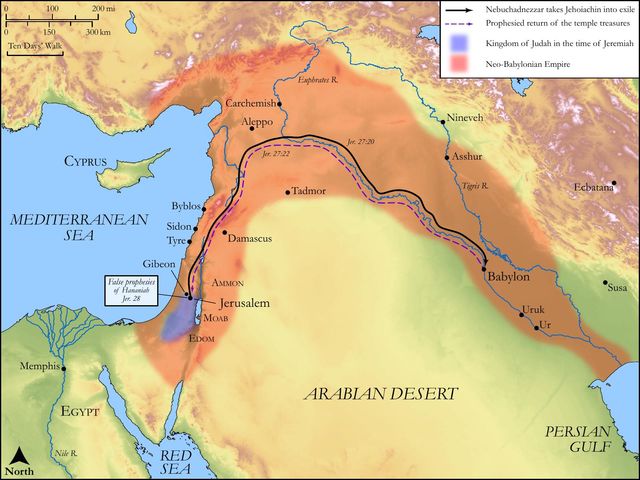
The events of Jeremiah 28 are situated in Jerusalem around 593 BC, during the fourth year of King Zedekiah's reign, a period marked by profound political instability and spiritual confusion. The Babylonian Empire, under Nebuchadnezzar, had already asserted its dominance, having carried off significant portions of the Judean population, including King Jehoiachin and leading citizens, in the 597 BC exile. Judah existed as a precarious vassal state, and amidst this subjugation, various nations in the region were contemplating rebellion, often encouraged by prophets who promised a swift end to Babylonian oppression and the immediate return of exiles. The populace, desperate for relief and restoration, eagerly embraced such optimistic messages. In this volatile atmosphere, true prophets like Jeremiah, who called for submission to Babylon as God's decreed judgment, were deeply unpopular and frequently faced persecution. The cultural understanding of prophecy, particularly as articulated in Deuteronomy 18:20-22, emphasized that a prophet who spoke in the Lord's name but whose words did not come true was a false prophet deserving of death. Hananiah's swift death, as foretold by Jeremiah and recorded in Jeremiah 28:17, served as a dramatic and public confirmation of this Deuteronomic test, unequivocally validating Jeremiah's prophetic authority.
Key Themes
ShowHideJeremiah 28:16 is central to several profound themes woven throughout the book of Jeremiah. Most prominent is the crucial distinction between Authentic Prophecy and False Prophecy, highlighting the severe consequences for those who presume to speak for God without His authorization. Hananiah's demise serves as an undeniable divine validation of Jeremiah's unpopular but true message, clearly separating it from popular but deceptive pronouncements. This verse also powerfully underscores the theme of Divine Sovereignty over nations and historical events; despite human resistance or denial of God's decreed judgment (the Babylonian captivity), His ultimate will and plan are unalterable and will prevail. Furthermore, it emphasizes the profound gravity of Rebellion against the LORD, not merely as disobedience to His commands, but specifically as defiance against His revealed word delivered through His chosen messengers. Hananiah's actions were not a mere miscalculation but an active incitement to defy God's established plan, leading the people into deeper sin and spiritual delusion. This echoes Jeremiah's broader warnings against the spiritual blindness and stubbornness that characterize Judah's sin (Jeremiah 7:24).
Exposition and Analysis
ShowHideKey Word Analysis
ShowHideThis is the sacred, covenantal name of God (H3068), derived from a root signifying "to be" or "to exist," emphasizing His self-existence, eternal nature, and His absolute authority as the sovereign God of Israel. When the text declares "thus saith the LORD," it unequivocally asserts that the pronouncement is not merely Jeremiah's human opinion or interpretation, but a direct, authoritative declaration from the ultimate divine power, whose word is immutable and cannot be gainsaid or nullified. The judgment against Hananiah is, therefore, a direct affront to God's very being and His covenant faithfulness, demanding a divine response.
This term (H5627), derived from a root meaning "to turn away," denotes apostasy, crime, revolt, or defection. It is a potent word that signifies Hananiah's false prophecy was not an innocent or well-intentioned error, but an active, deliberate act of leading the people away from God's revealed will and into direct opposition against Him. It implies a mutinous spirit, challenging God's authority and inciting others to do the same, thereby making his sin particularly grievous in the eyes of the Lord, as it undermined the very foundation of divine-human relationship and national obedience.
As a primitive root (H4191), this word signifies to cease living, either literally or figuratively, and can also convey the act of killing. In this context, it is an unequivocal and immediate literal death sentence. The phrase "thou shalt die" is an absolute, non-negotiable pronouncement of physical demise, underscoring the finality, severity, and certainty of God's judgment upon Hananiah for his rebellion. It serves as the ultimate, undeniable proof of his false prophecy, as his own life is forfeited within the very timeframe he had falsely prophesied for the end of the Babylonian exile.
Verse Breakdown
ShowHide"Therefore thus saith the LORD; Behold, I will cast thee from off the face of the earth:"
This opening clause firmly establishes the divine origin and irreversible nature of the impending judgment. The connective "Therefore" directly links the pronouncement to Hananiah's preceding actions of false prophecy and incitement to rebellion. "Thus saith the LORD" asserts God's absolute authority and the non-negotiable truth of His declaration. The powerful idiom "cast thee from off the face of the earth" is an emphatic expression of complete and utter removal, signifying not just death but a total erasure of Hananiah's presence and influence from the land of the living, representing a severe form of divine rejection and condemnation.
"this year thou shalt die,"
This clause provides a precise and immediate timeframe for the execution of the judgment, making it a verifiable prophecy. The specificity of "this year" (implying within 12 months from the time of the prophecy) would serve as an undeniable and swift sign to all who witnessed the confrontation between Jeremiah and Hananiah, unequivocally confirming Jeremiah's authenticity and the veracity of God's word. This immediate and personal judgment stands in stark contrast to Hananiah's own two-year prophecy for the return of the exiles, highlighting the swift and personal nature of God's justice.
"because thou hast taught rebellion against the LORD."
This concluding clause explicitly states the profound reason for Hananiah's severe punishment. His offense was not merely an error in judgment or a mistaken prediction; it was an active and deliberate act of "teaching rebellion" (from the Hebrew H1696, dâbar, meaning to speak or teach, combined with H5627, çârâh, rebellion). This means Hananiah purposefully propagated a message that directly contradicted God's revealed will, thereby inciting the people to defy divine instruction and cling to a deceptive hope. By doing so, he led them further into sin and away from the path of repentance, submission, and patient endurance that God required. This highlights the immense and grave responsibility of all who claim to speak on behalf of God.
Literary Devices
ShowHideJeremiah 28:16 is powerfully constructed through several literary devices that amplify its message of divine judgment. The most prominent is the Divine Oracle, immediately signaled by the authoritative declaration, "Thus saith the LORD." This phrase establishes the absolute authority and divine origin of the pronouncement, unequivocally distinguishing it from any human opinion or wishful thinking. The expression "cast thee from off the face of the earth" employs potent Hyperbole to emphasize the totality and severity of Hananiah's removal; it signifies not merely death, but a complete eradication of his presence, influence, and memory. This hyperbole underscores God's utter rejection of false prophecy and those who propagate it. Furthermore, the verse functions as a critical moment of Prophetic Fulfillment. Jeremiah's earlier, more general warning to Hananiah (Jeremiah 28:15) is here given a precise and immediate timeline, and Hananiah's subsequent death (Jeremiah 28:17) serves as a dramatic, public, and irrefutable validation of Jeremiah's true prophetic office, directly fulfilling the test of a true prophet as outlined in the Mosaic Law.
Theological and Thematic Connections
ShowHideJeremiah 28:16 stands as a profound theological declaration concerning the sanctity of God's revealed word, the nature of divine truth, and the severe consequences reserved for spiritual deception. It vividly illustrates God's active involvement in human history, not only in guiding His covenant people but also in executing righteous judgment upon those who mislead them. The Lord's immediate and public judgment on Hananiah underscores that false prophecy is not a minor theological error but a grave act of rebellion that directly undermines God's authority, endangers the spiritual well-being of His people, and ultimately challenges His very character. This passage serves as a timeless warning against those who presumptuously speak in God's name, offering comforting lies or self-serving narratives instead of challenging truths. It highlights God's unwavering commitment to vindicating His authentic messengers and His revealed word, reminding us that God is not mocked, and His justice will ultimately prevail against all forms of spiritual falsehood and rebellion.
Reflection and Application
ShowHideJeremiah 28:16 offers a piercing and enduring lesson for believers across all generations, particularly pertinent in a contemporary world saturated with diverse voices claiming spiritual authority. This passage compels us to cultivate a profound and vigilant sense of spiritual discernment, recognizing that not every comforting message, popular teaching, or charismatic speaker genuinely originates from God. The swift and public judgment on Hananiah serves as a stark and sobering reminder of the immense gravity of speaking falsely in the Lord's name and the profound responsibility incumbent upon all who teach or preach. We are called to rigorously test all teachings and pronouncements against the infallible standard of Holy Scripture, understanding that true faith often involves embracing uncomfortable truths and submitting to God's sovereign will, even when it demands patience, sacrifice, or a prolonged period of waiting. This verse challenges us to prioritize divine truth over personal comfort, to seek genuine repentance and transformation over superficial assurances, and to trust implicitly in God's perfect timing and sovereign plan, rather than succumbing to the allure of messages that promise immediate relief without addressing the deeper issues of sin, obedience, and divine judgment.
Questions for Reflection
ShowHideFAQ
ShowHideHow can believers today discern between true and false spiritual messages, especially when they sound comforting or popular?
ShowHideDiscerning true from false messages today requires a deep commitment to God's Word and a humble reliance on the Holy Spirit. Firstly, compare all teachings to Scripture. A true message will always align consistently with the entirety of God's revealed Word, rather than relying on isolated verses taken out of context. As 2 Timothy 3:16-17 states, "All Scripture is God-breathed and is useful for teaching, rebuking, correcting and training in righteousness, so that the servant of God may be thoroughly equipped for every good work." Secondly, examine the fruit of the teaching and the character of the teacher. Matthew 7:15-20 warns us to "watch out for false prophets... by their fruit you will recognize them." Does the teaching promote genuine godliness, humility, Christ-like love, and obedience to God, or does it primarily appeal to selfish desires, pride, worldly gain, or a disregard for sound doctrine? Thirdly, seek confirmation from the Holy Spirit. The Spirit of truth guides believers into all truth (John 16:13). Finally, consider the historical witness of the church and the wisdom of mature, godly leaders who have demonstrated faithfulness to biblical truth over time.
Does God still bring such immediate and severe judgment on those who teach rebellion today?
ShowHideWhile God's character, holiness, and principles of justice remain eternally unchanging, His methods of judgment have indeed shifted with the inauguration of the new covenant. In the Old Testament, particularly concerning prophets who spoke in His name, immediate and often physical judgment served as a clear, public sign to a specific covenant people, unequivocally demonstrating divine authority and the consequences of disobedience. In the New Testament era, the ultimate judgment for rebellion and false teaching is primarily spiritual and eternal, though temporal consequences and divine discipline can still occur. Romans 1:18 speaks of God's wrath being revealed from heaven against all ungodliness and wickedness. The New Testament warns of spiritual blindness, increasing deception, and ultimately, eternal separation from God for those who persist in teaching rebellion and rejecting Christ (2 Peter 2:1-3). While we may not witness individuals struck dead for false prophecy in the same dramatic fashion today, the spiritual consequences are no less severe, and God's ultimate and final judgment for unrepentant rebellion is certain.
Christ-Centered Fulfillment
ShowHideJeremiah 28:16, with its stark portrayal of divine judgment against a false prophet, finds its ultimate fulfillment and profound resolution in the person and redemptive work of Jesus Christ. Hananiah's swift death was a temporary and localized vindication of Jeremiah's true prophecy, but Jesus is the True Prophet par excellence, the one whom Moses foretold would be raised up, to whom all must listen (Deuteronomy 18:15-18). He is the very Word of God made flesh (John 1:14), who perfectly reveals the Father's will and speaks only unadulterated truth. Unlike Hananiah, who "taught rebellion," Jesus perfectly embodied absolute obedience, even to the ignominious death on a cross (Philippians 2:8). His life and teachings consistently exposed the falsehoods, hypocrisy, and spiritual rebellion of the religious leaders of His day, warning His followers against those who would lead others astray with deceptive messages (Matthew 23:13). Furthermore, the judgment against Hananiah foreshadows Christ's ultimate and universal authority to judge all rebellion and falsehood. He is the one who will cast out all those who practice lawlessness and claim to know Him falsely (Matthew 7:23), and whose word will stand forever as the final arbiter of truth for all humanity (Matthew 24:35). Through His atoning sacrifice on the cross, Jesus also offers the only true way to overcome the "rebellion" of sin that plagues humanity, providing forgiveness, reconciliation with God, and genuine peace, thereby fulfilling the deepest longing for restoration that Hananiah falsely promised (Colossians 1:20). In Christ, God's word is not only spoken but perfectly embodied, and His judgment is not merely a threat but a saving act for all who believe and submit to His truth.