


2 Timothy 3:8
Bible text: King James Version (1769 Blayney text) · Public domain
Bible text: King James Version with Strong's numbers · Public domain
Bible text: Berean Standard Bible · Public domain
Bible text: American Standard Version (1901) · Public domain
Bible text: World English Bible, Messianic edition · Public domain
Bible text: Geneva Bible (1599) · Public domain
Bible text: Young's Literal Translation · Public domain
- ὋνHonBy whichG3739R-ASMRelative pronoun Accusative Singular Masculine
- τρόπονtroponwayG5158N-ASMNoun Accusative Singular Masculine
- δὲdenowG1161CONJConjunction
- ἸάννηςIannēsJannesG2389N-NSM-PNoun Nominative Singular Masculine Individual
- καὶkaiandG2532CONJConjunction
- ἸαμβρῆςIambrēsJambresG2387N-NSM-PNoun Nominative Singular Masculine Individual
- ἀντέστησανantestēsanopposedG436V-2AAI-3PVerb 2nd Aorist Active Indicative 3rd Plural
- ΜωϋσεῖMōuseito MosesG3475N-DSM-PNoun Dative Singular Masculine Individual
- οὕτωςhoutōssoG3779ADVAdverb
- καὶkaialsoG2532CONJConjunction
- οὗτοιhoutoitheseG3778D-NPMDemonstrative pronoun Nominative Plural Masculine
- ἀνθίστανταιanthistantaiopposeG436V-PMI-3PVerb Present Middle Indicative 3rd Plural
- τῇtēato theG3588T-DSFDefinite article Dative Singular Feminine
- ἀληθείᾳalētheiatruthG225N-DSFNoun Dative Singular Feminine
- ἄνθρωποιanthrōpoimenG444N-NPMNoun Nominative Plural Masculine
- κατεφθαρμένοιkatephtharmenoidepravedG2704V-RPP-NPMVerb Perfect Passive Participle Nominative Plural Masculine
- τὸνton<the>G3588T-ASMDefinite article Accusative Singular Masculine
- νοῦνnounin mindG3563N-ASMNoun Accusative Singular Masculine
- ἀδόκιμοιadokimoidisqualifiedG96A-NPMAdjective Nominative Plural Masculine
- περὶperiregardingG4012PREPPreposition
- τὴνtēntheG3588T-ASFDefinite article Accusative Singular Feminine
- πίστινpistinfaithG4102N-ASFNoun Accusative Singular Feminine
English is a literal word-by-word gloss of the Greek, not the KJV's wording. Why?
This is the original text the KJV's translators worked from — each Greek word with its own literal English meaning in this verse, prepared by scholars at Tyndale House, Cambridge. The KJV translates whole sentences, not word by word, so its wording differs: one Greek word can become several English words, and the KJV may choose “charity” where the gloss reads “love”. Both are faithful — they answer different questions. For the KJV's own rendering, switch to the KJV text.
Details
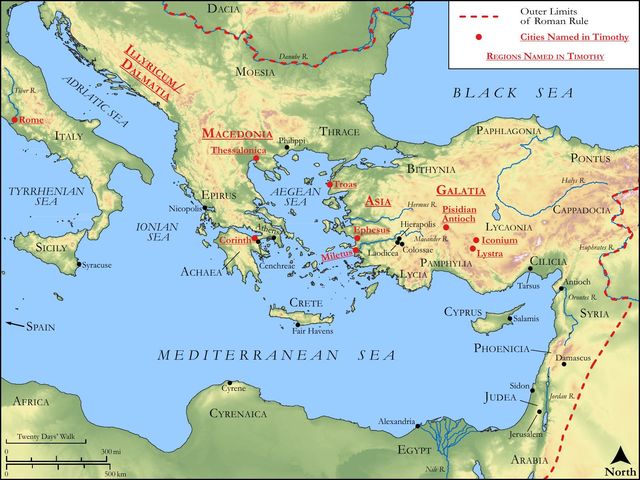
See on the biblical-era maps

Study this verse
Public-domain commentary
Matthew Henry
From his Commentary on the Whole Bible. Henry comments on passages, not single verses — this entry covers 2 Timothy 3:1–9. His three-level outline is real structure in the source text, so it is rendered as structure.
Timothy must not think it strange if there were in the church bad men; for the net of the gospel was to enclose both good fish and bad, Mat 13:47, Mat 13:48. Jesus Christ had foretold (Mt. 24) that there would come seducers, and therefore we must not be offended at it, nor think the worse of religion or the church for it. Even in gold ore there will be dross, and a great deal of chaff among the wheat when it lies on the floor.
I.Timothy must know that in the last days (Ti2 3:1), in gospel times, there would come perilous times.
Though gospel times were times of reformation in many respects, let him know that even in gospel times there would be perilous times; not so much on account of persecution from without as on account of corruptions within. These would be difficult times, wherein it would be difficult for a man to keep a good conscience. He does not say, "Perilous times shall come, for both Jews and Gentiles shall be combined to root out Christianity;" but "perilous times shall come, for such as have the form of godliness (Ti2 3:5) shall be corrupt and wicked, and do a great deal of damage to the church." Two traitors within the garrison may do more hurt to it than two thousand besiegers without. Perilous times shall come, for men shall be wicked. Note,
1.Sin makes the times perilous. When there is a general corruption of manners, and of the tempers of men, this makes the times dangerous to live in; for it is hard to keep our integrity in the midst of general corruption.
2.The coming of perilous times is an evidence of the truth of scripture-predictions; if the event in this respect did not answer to the prophecy, we might be tempted to question the divinity of the Bible.
3.We are all concerned to know this, to believe and consider it, that we may not be surprised when we see the times perilous: This know also.
II.Paul tells Timothy what would be the occasion of making these times perilous, or what shall be the marks and signs whereby these times may be known, Ti2 3:2, etc.
1.Self-love will make the times perilous. Who is there who does not love himself? But this is meant of an irregular sinful self-love. Men love their carnal selves better than their spiritual selves. Men love to gratify their own lusts, and make provision for them, more than to please God and do their duty. Instead of Christian charity, which takes care for the good of others, they will mind themselves only, and prefer their own gratification before the church's edification.
2.Covetousness. Observe, Self-love brings in a long train of sins and mischiefs. When men are lovers of themselves, no good can be expected from them, as all good may be expected from those who love God with all their hearts. When covetousness generally prevails, when every man is for what he can get and for keeping what he has, this makes men dangerous to one another, and obliges every man to stand on his guard against his neighbour.
3.Pride and vain-glory. The times are perilous when men, being proud of themselves, are boasters and blasphemers, boasters before men whom they despise and look upon with scorn, and blasphemers of God and of his name. When men do not fear God they will not regard man, and so vice vers.
4.When children are disobedient to their parents, and break through the obligations which they lie under to them both in duty and gratitude, and frequently in interest, having their dependence upon them and their expectation from them, they make the times perilous; for what wickedness will those stick at who will be abusive to their own parents and rebel against them?
5.Unthankfulness and unholiness make the times perilous, and these two commonly go together. What is the reason that men are unholy and without the fear of God, but that they are unthankful for the mercies of God? Ingratitude and impiety go together; for call a man ungrateful, and you can call him by no worse name. Unthankful, and impure, defiled with fleshly lusts, which is an instance of great ingratitude to that God who has provided so well for the support of the body; we abuse his gifts, if we make them the food and fuel of our lusts.
6.The times are perilous when men will not be held by the bonds either of nature or common honesty, when they are without natural affection, and truce-breakers, Ti2 3:3. There is a natural affection due to all. Wherever there is the human nature, there should be humanity towards those of the same nature, but especially between relations. Times are perilous when children are disobedient to their parents (Ti2 3:2) and when parents are without natural affection to their children, Ti2 3:3. See what a corruption of nature sin is, how it deprives men even of that which nature has implanted in them for the support of their own kind; for the natural affection of parents to their children is that which contributes very much to the keeping up of mankind upon the earth. And those who will not be bound by natural affection, no marvel that they will not be bound by the most solemn leagues and covenants. They are truce-breakers, that make no conscience of the engagements they have laid themselves under.
7.The times are perilous when men are false accusers one of another, diaboloi - devils one to another, having no regard to the good name of others, or to the religious obligations of an oath, but thinking themselves at liberty to say and do what they please, Psa 12:4.
8.When men have no government of themselves and their own appetites: not of their own appetites, for they are incontinent; not of their own passions, for they are fierce; when they have no rule over their own spirits, and therefore are like a city that is broken down, and has no walls; they are soon fired, upon the least provocation.
9.When that which is good and ought to be honoured is generally despised and looked upon with contempt. It is the pride of persecutors that they look with contempt upon good people, though they are more excellent than their neighbours.
10.When men are generally treacherous, wilful, and haughty, the times are perilous (Ti2 3:4) - when men are traitors, heady, high-minded. Our Saviour has foretold that the brother shall betray the brother to death and the father the child (Mat 10:21), and those are the worst sort of traitors: those who delivered up their Bibles to persecutors were called traditores, for they betrayed the trust committed to them. When men are petulant and puffed up, behaving scornfully to all about them, and when this temper generally prevails, then the times are perilous.
11.When men are generally lovers of pleasure more than lovers of God. When there are more epicures than true Christians, then the times are bad indeed. God is to be loved above all. That is a carnal mind, and is full of enmity against him, which prefers any thing before him, especially such a sordid thing as carnal pleasure is.
12.When, notwithstanding all this, they have the form of godliness (Ti2 3:5), are called by the Christian name, baptized into the Christian faith, and make a show of religion; but, how plausible soever their form of godliness is, they deny the power of it. When they take upon them the form which should and would bring along with it the power thereof, they will put asunder what God hath joined together: they will assume the form of godliness, to take away their reproach; but they will not submit to the power of it, to take away their sin. Observe here,
(1.)Men may be very bad and wicked under a profession of religion; they may be lovers of themselves, etc., yet have a form of godliness.
(2.)A form of godliness is a very different thing from the power of it; men may have the one and be wholly destitute of the other; yea, they deny it, at least practically in their lives.
(3.)From such good Christians must withdraw themselves.
III.Here Paul warns Timothy to take heed of certain seducers, not only that he might not be drawn away by them himself, but that he might arm those who were under his charge against their seduction.
1.He shows how industrious they were to make proselytes (Ti2 3:6): they applied themselves to particular persons, visited them in their houses, not daring to appear openly; for those that do evil hate the light, Joh 3:20. They were not forced into houses, as good Christians often were by persecution; but they of choice crept into houses, to insinuate themselves into the affections and good opinion of people, and so to draw them over to their party. And see what sort of people those were that they gained, and made proselytes of; they were such as were weak, silly women; and such as were wicked, laden with sins, and led away with divers lusts. A foolish head and a filthy heart make persons, especially women, an easy prey to seducers.
2.He shows how far they were from coming to the knowledge of the truth, though they pretended to be ever learning, Ti2 3:7. In one sense we must all be ever learning, that is, growing in knowledge, following on to know the Lord, pressing forward; but these were sceptics, giddy and unstable, who were forward to imbibe every new notion, under pretence of advancement in knowledge, but never came to a right understanding of the truth as it is in Jesus.
3.He foretels the certain stop that should be put to their progress (Ti2 3:8, Ti2 3:9), comparing them to the Egyptian magicians who withstood Moses, and who are here named, Jannes and Jambres; though the names are not to be met with in the story of the Old Testament, yet they are found in some old Jewish writers. When Moses came with a divine command to fetch Israel out of Egypt, these magicians opposed him. Thus those heretics resisted the truth and like them were men of corrupt minds, men who had their understandings perverted, biassed and prejudiced against the truth, and reprobate concerning the faith, or very far from being true Christians; but they shall proceed no further, or not much further, as some read it. Observe,
(1.)Seducers seek for corners, and love obscurity; for they are afraid to appear in public, and therefore creep into houses. Further, They attack those who are the least able to defend themselves, silly and wicked women.
(2.)Seducers in all ages are much alike. Their characters are the same - namely, Men of corrupt minds, etc.; their conduct is much the same - they resist the truth, as Jannes and Jambres withstood Moses; and they will be alike in their disappointment.
(3.)Those who resist the truth are guilty of folly, yea, of egregious folly; for magna est veritas, et praevalebit - Great is the truth, and shall prevail.
(4.)Though the spirit of error may be let loose for a time, God has it in a chain. Satan can deceive the nations and the churches no further and no longer than God will permit him: Their folly shall be manifest, it shall appear that they are imposters, and every man shall abandon them.
Historical interpretation
Eight Centuries of Reception
9 surviving comments on this verse. Each one is dated, so this reads as a timeline rather than a list.
Select a marker to jump to its quote. Markers stagger vertically where authors wrote within a few decades of each other.
So, too, that other species of magic which operates by miracles, emulous even in opposition to Moses, tried God's patience until the Gospel.
Not lawful, and what is not lawful is lawful. Even as Jannes and Mambres
The one was resisted by Jannes and Jambres, the other by Annas and Caiaphas.
"Now as Jannes and Jambres withstood Moses, so do these also resist the truth." Who are these? The magicians in the time of Moses. But how is it their names are nowhere else introduced? Either they were handed down by tradition, or it is probable that Paul knew them by inspiration. "Men of corrupt minds," he says, "reprobate concerning the faith. But they shall proceed no further; for their folly shall be manifested unto all men, as theirs also was." "They shall proceed no further"; how then does he say elsewhere, "They will increase unto more ungodliness"? (2 Tim. ii. 16.) He there means, that beginning to innovate and to deceive, they will not pause in their error, but will always invent new deceits and corrupt doctrines, for error is never stationary. But here he says, that they shall not be able to deceive, nor carry men away with them, for however at first they may seem to impose upon them, they will soon and easily be detected. For that he is speaking to this effect appears from what follows. "For their folly shall be manifest unto all." Whence? Every way-"as theirs also was." For if errors flourish at first, they do not continue to the end, for so it is with things that are not fair by nature, but fair in appearance; they flourish for a time, and then are detected, and come to nought. But not such are our doctrines, and of these thou art a witness, for in our doctrines there is no deceit, for who would choose to die for a deceit?
A great deal of foolishness has been written about how Paul could have known the names of these two men who resisted Moses. Particularly absurd is the notion that he had access to some information or writing now lost to us.
Do they not resist this truth, men corrupted in mind, reprobates concerning the faith, who respond and speak iniquity, saying, “We have it from God that we are men but from our own selves that we are just”? What are you [Pelagians] saying? You deceive your own selves, not protecting but jettisoning free will, from the height of haughtiness through empty expanses of presumption into the depths of a drowning deep in the sea. Without doubt it is your pronouncement that man of himself does justice. This is the height of your presumption.
Paul takes the story of Jannes and Jambres not from holy Scripture but from an unwritten Jewish tradition.
The sins of the wicked come about in three ways. Either they are bound up with sacrileges or vices or crimes. For they commit sacrilege when they do not believe rightly concerning God and depart from the true faith either because of fear of temporal misfortunes or desire for temporal advantages or by blindness or perversity of heart alone. They sin by vice when unrestrained or obscene in themselves; they live in a shameful fashion. Then they sin by crimes when they cruelly harm others, either by damages or some kind of oppression. The blessed apostle calls both of them reprobate whether sinning capitally in faith or in works, saying about those who contradict the true faith, “Just as Jannes and Jambres opposed Moses, so they also oppose the truth, people of depraved mind, unqualified in the faith.”
Just as Jannes and Jambres resisted Moses, so do these also resist the truth, men corrupted in mind, reprobate concerning the faith, but they will progress no further. For their folly will be evident to all, as was that of those men.
Jannes and Jambres. These were the magicians of Pharaoh. But how does one know their names when Scripture does not say? We say that it was from unwritten tradition; it was likely from the Holy Spirit that Paul knew.
so do these also resist the truth. To the true faith.
men corrupted in mind, reprobate concerning the faith, but they will progress no further. When someone's mind is corrupted by passions, then they become unreliable regarding faith. How could they advance in wickedness without saying "they will advance"? Here it says, "they will progress no further." There it says that once they begin to wander, they will not stand anywhere, but will always devise something worse; here, however, it says that they will neither deceive nor seize many of the prudent.
— [OECUMENIUS] For Paul said beforehand, "Wandering and being led astray." (2 Tim. 3:13) Therefore, the power lies with those who are not easily deceived. [end of the excerpt by Oecumenius A f. 181r; B f. 219r; G f. 308r] —
For their folly will be evident to all. Where does this come from? "From ancient times," Paul says, "be assured. For wickedness is easily exposed."
In another way. If you are unbelieving, learn from what happened to those magicians (Jannes and Jambres). For even they were exposed as performing illusions and deceiving, when Moses truly performed wonders, so that all things of deceit flourish only for a time.
Encouragement to imitate them in opposition to the wicked, in the patience of God.
Continue studying 2 Timothy 3:8 across the web’s major study libraries — every link below opens this exact verse, chapter, or book on the destination site.
Read & Compare
 BibleGatewayThis verse in more than 200 translations and 70 languages.
 Bible.comThe YouVersion reader — hundreds of translations, reading plans, and highlights.
 ESV.orgCrossway's official English Standard Version reader.
 NET BibleThe NET translation with 60,000+ translators' notes on every rendering decision.
 STEP BibleTyndale House's free study tool — original text, vocabulary, and scholarly resources.
 BibliaLogos Bible Software's free web reader.
 USCCBThe New American Bible (Revised Edition) with the U.S. bishops' study notes.
Commentaries
 BibleHub CommentariesDozens of classic commentaries on this verse, gathered on one page.
 StudyLightMore than 100 commentary sets — the largest collection on the web.
 BibleRefPlain-English commentary on what this verse means, verse by verse.
 Enduring WordDavid Guzik's free commentary on this chapter, widely used by Bible teachers.
 Bible Study ToolsVerse commentary alongside Greek and Hebrew study aids.
Original Language & Research
- BibleHub InterlinearThe verse word by word — original language, transliteration, and English.
- BibleHub LexiconEvery word's original-language definition and Strong's entry.
 Blue Letter BibleDeep-study tools — Strong's numbers, concordance, and word studies.
 CNTR CollationThe earliest Greek manuscripts of this verse, collated letter by letter.
Sermons, Hymns & Audio


TrulyRandomVerse is not affiliated with these sites and doesn’t control their content. They’re linked because they’re genuinely useful.
Summary
In 2 Timothy 3:8, the Apostle Paul issues a solemn warning to Timothy, drawing a vivid parallel between the ancient Egyptian magicians Jannes and Jambres, who vehemently opposed Moses, and contemporary individuals who similarly resist the truth of God. These adversaries are characterized by minds corrupted by sin and a spiritual state described as "reprobate concerning the faith," indicating a profound and deliberate rejection of divine revelation and sound doctrine, rendering them disqualified or worthless in matters of genuine belief.
Context
ShowHideLiterary Context
This verse is deeply embedded within Paul's final letter to his beloved protégé, Timothy, serving as a crucial warning against the spiritual and moral decay characteristic of the "last days" (2 Timothy 3:1). Paul has just enumerated a litany of vices that will define people in these perilous times, ranging from self-love and greed to a superficial religiosity that denies genuine divine power (2 Timothy 3:2-5). Verse 8 specifically identifies the active opposition of such individuals, moving beyond mere character flaws to deliberate resistance against God's truth. The immediate verses that follow (2 Timothy 3:9) promise that the folly of these false teachers will eventually be exposed, just as that of Jannes and Jambres was, providing a glimmer of hope and assurance amidst the dire warning. The broader context of 2 Timothy emphasizes the importance of holding fast to sound doctrine, enduring hardship, and faithfully proclaiming the Word, all of which are essential in confronting the very opposition described here.
Historical & Cultural Context
Paul's reference to "Jannes and Jambres" is particularly insightful, drawing upon a tradition not explicitly detailed in the Old Testament but well-known within Jewish literature and oral tradition of the time. These two figures are widely identified as the chief magicians or sorcerers in Pharaoh's court who attempted to replicate the miraculous signs performed by Moses and Aaron before Pharaoh (as recounted in Exodus 7:11-12 and Exodus 8:7). While they could initially mimic some of God's power, their limitations were starkly revealed when they failed to reproduce the plague of gnats, confessing, "This is the finger of God!" (as seen in Exodus 8:18-19). By invoking these specific names, Paul taps into a powerful archetype of those who, despite witnessing undeniable divine power and truth, stubbornly resist it through deceptive means, ultimately failing. This historical allusion would have resonated strongly with Timothy, a Jewish Christian, and his audience, providing a clear and universally understood example of spiritual opposition.
Key Themes
ShowHideThe passage powerfully articulates several interconnected themes. Firstly, it highlights the Persistent Nature of Spiritual Opposition, underscoring that resistance to God's truth is not a new phenomenon but a recurring pattern throughout redemptive history, from the time of Moses to the "last days" Timothy now faced and believers continue to face. Secondly, it delves into the Moral and Intellectual Corruption that fuels such resistance, describing these individuals as having "corrupt minds" and being "reprobate concerning the faith." This speaks to a profound internal spiritual decay that renders them incapable of discerning or accepting divine truth, often leading to a rejection of the very core tenets of the gospel, as seen in Titus 1:15-16. Lastly, the verse implicitly emphasizes the Discernment and Steadfastness Required of believers like Timothy. Just as Moses persevered despite opposition, so too must God's servants remain firm in sound doctrine and righteous living, trusting that the ultimate exposure of falsehood is inevitable, as Paul reiterates in 2 Timothy 3:9.
Exposition and Analysis
ShowHideKey Word Analysis
ShowHideThis verb, used twice in the verse, signifies "to stand against," "to oppose," or "to set oneself in opposition to." It implies an active, deliberate, and often hostile confrontation. In the context of Jannes and Jambres, it describes their direct challenge to Moses' divine authority and miraculous signs. When applied to the "these also," it denotes a similar, intentional antagonism toward the truth of the gospel. It's not passive ignorance but an active stance against what is right and true.
Derived from a verb meaning "to spoil entirely" or "to destroy," this term, when used figuratively, means "to deprave" or "to utterly perish." Here, it describes the state of the minds (noûs) of the adversaries. Their intellect and moral understanding are not merely flawed but are thoroughly ruined, depraved, and spiritually decayed, rendering them incapable of sound judgment or reception of truth.
This adjective literally means "not standing the test," "unapproved," or "rejected after examination." It was used in contexts like metals that failed to meet a standard of purity or athletes disqualified from a competition. In a theological sense, it describes those who, when tested by the standard of faith and truth, are found wanting and are therefore disapproved or rejected by God. It signifies a state of spiritual worthlessness or disqualification, not necessarily from salvation (which is God's prerogative) but certainly from genuine participation in or understanding of true faith.
Verse Breakdown
ShowHide"Now as Jannes and Jambres withstood Moses"
This opening clause establishes the historical precedent and the nature of the opposition. Paul immediately grounds his contemporary warning in a well-known ancient narrative, drawing a direct and powerful analogy. The resistance of Jannes and Jambres to Moses was a direct challenge to God's divinely appointed messenger and His revealed power. Their actions were characterized by an attempt to counterfeit divine works and undermine God's authority.
"so do these also resist the truth"
This is the core of Paul's analogy, applying the historical example to the present situation. The "these" refers to the false teachers and morally corrupt individuals Paul has been describing in the preceding verses. Their resistance is not against a person, but against "the truth" itself—the revealed Word of God, the gospel, and sound doctrine. This resistance implies a deliberate choice to stand against divine revelation, often through deception, false teaching, or a rejection of moral and spiritual standards.
"men of corrupt minds, reprobate concerning the faith"
This final clause describes the internal spiritual condition of those who resist the truth. Their "minds" (intellect, understanding, moral faculty) are "corrupt," meaning they are thoroughly depraved, ruined, or spoiled by sin and falsehood. This corruption prevents them from discerning or accepting truth. Furthermore, they are "reprobate concerning the faith," indicating that in matters of faith, they are found to be disqualified, worthless, or rejected. This is not a statement about God's election but about their demonstrated spiritual bankruptcy and inability to genuinely embrace or live out true, saving faith.
Literary Devices
ShowHidePaul masterfully employs several literary devices in this verse. The most prominent is Analogy/Comparison, where he directly likens the contemporary opponents of truth to the ancient figures of Jannes and Jambres. This comparison serves to clarify the nature of the opposition Timothy faces, providing a historical precedent and suggesting the ultimate outcome. By using Jannes and Jambres, Paul also employs Archetype, presenting these figures as symbolic representations of all who stubbornly resist divine truth despite clear evidence. Furthermore, the descriptions "corrupt minds" and "reprobate concerning the faith" function as powerful Metaphors for the internal spiritual state of these individuals, painting a vivid picture of intellectual and moral decay that renders them spiritually bankrupt and disqualified from true faith.
Theological and Thematic Connections
ShowHideThis verse profoundly connects to the broader biblical narrative of spiritual warfare, highlighting the ongoing conflict between truth and falsehood, light and darkness. It underscores that resistance to God's truth is not merely intellectual disagreement but often stems from a deep-seated moral and spiritual corruption. The "reprobate" nature of these individuals points to a state where, having repeatedly rejected God's truth, their capacity for spiritual discernment becomes severely impaired, leading to a divine "giving over" to their own darkened understanding. This serves as a sober warning about the consequences of persistent rebellion against God's revealed will and the importance of guarding one's mind and heart against the insidious influence of error.
Reflection and Application
ShowHidePaul's warning in 2 Timothy 3:8 serves as an enduring call for vigilance and discernment for believers in every age. It reminds us that spiritual opposition is an ever-present reality, often manifesting not as overt persecution but as subtle deception and resistance to truth from within the broader spiritual landscape. We are challenged to cultivate minds that are not easily swayed by corrupt ideologies or false teachings, but are instead renewed by the Spirit and anchored in the unshakeable truth of God's Word. This requires not only intellectual engagement with Scripture but also a deep commitment to moral purity and spiritual integrity, recognizing that a corrupt mind and a reprobate faith are often intertwined. Ultimately, this verse encourages us to stand firm, knowing that just as Jannes and Jambres' folly was exposed, so too will the emptiness of all who resist the truth ultimately be made manifest, and God's truth will prevail.
Questions for Reflection
ShowHideFAQ
ShowHideWho were Jannes and Jambres, and why does Paul mention them?
ShowHideJannes and Jambres were, according to ancient Jewish tradition and extra-biblical sources, the chief magicians or sorcerers in Pharaoh's court who opposed Moses and Aaron during the Exodus. While they are not explicitly named in the Old Testament book of Exodus, their involvement is widely accepted in Jewish lore. Paul mentions them in 2 Timothy 3:8 to draw a direct parallel between their historical resistance to God's power demonstrated through Moses, and the contemporary resistance to God's truth exhibited by false teachers and morally corrupt individuals in Timothy's day. They serve as an archetype of those who, despite witnessing undeniable divine power, stubbornly resist the truth through deception and imitation, ultimately failing.
What does it mean to have "corrupt minds" and be "reprobate concerning the faith"?
ShowHideTo have "corrupt minds" (Greek: kataphtheírō noûs) means that one's intellect, understanding, and moral faculty are thoroughly depraved, spoiled, or ruined by sin and falsehood. This corruption renders them incapable of discerning or accepting spiritual truth. It's not merely a lack of knowledge but a deep-seated moral and intellectual decay. To be "reprobate concerning the faith" (Greek: adókimos perí pístin) means to be "unapproved," "disqualified," or "rejected after examination" in matters of faith. This signifies a spiritual state where, when put to the test of genuine faith and sound doctrine, these individuals are found wanting and are therefore disapproved by God. It indicates a fundamental spiritual bankruptcy and an inability to truly embrace or live out authentic Christian faith, often as a consequence of persistent rejection of the truth, as described in Romans 1:28.
Christ-Centered Fulfillment
ShowHideThe resistance to truth and the presence of corrupt, reprobate minds, as described in 2 Timothy 3:8, finds its ultimate contrast and conquest in Jesus Christ. He is not merely a messenger of truth, but the very embodiment of it, declaring, "I am the way, the truth, and the life" (John 14:6). Throughout His earthly ministry, Jesus Himself faced relentless opposition from those with corrupt minds and reprobate hearts, particularly the religious leaders who, like Jannes and Jambres, resisted the undeniable signs of God's power and the truth of His words (John 8:44 reveals the source of their deception). Their spiritual blindness and hardened hearts prevented them from recognizing the Messiah. However, Christ's victory on the cross and His resurrection utterly disarmed all spiritual adversaries and powers that stand against the truth (Colossians 2:15). For believers, our fulfillment lies in Christ, who empowers us to "put on the full armor of God, so that you can take your stand against the devil's schemes" (Ephesians 6:11). Through Him, we are not only enabled to discern and resist falsehood but are also transformed by the renewing of our minds, allowing us to prove what is the good, pleasing, and perfect will of God (Romans 12:2). In Christ, the truth always triumphs over every form of resistance and corruption.