


Acts 13:11
- καὶkaiAndG2532CONJConjunction
- νῦνnunnowG3568ADVAdverb
- ἰδοὺidoubeholdG2400INJInterjection
- χεὶρcheir[the] handG5495N-NSFNoun Nominative Singular Feminine
- τοῦtou<the>G3588T-GSMDefinite article Genitive Singular Masculine
- κυρίουkuriouof the LordG2962N-GSM-TNoun Genitive Singular Masculine Title
- ἐπὶepi[is] uponG1909PREPPreposition
- σέseyouG4771P-2ASPersonal pronoun Accusative 2nd Singular
- καὶkaiandG2532CONJConjunction
- ἔσῃesēyou will beG1510V-FDI-2SVerb Future Middle Deponent Indicative 2nd Singular
- τυφλὸςtuphlosblindG5185A-NSMAdjective Nominative Singular Masculine
- μὴmēnotG3361PRT-NNegative Particle Negative
- βλέπωνblepōnseeingG991V-PAP-NSMVerb Present Active Participle Nominative Singular Masculine
- τὸνtontheG3588T-ASMDefinite article Accusative Singular Masculine
- ἥλιονhēlionsunG2246N-ASMNoun Accusative Singular Masculine
- ἄχριachriduringG891PREPPreposition
- καιροῦkairoua seasonG2540N-GSMNoun Genitive Singular Masculine
- παραχρῆμάparachrēmaImmediatelyG3916ADVAdverb
- τεtethenG5037CONJConjunction
- ἔπεσενepesendescendedG4098V-2AAI-3SVerb 2nd Aorist Active Indicative 3rd Singular
- ἐπ᾽ep᾽uponG1909PREPPreposition
- αὐτὸνautonhimG846P-ASMPersonal pronoun Accusative Singular Masculine
- ἀχλὺςachlusmistG887N-NSFNoun Nominative Singular Feminine
- καὶkaiandG2532CONJConjunction
- σκότοςskotosdarknessG4655N-NSNNoun Nominative Singular Neuter
- καὶkaiandG2532CONJConjunction
- περιάγωνperiagōngoing aboutG4013V-PAP-NSMVerb Present Active Participle Nominative Singular Masculine
- ἐζήτειezēteihe was seekingG2212V-IAI-3SVerb Imperfect Active Indicative 3rd Singular
- χειραγωγούςcheiragōgousone to lead by handG5497N-APMNoun Accusative Plural Masculine
English is a literal word-by-word gloss of the Greek, not the KJV's wording. Why?
This is the original text the KJV's translators worked from — each Greek word with its own literal English meaning in this verse, prepared by scholars at Tyndale House, Cambridge. The KJV translates whole sentences, not word by word, so its wording differs: one Greek word can become several English words, and the KJV may choose “charity” where the gloss reads “love”. Both are faithful — they answer different questions. For the KJV's own rendering, switch to the KJV text.
Details
See on the biblical-era map
Study this verse
Public-domain commentary
Matthew Henry
From his Commentary on the Whole Bible. Henry comments on passages, not single verses — this entry covers Acts 13:4–13. His four-level outline is real structure in the source text, so it is rendered as structure.
In these verses we have,
I.A general account of the coming of Barnabas and Saul to the famous island of Cyprus; and perhaps thitherward they steered their course because Barnabas was a native of that country (Act 4:36), and he was willing they should have the first-fruits of his labours, pursuant to his new commission. Observe,
1.Their being sent forth by the Holy Ghost was the great thing that encouraged them in this undertaking, Act 13:4. If the Holy Ghost send them forth, he will go along with them, strengthen them, carry them on in their work, and give them success; and then they fear no colours, but can cheerfully venture upon a stormy sea from Antioch, which was now to them a quiet harbour.
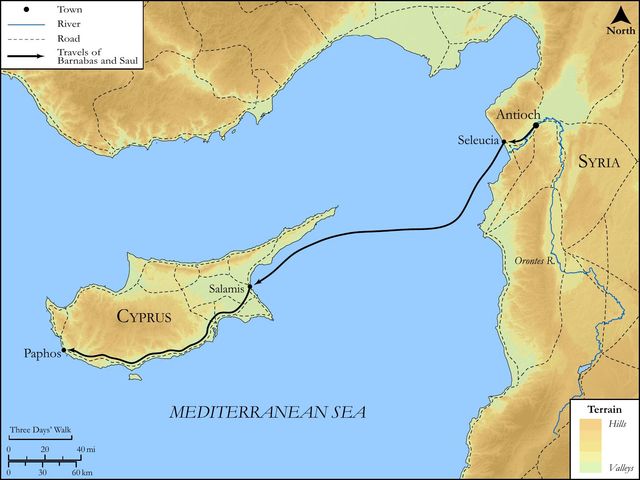
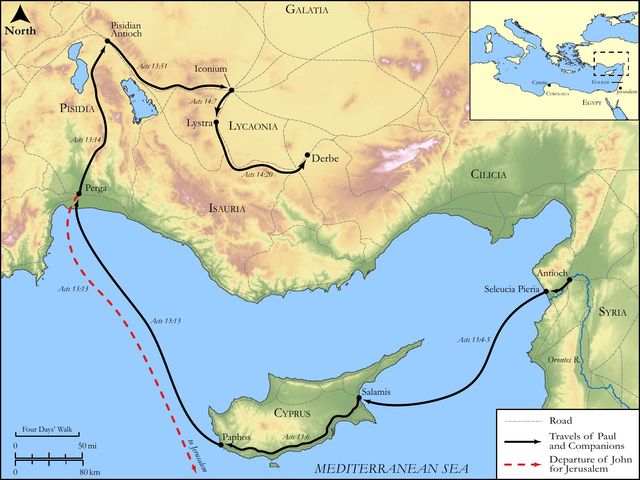
2.They came to Seleucia, the sea-port town opposite to Cyprus, thence crossed the sea to Cyprus, and in that island the first city they came to was Salamis, a city on the east side of the island (Act 13:5); and, when they had sown good seed there, thence they went onward through the isle (Act 13:6) till they came to Paphos, which lay on the western coast.
3.They preached the word of God wherever they came, in the synagogues of the Jews; so far were they from excluding them that they gave them the preference, and so left those among them who believed not inexcusable; they would have gathered them, but they would not. They did not act clandestinely, nor preach the Messiah to others unknown to them, but laid their doctrine open to the censure of the rulers of their synagogues, who might, if they had any thing to say, object against it. Nor would they have acted separately, but in concert with them, if they had not driven them out from them, and from their synagogues.
4.They had John for their minister; not their servant in common things, but their assistant in the things of God, either to prepare their way in places where they designed to come or to carry on their work in places where they had begun it, or to converse familiarly with those to whom they preached publicly, and explain things to them; and such a one might be many ways of use to them, especially in a strange country.
II.A particular account of their encounter with Elymas the sorcerer, whom they met with at Paphos, where the governor resided; a place famous for a temple built to Venus there, thence called Paphian Venus; and therefore there was more than ordinary need that the Son of God should there be manifested to destroy the works of the devil.
1.There the deputy, a Gentile, Sergius Paulus by name, encouraged the apostles, and was willing to hear their message. He was governor of the country, under the Roman emperor; proconsul or propraetor, such a one as we should call lord lieutenant of the island. He had the character of a prudent man, an intelligent, considerate man, that was ruled by reason, not passion nor prejudice, which appeared by this, that, having a character of Barnabas and Saul, he sent for them, and desired to hear the word of God. Note, When that which we hear has a tendency to lead us to God, it is prudence to desire to hear more of it. Those are wise people, however they may be ranked among the foolish of this world, who are inquisitive after the mind and will of God. Though he was a great man, and a man in authority, and the preachers of the gospel were men that made no figure, yet, if they have a message from God, let him know what it is, and, if it appear to be so, he is ready to receive it.
2.There Elymas, a Jew, a sorcerer, opposed them, and did all he could to obstruct their progress. This justified the apostles in turning to the Gentiles, that this Jew was so malignant against them.
(1.)This Elymas was a pretender to the gift of prophecy, a sorcerer, a false-prophet - one that would be taken for a divine, because he was skilled in the arts of divination; he was a conjurer, and took on him to tell people their fortune, and to discover things lost, and probably was in league with the devil for this purpose; his name was Barjesus - the son of Joshua; it signifies the son of salvation; but the Syriac calls him, Bar-shoma - the son of pride; filius inflationis - the son of inflation.
(2.)He was hanging on at court, was with the deputy of the country. It does not appear that the deputy called for him, as he did for Barnabas and Saul; but he thrust himself upon him, aiming, no doubt, to make a hand of him, and get money by him.
(3.)He made it his business to withstand Barnabas and Saul, as the magicians of Egypt, in Pharaoh's court, withstood Moses and Aaron, Ti2 3:8. He set up himself to be a messenger from heaven, and denied that they were. And thus he sought to turn away the deputy from the faith (Act 13:8), to keep him from receiving the gospel, which he saw him inclined to do. Note, Satan is in a special manner busy with great men and men of power, to keep them from being religious; because he knows that their example, whether good or bad, will have an influence upon many. And those who are in any way instrumental to prejudice people against the truths and ways of Christ are doing the devil's work.
(4.)Saul (who is here for the first time called Paul) fell upon him for this with a holy indignation. Saul, who is also called Paul, Act 13:9. Saul was his name as he was a Hebrew, and of the tribe of Benjamin; Paul was his name as he was a citizen of Rome. Hitherto we have had him mostly conversant among the Jews, and therefore called by his Jewish name; but now, when he is sent forth among the Gentiles, he is called by his Roman name, to put somewhat of a reputation upon him in the Roman cities, Paulus being a very common name among them. But some think he was never called Paul till now that he was instrumental in the conversion of Sergius Paulus to the faith of Christ, and that he took the name Paulus as a memorial of this victory obtained by the gospel of Christ, as among the Romans he that had conquered a country took his denomination from it, as Germanicus, Britannicus, Africanus; or rather, Sergius Paulus himself gave him the name Paulus in token of his favour and respect to him, as Vespasian gave his name Flavius to Josephus the Jew. Now of Paul it is said,
[1.]That he was filled with the Holy Ghost upon this occasion, filled with a holy zeal against a professed enemy of Christ, which was one of the graces of the Holy Ghost - a spirit of burning; filled with power to denounce the wrath of God against him, which was one of the gifts of the Holy Ghost - a spirit of judgment. He felt a more than ordinary fervour in his mind, as the prophet did when he was full of power by the Spirit of the Lord (Mic 3:8), and another prophet when his face was made harder than flint (Eze 3:9), and another when his mouth was made like a sharp sword, Isa 49:2. What Paul said did not come from any personal resentment, but from the strong impressions which the Holy Ghost made upon his spirit.
[2.]He set his eyes upon him, to face him down, and to show a holy boldness, in opposition to his wicked impudence. He set his eyes upon him, as an indication that the eye of the heart-searching God was upon him, and saw through and through him; nay, that the face of the Lord was against him, Psa 34:16. He fixed his eyes upon him, to see if he could discern in his countenance any marks of remorse for what he had done; for, if he could have discerned the least sign of this, it would have prevented the ensuing doom.
[3.]He gave him his true character, not in passion, but by the Holy Ghost, who knows men better than they know themselves, Act 13:10. He describes him to be, First, An agent for hell; and such there have been upon this earth (the seat of the war between the seed of the woman and of the serpent) ever since Cain who was of that wicked one, an incarnate devil, slew his brother, for no other reason than because his own works were evil and his brother's righteous. This Elymas, though called Bar-jesus - a son of Jesus, was really a child of the devil, bore his image, did his lusts, and served his interests, Joh 8:44. In two things he resembled the devil as a child does his father - 1. In craftiness. The serpent was more subtle than any beast of the field (Gen 3:1), and Elymas, though void of all wisdom, was full of all subtlety, expert in all the arts of deceiving men and imposing upon them. 2. In malice. He was full of all mischief - a spiteful ill-conditioned man, and a sworn implacable enemy to God and goodness. Note, A fulness of subtlety and mischief together make a man indeed a child of the devil. Secondly, An adversary to heaven. If he be a child of the devil, it follows of course that he is an enemy to all righteousness, for the devil is so. Note, Those that are enemies to the doctrine of Christ are enemies to all righteousness, for in it all righteousness is summed up and fulfilled.
[4.]He charged upon him his present crime, and expostulated with him upon it: "Wilt thou not cease to pervert the right ways of the Lord, to misrepresent them, to put false colours upon them, and so to discourage people from entering into them, and walking in them?" Note, First, The ways of the Lord are right: they are all so, they are perfectly so. The ways of the Lord Jesus are right, the only right ways to heaven and happiness. Secondly, There are those who pervert these right ways, who not only wander out of these ways themselves (as Elihu's penitent, who owns, I have perverted that which was right and it profited me not), but mislead others, and suggest to them unjust prejudices against these ways: as if the doctrine of Christ were uncertain and precarious, the laws of Christ unreasonable and impractical, and the service of Christ unpleasant and unprofitable, which is an unjust perverting of the right ways of the Lord, and making them seem crooked ways. Thirdly, Those who pervert the right ways of the Lord are commonly so hardened in it that, though the equity of those ways be set before them by the most powerful and commanding evidence, yet they will not cease to do it. Etsi suaseris, non persuaseris - You may advise, but you will never persuade; they will have it their own way; they have loved strangers, and after them they will go.
[5.]He denounced the judgment of God upon him, in a present blindness (Act 13:11): "And now, behold, the hand of the Lord is upon thee, a righteous hand. God is now about to lay hands on thee, and make thee his prisoner, for thou art taken in arms against him; thou shalt be blind, not seeing the sun for a season." This was designed both for the proof of his crime, as it was a miracle wrought to confirm the right ways of the Lord, and consequently to show the wickedness of him who would not cease to pervert them, as also for the punishment of his crime. It was a suitable punishment; he shut his eyes, the eyes of his mind, against the light of the gospel, and therefore justly were the eyes of his body shut against the light of the sun; he sought to blind the deputy (as an agent for the god of this world, who blindeth the minds of those that believe not, lest the light of the gospel should shine unto them, Co2 4:4), and therefore is himself struck blind. Yet it was a moderate punishment: he was only struck blind, when he might most justly have been struck dead; and it was only for a season; if he will repent, and give glory to God, by making confession, his sight shall be restored; nay, it should seem, though he do not, yet his sight shall be restored, to try if he will be led to repentance either by the judgments of God or by his mercies.
[6.]This judgment was immediately executed: There fell on him a mist and a darkness, as on the Sodomites when they persecuted Elisha. This silenced him presently, filled him with confusion, and was an effectual confutation of all he said against the doctrine of Christ. Let not him any more pretend to be a guide to the deputy's conscience who is himself struck blind. It was also an earnest to him of a much sorer punishment if he repent not; for he is one of those wandering stars to whom is reserved the blackness of darkness for ever, Jde 1:13. Elymas did himself proclaim the truth of the miracle, when he went about seeking some to lead him by the hand; and where now is all his skill in sorcery, upon which he had so much valued himself, when he can neither find his way nor find a friend that will be so kind as to lead him!
3.Notwithstanding all the endeavours of Elymas to turn away the deputy from the faith, he was brought to believe, and this miracle, wrought upon the magician himself (like the boils of Egypt, which were upon the magicians, so that they could not stand before Moses, Exo 9:11), contributed to it. The deputy was a very sensible man, and observed something uncommon, and which intimated its divine original,
(1.)In Paul's preaching: he was astonished at the doctrine of the Lord, the Lord Christ - the doctrine that is from him, the discoveries he has made of the Father - the doctrine that is concerning him, his person, natures, offices, undertaking. Note, The doctrine of Christ has a great deal in it that is astonishing; and the more we know of it the more reason we shall see to wonder and stand amazed at it.
(2.)In this miracle: When he saw what was done, and how much Paul's power transcended that of the magician, and how plainly Elymas was baffled and confounded, he believed. It is not said that he was baptized, and so made a complete convert, but it is probable that he was. Paul would not do his business by the halves; as for God, his work is perfect. When he became a Christian, he neither laid down his government, nor was turned out of it, but we may suppose, as a Christian magistrate, by his influence helped very much to propagate Christianity in that island. The tradition of the Romish church, which has taken care to find bishoprics for all the eminent converts we read of in the Acts, has made this Sergius Paulus bishop of Narbon in France, left there by Paul in his journey to Spain.
III.Their departure from the island of Cyprus.
It is probable that they did a great deal more there than is recorded, where an account is given only of that which was extraordinary - the conversion of the deputy. When they had done what they had to do,
1.They quitted the country, and went to Perga. Those that went were Paul and his company, which, it is probable, was increased in Cyprus, many being desirous to accompany him. Anachthentes hoi peri ton Paulon - Those that were about Paul loosed from Paphos, which supposes that he went too; but such an affection had his new friends for him that they were always about him, and by their good will would be never from him.
2.Then John Mark quitted them, and returned to Jerusalem, without the consent of Paul and Barnabas; either he did not like the work, or he wanted to go and see his mother. It was his fault, and we shall hear of it again.
Historical interpretation
Three Centuries of Reception
6 surviving comments on this verse. Each one is dated, so this reads as a timeline rather than a list.
Select a marker to jump to its quote. Markers stagger vertically where authors wrote within a few decades of each other.
He first convicted the sorcerer (and showed), what he was; and that he was such, the sign showed: "thou shalt be blind, not seeing the sun" this was a sign of the blindness of his soul: "for a season": he says, to bring him to repentance.
"And now, behold, the hand of the Lord is upon thee, and thou shalt be blind." It was the sign by which he was himself converted, and by this he would fain convert this man. As also that expression, "for a season," puts it not as an act of punishing, but as meant for his conversion: had it been for punishment, he would have made him lastingly blind, but now it is not so, but "for a season" (and this), that he may gain the proconsul. For, as he was prepossessed by the sorcery, it was well to teach him a lesson by this infliction (and the sorcerer also), in the same way as the magicians (in Egypt) were taught by the boils. "And immediately there fell on him a mist and a darkness: and he went about seeking some to lead him by the hand."
"And now behold the hand of the Lord is upon thee." It was not vengeance then, but healing: for it is as though he said: "It is not I that do it, but the hand of God." Mark how unassuming! No "light," as in the case of Paul, "shone round about him." "Thou shalt be blind," he says, "not seeing the sun for a season," that he may give him opportunity for repentance: for we nowhere find them wishing to be made conspicuous by the more stern (exercise of their authority), even though it was against enemies that this was put forth: in respect of those of their own body (they used severity), and with good reason, but in dealing with those without, not so; that (the obedience of faith) might not seem to be matter of compulsion and fear. It is a proof of his blindness, his "seeking some to lead him by the hand."
Be reasonable now. What happened to the magician through the intervention of the apostle is not contrary to the divine commandment that commands us to love our enemies. But since that man distorted the ways of preaching and drove the proconsul away from the faith through which the entire multitude could easily have been admitted to salvation, Paul punished that blasphemer on the basis of his own way of working things out. After he was warned by being blinded he was then led to knowledge. Indeed he was taught through Paul to cure his infidelity with a remedy, just as Paul cured the contradictions of the law. After he set the limit “until the right time” for judgment so that it might cause in itself the recuperation of the man, he changed his ways for the better.
Behold, the hand of the Lord is upon you, and you will be blind. The Apostle, mindful of his own example, knew that it was possible to rise from the darkness of the eyes of the mind to light. For he did not deserve to have the eyes of the flesh, who labored to take away the eyes of the mind from others.
And immediately a mist and darkness fell upon him. The name of darkness in Greek is placed in the singular number σκότος, which the Latin interpreter did not follow, because this name does not have a singular number in Latin as we have similarly taught above.
Continue studying Acts 13:11 across the web’s major study libraries — every link below opens this exact verse, chapter, or book on the destination site.
Read & Compare
 BibleGatewayThis verse in more than 200 translations and 70 languages.
 Bible.comThe YouVersion reader — hundreds of translations, reading plans, and highlights.
 ESV.orgCrossway's official English Standard Version reader.
 NET BibleThe NET translation with 60,000+ translators' notes on every rendering decision.
 STEP BibleTyndale House's free study tool — original text, vocabulary, and scholarly resources.
 BibliaLogos Bible Software's free web reader.
 USCCBThe New American Bible (Revised Edition) with the U.S. bishops' study notes.
Commentaries
 BibleHub CommentariesDozens of classic commentaries on this verse, gathered on one page.
 StudyLightMore than 100 commentary sets — the largest collection on the web.
 BibleRefPlain-English commentary on what this verse means, verse by verse.
 Enduring WordDavid Guzik's free commentary on this chapter, widely used by Bible teachers.
 Bible Study ToolsVerse commentary alongside Greek and Hebrew study aids.
Original Language & Research
- BibleHub InterlinearThe verse word by word — original language, transliteration, and English.
- BibleHub LexiconEvery word's original-language definition and Strong's entry.
 Blue Letter BibleDeep-study tools — Strong's numbers, concordance, and word studies.
 CNTR CollationThe earliest Greek manuscripts of this verse, collated letter by letter.
Sermons, Hymns & Audio


TrulyRandomVerse is not affiliated with these sites and doesn’t control their content. They’re linked because they’re genuinely useful.
Summary
Acts 13:11 records the dramatic divine judgment pronounced by the Apostle Paul upon Elymas, the sorcerer, who actively opposed the Gospel message in Paphos. This pivotal moment on Paul's first missionary journey demonstrates God's immediate and powerful intervention to protect His message and validate the authority of His apostles, resulting in Elymas's temporary blindness and the proconsul Sergius Paulus's conversion.
Context
ShowHideLiterary Context
This verse is situated within the broader narrative of Paul and Barnabas's first missionary journey, specifically during their time on the island of Cyprus. Having preached in Salamis, they arrive in Paphos, where they encounter Sergius Paulus, the Roman proconsul, who is described as an intelligent man eager to hear the word of God. Standing in opposition is Bar-Jesus, also known as Elymas, a Jewish sorcerer and false prophet. Elymas actively attempts to turn the proconsul away from the faith, distorting the truth and hindering the Gospel's progress. Paul, described as "filled with the Holy Spirit" in Acts 13:9, directly confronts Elymas, exposing his deceit and pronouncing the divine judgment detailed in this verse. The immediate consequence of this judgment, Sergius Paulus's belief, is recorded in Acts 13:12.
Historical & Cultural Context
Paphos was a significant city on the island of Cyprus, serving as the Roman capital. As such, it would have been a hub of Roman administration, culture, and various religious practices, including local cults, Greek and Roman polytheism, and a Jewish community. Sorcerers and magicians like Elymas (Bar-Jesus, meaning "son of Jesus" or "son of Joshua," but ironically, a son of deceit) were common figures in the ancient world, often serving as advisors or spiritual guides to prominent individuals. Their practices frequently involved divination, magic, and attempts to manipulate spiritual forces. The presence of a proconsul, a high-ranking Roman official, indicates the strategic importance of reaching leaders with the Gospel, and the public nature of this confrontation would have had significant implications for the perception of Christianity in the Roman world.
Key Themes
ShowHideActs 13:11 contributes significantly to several key themes within the book of Acts and the broader biblical narrative. Firstly, it powerfully underscores the theme of Divine Authority and Power, demonstrating that the apostolic ministry is not merely human endeavor but operates under the direct power and sanction of God, as Paul's declaration, "the hand of the Lord is upon thee," clearly indicates. Secondly, it highlights the Consequences of Opposing God's Work, serving as a stark warning that active resistance to the spread of the Gospel and the perversion of God's truth brings swift divine judgment, making Elymas's spiritual darkness manifest in physical blindness. Thirdly, the event functions as a Confirmation of the Message, providing undeniable evidence to onlookers, particularly Sergius Paulus, of the truth and power of the Gospel preached by Paul and Barnabas, leading directly to the proconsul's conversion, as seen in Acts 13:12. Finally, the phrase "for a season" introduces the theme of Temporary Judgment with a Possibility of Repentance, echoing Paul's own experience of temporary blindness on the road to Damascus and suggesting that even divine judgment can serve a redemptive purpose.
Exposition and Analysis
ShowHideKey Word Analysis
ShowHideThis word, often translated as "hand," carries significant idiomatic weight in biblical literature, especially when paired with "Lord" (Kyrios). "The hand of the Lord" (ἡ χεὶρ Κυρίου) is a common biblical idiom (e.g., Exodus 9:3, 1 Samuel 5:6) that signifies God's active power, direct intervention, or sovereign judgment. It emphasizes that the blindness inflicted upon Elymas was not a random occurrence or a personal curse from Paul, but a purposeful, direct act orchestrated by God Himself. It underscores the divine origin and authority behind Paul's pronouncement.
Derived from a root suggesting "opaque" or "smoky," this term describes physical blindness. In this context, it signifies a complete inability to see. The choice of blindness as a judgment is highly symbolic, directly mirroring Elymas's spiritual condition. As one who sought to "make crooked the right ways of the Lord" (Acts 13:10), he was spiritually blind to God's truth. His physical blindness serves as a tangible manifestation of his internal spiritual darkness and his attempt to obscure the light of the Gospel from others.
This word denotes a "set or proper time," an "occasion," or a "due season," distinguishing it from chronos (G5550), which refers to general chronological time. The phrase "for a season" (ἄχρι καιροῦ) explicitly indicates a limited duration, underscoring the temporary nature of Elymas's affliction. This suggests that the judgment was punitive and corrective, possibly offering an opportunity for repentance, rather than a final, irreversible condemnation. It highlights God's justice tempered with a measure of grace, leaving open the possibility of future restoration or a period for reflection.
Verse Breakdown
ShowHide"And now, behold, the hand of the Lord is upon thee,"
Paul, filled with the Holy Spirit, directly addresses Elymas, declaring an immediate divine judgment. The phrase "behold" (G2400, idoú) draws immediate attention to the impending, undeniable act of God. "The hand of the Lord" (G5495, G2962) signifies God's active, sovereign power and intervention, clearly indicating that this is not Paul's personal vendetta but a direct divine act. The judgment is not merely a prediction but a present reality, "is upon thee," implying an immediate and inescapable imposition of God's will.
"and thou shalt be blind, not seeing the sun for a season."
This clause specifies the nature of the judgment: Elymas will be afflicted with blindness. The inability to see "the sun" (G2246, hḗlios), the source of natural light, underscores the totality of his physical darkness. The crucial phrase "for a season" (G891, G2540, áchri kairou) indicates that this blindness is not necessarily permanent. This limitation implies a punitive measure designed to humble Elymas and perhaps offer a period for reflection and repentance, rather than a final, irreversible condemnation.
"And immediately there fell on him a mist and a darkness;"
The judgment is instantaneous and palpable. The Greek word "immediately" (G3916, parachrēma) emphasizes the swiftness of God's action. "Mist" (G887, achlýs) suggests a dimness of sight, perhaps like a cataract, while "darkness" (G4655, skótos) signifies a complete lack of light. This dual description powerfully conveys the progressive and overwhelming nature of the blindness, enveloping him completely.
"and he went about seeking some to lead him by the hand."
The immediate consequence of the blindness is Elymas's utter helplessness. The once influential sorcerer, who sought to lead Sergius Paulus astray, is now himself in need of guidance, literally "seeking some to lead him by the hand" (G5497, cheiragōgós). This physical dependence starkly contrasts with his previous position of spiritual influence and highlights the dramatic reversal of his power and autonomy, serving as a public humiliation and a clear sign to all present.
Literary Devices
ShowHideActs 13:11 employs several powerful literary devices. Divine Judgment is the overarching theme, manifested through the direct and immediate infliction of blindness. This act serves as a dramatic demonstration of God's sovereignty over those who oppose His truth. Symbolism is profoundly at play, as Elymas's physical blindness directly mirrors his spiritual darkness and his attempts to obscure the light of the Gospel from the proconsul. The inability to see the sun is a potent symbol of his spiritual inability to perceive divine truth. There is a strong element of Irony in the scene: Elymas, the sorcerer who claimed spiritual insight and sought to manipulate others, is rendered utterly helpless and dependent, forced to seek guidance from others. This ironic reversal underscores the futility of human opposition to divine will. Furthermore, the temporary nature of the blindness, indicated by "for a season," creates a subtle Foreshadowing or parallel to Paul's own experience of temporary blindness on the road to Damascus (Acts 9:8), suggesting that even judgment can be a means to revelation or a call to repentance.
Theological and Thematic Connections
ShowHideActs 13:11 profoundly illustrates the active nature of God's sovereignty in defending His Gospel and His messengers. It reveals that opposition to divine truth is not merely a human conflict but a direct affront to God Himself, often met with swift and visible consequences. This passage underscores the seriousness of spiritual warfare, where forces of darkness actively seek to pervert God's "right ways," and God's willingness to intervene miraculously to confirm His message and protect His people. It also highlights the principle that God's judgment, while severe, can sometimes be temporary and corrective, designed to humble and potentially lead to repentance, rather than immediate destruction. The immediate conversion of Sergius Paulus following this event further emphasizes that God's displays of power are ultimately for the purpose of drawing people to Himself and advancing His kingdom.
Reflection and Application
ShowHideActs 13:11 serves as a powerful reminder that the Gospel is not merely a set of ideas but a living, active force backed by the power of God. For believers, this passage offers encouragement that God actively defends His truth and those who faithfully proclaim it, even in the face of intense spiritual opposition. It calls us to discern spiritual forces at work, recognizing that some opposition to the Gospel is not merely intellectual disagreement but a deliberate attempt to "pervert the right ways of the Lord." While divine judgment today may not always manifest in such dramatic physical ways, the principle remains: actively hindering God's work and distorting His truth carries serious spiritual consequences. This verse challenges us to stand firm in the truth, to pray for discernment against deceptive influences, and to trust that God's power will ultimately prevail over all forms of darkness and deception, leading to the spiritual sight of those who are currently blind.
Questions for Reflection
ShowHideFAQ
ShowHideWas Elymas's blindness permanent, or did he ever regain his sight?
ShowHideThe text explicitly states that Elymas would be blind "for a season" (G2540, kairós). This Greek term denotes a specific, limited period of time, not an indefinite or permanent state. While the Bible does not record Elymas's subsequent fate or whether he ever regained his sight, the phrase "for a season" strongly implies that the blindness was temporary. This temporary nature suggests that the judgment was intended as a corrective measure, a severe warning, and potentially an opportunity for repentance, rather than a final, irreversible condemnation. It mirrors the temporary blindness experienced by Paul himself on the road to Damascus, which led to his conversion and spiritual sight, as described in Acts 9:8-18.
Christ-Centered Fulfillment
ShowHideActs 13:11, while a powerful display of divine judgment against an opponent of the Gospel, ultimately points to the greater work of Christ. Elymas's physical blindness, a direct consequence of his spiritual darkness and opposition to the light of Christ, profoundly foreshadows Jesus' mission to bring spiritual sight to the blind. Just as Elymas sought to "make crooked the right ways of the Lord" (Acts 13:10), humanity, in its fallen state, is spiritually blind, unable to perceive God's truth or walk in His ways. Jesus, the "Light of the World" (John 8:12), came precisely to open the eyes of the spiritually blind, declaring His mission to "proclaim recovery of sight to the blind" (Luke 4:18). The temporary nature of Elymas's blindness, in particular, echoes the transformative grace offered through Christ, who can turn spiritual darkness into glorious light, just as He did for Paul on the Damascus road (Acts 9:1-19). Ultimately, this passage, in its stark depiction of judgment and the subsequent conversion of Sergius Paulus, powerfully underscores the necessity of Christ's redemptive work to deliver humanity from spiritual blindness and lead them into the marvelous light of His truth, fulfilling the prophecy that His coming would bring light to those "sitting in darkness and in the shadow of death" (Luke 1:79).