


Acts 13:10
- εἶπεν·eipensaidG2036V-2AAI-3SVerb 2nd Aorist Active Indicative 3rd Singular
- ὦōOG5599INJInterjection
- πλήρηςplērēsfullG4134A-VSMAdjective Vocative Singular Masculine
- παντὸςpantosof allG3956A-GSMAdjective Genitive Singular Masculine
- δόλουdoloudeceitG1388N-GSMNoun Genitive Singular Masculine
- καὶkaiandG2532CONJConjunction
- πάσηςpasēsallG3956A-GSFAdjective Genitive Singular Feminine
- ῥᾳδιουργίαςrhadiourgiascraftG4468N-GSFNoun Genitive Singular Feminine
- υἱὲhuiesonG5207N-VSMNoun Vocative Singular Masculine
- διαβόλουdiabolouof [the] devilG1228A-GSMAdjective Genitive Singular Masculine
- ἐχθρὲechthreenemyG2190N-VSMNoun Vocative Singular Masculine
- πάσηςpasēsof allG3956A-GSFAdjective Genitive Singular Feminine
- δικαιοσύνηςdikaiosunēsrighteousnessG1343N-GSFNoun Genitive Singular Feminine
- οὐounotG3756PRT-NNegative Particle Negative
- παύσῃpausēwill you ceaseG3973V-FDI-2SVerb Future Middle Deponent Indicative 2nd Singular
- διαστρέφωνdiastrephōnpervertingG1294V-PAP-NSMVerb Present Active Participle Nominative Singular Masculine
- τὰςtastheG3588T-APFDefinite article Accusative Plural Feminine
- ὁδοὺςhodouswaysG3598N-APFNoun Accusative Plural Feminine
- κυρίουkuriouLordG2962N-GSM-TNoun Genitive Singular Masculine Title
- τὰςtas<the>G3588T-APFDefinite article Accusative Plural Feminine
- εὐθείας;eutheiasupright?G2117A-APFAdjective Accusative Plural Feminine
English is a literal word-by-word gloss of the Greek, not the KJV's wording. Why?
This is the original text the KJV's translators worked from — each Greek word with its own literal English meaning in this verse, prepared by scholars at Tyndale House, Cambridge. The KJV translates whole sentences, not word by word, so its wording differs: one Greek word can become several English words, and the KJV may choose “charity” where the gloss reads “love”. Both are faithful — they answer different questions. For the KJV's own rendering, switch to the KJV text.
Details
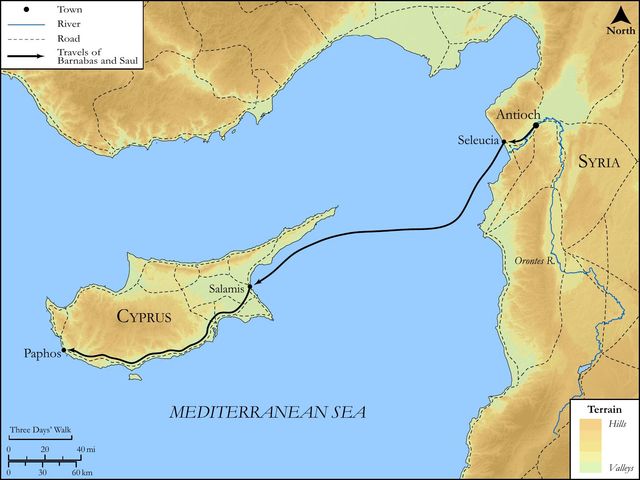
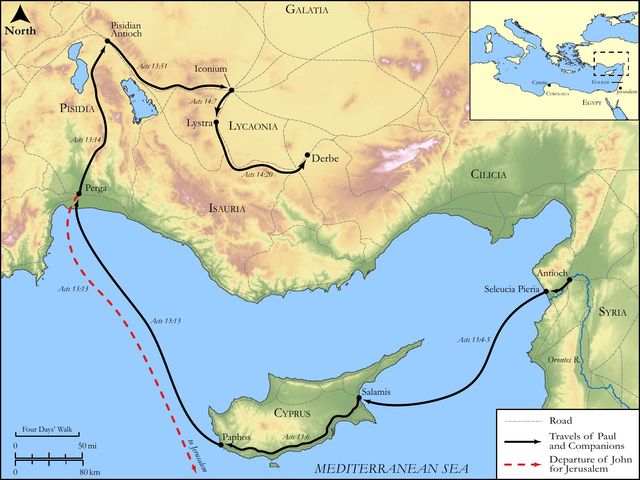
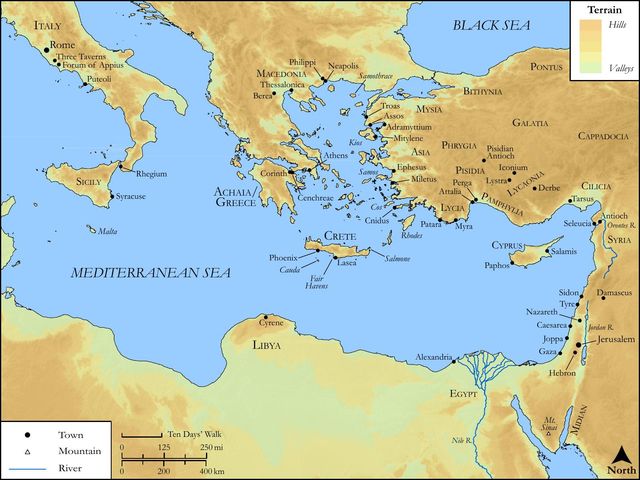
See on the biblical-era map
Study this verse
Public-domain commentary
Matthew Henry
From his Commentary on the Whole Bible. Henry comments on passages, not single verses — this entry covers Acts 13:4–13. His four-level outline is real structure in the source text, so it is rendered as structure.
In these verses we have,
I.A general account of the coming of Barnabas and Saul to the famous island of Cyprus; and perhaps thitherward they steered their course because Barnabas was a native of that country (Act 4:36), and he was willing they should have the first-fruits of his labours, pursuant to his new commission. Observe,
1.Their being sent forth by the Holy Ghost was the great thing that encouraged them in this undertaking, Act 13:4. If the Holy Ghost send them forth, he will go along with them, strengthen them, carry them on in their work, and give them success; and then they fear no colours, but can cheerfully venture upon a stormy sea from Antioch, which was now to them a quiet harbour.
2.They came to Seleucia, the sea-port town opposite to Cyprus, thence crossed the sea to Cyprus, and in that island the first city they came to was Salamis, a city on the east side of the island (Act 13:5); and, when they had sown good seed there, thence they went onward through the isle (Act 13:6) till they came to Paphos, which lay on the western coast.
3.They preached the word of God wherever they came, in the synagogues of the Jews; so far were they from excluding them that they gave them the preference, and so left those among them who believed not inexcusable; they would have gathered them, but they would not. They did not act clandestinely, nor preach the Messiah to others unknown to them, but laid their doctrine open to the censure of the rulers of their synagogues, who might, if they had any thing to say, object against it. Nor would they have acted separately, but in concert with them, if they had not driven them out from them, and from their synagogues.
4.They had John for their minister; not their servant in common things, but their assistant in the things of God, either to prepare their way in places where they designed to come or to carry on their work in places where they had begun it, or to converse familiarly with those to whom they preached publicly, and explain things to them; and such a one might be many ways of use to them, especially in a strange country.
II.A particular account of their encounter with Elymas the sorcerer, whom they met with at Paphos, where the governor resided; a place famous for a temple built to Venus there, thence called Paphian Venus; and therefore there was more than ordinary need that the Son of God should there be manifested to destroy the works of the devil.
1.There the deputy, a Gentile, Sergius Paulus by name, encouraged the apostles, and was willing to hear their message. He was governor of the country, under the Roman emperor; proconsul or propraetor, such a one as we should call lord lieutenant of the island. He had the character of a prudent man, an intelligent, considerate man, that was ruled by reason, not passion nor prejudice, which appeared by this, that, having a character of Barnabas and Saul, he sent for them, and desired to hear the word of God. Note, When that which we hear has a tendency to lead us to God, it is prudence to desire to hear more of it. Those are wise people, however they may be ranked among the foolish of this world, who are inquisitive after the mind and will of God. Though he was a great man, and a man in authority, and the preachers of the gospel were men that made no figure, yet, if they have a message from God, let him know what it is, and, if it appear to be so, he is ready to receive it.
2.There Elymas, a Jew, a sorcerer, opposed them, and did all he could to obstruct their progress. This justified the apostles in turning to the Gentiles, that this Jew was so malignant against them.
(1.)This Elymas was a pretender to the gift of prophecy, a sorcerer, a false-prophet - one that would be taken for a divine, because he was skilled in the arts of divination; he was a conjurer, and took on him to tell people their fortune, and to discover things lost, and probably was in league with the devil for this purpose; his name was Barjesus - the son of Joshua; it signifies the son of salvation; but the Syriac calls him, Bar-shoma - the son of pride; filius inflationis - the son of inflation.
(2.)He was hanging on at court, was with the deputy of the country. It does not appear that the deputy called for him, as he did for Barnabas and Saul; but he thrust himself upon him, aiming, no doubt, to make a hand of him, and get money by him.
(3.)He made it his business to withstand Barnabas and Saul, as the magicians of Egypt, in Pharaoh's court, withstood Moses and Aaron, Ti2 3:8. He set up himself to be a messenger from heaven, and denied that they were. And thus he sought to turn away the deputy from the faith (Act 13:8), to keep him from receiving the gospel, which he saw him inclined to do. Note, Satan is in a special manner busy with great men and men of power, to keep them from being religious; because he knows that their example, whether good or bad, will have an influence upon many. And those who are in any way instrumental to prejudice people against the truths and ways of Christ are doing the devil's work.
(4.)Saul (who is here for the first time called Paul) fell upon him for this with a holy indignation. Saul, who is also called Paul, Act 13:9. Saul was his name as he was a Hebrew, and of the tribe of Benjamin; Paul was his name as he was a citizen of Rome. Hitherto we have had him mostly conversant among the Jews, and therefore called by his Jewish name; but now, when he is sent forth among the Gentiles, he is called by his Roman name, to put somewhat of a reputation upon him in the Roman cities, Paulus being a very common name among them. But some think he was never called Paul till now that he was instrumental in the conversion of Sergius Paulus to the faith of Christ, and that he took the name Paulus as a memorial of this victory obtained by the gospel of Christ, as among the Romans he that had conquered a country took his denomination from it, as Germanicus, Britannicus, Africanus; or rather, Sergius Paulus himself gave him the name Paulus in token of his favour and respect to him, as Vespasian gave his name Flavius to Josephus the Jew. Now of Paul it is said,
[1.]That he was filled with the Holy Ghost upon this occasion, filled with a holy zeal against a professed enemy of Christ, which was one of the graces of the Holy Ghost - a spirit of burning; filled with power to denounce the wrath of God against him, which was one of the gifts of the Holy Ghost - a spirit of judgment. He felt a more than ordinary fervour in his mind, as the prophet did when he was full of power by the Spirit of the Lord (Mic 3:8), and another prophet when his face was made harder than flint (Eze 3:9), and another when his mouth was made like a sharp sword, Isa 49:2. What Paul said did not come from any personal resentment, but from the strong impressions which the Holy Ghost made upon his spirit.
[2.]He set his eyes upon him, to face him down, and to show a holy boldness, in opposition to his wicked impudence. He set his eyes upon him, as an indication that the eye of the heart-searching God was upon him, and saw through and through him; nay, that the face of the Lord was against him, Psa 34:16. He fixed his eyes upon him, to see if he could discern in his countenance any marks of remorse for what he had done; for, if he could have discerned the least sign of this, it would have prevented the ensuing doom.
[3.]He gave him his true character, not in passion, but by the Holy Ghost, who knows men better than they know themselves, Act 13:10. He describes him to be, First, An agent for hell; and such there have been upon this earth (the seat of the war between the seed of the woman and of the serpent) ever since Cain who was of that wicked one, an incarnate devil, slew his brother, for no other reason than because his own works were evil and his brother's righteous. This Elymas, though called Bar-jesus - a son of Jesus, was really a child of the devil, bore his image, did his lusts, and served his interests, Joh 8:44. In two things he resembled the devil as a child does his father - 1. In craftiness. The serpent was more subtle than any beast of the field (Gen 3:1), and Elymas, though void of all wisdom, was full of all subtlety, expert in all the arts of deceiving men and imposing upon them. 2. In malice. He was full of all mischief - a spiteful ill-conditioned man, and a sworn implacable enemy to God and goodness. Note, A fulness of subtlety and mischief together make a man indeed a child of the devil. Secondly, An adversary to heaven. If he be a child of the devil, it follows of course that he is an enemy to all righteousness, for the devil is so. Note, Those that are enemies to the doctrine of Christ are enemies to all righteousness, for in it all righteousness is summed up and fulfilled.
[4.]He charged upon him his present crime, and expostulated with him upon it: "Wilt thou not cease to pervert the right ways of the Lord, to misrepresent them, to put false colours upon them, and so to discourage people from entering into them, and walking in them?" Note, First, The ways of the Lord are right: they are all so, they are perfectly so. The ways of the Lord Jesus are right, the only right ways to heaven and happiness. Secondly, There are those who pervert these right ways, who not only wander out of these ways themselves (as Elihu's penitent, who owns, I have perverted that which was right and it profited me not), but mislead others, and suggest to them unjust prejudices against these ways: as if the doctrine of Christ were uncertain and precarious, the laws of Christ unreasonable and impractical, and the service of Christ unpleasant and unprofitable, which is an unjust perverting of the right ways of the Lord, and making them seem crooked ways. Thirdly, Those who pervert the right ways of the Lord are commonly so hardened in it that, though the equity of those ways be set before them by the most powerful and commanding evidence, yet they will not cease to do it. Etsi suaseris, non persuaseris - You may advise, but you will never persuade; they will have it their own way; they have loved strangers, and after them they will go.
[5.]He denounced the judgment of God upon him, in a present blindness (Act 13:11): "And now, behold, the hand of the Lord is upon thee, a righteous hand. God is now about to lay hands on thee, and make thee his prisoner, for thou art taken in arms against him; thou shalt be blind, not seeing the sun for a season." This was designed both for the proof of his crime, as it was a miracle wrought to confirm the right ways of the Lord, and consequently to show the wickedness of him who would not cease to pervert them, as also for the punishment of his crime. It was a suitable punishment; he shut his eyes, the eyes of his mind, against the light of the gospel, and therefore justly were the eyes of his body shut against the light of the sun; he sought to blind the deputy (as an agent for the god of this world, who blindeth the minds of those that believe not, lest the light of the gospel should shine unto them, Co2 4:4), and therefore is himself struck blind. Yet it was a moderate punishment: he was only struck blind, when he might most justly have been struck dead; and it was only for a season; if he will repent, and give glory to God, by making confession, his sight shall be restored; nay, it should seem, though he do not, yet his sight shall be restored, to try if he will be led to repentance either by the judgments of God or by his mercies.
[6.]This judgment was immediately executed: There fell on him a mist and a darkness, as on the Sodomites when they persecuted Elisha. This silenced him presently, filled him with confusion, and was an effectual confutation of all he said against the doctrine of Christ. Let not him any more pretend to be a guide to the deputy's conscience who is himself struck blind. It was also an earnest to him of a much sorer punishment if he repent not; for he is one of those wandering stars to whom is reserved the blackness of darkness for ever, Jde 1:13. Elymas did himself proclaim the truth of the miracle, when he went about seeking some to lead him by the hand; and where now is all his skill in sorcery, upon which he had so much valued himself, when he can neither find his way nor find a friend that will be so kind as to lead him!
3.Notwithstanding all the endeavours of Elymas to turn away the deputy from the faith, he was brought to believe, and this miracle, wrought upon the magician himself (like the boils of Egypt, which were upon the magicians, so that they could not stand before Moses, Exo 9:11), contributed to it. The deputy was a very sensible man, and observed something uncommon, and which intimated its divine original,
(1.)In Paul's preaching: he was astonished at the doctrine of the Lord, the Lord Christ - the doctrine that is from him, the discoveries he has made of the Father - the doctrine that is concerning him, his person, natures, offices, undertaking. Note, The doctrine of Christ has a great deal in it that is astonishing; and the more we know of it the more reason we shall see to wonder and stand amazed at it.
(2.)In this miracle: When he saw what was done, and how much Paul's power transcended that of the magician, and how plainly Elymas was baffled and confounded, he believed. It is not said that he was baptized, and so made a complete convert, but it is probable that he was. Paul would not do his business by the halves; as for God, his work is perfect. When he became a Christian, he neither laid down his government, nor was turned out of it, but we may suppose, as a Christian magistrate, by his influence helped very much to propagate Christianity in that island. The tradition of the Romish church, which has taken care to find bishoprics for all the eminent converts we read of in the Acts, has made this Sergius Paulus bishop of Narbon in France, left there by Paul in his journey to Spain.
III.Their departure from the island of Cyprus.
It is probable that they did a great deal more there than is recorded, where an account is given only of that which was extraordinary - the conversion of the deputy. When they had done what they had to do,
1.They quitted the country, and went to Perga. Those that went were Paul and his company, which, it is probable, was increased in Cyprus, many being desirous to accompany him. Anachthentes hoi peri ton Paulon - Those that were about Paul loosed from Paphos, which supposes that he went too; but such an affection had his new friends for him that they were always about him, and by their good will would be never from him.
2.Then John Mark quitted them, and returned to Jerusalem, without the consent of Paul and Barnabas; either he did not like the work, or he wanted to go and see his mother. It was his fault, and we shall hear of it again.
Historical interpretation
Historical reception
2 surviving comments on this verse. Each one is dated, so this reads as a timeline rather than a list.
Observe, how he said nothing to the sorcerer, until he gave him an occasion: but they only "preached the word of the Lord." Since (though Elymas) saw the rest attending to them, he looked only to this one object, that the proconsul might not be won over. Why did not (Paul) perform some other miracle? Because there was none equal to this, the taking the enemy captive. And observe, he first impeaches, and then punishes, him. He shows how justly the man deserved to suffer, by his saying, "O full of all deceit": ("full of all,") he says: nothing wanting to the full measure: and he well says, of all "deceit," for the man was playing the part of a hypocrite.-"Child of the devil," because he was doing his work: "enemy of all righteousness," since this (which they preached) was the whole of righteousness (though at the same time): I suppose in these words he reproves his manner of life. His words were not prompted by anger, and to show this, the writer premises, "filled with the Holy Ghost," that is, with His operation.
"Filled with the Holy Ghost, looked upon him, and said, O full of all guile and all villany, thou child of the devil:" and observe, this is not abuse, but accusation: for so ought forward, impudent people to be rebuked "thou enemy of all righteousness;" here he lays bare what was in the thoughts of the man, while under pretext of saving he was ruining the proconsul: "wilt thou not cease," he says, "to pervert the ways of the Lord?" (He says it) both confidently, It is not with us thou art warring, nor art thou fighting (with us), but "the ways of the Lord" thou art perverting, and with praise (of these, he adds) "the right" ways.
Continue studying Acts 13:10 across the web’s major study libraries — every link below opens this exact verse, chapter, or book on the destination site.
Read & Compare
 BibleGatewayThis verse in more than 200 translations and 70 languages.
 Bible.comThe YouVersion reader — hundreds of translations, reading plans, and highlights.
 ESV.orgCrossway's official English Standard Version reader.
 NET BibleThe NET translation with 60,000+ translators' notes on every rendering decision.
 STEP BibleTyndale House's free study tool — original text, vocabulary, and scholarly resources.
 BibliaLogos Bible Software's free web reader.
 USCCBThe New American Bible (Revised Edition) with the U.S. bishops' study notes.
Commentaries
 BibleHub CommentariesDozens of classic commentaries on this verse, gathered on one page.
 StudyLightMore than 100 commentary sets — the largest collection on the web.
 BibleRefPlain-English commentary on what this verse means, verse by verse.
 Enduring WordDavid Guzik's free commentary on this chapter, widely used by Bible teachers.
 Bible Study ToolsVerse commentary alongside Greek and Hebrew study aids.
Original Language & Research
- BibleHub InterlinearThe verse word by word — original language, transliteration, and English.
- BibleHub LexiconEvery word's original-language definition and Strong's entry.
 Blue Letter BibleDeep-study tools — Strong's numbers, concordance, and word studies.
 CNTR CollationThe earliest Greek manuscripts of this verse, collated letter by letter.
Sermons, Hymns & Audio


TrulyRandomVerse is not affiliated with these sites and doesn’t control their content. They’re linked because they’re genuinely useful.
Summary
In Acts 13:10, the Apostle Paul, filled with the Holy Spirit, delivers a scathing rebuke to Elymas the sorcerer, also known as Bar-Jesus, who was attempting to hinder Sergius Paulus, the Roman proconsul, from embracing the Christian faith. Paul's powerful denunciation exposes Elymas's true spiritual nature, identifying him as a deceiver, an agent of the devil, and an adversary of divine truth, actively seeking to distort the clear path of the Lord. This pivotal moment underscores the spiritual warfare inherent in the proclamation of the Gospel and the divine authority vested in God's messengers.
Context
ShowHideLiterary Context
Acts 13 marks a significant turning point in the book of Acts, initiating Paul's first missionary journey, accompanied by Barnabas and John Mark. After ministering in Salamis, they arrive in Paphos, the capital of Cyprus. Here, they encounter Sergius Paulus, the proconsul, described as an intelligent man eager to hear the word of God. However, his consultant, a Jewish sorcerer named Bar-Jesus (Elymas), actively opposes Paul and Barnabas, attempting to dissuade the proconsul from faith. Acts 13:9 explicitly states that Paul, "filled with the Holy Spirit," fixed his gaze on Elymas, setting the stage for the direct confrontation in verse 10. The immediate consequence of Paul's rebuke is Elymas's temporary blindness (as described in Acts 13:11), which serves as a divine sign validating Paul's words and leading Sergius Paulus to believe, astonished by the Lord's teaching.
Historical & Cultural Context
Cyprus was a Roman senatorial province, and Sergius Paulus, as proconsul, was a high-ranking Roman official. The presence of sorcerers and magicians like Elymas was common in the Greco-Roman world, where various forms of divination, magic, and philosophical systems competed for influence. Many, like Elymas, were Jewish, blending Jewish traditions with occult practices, often exploiting people for personal gain. The term "Bar-Jesus" (son of Jesus/Joshua) might suggest a claim to divine power or prophetic insight, which Elymas used to exert influence. Paul's confrontation of Elymas was not merely a theological debate but a direct challenge to a powerful figure who embodied the spiritual darkness and deception prevalent in the culture, obstructing the advance of the Gospel. This encounter highlights the clash between the true power of God and the deceptive arts of the occult.
Key Themes
ShowHideActs 13:10 powerfully contributes to several overarching themes within the book of Acts and the broader biblical narrative. Firstly, it exemplifies the theme of Spiritual Warfare, demonstrating that the spread of the Gospel is not merely an intellectual or social endeavor but a direct confrontation with spiritual forces of evil that seek to hinder God's purposes. Paul's Spirit-filled rebuke shows that believers are equipped to stand against such opposition, as seen throughout the early church's ministry (e.g., Acts 8:9-24). Secondly, it reinforces the theme of Divine Authority and Empowerment, as Paul's words are not his own but a direct utterance from God, validated by the immediate miraculous judgment. This highlights God's active involvement in His mission and His protection of His messengers. Thirdly, the verse underscores the stark contrast between Truth and Deception, portraying Elymas as one who actively "perverts the right ways of the Lord," in opposition to the clear, saving truth of the Gospel proclaimed by Paul and Barnabas. This echoes the biblical emphasis on discerning truth from error, a recurring motif in the New Testament (e.g., 2 Timothy 3:1-9).
Exposition and Analysis
ShowHideKey Word Analysis
ShowHideThis term refers to deceit, cunning, or trickery, often involving a bait or wile. In this context, it highlights Elymas's deceptive nature and his use of manipulative tactics to mislead Sergius Paulus and obstruct the truth of the Gospel. It implies a deliberate, artful deception rather than simple error.
Derived from a verb meaning "to traduce" or "to slander," this word primarily refers to Satan, the ultimate adversary. Calling Elymas a "child of the devil" is a profound spiritual indictment, signifying that his character, actions, and ultimate allegiance are aligned with the devil's purposes, marked by slander, opposition, and a desire to destroy God's work.
This verb means to distort, twist, or turn away from the correct path. It implies a deliberate corruption or misinterpretation of what is true and right. Paul's accusation indicates that Elymas was not merely mistaken but actively and maliciously attempting to distort the clear, righteous path (the "right ways") of the Lord, leading others astray from divine truth.
Verse Breakdown
ShowHide"And said, O full of all subtilty and all mischief,"
Paul begins his rebuke with a powerful, direct address, using the vocative "O" (G5599) to emphasize the intensity of his condemnation. He declares Elymas to be completely saturated ("full of all," G4134, G3956) with "subtilty" (G1388, deceit, cunning) and "mischief" (G4468, recklessness, malignity, villainy). This opening statement immediately establishes Elymas's character as fundamentally deceptive and malicious, highlighting his moral and spiritual depravity. The repetition of "all" underscores the pervasive nature of these negative qualities in him.
"[thou] child of the devil,"
This is a severe spiritual denunciation. By calling Elymas a "child of the devil" (G5207, G1228), Paul asserts that Elymas's spiritual parentage and allegiance are with Satan. This is not a literal biological relationship but a figurative one, indicating that Elymas's character, motives, and actions are consistent with the devil's work—namely, opposing God and His truth, and leading people into deception. It signifies a complete alignment with evil.
"[thou] enemy of all righteousness,"
Following the previous indictment, Paul further defines Elymas's nature as an "enemy" (G2190, hostile adversary) of "all righteousness" (G1343, G3956, equity of character or act, justification). This means Elymas is fundamentally opposed to everything that is morally upright, just, and aligned with God's character and will. His very being is set against divine truth and goodness, making him an antagonist to God's righteous plan for humanity.
"wilt thou not cease to pervert the right ways of the Lord?"
This is a forceful rhetorical question, expressing Paul's indignation and demanding an end to Elymas's destructive behavior. To "pervert" (G1294, distort, twist) the "right ways" (G2117, straight, true; G3598, paths, modes) of the "Lord" (G2962, supreme authority, Master) means to deliberately corrupt or lead astray from God's clear, true, and righteous path. Paul highlights Elymas's active and persistent efforts to obstruct the divine will and mislead those seeking God's truth, specifically the proconsul.
Literary Devices
ShowHidePaul's confrontation with Elymas in Acts 13:10 is rich with rhetorical force and employs several literary devices to amplify its impact. The most striking is Apostrophe, where Paul directly addresses Elymas with a series of accusatory epithets, creating a dramatic and confrontational tone. The repeated use of the intensifier "all" (Hyperbole/Intensification) in "full of all subtilty and all mischief" and "enemy of all righteousness" serves to emphasize the pervasive and total nature of Elymas's depravity, leaving no room for ambiguity about his character. The phrases "child of the devil" and "enemy of all righteousness" are powerful Metaphors that define Elymas's spiritual identity and allegiance, revealing his true nature beyond his outward profession or magical abilities. Finally, Paul employs a Rhetorical Question ("wilt thou not cease to pervert the right ways of the Lord?"), which, rather than seeking an answer, serves as a forceful condemnation and a demand for Elymas to desist from his wicked actions, underscoring the gravity of his opposition to God's truth.
Theological and Thematic Connections
ShowHideActs 13:10 stands as a profound theological statement on the nature of spiritual opposition and the authority of God's messengers. It reveals that those who actively oppose the Gospel are not merely misguided but are often agents of spiritual darkness, aligning themselves with the devil's purposes. Paul's Spirit-filled denunciation underscores the reality of a cosmic battle between light and darkness, truth and deception. The "right ways of the Lord" represent God's revealed truth and His righteous path for humanity, which the enemy consistently seeks to pervert. This passage affirms that God empowers His servants to confront and overcome such spiritual forces, validating His message through divine judgment when necessary. It is a powerful reminder that the proclamation of the Kingdom of God inevitably encounters resistance from the kingdom of darkness, but God's power ultimately prevails.
Reflection and Application
ShowHideActs 13:10 serves as a potent reminder for believers today that the proclamation of the Gospel will inevitably encounter spiritual opposition. Just as Elymas sought to "pervert the right ways of the Lord," so too will contemporary forces of deception, false ideologies, and spiritual darkness attempt to obscure or distort God's truth. This passage calls us to cultivate spiritual discernment, recognizing that not all opposition is merely human, but often stems from deeper spiritual roots. Like Paul, we are called to be filled with the Holy Spirit, enabling us to speak truth with courage and authority, even in the face of hostility. It encourages us not to shy away from confronting error, but to do so with the wisdom and power that comes from God, trusting that His truth will ultimately prevail. Our mission is to illuminate God's "right ways" clearly and unequivocally, standing firm against any attempt to mislead or pervert the Gospel.
Questions for Reflection
ShowHideFAQ
ShowHideWhy did Paul use such harsh language against Elymas?
ShowHidePaul's strong language was not a result of personal anger or a lack of self-control, but rather a divinely inspired denunciation of spiritual evil. The text explicitly states that Paul was "filled with the Holy Spirit" just before he spoke. His words were a prophetic indictment, exposing Elymas's true nature as an agent of the devil who was actively hindering the work of God. The severity of the language ("child of the devil," "enemy of all righteousness") reflects the gravity of Elymas's sin: deliberately attempting to "pervert the right ways of the Lord" and prevent a high-ranking official from hearing and believing the Gospel. This was a spiritual battle, and Paul, acting under divine authority, delivered a judgment, not merely a rebuke.
Christ-Centered Fulfillment
ShowHideActs 13:10, with Paul's forceful confrontation of Elymas, finds its ultimate fulfillment and meaning in the person and work of Jesus Christ. Jesus is the embodiment of "the right ways of the Lord," declaring Himself to be "the way, the truth, and the life" (John 14:6). Elymas's attempt to "pervert" these ways is a direct assault on Christ's very nature and mission. Throughout His ministry, Jesus consistently confronted spiritual darkness and the works of the devil, casting out demons and exposing the deceit of those who opposed God's truth, much like His strong rebukes to the Pharisees (e.g., Matthew 23). The title "child of the devil" echoes Jesus's own words to those who rejected Him, stating that "You are of your father the devil" (John 8:44). Ultimately, Christ's death and resurrection represent the decisive victory over "the ruler of this world" (John 12:31) and "the powers and authorities" (Colossians 2:15), disarming them publicly. Paul, filled with the Holy Spirit, acts as an agent of this already accomplished victory, demonstrating that believers, empowered by Christ, participate in His ongoing triumph over spiritual forces that seek to pervert the glorious Gospel.