


Galatians 1:7
Bible text: King James Version (1769 Blayney text) · Public domain
Bible text: Berean Standard Bible · Public domain
Bible text: American Standard Version (1901) · Public domain
Bible text: World English Bible, Messianic edition · Public domain
Bible text: Geneva Bible (1599) · Public domain
Bible text: Young's Literal Translation · Public domain
- ὃhowhichG3739R-NSNRelative pronoun Nominative Singular Neuter
- οὐκouknotG3756PRT-NNegative Particle Negative
- ἔστινestinisG1510V-PAI-3SVerb Present Active Indicative 3rd Singular
- ἄλλοalloanotherG243A-NSNAdjective Nominative Singular Neuter
- εἰeionlyG1487CONDConjunction
- μήmēexceptG3361PRT-NNegative Particle Negative
- τινέςtinessomeG5100X-NPMIndefinite pronoun Nominative Plural Masculine
- εἰσινeisinthere areG1510V-PAI-3PVerb Present Active Indicative 3rd Plural
- οἱhoiwhoG3588T-NPMDefinite article Nominative Plural Masculine
- ταράσσοντεςtarassontesare troublingG5015V-PAP-NPMVerb Present Active Participle Nominative Plural Masculine
- ὑμᾶςhumasyouG4771P-2APPersonal pronoun Accusative 2nd Plural
- καὶkaiandG2532CONJConjunction
- θέλοντεςthelontesare desiringG2309V-PAP-NPMVerb Present Active Participle Nominative Plural Masculine
- μεταστρέψαιmetastrepsaito pervertG3344V-AANVerb Aorist Active Infinitive
- τὸtotheG3588T-ASNDefinite article Accusative Singular Neuter
- εὐαγγέλιονeuangeliongospelG2098N-ASNNoun Accusative Singular Neuter
- τοῦtou<the>G3588T-GSMDefinite article Genitive Singular Masculine
- ΧριστοῦChristouof ChristG5547N-GSM-TNoun Genitive Singular Masculine Title
English is a literal word-by-word gloss of the Greek, not the KJV's wording. Why?
This is the original text the KJV's translators worked from — each Greek word with its own literal English meaning in this verse, prepared by scholars at Tyndale House, Cambridge. The KJV translates whole sentences, not word by word, so its wording differs: one Greek word can become several English words, and the KJV may choose “charity” where the gloss reads “love”. Both are faithful — they answer different questions. For the KJV's own rendering, switch to the KJV text.
Details
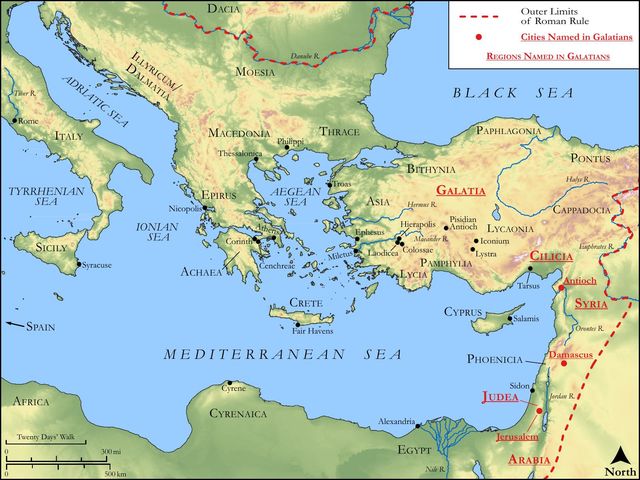
See on the biblical-era maps

Study this verse
Public-domain commentary
Matthew Henry
From his Commentary on the Whole Bible. Henry comments on passages, not single verses — this entry covers Galatians 1:6–9. His two-level outline is real structure in the source text, so it is rendered as structure.
Here the apostle comes to the body of the epistle; and he begins it with a more general reproof of these churches for their unsteadiness in the faith, which he afterwards, in some following parts of it, enlarges more upon. Here we may observe,
I.How much he was concerned at their defection:
I marvel, etc. It filled him at once with the greatest surprise and sorrow. Their sin and folly were that they did not hold fast the doctrine of Christianity as it had been preached to them, but suffered themselves to be removed from the purity and simplicity of it. And there were several things by which their defection was greatly aggravated; as,
1.That they were removed from him that had called them; not only from the apostle, who had been the instrument of calling them into the fellowship of the gospel, but from God himself, by whose order and direction the gospel was preached to them, and they were invited to a participation of the privileges of it: so that herein they had been guilty of a great abuse of his kindness and mercy towards them.
2.That they had been called into the grace of Christ. As the gospel which had been preached to them was the most glorious discovery of divine grace and mercy in Christ Jesus; so thereby they had been called to partake of the greatest blessings and benefits, such as justification, and reconciliation with God here, and eternal life and happiness hereafter. These our Lord Jesus has purchased for us at the expense of his precious blood, and freely bestows upon all who sincerely accept of him: and therefore, in proportion to the greatness of the privilege they enjoyed, such were their sin and folly in deserting it and suffering themselves to be drawn off from the established way of obtaining these blessings.
3.That they were so soon removed. In a very little time they lost that relish and esteem of this grace of Christ which they seemed to have, and too easily fell in with those who taught justification by the works of the law, as many did, who had been bred up in the opinions and notions of the Pharisees, which they mingled with the doctrine of Christ, and so corrupted it; and this, as it was an instance of their weakness, so it was a further aggravation of their guilt.
4.That they were removed to another gospel, which yet was not another. Thus the apostle represents the doctrine of these judaizing teachers; he calls it another gospel, because it opened a different way of justification and salvation from that which was revealed in the gospel, namely, by works, and not by faith in Christ. And yet he adds, "Which is not another - you will find it to be no gospel at all - not really another gospel, but the perverting of the gospel of Christ, and the overturning of the foundations of that" - whereby he intimates that those who go about to establish any other way to heaven than what the gospel of Christ has revealed are guilty of a gross perversion of it, and in the issue will find themselves wretchedly mistaken. Thus the apostle endeavours to impress upon these Galatians a due sense of their guilt in forsaking the gospel way of justification; and yet at the same time he tempers his reproof with mildness and tenderness towards them, and represents them as rather drawn into it by the arts and industry of some that troubled them than as coming into it of their own accord, which, though it did not excuse them, yet was some extenuation of their fault. And hereby he teaches us that, in reproving others, as we should be faithful, so we should also be gentle, and endeavour to restore them in the spirit of meekness, Gal 6:1.
II.How confident he was that the gospel he had preached to them was the only true gospel.
He was so fully persuaded of this that he pronounced an anathema upon those who pretended to preach any other gospel (Gal 1:8), and, to let them see that this did not proceed from any rashness or intemperate zeal in him, he repeated it, Gal 1:9. This will not justify our thundering out anathemas against those who differ from us in minor things. It is only against those who forge a new gospel, who overturn the foundation of the covenant of grace, by setting up the works of the law in the place of Christ's righteousness, and corrupting Christianity with Judaism, that Paul denounces this. He puts the case: "Suppose we should preach any other gospel; nay, suppose an angel from heaven should:" not as if it were possible for an angel from heaven to be the messenger of a lie; but it is expressed so the more to strengthen what he was about to say. "If you have any other gospel preached to you by any other person, under our name, or under colour of having it from an angel himself, you must conclude that you are imposed upon: and whoever preaches another gospel lays himself under a curse, and is in danger of laying you under it too."
Historical interpretation
Five Centuries of Reception
9 surviving comments on this verse. Each one is dated, so this reads as a timeline rather than a list.
Select a marker to jump to its quote. Markers stagger vertically where authors wrote within a few decades of each other.
For nobody had induced them to apostatize from the Creator, that they should seem to "be removed to another gospel," simply when they return again to the Creator. When he adds, too, the words, "which is not another," he confirms the fact that the gospel which he maintains is the Creator's.
So that there are two gospels for two gods; and the apostle made a great mistake when he said that "there is not another" gospel, since there is (on the hypothesis) another; and so he might have made a better defence of his gospel, by rather demonstrating this, than by insisting on its being but one.
Where then are those who charge us with being contentious in separating from heretics, and say that there is no real difference between us except what arises from our ambition? Let them hear Paul's assertion, that those who had but slightly innovated, subverted the Gospel. Not to say that the Son of God is a created Being, is a small matter. Know you not that even under the elder covenant, a man who gathered sticks on the sabbath, and transgressed a single commandment, and that not a great one, was punished with death? and that Uzzah, who supported the Ark when on the point of being overturned, was struck suddenly dead, because he had intruded upon an office which did not pertain to him? Wherefore if to transgress the sabbath, and to touch the falling Ark, drew down the wrath of God so signally as to deprive the offender of even a momentary respite, shall he who corrupts unutterably awful doctrines find excuse and pardon? Assuredly not. A want of zeal in small matters is the cause of all our calamities; and because slight errors escape fitting correction, greater ones creep in.
"Which is not another Gospel."
And justly, for there is not another. Nevertheless the Marcionites are misled by this phrase, as diseased persons are injured even by healthy food, for they have seized upon it, and exclaim, "So Paul himself has declared there is no other Gospel." For they do not allow all the Evangelists, but one only, and him mutilated and confused according to their pleasure. Their explanation of the words, "according to my Gospel and the preaching of Jesus Christ," is sufficiently ridiculous; nevertheless, for the sake of those who are easily seduced, it is necessary to refute it. We assert, therefore, that, although a thousand Gospels were written, if the contents of all were the same, they would still be one, and their unity no wise infringed by the number of writers. So, on the other hand, if there were one writer only, but he were to contradict himself, the unity of the things written would be destroyed. For the oneness of a work depends not on the number of its authors, but on the agreement or contradictoriness of its contents. Whence it is clear that the four Gospels are one Gospel; for, as the four say the same thing, its oneness is preserved by the harmony of the contents, and not impaired by the difference of persons.
"Only there are some that trouble you, and would pervert the Gospel of Christ."
That is to say, ye will not recognize another Gospel, so long as your mind is sane, so long as your vision remains healthy, and free from distorted and imaginary phantoms. For as the disordered eye mistakes the object presented to it, so does the mind when made turbid by the confusion of evil thoughts. Thus the madman confounds objects; but this insanity is more dangerous than a physical malady, for it works injury not in the regions of sense, but of the mind; it creates confusion not in the organ of bodily vision, but in the eye of the understanding.
"And would pervert the Gospel of Christ." They had, in fact, only introduced one or two commandments, circumcision and the observance of days, but he says that the Gospel was subverted, in order to show that a slight adulteration vitiates the whole. For as he who but partially pares away the image on a royal coin renders the whole spurious, so he who swerves ever so little from the pure faith, soon proceeds from this to graver errors, and becomes entirely corrupted.
Not another gospel, because all that is false is insubstantial, and that which is contrary to truth finally has no existence.
They wish, he says, to disturb the gospel of Christ but cannot prevail, because it is of such a nature that it cannot be other than the truth.
Just as with royal currency—anyone who cuts off a little from the impress has debased the whole currency—so one who makes even the smallest change in sound faith adulterates the whole.
He rightly said, “those who disturb,” and not “those who teach,” or “those who persuade,” so as to show that the whole case was entirely one of deceit.”
Continue studying Galatians 1:7 across the web’s major study libraries — every link below opens this exact verse, chapter, or book on the destination site.
Read & Compare
 BibleGatewayThis verse in more than 200 translations and 70 languages.
 Bible.comThe YouVersion reader — hundreds of translations, reading plans, and highlights.
 ESV.orgCrossway's official English Standard Version reader.
 NET BibleThe NET translation with 60,000+ translators' notes on every rendering decision.
 STEP BibleTyndale House's free study tool — original text, vocabulary, and scholarly resources.
 BibliaLogos Bible Software's free web reader.
 USCCBThe New American Bible (Revised Edition) with the U.S. bishops' study notes.
Commentaries
 BibleHub CommentariesDozens of classic commentaries on this verse, gathered on one page.
 StudyLightMore than 100 commentary sets — the largest collection on the web.
 BibleRefPlain-English commentary on what this verse means, verse by verse.
 Enduring WordDavid Guzik's free commentary on this chapter, widely used by Bible teachers.
 Bible Study ToolsVerse commentary alongside Greek and Hebrew study aids.
Original Language & Research
- BibleHub InterlinearThe verse word by word — original language, transliteration, and English.
- BibleHub LexiconEvery word's original-language definition and Strong's entry.
 Blue Letter BibleDeep-study tools — Strong's numbers, concordance, and word studies.
 CNTR CollationThe earliest Greek manuscripts of this verse, collated letter by letter.
Sermons, Hymns & Audio


TrulyRandomVerse is not affiliated with these sites and doesn’t control their content. They’re linked because they’re genuinely useful.
Summary
Galatians 1:7 serves as a crucial clarification from the Apostle Paul, immediately following his astonishment at the Galatians' swift departure from the true gospel. He asserts with unwavering conviction that there is no legitimate alternative gospel; what is being presented to them is not merely "another" message, but a deliberate and destructive perversion of the singular, saving truth centered on Christ. This verse identifies the agents of this distortion as individuals who actively trouble the believers by corrupting the pure message of salvation.
Context
ShowHideLiterary Context
This verse is an immediate and forceful follow-up to Paul's expression of "marvel" in Galatians 1:6, where he laments that the Galatians are "so quickly deserting him who called you in the grace of Christ and are turning to a different gospel." Verse 7 clarifies that this "different gospel" is not a valid alternative but a non-existent entity, a mere distortion. It sets the stage for Paul's vigorous defense of the true gospel of grace and his apostolic authority throughout the remainder of the letter, emphasizing the singular nature of the message of salvation and the severe consequences of corrupting it.
Historical & Cultural Context
The churches in Galatia (likely located in the Roman province of Galatia, modern-day central Turkey) were being infiltrated by a group commonly referred to as Judaizers. These were Jewish Christians who insisted that Gentile converts to Christianity must adhere to certain aspects of the Mosaic Law, particularly circumcision, in addition to faith in Christ, to be truly saved or fully righteous. This teaching directly contradicted Paul's gospel, which proclaimed salvation by grace through faith in Christ alone, apart from works of the Law (as powerfully articulated in Galatians 2:16). The Judaizers likely leveraged their Jewish heritage and claims of closer ties to the original apostles in Jerusalem to undermine Paul's authority and message, causing significant confusion and division within the young Galatian congregations.
Key Themes
ShowHideGalatians 1:7 powerfully contributes to several overarching themes within the epistle. Firstly, it underscores The Uniqueness and Exclusivity of the Gospel, vehemently denying the possibility of any other legitimate path to salvation beyond the one revealed in Christ. Secondly, it highlights The Danger and Destructive Nature of False Teaching, portraying it not as a benign alternative but as an active "troubling" and "perversion" that leads believers astray from the truth of the gospel of Christ. Thirdly, the verse introduces the theme of Doctrinal Purity and Apostolic Authority, as Paul, through his strong language, defends the integrity of the message he received directly from Christ, which he will elaborate on in Galatians 1:11-12.
Exposition and Analysis
ShowHideKey Word Analysis
ShowHideThis word, G243, means "else," or "different." Paul uses it in Galatians 1:6 to describe the "different gospel" the Galatians are turning to. However, in verse 7, he immediately qualifies it by stating, "Which is not another." This implies that while it appears to be a different gospel, it is not truly "another" of the same kind (i.e., a valid gospel), but rather something fundamentally distinct and illegitimate. It's a play on words to emphasize its fraudulent nature.
Meaning "to stir or agitate (roil water)." This word conveys the disruptive and unsettling effect of the false teachers on the Galatian believers. It suggests mental and spiritual agitation, causing confusion, anxiety, and a departure from their previous stability in the truth. The false teaching was not merely academic but deeply unsettling to their faith and peace.
Meaning "to turn across, i.e., transmute or (figuratively) corrupt." This is a strong term indicating a complete reversal or fundamental alteration of something from its original state. It's not just an addition or a slight modification; it's a twisting, a distortion, or a corruption that renders the original message ineffective and indeed, "no gospel at all." Paul's choice of this word underscores the severe and destructive nature of the Judaizers' actions.
Verse Breakdown
ShowHide"Which is not another"
This clause directly refutes the idea that there could be a legitimate alternative gospel. Paul emphatically states that the "different gospel" mentioned in the previous verse is not a valid, distinct gospel from the one he preached. It is a non-entity in terms of truth and divine origin.
"but there be some that trouble you"
This identifies the active agents behind the false teaching. "Some" refers to the Judaizers, who were actively disrupting the peace and faith of the Galatian believers. Their teaching caused confusion, doubt, and spiritual agitation, leading the believers astray from the simplicity of Christ's message.
"and would pervert the gospel of Christ"
This specifies the nature of the false teachers' actions. They are not merely adding to or misunderstanding the gospel; they are actively twisting, corrupting, and fundamentally altering its core message. The phrase "the gospel of Christ" emphasizes that the true gospel is centered entirely on the person and work of Jesus Christ, and any alteration of this focus constitutes a perversion.
Literary Devices
ShowHidePaul employs several potent literary devices in Galatians 1:7 to convey the gravity of the situation. Antithesis is evident in the contrast between "not another" and "pervert the gospel," highlighting that what appears to be an alternative is, in reality, a destructive distortion of the singular truth. The strong verbs "trouble" and "pervert" demonstrate Hyperbole or intense language, reflecting Paul's profound indignation and the severe spiritual danger posed by the false teaching. The phrase "gospel of Christ" functions as a form of Metonymy, where "Christ" stands for the entire redemptive work and person of Jesus, emphasizing that any deviation from this central figure is a corruption of the message itself.
Theological and Thematic Connections
ShowHideGalatians 1:7 is foundational for understanding the absolute uniqueness and purity of the Christian gospel. Theologically, it asserts that salvation is not a mutable concept open to redefinition or supplementation by human effort or tradition. The "gospel of Christ" is a singular divine revelation, complete and sufficient in itself, centered on the finished work of Jesus Christ. Any attempt to add conditions, rituals, or works to this message fundamentally corrupts its nature, transforming it from good news of grace into a burdensome system of human achievement. This verse underscores the critical importance of doctrinal fidelity and the grave responsibility of those who teach within the church, as perverting the gospel leads people away from the true source of life and righteousness.
Reflection and Application
ShowHideGalatians 1:7 serves as a timeless and urgent warning for believers in every generation. It calls us to cultivate a spirit of discernment, to be vigilant against teachings that subtly, or overtly, deviate from the core truth of the gospel—salvation by grace through faith in Christ alone. In a world saturated with diverse spiritual messages, it is crucial to continually test what we hear against the unchanging standard of God's Word. Any message that adds human works, personal merit, or cultural traditions as necessary components for salvation, or that diminishes the sufficiency of Christ's atoning work, is a perversion of the true gospel. Paul's uncompromising stance encourages us to stand firm, to contend earnestly for the faith once for all delivered to the saints, and to protect the purity of the message that brings true freedom and life.
Questions for Reflection
ShowHideFAQ
ShowHideWhat does Paul mean by "Which is not another" gospel?
ShowHidePaul means that there is no legitimate or valid alternative gospel. The message being preached by the Judaizers in Galatia was not simply a different version of the good news; it was a complete distortion that rendered it "no gospel at all." He is emphasizing the singular and exclusive nature of the true gospel of Christ, implying that any deviation from it is a corruption, not merely an alternative path.
Who were "some that trouble you" in Galatians 1:7?
ShowHideThe phrase "some that trouble you" primarily refers to the Judaizers. These were Jewish Christians who insisted that Gentile converts to Christianity must adhere to the Mosaic Law, particularly circumcision, in addition to faith in Christ, to be truly saved or fully righteous. Their teaching caused significant spiritual agitation and confusion among the Galatian believers, leading them away from the simplicity and freedom found in the gospel of grace. This issue was a major point of contention in the early church, as seen in Acts 15:1-2.
Why is "perverting the gospel" considered such a serious offense by Paul?
ShowHidePerverting the gospel is a grave offense because it fundamentally alters the message of salvation. The true gospel of Christ proclaims salvation by grace through faith alone in Jesus' finished work on the cross. To "pervert" it means to twist or corrupt this message, typically by adding human works, rituals, or conditions as necessary for salvation. This undermines the sufficiency of Christ's sacrifice, nullifies God's grace, and leads people away from true spiritual freedom and righteousness, effectively offering a false hope that cannot save. Paul considers it so serious that he pronounces a curse on anyone, even an angel, who preaches a different gospel in Galatians 1:8-9.
Christ-Centered Fulfillment
ShowHideGalatians 1:7, by passionately defending the singular "gospel of Christ," inherently points to the exclusivity and supremacy of Jesus Christ as the sole means of salvation. The "gospel" is not a set of abstract principles or a system of human achievements, but the good news about a person—Jesus Christ—and His finished work. Any teaching that "perverts" this gospel does so by diminishing Christ's unique role, His perfect sacrifice, or His absolute sufficiency. The Judaizers' insistence on circumcision and law-keeping effectively undermined the truth that Christ is the end of the law for righteousness. The "gospel of Christ" is fulfilled in the Person of Jesus, who, through His life, death, and resurrection, perfectly accomplished what no human effort or legalistic system ever could. He is the Lamb of God who takes away the sin of the world, the one mediator between God and mankind, and the author and perfecter of our faith. To pervert His gospel is to deny His unique glory and His all-sufficient work, thereby leading people away from the only source of true life and salvation found in Him.