


2 Corinthians 11:13
- οἱhoi<the>G3588T-NPMDefinite article Nominative Plural Masculine
- γὰρgarForG1063CONJConjunction
- τοιοῦτοιtoioutoisuch [are]G5108D-NPMDemonstrative pronoun Nominative Plural Masculine
- ψευδαπόστολοιpseudapostoloifalse apostlesG5570N-NPMNoun Nominative Plural Masculine
- ἐργάταιergataiworkersG2040N-NPMNoun Nominative Plural Masculine
- δόλιοιdolioideceitfulG1386A-NPMAdjective Nominative Plural Masculine
- μετασχηματιζόμενοιmetaschēmatizomenoidisguising themselvesG3345V-PMP-NPMVerb Present Middle Participle Nominative Plural Masculine
- εἰςeisasG1519PREPPreposition
- ἀποστόλουςapostolousapostlesG652N-APMNoun Accusative Plural Masculine
- Χριστοῦ·Christouof ChristG5547N-GSM-TNoun Genitive Singular Masculine Title
English is a literal word-by-word gloss of the Greek, not the KJV's wording. Why?
This is the original text the KJV's translators worked from — each Greek word with its own literal English meaning in this verse, prepared by scholars at Tyndale House, Cambridge. The KJV translates whole sentences, not word by word, so its wording differs: one Greek word can become several English words, and the KJV may choose “charity” where the gloss reads “love”. Both are faithful — they answer different questions. For the KJV's own rendering, switch to the KJV text.
Details
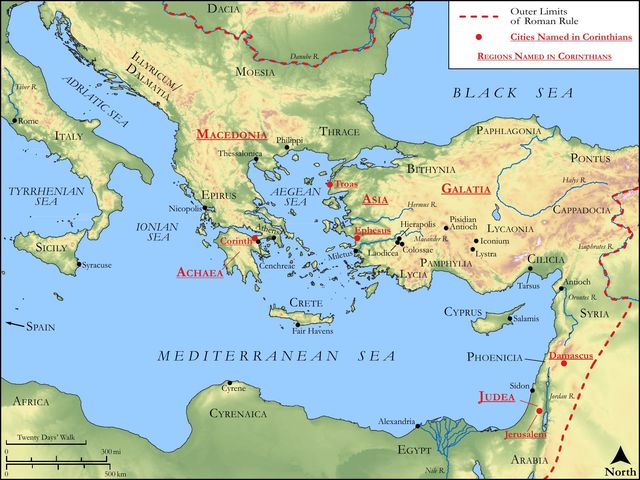
See on the biblical-era maps

Study this verse
Public-domain commentary
Matthew Henry
From his Commentary on the Whole Bible. Henry comments on passages, not single verses — this entry covers 2 Corinthians 11:5–15. His two-level outline is real structure in the source text, so it is rendered as structure.
After the foregoing preface to what he was about to say, the apostle in these verses mentions,
I.His equality with the other apostles - that he was not a whit behind the very chief of the apostles, Co2 11:5.
This he expresses very modestly: I suppose so. He might have spoken very positively. The apostleship, as an office, was equal in all the apostles; but the apostles, like other Christians, differed one from another. These stars differed one from another in glory, and Paul was indeed of the first magnitude; yet he speaks modestly of himself, and humbly owns his personal infirmity, that he was rude in speech, had not such a graceful delivery as some others might have. Some think that he was a man of very low stature, and that his voice was proportionably small; others think that he may have had some impediment in his speech, perhaps a stammering tongue. However, he was not rude in knowledge; he was not unacquainted with the best rules of oratory and the art of persuasion, much less was he ignorant of the mysteries of the kingdom of heaven, as had been thoroughly manifested among them.
II.His equality with the false apostles in this particular - the preaching of the gospel unto them freely, without wages.
This the apostle largely insists on, and shows that, as they could not but own him to be a minister of Christ, so they ought to acknowledge he had been a good friend to them. For,
1.He had preached the gospel to them freely, Co2 11:7-10. He had proved at large, in his former epistle to them, the lawfulness of ministers' receiving maintenance from the people, and the duty of the people to give them an honourable maintenance; and here he says he himself had taken wages of other churches (Co2 11:8), so that he had a right to have asked and received from them: yet he waived his right, and chose rather to abase himself, by working with his hands in the trade of tent-making to maintain himself, than be burdensome to them, that they might be exalted, or encouraged to receive the gospel, which they had so cheaply; yea, he chose rather to be supplied from Macedonia than to be chargeable unto them.
2.He informs them of the reason of this his conduct among them. It was not because he did not love them (Co2 11:11), or was unwilling to receive tokens of their love (for love and friendship are manifested by mutual giving and receiving), but it was to avoid offence, that he might cut off occasion from those that desired occasion. He would not give occasion for any to accuse him of worldly designs in preaching the gospel, or that he intended to make a trade of it, to enrich himself; and that others who opposed him at Corinth might not in this respect gain an advantage against him: that wherein they gloried, as to this matter, they might be found even as he, Co2 11:12. It is not improbable to suppose that the chief of the false teachers at Corinth, or some among them, were rich, and taught (or deceived) the people freely, and might accuse the apostle or his fellow-labourers as mercenary men, who received hire or wages, and therefore the apostle kept to his resolution not to be chargeable to any of the Corinthians.
III.The false apostles are charged as deceitful workers (Co2 11:13), and that upon this account, because they would transform themselves into the likeness of the apostles of Christ, and, though they were the ministers of Satan, would seem to be the ministers of righteousness. They would be as industrious and as generous in promoting error as the apostles were in preaching truth; they would endeavour as much to undermine the kingdom of Christ as the apostles did to establish it. There were counterfeit prophets under the Old Testament, who wore the garb and learned the language of the prophets of the Lord. So there were counterfeit apostles under the New Testament, who seemed in many respects like the true apostles of Christ. And no marvel (says the apostle); hypocrisy is a thing not to be much wondered at in this world, especially when we consider the great influence Satan has upon the minds of many, who rules in the hearts of the children of disobedience. As he can turn himself into any shape, and put on almost any form, and look sometimes like an angel of light, in order to promote his kingdom of darkness, so he will teach his ministers and instruments to do the same. But it follows, Their end is according to their works (Co2 11:15); the end will discover them to be deceitful workers, and their work will end in ruin and destruction.
Historical interpretation
Two Centuries of Reception
5 surviving comments on this verse. Each one is dated, so this reads as a timeline rather than a list.
Select a marker to jump to its quote. Markers stagger vertically where authors wrote within a few decades of each other.
I have quoted these remarks to prove in error those Basilidians who do not live purely, supposing either that they have the power even to commit sin because of their perfection, or indeed that they will be saved by nature even if they sin in this life because they possess an innate election. For the original teachers of their doctrines do not allow one to do the same as they are now doing. They ought not, therefore, to take as a covering cloak the name of Christ and, by living lewder lives than the most uncontrolled heathen, bring blasphemy upon his name. "For such people are false apostles, deceitful workers" as far as the words "whose end shall be like their works."
when he designates "false apostles, deceitful workers transforming themselves" into likenesses of himself, of course by their hypocrisy, he charges them with the guilt of disorderly conversation, rather than of false doctrine.
And after this manner the most atheistical heresy of the Simonians was first established in Rome; and the devil wrought by the rest of the false apostles
Beloved brethren! That a man should build up and establish the brethren on the faith in one God, this also is manifest and well-known. This too, again, is comely, that a man should not be envious of his neighbour. And moreover, again, it is suitable and comely that all those who work the works of the Lord should work the works of the Lord in the fear of God. Thus is it required of them to conduct themselves. That "the harvest is great, but the workmen are few," this also is well-known and manifest. Let us, therefore, "ask of the Lord of the harvest" that He would send forth workmen into the harvest; [Matthew 9:37-38] such workmen as "shall skilfully dispense the word of truth;" workmen "who shall not be ashamed;" faithful workmen; workmen who shall be "the light of the world;" [Matthew 5:14] workmen who "work not for the food that perishes, but for that food which abides unto life eternal;" [John 6:27] workmen who shall be such as the apostles; workmen who imitate the Father, and the Son, and the Holy Spirit; who are concerned for the salvation of men; not "hireling" [John 10:12-13] workmen; not workmen to whom the fear of God and righteousness appear to be gain; not workmen who "serve their belly;" not workmen who "with fair speeches and pleasant words mislead the hearts of the innocent;" [Romans 16:18] not workmen who imitate the children of light, while they are not light but darkness — "men whose end is destruction;" [Philippians 3:9] not workmen who practise iniquity and wickedness and fraud; not "crafty workmen;" [2 Corinthians 11:13] not workmen "drunken" and "faithless;" nor workmen who traffic in Christ; not misleaders; not "lovers of money; not malevolent."
What sayest thou? they that preach Christ, they that take not money, they that bring not in a different gospel, "false apostles?" 'Yes,' he saith, and for this very reason most of all, because they make pretense of all these things for the purpose of deceiving. "Deceitful workers," for they do work indeed, but pull up what has been planted. For being well aware that otherwise they would not be well received, they take the mask of truth and so enact the drama of error. 'And yet,' saith one, 'they take no money.' That they may take greater things; that they may destroy the soul. Yea rather, even that was a falsehood; and they took money but did it secretly: and he shows this in what follows. And indeed he already hinted this where he said, "that wherein they glory, they may be found even as we:" in what follows, however, he hinted it more plainly, saying, "If a man devour you, if a man take you captive, if a man exalt himself, ye bear with him." But at present he accuses them on another account, saying, "fashioning themselves." They had only a "fashion;" the skin of the sheep was but outside clothing.
Continue studying 2 Corinthians 11:13 across the web’s major study libraries — every link below opens this exact verse, chapter, or book on the destination site.
Read & Compare
 BibleGatewayThis verse in more than 200 translations and 70 languages.
 Bible.comThe YouVersion reader — hundreds of translations, reading plans, and highlights.
 ESV.orgCrossway's official English Standard Version reader.
 NET BibleThe NET translation with 60,000+ translators' notes on every rendering decision.
 STEP BibleTyndale House's free study tool — original text, vocabulary, and scholarly resources.
 BibliaLogos Bible Software's free web reader.
 USCCBThe New American Bible (Revised Edition) with the U.S. bishops' study notes.
Commentaries
 BibleHub CommentariesDozens of classic commentaries on this verse, gathered on one page.
 StudyLightMore than 100 commentary sets — the largest collection on the web.
 BibleRefPlain-English commentary on what this verse means, verse by verse.
 Enduring WordDavid Guzik's free commentary on this chapter, widely used by Bible teachers.
 Bible Study ToolsVerse commentary alongside Greek and Hebrew study aids.
Original Language & Research
- BibleHub InterlinearThe verse word by word — original language, transliteration, and English.
- BibleHub LexiconEvery word's original-language definition and Strong's entry.
 Blue Letter BibleDeep-study tools — Strong's numbers, concordance, and word studies.
 CNTR CollationThe earliest Greek manuscripts of this verse, collated letter by letter.
Sermons, Hymns & Audio


TrulyRandomVerse is not affiliated with these sites and doesn’t control their content. They’re linked because they’re genuinely useful.
Summary
In the Apostle Paul delivers a severe indictment against individuals within the Corinthian church who masquerade as genuine ministers of the gospel. He unmasks them as "false apostles" and "deceitful workers" who deliberately "transform themselves" to appear as legitimate emissaries of Christ, intending to mislead and corrupt the believers. This verse serves as a critical warning, exposing the deceptive nature of those who operate under false pretenses, undermining true doctrine and authentic Christian ministry.
Context
ShowHideLiterary Context
This verse is situated within Paul's fervent defense of his apostolic authority and the purity of the gospel against rival teachers who had infiltrated the Corinthian church. Chapters 10-13 of 2 Corinthians constitute Paul's "fool's speech," where he reluctantly boasts of his sufferings, weaknesses, and true credentials to highlight the stark contrast with his opponents' superficial claims. He sarcastically refers to these interlopers as "super-apostles" in 2 Corinthians 11:5 and 2 Corinthians 12:11, exposing their self-exaltation and lack of genuine spiritual fruit. Paul's deep concern for the Corinthians' spiritual fidelity is palpable, as he expresses a "divine jealousy" for them, desiring to present them as a "pure virgin to Christ" (2 Corinthians 11:2). The immediate verses following 2 Corinthians 11:13 further intensify the warning, revealing that these false ministers are merely imitating Satan, who himself "transforms himself into an angel of light" (2 Corinthians 11:14).
Historical & Cultural Context
The city of Corinth was a bustling, cosmopolitan trade hub, known for its diverse religious practices, philosophical schools, and moral laxity. The Corinthian church, though gifted, struggled with internal divisions, pride, and external influences. In this environment, itinerant teachers and rhetoricians were common, often vying for influence and financial support based on their oratorical skills and perceived wisdom. Paul's opponents were likely Jewish-Christian teachers, possibly from Jerusalem, who boasted of their Jewish heritage, perhaps emphasized adherence to the Mosaic Law (circumcision, dietary laws), and criticized Paul's lack of impressive rhetoric, his manual labor, and his refusal to accept financial support from the Corinthians. They presented themselves as superior apostles, perhaps with letters of recommendation, contrasting their "strength" with Paul's "weakness." Paul's warning addresses the vulnerability of the Corinthian believers to these seemingly authoritative figures who, despite their impressive outward appearance, preached a distorted gospel and sought to exploit the church for personal gain.
Key Themes
ShowHideThe central theme in 2 Corinthians 11:13 is spiritual deception and the profound danger it poses to the church. These individuals are not simply mistaken; they are actively engaged in calculated fraud, presenting a counterfeit version of truth and ministry. This highlights the theme of authenticity versus counterfeit, where Paul, as a true apostle, contrasts his genuine, Spirit-empowered ministry, marked by suffering and humility, with the deceptive, self-serving operations of his opponents. The verse also underscores the critical need for discernment within the believing community. Believers are called to look beyond charismatic appearances and evaluate teachers and their messages based on their adherence to the true gospel of Christ and the fruit of their lives, as Jesus warned in Matthew 7:15-20. Paul's defense throughout 2 Corinthians 10-13 consistently emphasizes the true nature of apostolic authority, which is rooted in Christ's power made perfect in weakness, not in human boasting or outward show.
Exposition and Analysis
ShowHideKey Word Analysis
ShowHideA compound word derived from pseudēs (false, lying) and apóstolos (apostle, messenger). This term directly means "spurious apostle" or "pretended preacher." It signifies individuals who claim apostolic authority and status but lack divine commission, genuine spiritual power, or adherence to the true gospel. Their claim is a deliberate fabrication, designed to deceive.
Meaning "guileful," "treacherous," or "cunning." This adjective describes the inherent character and method of these false apostles. Their work is not merely mistaken or misguided, but actively characterized by trickery, cunning, and dishonest practices, aiming to manipulate and exploit.
Meaning "to transfigure or disguise," or figuratively, "to apply by accommodation." This verb implies a superficial change in outward form or appearance, a masquerade, rather than a genuine change of nature. It denotes a deliberate act of putting on a disguise to deceive, making themselves appear as something they are not, much like an actor playing a role.
Verse Breakdown
ShowHide"For such [are] false apostles"
Paul begins by definitively identifying the true nature of his opponents. The word "such" (G5108, toioûtos) refers back to the characteristics of the "super-apostles" he has been discussing, particularly their boasting and self-exaltation. They are not merely mistaken or misguided teachers, but fundamentally "false apostles," meaning they are counterfeit, lacking any legitimate divine appointment or commission from Christ. Their claim to apostleship is fraudulent.
"deceitful workers"
This phrase further elaborates on their character and methodology. They are "workers" (G2040, ergátēs), implying active engagement in ministry, but their work is characterized by "deceit" (G1386, dólios). They operate with cunning, guile, and treachery, actively misleading people rather than genuinely serving them. Their labor is for their own gain and agenda, not for the glory of Christ or the edification of the church.
"transforming themselves into the apostles of Christ"
This clause reveals the core of their deception. The verb "transforming themselves" (G3345, metaschēmatízō) highlights their deliberate act of disguise. They are not truly apostles of Christ, but they adopt the outward appearance, language, and perhaps even some practices of genuine apostles to gain credibility and influence. This is a calculated act of mimicry, designed to present a façade of legitimacy and spiritual authority, making it difficult for the undiscerning to distinguish them from authentic servants of God.
Literary Devices
ShowHidePaul employs several potent literary devices in this verse to expose the true nature of his opponents. The primary device is Irony, as he sarcastically refers to them as "super-apostles" in earlier verses, only to reveal them here as "false apostles" – a stark contrast between their self-proclaimed status and their actual fraudulent identity. This sets up a powerful Antithesis between genuine and counterfeit ministry. The description of them as "deceitful workers" is a form of Epithet, a descriptive phrase that captures their essential character, emphasizing their guileful nature. The verb "transforming themselves" uses Metaphor to describe their deceptive practice, likening their outward appearance to a theatrical disguise. This foreshadows the more explicit Analogy in the very next verse (2 Corinthians 11:14), where Paul compares their transformation to Satan disguising himself as an "angel of light," thereby revealing the demonic source and ultimate purpose behind their deception.
Theological and Thematic Connections
ShowHideThe warning in 2 Corinthians 11:13 is a foundational text for understanding the persistent threat of spiritual deception within the church throughout history. It underscores the reality that not all who claim to speak for God or minister in His name are legitimate; some are actively engaged in undermining the truth. This verse highlights the critical importance of discerning spirits and testing teachings against the unchanging standard of God's Word, rather than relying solely on outward appearances, charisma, or impressive claims. Paul's concern is not merely for his own reputation, but for the purity of the gospel and the spiritual well-being of the Corinthian believers, whom he likens to a bride he wants to present undefiled to Christ. The existence of "false apostles" necessitates vigilance and a deep commitment to biblical truth.
Reflection and Application
ShowHidePaul's stark warning in 2 Corinthians 11:13 remains profoundly relevant for believers today. In an age saturated with information, diverse spiritual claims, and readily accessible platforms, the ability to discern truth from error is not merely helpful but absolutely essential for spiritual survival and growth. We are called to cultivate a spirit of discernment, not cynicism, by grounding ourselves deeply in the authentic gospel and the full counsel of God's Word. This means actively engaging with Scripture, seeking the Holy Spirit's guidance, and evaluating all teachings and ministries against the plumb line of biblical truth. We must look beyond captivating personalities, impressive rhetoric, or outward displays of piety, and instead examine the fruit of their lives and the consistency of their message with the teachings of Christ and His apostles. Protecting the purity of the gospel requires both a firm grasp of what is true and a keen awareness of what is counterfeit.
Questions for Reflection
ShowHideFAQ
ShowHideWhat is the primary danger posed by "false apostles" as described in this verse?
ShowHideThe primary danger posed by "false apostles" is their deceptive nature. They do not openly oppose Christ but rather "transform themselves into the apostles of Christ," mimicking genuine ministry to subtly introduce false doctrine, undermine true leadership, and exploit believers for personal gain. Their danger lies in their ability to appear legitimate, making it difficult for the undiscerning to recognize their harmful influence, which ultimately leads people away from the authentic gospel and true devotion to Christ. As 2 Corinthians 11:14-15 explains, their ultimate source of inspiration is often demonic, as Satan himself disguises as an "angel of light."
Christ-Centered Fulfillment
ShowHide2 Corinthians 11:13 finds its ultimate Christ-centered fulfillment in Jesus as the sole standard of truth and the embodiment of authentic apostleship. These "false apostles" are condemned precisely because they are not genuinely "of Christ" but merely masquerade as such, seeking to lead people away from Him. In contrast, Jesus is the "faithful and true witness" (Revelation 3:14), the one through whom all truth is revealed. He is the ultimate "apostle and high priest of our confession" (Hebrews 3:1), sent by the Father to accomplish salvation. True apostles, like Paul, derive their authority and message directly from Christ (Galatians 1:11-12), living lives that reflect His humility and suffering, not self-exaltation. Therefore, the only defense against those who "transform themselves into the apostles of Christ" is a steadfast adherence to Christ Himself—His person, His teachings, and His finished work on the cross (Colossians 2:8-9). He is the true light that exposes all darkness and deception, ensuring that His church, built upon the foundation of the apostles and prophets with Christ Jesus Himself as the chief cornerstone (Ephesians 2:20), remains pure and unblemished.