


Acts 13:9
- ΣαῦλοςSaulosSaulG4569N-NSM-PNoun Nominative Singular Masculine Individual
- δὲdethenG1161CONJConjunction
- ὁho<the>G3588T-NSMDefinite article Nominative Singular Masculine
- καὶkaialso [called]G2532CONJConjunction
- ΠαῦλοςPaulosPaulG3972N-NSM-PNoun Nominative Singular Masculine Individual
- πλησθεὶςplēstheishaving been filledG4130V-APP-NSMVerb Aorist Passive Participle Nominative Singular Masculine
- πνεύματοςpneumatos[the] SpiritG4151N-GSNNoun Genitive Singular Neuter
- ἁγίουhagiouHolyG40A-GSNAdjective Genitive Singular Neuter
- καὶkaiandG2532CONJConjunction
- ἀτενίσαςatenisashaving looked intentlyG816V-AAP-NSMVerb Aorist Active Participle Nominative Singular Masculine
- εἰςeisuponG1519PREPPreposition
- αὐτὸνautonhimG846P-ASMPersonal pronoun Accusative Singular Masculine
English is a literal word-by-word gloss of the Greek, not the KJV's wording. Why?
This is the original text the KJV's translators worked from — each Greek word with its own literal English meaning in this verse, prepared by scholars at Tyndale House, Cambridge. The KJV translates whole sentences, not word by word, so its wording differs: one Greek word can become several English words, and the KJV may choose “charity” where the gloss reads “love”. Both are faithful — they answer different questions. For the KJV's own rendering, switch to the KJV text.
Details
See on the biblical-era map
Study this verse
Public-domain commentary
Matthew Henry
From his Commentary on the Whole Bible. Henry comments on passages, not single verses — this entry covers Acts 13:4–13. His four-level outline is real structure in the source text, so it is rendered as structure.
In these verses we have,
I.A general account of the coming of Barnabas and Saul to the famous island of Cyprus; and perhaps thitherward they steered their course because Barnabas was a native of that country (Act 4:36), and he was willing they should have the first-fruits of his labours, pursuant to his new commission. Observe,
1.Their being sent forth by the Holy Ghost was the great thing that encouraged them in this undertaking, Act 13:4. If the Holy Ghost send them forth, he will go along with them, strengthen them, carry them on in their work, and give them success; and then they fear no colours, but can cheerfully venture upon a stormy sea from Antioch, which was now to them a quiet harbour.
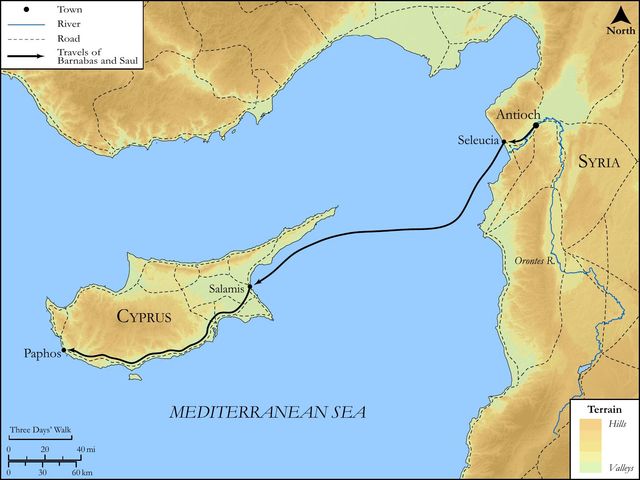
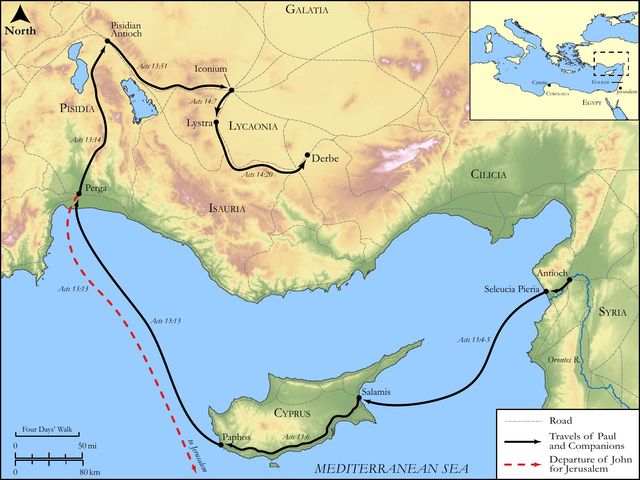
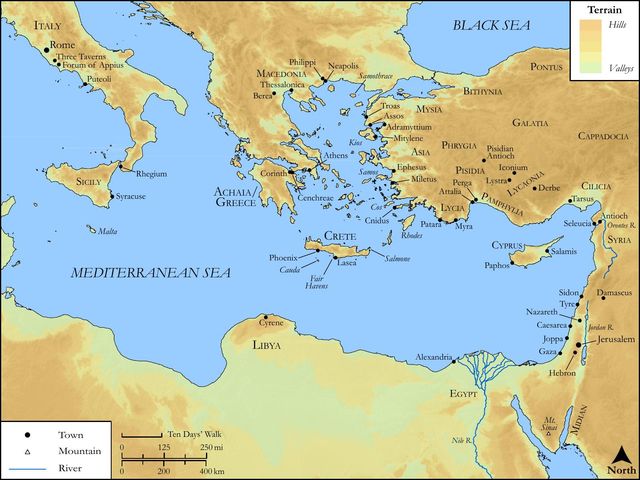
2.They came to Seleucia, the sea-port town opposite to Cyprus, thence crossed the sea to Cyprus, and in that island the first city they came to was Salamis, a city on the east side of the island (Act 13:5); and, when they had sown good seed there, thence they went onward through the isle (Act 13:6) till they came to Paphos, which lay on the western coast.
3.They preached the word of God wherever they came, in the synagogues of the Jews; so far were they from excluding them that they gave them the preference, and so left those among them who believed not inexcusable; they would have gathered them, but they would not. They did not act clandestinely, nor preach the Messiah to others unknown to them, but laid their doctrine open to the censure of the rulers of their synagogues, who might, if they had any thing to say, object against it. Nor would they have acted separately, but in concert with them, if they had not driven them out from them, and from their synagogues.
4.They had John for their minister; not their servant in common things, but their assistant in the things of God, either to prepare their way in places where they designed to come or to carry on their work in places where they had begun it, or to converse familiarly with those to whom they preached publicly, and explain things to them; and such a one might be many ways of use to them, especially in a strange country.
II.A particular account of their encounter with Elymas the sorcerer, whom they met with at Paphos, where the governor resided; a place famous for a temple built to Venus there, thence called Paphian Venus; and therefore there was more than ordinary need that the Son of God should there be manifested to destroy the works of the devil.
1.There the deputy, a Gentile, Sergius Paulus by name, encouraged the apostles, and was willing to hear their message. He was governor of the country, under the Roman emperor; proconsul or propraetor, such a one as we should call lord lieutenant of the island. He had the character of a prudent man, an intelligent, considerate man, that was ruled by reason, not passion nor prejudice, which appeared by this, that, having a character of Barnabas and Saul, he sent for them, and desired to hear the word of God. Note, When that which we hear has a tendency to lead us to God, it is prudence to desire to hear more of it. Those are wise people, however they may be ranked among the foolish of this world, who are inquisitive after the mind and will of God. Though he was a great man, and a man in authority, and the preachers of the gospel were men that made no figure, yet, if they have a message from God, let him know what it is, and, if it appear to be so, he is ready to receive it.
2.There Elymas, a Jew, a sorcerer, opposed them, and did all he could to obstruct their progress. This justified the apostles in turning to the Gentiles, that this Jew was so malignant against them.
(1.)This Elymas was a pretender to the gift of prophecy, a sorcerer, a false-prophet - one that would be taken for a divine, because he was skilled in the arts of divination; he was a conjurer, and took on him to tell people their fortune, and to discover things lost, and probably was in league with the devil for this purpose; his name was Barjesus - the son of Joshua; it signifies the son of salvation; but the Syriac calls him, Bar-shoma - the son of pride; filius inflationis - the son of inflation.
(2.)He was hanging on at court, was with the deputy of the country. It does not appear that the deputy called for him, as he did for Barnabas and Saul; but he thrust himself upon him, aiming, no doubt, to make a hand of him, and get money by him.
(3.)He made it his business to withstand Barnabas and Saul, as the magicians of Egypt, in Pharaoh's court, withstood Moses and Aaron, Ti2 3:8. He set up himself to be a messenger from heaven, and denied that they were. And thus he sought to turn away the deputy from the faith (Act 13:8), to keep him from receiving the gospel, which he saw him inclined to do. Note, Satan is in a special manner busy with great men and men of power, to keep them from being religious; because he knows that their example, whether good or bad, will have an influence upon many. And those who are in any way instrumental to prejudice people against the truths and ways of Christ are doing the devil's work.
(4.)Saul (who is here for the first time called Paul) fell upon him for this with a holy indignation. Saul, who is also called Paul, Act 13:9. Saul was his name as he was a Hebrew, and of the tribe of Benjamin; Paul was his name as he was a citizen of Rome. Hitherto we have had him mostly conversant among the Jews, and therefore called by his Jewish name; but now, when he is sent forth among the Gentiles, he is called by his Roman name, to put somewhat of a reputation upon him in the Roman cities, Paulus being a very common name among them. But some think he was never called Paul till now that he was instrumental in the conversion of Sergius Paulus to the faith of Christ, and that he took the name Paulus as a memorial of this victory obtained by the gospel of Christ, as among the Romans he that had conquered a country took his denomination from it, as Germanicus, Britannicus, Africanus; or rather, Sergius Paulus himself gave him the name Paulus in token of his favour and respect to him, as Vespasian gave his name Flavius to Josephus the Jew. Now of Paul it is said,
[1.]That he was filled with the Holy Ghost upon this occasion, filled with a holy zeal against a professed enemy of Christ, which was one of the graces of the Holy Ghost - a spirit of burning; filled with power to denounce the wrath of God against him, which was one of the gifts of the Holy Ghost - a spirit of judgment. He felt a more than ordinary fervour in his mind, as the prophet did when he was full of power by the Spirit of the Lord (Mic 3:8), and another prophet when his face was made harder than flint (Eze 3:9), and another when his mouth was made like a sharp sword, Isa 49:2. What Paul said did not come from any personal resentment, but from the strong impressions which the Holy Ghost made upon his spirit.
[2.]He set his eyes upon him, to face him down, and to show a holy boldness, in opposition to his wicked impudence. He set his eyes upon him, as an indication that the eye of the heart-searching God was upon him, and saw through and through him; nay, that the face of the Lord was against him, Psa 34:16. He fixed his eyes upon him, to see if he could discern in his countenance any marks of remorse for what he had done; for, if he could have discerned the least sign of this, it would have prevented the ensuing doom.
[3.]He gave him his true character, not in passion, but by the Holy Ghost, who knows men better than they know themselves, Act 13:10. He describes him to be, First, An agent for hell; and such there have been upon this earth (the seat of the war between the seed of the woman and of the serpent) ever since Cain who was of that wicked one, an incarnate devil, slew his brother, for no other reason than because his own works were evil and his brother's righteous. This Elymas, though called Bar-jesus - a son of Jesus, was really a child of the devil, bore his image, did his lusts, and served his interests, Joh 8:44. In two things he resembled the devil as a child does his father - 1. In craftiness. The serpent was more subtle than any beast of the field (Gen 3:1), and Elymas, though void of all wisdom, was full of all subtlety, expert in all the arts of deceiving men and imposing upon them. 2. In malice. He was full of all mischief - a spiteful ill-conditioned man, and a sworn implacable enemy to God and goodness. Note, A fulness of subtlety and mischief together make a man indeed a child of the devil. Secondly, An adversary to heaven. If he be a child of the devil, it follows of course that he is an enemy to all righteousness, for the devil is so. Note, Those that are enemies to the doctrine of Christ are enemies to all righteousness, for in it all righteousness is summed up and fulfilled.
[4.]He charged upon him his present crime, and expostulated with him upon it: "Wilt thou not cease to pervert the right ways of the Lord, to misrepresent them, to put false colours upon them, and so to discourage people from entering into them, and walking in them?" Note, First, The ways of the Lord are right: they are all so, they are perfectly so. The ways of the Lord Jesus are right, the only right ways to heaven and happiness. Secondly, There are those who pervert these right ways, who not only wander out of these ways themselves (as Elihu's penitent, who owns, I have perverted that which was right and it profited me not), but mislead others, and suggest to them unjust prejudices against these ways: as if the doctrine of Christ were uncertain and precarious, the laws of Christ unreasonable and impractical, and the service of Christ unpleasant and unprofitable, which is an unjust perverting of the right ways of the Lord, and making them seem crooked ways. Thirdly, Those who pervert the right ways of the Lord are commonly so hardened in it that, though the equity of those ways be set before them by the most powerful and commanding evidence, yet they will not cease to do it. Etsi suaseris, non persuaseris - You may advise, but you will never persuade; they will have it their own way; they have loved strangers, and after them they will go.
[5.]He denounced the judgment of God upon him, in a present blindness (Act 13:11): "And now, behold, the hand of the Lord is upon thee, a righteous hand. God is now about to lay hands on thee, and make thee his prisoner, for thou art taken in arms against him; thou shalt be blind, not seeing the sun for a season." This was designed both for the proof of his crime, as it was a miracle wrought to confirm the right ways of the Lord, and consequently to show the wickedness of him who would not cease to pervert them, as also for the punishment of his crime. It was a suitable punishment; he shut his eyes, the eyes of his mind, against the light of the gospel, and therefore justly were the eyes of his body shut against the light of the sun; he sought to blind the deputy (as an agent for the god of this world, who blindeth the minds of those that believe not, lest the light of the gospel should shine unto them, Co2 4:4), and therefore is himself struck blind. Yet it was a moderate punishment: he was only struck blind, when he might most justly have been struck dead; and it was only for a season; if he will repent, and give glory to God, by making confession, his sight shall be restored; nay, it should seem, though he do not, yet his sight shall be restored, to try if he will be led to repentance either by the judgments of God or by his mercies.
[6.]This judgment was immediately executed: There fell on him a mist and a darkness, as on the Sodomites when they persecuted Elisha. This silenced him presently, filled him with confusion, and was an effectual confutation of all he said against the doctrine of Christ. Let not him any more pretend to be a guide to the deputy's conscience who is himself struck blind. It was also an earnest to him of a much sorer punishment if he repent not; for he is one of those wandering stars to whom is reserved the blackness of darkness for ever, Jde 1:13. Elymas did himself proclaim the truth of the miracle, when he went about seeking some to lead him by the hand; and where now is all his skill in sorcery, upon which he had so much valued himself, when he can neither find his way nor find a friend that will be so kind as to lead him!
3.Notwithstanding all the endeavours of Elymas to turn away the deputy from the faith, he was brought to believe, and this miracle, wrought upon the magician himself (like the boils of Egypt, which were upon the magicians, so that they could not stand before Moses, Exo 9:11), contributed to it. The deputy was a very sensible man, and observed something uncommon, and which intimated its divine original,
(1.)In Paul's preaching: he was astonished at the doctrine of the Lord, the Lord Christ - the doctrine that is from him, the discoveries he has made of the Father - the doctrine that is concerning him, his person, natures, offices, undertaking. Note, The doctrine of Christ has a great deal in it that is astonishing; and the more we know of it the more reason we shall see to wonder and stand amazed at it.
(2.)In this miracle: When he saw what was done, and how much Paul's power transcended that of the magician, and how plainly Elymas was baffled and confounded, he believed. It is not said that he was baptized, and so made a complete convert, but it is probable that he was. Paul would not do his business by the halves; as for God, his work is perfect. When he became a Christian, he neither laid down his government, nor was turned out of it, but we may suppose, as a Christian magistrate, by his influence helped very much to propagate Christianity in that island. The tradition of the Romish church, which has taken care to find bishoprics for all the eminent converts we read of in the Acts, has made this Sergius Paulus bishop of Narbon in France, left there by Paul in his journey to Spain.
III.Their departure from the island of Cyprus.
It is probable that they did a great deal more there than is recorded, where an account is given only of that which was extraordinary - the conversion of the deputy. When they had done what they had to do,
1.They quitted the country, and went to Perga. Those that went were Paul and his company, which, it is probable, was increased in Cyprus, many being desirous to accompany him. Anachthentes hoi peri ton Paulon - Those that were about Paul loosed from Paphos, which supposes that he went too; but such an affection had his new friends for him that they were always about him, and by their good will would be never from him.
2.Then John Mark quitted them, and returned to Jerusalem, without the consent of Paul and Barnabas; either he did not like the work, or he wanted to go and see his mother. It was his fault, and we shall hear of it again.
Historical interpretation
Three Centuries of Reception
5 surviving comments on this verse. Each one is dated, so this reads as a timeline rather than a list.
Select a marker to jump to its quote. Markers stagger vertically where authors wrote within a few decades of each other.
"But Saul, who is also Paul,"-here his name is changed at the same time that he is ordained, as it was in Peter's case.
The apostle Paul, who was previously called Saul, had no other reason, it seems to me, for choosing this name but to point out his own smallness as the least of the apostles. Hence, in order to praise this grace of God, he frequently fought courageously and vigorously against the proud and the arrogant and those who relied on their own works. After all, the grace of God was really seen more clearly and more obviously in him.
"Then Saul, otherwise Paul, filled with the Holy Ghost, said. "This continues what started above. While Sergius the proconsul and Paulus the prudent man listened, the apostle Paul, filled with the Holy Ghost, vigorously reproved Bar-jesu the false prophet; and to show that his invective had been for the love of the Lord, he said to him: "Thou shalt be blind, and shalt not see the sun at all for a time." Then a dark mist coming upon him shut up his natural sight in such a way that he sought someone else's hands to help him leave. The performance of this miracle being ascertained, the judges who saw it were converted, believing that a doctrine proven to be displayed by such miracles was truly that of the supreme God.
But Saul, who is also Paul, filled with the Holy Spirit, and so on. Just as Barnabas' name was changed immediately after his renunciation, so that instead of Joseph he was called Barnabas, which is, instead of "increased," "son of consolation." For after he was increased and added to the number of the elect, he immediately deserved to be both called and to be "son of παράκλησις," that is, "of consolation" through the received grace of the Spirit; so Saul, after receiving the rank of apostleship, was named Paul. Because he had become humble from being proud, he was rightly called Paul instead of Saul: for Saul was named after the impious and persecutor king Saul, but Paul is named from humble and small spirit. For Paul means "small." Hence, interpreting his own name in a certain way, he himself would say: For I am the least of the apostles, who am not worthy to be called an apostle, because I persecuted the Church of God (I Cor. XV).
Saul, who is also called Paul, filled with the Holy Spirit. From Sergius Paulus the proconsul, because he subjugated him to the faith of Christ, he took the name of Paul. And the subsequent sections of this account deal with the miracles of Paul. For it was fitting that he should give the completion to apostolic acts, whom the Lord had long chosen despite him kicking against the goads.
Continue studying Acts 13:9 across the web’s major study libraries — every link below opens this exact verse, chapter, or book on the destination site.
Read & Compare
 BibleGatewayThis verse in more than 200 translations and 70 languages.
 Bible.comThe YouVersion reader — hundreds of translations, reading plans, and highlights.
 ESV.orgCrossway's official English Standard Version reader.
 NET BibleThe NET translation with 60,000+ translators' notes on every rendering decision.
 STEP BibleTyndale House's free study tool — original text, vocabulary, and scholarly resources.
 BibliaLogos Bible Software's free web reader.
 USCCBThe New American Bible (Revised Edition) with the U.S. bishops' study notes.
Commentaries
 BibleHub CommentariesDozens of classic commentaries on this verse, gathered on one page.
 StudyLightMore than 100 commentary sets — the largest collection on the web.
 BibleRefPlain-English commentary on what this verse means, verse by verse.
 Enduring WordDavid Guzik's free commentary on this chapter, widely used by Bible teachers.
 Bible Study ToolsVerse commentary alongside Greek and Hebrew study aids.
Original Language & Research
- BibleHub InterlinearThe verse word by word — original language, transliteration, and English.
- BibleHub LexiconEvery word's original-language definition and Strong's entry.
 Blue Letter BibleDeep-study tools — Strong's numbers, concordance, and word studies.
 CNTR CollationThe earliest Greek manuscripts of this verse, collated letter by letter.
Sermons, Hymns & Audio


TrulyRandomVerse is not affiliated with these sites and doesn’t control their content. They’re linked because they’re genuinely useful.
Summary
Acts 13:9 marks a pivotal moment in the ministry of Saul, who is here first identified as Paul, as he is supernaturally empowered by the Holy Spirit to confront a spiritual adversary. This verse encapsulates a significant transition in his identity and mission, demonstrating the divine authority bestowed upon him for the advancement of the Gospel against forces of deception and darkness. It sets the stage for a dramatic display of God's power through His chosen apostle.
Context
ShowHideLiterary Context
Acts 13 begins the account of Paul's (then Saul's) first missionary journey, accompanied by Barnabas and John Mark. After ministering in Salamis, they arrive in Paphos, Cyprus. The narrative immediately preceding Acts 13:9 describes their encounter with the Roman proconsul Sergius Paulus, who, being a man of intelligence, seeks to hear the word of God. However, a Jewish sorcerer and false prophet named Bar-Jesus, also known as Elymas, actively opposes them, attempting to turn the proconsul away from the faith. This verse, therefore, serves as the spiritual climax of this confrontation, where Paul, filled with divine power, directly addresses and rebukes the sorcerer, setting the stage for Elymas's temporary blindness in the verses that follow.
Historical & Cultural Context
The setting is Paphos, a significant Roman administrative center on the island of Cyprus. Roman proconsuls like Sergius Paulus held considerable authority, and their conversion would have immense implications for the spread of Christianity. The presence of sorcerers like Bar-Jesus (Elymas) was common in the Greco-Roman world, where various forms of magic, divination, and philosophical schools vied for influence. Such individuals often served as advisors or spiritual guides to prominent figures, making their opposition a direct challenge to the apostles' message and authority. The confrontation highlights the clash between the emerging Christian faith and the prevalent pagan and occult practices of the era, emphasizing the unique power of the Holy Spirit over rival spiritual forces.
Key Themes
ShowHideThis verse is rich with themes central to the Book of Acts. The most prominent is the transformation and new identity of Saul, who is explicitly named Paul for the first time in Luke's narrative. This parenthetical naming signals a shift in his primary identity and ministry focus, particularly to the Gentiles, for whom the Roman name "Paul" would be more accessible. This transformation echoes the profound change initiated by his conversion experience on the road to Damascus, as detailed in Acts 9:1-19. Another crucial theme is the empowerment by the Holy Spirit. Like the disciples at Pentecost in Acts 2:1-4, Paul's being "filled with the Holy Ghost" signifies divine enablement for a specific task, granting him spiritual insight, authority, and boldness to confront evil. This divine filling is a hallmark of effective ministry throughout the Book of Acts. Finally, the verse introduces the theme of spiritual confrontation and divine authority. Paul's intense gaze and subsequent actions demonstrate the power of God's Spirit to expose and overcome spiritual darkness and deception, asserting the supremacy of Christ's kingdom over all other powers.
Exposition and Analysis
ShowHideKey Word Analysis
ShowHideThis verb, G4130, means "to fill" literally or figuratively, often implying an imbueing, influencing, or supplying. In this context, it is a passive participle, indicating that Paul was acted upon by an external agent – the Holy Spirit. It signifies a divine impartation of power and authority, not a self-generated state, enabling him for a specific purpose.
Meaning "sacred," "pure," "blameless," or "consecrated." When applied to the Spirit (G4151, pneûma), it emphasizes the Spirit's divine nature, His moral purity, and His consecrating power. This filling is not merely an emotional experience but an infusion of divine holiness and power for God's purposes.
Meaning "to gaze intently," "to behold earnestly," or "to fasten eyes upon." This word conveys a focused, unwavering stare. In this context, it suggests Paul's spiritual discernment, his readiness for direct confrontation, and the intense, Spirit-empowered focus he brought to bear upon Elymas. It is an action of spiritual authority and resolute determination.
Verse Breakdown
ShowHide"Then Saul, (who also [is called] Paul,)"
This opening clause marks a significant narrative transition. "Then" (G1161, dé) indicates a progression in the story. The parenthetical remark is crucial: it formally introduces Paul's Roman name, which Luke will use almost exclusively from this point forward. This naming convention subtly underscores his burgeoning ministry to the Gentile world, where a Roman name would be more familiar and acceptable than his Hebrew name, Saul. It signifies a new phase of his identity and mission, moving from being a persecutor of the church to its foremost apostle to the Gentiles.
"filled with the Holy Ghost,"
This phrase describes the divine empowerment that immediately precedes Paul's decisive action. The Greek verb for "filled" (G4130, plḗthō) is in the passive voice, emphasizing that this state is a divine impartation, not a human achievement. The "Holy Ghost" (G40 hágios G4151 pneûma) refers to the Third Person of the Trinity, the Spirit of God. This filling signifies a fresh anointing of power, spiritual insight, and authority, enabling Paul to discern the spiritual darkness embodied by Elymas and to act with divine backing. It is a recurring motif in Acts, indicating God's active involvement in His servants' ministry.
"set his eyes on him,"
This final clause describes Paul's intense, focused gaze upon Elymas. The verb "set his eyes" (G816, atenízō) conveys a piercing, unwavering stare, indicative of spiritual discernment and resolute confrontation. It is not merely a physical act but a spiritual one, demonstrating Paul's readiness to engage in direct spiritual warfare. Empowered by the Holy Spirit, Paul is prepared to expose and rebuke the sorcerer, asserting the superior power of God over the forces of deception.
Literary Devices
ShowHideLuke employs several Literary Devices in Acts 13:9 to convey its profound significance. The most prominent is Parenthesis, used in "(who also [is called] Paul)." This seemingly simple insertion is highly significant, acting as a narrative marker for Saul's transformation and the shift in his public identity. It signals the beginning of his primary role as the apostle to the Gentiles, for whom the Roman name "Paul" would be more appropriate. This transition is not merely nominal but symbolic of his new mission and the broader scope of the Gospel's reach. Additionally, the phrase "filled with the Holy Ghost" functions as Foreshadowing, hinting at the powerful spiritual confrontation that is about to unfold. It immediately alerts the reader that Paul's subsequent actions will be divinely inspired and empowered, elevating the encounter beyond a mere human dispute to a clash of spiritual realms. Finally, Paul's action of "set his eyes on him" serves as a powerful Visual Metaphor for spiritual discernment and direct confrontation. It vividly portrays Paul's intense focus and readiness to engage the spiritual opposition head-on, embodying the authority given to him by the Spirit.
Theological and Thematic Connections
ShowHideActs 13:9 is a powerful theological statement about divine empowerment, the nature of spiritual authority, and the ongoing spiritual battle inherent in the advancement of God's kingdom. The Holy Spirit's filling is not merely for personal piety but for missional effectiveness, equipping believers with discernment and power to confront spiritual opposition. This moment highlights that true authority in ministry comes not from human charisma or intellect, but from the indwelling and overflow of the Holy Spirit, enabling God's servants to speak and act with divine backing against the forces of darkness. It underscores the reality that the Gospel's progress often involves direct confrontation with spiritual deception, and that God provides the necessary power for His people to prevail.
Reflection and Application
ShowHideActs 13:9 offers profound insights for contemporary believers, calling us to a deeper reliance on the Holy Spirit and a courageous engagement with spiritual realities. Just as Saul embraced his new identity as Paul for the sake of the Gospel, we are called to live out our new identity in Christ, shedding old patterns and embracing God's unique purpose for our lives. This verse reminds us that effective ministry and spiritual discernment are not born of human effort or cleverness, but from being continually "filled with the Holy Ghost." In a world increasingly marked by deception and spiritual confusion, believers are challenged to cultivate a deep intimacy with the Spirit, allowing Him to grant us wisdom, boldness, and the ability to discern truth from falsehood. Furthermore, Paul's direct confrontation with Elymas serves as a powerful reminder that spiritual warfare is a real and present dimension of Christian life and mission. We are called not to shrink from spiritual opposition but to stand firm, discerning the schemes of the enemy and confronting them with the authority and power that only the Holy Spirit can provide, always remembering that the battle is the Lord's, and He equips us for victory.
Questions for Reflection
ShowHideFAQ
ShowHideWhy is Saul suddenly called Paul in this verse?
ShowHideActs 13:9 marks the first time Luke explicitly refers to Saul as Paul. While the verse states "who also [is called] Paul," suggesting he already had this name, its introduction here is highly significant. Saul was his Hebrew name, reflecting his Jewish heritage, while Paul was his Roman (Latin) name. From this point forward, as his ministry increasingly shifts towards the Gentile world, Luke consistently uses "Paul." This transition symbolizes his new primary identity and mission as the apostle to the Gentiles, making him more relatable and accessible to the Roman and Greek audiences he would encounter. It's not a change of person, but a change in the prominent name used to reflect his evolving ministry focus, as seen in his later letters where he identifies himself as Paul, an apostle of Christ Jesus.
Christ-Centered Fulfillment
ShowHideActs 13:9, though focusing on Paul's empowerment, finds its ultimate Christ-centered fulfillment in the person and work of Jesus Himself. Paul's being "filled with the Holy Ghost" and confronting spiritual darkness directly mirrors Christ's own ministry, which was characterized by the boundless anointing of the Spirit and direct confrontation with demonic forces. Jesus, the Son of God, was Himself "full of the Holy Spirit" (as described in Luke 4:1), leading Him into the wilderness to overcome temptation by Satan. His entire public ministry was a demonstration of the Spirit's power over sickness, sin, and spiritual oppression, culminating in His ultimate victory over sin and death on the cross and His resurrection. Paul's authority to blind Elymas, though temporary, powerfully foreshadows Christ's sovereign authority over all spiritual powers and principalities, an authority He now shares with His church (as promised in Matthew 28:18-20). Thus, Paul's Spirit-empowered confrontation is a tangible manifestation of the ongoing work of the resurrected Christ through His body, the church, demonstrating that the power that raised Jesus from the dead is at work in believers to advance His kingdom against all opposition, as promised in Ephesians 1:19-20.