


Mark 3:5
Bible text: King James Version (1769 Blayney text) · Public domain
Bible text: King James Version with Strong's numbers · Public domain
Bible text: Berean Standard Bible · Public domain
Bible text: American Standard Version (1901) · Public domain
Bible text: World English Bible, Messianic edition · Public domain
Bible text: Geneva Bible (1599) · Public domain
Bible text: Young's Literal Translation · Public domain
- καὶkaiAndG2532CONJConjunction
- περιβλεψάμενοςperiblepsamenoshaving looked around onG4017V-AMP-NSMVerb Aorist Middle Participle Nominative Singular Masculine
- αὐτοὺςautousthemG846P-APMPersonal pronoun Accusative Plural Masculine
- μετ᾽met᾽withG3326PREPPreposition
- ὀργῆςorgēsangerG3709N-GSFNoun Genitive Singular Feminine
- συλλυπούμενοςsullupoumenosbeing grievedG4818V-PNP-NSMVerb Present Middle Or Passive Deponent Participle Nominative Singular Masculine
- ἐπὶepiatG1909PREPPreposition
- τῇtēatheG3588T-DSFDefinite article Dative Singular Feminine
- πωρώσειpōrōseihardnessG4457N-DSFNoun Dative Singular Feminine
- τῆςtēsof theG3588T-GSFDefinite article Genitive Singular Feminine
- καρδίαςkardiasheartG2588N-GSFNoun Genitive Singular Feminine
- αὐτῶνautōnof themG846P-GPMPersonal pronoun Genitive Plural Masculine
- λέγειlegeiHe saysG3004V-PAI-3SVerb Present Active Indicative 3rd Singular
- τῷtōto theG3588T-DSMDefinite article Dative Singular Masculine
- ἀνθρώπῳ·anthrōpōmanG444N-DSMNoun Dative Singular Masculine
- ἔκτεινονekteinondo stretch outG1614V-AAM-2SVerb Aorist Active Imperative 2nd Singular
- τὴνtēntheG3588T-ASFDefinite article Accusative Singular Feminine
- χεῖραcheirahandG5495N-ASFNoun Accusative Singular Feminine
- σουsouof youG4771P-2GSPersonal pronoun Genitive 2nd Singular
- καὶkaiAndG2532CONJConjunction
- ἐξέτεινενexeteinenhe stretched [it] outG1614V-AAI-3SVerb Aorist Active Indicative 3rd Singular
- καὶkaiandG2532CONJConjunction
- ἀπεκατεστάθηapekatestathēwas restoredG600V-API-3SVerb Aorist Passive Indicative 3rd Singular
- ἡhētheG3588T-NSFDefinite article Nominative Singular Feminine
- χεὶρcheirhandG5495N-NSFNoun Nominative Singular Feminine
- αὐτοῦautouof himG846P-GSMPersonal pronoun Genitive Singular Masculine
- ὑγιὴςhugiēssoundG5199A-NSFAdjective Nominative Singular Feminine
- ὡςhōsasG5613PRTParticle or Disjunctive
- ἡhē<the>G3588T-NSFDefinite article Nominative Singular Feminine
- ἄλληallēanotherG243A-NSFAdjective Nominative Singular Feminine
English is a literal word-by-word gloss of the Greek, not the KJV's wording. Why?
This is the original text the KJV's translators worked from — each Greek word with its own literal English meaning in this verse, prepared by scholars at Tyndale House, Cambridge. The KJV translates whole sentences, not word by word, so its wording differs: one Greek word can become several English words, and the KJV may choose “charity” where the gloss reads “love”. Both are faithful — they answer different questions. For the KJV's own rendering, switch to the KJV text.
Details
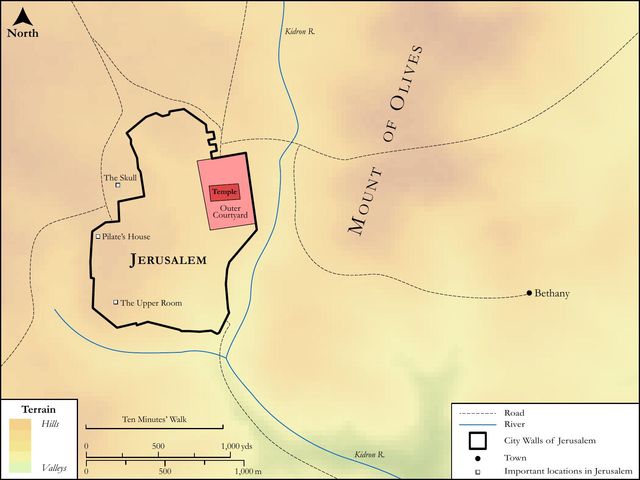
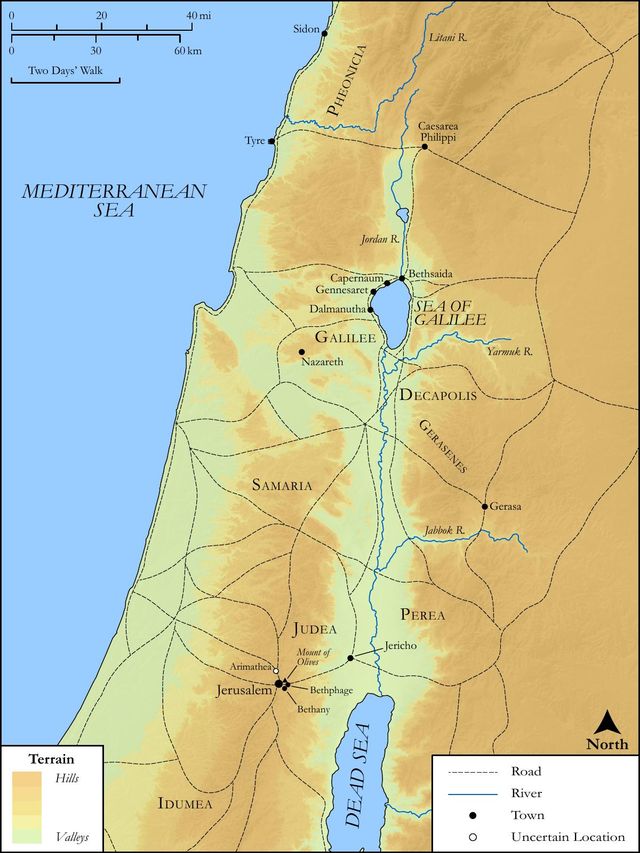
See on the biblical-era maps
Study this verse
Public-domain commentary
Matthew Henry
From his Commentary on the Whole Bible. Henry comments on passages, not single verses — this entry covers Mark 3:1–12. His four-level outline is real structure in the source text, so it is rendered as structure.
Here, as before, we have our Lord Jesus busy at work in the synagogue first, and then by the sea side; to teach us that his presence should not be confined either to the one or to the other, but, wherever any are gathered together in his name, whether in the synagogue or any where else, there is he in the midst of them. In every place where he records his name, he will meet his people, and bless them; it is his will that men pray every where. Now here we have some account of what he did.
I.When he entered again into the synagogue, he improved the opportunity he had there, of doing good, and having, no doubt, preached a sermon there, he wrought a miracle for the confirmation of it, or at least for the confirmation of this truth - that it is lawful to do good on the sabbath day. We had the narrative, Mat 12:9.
1.The patient's case was piteous; he had a withered hand, by which he was disabled to work for his living; and those that are so, are the most proper objects of charity; let those be helped that cannot help themselves.
2.The spectators were very unkind, both to the patient and to the Physician; instead of interceding for a poor neighbour, they did what they could to hinder his cure: for they intimated that if Christ cured him now on the sabbath day, they would accuse him as a Sabbath breaker. It had been very unreasonable, if they should have opposed a physician or surgeon in helping any poor body in misery, by ordinary methods; but much more absurd was it to oppose him that cured without any labour, but by a word's speaking.
3.Christ dealt very fairly with the spectators, and dealt with them first, if possible to prevent the offence.
(1.)He laboured to convince their judgment. He bade the man stand forth (Mar 3:3), that by the sight of him they might be moved with compassion toward him, and might not, for shame, account his cure a crime. And then he appeals to their own consciences; though the thing speaks itself, yet he is pleased to speak it; "Is it lawful to do good on the sabbath days, as I design to do, or to do evil, as you design to do? Whether is better, to save life or to kill?" What fairer question could be put? And yet, because they saw it would turn against them, they held their peace. Note, Those are obstinate indeed in their infidelity, who, when they can say nothing against a truth, will say nothing to it; and, when they cannot resist, yet will not yield.
(2.)When they rebelled against the light, he lamented their stubbornness (Mar 3:5); He looked round about on them with anger, being grieved for the hardness of their hearts. The sin he had an eye to, was, the hardness of their hearts, their insensibleness of the evidence of his miracles, and their inflexible resolution to persist in unbelief. We hear what is said amiss, and see what is done amiss; but Christ looks at the root of bitterness in the heart, the blindness and hardness of that. Observe,
[1.]How he was provoked by the sin; he looked round upon them; for they were so many, and had so placed themselves, that they surrounded him: and he looked with anger; his anger, it is probable, appeared in his countenance; his anger was, like God's, without the least perturbation to himself, but not without great provocation from us. Note, The sin of sinners is very displeasing to Jesus Christ; and the way to be angry, and not to sin, is it be angry, as Christ was, at nothing but sin. Let hard-hearted sinners tremble to think of the anger with which he will look round upon them shortly, when the great day of his wrath comes.
[2.]How he pitied the sinners; he was grieved for the hardness of their hearts; as God was grieved forty years for the hardness of the hearts of their fathers in the wilderness. Note, It is a great grief to our Lord Jesus, to see sinners bent upon their own ruin, and obstinately set against the methods of their conviction and recovery, for he would not that any should perish. This is a good reason why the hardness of our own hearts and of the hearts of others, should be a grief to us.
4.Christ dealt very kindly with the patient; he bade him stretch forth his hand, and it was immediately restored. Now,
(1.)Christ has hereby taught us to go on with resolution in the way of our duty, how violent soever the opposition is, that we meet with in it. We must deny ourselves sometimes in our ease, pleasure, and convenience, rather than give offence even to those who causelessly take it; but we must not deny ourselves the satisfaction of serving God, and doing good, though offence may unjustly be taken at it. None could be more tender of giving offence than Christ; yet, rather than send this poor man away uncured, he would venture offending all the scribes and Pharisees that compassed him about.
(2.)He hath hereby given us a specimen of the cures wrought by his grace upon poor souls; our hands are spiritually withered, the powers of our souls weakened by sin, and disabled for that which is good. The great healing day is the sabbath, and the healing place the synagogue; the healing power is that of Christ. The gospel command is like this recorded here; and the command is rational and just; though our hands are withered, and we cannot of ourselves stretch them forth, we must attempt it, must, as well as we can, lift them up to God in prayer, lay hold on Christ and eternal life, and employ them in good works; and if we do our endeavour, power goes along with the word of Christ, he effects the cure. Though our hands be withered, yet, if we will not offer to stretch them out, it is our own fault that we are not healed; but if we do, and are healed, Christ and his power and grace must have all the glory.
5.The enemies of Christ dealt very barbarously with him. Such a work of mercy should have engaged their love to him, and such a work of wonder their faith in him. But, instead of that, the Pharisees, who pretended to be oracles in the church, and the Herodians, who pretended to be the supporters of the state, though of opposite interests one to another, took counsel together against him, how they might destroy him. Note, They that suffer for doing good, do but suffer as their Master did.
II.When he withdrew to the sea, he did good there.
While his enemies sought to destroy him, he quitted the place; to teach us in troublous times to shift for our own safety; but see here,
1.How he was followed into his retirement. When some had such an enmity to him, that they drove him out of their country, others had such a value for him, that they followed him wherever he went; and the enmity of their leaders to Christ did not cool their respect to him. Great multitudes followed him from all parts of the nation; as far north, as from Galilee; as far south, as from Judea and Jerusalem; nay, and from Idumea; as far east, as from beyond Jordan; and west, as from about Tyre and Sidon, Mar 3:7, Mar 3:8. Observe,
(1.)What induced them to follow him; it was the report they heard of the great things he did for all that applied themselves to him; some wished to see one that had done such great things, and others hoped he would do great things for them. Note, The consideration of the great things Christ has done, should engage us to come to him.
(2.)What they followed him for (Mar 3:10); They pressed upon him, to touch him, as many as had plagues. Diseases are here called plagues, mastigas - corrections, chastisements; so they are designed to be, to make us smart for our sins, that thereby we may be made sorry for them, and may be warned not to return to them. Those that were under these scourgings came to Jesus; this is the errand on which sickness is sent, to quicken us to enquire after Christ, and apply ourselves to him as our Physician. They pressed upon him, each striving which should get nearest to him, and which should be first served. They fell down before him (so Dr. Hammond), as petitioners for his favour; they desired leave but to touch him, having faith to be healed, not only by his touching them, but by their touching him; which no doubt they had many instances of.
(3.)What provision he made to be ready to attend them (Mar 3:9); He spoke to his disciples, who were fishermen, and had fisher-boats at command, that a small ship should constantly wait on him, to carry him from place to place on the same coast; that, when he had despatched the necessary business he had to do in one place, he might easily remove to another, where his presence was requisite, without pressing through the crowds of people that followed him for curiosity. Wise men, as much as they can, decline a crowd.
2.What abundance of good he did in his retirement. He did not withdraw to be idle, nor did he send back those who rudely crowded after him when he withdrew, but took it kindly, and gave them what they came for; for he never said to any that sought him diligently, Seek ye me in vain.
(1.)Diseases were effectually cured; He healed many; divers sorts of patients, ill of divers sorts of diseases; though numerous, though various, he healed them.
(2.)Devils were effectually conquered; those whom unclean spirits had got possession of, when they saw him, trembled at his presence, and they also fell down before him, not to supplicate his favour, but to deprecate his wrath, and by their own terrors were compelled to own that he was the Son of God, Mar 3:11. It is sad that this great truth should be denied by any of the children of men, who may have the benefit of it, when a confession of it has so often been extorted from devils, who are excluded from having benefit by it.
(3.)Christ sought not applause to himself in doing those great things, for he strictly charged those for whom he did them, that they should not make him known (Mar 3:12); that they should not be industrious to spread the notice of his cures, as it were by advertisements in the newspapers, but let them leave his own works to praise him, and let the report of them diffuse itself, and make its own way. Let not those that are cured, be forward to divulge it, lest it should feed their pride who are so highly favoured; but let the standers-by carry away the intelligence of it. When we do that which is praiseworthy, and yet covet not to be praised of men for it, then the same mind is in us, which was in Christ Jesus.
Historical interpretation
Seven Centuries of Reception
8 surviving comments on this verse. Each one is dated, so this reads as a timeline rather than a list.
Select a marker to jump to its quote. Markers stagger vertically where authors wrote within a few decades of each other.
Or else it means the avaricious, who, being able to give had rather receive, and love robbery rather than making gifts. And they are commanded to stretch forth their hands, that is, let him that stole steal no more, but rather let him labour, working with his hand the thing which is good, that he may have to give to him that needeth. (Eph. 4:28)
But Jesus, deeply grieved in heart at the hardness of their hearts, said in effect: “Let the ones who see continue to see. Let the ones who refuse to hear do what they want to do. Let the ones who are hard in heart become stone. But let your right hand become full and tender. Rise, beg no longer.” … In effect Jesus was saying: “Do not continue to beg because of having a withered hand, but after you finally have received it healthy and whole and have begun to work, stretch out your hand to the poor. Rise up and stand in their midst. Become a marvel to those who see. In you the struggle concerning the sabbath is finally being contested. Stand in their midst, so that the ones who are lame in their legs might stand.… Stretch out your hand. I am not touching you so that they may not bring a charge against me. I am speaking with a speech so that they may not think that touching is an act of work. God did not say, ‘Do not speak on the sabbath.’ But if speech becomes an act of work, let the one who has spoken be an object of amazement. Stretch out your hand.” … While the withered hand was restored, the withered minds of the onlookers were not. For they went out and immediately, according to the reading, were debating what they would do to Jesus. Are you debating what you will do? Worship him as God. Worship the wonder worker. Worship one who worked good things on behalf of another. He did not add plasters; he was not tenderizing with lotions. He did not apply medical ointments. He did this work openly, standing in their midst, and not in a hidden way, so that some might retort: “He applied a plant; he added a plaster.”
I exhort you that you not carelessly slumber so as to leave everything to God. Nor, when diligent in your endeavors, imagine that by your own exertions the whole work is achieved. God does not will that we should be indolent. For God does not do the whole work by himself by fiat. Nor is it his will that we should be entirely self-sufficient. For God does not commit the whole work to us alone. THE GOSPEL OF ST.
If angry emotions which spring from a love of what is good and from holy charity are to be labeled vices, then all I can say is that some vices should be called virtues. When such affections as anger are directed to their proper objects, they are following good reasoning, and no one should dare to describe them as maladies or vicious passions. This explains why the Lord himself, who humbled himself to the form of a servant, was guilty of no sin whatever as he displayed these emotions openly when appropriate. Surely the One who assumed a true human body and soul would not counterfeit his human affections. Certainly, the Gospel does not falsely attribute emotions to Christ when it speaks of him being saddened and angered by the lawyers because of their blindness of heart.
Feelings cannot exist in anything but a living soul. These events show that just as Jesus had a human body he had a human soul. We read about the diversity of his feelings in the reports of the same Evangelists [who attested his divinity]: Jesus was astonished, was angered, was grieved, was elated, and similar emotive responses without number. Likewise it is clear that he experienced the ordinary fully human experience of interconnectedness between his body and his soul. He was hungry; he slept; he was tired from his journey.
(Vict. Ant. e Cat. in Marc. v. Chrys. Hom. in Matt. 40) He placed him in the midst, that they might be frightened at the sight, and on seeing him compassionate him, and lay aside their malice.
(Vict. Ant. e Cat, in Marc.) For they knew that He would certainly cure him. It goes on: And looking round about upon them with anger. His looking round upon them in anger, and being saddened at the blindness of their hearts, is fitting for His humanity, which He deigned to take upon Himself for us. He connects the working of the miracle with a word, which proves that the man is cured by His voice alone. It follows therefore, And he stretched it out, and his hand was restored. Answering by all these things for His disciples, and at the same time showing that His life is above the law.
(in Marc. i. 14) For, since He had defended the breaking of the sabbath, which they objected to His disciples, by an approved example, now they wish, by watching Him, to calumniate Himself, that they might accuse Him of a transgression, if He cured on the sabbath, of cruelty or of folly, if He refused. It goes on: And he saith unto the man which had the withered hand, Stand in the midst.
(ubi sup.) And anticipating the calumny of the Jews, which they had prepared for Him, He accused them of violating the precepts of the law, by a wrong interpretation. Wherefore there follows: And he saith unto them, Is it lawful to do good on the sabbath-day, or to do evil? And this He asks, because they thought that on the sabbath they were to rest even from good works, whilst the law commands to abstain from bad, saying, Ye shall do no servile work therein; (Levit. 23:7) that is, sin: for Whosoever committeth sin is the servant of sin. (John 8:34) What He first says, to do good on the sabbath-day or to do evil, is the same as what He afterwards adds, to save a life or to lose it; that is, to cure a man or not. Not that God, Who is in the highest degree good, can be the author of perdition to us, but that His not saving is in the language of Scripture to destroy. But if it be asked, wherefore the Lord, being about to cure the body, asked about the saving of the soul, let him understand either that in the common way of Scripture the soul is put for the man; as it is said, All the souls that came out of the loins of Jacob; (Exodus 1:5) or because he did those miracles for the saving of a soul, or because the healing itself of the hand signified the saving of the soul.
(ubi sup.) But mystically, the man with a withered hand shows the human race, dried up as to its fruitfulness in good works, but now cured by the mercy of the Lord; the hand of man, which in our first parent had been dried up when he plucked the fruit of the forbidden tree, through the grace of the Redeemer, Who stretched His guiltless hands on the tree of the cross, has been restored to health by the juices of good works. Well too was it in the synagogue that the hand was withered; for where the gift of knowledge is greater, there also the danger of inexcusable guilt is greater.
After confounding the Jews, who had blamed His disciples, for pulling the ears of corn on the sabbath day, by the example of David, the Lord now further bringing them to the truth, works a miracle on the sabbath; showing that, if it is a pious deed to work miracles on the sabbath for the health of men, it is not wrong to do on the sabbath things necessary for the body: he says therefore, And he entered again into the synagogue; and there was a man there which had a withered hand. And they watched him, whether he would heal him on the sabbath-day; that they might accuse him.
Or, he has his right hand withered, who does not the works which belong to the right side; for from the time that our hand is employed in forbidden deeds, from that time it is withered to the working of good. But it will be restored whenever it stands firm in virtue; wherefore Christ saith, Arise, that is, from sin, and stand in the midst; that thus it may stretch itself forth neither too little or too much.
Continue studying Mark 3:5 across the web’s major study libraries — every link below opens this exact verse, chapter, or book on the destination site.
Read & Compare
 BibleGatewayThis verse in more than 200 translations and 70 languages.
 Bible.comThe YouVersion reader — hundreds of translations, reading plans, and highlights.
 ESV.orgCrossway's official English Standard Version reader.
 NET BibleThe NET translation with 60,000+ translators' notes on every rendering decision.
 STEP BibleTyndale House's free study tool — original text, vocabulary, and scholarly resources.
 BibliaLogos Bible Software's free web reader.
 USCCBThe New American Bible (Revised Edition) with the U.S. bishops' study notes.
Commentaries
 BibleHub CommentariesDozens of classic commentaries on this verse, gathered on one page.
 StudyLightMore than 100 commentary sets — the largest collection on the web.
 BibleRefPlain-English commentary on what this verse means, verse by verse.
 Enduring WordDavid Guzik's free commentary on this chapter, widely used by Bible teachers.
 Bible Study ToolsVerse commentary alongside Greek and Hebrew study aids.
Original Language & Research
- BibleHub InterlinearThe verse word by word — original language, transliteration, and English.
- BibleHub LexiconEvery word's original-language definition and Strong's entry.
 Blue Letter BibleDeep-study tools — Strong's numbers, concordance, and word studies.
 CNTR CollationThe earliest Greek manuscripts of this verse, collated letter by letter.
Sermons, Hymns & Audio


TrulyRandomVerse is not affiliated with these sites and doesn’t control their content. They’re linked because they’re genuinely useful.
Summary
Mark 3:5 captures a profound moment in Jesus' ministry, revealing His divine authority, deep emotional response to spiritual apathy, and direct confrontation with religious legalism. In a synagogue on the Sabbath, Jesus, observing the hardened hearts of the religious leaders who sought to condemn Him for healing, expresses both righteous anger and profound grief. He then commands a man with a withered hand to stretch it out, resulting in an instantaneous and complete restoration, powerfully demonstrating His sovereignty over human infirmity and the true purpose of the Sabbath.
Context
ShowHideLiterary Context
This verse is strategically placed within Mark's narrative, immediately following Jesus' declaration that the Sabbath was made for man, not man for the Sabbath, and that the Son of Man is Lord even of the Sabbath (Mark 2:27-28). The preceding verses describe the Pharisees' increasing hostility and their conspiracy with the Herodians to destroy Jesus (Mark 3:1-6). The healing of the man with the withered hand serves as a direct challenge to their legalistic interpretation of the Sabbath, forcing them to confront Jesus' authority and compassionate actions. This event escalates the conflict between Jesus and the religious establishment, setting the stage for further opposition and ultimately, His crucifixion.
Historical & Cultural Context
The Sabbath, a cornerstone of Jewish life, was intended as a day of rest and worship, a sign of God's covenant with Israel (Exodus 31:16-17). Over centuries, rabbinic traditions had developed numerous intricate rules defining what constituted "work" on the Sabbath, often overshadowing its original intent of spiritual refreshment and acts of mercy. Healing was generally considered "work" unless a life was in immediate danger. The Pharisees, a prominent Jewish sect, meticulously adhered to these oral traditions, often prioritizing them over the spirit of the Law. Their presence in the synagogue, observing Jesus, underscores their role as guardians of these traditions and their readiness to accuse anyone who violated them. The withered hand, likely a result of atrophy or paralysis, would have rendered the man unable to perform manual labor, making him dependent and overlooked in a society where physical wholeness was often associated with divine favor.
Key Themes
ShowHideMark 3:5 powerfully contributes to several overarching themes in the Gospel of Mark. It highlights Jesus' Divine Authority, demonstrating His power over disease with a simple command, affirming His identity as the Son of God (Mark 1:1). The verse also underscores the Conflict Between Compassion and Legalism, contrasting Jesus' merciful actions with the rigid, unfeeling adherence to tradition by the religious leaders. Jesus' question in Mark 3:4 directly challenges their priorities, revealing their spiritual blindness. Furthermore, Jesus' Righteous Anger and Grief over the "hardness of their hearts" introduces the theme of spiritual insensitivity and resistance to God's truth, a condition that Jesus consistently laments throughout His ministry (Matthew 23:37). This event solidifies Jesus' role not just as a healer, but as one who exposes and confronts the spiritual maladies of His generation.
Exposition and Analysis
ShowHideKey Word Analysis
ShowHideThis word signifies a violent passion, ire, or justifiable abhorrence. Here, it describes Jesus' righteous indignation, not a sinful outburst, but a holy displeasure at the spiritual blindness and malicious intent of the religious leaders. It is an anger born of love for God's law and compassion for humanity, directed against injustice and spiritual obstinacy.
Meaning to afflict jointly or sorrow at (on account of) someone. This word reveals Jesus' profound empathy and sorrow. His grief is not merely sadness but a deep anguish over the spiritual condition of those who, despite witnessing His power and compassion, remained stubbornly resistant to God's truth and mercy. It shows the depth of His humanity and His burden for the lost.
Meaning stupidity or callousness, often used to describe a callus or petrification. Spiritually, it denotes an insensitivity, dullness, or obstinacy of heart, rendering one unresponsive to divine truth or human need. This spiritual "callus" prevented the Pharisees from recognizing God's work in their midst and from extending compassion.
Verse Breakdown
ShowHide"And when he had looked round about on them with anger,"
Jesus' action of "looking round about" (G4017, periblépō) indicates a deliberate, searching gaze that encompasses all those present, particularly His adversaries. His "anger" (G3709, orgḗ) is a righteous indignation, a holy wrath against the spiritual obstinacy and malicious intent of the Pharisees and Herodians who prioritized their legalistic traditions over human suffering and God's compassionate will. This is not a loss of temper, but a profound moral disapproval.
"being grieved for the hardness of their hearts,"
This clause reveals the dual nature of Jesus' emotional response. His anger is coupled with deep "grief" (G4818, syllypéō), a sorrow stemming from the spiritual "hardness" (G4457, pṓrōsis) of their "hearts" (G2588, kardía). This hardness signifies a spiritual insensitivity, a calloused resistance to God's truth and compassion, which prevented them from seeing the divine mercy unfolding before their eyes.
"he saith unto the man, "Stretch forth thine hand."
Despite His emotional turmoil, Jesus acts decisively. His command, "Stretch forth" (G1614, ekteínō), is an authoritative word that requires an act of faith from the man. This simple instruction bypasses the need for physical touch or elaborate ritual, emphasizing the inherent power of Jesus' word. It also directly challenges the Pharisees' unspoken accusations about Sabbath work.
"And he stretched [it] out:"
The man's immediate obedience demonstrates his faith. Despite his physical inability—a withered hand would make stretching it out impossible by natural means—he responds to Jesus' command. This act of faith is crucial for the miracle to occur, highlighting the interplay between divine power and human receptiveness.
"and his hand was restored whole as the other."
The result is instantaneous and complete restoration (G600, apokathístēmi). The hand is made "whole" (G5199, hygiḗs), perfectly sound, "as the other" (G243, állos), indicating full functionality and health. This miracle serves as undeniable proof of Jesus' divine power and His authority over the Sabbath, validating His claim to be Lord of the Sabbath and exposing the spiritual blindness of His accusers.
Literary Devices
ShowHideMark 3:5 is rich with literary devices that amplify its theological impact. The most prominent is Contrast, starkly juxtaposing Jesus' profound compassion and righteous indignation with the cold, calculating legalism and spiritual insensitivity of the religious leaders. Jesus' internal emotional state—anger and grief—provides a powerful Pathos, inviting the reader to empathize with His burden for those who refuse to see God's truth. The Irony is palpable: those who claim to be guardians of God's law are more concerned with finding fault than with celebrating a divine act of mercy. The withered hand itself can be seen as Symbolism, representing not only physical infirmity but also the spiritual paralysis and inability of the Pharisees to perform good works or embrace God's compassionate will. Jesus' command and the man's immediate obedience also highlight the Theme of Faith, where a simple act of trust in Jesus' word leads to miraculous transformation.
Theological and Thematic Connections
ShowHideMark 3:5 is a pivotal text that profoundly illustrates Jesus' unique authority and His redefinition of true righteousness. His righteous anger and grief over the "hardness of hearts" underscore that spiritual apathy and resistance to God's truth are deeply offensive to Him. This passage reveals that true worship and obedience to God's law are not found in rigid adherence to external rules, but in a heart of compassion that seeks to do good and save life, even on the Sabbath. Jesus' healing act is not merely a display of power, but a demonstration of God's active will to restore and redeem, challenging the prevailing religious mindset that valued tradition over human need. It foreshadows the ultimate restoration Jesus brings to those whose hearts are open to Him.
Reflection and Application
ShowHideMark 3:5 serves as a powerful mirror for self-examination, challenging believers to honestly assess the condition of their own hearts. Are we prone to spiritual "hardness," prioritizing our traditions, comfort, or even our interpretations of scripture over genuine compassion and the pressing needs of others? Jesus' example teaches us that righteous anger is a valid, even necessary, response to injustice, spiritual apathy, and willful resistance to God's truth, but it is always tempered by profound grief for those who are spiritually blind. This passage calls us to cultivate a heart that is tender towards God's Spirit and quick to respond to human suffering, rather than becoming calloused by legalism or indifference. It reminds us that true faith involves an obedient response to Jesus' commands, even when they seem impossible or challenge our preconceived notions. Just as the man stretched out his withered hand in faith, we too are called to act in obedience, trusting in Jesus' power to bring healing and restoration to every area of our lives and to the world around us.
Questions for Reflection
ShowHideFAQ
ShowHideWhy was Jesus angry and grieved at the same time?
ShowHideJesus' dual emotional response in Mark 3:5 highlights His perfect humanity and divine nature. His "anger" (Greek: orgḗ) was not a sinful outburst but a righteous indignation against the spiritual blindness and malicious intent of the religious leaders. He was angered by their willful rejection of God's compassionate will and their prioritization of rigid rules over human suffering. Simultaneously, His "grief" (Greek: syllypéō) stemmed from a profound sorrow over the "hardness of their hearts" (Greek: pṓrōsis), a spiritual insensitivity that prevented them from recognizing God's work and embracing His truth. This combination of anger and grief reveals a deep love that is pained by sin and rebellion, yet longs for repentance and restoration. It demonstrates that God's justice and mercy are not mutually exclusive but flow from His holy character.
Christ-Centered Fulfillment
ShowHideMark 3:5, while a powerful account of physical healing, points profoundly to the broader Christ-centered fulfillment of spiritual restoration. The man's withered hand, a symbol of human brokenness and inability, finds its ultimate healing in Jesus, who comes to restore all that is fallen. Just as Jesus' word brought physical wholeness, so too does His gospel bring spiritual wholeness to hearts withered by sin and spiritual blindness. His righteous anger and grief over the "hardness of hearts" foreshadow His ultimate confrontation with the spiritual death that grips humanity, a death from which only He can deliver. The true Sabbath rest, which the Pharisees failed to grasp, is found not in legalistic observance, but in the person of Christ Himself, who offers rest for our souls (Matthew 11:28-30). Through His atoning work on the cross, Jesus stretched out His own hands, not to be restored, but to be broken, so that our spiritually withered hands might be made whole and capable of reaching out to God in faith. He is the one who takes away the "heart of stone" and gives a "heart of flesh" (Ezekiel 36:26), enabling us to truly see, understand, and obey God's compassionate will. This healing in Mark 3:5 is a tangible sign of the new creation and spiritual life that is found in Christ, the Lord of the Sabbath and the Restorer of all things (Colossians 1:19-20).