


1 Kings 13:6
- וַיַּעַןvai·Ya·'anand he answeredH6030Conj-w ¦ V-Qal-ConsecImperf-3msVerb Qal Consecutive Imperfect 3rd Singular Masculineוַandיַּעַןhe answered
- הַמֶּלֶךְha·Me·lekhthe kingH4428Art ¦ N-msNoun Singular Masculine Absoluteהַtheמֶּלֶךְking
- וַיֹּאמֶרvai·Yo·merand he saidH559Conj-w ¦ V-Qal-ConsecImperf-3msVerb Qal Consecutive Imperfect 3rd Singular Masculineוַandיֹּאמֶרhe said
- אֶל'eltoH413PrepPreposition
- אִישׁ'ish[the] man ofH376N-mscNoun Singular Masculine Construct
- הָאֱלֹהִיםha·'E·lo·Him<the> GodH430Art ¦ N-mpNoun Plural Masculine Absoluteהָ<the>אֱלֹהִיםGod
- חַלchalentreatH2470V-Piel-Imp-2msVerb Piel Imperative 2nd Singular Masculine
- נָאna'pleaseH4994PrtParticle Interjection
- אֶת'et<obj.>H853DirObjMParticle Object Indicator
- פְּנֵיpe·Nei[the] face ofH6440N-mpcNoun Plural Masculine Construct
- יְהוָהYah·wehYahwehH3068N-properNoun Proper Title
- אֱלֹהֶיךָ'e·lo·Hei·khayour GodH430N-mpc ¦ 2msNoun Plural Masculine ConstructאֱלֹהֶיGodךָyour
- וְהִתְפַּלֵּלve·hit·pa·Leland prayH6419Conj-w ¦ V-Hithpael-Imp-2msVerb Hithpael Imperative 2nd Singular Masculineוְandהִתְפַּלֵּלpray
- בַּעֲדִיba·'a·Difor meH1157Adj-csc ¦ 1csAdjective Numerical Singular common gender Constructבַּעֲדִforיme
- וְתָשֹׁבve·ta·Shoso may it come backH7725Conj-w ¦ V-Qal-Imperf-3fsVerb Qal Imperfect 3rd Singular Feminineוְsoתָשֹׁבmay it come back
- יָדִיya·Dimy handH3027N-csc ¦ 1csNoun Singular common gender Constructיָדִhandיmy
- אֵלָי'e·Laito meH413Prep ¦ 1csPrepositionאֵלָtoיme
- וַיְחַלvay·Chaland he entreatedH2470Conj-w ¦ V-Piel-ConsecImperf-3msVerb Piel Consecutive Imperfect 3rd Singular Masculineוַandיְחַלhe entreated
- אִישׁ'ish[the] man ofH376N-mscNoun Singular Masculine Construct
- הָאֱלֹהִיםha·'E·lo·Him<the> GodH430Art ¦ N-mpNoun Plural Masculine Absoluteהָ<the>אֱלֹהִיםGod
- אֶת'et<obj.>H853DirObjMParticle Object Indicator
- פְּנֵיpe·Nei[the] face ofH6440N-mpcNoun Plural Masculine Construct
- יְהוָהYah·wehYahwehH3068N-properNoun Proper Title
- וַתָּשָׁבva·Ta·shovand it came backH7725Conj-w ¦ V-Qal-ConsecImperf-3fsVerb Qal Consecutive Imperfect 3rd Singular Feminineוַandתָּשָׁבit came back
- יַדyad[the] hand ofH3027N-cscNoun Singular common gender Construct
- הַמֶּלֶךְha·Me·lekhthe kingH4428Art ¦ N-msNoun Singular Masculine Absoluteהַtheמֶּלֶךְking
- אֵלָיו'e·Lavto himH413Prep ¦ 3msPrepositionאֵלָיtoוhim
- וַתְּהִיva·te·Hiand it wasH1961Conj-w ¦ V-Qal-ConsecImperf-3fsVerb Qal Consecutive Imperfect 3rd Singular Feminineוַandתְּהִיit was
- כְּבָרִאשֹׁנָהke·va·Ri·sho·Nahas at the former [time]H7223Prep-k ¦ Prep-b ¦ Adj-fsAdjective Numerical Position Singular Feminine Absoluteכְּasבָat theרִאשֹׁנָהformer [time]
English is a literal word-by-word gloss of the Hebrew, not the KJV's wording. Why?
This is the original text the KJV's translators worked from — each Hebrew word with its own literal English meaning in this verse, prepared by scholars at Tyndale House, Cambridge. The KJV translates whole sentences, not word by word, so its wording differs: one Hebrew word can become several English words, and the KJV may choose “the LORD” where the gloss reads “Yahweh”. Both are faithful — they answer different questions. For the KJV's own rendering, switch to the KJV text.
Details
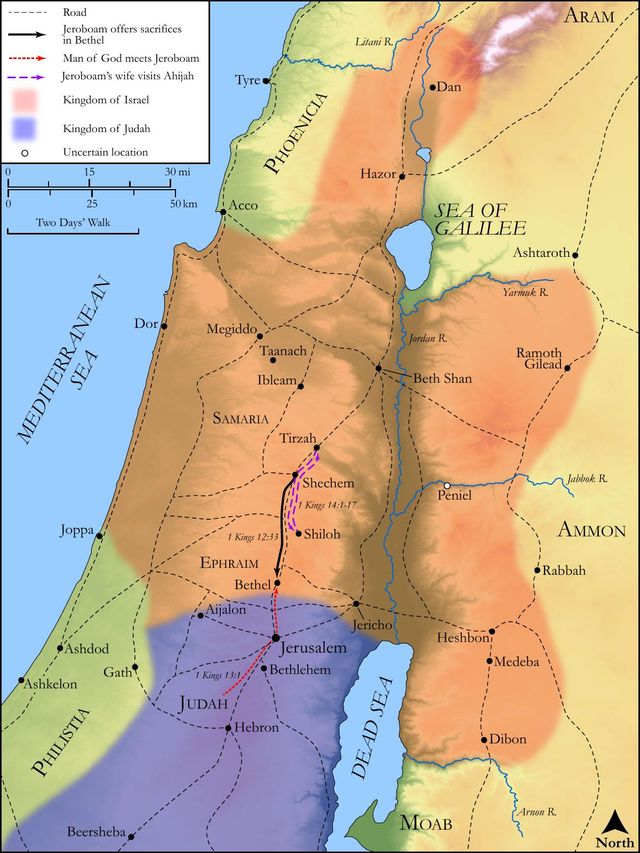
See on the biblical-era map

Study this verse
Public-domain commentary
Matthew Henry
From his Commentary on the Whole Bible. Henry comments on passages, not single verses — this entry covers 1 Kings 13:1–10. His two-level outline is real structure in the source text, so it is rendered as structure.
Here is, I. A messenger sent to Jeroboam, to signify to him God's displeasure against his idolatry, Kg1 13:1. The army of Judah that aimed to ruin him was countermanded, and might not draw a sword against him (Kg1 12:24); but a prophet of Judah is, instead thereof, sent to reclaim him from his evil way, and is sent in time, while he is but dedicating his altar, before his heart is hardened by the deceitfulness of his sin; for God delights not in the death of sinners, but would rather they would burn and live. How bold was the messenger that durst attack the king in his pride and interrupt the solemnity he was proud of! Those that go on God's errand must not fear the face of man; they know who will bear them out. How kind was he that sent him to warn Jeroboam of the wrath of God revealed from heaven against his ungodliness and unrighteousness!
II.The message delivered in God's name, not whispered, but cried with a loud voice, denoting both the prophet's courage, that he was neither afraid nor ashamed to own it, and his earnestness, that he desired to be heard and heeded by all that were present, who were not a few, on this great occasion. It was directed, not to Jeroboam nor to the people, but to the altar, the stones of which would sooner hear and yield than those who were mad upon their idols and deaf to divine calls. Yet, in threatening the altar, God threatened the founder and worshippers, to whom it was as dear as their own souls, and who might conclude, "If God's wrath fasten upon the lifeless guiltless altar, how shall we escape?" That which was foretold concerning the altar (Kg1 13:2) was that, in process of time, a prince of the house of David, Josiah by name, should pollute this altar by sacrificing the idolatrous priests themselves upon it, and burning the bones of dead men. Let Jeroboam know and be sure,
1.That the altar he now consecrated should be desecrated. Idolatrous worship will not continue, but the word of the Lord will endure for ever.
2.That the priests of the high places he now made should themselves be made sacrifices to the justice of God, and the first and only sacrifices upon this altar that would be pleasing to him. If the offering be such as is an abomination to God, it will follow, of course, that the offerers must themselves fall under his wrath, which will abide upon them, since it is not otherwise transmitted.
3.That this should be done by a branch of the house of David. That family which he and his kingdom had despised and treacherously deserted should recover so much power as to demolish that altar which he thought to establish; so that right and truth should at length prevail, both in civil and sacred matters, notwithstanding the present triumphs of those that were given to change the fear both of God and the king. It was about 356 years ere this prediction was fulfilled, yet it was spoken of as sure and nigh at hand, for a thousand years with God are but as one day. Nothing more contingent and arbitrary than the giving of names to persons, yet Josiah was here named above 300 years before he was born. Nothing future is hidden from God. There are names in the book of the divine prescience (Phi 4:3), names written in heaven.
III.A sign is given for the confirming of the truth of this prediction, that the altar should be shaken to pieces by an invisible power and the ashes of the sacrifice scattered (Kg1 13:3), which came to pass immediately, Kg1 13:5. This was,
1.A proof that the prophet was sent of God, who confirmed the word with this sign following, Mar 16:20.
2.A present indication of God's displeasure against these idolatrous sacrifices. How could the gift be acceptable when the altar that should sanctify it was an abomination?
3.It was a reproach to the people, whose hearts were harder than these stones and rent not under the word of the Lord.
4.It was a specimen of what should be done to it in the accomplishment of this prophecy by Josiah; it was now rent, in token of its being then ruined.
IV.Jeroboam's hand withered, which he stretched out to seize or smite the man of God, Kg1 13:4.
Instead of trembling at the message, as he might well have done, he assaulted him that brought it, in defiance of the wrath of which he was warned and contempt of that grace which sent him the warning. Rebuke a sinner and he will hate thee, and do thee a mischief if he can; yet God's prophets must rather expose themselves than betray their trust: he that employs them will protect them, and restrain the wrath of man, as he did Jeroboam's here by withering his hand, so that he could neither hurt the prophet nor draw it in to help himself. When his hand was stretched out to burn incense to his calves it was not withered; but, when it is stretched out against a prophet, he shall have no use of it till he humble himself. Of all the wickedness of the wicked there is none more provoking to God than their malicious attempts against his prophets, of whom he has said, Touch them not, do them no harm. As this was a punishment of Jeroboam, and answering to the sin, so it was the deliverance of the prophet. God has many ways of disabling the enemies of his church from executing their mischievous purposes. Jeroboam's inability to pull in his hand made him a spectacle to all about him, that they might see and fear. If God, in justice, harden the hearts of sinners, so that the hand they have stretched out in sin they cannot pull in again by repentance, that is a spiritual judgment, represented by this, and much more dreadful.
V.The sudden healing of the hand that was suddenly dried up, upon his submission, Kg1 13:6.
That word of God which should have touched his conscience humbled him not, but this which touched his bone and his flesh brings down his proud spirit. He looks for help now,
1.Not from his calves, but from God only, from his power and his favour. He wounded, and no hand but his can make whole.
2.Not by his own sacrifice or incense, but by the prayer and intercession of the prophet, whom he had just now threatened and aimed to destroy. The time may come when those that hate the preaching would be glad of the prayers of faithful ministers. "Pray to the Lord thy God," says Jeroboam; "thou hast an interest in him; improve it for me." But observe, He did not desire the prophet to pray that his sin might be pardoned, and his heart changed, only that his hand might be restored; thus Pharaoh would have Moses to pray that God would take away this death only (Exo 10:17), not this sin. The prophet, as became a man of God, renders good for evil, upbraids not Jeroboam with his impotent malice, nor triumphs in his submission, but immediately addresses himself to God for him. Those only are entitled to the blessing Christ pronounced on the persecuted that learn of him to pray for their persecutors, Mat 5:10, Mat 5:44. When the prophet thus honoured God, by showing himself of a forgiving spirit, God put this further honour upon him, that at his word he recalled the judgment and by another miracle healed the withered hand, that by the goodness of God Jeroboam might be led to repentance, and, if he were not broken by the judgment, yet might be melted by the mercy. With both he seemed affected for the present, but the impressions wore off.
VI.The prophet's refusal of Jeroboam's kind invitation, in which observe,
1.That God forbade his messenger to eat or drink in Beth-el (Kg1 13:9), to show his detestation of their execrable idolatry and apostasy from God, and to teach us not to have fellowship with the works of darkness, lest we have infection from them or give encouragement to them. He must not turn back the same way, but deliver his message, as it were, in transitu - as he passes along. He shall not seem to be sent on purpose (they were unworthy such a favour), but as if he only called by the way, his spirit being stirred, like Paul's at Athens, as he passed and saw their devotions. God would, by this command, try his prophet, as he did Ezekiel, whether he would not be rebellious, like that rebellious house, Eze 2:8.
2.That Jeroboam was so affected with the cure of his hand that though we read not of his thanksgivings to God for the mercy, or of his sending an offering to the altar at Jerusalem in acknowledgment of it, yet he was willing to express his gratitude to the prophet and pay him for his prayers, Kg1 13:7. Favours to the body will make even graceless men seem grateful to good ministers.
3.That the prophet, though hungry and weary, and perhaps poor, in obedience to the divine command refused both the entertainment and the reward proffered him. He might have supposed his acceptance of it would give him an opportunity of discoursing further with the king, in order to his effectual reformation, now that he was convinced; yet he will not think himself wiser than God, but, like a faithful careful messenger, hastens home when he has done his errand. Those have little learned the lessons of self-denial that cannot forbear one forbidden meal.
Historical interpretation
Historical reception
1 surviving comment on this verse from the historical church.
But when in the temple of our God, that wicked king Jeroboam took away the gifts that his father had laid up and offered them to idols on the holy altar, did not his right hand, which he stretched, wither, and his idols, which he called on, were not able to help him? Then, turning to the Lord, he asked for pardon, and at once his hand, which had withered by sacrilege, was healed by true religion. So complete an example was there set forth in one person, both of divine mercy and wrath, when he who was sacrificing suddenly lost his right hand but when penitent received forgiveness.
Continue studying 1 Kings 13:6 across the web’s major study libraries — every link below opens this exact verse, chapter, or book on the destination site.
Read & Compare
 BibleGatewayThis verse in more than 200 translations and 70 languages.
 Bible.comThe YouVersion reader — hundreds of translations, reading plans, and highlights.
 ESV.orgCrossway's official English Standard Version reader.
 NET BibleThe NET translation with 60,000+ translators' notes on every rendering decision.
 STEP BibleTyndale House's free study tool — original text, vocabulary, and scholarly resources.
 BibliaLogos Bible Software's free web reader.
 USCCBThe New American Bible (Revised Edition) with the U.S. bishops' study notes.
Commentaries
 BibleHub CommentariesDozens of classic commentaries on this verse, gathered on one page.
 StudyLightMore than 100 commentary sets — the largest collection on the web.
 BibleRefPlain-English commentary on what this verse means, verse by verse.
 Enduring WordDavid Guzik's free commentary on this chapter, widely used by Bible teachers.
 Bible Study ToolsVerse commentary alongside Greek and Hebrew study aids.
Original Language & Research
- BibleHub InterlinearThe verse word by word — original language, transliteration, and English.
- BibleHub LexiconEvery word's original-language definition and Strong's entry.
 Blue Letter BibleDeep-study tools — Strong's numbers, concordance, and word studies.
 SefariaThe Hebrew text with Rashi and centuries of Jewish commentary.
Sermons, Hymns & Audio


TrulyRandomVerse is not affiliated with these sites and doesn’t control their content. They’re linked because they’re genuinely useful.
Summary
1 Kings 13:6 records a pivotal moment where King Jeroboam, immediately afflicted with a withered hand as a divine judgment for his defiance and idolatry, desperately appeals to the unnamed man of God to intercede on his behalf. In a powerful display of both divine judgment and profound mercy, the Lord instantaneously restores Jeroboam's hand to its original, healthy state in response to the prophet's prayer, thereby unequivocally demonstrating God's sovereign authority over human affairs, His readiness to respond to the earnest pleas of His faithful servants, and His capacity for both swift retribution and compassionate healing.
Context
ShowHideLiterary Context
This verse serves as the immediate and dramatic climax of the confrontation between King Jeroboam and the man of God from Judah. The preceding chapter, 1 Kings 12, details Jeroboam's politically motivated religious apostasy, where he established golden calves in Bethel and Dan to prevent his northern kingdom subjects from worshipping in Jerusalem. In 1 Kings 13:1-2, the man of God, sent by divine command, boldly confronts Jeroboam at the altar in Bethel, prophesying its destruction and the desecration of its idolatrous priests. When Jeroboam, in a fit of rage, stretched out his hand to seize the prophet, his hand immediately withered, and the altar itself split apart, spilling its ashes, confirming the prophet's divine authority and the truth of his message (1 Kings 13:4-5). Verse 6 then captures Jeroboam's sudden shift from defiance to desperation, his plea for healing, and the Lord's swift, miraculous restoration of his hand, setting the stage for the subsequent narrative of the prophet's journey and further tests of obedience.
Historical & Cultural Context
The events of 1 Kings 13 are set during the nascent period of the divided monarchy, specifically during the reign of Jeroboam I over the northern kingdom of Israel (c. 931-910 BCE). Jeroboam's establishment of the golden calves was a calculated political maneuver, designed to secure his reign by severing religious ties with the southern kingdom of Judah, whose capital, Jerusalem, housed the legitimate temple. This act was a direct and egregious violation of the Mosaic Law, which strictly prohibited idolatry and mandated centralized worship at the tabernacle/temple. In ancient Near Eastern cultures, sudden, inexplicable physical afflictions were frequently interpreted as direct manifestations of divine judgment or displeasure, signifying a breach in the relationship between the deity and the afflicted individual or community. Prophets, like the unnamed man of God, held a unique and powerful position as direct conduits of divine revelation, delivering God's messages, warnings, and, as seen here, acting as intercessors on behalf of kings and the people, underscoring their unparalleled spiritual authority derived directly from Yahweh.
Key Themes
ShowHide1 Kings 13:6 powerfully illustrates several foundational themes. Firstly, it highlights Divine Judgment and Mercy: God's swift judgment on Jeroboam's hand underscores His intolerance for idolatry and rebellion against His commands, demonstrating that sin has immediate and tangible consequences. Yet, His immediate willingness to restore the hand upon the prophet's prayer also reveals His profound and readily available mercy, even towards those who have provoked Him. Secondly, the verse showcases the Potency of Intercessory Prayer: Jeroboam, in his distress, recognized the man of God's direct connection to the Lord and desperately requested his prayer. The immediate restoration of his hand demonstrates the profound effectiveness of intercessory prayer offered by a righteous servant of God, echoing the truth that "the prayer of a righteous person has great power as it is working" found in James 5:16. Thirdly, it unequivocally displays God's Sovereign Power to Heal: The miraculous restoration of Jeroboam's hand, becoming "as it was before," showcases God's absolute power over the human body and the natural order, a testament to His ability to heal all diseases and redeem all life, as celebrated in Psalm 103:3. Finally, the incident subtly introduces the tragic theme of Temporary or Superficial Repentance: While Jeroboam sought immediate physical relief, his request for healing did not lead to a lasting change in his heart or a turning away from his idolatrous practices, a sobering reality confirmed in later verses like 1 Kings 13:33-34.
Exposition and Analysis
ShowHideKey Word Analysis
ShowHideThe Hebrew verb חָלָה (H2470, châlâh) in its root form means "to be sick" or "to be weak." However, when used in the Hiphil stem, as it is here in the phrase "intreat the face of," it takes on a causative or intensive meaning, implying "to make sick," "to make weak," or metaphorically, "to soften," "to appease," or "to implore favor." When combined with "face" (פָּנִים, pânîym), it conveys the powerful image of earnestly seeking favor, pleading, or imploring with great urgency and humility, as if to "soften" God's countenance. Jeroboam's desperate use of this phrase highlights his recognition that only God's favor, mediated through the prophet, could reverse his severe affliction.
The Hebrew noun יָד (H3027, yâd) refers to the "hand," but its semantic range is exceptionally broad, encompassing concepts of power, means, direction, and even physical labor. In this context, the hand is not merely a physical appendage but a symbol of Jeroboam's authority and capacity for action. His withered hand signifies a direct divine judgment that rendered him powerless and unable to execute his will, particularly his defiant gesture against the prophet. Its restoration is a powerful demonstration of God's absolute sovereignty over human power and physical well-being.
The Hebrew verb שׁוּב (H7725, shûwb) is a fundamental word meaning "to turn," "to return," or "to restore." In this context, it signifies a complete reversal of the withered state, indicating that the hand did not merely improve but was returned to its original, healthy condition, becoming "as it was before." This emphasizes the completeness, instantaneousness, and miraculous nature of God's healing, demonstrating His absolute power to undo the effects of His judgment and to bring about full restoration.
Verse Breakdown
ShowHide"And the king answered and said unto the man of God,"
This clause marks Jeroboam's immediate and dramatic shift from defiant aggression to humble supplication. His previous attempt to seize the prophet is replaced by a desperate acknowledgment of the prophet's divine connection and the source of his affliction.
"Intreat now the face of the LORD thy God, and pray for me,"
Jeroboam recognizes the prophet's unique standing before God, referring to Yahweh as "thy God," indicating a personal relationship the prophet enjoys. His plea to "intreat the face of the LORD" conveys a profound sense of urgency and humility, a desperate request for divine favor and mercy, acknowledging that only God can reverse the judgment.
"that my hand may be restored me again."
This specifies the precise nature of Jeroboam's request: physical healing from the withered hand. It highlights his immediate concern for his personal well-being and the reversal of the visible, painful sign of divine judgment, demonstrating that even a defiant king will turn to God when faced with dire consequences.
"And the man of God besought the LORD,"
This clause describes the prophet's immediate and faithful obedience to Jeroboam's request. Despite Jeroboam's idolatry and defiance, the prophet, acting as God's compassionate servant, intercedes on his behalf, demonstrating his adherence to his prophetic role and God's willingness to hear the prayers of His messengers.
"and the king's hand was restored him again, and became as [it was] before."
This climactic phrase confirms the instantaneous and complete nature of God's miraculous intervention. The restoration is not partial but total, underscoring God's absolute power to heal and His immediate response to the prophet's prayer. This serves as a powerful validation of the prophet's message and God's sovereign control over life and death, health and sickness.
Literary Devices
ShowHideThe narrative of 1 Kings 13:6 is rich with literary devices that amplify its theological impact and underscore its dramatic tension. Divine Retribution is vividly displayed as Jeroboam's hand withers immediately after he stretches it out in defiance against God's prophet, a direct and precise lex talionis (law of retaliation) punishment for his attempted aggression and underlying idolatry. This swift judgment is immediately followed by Divine Intervention, as God's power is demonstrated not only in judgment but also in the instantaneous and complete restoration of the hand upon the prophet's prayer. There is a strong element of Irony in the scene: Jeroboam, who has rejected the true worship of Yahweh and established idolatrous altars, is forced to plead with Yahweh's prophet for healing, acknowledging the very God he sought to supplant. His hand, which he stretched out in a gesture of control and defiance, becomes useless, only to be restored by the power of the God he rejected. Furthermore, the withered hand serves as potent Symbolism, representing Jeroboam's spiritual paralysis and his inability to act effectively against God's will. Its restoration, while a physical miracle, also symbolizes God's offer of grace and a potential, though ultimately unheeded, call for Jeroboam to turn from his wicked ways and embrace true repentance.
Theological and Thematic Connections
ShowHide1 Kings 13:6 serves as a powerful testament to the dual nature of God's character: His unwavering justice against sin and His profound, readily available mercy. The immediate judgment on Jeroboam's hand underscores God's intolerance for idolatry and rebellion, serving as a tangible sign of His authority over human rulers and their defiance. Yet, the equally swift restoration of the hand upon the prophet's intercession reveals a God who is "slow to anger and abounding in steadfast love" (Psalm 103:8). This incident highlights the critical role of intercessory prayer, demonstrating that God hears and responds to the earnest pleas of His faithful servants, even on behalf of those who have provoked His wrath. It also raises a poignant question about the nature of repentance: was Jeroboam's plea genuine remorse leading to transformation, or merely a desperate cry for relief from consequences? The narrative suggests the latter, underscoring that while God's mercy is vast, it does not coerce true repentance, which must stem from a changed heart.
Reflection and Application
ShowHideThe account of Jeroboam's withered hand and its miraculous restoration in 1 Kings 13:6 offers profound lessons for contemporary believers. It reminds us that God is actively involved in human affairs, capable of both swift judgment and compassionate healing. We are challenged to examine the nature of our own repentance: do we, like Jeroboam, primarily seek God for relief from the painful consequences of our actions, or do we genuinely desire a transformation of heart that leads to a lasting turning away from sin and toward obedience? The incident also underscores the immense privilege and power of intercessory prayer. Just as the man of God stood in the gap for Jeroboam, we too are called to pray for others, for those who are suffering, and even for those who are in rebellion against God, trusting that God hears and acts according to His sovereign will and mercy. This narrative serves as a stark reminder that physical healing, while a profound blessing, is not always indicative of spiritual reconciliation or true repentance; genuine faith is demonstrated by sustained obedience and a life surrendered to God's will.
Questions for Reflection
ShowHideFAQ
ShowHideWhy did God heal Jeroboam's hand if he didn't truly repent and turn from his idolatry?
ShowHideGod's healing of Jeroboam's hand, despite his eventual failure to truly repent, serves multiple divine purposes. Firstly, it unequivocally validates the authority and message of the unnamed man of God. The immediate fulfillment of both the judgment (withered hand) and the restoration (healing) confirmed that the prophet was indeed a messenger from Yahweh, not merely a human voice. This public display of divine power served to authenticate God's word spoken through His servant. Secondly, it was an act of profound divine mercy and patience. God, in His compassion, offered Jeroboam a tangible sign of His power and a clear opportunity to repent and turn from his wicked ways. This demonstration of mercy, even to a defiant king, highlights God's character as one who is "gracious and compassionate, slow to anger and rich in love" (Psalm 145:8). While Jeroboam chose not to fully embrace this opportunity for lasting change (1 Kings 13:33-34), God's action still served as a powerful testimony to His sovereignty and a witness to all who observed, leaving Jeroboam without excuse.
Christ-Centered Fulfillment
ShowHideThe miraculous restoration of Jeroboam's withered hand in 1 Kings 13:6 finds its ultimate and most profound fulfillment in the person and work of Jesus Christ. Jeroboam's physical ailment was a direct consequence of his rebellion against God, and his healing, though temporary in its impact on his spiritual state, foreshadows the deeper, spiritual healing that Christ offers. Jesus, the true "man of God," came not merely to restore withered limbs (as seen in His healing of the man with the withered hand in Matthew 12:9-13), but to heal the withered souls of humanity, crippled by the spiritual paralysis of sin (Matthew 9:6). While the prophet in 1 Kings interceded for Jeroboam, Jesus himself is our ultimate and eternal intercessor, standing before the Father on our behalf, always living to make intercession for us (Hebrews 7:25). The immediate and complete restoration of Jeroboam's hand points to Christ's absolute power over all physical and spiritual brokenness, culminating in His own resurrection from the dead, which guarantees our future bodily resurrection and eternal life (Romans 6:23). Unlike Jeroboam's partial repentance, Jesus offers a complete and transformative salvation, taking away the sin of the world as the sacrificial Lamb of God (John 1:29), so that by His wounds, we are truly healed from the spiritual disease of sin unto eternal life and righteousness (1 Peter 2:24).