


Mark 1:1
Bible text: King James Version (1769 Blayney text) · Public domain
Bible text: Berean Standard Bible · Public domain
Bible text: American Standard Version (1901) · Public domain
Bible text: World English Bible, Messianic edition · Public domain
Bible text: Geneva Bible (1599) · Public domain
Bible text: Young's Literal Translation · Public domain
- ἈρχὴArchē[The] beginningG746N-NSFNoun Nominative Singular Feminine
- τοῦtouof theG3588T-GSNDefinite article Genitive Singular Neuter
- εὐαγγελίουeuangeliougospelG2098N-GSNNoun Genitive Singular Neuter
- ἸησοῦIēsouof JesusG2424N-GSM-PNoun Genitive Singular Masculine Individual
- ΧριστοῦChristouChristG5547N-GSM-TNoun Genitive Singular Masculine Title
- υἱοῦhuiouSonG5207N-GSMNoun Genitive Singular Masculine
- τοῦtou<the>G3588T-GSMDefinite article Genitive Singular Masculine
- θεοῦ·theouof GodG2316N-GSM-TNoun Genitive Singular Masculine Title
English is a literal word-by-word gloss of the Greek, not the KJV's wording. Why?
This is the original text the KJV's translators worked from — each Greek word with its own literal English meaning in this verse, prepared by scholars at Tyndale House, Cambridge. The KJV translates whole sentences, not word by word, so its wording differs: one Greek word can become several English words, and the KJV may choose “charity” where the gloss reads “love”. Both are faithful — they answer different questions. For the KJV's own rendering, switch to the KJV text.
Details
See on the biblical-era maps
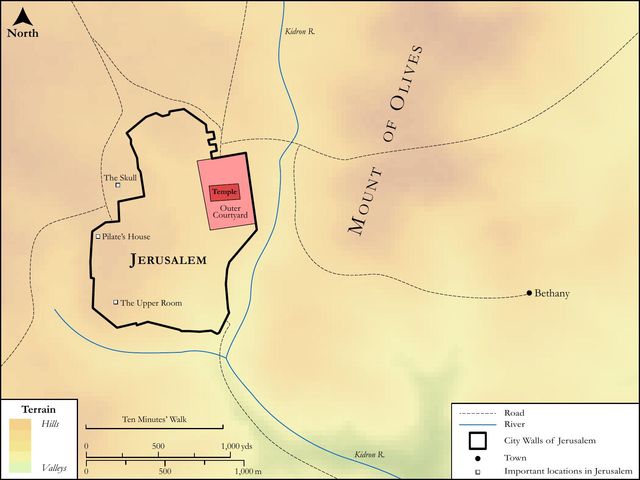
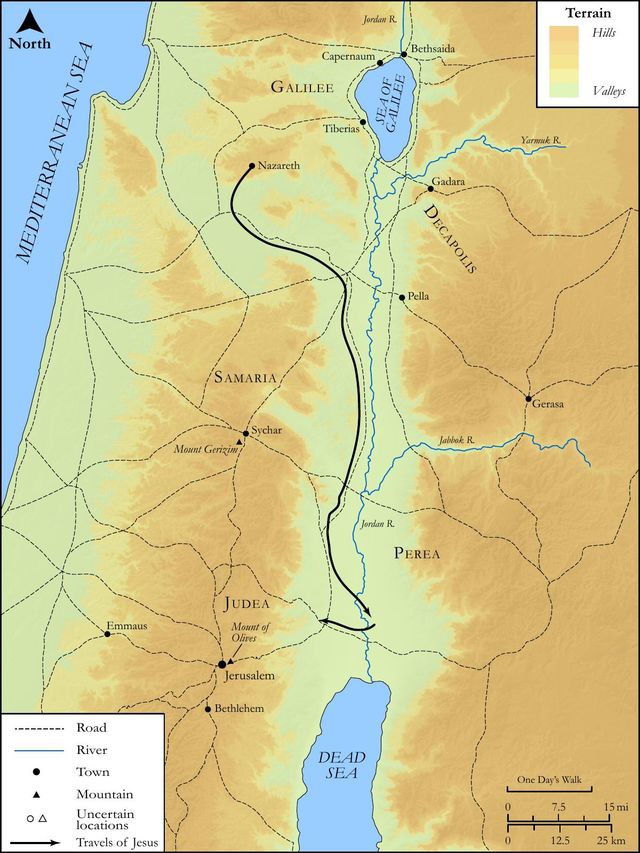
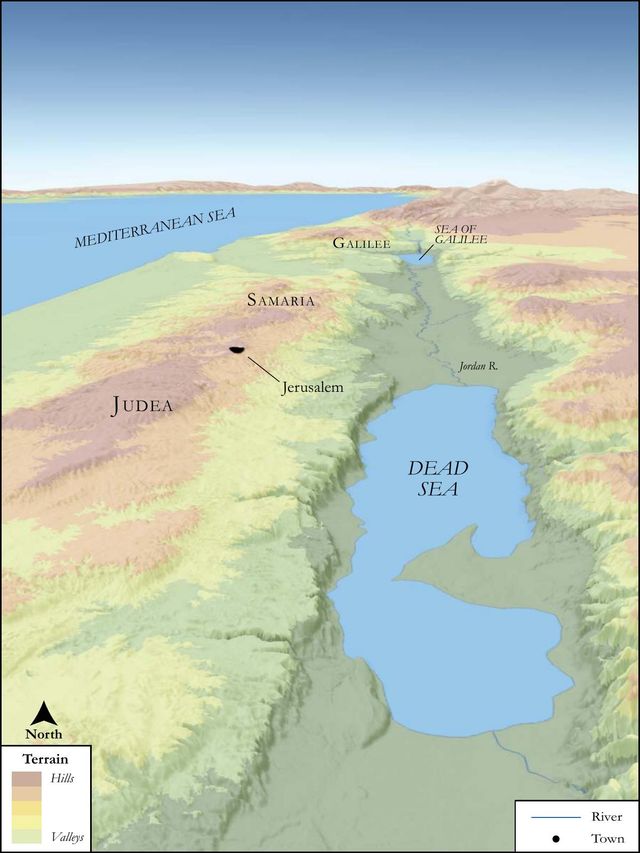
Study this verse
Public-domain commentary
Matthew Henry
From his Commentary on the Whole Bible. Henry comments on passages, not single verses — this entry covers Mark 1:1–8. His four-level outline is real structure in the source text, so it is rendered as structure.
We may observe here,
I.What the New Testament is - the divine testament, to which we adhere above all that is human; the new testament, which we advance above that which was old. It is the gospel of Jesus Christ the Son of God, Mar 1:1.
1.It is gospel; it is God's word, and is faithful and true; see Rev 19:9; Rev 21:5; Rev 22:6. It is a good word, and well worthy of all acceptation; it brings us glad tidings.
2.It is the gospel of Jesus Christ, the anointed Saviour, the Messiah promised and expected. The foregoing gospel began with the generation of Jesus Christ - that was but preliminary, this comes immediately to the business - the gospel of Christ. It is called his, not only because he is the Author of it, and it comes from him, but because he is the Subject of it, and it treats wholly concerning him.
3.This Jesus is the Son of God. That truth is the foundation on which the gospel is built, and which it is written to demonstrate; for is Jesus be not the Son of God, our faith is vain.
II.What the reference of the New Testament is to the Old, and its coherence with it.
The gospel of Jesus Christ begins, and so we shall find it goes on, just as it is written in the prophets (Mar 1:2); for it saith no other things than those which the prophets and Moses said should come (Act 26:22), which was most proper and powerful for the conviction of the Jews, who believed the Old Testament prophets to be sent of God and ought to have evidenced that they did so by welcoming the accomplishment of their prophecies in its season; but it is of use to us all, for the confirmation of our faith both in the Old Testament and in the New, for the exact harmony that there is between both shows that they both have the same divine original.
Quotations are here borrowed from two prophecies - that of Isaiah, which was the longest, and that of Malachi, which was the latest (and there were above three hundred years between them), both of whom spoke to the same purport concerning the beginning of the gospel of Jesus Christ, in the ministry of John.
1.Malachi, in whom we had the Old Testament farewell, spoke very plainly (Mal 3:1) concerning John Baptist, who was to give the New Testament welcome. Behold, I send my messenger before thy face, Mar 1:2. Christ himself had taken notice of this, and applied it to John (Mat 11:10), who was God's messenger, sent to prepare Christ's way.
2.Isaiah, the most evangelical of all the prophets, begins the evangelical part of his prophecy with this, which points to the beginning of the gospel of Christ (Isa 40:3); The voice of him that crieth in the wilderness, Mar 1:3. Matthew had taken notice of this, and applied it to John, Mat 3:3. But from these two put together here, we may observe,
(1.)That Christ, in his gospel, comes among us, bringing with him a treasure of grace, and a sceptre of government.
(2.)Such is the corruption of the world, that there is something to do to make room for him, and to remove that which gives not only obstruction, but opposition to his progress.
(3.)When God sent his Son into the world, he took care, and when he sends him into the heart, he takes care, effectual care, to prepare his way before him; for the designs of his grace shall not be frustrated; nor may any expect the comforts of that grace, but such as, by conviction of sin and humiliation for it, are prepared for those comforts, and disposed to receive them.
(4.)When the paths that were crooked, are made straight (the mistakes of the judgment rectified, and the crooked ways of the affections), then way is made for Christ's comforts.
(5.)It is in a wilderness, for such this world is, that Christ's way is prepared, and theirs that follow him, like that which Israel passed through to Canaan.
(6.)The messengers of conviction and terror, that come to prepare Christ's way, are God's messengers, whom he sends and will own, and must be received as such.
(7.)They that are sent to prepare the way of the Lord, in such a vast howling wilderness as this is, have need to cry aloud, and not spare, and to lift up their voice like a trumpet.
III.What the beginning of the New Testament was.
The gospel began in John Baptist; for the law and the prophets were, until John, the only divine revelation, but then the kingdom of God began to be preached, Luk 16:16. Peter begins from the baptism of John, Act 1:22. The gospel did not begin so soon as the birth of Christ, for he took time to increase in wisdom and stature, not so late as his entering upon his public ministry, but half a year before, when John began to preach the same doctrine that Christ afterward preached. His baptism was the dawning of the gospel day; for,
1.In John's way of living there was the beginning of a gospel spirit; for it bespoke great self-denial, mortification of the flesh, a holy contempt of the world, and nonconformity to it, which may truly be called the beginning of the gospel of Christ in any soul, Mar 1:6. He was clothed with camels' hair, not with soft raiment; was girt, not with a golden, but with a leathern girdle; and, in contempt of dainties and delicate things, his meat was locusts and wild honey. Note, The more we sit loose to the body, and live above the world, the better we are prepared for Jesus Christ.
2.In John's preaching and baptizing there was the beginning of the gospel doctrines and ordinances, and the first fruits of them.
(1.)He preached the remission of sins, which is the great gospel privilege; showed people their need of it, that they were undone without it, and that it might be obtained.
(2.)He preached repentance, in order to it; he told people that there must be a renovation of their hearts and a reformation of their lives, that they must forsake their sins and turn to God, and upon those terms and no other, their sins should be forgiven. Repentance for the remission of sins, was what the apostles were commissioned to preach to all nations, Luk 24:27.
(3.)He preached Christ, and directed his hearers to expect him speedily to appear, and to expect great things from him. The preaching of Christ is pure gospel, and that was John Baptist's preaching, Mar 1:7, Mar 1:8. Like a true gospel minister, he preaches,
[1.]The great pre-eminence Christ is advanced to; so high, so great, is Christ, that John, though one of the greatest that was born of women, thinks himself unworthy to be employed in the meanest office about him, even to stoop down, and untie his shoes. Thus industrious is he to give honour to him, and to bring others to do so too.
[2.]The great power Christ is invested with; He comes after me in time, but he is mightier than I, mightier than the mighty ones of the earth, for he is able to baptize with the Holy Ghost; he can give the Spirit of God, and by him govern the spirits of men.
[3.]The great promise Christ makes in his gospel to those who have repented, and have had their sins forgiven them; They shall be baptized with the Holy Ghost, shall be purified by his graces, and refreshed by his comforts. And, lastly, All those who received his doctrine, and submitted to his institution, he baptized with water, as the manner of the Jews was to admit proselytes, in token of their cleansing themselves by repentance and reformation (which were the duties required), and of God's cleansing them both by remission and by sanctification, which were the blessings promised. Now this was afterward to be advanced into a gospel ordinance, which John's using it was a preface to.
3.In the success of John's preaching, and the disciples he admitted by baptism, there was the beginning of a gospel church. He baptized in the wilderness, and declined going into the cities; but there went out unto him all the land of Judea, and they of Jerusalem, inhabitants both of city and country, families of them, and were all baptized of him. They entered themselves his disciples, and bound themselves to his discipline; in token of which, they confessed their sins; he admitted them his disciples, in token of which, he baptized them. Here were the stamina of the gospel church, the dew of its youth from the womb of the morning, Psa 110:3. Many of these afterward became followers of Christ, and preachers of his gospel, and this grain of mustard-seed became a tree.
Historical interpretation
Ten Centuries of Reception
17 surviving comments on this verse. Each one is dated, so this reads as a timeline rather than a list.
Select a marker to jump to its quote. Markers stagger vertically where authors wrote within a few decades of each other.
The Greek word 'Evangelium' means good tidings, in Latin it is explained, 'bona annunciatio,' or, the good news; these terms properly belong to the kingdom of God and to the remission of sins; for the Gospel is that, by which comes the redemption of the faithful and the beatitude of the saints. But the four Gospels are one, and one Gospel is four. In Hebrew, His name is Jesus, in Greek, Soter, in Latin, Salvator; but men say Christus in Greek, Messias in Hebrew, Unctus in Latin, that is, King and Priest.
This also the presbyter [John] said: Mark, having become the interpreter of Peter, wrote down accurately, though not in order, whatsoever he remembered of the things said or done by Christ. For he neither heard the Lord nor followed him, but afterward, as I said, he followed Peter, who adapted his teaching to the needs of his hearers, but with no intention of giving a connected account of the Lord's discourses, so that Mark committed no error while he thus wrote some things as he remembered them. For he was careful of one thing, not to omit any of the things which he had heard, and not to state any of them falsely.
Wherefore Mark also says: "The beginning of the Gospel of Jesus Christ, the Son of God; as it is written in the prophets."
Mark, the follower of Peter, while Peter publicly preached the Gospel at Rome before some of Cæsar's equites, and adduced many testimonies to Christ, in order that thereby they might be able to commit to memory what was spoken, of what was spoken by Peter, wrote entirely what is called the Gospel according to Mark.
The way of the Lord must be prepared within the heart; for great and spacious is the heart of man, as if it were a whole world. But see its greatness, not in bodily quantity, but in the power of the mind which enables it to encompass so great a knowledge of the truth. Prepare, therefore, in your hearts the way of the Lord, by a worthy manner of life. Keep straight the path of your life, so that the words of the Lord may enter in without hindrance.
The gospel is primarily concerned with Christ Jesus, who is the head of the whole body of those who are being saved. Mark conveys this point when he says, “The beginning of the gospel concerning Christ Jesus.” … In its unfolding the gospel has a beginning, a continuing middle and an end. The beginning can be viewed either as the entire Old Testament, with John the Baptist being its summarizing type, or (because he stands at the juncture of the new with the old) the final stages of the old covenant. This runs counter to those who would assign the two covenants to two different Gods.
Those who deepen in the knowledge of Christianity do not treat the things written in the law with disrespect.… In saying: “The beginning of the gospel of Jesus Christ, as it is written in the prophet Isaiah,” Mark shows that the beginning of the gospel is intrinsically connected with the Old Testament.
And thus when the divine word had made its home among them, the power of Simon was quenched and immediately destroyed, together with the man himself. And so greatly did the splendor of piety illumine the minds of Peter's hearers that they were not satisfied with hearing once only, and were not content with the unwritten teaching of the divine Gospel, but with all sorts of entreaties they besought Mark, a follower of Peter, and the one whose Gospel is extant, that he would leave them a written monument of the doctrine which had been orally communicated to them. Nor did they cease until they had prevailed with the man, and had thus become the occasion of the written Gospel which bears the name of Mark.
And they say that Peter — when he had learned, through a revelation of the Spirit, of that which had been done — was pleased with the zeal of the men, and that the work obtained the sanction of his authority for the purpose of being used in the churches. Clement in the eighth book of his Hypotyposes gives this account, and with him agrees the bishop of Hierapolis named Papias. And Peter makes mention of Mark in his first epistle which they say that he wrote in Rome itself, as is indicated by him, when he calls the city, by a figure, Babylon, as he does in the following words: "The church that is at Babylon, elected together with you, salutes you; and so does Marcus my son." [1 Peter 5:13]
De Trin., iii, 11: He has testified, that Christ was the Son of God, not in name only, but by His own proper nature. We are the sons of God, but He is not a son as we are; for He is the very and proper Son, by origin, not by adoption; in truth, not in name; by birth, not by creation.
With baptism the old covenant ends and the new begins. This is seen in the fact that the inaugurator of the New Testament is John the Baptist. “Among those born of women there is none greater than John.” He is the crown of all the prophetic tradition: “For all the prophets and the law prophesied until John.” Of the gospel dispensation he was the firstfruits, for we read “the beginning of the gospel of Jesus Christ” and after some words “John did baptize in the wilderness.”
Mark the disciple and interpreter of Peter wrote a short gospel at the request of the brethren at Rome embodying what he had heard Peter tell. When Peter had heard this, he approved it and published it to the churches to be read by his authority as Clemens in the sixth book of his Hypotyposes and Papias, bishop of Hierapolis, record. Peter also mentions this Mark in his first epistle, figuratively indicating Rome under the name of Babylon "She who is in Babylon elect together with you salutes you and so does Mark my son." So, taking the gospel which he himself composed, he went to Egypt and first preaching Christ at Alexandria he formed a church so admirable in doctrine and continence of living that he constrained all followers of Christ to his example. Philo most learned of the Jews seeing the first church at Alexandria still Jewish in a degree, wrote a book on their manner of life as something creditable to his nation telling how, as Luke says, the believers had all things in common at Jerusalem, so he recorded that he saw was done at Alexandria, under the learned Mark. He died in the eighth year of Nero and was buried at Alexandria, Annianus succeeding him.
(in Prolog.) Mark the Evangelist, who served the priesthood in Israel, according to the flesh a Levite, having been converted to the Lord, wrote his Gospel in Italy, showing in it how even his family benefited Christ. For, commencing his Gospel with the voice of the prophetic cry, he shows the order of the election of Levi, declaring that John the son of Zachariah was sent forth by the voice of an angel, and saying, The beginning of the Gospel of Jesus Christ, the Son of God.
Note that Mark mentions nothing of the nativity or infancy or youth of the Lord. He has made his Gospel begin directly with the preaching of John.
The Life of the Evangelist Mark
Mark was the disciple and interpreter of Peter, and, at the urging of the brethren in Rome, Mark wrote his short Gospel, following exactly what he had heard Peter tell. When Peter saw it, he gave it his approval, and directed that it be read in the Church, as Clement says in Book VI of his Outline. Papias, Bishop of Hierapolis, makes mention of this same Mark. Peter, in his first Epistle, refers to Rome metaphorically by the name “Babylon”: The church that is at Babylon, chosen together with you, saluteth you; and so doth Mark my son (I Pet. 5:13). Taking with him the Gospel which he himself had written, Mark went to Egypt, and was the first to preach Jesus Christ in Alexandria, where he established the Church. So highly did he excel both in teaching and in a life of steadfast endurance, that all those who came to believe in Christ, followed his example. And Philo [an Alexandrian Jewish philosopher of the first century AD], the most eloquent of the Jews, was so impressed when he saw the first church in Alexandria while it was still made up primarily of Jews, that he wrote a book about the life of those Christians, praising, as it were, his own race. Luke relates that the believers in Jerusalem held everything in common; likewise Philo preserved the memory of what he had seen occurring in Alexandria under the guidance of Mark. Mark reposed in the eighth year of Nero’s reign [63 A.D.]. He was buried in Alexandria, where Ananias succeeded him as bishop.
The beginning of the Gospel of Jesus Christ, etc. As it is written in Isaiah the prophet. The beginning of the Gospel of Mark should be compared to the beginning of Matthew, where he says: The book of the generation of Jesus Christ, the son of David, etc. And from both, our one Lord Jesus Christ is to be understood as the Son of God and man. And fittingly the first evangelist calls him the Son of Man, the second the Son of God, so that our understanding may gradually rise from the lesser to the greater, and through faith and the sacraments of assumed humanity, ascend to the recognition of divine eternity. Fittingly, he who was to describe human genealogy began with the Son of Man, namely David or Abraham, from whose lineage he assumed the substance of flesh. Fittingly, he who was to start his book from the beginning of the evangelical preaching wished to call our Lord Jesus Christ more as the Son of God, because it was in accordance with both aspects: the human nature from the lineage of patriarchs or kings of flesh, and the divine power to preach the Gospel to the world. Indeed, the Gospel is called the good news. And what is better news than: Repent, for the kingdom of heaven is at hand (Matt. III)? Therefore, it is human to be born humanly, but it is of God to preach the entry of the heavenly kingdom to the repentant. And thus Matthew rightly calls him the Son of David, whom he asserts to come in the flesh. Mark rightly calls him the Son of God, whom he designates at the very front of his writing as the author of the Gospel and the sponsor of the eternal kingdom. It is noteworthy that the holy Evangelists, who left us the written dispensation of the Lord's incarnation, were indeed fired by one spirit in their approach to their writing duty, but each set a different beginning and a different endpoint for their narrative. Matthew, taking his beginning from the nativity of the Lord, carried the sequence of his narration up to the time of the Lord’s resurrection. Mark, starting from the beginning of the evangelical preaching, reached up to the time of the Lord's ascension and the preaching of his disciples to all nations over the world. Luke, beginning from the nativity of the forerunner, ended his Gospel in the ascension of the Lord, when the disciples returning to Jerusalem were expecting the advent of the Holy Spirit in divine praises. John, taking his beginning from the eternity of the Word of God, by whom all things were made, himself reached up to the time of the Lord's resurrection by evangelizing. Therefore, intending to write the Gospel, Mark aptly first of all puts forth the testimonies of the prophets by whom this was long ago foretold to happen. So that he might indicate to all that the things he was writing were to be received as true and without a scruple of doubt, because he showed them to have been foreseen and foretold by prophets filled with the Holy Spirit, and at the same time in the same beginning of his Gospel instructs both the Jews, who had received the Law and the Prophets, to also receive the sacraments of the Gospel which their prophets had foretold, and the Gentiles, who had come to the Lord through all the proclamations of the Gospel, to also receive and venerate the authority of the Law and the Prophets, lest anyone, like the heretics, should accept either only the Old Testament or only the New, and thus remain alien to the testament of God.
(in Marc. i. 1) The beginning of this Gospel should be compared with that of Matthew, in which it is said, The book of the generation of Jesus Christ, the Son of David, the Son of Abraham. But here He is called the Son of God. Now from both we must understand one Lord Jesus Christ, Son of God, and of man. And fitly the first Evangelist names Him Son of man, the second, Son of God, that from less things our sense may by degrees mount up to greater, and by faith and the sacraments of the human nature assumed, rise to the acknowledgment of His divine eternity. Fitly also did He, who was about to describe His human generation, begin with a son of man, namely, David or Abraham. Fitly again, he who was beginning his book with the first preaching of the Gospel, chose rather to call Jesus Christ, the Son of God; for it belonged to the human nature to take upon Him the reality of our flesh, of the race of the patriarchs, and it was the work of Divine power to preach the Gospel to the world.
The Gospel According to St. Mark was written ten years after the Ascension of Christ. This Mark was a disciple of Peter, whom Peter calls his son, that is, his spiritual son. He was also called John (Acts 12:12), and the nephew of Barnabas (Col. 4:10), and the companion of Paul (Philemon 24). But eventually he accompanied Peter the most, and was with him in Rome. The believers in Rome begged Mark not only to preach orally, but also to give them a written account of Christ’s life. He agreed, and composed it immediately. God revealed to Peter that Mark had written this Gospel, and when he saw it, Peter confirmed its truth, and sent Mark as bishop to Egypt. There Mark preached and established the Church in Alexandria, enlightening all those in that sunny land to the south. The character of this Gospel, therefore, is unclouded and clear, containing nothing that is hidden.
Mark’s Gospel agrees with Matthew’s in every respect, except that Matthew goes into greater detail. And while Matthew begins with the Nativity of the Lord according to the flesh, Mark begins with the prophet and forerunner John. Therefore, though it may appear incomprehensible, some have given this understanding of the four Evangelists: God, Who sits upon the four-faced Cherubim, as Scripture says (see Ezekiel 1:10, 10:14; also Rev. 4:7) gave us the Gospel which likewise appears in four forms, but is held together by one Spirit. Just as one of the Cherubim had the face of a lion, and another the face of a man, and another the face of an eagle, and another the face of a bullock, so it is with the preaching of the Gospel.
The Gospel of John has the face of a lion, for the lion is royal and princely; and John began his Gospel with the royal and lordly dignity of the divine Word, saying, In the beginning was the Word, and the Word was God. But the Gospel of Matthew is in the likeness of a man, for it begins with the Nativity according to the flesh and the incarnation of the Word. The Gospel of Mark is likened to an eagle, for it begins with the prophet and forerunner John. And the prophetic gift, by which one can foresee and keenly perceive things that are a great way off, is like an eagle. For it is said that the eagle is the most keen sighted of all the animals, and can even gaze at the sun without shutting its eyes. The Gospel of Luke is like the bullock, because it begins with the priestly service of Zacharias, in the course of which he made sacrifice for the sins of the people, sacrificing a bullock.
But Mark begins his Gospel by describing the way of life of the Forerunner. Listen then to what he says.
Continue studying Mark 1:1 across the web’s major study libraries — every link below opens this exact verse, chapter, or book on the destination site.
Read & Compare
 BibleGatewayThis verse in more than 200 translations and 70 languages.
 Bible.comThe YouVersion reader — hundreds of translations, reading plans, and highlights.
 ESV.orgCrossway's official English Standard Version reader.
 NET BibleThe NET translation with 60,000+ translators' notes on every rendering decision.
 STEP BibleTyndale House's free study tool — original text, vocabulary, and scholarly resources.
 BibliaLogos Bible Software's free web reader.
 USCCBThe New American Bible (Revised Edition) with the U.S. bishops' study notes.
Commentaries
 BibleHub CommentariesDozens of classic commentaries on this verse, gathered on one page.
 StudyLightMore than 100 commentary sets — the largest collection on the web.
 BibleRefPlain-English commentary on what this verse means, verse by verse.
 Enduring WordDavid Guzik's free commentary on this chapter, widely used by Bible teachers.
 Bible Study ToolsVerse commentary alongside Greek and Hebrew study aids.
Original Language & Research
- BibleHub InterlinearThe verse word by word — original language, transliteration, and English.
- BibleHub LexiconEvery word's original-language definition and Strong's entry.
 Blue Letter BibleDeep-study tools — Strong's numbers, concordance, and word studies.
 CNTR CollationThe earliest Greek manuscripts of this verse, collated letter by letter.
Sermons, Hymns & Audio


TrulyRandomVerse is not affiliated with these sites and doesn’t control their content. They’re linked because they’re genuinely useful.
Summary
Mark 1:1 serves as the powerful, concise, and theologically charged inaugural statement of the Gospel of Mark, immediately declaring its profound purpose and unequivocally establishing the identity of its central figure. Far more than a mere title, this verse functions as a foundational theological assertion, setting the stage for the entire narrative that unfolds, proclaiming the "beginning of the good news" concerning Jesus Christ, who is definitively identified as the Son of God.
Context
ShowHideLiterary Context
The Gospel of Mark distinguishes itself from Matthew and Luke by its striking brevity and immediate commencement of Jesus' public ministry, bypassing genealogies or birth narratives. Mark 1:1 acts as a succinct thesis statement, plunging directly into the core message of the "gospel" (good news) of Jesus Christ. This directness establishes a sense of urgency and dynamism that characterizes the entire book, presenting Jesus as a figure of action and authority from the very first verse. The subsequent verses immediately transition into John the Baptist's preparatory ministry, further emphasizing the "beginning" aspect of Mark's narrative.
Historical & Cultural Context
Traditionally attributed to John Mark, a companion of Peter, this Gospel is believed to have been written primarily for a Roman audience, likely explaining its concise style and less emphasis on Jewish customs and genealogies compared to other Gospels. In the ancient world, the Greek term "euangelion" (gospel) was often used for official announcements of great significance, such as a military victory, the accession of an emperor, or the birth of a royal heir, carrying connotations of public proclamation and joyous tidings. By employing this term, Mark immediately elevates the story of Jesus to a level of supreme importance, declaring it the ultimate good news for all humanity, surpassing any earthly imperial decree.
Key Themes
ShowHideMark 1:1 introduces several pivotal themes that resonate throughout the Gospel. First, the phrase "The beginning of the gospel" highlights the inauguration of God's redemptive plan through Jesus, signaling a new era of salvation history. Second, the identification of Jesus as "Christ" (Greek: Christos, Hebrew: Mashiach) underscores His role as the long-awaited Messiah, the Anointed One prophesied in the Old Testament, chosen by God to establish His kingdom. This identity is crucial for understanding the entirety of the New Testament, as seen in Peter's confession in Matthew 16:16. Third, the declaration "the Son of God" is the most profound theological claim, asserting Jesus' unique divine relationship and identity with God the Father. This title signifies His inherent authority, power, and ultimate divinity, distinguishing Him from mere prophets or kings. This foundational truth is powerfully reinforced throughout Mark's Gospel, notably at His baptism in Mark 1:11 and transfiguration in Mark 9:7.
Exposition and Analysis
ShowHideKey Word Analysis
ShowHideFrom the Greek word archomai meaning "to begin," this term signifies a commencement, origin, or even a chief point. In Mark 1:1, it denotes not merely the start of a book, but the inauguration of a new epoch—the dawning of God's redemptive work through Jesus. It implies a foundational point from which all subsequent events derive their meaning and purpose.
Derived from the Greek term meaning "good message" or "good tidings," this word carries immense theological weight. It refers to the joyous proclamation of God's saving activity in Jesus Christ. In the Greco-Roman world, it was used for announcements of victory or imperial decrees; here, it is repurposed to describe the ultimate, divine proclamation of salvation and hope, centered on Jesus.
This title is the Greek equivalent of the Hebrew Mashiach (Messiah), meaning "Anointed One." It signifies Jesus' divinely appointed role as the long-prophesied King, Priest, and Prophet, chosen by God to deliver His people and establish His eternal kingdom. Its inclusion immediately identifies Jesus with the fulfillment of Old Testament messianic expectations.
Verse Breakdown
ShowHide"¶ The beginning"
This phrase immediately sets the tone, indicating an inaugural event or the commencement of a significant narrative. It is not just a book title but points to the historical and theological initiation of the "gospel" era.
"of the gospel"
This identifies the content of the "beginning" as "good news." This "good news" is not merely information but a powerful, transformative message concerning God's redemptive action for humanity.
"of Jesus Christ"
This specifies the subject and agent of this good news. "Jesus" is His given human name, signifying His historical reality. "Christ" is His title, identifying Him as the promised Messiah, the Anointed One of God, fulfilling Old Testament prophecies.
"the Son of God;"
This climactic declaration reveals Jesus' ultimate identity. It is a profound theological assertion of His divine nature, His unique relationship with the Father, and His inherent authority, setting Him apart as more than just a prophet or king.
Literary Devices
ShowHideMark 1:1 is a masterclass in Conciseness and Brevity, characteristic of Mark's fast-paced narrative style. Unlike other Gospels, Mark wastes no words, plunging directly into the core message. It functions as a powerful Declarative Statement, asserting Jesus' identity and the nature of His mission with immediate authority. The verse serves as both a Title for the entire book and a Thesis Statement, encapsulating the fundamental truth that the subsequent narrative will unpack. Furthermore, it is a profound Theological Assertion, immediately establishing Jesus' divine nature and messianic role, setting the interpretive lens through which the reader is to understand all that follows.
Theological and Thematic Connections
ShowHideMark 1:1 encapsulates the very essence of the Christian message, declaring the arrival of God's ultimate good news in the person of Jesus Christ. The "gospel" is not merely a story about Jesus, but the divine announcement of God's redemptive plan being fully realized through Him. By identifying Jesus as both "Christ" (Messiah) and "Son of God," the verse establishes His unique dual identity as the promised human deliverer and the divine manifestation of God Himself, thereby laying the theological cornerstone for understanding God's nature, humanity's need for salvation, and the means by which that salvation is accomplished. This foundational truth underscores the sovereignty of God in initiating salvation history and His profound love in sending His Son.
Reflection and Application
ShowHideMark 1:1 compels us to confront and embrace the profound significance of Jesus Christ. It is a call to recognize that the entire narrative of human history, and indeed our personal lives, finds its ultimate meaning and direction in the "good news" that begins with Him. Understanding Jesus as the Christ, the Anointed One, means acknowledging Him as the fulfillment of all God's promises and the one chosen to bring about true justice and peace. Recognizing Him as the Son of God means submitting to His divine authority, trusting in His perfect wisdom, and resting in His sovereign power. This foundational truth transforms our perspective on sin, salvation, and the very purpose of existence. It invites us to respond with faith, repentance, and a commitment to live in light of this ultimate good news, which is not merely a historical account but a living, transformative reality that continues to be proclaimed and experienced today.
Questions for Reflection
ShowHideFAQ
ShowHideWhy does Mark's Gospel start so abruptly, without a birth narrative or genealogy?
ShowHideMark's Gospel is characterized by its sense of urgency and action, often using the Greek word "euthys" (immediately). This abrupt beginning, without genealogies or birth narratives found in Matthew and Luke, serves to propel the reader directly into Jesus' public ministry and the immediate proclamation of the "good news." This style was likely appealing to a Roman audience, who valued directness and power over extensive historical background. Mark's focus is on what Jesus did and who He is as revealed through His actions, rather than His lineage or early life. The "beginning" in Mark 1:1 refers to the inauguration of Jesus' public ministry and the gospel itself, rather than a chronological start of His life.
What is the significance of the title "Son of God" in Mark 1:1?
ShowHideThe title "Son of God" is profoundly significant in Mark 1:1 because it immediately establishes Jesus' divine nature and unique relationship with God the Father. While "Christ" identifies Him as the Messiah, "Son of God" goes further, asserting His inherent divinity and authority. This declaration is a central theological theme throughout Mark's Gospel, confirmed by God's own voice at Jesus' baptism (Mark 1:11) and transfiguration (Mark 9:7), and even confessed by a Roman centurion at the cross (Mark 15:39). It signifies that Jesus is not merely a human prophet or king, but God's own divine Son, possessing ultimate power and authority.
Christ-Centered Fulfillment
ShowHideMark 1:1, "The beginning of the gospel of Jesus Christ, the Son of God," serves as a profound Christ-centered declaration, announcing the ultimate fulfillment of God's redemptive plan in the person of Jesus. The "gospel" itself, as "good news," finds its complete embodiment and power in Christ. He is not merely the subject of the good news, but its very content. As the "Christ," Jesus fulfills the myriad Old Testament prophecies concerning the Anointed One, the Messiah who would deliver His people and establish an everlasting kingdom, as foreshadowed in passages like Isaiah 9:6-7. More profoundly, His identity as "the Son of God" reveals His unique divine nature and relationship with the Father, a truth that echoes throughout the New Testament, culminating in His resurrection, which powerfully declared Him to be the Son of God with power (Romans 1:3-4). Thus, Mark 1:1 points to Jesus as the one in whom all of God's promises are "Yes" and "Amen" (2 Corinthians 1:20), the one through whom humanity's deepest need for salvation is met, and the one whose life, death, and resurrection constitute the very heart of the good news proclaimed to all nations (Luke 24:46-47).