


Revelation 19:9
Bible text: King James Version (1769 Blayney text) · Public domain
Bible text: King James Version with Strong's numbers · Public domain
Bible text: Berean Standard Bible · Public domain
Bible text: American Standard Version (1901) · Public domain
Bible text: World English Bible, Messianic edition · Public domain
Bible text: Geneva Bible (1599) · Public domain
Bible text: Young's Literal Translation · Public domain
- καὶkaiAndG2532CONJConjunction
- λέγειlegeihe saysG3004V-PAI-3SVerb Present Active Indicative 3rd Singular
- μοι·moito meG3165P-1DSPersonal pronoun Dative 1st Singular
- γράψον·grapsondo writeG1125V-AAM-2SVerb Aorist Active Imperative 2nd Singular
- μακάριοιmakarioiBlessed [are]G3107A-NPMAdjective Nominative Plural Masculine
- οἱhoithoseG3588T-NPMDefinite article Nominative Plural Masculine
- εἰςeistoG1519PREPPreposition
- τὸtotheG3588T-ASNDefinite article Accusative Singular Neuter
- δεῖπνονdeipnonsupperG1173N-ASNNoun Accusative Singular Neuter
- τοῦtouof theG3588T-GSMDefinite article Genitive Singular Masculine
- γάμουgamoumarriageG1062N-GSMNoun Genitive Singular Masculine
- τοῦtouof theG3588T-GSNDefinite article Genitive Singular Neuter
- ἀρνίουarniouLambG721N-GSNNoun Genitive Singular Neuter
- κεκλημένοιkeklēmenoiinvitedG2564V-RPP-NPMVerb Perfect Passive Participle Nominative Plural Masculine
- καὶkaiAndG2532CONJConjunction
- λέγειlegeihe saysG3004V-PAI-3SVerb Present Active Indicative 3rd Singular
- μοι·moito meG3165P-1DSPersonal pronoun Dative 1st Singular
- οὗτοιhoutoiTheseG3778D-NPMDemonstrative pronoun Nominative Plural Masculine
- οἱhoitheG3588T-NPMDefinite article Nominative Plural Masculine
- λόγοιlogoiwordsG3056N-NPMNoun Nominative Plural Masculine
- ἀληθινοὶalēthinoitrueG228A-NPMAdjective Nominative Plural Masculine
- τοῦtou<the>G3588T-GSMDefinite article Genitive Singular Masculine
- θεοῦtheouof GodG2316N-GSM-TNoun Genitive Singular Masculine Title
- εἰσινeisinareG1510V-PAI-3PVerb Present Active Indicative 3rd Plural
English is a literal word-by-word gloss of the Greek, not the KJV's wording. Why?
This is the original text the KJV's translators worked from — each Greek word with its own literal English meaning in this verse, prepared by scholars at Tyndale House, Cambridge. The KJV translates whole sentences, not word by word, so its wording differs: one Greek word can become several English words, and the KJV may choose “charity” where the gloss reads “love”. Both are faithful — they answer different questions. For the KJV's own rendering, switch to the KJV text.
Details
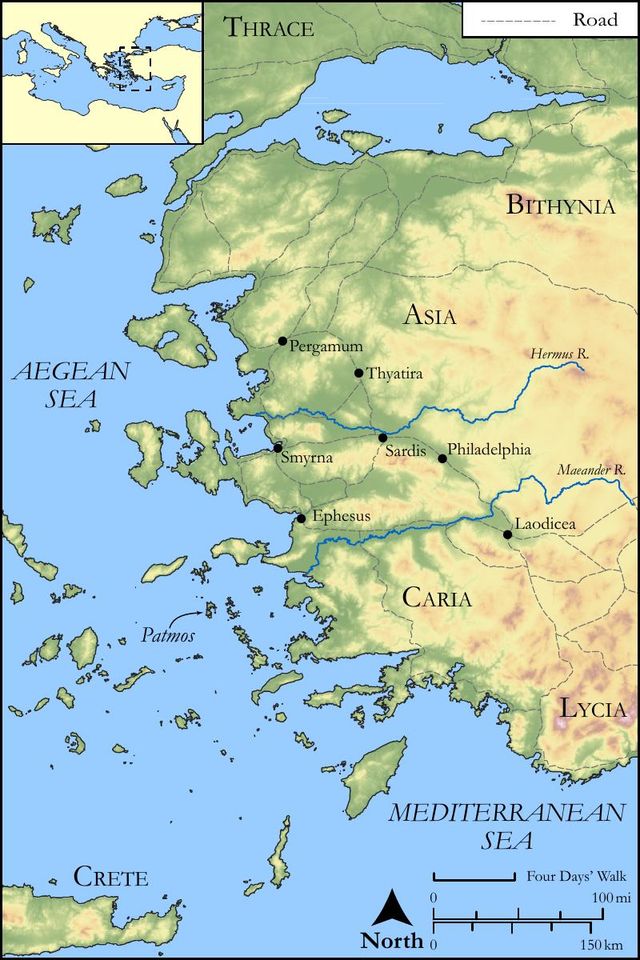
See on the biblical-era maps

Study this verse
Public-domain commentary
Matthew Henry
From his Commentary on the Whole Bible. Henry comments on passages, not single verses — this entry covers Revelation 19:5–10. His three-level outline is real structure in the source text, so it is rendered as structure.
The triumphant song being ended, and epithalamium, or marriage-song, begins, Rev 19:6. Here observe,
I.The concert of heavenly music.
The chorus was large and loud, as the voice of many waters and of mighty thunderings. God is fearful in praises. There is no discord in heaven; the morning stars sing together; no jarring string, nor key untuned, but pure and perfect melody.
II.The occasion of this song; and that is the reign and dominion of that omnipotent God who has redeemed his church by his own blood, and is now in a more public manner betrothing her to himself: The marriage of the Lamb has come, Rev 19:7. Some think this refers to the conversion of the Jews, which they suppose will succeed the fall of Babylon; others, to the general resurrection: the former seems more probable. Now,
1.You have here a description of the bride, how she appeared; not in the gay and gaudy dress of the mother of harlots, but in fine linen, clean and white, which is the righteousness of saints; in the robes of Christ's righteousness, both imputed for justification and imparted for sanctification - the stola, the white robe of absolution, adoption, and enfranchisement, and the white robe of purity and universal holiness. She had washed her robes and made them white in the blood of the Lamb; and these her nuptial ornaments she did not purchase by any price of her own, but received them as the gift and grant of her blessed Lord.
2.The marriage-feast, which, though not particularly described (as Mat 22:4), yet is declared to be such as would make all those happy who were called to it, so called as to accept the invitation, a feast made up of the promises of the gospel, the true sayings of God, Rev 19:9. These promises, opened, applied, sealed, and earnested by the Spirit of God, in holy eucharistical ordinances, are the marriage-feast; and the whole collective body of all those who partake of this feast is the bride, the Lamb's wife; they eat into one body, and drink into one Spirit, and are not mere spectators or guests, but coalesce into the espoused party, the mystical body of Christ.
3.The transport of joy which the apostle felt in himself at this vision. He fell down at the feet of the angel, to worship him, supposing him to be more than a creature, or having his thoughts at the present overpowered by the vehemency of his affections. Here observe,
(1.)What honour he offered to the angel: He fell at his feet, to worship him; this prostration was a part of external worship, it was a posture of proper adoration.
(2.)How the angel refused it, and this was with some resentment: "See thou do it not; have a care what thou doest, thou art doing a wrong thing." (3.) He gave a very good reason for his refusal: "I am thy fellow-servant, and of thy brethren which have the testimony of Jesus - I am a creature, thine equal in office, though not in nature; I, as an angel and messenger of God, have the testimony of Jesus, a charge to be a witness for him and to testify concerning him, and thou, as an apostle, having the Spirit of prophecy, hast the same testimony to give in; and therefore we are in this brethren and fellow-servants." (4.) He directs him to the true and only object of religious worship; namely, God: "Worship God, and him alone." This fully condemns both the practice of the papists in worshipping the elements of bread and wine, and saints, and angels, and the practice of those Socinians and Arians who do not believe that Christ is truly and by nature God, and yet pay him religious worship; and this shows what wretched fig-leaves all their evasions and excuses are which they offer in their own vindication: they stand hereby convicted of idolatry by a messenger from heaven.
Historical interpretation
Four Centuries of Reception
6 surviving comments on this verse. Each one is dated, so this reads as a timeline rather than a list.
Select a marker to jump to its quote. Markers stagger vertically where authors wrote within a few decades of each other.
The Lord spoke of this, saying, “They will recline at table with Abraham, Isaac and Jacob in the kingdom of heaven,” and again, “He will come and serve them.” Certainly [the Lord] is indicating those “who are called according to his purpose” and who enter the full number of the elect. “For many are called, but few are chosen.”
Who are those who have been invited to the feast of the Lamb, unless those to whom it is said: “I will not drink from this fruit of the vine until I will drink it new with you in the kingdom of my Father who is in heaven.” And again, “Many will come from east and west and will recline at table with Abraham, Isaac, and Jacob in the kingdom of heaven.” This is to drink the new cup, to prepare the new bodies of those being raised, to keep a new joy, and to repay the sincere righteousness of a true faith. These are the blessed who are prepared for this feast and for this repast.
The marriage supper of Christ is the feast of those who are being saved and the joy that accompanies it. The blessed will come into these things when they enter into the eternal bridal chamber with the holy Bridegroom of their purified souls. For he who has promised this is faithful. Since there are many blessings in the coming age, which surpass every understanding, the participation in them is indicated through various terms. Sometimes they are called the “kingdom of heaven” on account of their glory and honor; sometimes they are called “paradise” on account of the everlasting banquet of good things; sometimes they are called the “bosom of Abraham” on account of the rest of those who repose there, or the “bridechamber” and “marriage” because of the endless joy and the perfect and inexpressible union of God with his servants. This union surpasses every carnal and bodily union as much as light is separated from darkness or a perfume from a foul odor.
And he said to me: Write: Blessed are those who are called to the marriage supper of the Lamb. He says they are called not to lunch, but to supper, because indeed the feast at the end of the day is supper. Therefore, those who, at the end of the present life, come to the refreshment of heavenly contemplation are surely called to the supper of the Lamb.
These are the true words of God. That is, what I have foretold will truly happen.
And he says to me, "Write: Blessed are those who are called to the marriage supper of the Lamb," and indeed go forth as is proper; for we know many who are called in the Gospels, but who have renounced the spiritual banquet or even, though they have gone away, are cast out as not having wedding garments, (Matt. 22:11-12) as is shortly shown. But the divine apostle also said, "many are called, but few are chosen." (Matt. 22:14)
Continue studying Revelation 19:9 across the web’s major study libraries — every link below opens this exact verse, chapter, or book on the destination site.
Read & Compare
 BibleGatewayThis verse in more than 200 translations and 70 languages.
 Bible.comThe YouVersion reader — hundreds of translations, reading plans, and highlights.
 ESV.orgCrossway's official English Standard Version reader.
 NET BibleThe NET translation with 60,000+ translators' notes on every rendering decision.
 STEP BibleTyndale House's free study tool — original text, vocabulary, and scholarly resources.
 BibliaLogos Bible Software's free web reader.
 USCCBThe New American Bible (Revised Edition) with the U.S. bishops' study notes.
Commentaries
 BibleHub CommentariesDozens of classic commentaries on this verse, gathered on one page.
 StudyLightMore than 100 commentary sets — the largest collection on the web.
 BibleRefPlain-English commentary on what this verse means, verse by verse.
 Enduring WordDavid Guzik's free commentary on this chapter, widely used by Bible teachers.
 Bible Study ToolsVerse commentary alongside Greek and Hebrew study aids.
Original Language & Research
- BibleHub InterlinearThe verse word by word — original language, transliteration, and English.
- BibleHub LexiconEvery word's original-language definition and Strong's entry.
 Blue Letter BibleDeep-study tools — Strong's numbers, concordance, and word studies.
 CNTR CollationThe earliest Greek manuscripts of this verse, collated letter by letter.
Sermons, Hymns & Audio


TrulyRandomVerse is not affiliated with these sites and doesn’t control their content. They’re linked because they’re genuinely useful.
Summary
Revelation 19:9 delivers a profound divine mandate to John, instructing him to record a beatitude of immense significance: "Blessed are they which are called unto the marriage supper of the Lamb." This declaration, immediately affirmed as "the true sayings of God," pivots the apocalyptic narrative from the preceding judgments against Babylon to the glorious culmination of God's redemptive plan, highlighting the joyous, intimate union between Christ and His redeemed people.
Context
ShowHideLiterary Context
Revelation 19:9 stands as a pivotal declaration within the broader apocalyptic vision, immediately following the resounding pronouncements of judgment against "Babylon the Great" in Revelation 17, Revelation 18 and the heavenly chorus celebrating God's righteous vindication. The preceding verses in Revelation 19:1-8 describe a fourfold Hallelujah chorus in heaven, praising God for His justice and announcing that "the marriage of the Lamb is come, and his wife hath made herself ready." This verse, therefore, serves as a direct, divinely inspired commentary on the significance of this wedding of the Lamb, shifting the narrative focus from the destruction of evil to the joyous, eternal destiny of God's people. The angelic command to John, "Write," underscores the absolute authority, certainty, and enduring importance of this beatitude for all who read and heed the prophecy.
Historical & Cultural Context
To fully appreciate the imagery of the "marriage supper of the Lamb," it is essential to understand Jewish wedding customs. A typical Jewish wedding involved several stages: the betrothal (kiddushin), a period of separation, and then the wedding feast (nisu'in), which could last for days, often celebrated at the groom's home. The "supper" (deîpnon) was the main meal of the day, usually eaten in the evening, signifying a time of celebration, fellowship, and abundance. In this context, the imagery evokes a grand, joyous, and final celebration, symbolizing the consummation of a covenant relationship. The invitation to such a feast would be a great honor, signifying inclusion and favor. For John's original audience, familiar with these customs, the "marriage supper" would immediately convey a sense of ultimate fulfillment, intimate communion, and unparalleled joy, contrasting sharply with the preceding scenes of tribulation and judgment.
Key Themes
ShowHideRevelation 19:9 contributes significantly to several overarching themes within the book of Revelation and biblical theology. Firstly, it highlights the theme of Divine Blessing and Eschatological Hope, presenting a beatitude that promises profound happiness and favor to those who are God's chosen. This blessing is tied directly to the ultimate consummation of God's redemptive plan. Secondly, the central image of The Marriage Supper of the Lamb encapsulates the theme of Divine-Human Union and Covenant Fulfillment. It symbolizes the joyous, eternal union between Christ, the victorious "Lamb" who was slain (Revelation 5:6), and His redeemed Church, often portrayed as His bride (Ephesians 5:25-27). This theme finds its roots in Old Testament prophetic imagery of God's covenant relationship with Israel as a marriage (Isaiah 62:5). Finally, the affirmation "These are the true sayings of God" underscores the theme of Divine Veracity and Certainty of Prophecy, assuring believers of the absolute trustworthiness and infallible nature of God's revealed word regarding future events.
Exposition and Analysis
ShowHideKey Word Analysis
ShowHideThis term denotes a state of profound and enduring happiness, spiritual well-being, and divine favor that is independent of external circumstances. It signifies a deep, inner joy that comes from being in a right relationship with God and receiving His approval. The blessedness here is not merely a wish but a declared reality for those invited to the Lamb's supper.
Meaning "to call" (properly, aloud), this word emphasizes a divine invitation and summons. In a theological context, it refers to God's sovereign act of drawing individuals to Himself, often implying an effective call that leads to salvation and participation in His purposes. It highlights that inclusion in the marriage supper is not by human merit but by divine grace and initiative.
A diminutive form of "lamb," this term is used almost exclusively in Revelation to refer to Jesus Christ. It powerfully symbolizes His sacrificial death as the innocent Passover Lamb (John 1:29), His meekness, and yet paradoxically, His supreme authority and victorious power as the resurrected Lord who conquers evil and reigns eternally.
Verse Breakdown
ShowHide"And he saith unto me, Write"
This is a direct divine command to John, emphasizing the imperative nature and authoritative origin of the message that follows. It signifies that the revelation is not merely for John's understanding but for recording and dissemination to the churches, ensuring its preservation and transmission for all generations.
"Blessed [are] they which are called unto the marriage supper of the Lamb"
This is the core beatitude, declaring a state of profound happiness and divine favor upon those who have received God's sovereign invitation to the ultimate celebratory feast. It points to the eschatological union between Christ and His redeemed people, a joyous consummation of their relationship.
"And he saith unto me, These are the true sayings of God"
This concluding affirmation serves as a powerful validation of the preceding statement. It underscores the absolute veracity, reliability, and divine origin of the entire message, guaranteeing its fulfillment and trustworthiness to the reader, reinforcing the infallibility of God's prophetic word.
Literary Devices
ShowHideRevelation 19:9 employs several powerful Literary Devices to convey its profound message. The most prominent is Symbolism, particularly through the image of the "marriage supper of the Lamb." This metaphor vividly represents the intimate, joyous, and eternal union between Christ (the Lamb) and His Church (His bride), signifying the consummation of God's redemptive plan. The phrase "Blessed are they" is a Beatitude, a common literary form in both the Old and New Testaments (e.g., the Beatitudes in the Sermon on the Mount), which pronounces divine favor and happiness upon a specific group or condition. This beatitude stands in stark Contrast to the preceding judgments, shifting the focus from destruction to celebration and eternal life. The angelic instruction, "Write," serves as a Divine Command, emphasizing the authority and certainty of the message, ensuring its preservation and transmission. Finally, the concluding affirmation, "These are the true sayings of God," acts as a powerful Validation or Divine Attestation, reinforcing the absolute trustworthiness and infallibility of the prophetic word.
Theological and Thematic Connections
ShowHideRevelation 19:9 stands as a theological cornerstone, linking the culmination of salvation history to the intimate, covenantal relationship between God and His people. The "marriage supper of the Lamb" is the ultimate expression of God's faithfulness to His promises, a grand celebration where the redeemed, cleansed and made ready by the Lamb's sacrifice, enter into eternal communion with their Savior. This imagery echoes the Old Testament prophetic vision of a great feast at the end of days, signifying God's abundant provision and the joyous fellowship of His kingdom. It underscores the active, sovereign nature of God's call to salvation, emphasizing that participation in this glorious future is a gracious invitation extended to those chosen by Him. The certainty of this promise, affirmed as "true sayings of God," provides profound assurance for believers across all generations, anchoring their hope in the infallible word of God.
Reflection and Application
ShowHideRevelation 19:9 offers a profound wellspring of hope, assurance, and motivation for believers navigating the complexities of life in a fallen world. It redirects our gaze from present struggles and the pervasive presence of evil towards the glorious, certain future awaiting those who are in Christ. The declaration of blessedness reminds us that true happiness and spiritual prosperity are found not in worldly achievements or circumstances, but in being divinely called into an eternal, intimate relationship with the Lamb. This verse calls us to live with eager anticipation for Christ's return and the full realization of His kingdom, inspiring perseverance in faith, purity in life, and active participation in the mission of God, knowing that our ultimate destiny is a joyous, unending feast with our Savior. It encourages us to respond daily to God's call, preparing ourselves as the bride for her groom, living lives that reflect the holiness and love of our coming King.
Questions for Reflection
ShowHideFAQ
ShowHideWho are "they which are called" in this verse?
ShowHide"They which are called" refers to God's elect, those who have responded in faith to His sovereign invitation to salvation through Jesus Christ. In biblical theology, being "called" (Greek: kaléō) often implies an effective, divine summons that leads to a saving relationship with God. These are the redeemed, the Church, who are described elsewhere in Revelation as the "wife" of the Lamb, made ready for the marriage (Revelation 19:7-8).
What is the significance of the "marriage supper of the Lamb"?
ShowHideThe "marriage supper of the Lamb" is a powerful symbolic image representing the ultimate, joyous consummation of the covenant relationship between Christ (the Lamb) and His Church (His bride). It signifies the final and eternal union of God with His redeemed people, a celebration of salvation, victory over evil, and the full establishment of God's kingdom. It is the fulfillment of all redemptive history, a feast of intimate fellowship and unparalleled joy, echoing Old Testament prophecies of a great eschatological banquet (Isaiah 25:6).
Christ-Centered Fulfillment
ShowHideRevelation 19:9 finds its profound Christ-centered fulfillment in the person and work of Jesus Christ, the Lamb of God. He is the central figure of this glorious "marriage supper," not merely as the groom, but as the sacrificial Lamb whose shed blood makes this union possible. The "blessedness" pronounced in this verse is entirely predicated on His atoning work, for it is through His death and resurrection that believers are "called" and made worthy to participate. The Lamb's supper is the ultimate celebration of the new covenant, inaugurated by Christ's blood (Luke 22:20), where He, as the true bread of life (John 6:35), provides eternal sustenance and fellowship. His ultimate victory over sin and death, foreshadowed by His first coming and fully realized at His second, ensures that these "true sayings of God" will indeed come to pass, culminating in an eternal, intimate communion between the Bridegroom and His redeemed bride (Revelation 21:2).