


Revelation 22:6
Bible text: King James Version (1769 Blayney text) · Public domain
Bible text: King James Version with Strong's numbers · Public domain
Bible text: Berean Standard Bible · Public domain
Bible text: American Standard Version (1901) · Public domain
Bible text: World English Bible, Messianic edition · Public domain
Bible text: Geneva Bible (1599) · Public domain
Bible text: Young's Literal Translation · Public domain
- ΚαὶKaiAndG2532CONJConjunction
- εἶπένeipenhe saidG2036V-2AAI-3SVerb 2nd Aorist Active Indicative 3rd Singular
- μοι·moito meG3165P-1DSPersonal pronoun Dative 1st Singular
- οὗτοιhoutoiTheseG3778D-NPMDemonstrative pronoun Nominative Plural Masculine
- οἱhoi<the>G3588T-NPMDefinite article Nominative Plural Masculine
- λόγοιlogoiwordsG3056N-NPMNoun Nominative Plural Masculine
- πιστοὶpistoi[are] faithfulG4103A-NPMAdjective Nominative Plural Masculine
- καὶkaiandG2532CONJConjunction
- ἀληθινοίalēthinoitrueG228A-NPMAdjective Nominative Plural Masculine
- καὶkaiAndG2532CONJConjunction
- κύριοςkuriosLordG2962N-NSM-TNoun Nominative Singular Masculine Title
- ὁhotheG3588T-NSMDefinite article Nominative Singular Masculine
- θεὸςtheosGodG2316N-NSM-TNoun Nominative Singular Masculine Title
- τῶνtōnof theG3588T-GPNDefinite article Genitive Plural Neuter
- πνευμάτωνpneumatōnspiritsG4151N-GPNNoun Genitive Plural Neuter
- τῶνtōnof theG3588T-GPMDefinite article Genitive Plural Masculine
- προφητῶνprophētōnprophetsG4396N-GPMNoun Genitive Plural Masculine
- ἀπέστειλενapesteilensentG649V-AAI-3SVerb Aorist Active Indicative 3rd Singular
- τὸνtontheG3588T-ASMDefinite article Accusative Singular Masculine
- ἄγγελονangelonangelG32N-ASMNoun Accusative Singular Masculine
- αὐτοῦautouof HimG846P-GSMPersonal pronoun Genitive Singular Masculine
- δεῖξαιdeixaito showG1166V-AANVerb Aorist Active Infinitive
- τοῖςtoisto theG3588T-DPMDefinite article Dative Plural Masculine
- δούλοιςdouloisservantsG1401N-DPMNoun Dative Plural Masculine
- αὐτοῦautouof HimG846P-GSMPersonal pronoun Genitive Singular Masculine
- ἃha[the things] thatG3739R-APNRelative pronoun Accusative Plural Neuter
- δεῖdeimustG1163V-PAI-3SVerb Present Active Indicative 3rd Singular
- γενέσθαιgenesthaicome to passG1096V-2ADNVerb 2nd Aorist Middle Deponent Infinitive
- ἐνenwithG1722PREPPreposition
- τάχειtacheispeedG5034N-DSNNoun Dative Singular Neuter
English is a literal word-by-word gloss of the Greek, not the KJV's wording. Why?
This is the original text the KJV's translators worked from — each Greek word with its own literal English meaning in this verse, prepared by scholars at Tyndale House, Cambridge. The KJV translates whole sentences, not word by word, so its wording differs: one Greek word can become several English words, and the KJV may choose “charity” where the gloss reads “love”. Both are faithful — they answer different questions. For the KJV's own rendering, switch to the KJV text.
Details
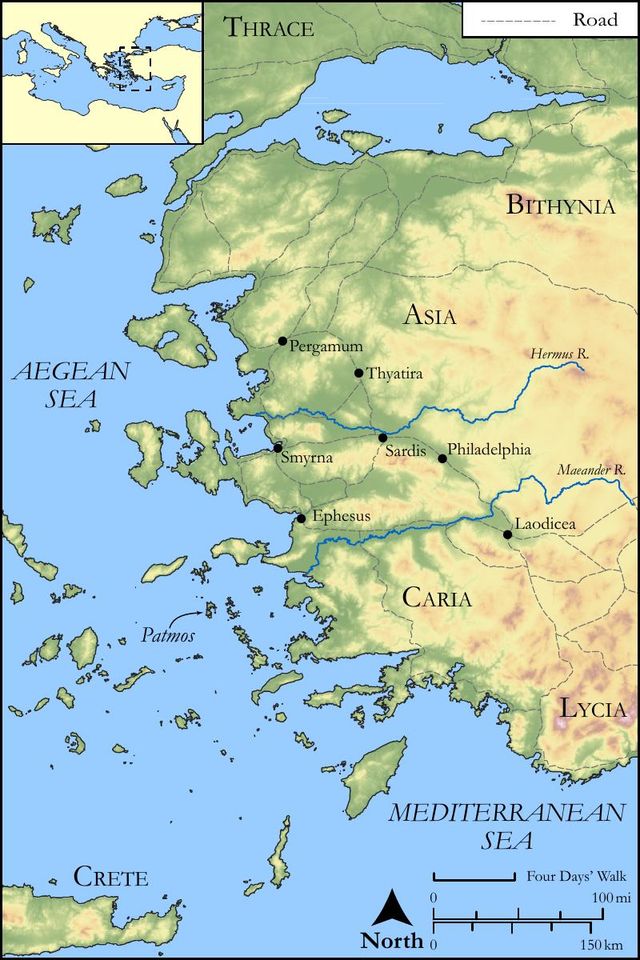
See on the biblical-era maps

Study this verse
Public-domain commentary
Matthew Henry
From his Commentary on the Whole Bible. Henry comments on passages, not single verses — this entry covers Revelation 22:6–19.
We have here a solemn ratification of the contents of this book, and particularly of this last vision (though some think it may not only refer to the whole book, but to the whole New Testament, yea, to the whole Bible, completing and confirming the canon of scripture); and here, 1. This is confirmed by the name and nature of that God who gave out these discoveries: he is the Lord God, faithful and true, and so are all his sayings. 2. By the messengers he chose, to reveal these things to the world; the holy angels showed them to holy men of God; and God would not employ his saints and angels in deceiving the world. 3. They will soon be confirmed by their accomplishment: they are things that must shortly be done; Christ will make haste, he will come quickly, and put all things out of doubt; and then those will prove the wise and happy men who have believed and kept his words. 4. By the integrity of that angel who had been the apostle's guide and interpreter in these visions; this integrity was such that he not only refused to accept religious adoration from John, but once and again reproved him for it. He who was so tender of the honour of God, and so displeased with what was a wrong to God, would never come in his name to lead the people of God into mere dreams and delusions; and it is a still further confirmation of the sincerity of this apostle that he confesses his own sin and folly, into which he had now again relapsed, and he leaves this his failing on perpetual record: this shows he was a faithful and an impartial writer. 5. By the order given to leave the book of the prophecy open, to be perused by all, that they might labour to understand it, that they might make their objections against it, and compare the prophecy with the events. God here deals freely and openly with all; he does not speak in secret, but calls every one to witness to the declarations here made, Rev 22:10. 6. By the effect this book, thus kept open, will have upon men; those that are filthy and unjust will take occasion thence to be more so, but it will confirm, strengthen, and further sanctify those that are upright with God; it will be a savour of life to some and of death to others, and so will appear to be from God, Rev 22:12. 7. It will be Christ's rule of judgment at the great day; he will dispense rewards and punishments to men according as their works agree or disagree with the word of God; and therefore that word itself must needs be faithful and true. 8. It is the word of him who is the author, finisher, and rewarder of the faith and holiness of his people, Rev 22:13, Rev 22:14. He is the first and the last, and the same from first to last, and so is his word too; and he will by this word give to his people, who conform themselves to it, a right to the tree of life, and an entrance into heaven; and this will be a full confirmation of the truth and authority of his word, since it contains the title and evidence of that confirmed state of holiness and happiness that remains for his people in heaven. 9. It is a book that condemns and excludes from heaven all wicked, unrighteous persons, and particularly those that love and make lies (Rev 22:15), and therefore can never be itself a lie. 10. It is confirmed by the testimony of Jesus, which is the Spirit of prophecy. And this Jesus, as God, is the root of David, though, as man, his offspring - a person in whom all uncreated and created excellencies meet, too great and too good to deceive his churches and the world. He is the fountain of all light, the bright and the morning star, and as such has given to his churches this morning light of prophecy, to assure them of the light of that perfect day which is approaching. 11. It is confirmed by an open and general invitation to all to come and partake of the promises and privileges of the gospel, those streams of the water of life; these are tendered to all who feel in their souls a thirst which nothing in this world can quench. 12. It is confirmed by the joint testimony of the Spirit of God, and that gracious Spirit that is in all the true members of the church of God; the Spirit and the bride join in testifying the truth and excellency of the gospel. 13. It is confirmed by a most solemn sanction, condemning and cursing all who should dare to corrupt or change the word of God, either by adding to it or taking from it, Rev 22:18, Rev 22:19. He that adds to the word of God draws down upon himself all the plagues written in this book; and he who takes any thing away from it cuts himself off from all the promises and privileges of it. This sanction is like a flaming sword, to guard the canon of the scripture from profane hands. Such a fence as this God set about the law (Deu 4:2), and the whole Old Testament (Mal 4:4), and now in the most solemn manner about the whole Bible, assuring us that it is a book of the most sacred nature, divine authority, and of the last importance, and therefore the peculiar care of the great God.
Historical interpretation
Four Centuries of Reception
7 surviving comments on this verse. Each one is dated, so this reads as a timeline rather than a list.
Select a marker to jump to its quote. Markers stagger vertically where authors wrote within a few decades of each other.
He is not expressing any doubts about the trustworthiness of John. Rather, he is commending this vision to the whole church as true, for he knew that in the future there would also be those who are to learn from it. [By speaking of his angel], he teaches that he has always looked after the welfare of all. He is the Spirit of the prophets who is also the Holy Spirit and indeed is the Lord. For this reason the prophet said, “I will hear what the Lord God speaks to me,” and “The beginning of the speaking of God to Hosea.” Because of the essence of the one, divine Trinity, he also fittingly mentions here the Holy Spirit, since above he had mentioned the Father and the Son. For when we read that “God is spirit,” it refers to the entire Trinity.
What is so faithful and true as the promise of Christ and the future hope of the saints? He who spoke through his servants, the prophets, did so that he might be recognized as the Lord of the living and be called “the Spirit of the Lord.” For the Spirit is life, and all flesh is made alive by the Spirit.
These words are “trustworthy and true” because they come from the Truth.… Since Christ is “the God of the prophets, who sent his angel” by means of the blessed John who saw this vision, “to show his servants what is to take place,” it is clear that he gave the Revelation for the sake of the flesh according to the condescension of the economy of the Son, as it said at the beginning. For he who is the God of the prophets and who sent his angels as ministering spirits for the revelation of coming things would not be ignorant of the hour or the day of the consummation, so that he who has all “the hidden treasures of wisdom and knowledge” would learn [these things] only now from the Father.
To show his servants what must soon take place. As I said, he showed that he foresaw things generally useful for everyone.
And the Lord God of the spirits of the prophets sent his angel. Do not doubt, he says, about the person giving the warning. For God himself, who usually imbues the spirits of the prophets with a heavenly vision, has sent me to show you these future things.
And he said to me: These words are faithful and true. He did not doubt the faith of John, but commended the true vision to the whole Church, in which he knew there would be even the little ones.
These words, he says, are faithful, that is, true. And the Lord is the spirit of the prophets. He says "spirits of prophets" to mean the prophetic gifts, according to what was said to the most wise Paul. And "the spirits of prophets are subject to prophets," (1 Cor. 14:32) and to the divine prophet Isaiah: "Because of your fear, O Lord, we conceived in the womb and we travailed; and we bore the spirit of your salvation, which you made upon the earth." (Isa. 26:18)
He says to show his servants the things which must shortly take place. For through John and his writings all things that were shown to him have been learned. And he rightly said "shortly," for every time is short, as was said before, even if some appear to be especially great, when compared with the coming unending ages.
Continue studying Revelation 22:6 across the web’s major study libraries — every link below opens this exact verse, chapter, or book on the destination site.
Read & Compare
 BibleGatewayThis verse in more than 200 translations and 70 languages.
 Bible.comThe YouVersion reader — hundreds of translations, reading plans, and highlights.
 ESV.orgCrossway's official English Standard Version reader.
 NET BibleThe NET translation with 60,000+ translators' notes on every rendering decision.
 STEP BibleTyndale House's free study tool — original text, vocabulary, and scholarly resources.
 BibliaLogos Bible Software's free web reader.
 USCCBThe New American Bible (Revised Edition) with the U.S. bishops' study notes.
Commentaries
 BibleHub CommentariesDozens of classic commentaries on this verse, gathered on one page.
 StudyLightMore than 100 commentary sets — the largest collection on the web.
 BibleRefPlain-English commentary on what this verse means, verse by verse.
 Enduring WordDavid Guzik's free commentary on this chapter, widely used by Bible teachers.
 Bible Study ToolsVerse commentary alongside Greek and Hebrew study aids.
Original Language & Research
- BibleHub InterlinearThe verse word by word — original language, transliteration, and English.
- BibleHub LexiconEvery word's original-language definition and Strong's entry.
 Blue Letter BibleDeep-study tools — Strong's numbers, concordance, and word studies.
 CNTR CollationThe earliest Greek manuscripts of this verse, collated letter by letter.
Sermons, Hymns & Audio


TrulyRandomVerse is not affiliated with these sites and doesn’t control their content. They’re linked because they’re genuinely useful.
Summary
Revelation 22:6 serves as a climactic divine affirmation, validating the entirety of the prophetic visions presented in the book. It declares with absolute certainty that the messages conveyed to John are divinely inspired, inherently trustworthy, and destined for swift and sure fulfillment. This verse underscores God's unwavering faithfulness and His sovereign control over history, assuring His servants that the revealed future events, culminating in the establishment of His eternal kingdom, are not merely possibilities but certainties.
Context
ShowHideLiterary Context
This verse appears at a pivotal point in the book of Revelation, marking the conclusion of the angel's direct discourse with John and serving as a divine seal on all the preceding revelations. It immediately follows the glorious descriptions of the New Heaven and New Earth and the New Jerusalem, and the River of Life. The angel, who has been John's primary guide through much of the apocalyptic visions, delivers this emphatic declaration of truth and reliability, setting the stage for Jesus's own concluding words and the final benedictions and warnings of the book. It echoes the opening declaration of the book in Revelation 1:1 regarding "things which must shortly come to pass," creating an inclusio that frames the entire prophecy with divine certainty.
Historical & Cultural Context
Written during a period of intense persecution for early Christians under the Roman Empire, the book of Revelation offered a message of hope, endurance, and ultimate triumph. Prophetic literature, especially apocalyptic, was a common genre in Jewish and early Christian contexts, designed to reveal divine truths about the end times and God's ultimate victory over evil. The assertion that "These sayings are faithful and true" would have provided immense encouragement to believers facing tribulation, assuring them that their suffering was not in vain and that God's promised justice and deliverance were absolutely reliable. The emphasis on God as "the Lord God of the holy prophets" firmly grounds John's revelation within the established tradition of Old Testament prophecy, lending it authority and continuity with God's historical dealings with His people.
Key Themes
ShowHideRevelation 22:6 powerfully reinforces several overarching themes of the book. Firstly, it highlights Divine Authority and Truthfulness, asserting that the entire prophecy originates from God and is therefore absolutely reliable and trustworthy. This echoes similar affirmations throughout Revelation, such as God's declaration in Revelation 21:5 that "these words are faithful and true." Secondly, the verse emphasizes God's Sovereignty and Control over History, portraying Him as the one who orchestrates all events, past, present, and future, through His "holy prophets" and His "angel." Thirdly, the phrase "must shortly be done" reiterates the theme of Imminence and Urgency, a recurring motif from the book's very beginning in Revelation 1:1. While not necessarily implying immediate chronological fulfillment, it conveys the certainty and rapid unfolding of events once they commence, demanding a posture of readiness from believers. Finally, the revelation is specifically "to shew unto his servants," reinforcing the theme of Divine Disclosure for God's People, indicating that God reveals His plans not to terrify, but to inform, comfort, and prepare those who are devoted to Him.
Exposition and Analysis
ShowHideKey Word Analysis
ShowHideReferring to something said, a topic, discourse, or word. In this context, it refers to the entire body of prophetic revelations and visions that John has received and recorded in the book of Revelation. The use of "sayings" emphasizes the verbal and declarative nature of the divine message, highlighting that these are not mere human speculations but divinely communicated truths.
Meaning objectively trustworthy, reliable, or deserving of belief. When applied to God's words, it signifies their absolute dependability and immutability. What God has spoken, He will surely bring to pass; His promises are secure, and His character is consistent with His declarations.
Meaning truthful, genuine, or authentic. This word contrasts with what is false, illusory, or merely an appearance. It affirms the reality and authenticity of the prophetic content, emphasizing that the visions and prophecies are not deceptive or metaphorical in a way that negates their ultimate reality, but rather convey genuine divine truth.
Meaning it is necessary, behoved, or ought. This term conveys divine compulsion and inevitability. The events foretold are not optional or contingent but are part of God's unalterable plan, ensuring their certain occurrence.
Meaning a brief space of time, in haste, quickly, or speedily. Combined with "must be done," this adverb emphasizes the certainty and swiftness of the events' unfolding once they begin. It speaks to the imminence of the divine timetable from God's perspective, urging a sense of urgency and readiness for those awaiting their fulfillment.
Meaning to cause to be, to become, or to come into being. This verb signifies the actualization and realization of the prophecies. The "things" revealed are not static predictions but dynamic events that will literally "come to pass" or "be brought to pass" in history, confirming the active and sovereign hand of God in their execution.
Verse Breakdown
ShowHide"And he said unto me,"
This clause identifies the speaker as the angel who has been revealing these final visions to John. It underscores the divine origin of the message, as the angel acts as God's authorized messenger.
"These sayings are faithful and true:"
This is a powerful affirmation of the absolute reliability and authenticity of all the prophecies and revelations contained within the book of Revelation. It serves as a divine seal of approval, guaranteeing the veracity of the entire prophetic message.
"and the Lord God of the holy prophets"
This phrase identifies the ultimate source of the revelation: the sovereign God who has consistently communicated His will and future plans through His chosen messengers throughout history, from the Old Testament prophets to John himself. It establishes continuity and authority.
"sent his angel to shew unto his servants"
This explains the mechanism and purpose of the revelation. God, through His angel, actively discloses these truths. The recipients are specifically identified as "his servants," indicating that the message is intended for those who belong to God and are committed to serving Him, providing them with understanding and guidance.
"the things which must shortly be done."
This final clause emphasizes the nature and timing of the revealed events. They are not optional but divinely ordained ("must"), and their fulfillment is certain and will occur with a sense of divine urgency and swiftness ("shortly"). This phrase encapsulates the eschatological focus of Revelation, pointing to the imminent unfolding of God's ultimate plan.
Literary Devices
ShowHideRevelation 22:6 employs several significant literary devices. The most prominent is Affirmation, as the verse explicitly declares the "sayings" to be "faithful and true," serving as a powerful concluding validation for the entire prophetic book. This emphatic statement functions as a Seal or a divine guarantee, reinforcing the credibility of the preceding visions. The phrase "the Lord God of the holy prophets" uses Appellation to describe God, connecting Him to the long tradition of biblical prophecy and emphasizing His consistent character as the source of all divine revelation. The angel acts as a Messenger Figure, a common trope in apocalyptic literature, bridging the divine and human realms. Finally, the phrase "must shortly be done" utilizes Foreshadowing and Imminence, creating a sense of urgency and certainty about future events without necessarily specifying an exact chronological timeline, but rather emphasizing their divine inevitability and rapid unfolding once they commence.
Theological and Thematic Connections
ShowHideRevelation 22:6 firmly grounds the entire apocalyptic vision in the unshakeable character of God. The declaration that "These sayings are faithful and true" is not merely a statement about the accuracy of John's record, but a profound theological assertion about God's own nature. He is a God who cannot lie, whose word is utterly dependable, and whose promises are guaranteed. This truthfulness is the bedrock of all biblical prophecy, ensuring that His redemptive plan, from creation to consummation, will be perfectly executed. The verse also highlights God's active involvement in human history, demonstrating His sovereign will through sending His angel to reveal "the things which must shortly be done." This divine necessity ("must") underscores that the unfolding of eschatological events is not random but part of a predetermined, unalterable divine agenda, providing comfort and assurance to His servants amidst the uncertainties of the world.
Reflection and Application
ShowHideRevelation 22:6 offers profound comfort and a clear call to action for believers today. In a world often characterized by uncertainty, deception, and shifting truths, this verse provides an anchor: God's word, specifically His prophetic word concerning the future, is absolutely "faithful and true." This assurance should cultivate deep trust in God's promises, including His ultimate victory over evil, the establishment of His eternal kingdom, and the return of Christ. Such confidence empowers believers to live with hope, perseverance, and courage, knowing that their faith is founded on an unshakeable reality. Furthermore, the revelation is given "to shew unto his servants," reminding us that God desires His people to be informed and prepared. This calls us to diligent study of His word, a life of readiness, and a faithful witness to His coming kingdom, living out the truths revealed in anticipation of their glorious fulfillment.
Questions for Reflection
ShowHideFAQ
ShowHideWhat does "shortly be done" mean in the context of Revelation?
ShowHideThe phrase "shortly be done" (Greek: en tachei) does not necessarily imply immediate chronological fulfillment within a human timescale, but rather emphasizes the certainty and swiftness of the events once they commence. From God's eternal perspective, time operates differently. It conveys that when these events begin to unfold, they will do so rapidly and without delay until completion. It also suggests a state of readiness for believers, as the timing remains unknown but the certainty is absolute. This phrase appears at the beginning of Revelation in Revelation 1:1 and here at the end, creating a literary frame that underscores the book's urgent message of divine certainty and the need for preparedness.
Who is "he" who said these words to John in Revelation 22:6?
ShowHideThe immediate context indicates that "he" refers to the angel who has been guiding John through the visions and explaining them, particularly from Revelation 21:9 onwards. This angel acts as a divine messenger, conveying God's authoritative word to John. While the ultimate source of the message is "the Lord God of the holy prophets," the direct speaker to John at this moment is the angel, serving as an intermediary for the divine revelation.
Christ-Centered Fulfillment
ShowHideRevelation 22:6, while spoken by an angel, points directly to Christ as the ultimate embodiment and fulfiller of these "faithful and true sayings." Jesus Himself is the "faithful and true witness" (Revelation 3:14), the very Word of God (the Logos), through whom all things were created and by whom all prophecies are ultimately brought to fruition. He is the Lamb who was slain, worthy to open the scroll and reveal God's plan (Revelation 5:1-7). The "Lord God of the holy prophets" is the Father who sent His Son, Jesus, to reveal His will, and Jesus, in turn, sent His angel to John (Revelation 1:1). Therefore, the "things which must shortly be done" are intrinsically linked to Christ's ongoing work, His second coming (Revelation 22:7), and the establishment of His eternal kingdom where He reigns supreme. Every truth, every promise, and every future event declared in Revelation finds its ultimate guarantee and realization in the person and work of Jesus Christ, the Alpha and the Omega, the beginning and the end.