


Mark 3:4
Bible text: King James Version (1769 Blayney text) · Public domain
Bible text: King James Version with Strong's numbers · Public domain
Bible text: Berean Standard Bible · Public domain
Bible text: American Standard Version (1901) · Public domain
Bible text: World English Bible, Messianic edition · Public domain
Bible text: Geneva Bible (1599) · Public domain
Bible text: Young's Literal Translation · Public domain
- καὶkaiAndG2532CONJConjunction
- λέγειlegeiHe saysG3004V-PAI-3SVerb Present Active Indicative 3rd Singular
- αὐτοῖς·autoisto themG846P-DPMPersonal pronoun Dative Plural Masculine
- ἔξεστινexestinIs it lawfulG1832V-PAI-3SVerb Present Active Indicative 3rd Singular
- τοῖςtoison theG3588T-DPNDefinite article Dative Plural Neuter
- σάββασινsabbasinSabbathsG4521N-DPNNoun Dative Plural Neuter
- ἀγαθὸνagathongoodG18A-ASNAdjective Accusative Singular Neuter
- ποιῆσαιpoiēsaito doG4160V-AANVerb Aorist Active Infinitive
- ἢēorG2228CONJConjunction
- κακοποιῆσαιkakopoiēsaito do evil?G2554V-AANVerb Aorist Active Infinitive
- ψυχὴνpsuchēnLifeG5590N-ASFNoun Accusative Singular Feminine
- σῶσαιsōsaito saveG4982V-AANVerb Aorist Active Infinitive
- ἢēorG2228CONJConjunction
- ἀποκτεῖναι;apokteinaito kill?G615V-AANVerb Aorist Active Infinitive
- οἱhoi<the>G3588T-NPMDefinite article Nominative Plural Masculine
- δὲdeButG1161CONJConjunction
- ἐσιώπωνesiōpōnthey were silentG4623V-IAI-3PVerb Imperfect Active Indicative 3rd Plural
English is a literal word-by-word gloss of the Greek, not the KJV's wording. Why?
This is the original text the KJV's translators worked from — each Greek word with its own literal English meaning in this verse, prepared by scholars at Tyndale House, Cambridge. The KJV translates whole sentences, not word by word, so its wording differs: one Greek word can become several English words, and the KJV may choose “charity” where the gloss reads “love”. Both are faithful — they answer different questions. For the KJV's own rendering, switch to the KJV text.
Details
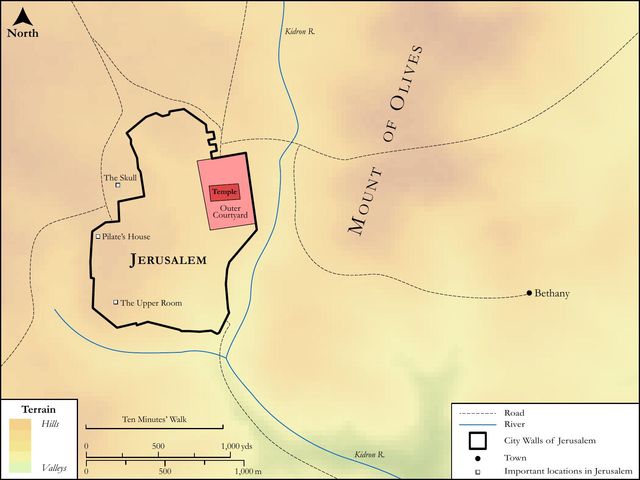
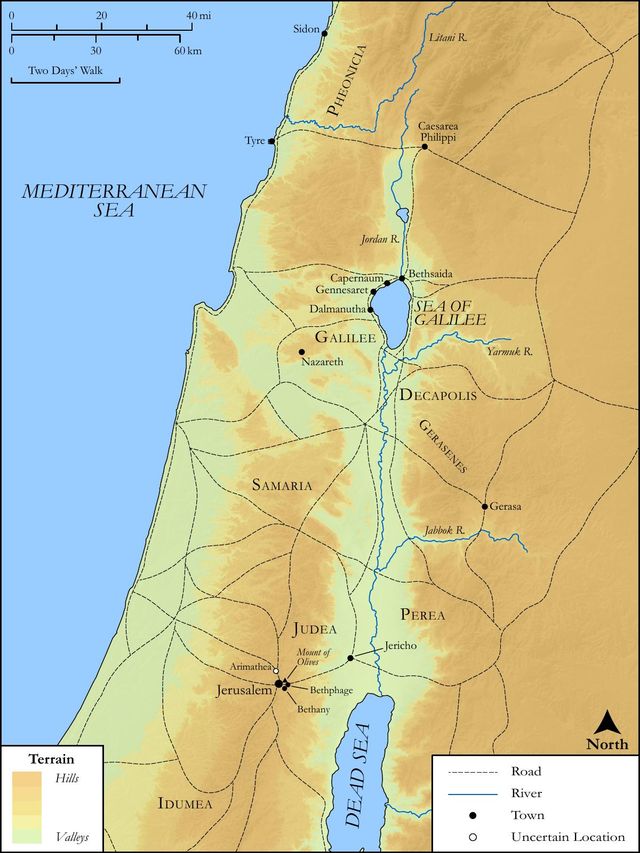
See on the biblical-era maps
Study this verse
Public-domain commentary
Matthew Henry
From his Commentary on the Whole Bible. Henry comments on passages, not single verses — this entry covers Mark 3:1–12. His four-level outline is real structure in the source text, so it is rendered as structure.
Here, as before, we have our Lord Jesus busy at work in the synagogue first, and then by the sea side; to teach us that his presence should not be confined either to the one or to the other, but, wherever any are gathered together in his name, whether in the synagogue or any where else, there is he in the midst of them. In every place where he records his name, he will meet his people, and bless them; it is his will that men pray every where. Now here we have some account of what he did.
I.When he entered again into the synagogue, he improved the opportunity he had there, of doing good, and having, no doubt, preached a sermon there, he wrought a miracle for the confirmation of it, or at least for the confirmation of this truth - that it is lawful to do good on the sabbath day. We had the narrative, Mat 12:9.
1.The patient's case was piteous; he had a withered hand, by which he was disabled to work for his living; and those that are so, are the most proper objects of charity; let those be helped that cannot help themselves.
2.The spectators were very unkind, both to the patient and to the Physician; instead of interceding for a poor neighbour, they did what they could to hinder his cure: for they intimated that if Christ cured him now on the sabbath day, they would accuse him as a Sabbath breaker. It had been very unreasonable, if they should have opposed a physician or surgeon in helping any poor body in misery, by ordinary methods; but much more absurd was it to oppose him that cured without any labour, but by a word's speaking.
3.Christ dealt very fairly with the spectators, and dealt with them first, if possible to prevent the offence.
(1.)He laboured to convince their judgment. He bade the man stand forth (Mar 3:3), that by the sight of him they might be moved with compassion toward him, and might not, for shame, account his cure a crime. And then he appeals to their own consciences; though the thing speaks itself, yet he is pleased to speak it; "Is it lawful to do good on the sabbath days, as I design to do, or to do evil, as you design to do? Whether is better, to save life or to kill?" What fairer question could be put? And yet, because they saw it would turn against them, they held their peace. Note, Those are obstinate indeed in their infidelity, who, when they can say nothing against a truth, will say nothing to it; and, when they cannot resist, yet will not yield.
(2.)When they rebelled against the light, he lamented their stubbornness (Mar 3:5); He looked round about on them with anger, being grieved for the hardness of their hearts. The sin he had an eye to, was, the hardness of their hearts, their insensibleness of the evidence of his miracles, and their inflexible resolution to persist in unbelief. We hear what is said amiss, and see what is done amiss; but Christ looks at the root of bitterness in the heart, the blindness and hardness of that. Observe,
[1.]How he was provoked by the sin; he looked round upon them; for they were so many, and had so placed themselves, that they surrounded him: and he looked with anger; his anger, it is probable, appeared in his countenance; his anger was, like God's, without the least perturbation to himself, but not without great provocation from us. Note, The sin of sinners is very displeasing to Jesus Christ; and the way to be angry, and not to sin, is it be angry, as Christ was, at nothing but sin. Let hard-hearted sinners tremble to think of the anger with which he will look round upon them shortly, when the great day of his wrath comes.
[2.]How he pitied the sinners; he was grieved for the hardness of their hearts; as God was grieved forty years for the hardness of the hearts of their fathers in the wilderness. Note, It is a great grief to our Lord Jesus, to see sinners bent upon their own ruin, and obstinately set against the methods of their conviction and recovery, for he would not that any should perish. This is a good reason why the hardness of our own hearts and of the hearts of others, should be a grief to us.
4.Christ dealt very kindly with the patient; he bade him stretch forth his hand, and it was immediately restored. Now,
(1.)Christ has hereby taught us to go on with resolution in the way of our duty, how violent soever the opposition is, that we meet with in it. We must deny ourselves sometimes in our ease, pleasure, and convenience, rather than give offence even to those who causelessly take it; but we must not deny ourselves the satisfaction of serving God, and doing good, though offence may unjustly be taken at it. None could be more tender of giving offence than Christ; yet, rather than send this poor man away uncured, he would venture offending all the scribes and Pharisees that compassed him about.
(2.)He hath hereby given us a specimen of the cures wrought by his grace upon poor souls; our hands are spiritually withered, the powers of our souls weakened by sin, and disabled for that which is good. The great healing day is the sabbath, and the healing place the synagogue; the healing power is that of Christ. The gospel command is like this recorded here; and the command is rational and just; though our hands are withered, and we cannot of ourselves stretch them forth, we must attempt it, must, as well as we can, lift them up to God in prayer, lay hold on Christ and eternal life, and employ them in good works; and if we do our endeavour, power goes along with the word of Christ, he effects the cure. Though our hands be withered, yet, if we will not offer to stretch them out, it is our own fault that we are not healed; but if we do, and are healed, Christ and his power and grace must have all the glory.
5.The enemies of Christ dealt very barbarously with him. Such a work of mercy should have engaged their love to him, and such a work of wonder their faith in him. But, instead of that, the Pharisees, who pretended to be oracles in the church, and the Herodians, who pretended to be the supporters of the state, though of opposite interests one to another, took counsel together against him, how they might destroy him. Note, They that suffer for doing good, do but suffer as their Master did.
II.When he withdrew to the sea, he did good there.
While his enemies sought to destroy him, he quitted the place; to teach us in troublous times to shift for our own safety; but see here,
1.How he was followed into his retirement. When some had such an enmity to him, that they drove him out of their country, others had such a value for him, that they followed him wherever he went; and the enmity of their leaders to Christ did not cool their respect to him. Great multitudes followed him from all parts of the nation; as far north, as from Galilee; as far south, as from Judea and Jerusalem; nay, and from Idumea; as far east, as from beyond Jordan; and west, as from about Tyre and Sidon, Mar 3:7, Mar 3:8. Observe,
(1.)What induced them to follow him; it was the report they heard of the great things he did for all that applied themselves to him; some wished to see one that had done such great things, and others hoped he would do great things for them. Note, The consideration of the great things Christ has done, should engage us to come to him.
(2.)What they followed him for (Mar 3:10); They pressed upon him, to touch him, as many as had plagues. Diseases are here called plagues, mastigas - corrections, chastisements; so they are designed to be, to make us smart for our sins, that thereby we may be made sorry for them, and may be warned not to return to them. Those that were under these scourgings came to Jesus; this is the errand on which sickness is sent, to quicken us to enquire after Christ, and apply ourselves to him as our Physician. They pressed upon him, each striving which should get nearest to him, and which should be first served. They fell down before him (so Dr. Hammond), as petitioners for his favour; they desired leave but to touch him, having faith to be healed, not only by his touching them, but by their touching him; which no doubt they had many instances of.
(3.)What provision he made to be ready to attend them (Mar 3:9); He spoke to his disciples, who were fishermen, and had fisher-boats at command, that a small ship should constantly wait on him, to carry him from place to place on the same coast; that, when he had despatched the necessary business he had to do in one place, he might easily remove to another, where his presence was requisite, without pressing through the crowds of people that followed him for curiosity. Wise men, as much as they can, decline a crowd.
2.What abundance of good he did in his retirement. He did not withdraw to be idle, nor did he send back those who rudely crowded after him when he withdrew, but took it kindly, and gave them what they came for; for he never said to any that sought him diligently, Seek ye me in vain.
(1.)Diseases were effectually cured; He healed many; divers sorts of patients, ill of divers sorts of diseases; though numerous, though various, he healed them.
(2.)Devils were effectually conquered; those whom unclean spirits had got possession of, when they saw him, trembled at his presence, and they also fell down before him, not to supplicate his favour, but to deprecate his wrath, and by their own terrors were compelled to own that he was the Son of God, Mar 3:11. It is sad that this great truth should be denied by any of the children of men, who may have the benefit of it, when a confession of it has so often been extorted from devils, who are excluded from having benefit by it.
(3.)Christ sought not applause to himself in doing those great things, for he strictly charged those for whom he did them, that they should not make him known (Mar 3:12); that they should not be industrious to spread the notice of his cures, as it were by advertisements in the newspapers, but let them leave his own works to praise him, and let the report of them diffuse itself, and make its own way. Let not those that are cured, be forward to divulge it, lest it should feed their pride who are so highly favoured; but let the standers-by carry away the intelligence of it. When we do that which is praiseworthy, and yet covet not to be praised of men for it, then the same mind is in us, which was in Christ Jesus.
Historical interpretation
Seven Centuries of Reception
7 surviving comments on this verse. Each one is dated, so this reads as a timeline rather than a list.
Select a marker to jump to its quote. Markers stagger vertically where authors wrote within a few decades of each other.
Or else it means the avaricious, who, being able to give had rather receive, and love robbery rather than making gifts. And they are commanded to stretch forth their hands, that is, let him that stole steal no more, but rather let him labour, working with his hand the thing which is good, that he may have to give to him that needeth. (Eph. 4:28)
In the synagogue of the Jews was a man who had a withered hand. If he was withered in his hand, the ones who stood by were withered in their minds. And they were not looking at the crippled man nor were they expecting the miraculous deed of the one who was about to work. But before doing the work, the Savior ploughed up their minds with words. For knowing the evil of the mind and its bitter depth, he first softened them up in advance with words so as to tame the wildness of their understanding, asking: “Is it permitted to do good on the sabbath or to do evil; to save a life or to destroy one?” For if he had said to them, “Is it permitted to work?” immediately they would have said, “You are speaking contrary to the law.” Then he told them what was intended by the law, for he spoke as the One who established the laws concerning the sabbath, adding, “except this: that which will be done for the sake of a life.” Again if a person falls into a hole on a sabbath, Jews are permitted to pull the person out. This not only applies to a person, but also an ox or a donkey. In this way the law agrees that things relating to preservation may be done, hence Jews prepare meals on the sabbath. Then he asked them about a point on which they could hardly disagree: “Is it permitted to do good?” But they did not even so much as say, “Yes,” because by then they were not in a good temper.
Jesus said to the man with the withered hand, “Come here.” Then he challenged the Pharisees as to whether it would be lawful to do good on the sabbath. Note the tender compassion of the Lord when he deliberately brought the man with the withered hand right into their presence. He hoped that the mere sight of the misfortune might soften them, that they might become a little less spiteful by seeing the affliction, and perhaps out of sorrow mend their own ways. But they remained callous and unfeeling. They preferred to do harm to the name of Christ than to see this poor man made whole. They betrayed their wickedness not only by their hostility to Christ, but also by their doing so with such contentiousness that they treated with disdain his mercies to others. GOSPEL OF ST.
(de Con. Evan. ii. 35) But some one may wonder how Matthew could have said, that they themselves asked the Lord, if it was lawful to heal on the sabbath-day; when Mark rather relates that they were asked by our Lord, Is it lawful to do good on the sabbath-day, or to do evil? Therefore we must understand that they first asked the Lord, if it was lawful to heal on the sabbath-day, then that understanding their thoughts, and that they were seeking an opportunity to accuse Him, He placed in the middle him whom He was about to cure, and put those questions, which Mark and Luke relate. We must then suppose, that when they were silent, He propounded the parable of the sheep, and concluded, that it was lawful to do good on the sabbath-day. It goes on: But they were silent.
(Vict. Ant. e Cat. in Marc. v. Chrys. Hom. in Matt. 40) He placed him in the midst, that they might be frightened at the sight, and on seeing him compassionate him, and lay aside their malice.
(Vict. Ant. e Cat, in Marc.) For they knew that He would certainly cure him. It goes on: And looking round about upon them with anger. His looking round upon them in anger, and being saddened at the blindness of their hearts, is fitting for His humanity, which He deigned to take upon Himself for us. He connects the working of the miracle with a word, which proves that the man is cured by His voice alone. It follows therefore, And he stretched it out, and his hand was restored. Answering by all these things for His disciples, and at the same time showing that His life is above the law.
(in Marc. i. 14) For, since He had defended the breaking of the sabbath, which they objected to His disciples, by an approved example, now they wish, by watching Him, to calumniate Himself, that they might accuse Him of a transgression, if He cured on the sabbath, of cruelty or of folly, if He refused. It goes on: And he saith unto the man which had the withered hand, Stand in the midst.
(ubi sup.) And anticipating the calumny of the Jews, which they had prepared for Him, He accused them of violating the precepts of the law, by a wrong interpretation. Wherefore there follows: And he saith unto them, Is it lawful to do good on the sabbath-day, or to do evil? And this He asks, because they thought that on the sabbath they were to rest even from good works, whilst the law commands to abstain from bad, saying, Ye shall do no servile work therein; (Levit. 23:7) that is, sin: for Whosoever committeth sin is the servant of sin. (John 8:34) What He first says, to do good on the sabbath-day or to do evil, is the same as what He afterwards adds, to save a life or to lose it; that is, to cure a man or not. Not that God, Who is in the highest degree good, can be the author of perdition to us, but that His not saving is in the language of Scripture to destroy. But if it be asked, wherefore the Lord, being about to cure the body, asked about the saving of the soul, let him understand either that in the common way of Scripture the soul is put for the man; as it is said, All the souls that came out of the loins of Jacob; (Exodus 1:5) or because he did those miracles for the saving of a soul, or because the healing itself of the hand signified the saving of the soul.
(ubi sup.) But mystically, the man with a withered hand shows the human race, dried up as to its fruitfulness in good works, but now cured by the mercy of the Lord; the hand of man, which in our first parent had been dried up when he plucked the fruit of the forbidden tree, through the grace of the Redeemer, Who stretched His guiltless hands on the tree of the cross, has been restored to health by the juices of good works. Well too was it in the synagogue that the hand was withered; for where the gift of knowledge is greater, there also the danger of inexcusable guilt is greater.
After confounding the Jews, who had blamed His disciples, for pulling the ears of corn on the sabbath day, by the example of David, the Lord now further bringing them to the truth, works a miracle on the sabbath; showing that, if it is a pious deed to work miracles on the sabbath for the health of men, it is not wrong to do on the sabbath things necessary for the body: he says therefore, And he entered again into the synagogue; and there was a man there which had a withered hand. And they watched him, whether he would heal him on the sabbath-day; that they might accuse him.
Or, he has his right hand withered, who does not the works which belong to the right side; for from the time that our hand is employed in forbidden deeds, from that time it is withered to the working of good. But it will be restored whenever it stands firm in virtue; wherefore Christ saith, Arise, that is, from sin, and stand in the midst; that thus it may stretch itself forth neither too little or too much.
Continue studying Mark 3:4 across the web’s major study libraries — every link below opens this exact verse, chapter, or book on the destination site.
Read & Compare
 BibleGatewayThis verse in more than 200 translations and 70 languages.
 Bible.comThe YouVersion reader — hundreds of translations, reading plans, and highlights.
 ESV.orgCrossway's official English Standard Version reader.
 NET BibleThe NET translation with 60,000+ translators' notes on every rendering decision.
 STEP BibleTyndale House's free study tool — original text, vocabulary, and scholarly resources.
 BibliaLogos Bible Software's free web reader.
 USCCBThe New American Bible (Revised Edition) with the U.S. bishops' study notes.
Commentaries
 BibleHub CommentariesDozens of classic commentaries on this verse, gathered on one page.
 StudyLightMore than 100 commentary sets — the largest collection on the web.
 BibleRefPlain-English commentary on what this verse means, verse by verse.
 Enduring WordDavid Guzik's free commentary on this chapter, widely used by Bible teachers.
 Bible Study ToolsVerse commentary alongside Greek and Hebrew study aids.
Original Language & Research
- BibleHub InterlinearThe verse word by word — original language, transliteration, and English.
- BibleHub LexiconEvery word's original-language definition and Strong's entry.
 Blue Letter BibleDeep-study tools — Strong's numbers, concordance, and word studies.
 CNTR CollationThe earliest Greek manuscripts of this verse, collated letter by letter.
Sermons, Hymns & Audio


TrulyRandomVerse is not affiliated with these sites and doesn’t control their content. They’re linked because they’re genuinely useful.
Summary
In Mark 3:4, Jesus directly confronts the legalistic religious leaders in a synagogue on the Sabbath, posing a profound rhetorical question: "Is it lawful to do good on the sabbath days, or to do evil? to save life, or to kill?" This stark moral dilemma exposes their misplaced priorities and hardened hearts, as their subsequent silence reveals their inability to answer without condemning themselves. The passage underscores Jesus' authority over the Sabbath and His unwavering commitment to compassion and the preservation of life, even in the face of opposition.
Context
ShowHideLiterary Context
This verse is a pivotal moment following a series of escalating confrontations between Jesus and the religious authorities, particularly concerning Sabbath observance. In Mark 2:23-28, Jesus' disciples are criticized for plucking grain on the Sabbath, prompting Jesus to declare, "The sabbath was made for man, and not man for the sabbath." Here, Jesus intentionally enters a synagogue on the Sabbath, knowing a man with a withered hand is present and that His adversaries are watching Him closely. His question sets the stage for the healing that immediately follows in Mark 3:5, further intensifying the conflict and leading directly to the Pharisees and Herodians plotting His destruction.
Historical & Cultural Context
First-century Jewish society, particularly under the influence of the Pharisees, had developed an elaborate system of oral traditions (halakha) that interpreted and expanded upon the Mosaic Law. Sabbath observance was a cornerstone of Jewish identity, but these traditions often became burdensome, emphasizing strict prohibitions over the spirit of the law. Healing, unless a life was in immediate danger, was considered "work" and thus forbidden on the Sabbath. The synagogue was the central place of worship and community gathering, making Jesus' actions there a public challenge to the established religious order. The presence of both Pharisees (religious conservatives) and Herodians (political supporters of Herod, often aligned with Rome) highlights the broad opposition Jesus faced, as these two groups typically had little in common but united in their desire to discredit Him.
Key Themes
ShowHideMark 3:4 contributes significantly to several overarching themes in the Gospel of Mark. It highlights the true purpose of the Sabbath, which Jesus asserts is for doing good and showing mercy, not for rigid legalistic adherence that hinders compassion. This contrasts sharply with the legalism versus compassion theme, where the religious leaders prioritize their interpretations of the law over human suffering, while Jesus consistently prioritizes alleviating pain and restoring wholeness. The verse also underscores Jesus' divine authority as He boldly challenges the prevailing religious interpretations and demonstrates His lordship over the Sabbath. Finally, the silence of the accusers introduces the theme of hardening of hearts, revealing their spiritual blindness and unwillingness to acknowledge the truth, a theme that tragically culminates in their decision to seek Jesus' death.
Exposition and Analysis
ShowHideKey Word Analysis
ShowHideThis term (G1832) signifies more than mere legal permissibility; it implies what is morally right, proper, or permissible in God's eyes. Jesus' question transcends a legalistic debate, pushing the issue into the realm of ethical imperative. He is asking what is inherently good and acceptable, not just what is technically allowed by human interpretations.
Derived from G15, this verb means to be a well-doer, to perform acts of kindness, beneficence, or righteousness. It emphasizes active, positive contribution to well-being. Jesus posits that the Sabbath, a day consecrated to God, should be a day characterized by such actions, aligning with God's own benevolent character.
This word (G4623) describes a state of being silent or dumb, often implying an involuntary stillness or inability to speak. In this context, it powerfully conveys the religious leaders' speechless inability to respond to Jesus' morally unassailable question. Their silence is not merely a lack of words, but a profound indictment of their hardened hearts and the bankruptcy of their legalistic position.
Verse Breakdown
ShowHide"And he saith unto them,"
Jesus takes the initiative, directly addressing His accusers. This is not a casual remark but a deliberate challenge, designed to expose their hypocrisy and force a moral reckoning. He is not waiting for them to accuse Him; He is putting them on trial.
"Is it lawful to do good on the sabbath days, or to do evil?"
Jesus frames the choice in stark, absolute moral terms. He presents a dichotomy that leaves no room for neutrality or evasion. The question forces them to consider whether inaction in the face of suffering, or adherence to a rigid interpretation that prevents good, is tantamount to doing evil.
"to save life, or to kill?"
This is a powerful rhetorical escalation. By equating not healing (doing good) with actively "killing" (doing evil), Jesus uses hyperbole to expose the spiritual depravity of their legalism. He implies that their rigid adherence to tradition, which would prevent an act of mercy, is morally equivalent to taking a life, highlighting the ultimate consequences of their uncompassionate stance.
"But they held their peace."
This concluding phrase is profoundly significant. Their silence is a confession of guilt. They cannot answer without either affirming Jesus' compassionate action (which would undermine their authority) or explicitly stating that it is lawful to do evil (which would expose their moral bankruptcy). Their muteness reveals their hardened hearts and spiritual blindness, setting the stage for Jesus' grief and anger in the subsequent verse.
Literary Devices
ShowHideMark 3:4 is rich in literary devices that amplify its message. The most prominent is Rhetorical Question, where Jesus asks a question not to elicit information, but to make a forceful point and expose the moral and spiritual bankruptcy of His adversaries. The question itself employs powerful Antithesis and Juxtaposition, setting up stark contrasts between "doing good" and "doing evil," and between "saving life" and "killing." This binary choice forces an immediate moral decision, highlighting the extreme nature of their legalistic stance. Furthermore, Jesus utilizes Hyperbole by equating the failure to "save life" (i.e., heal) with "killing." This deliberate overstatement serves to shock His listeners and underscore the gravity of their uncompassionate interpretation of the Sabbath law. Finally, the Dramatic Irony is palpable: the religious leaders believe they are upholding God's law, yet their actions and silence reveal their opposition to God's very character, which is mercy and life, a truth apparent to the reader.
Theological and Thematic Connections
ShowHideMark 3:4 profoundly reveals God's character as one who desires mercy over rigid adherence to ritual, and life over legalistic death. Jesus, as the embodiment of God's will, challenges the prevailing human traditions that had obscured the true spirit of the Sabbath, transforming a day meant for rest and blessing into a burden. His question forces a choice between actively participating in God's redemptive work of healing and preserving life, or passively (or even actively) contributing to suffering and spiritual death through unloving interpretations. This passage underscores that true righteousness is not found in outward conformity to rules but in an inward disposition of compassion and a commitment to actively doing good, reflecting God's own heart.
Reflection and Application
ShowHideMark 3:4 serves as a timeless challenge to believers to examine the priorities that govern their faith and actions. Are we, like the religious leaders, more concerned with upholding traditions, rules, or even our own comfort, than with actively demonstrating compassion and doing tangible good in the world? This verse calls us to prioritize the spirit of God's law—which is love, mercy, and the preservation of life—over its mere letter, especially when the letter becomes an impediment to genuine care. It encourages us to question rigid interpretations that might hinder acts of love and service, and to actively seek opportunities to "do good" and "save life" in both spiritual and physical senses. Our silence in the face of injustice, suffering, or spiritual need can be as condemning as direct opposition to good, revealing a heart that is hardened to the cries of humanity and the promptings of the Holy Spirit. Let us strive to be those who, like Jesus, prioritize active love and mercy, even when it means challenging the status quo or risking personal comfort.
Questions for Reflection
ShowHideFAQ
ShowHideWhy was healing on the Sabbath controversial for the religious leaders?
ShowHideFor the religious leaders, particularly the Pharisees, their interpretation of the Sabbath commandment had evolved into a complex system of oral laws (halakha) that strictly defined what constituted "work." Healing, unless a life was in immediate danger, was categorized as a form of work and therefore prohibited. They believed that by healing on the Sabbath, Jesus was violating God's law, as they understood it, and undermining their authority. Their concern was not for the suffering man, but for the perceived breach of their traditions.
What does the silence of the religious leaders signify in this verse?
ShowHideTheir silence is profoundly significant. It reveals their inability to answer Jesus' morally unassailable question without exposing their own hypocrisy and lack of compassion. If they said "yes, it is lawful to do good," they would validate Jesus' actions and condemn their own legalism. If they said "no, it is not lawful to do good," they would reveal themselves as heartless and morally corrupt. Their silence, therefore, is a powerful indictment of their hardened hearts and spiritual blindness, demonstrating that their concern for the law had superseded their concern for humanity and the very character of God.
Christ-Centered Fulfillment
ShowHideMark 3:4, though seemingly a simple question, powerfully foreshadows the ultimate work of Christ. Jesus, as the Lord of the Sabbath, redefines its purpose from a day of restrictive legalism to a day of redemptive action and life-giving mercy. His question—"to save life, or to kill?"—points directly to His mission: to save humanity from spiritual death. He is the Good Shepherd who lays down his life for the sheep, actively choosing to "do good" and "save life" through His atoning sacrifice on the cross. The "evil" and "killing" that Jesus confronts in this verse culminate in the very forces that seek His death, but through His resurrection, He triumphs over them, offering eternal life to all who believe (John 3:16). His healing of the withered hand is a microcosm of His greater work of restoring broken humanity, bringing spiritual wholeness and life where there was only sin and death (Colossians 2:13-14). Thus, this passage is not just about Sabbath observance, but about the very essence of Christ's redemptive purpose: to bring life and do good, even when it means confronting the darkness of human sin and religious legalism.