


Luke 14:1
Bible text: King James Version (1769 Blayney text) · Public domain
Bible text: King James Version with Strong's numbers · Public domain
Bible text: Berean Standard Bible · Public domain
Bible text: American Standard Version (1901) · Public domain
Bible text: World English Bible, Messianic edition · Public domain
Bible text: Geneva Bible (1599) · Public domain
Bible text: Young's Literal Translation · Public domain
- ΚαὶKaiAndG2532CONJConjunction
- ἐγένετοegenetoit came to passG1096V-2ADI-3SVerb 2nd Aorist Middle Deponent Indicative 3rd Singular
- ἐνenonG1722PREPPreposition
- τῷtōtheG3588T-DSNDefinite article Dative Singular Neuter
- ἐλθεῖνeltheingoingG2064V-2AANVerb 2nd Aorist Active Infinitive
- αὐτὸνautonof HimG846P-ASMPersonal pronoun Accusative Singular Masculine
- εἰςeisintoG1519PREPPreposition
- οἶκόνoikona houseG3624N-ASMNoun Accusative Singular Masculine
- τινοςtinosof oneG5100X-GSMIndefinite pronoun Genitive Singular Masculine
- τῶνtōnof theG3588T-GPMDefinite article Genitive Plural Masculine
- ἀρχόντωνarchontōnrulersG758N-GPMNoun Genitive Plural Masculine
- τῶνtōnof theG3588T-GPMDefinite article Genitive Plural Masculine
- ΦαρισαίωνPharisaiōnPhariseesG5330N-GPM-TNoun Genitive Plural Masculine Title
- σαββάτῳsabbatōon a SabbathG4521N-DSNNoun Dative Singular Neuter
- φαγεῖνphageinto eatG5315V-AANVerb Aorist Active Infinitive
- ἄρτονartonbreadG740N-ASMNoun Accusative Singular Masculine
- καὶkaiandG2532CONJConjunction
- αὐτοὶautoithey themselvesG846P-NPMPersonal pronoun Nominative Plural Masculine
- ἦσανēsanwereG1510V-IAI-3PVerb Imperfect Active Indicative 3rd Plural
- παρατηρούμενοιparatēroumenoiwatchingG3906V-PMP-NPMVerb Present Middle Participle Nominative Plural Masculine
- αὐτόνautonHimG846P-ASMPersonal pronoun Accusative Singular Masculine
English is a literal word-by-word gloss of the Greek, not the KJV's wording. Why?
This is the original text the KJV's translators worked from — each Greek word with its own literal English meaning in this verse, prepared by scholars at Tyndale House, Cambridge. The KJV translates whole sentences, not word by word, so its wording differs: one Greek word can become several English words, and the KJV may choose “charity” where the gloss reads “love”. Both are faithful — they answer different questions. For the KJV's own rendering, switch to the KJV text.
Details
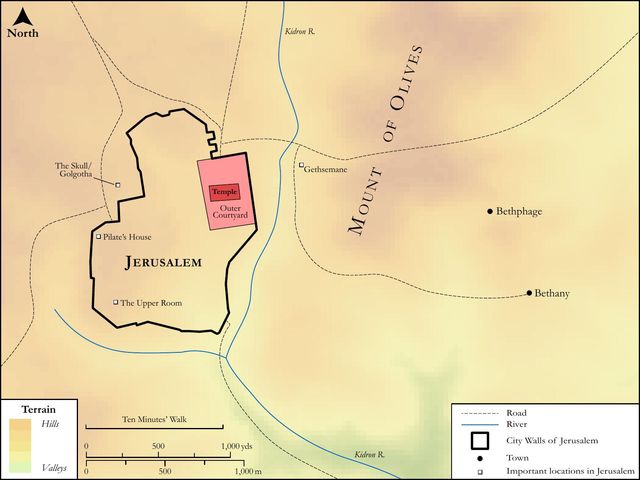
See on the biblical-era maps


Study this verse
Public-domain commentary
Matthew Henry
From his Commentary on the Whole Bible. Henry comments on passages, not single verses — this entry covers Luke 14:1–6.
In this passage of story we find,
I.That the Son of man came eating and drinking, conversing familiarly with all sorts of people; not declining the society of publicans, though they were of ill fame, nor of Pharisees, though they bore him ill will, but accepting the friendly invitations both of the one and the other, that, if possible, he might do good to both. Here he went into the house of one of the chief Pharisees, a ruler, it may be, and a magistrate in his country, to eat bread on the sabbath day, Luk 14:1. See how favourable God is to us, that he allows us time, even on his own day, for bodily refreshments; and how careful we should be not to abuse that liberty, or turn it into licentiousness. Christ went only to eat bread, to take such refreshment as was necessary on the sabbath day. Our sabbath meals must, with a particular care, be guarded against all manner of excess. On sabbath days we must do as Moses and Jethro did, eat bread before God (Exo 18:12), and, as is said of the primitive Christians, on the Lord's day, must eat and drink as those that must pray again before we go to rest, that we may not be unfit for that.
II.That he went about doing good.
Wherever he came he sought opportunities to do good, and not only improved those that fell in his way. Here was a certain man before him who had the dropsy, Luk 14:2. We do not find that he offered himself, or that his friends offered him to be Christ's patient, but Christ prevented him with the blessings of his goodness, and before he called he answered him. Note, It is a happy thing to be where Christ is, to be present before him, though we be not presented to him. This man had the dropsy, it is probable, in a high degree, and appeared much swoln with it; probably he was some relation of the Pharisee's, that now lodged in his house, which is more likely than that he should be an invited guest at the table.
III.That he endured the contradiction of sinners against himself:
They watched him, Luk 14:1. The Pharisee that invited him, it should seem, did it with a design to pick some quarrel with him; if it were so, Christ knew it, and yet went, for he knew himself a match for the most subtle of them, and knew how to order his steps with an eye to his observers. Those that are watched had need to be wary. It is, as Dr. Hammond observes, contrary to all laws of hospitality to seek advantage against one that you invited to be your guest, for such a one you have taken under your protection. These lawyers and Pharisees, like the fowler that lies in wait to ensnare the birds, held their peace, and acted very silently. When Christ asked them whether they thought it lawful to heal on the sabbath day (and herein he is said to answer them, for it was an answer to their thoughts, and thoughts are words to Jesus Christ), they would say neither yea nor nay, for their design was to inform against him, not to be informed by him. They would not say it was lawful to heal, for then they would preclude themselves from imputing it to him as a crime; and yet the thing was so plain and self-evident that they could not for shame say it was not lawful. Note, Good men have often been persecuted for doing that which even their persecutors, if they would but give their consciences leave to speak out, could not but own to be lawful and good. Many a good work Christ did, for which they cast stones at him and his name.
IV.That Christ would not be hindered from doing good by the opposition and contradiction of sinners.
He took him, and healed him, and let him go, Luk 14:4. Perhaps he took him aside into another room, and healed him there, because he would neither proclaim himself, such was his humility, nor provoke his adversaries, such was his wisdom, his meekness of wisdom. Note, Though we must not be driven off from our duty by the malice of our enemies, yet we should order the circumstances of it so as to make it the least offensive. Or, He took him, that is, he laid hands on him, to cure him; epilabomenos, complexus - he embraced him, took him in his arms, big and unwieldy as he was (for so dropsical people generally are), and reduced him to shape. The cure of a dropsy, as much as any disease, one would think, should be gradual; yet Christ cured even that disease, perfectly cured it, in a moment. He then let him go, lest the Pharisees should fall upon him for being healed, though he was purely passive; for what absurdities would not such men as they were be guilty of?
V.That our Lord Jesus did nothing but what he could justify, to the conviction and confusion of those that quarrelled with him, Luk 14:5, Luk 14:6. He still answered their thoughts, and made them hold their peace for shame who before held their peace for subtlety, by an appeal to their own practice, as he had been used to do upon such occasions, that he might show them how in condemning him they condemned themselves: which of you shall have an ass or an ox fallen into a pit, by accident, and will not pull him out on the sabbath day, and that straightway, not deferring it till the sabbath be over, lest it perish? Observe, It is not so much out of compassion to the poor creature that they do it as a concern for their own interest. It is their own ox, and their own ass, that is worth money, and they will dispense with the law of the sabbath for the saving of. Now this was an evidence of their hypocrisy, and that it was not out of any real regard to the sabbath that they found fault with Christ for healing on the sabbath day (that was only the pretence), but really because they were angry at the miraculous good works which Christ wrought, and the proof he thereby gave of his divine mission, and the interest he thereby gained among the people. Many can easily dispense with that, for their own interest, which they cannot dispense with for God's glory and the good of their brethren. This question silenced them: They could not answer him again to these things, Luk 14:6. Christ will be justified when he speaks, and every mouth must be stopped before him.
Historical interpretation
Seven Centuries of Reception
8 surviving comments on this verse. Each one is dated, so this reads as a timeline rather than a list.
Select a marker to jump to its quote. Markers stagger vertically where authors wrote within a few decades of each other.
First, Christ cures the man with dropsy. The abundant flow of the flesh had oppressed the functions of his soul and had quenched the glow of his spirit. Then, Christ teaches humility. At the feast, Christ gently opposes the longing for a better seat, so that the humanity of persuasion excludes the harshness of coercion, reason promotes the effect of persuasion, and correction chastises pride. He joins humanity to this, as if at the next threshold. The boundaries of the Lord’s saying differentiated this, if it is conferred on the poor and the weak. There is a greedy disposition in those who would be rewarded for hospitality.
He became the guest of his host to fulfill a duty. It says, "They watched him." Why did they watch him? They watched to see if he would disregard the honor of the law and so do something forbidden on the sabbath day. O senseless Jew, understand that the law was a shadow and type, waiting for the truth. The truth was Christ and his commandments. Why then do you arm the type against the truth? Why set the shadow in array against the spiritual interpretation? Keep your sabbath rationally.… Those who had the office to minister among you according to the law used to offer God the appointed sacrifices, even on the sabbath. They slaughtered the victims in the temple and performed the acts of service that were required of them. No one rebuked them, and the law itself was silent. It did not forbid people ministering on the sabbath. This was a type for us. As I said, it is our duty, keeping the sabbath in a rational manner, to please God by a sweet spiritual fragrance. As I have already said, we perform this when ceasing from sins, we offer God a life holy and worthy of admiration as a sacred oblation, steadily advancing to all virtue. This is the spiritual sacrifice well pleasing to God.
A Pharisee, of higher rank than usual, invited Jesus to a banquet. Although he knew their bad intentions, he went with him and ate in their company. He did not submit to this act of condescension to honor his host. He rather instructed his fellow guests by words and miraculous deeds that might lead them to the acknowledgment of the true service, even that taught us by the gospel. He knew that even against their will he would make them eyewitnesses of his power and his suprahuman glory. Perhaps they might believe that he is God and the Son of God, who took on our likeness but was unchanged and did not cease to be what he had been.
Although our Lord knew the malice of the Pharisees, yet He became their guest, that He might benefit by His words and miracles those who were present. Whence it follows, And it came to pass, as he went into the house of one of the chief Pharisees to eat bread on the sabbath day, that they watched him; to see whether He would despise the observance of the law, or do any thing that was forbidden on the sabbath day. When then the man with the dropsy came into the midst of them, He rebukes by a question the insolence of the Pharisees, who wished to detect Him; as it is said, And, behold, there was a certain man before him which had the dropsy. And Jesus answering, &c.
Disregarding then the snares of the Jews, He cures the dropsical, who from fear of the Pharisees did not ask to be healed on account of the sabbath, but only stood up, that when Jesus beheld him, He might have compassion on him and heal him. And the Lord knowing this, asked not whether he wished to be made whole, but forthwith healed him. Whence it follows; And he took him, and healed him, and let him go. Wherein our Lord took no thought not to offend the Pharisees, but only that He might benefit him who needed healing. For it becomes us, when a great good is the result, not to care if fools take offence.
But seeing the Pharisees awkwardly silent, Christ baffles their determined impudence by some important considerations. As it follows; And he answered and said unto them, Which of you shall have an ass or an ox fallen into a pit, and will not straightway pull him out on the sabbath day?
(14 Mor. c. 6.) Rightly then is the dropsical man healed in the Pharisees' presence, for by the bodily infirmity of the one, is expressed the mental disease of the other.
And it happened when he entered the house of a certain ruler of the Pharisees on the Sabbath to eat bread, and they watched him closely, and behold, there was before him a certain man suffering from dropsy. The disease of dropsy takes its name from a watery humor. For in Greek, ὕδωρ means water. It is a subcutaneous liquid born from a defect of the bladder, with swelling, and foul breath. It is peculiar to the dropsical person, the more the disordered humor abounds, the more they thirst. And so it is rightly compared to him whom the flowing excess of carnal pleasures oppresses. It is compared to the avaricious rich man, who, the more abundant his riches are, which he does not use well, the more ardently he covets such things.
When it is said that Jesus answered, there is a reference to the words which went before, And they watched him. For the Lord knew the thoughts of men.
But they who were asked, are rightly silent, for they perceived that whatever they said, would be against themselves. For if it is lawful to heal on the sabbath day, why did they watch the Saviour whether He would heal? If it is not lawful, why do they take care of their cattle on the sabbath? Hence it follows, But they held their peace.
By these words He so refutes His watchers, the Pharisees, as to condemn them also of covetousness, who in the deliverance of animals consult their own desire of wealth. How much more then ought Christ to deliver a man, who is much better than cattle!
By a suitable example then He settles the question, showing that they violate the sabbath by a work of covetousness, who contend that he does so by a work of charity. Hence it follows, And they could not answer him again to these things. Mystically, the dropsical man is compared to him who is weighed down by an overflowing stream of carnal pleasures. For the disease of dropsy derives the name from a watery humour.
In this example also He well refers to the ox and the ass; so as to represent either the wise and the foolish, or both nations; that is, the Jew oppressed by the burden of the law, the Gentile not subject to reason. For the Lord rescues from the pit of concupiscence all who are sunk therein.
But by His question He exposes their folly. For while God blessed the sabbath, (Gen. 2:1.) they forbade to do good on the sabbath; but the day which does not admit the works of the good is accursed.
As though He said, If the law forbids to have mercy on the sabbath-day, have no care of thy son when in danger on the sabbath-day. But why speak I of a son, when thou dost not even neglect an ox if thou seest it in danger?
Continue studying Luke 14:1 across the web’s major study libraries — every link below opens this exact verse, chapter, or book on the destination site.
Read & Compare
 BibleGatewayThis verse in more than 200 translations and 70 languages.
 Bible.comThe YouVersion reader — hundreds of translations, reading plans, and highlights.
 ESV.orgCrossway's official English Standard Version reader.
 NET BibleThe NET translation with 60,000+ translators' notes on every rendering decision.
 STEP BibleTyndale House's free study tool — original text, vocabulary, and scholarly resources.
 BibliaLogos Bible Software's free web reader.
 USCCBThe New American Bible (Revised Edition) with the U.S. bishops' study notes.
Commentaries
 BibleHub CommentariesDozens of classic commentaries on this verse, gathered on one page.
 StudyLightMore than 100 commentary sets — the largest collection on the web.
 BibleRefPlain-English commentary on what this verse means, verse by verse.
 Enduring WordDavid Guzik's free commentary on this chapter, widely used by Bible teachers.
 Bible Study ToolsVerse commentary alongside Greek and Hebrew study aids.
Original Language & Research
- BibleHub InterlinearThe verse word by word — original language, transliteration, and English.
- BibleHub LexiconEvery word's original-language definition and Strong's entry.
 Blue Letter BibleDeep-study tools — Strong's numbers, concordance, and word studies.
 CNTR CollationThe earliest Greek manuscripts of this verse, collated letter by letter.
Sermons, Hymns & Audio


TrulyRandomVerse is not affiliated with these sites and doesn’t control their content. They’re linked because they’re genuinely useful.
Summary
Luke 14:1 introduces a pivotal Sabbath encounter where Jesus accepts an invitation to dine at the home of a prominent Pharisee. This seemingly innocuous social event quickly reveals an underlying tension, as the religious leaders present are not merely hospitable but are intently observing Jesus, seeking grounds for accusation regarding His actions and teachings, particularly concerning Sabbath observance. This verse sets the stage for Jesus to challenge the legalistic interpretations of the Law with His divine authority and compassionate insight.
Context
ShowHideLiterary Context
Luke 14:1 marks the beginning of a new narrative section within Luke's Gospel, immediately following Jesus' teachings on humility and the cost of discipleship in Luke 13. The preceding chapters have consistently highlighted Jesus' interactions with various groups, including the Pharisees, and His repeated clashes with their rigid interpretations of the Law, especially concerning the Sabbath. This verse serves as a narrative bridge, transitioning from a series of parables and warnings to a direct confrontation that will further elaborate on the true meaning of the Sabbath and the nature of God's kingdom. The events that unfold in Luke 14 directly flow from the setting established here, with Jesus performing a healing and then teaching parables about humility and the cost of discipleship, all within the context of this Sabbath meal.
Historical & Cultural Context
The Sabbath, a day of rest and worship, was a cornerstone of Jewish life, rooted in the Mosaic Law as commanded in Exodus 20:8-11. By the first century CE, various Jewish groups, particularly the Pharisees, had developed an extensive body of oral traditions (later codified in the Mishnah) that meticulously defined what constituted "work" and thus what was permissible or forbidden on the Sabbath. These traditions often went far beyond the biblical injunctions, creating a complex web of regulations that could overshadow the spirit of the law. Dining at a Pharisee's house on the Sabbath was a common practice, as it was a day for communal meals and religious discussion. However, the presence of "chief Pharisees" and the stated intention of "watching him" indicate that this was not merely a social gathering but a calculated opportunity for scrutiny, reflecting the ongoing power struggle and theological disagreement between Jesus and the religious establishment.
Key Themes
ShowHideThis verse immediately introduces several prominent themes that resonate throughout Luke's Gospel. The central theme is the Sabbath observance versus legalism, where Jesus consistently challenges the Pharisees' burdensome interpretations of the Sabbath, emphasizing compassion and divine authority over human-made rules. This is evident in previous encounters, such as when Jesus healed on the Sabbath in Luke 13:10-17 and taught that the Sabbath was made for humanity, not the other way around, as seen in Mark 2:27. Another crucial theme is the scrutiny and opposition Jesus faced from religious authorities. The phrase "they watched him" underscores the constant surveillance and malicious intent of those who sought to discredit or condemn Him. Finally, the verse subtly highlights Jesus' boldness and authority. Despite knowing He was being observed, Jesus willingly enters the situation, demonstrating His unwavering commitment to His mission and His readiness to confront hypocrisy and reveal God's true heart.
Exposition and Analysis
ShowHideKey Word Analysis
ShowHideTranslated as "it came to pass," this verb signifies an event occurring or coming into being. In this context, it marks a transition, introducing a new scene or development in the narrative. It suggests that the events described are not accidental but part of a unfolding divine plan or a significant moment in Jesus' ministry, emphasizing the purposeful nature of this encounter.
Rendered "watched," this word carries a strong connotation of insidious observation, spying, or lying in wait. It implies a hostile intent, where individuals are not merely observing out of curiosity but are meticulously looking for a fault or an opportunity to accuse. Its use here immediately establishes the adversarial atmosphere of the meal, revealing the Pharisees' true agenda.
Translated as "sabbath day," this term refers to the weekly day of rest and worship. In the Gospels, the Sabbath often serves as a point of contention between Jesus and the religious leaders, as Jesus' actions (like healing) frequently challenged their rigid interpretations of permissible activities on this holy day. The mention of the Sabbath here signals that the upcoming events will likely revolve around a dispute concerning its proper observance.
Verse Breakdown
ShowHide"And it came to pass, as he went into the house of one of the chief Pharisees"
This clause sets the scene, indicating a specific event unfolding. Jesus, in His itinerant ministry, accepts an invitation to dine. The host is identified as "one of the chief Pharisees," signifying a person of considerable influence and authority within the Pharisaic sect. This detail immediately raises the stakes, as such a figure would be a prominent representative of the legalistic establishment that frequently opposed Jesus.
"to eat bread on the sabbath day"
This phrase specifies the purpose of Jesus' visit and the day on which it occurs. Eating a meal, particularly "bread" (a common term for a full meal), was a normal social activity. However, the mention of "the sabbath day" is crucial, as it immediately alerts the reader to the potential for conflict. The Pharisees had numerous regulations concerning Sabbath activities, and Jesus' previous actions often brought Him into direct confrontation with these rules.
"that they watched him."
This concluding clause reveals the true nature of the invitation and the atmosphere of the gathering. The pronoun "they" likely refers to the host Pharisee and other guests who were also Pharisees or sympathetic to their views. The verb "watched" (Greek: paratēréō) denotes a hostile, scrutinizing observation, implying that Jesus was under surveillance, with His every action being carefully monitored for any perceived transgression against their interpretations of the Law, providing grounds for accusation.
Literary Devices
ShowHideLuke 14:1 effectively employs Foreshadowing and Irony. The phrase "that they watched him" serves as a clear foreshadowing of the conflict that is about to unfold. It immediately signals to the reader that this is not a benign social visit but a setup, preparing them for the inevitable confrontation over Sabbath observance that follows in the chapter. The Irony lies in the apparent hospitality extended by the Pharisee. While inviting Jesus to a meal, a gesture of fellowship, their true intent is revealed to be one of suspicion and accusation, turning a seemingly friendly occasion into a trap. This highlights the deceptive nature of the religious leaders' opposition to Jesus.
Theological and Thematic Connections
ShowHideLuke 14:1 serves as a poignant illustration of the clash between genuine spirituality rooted in God's heart and a rigid, external religiosity focused on human traditions. The Pharisees' "watching" of Jesus reveals a fundamental misunderstanding of the Sabbath's purpose, prioritizing legalistic adherence over compassion and the divine prerogative to heal and restore. This encounter underscores Jesus' consistent challenge to the religious establishment's hypocrisy and their failure to grasp the true nature of God's kingdom, which values mercy over sacrifice and liberation over legal bondage. It highlights the pervasive spiritual blindness that can accompany outward religious zeal when it lacks a heart for God's justice and love.
Reflection and Application
ShowHideLuke 14:1 offers profound insights for contemporary believers, reminding us that authentic faith is often lived under scrutiny, particularly from those who may misunderstand or even oppose the liberating truth of the Gospel. Just as Jesus lived openly and truthfully despite being watched, we are called to live consistently with our faith, allowing our actions to speak for our convictions, even when under observation. This verse challenges us to examine our own hearts: are we more concerned with outward appearances and human approval, or with genuinely seeking God's heart and living by His principles of love, mercy, and justice? It encourages us to prioritize the spirit of God's commands over rigid, man-made rules that can stifle compassion and true worship. In a world quick to judge and find fault, we are to remain steadfast in proclaiming and embodying the truth of the Gospel, trusting in God's sovereignty and His ultimate vindication. Our witness is not just in what we say, but in how we live, especially when we know we are being observed.
Questions for Reflection
ShowHideFAQ
ShowHideWhy did the Pharisees invite Jesus if they intended to "watch" Him?
ShowHideThe invitation was likely a calculated move by the Pharisees, not an act of genuine hospitality. They sought to entrap Jesus, hoping He would perform an action or make a statement that violated their strict interpretations of the Sabbath law or other traditions. By inviting Him into their own territory, they could control the environment and observe Him closely, looking for grounds to accuse Him and undermine His growing influence among the people. This was a common tactic employed by the religious authorities throughout Jesus' ministry, as they felt threatened by His teachings and miracles.
Christ-Centered Fulfillment
ShowHideLuke 14:1, with its depiction of Jesus being "watched" by the Pharisees on the Sabbath, powerfully foreshadows the ultimate scrutiny and judgment He would endure for the sake of humanity. Jesus, the Son of God, willingly entered a situation where He knew He was under hostile observation, not for His own gain, but to reveal the Father's heart and to challenge the legalistic burdens imposed by human tradition. This act of deliberate vulnerability and confrontation with religious hypocrisy points directly to His mission as the Lamb of God, who takes away the sin of the world. He was constantly watched, not just by the Pharisees, but by a world in need of salvation, leading to His ultimate "watching" on the cross, where He was exposed and judged in our place. His willingness to submit to this intense scrutiny, even to the point of death, demonstrates His perfect obedience to the Father's will and His profound love for humanity, fulfilling the prophetic words of Isaiah 53:7. Jesus' actions in this passage, challenging the rigid Sabbath laws with compassion and authority, prefigure His role as the Lord of the Sabbath (Mark 2:28), who brings true rest and liberation from the bondage of sin and legalism, offering a new covenant of grace (Hebrews 8:6).