


John 14:30
- ΟὐκέτιOuketino longerG2089PRT-N + G2089=ADV
- πολλὰpollamuchG4183A-APNAdjective Accusative Plural Neuter
- λαλήσωlalēsōI will speakG2980V-FAI-1SVerb Future Active Indicative 1st Singular
- μεθ᾽meth᾽withG3326PREPPreposition
- ὑμῶν·humōnyouG4771P-2GPPersonal pronoun Genitive 2nd Plural
- ἔρχεταιerchetaicomesG2064V-PNI-3SVerb Present Middle Or Passive Deponent Indicative 3rd Singular
- γὰρgarforG1063CONJConjunction
- ὁhotheG3588T-NSMDefinite article Nominative Singular Masculine
- τοῦtou<the>G3588T-GSMDefinite article Genitive Singular Masculine
- κόσμουkosmouworldG2889N-GSMNoun Genitive Singular Masculine
- τούτουtoutouof thisG3778D-GSMDemonstrative pronoun Genitive Singular Masculine
- ἄρχωνarchōnrulerG758N-NSMNoun Nominative Singular Masculine
- καὶkaiandG2532CONJConjunction
- ἐνeninG1722PREPPreposition
- ἐμοὶemoiMe myselfG1473P-1DSPersonal pronoun Dative 1st Singular
- οὐκouknotG3756PRT-NNegative Particle Negative
- ἔχειecheihe hasG2192V-PAI-3SVerb Present Active Indicative 3rd Singular
- οὐδένoudenno [thing]G3762A-ASNAdjective Accusative Singular Neuter
English is a literal word-by-word gloss of the Greek, not the KJV's wording. Why?
This is the original text the KJV's translators worked from — each Greek word with its own literal English meaning in this verse, prepared by scholars at Tyndale House, Cambridge. The KJV translates whole sentences, not word by word, so its wording differs: one Greek word can become several English words, and the KJV may choose “charity” where the gloss reads “love”. Both are faithful — they answer different questions. For the KJV's own rendering, switch to the KJV text.
Details
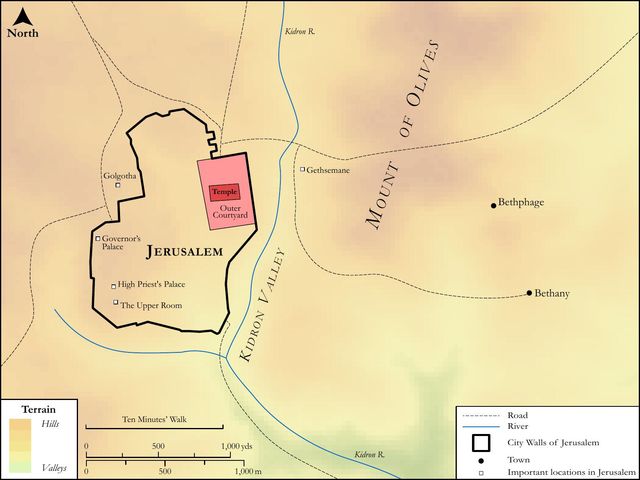
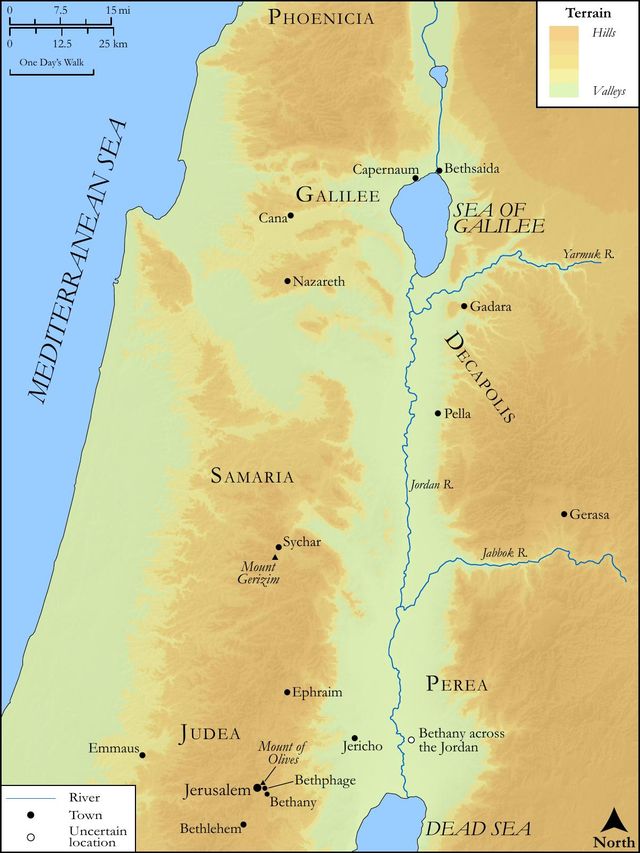
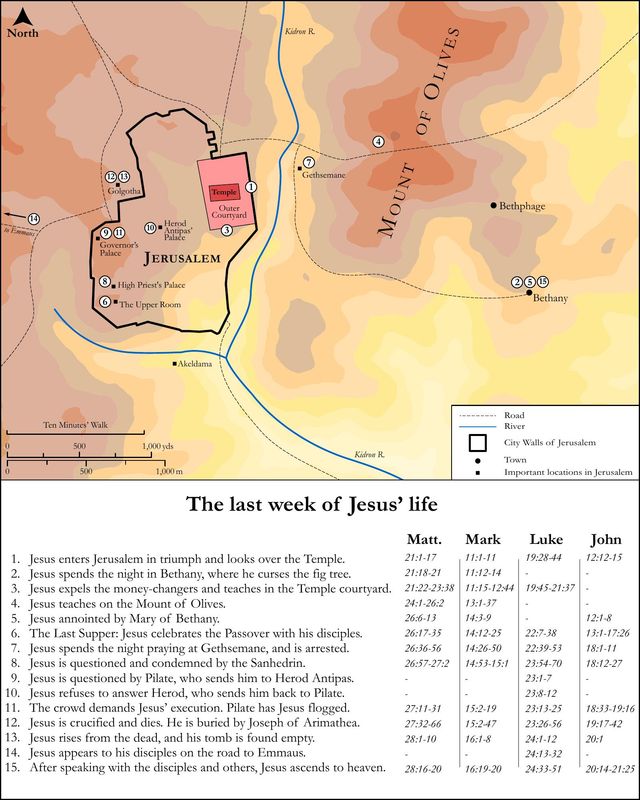
See on the biblical-era map
Study this verse
Public-domain commentary
Matthew Henry
From his Commentary on the Whole Bible. Henry comments on passages, not single verses — this entry covers John 14:28–31. His three-level outline is real structure in the source text, so it is rendered as structure.
Christ here gives his disciples another reason why their hearts should not be troubled for his going away; and that is, because his heart was not. And here he tells them what it was that enabled him to endure the cross and despise the shame, that they might look unto him, and run with patience. He comforted himself,
I.That, though he went away, he should come again:
"You have heard how I have said, and now I say it again, I go away, and come again." Note, What we have heard of the doctrine of Christ, especially concerning his second coming, we have need to be told again and again. When we are under the power of any transport of passion, grief, or fear, or care, we forget that Christ will come again. See Phi 4:5. Christ encouraged himself with this, in his sufferings and death, that he should come again, and the same should comfort us in our departure at death; we go away to come again; the leave we take of our friends at that parting is only a good night, not a final farewell. See Th1 4:13, Th1 4:14.
II.That he went to his Father:
"If you loved me, as by your sorrow you say you do, you would rejoice instead of mourning, because, though I leave you, yet I said, I go unto the Father, not only mine, but yours, which will be my advancement and your advantage; for my Father is greater than I." Observe here,
1.It is matter of joy to Christ's disciples that he is gone to the Father, to take possession for orphans, and make intercession for transgressors. His departure had a bright side as well as a dark side. Therefore he sent this message after his resurrection (Joh 20:17), I ascend to my Father and your Father, as most comfortable.
2.The reason of this is, because the Father is greater than he, which, if it be a proper proof of that for which it is alleged (as no doubt it is), must be understood thus, that his state with his Father would be much more excellent and glorious than his present state; his returning to his Father (so Dr. Hammond) would be the advancing of him to a much higher condition than that which he was now in. Or thus, His going to the Father himself, and bringing all his followers to him there, was the ultimate end of his undertaking, and therefore greater than the means. Thus Christ raises the thoughts and expectations of his disciples to something greater than that in which now they thought all their happiness bound up. The kingdom of the Father, wherein he shall be all in all, will be greater than the mediatorial kingdom.
3.The disciples of Christ should show that they love him by their rejoicing in the glories of his exaltation, rather than by lamenting the sorrows of his humiliation, and rejoicing that he is gone to his Father, where he would be, and where we shall be shortly with him. Many that love Christ, let their love run out in a wrong channel; they think if they love him they must be continually in pain because of him; whereas those that love him should dwell at ease in him, should rejoice in Christ Jesus.
III.That his going away, compared with the prophecies which went before of it, would be a means of confirming the faith of his disciples (Joh 14:29): "I have told you before it come to pass that I must die and rise again, and ascend to the Father, and send the Comforter, that, when it is come to pass, you might believe." See this reason, Joh 13:19; Joh 16:4. Christ told his disciples of his death, though he knew it would both puzzle them and grieve them, because it would afterwards redound to the confirmation of their faith in two things: - 1. That he who foretold these things had a divine prescience, and knew beforehand what day would bring forth. When St. Paul was going to Jerusalem, he knew not the things that did abide him there, but Christ did. 2. That the things foretold were according to the divine purpose and designation, not sudden resolves, but the counterparts of an eternal counsel. Let them therefore not be troubled at that which would be for the confirmation of their faith, and so would redound to their real benefit; for the trial of our faith is very precious, though it cost us present heaviness, through manifold temptations, Pe1 1:6.
IV.That he was sure of a victory over Satan, with whom he knew he was to have a struggle in his departure (Joh 14:30):
"Henceforth I will not talk much with you, having not much to say, but what may be adjourned to the pouring out of the Spirit." He had a great deal of good talk with them after this (ch. 15 and 16), but, in comparison with what he had said, it was not much. His time was now short, and he therefore spoke largely to them now, because the opportunity would soon be over. Note, We should always endeavour to talk to the purpose, because perhaps we may not have time to talk much. We know not how soon our breath may be stopped, and therefore should be always breathing something that is good. When we come to be sick and die, perhaps we may not be capable of talking much to those about us; and therefore what good counsel we have to give them, let us give it while we are in health. One reason why he would not talk much with them was because he had now other work to apply himself to: The prince of this world comes. He called the devil the prince of this world, Joh 12:31. The disciples dreamed of their Master being the prince of this world, and they worldly princes under him. But Christ tells them that the prince of this world was his enemy, and so were the princes of this world, that were actuated and ruled by him, Co1 2:8. But he has nothing in me. Observe here,
1.The prospect Christ had of an approaching conflict, not only with men, but with the powers of darkness. The devil had set upon him with his temptations (Mt. 4), had offered him the kingdoms of this world, if he would hold them as tributary to him, with an eye to which Christ calls him, in disdain, the prince of this world. Then the devil departed from him for a season; "But now," says Christ, "I see him rallying again, preparing to make a furious onset, and so to gain by terrors that which he could not gain by allurements;" to frighten from his undertaking, when he could not entice from it. Note, The foresight of a temptation gives us great advantage in our resistance of it; for, being fore-warned, we should be fore-armed. While we are here, we may see Satan continually coming against us, and ought therefore to be always upon our guard.
2.The assurance he had of good success in the conflict: He hath nothing in me, ouk echei ouden - He hath nothing at all.
(1.)There was no guilt in Christ to give authority to the prince of this world in his terrors. The devil is said to have the power of death (Heb 2:14); the Jews called him the angel of death, as an executioner. Now Christ having done no evil, Satan had no legal power against him, and therefore, though he prevailed to crucify him, he could not prevail to terrify him; though he hurried him to death, yet not to despair. When Satan comes to disquiet us, he has something in us to perplex us with, for we have all sinned; but, when he would disturb Christ, he found no occasion against him.
(2.)There was no corruption in Christ, to give advantage to the prince of this world in his temptations. He could not crush his undertaking by drawing him to sin, because there was nothing sinful in him, nothing irregular for his temptations to fasten upon, no tinder for him to strike fire into; such was the spotless purity of his nature that he was above the possibility of sinning. The more Satan's interest in us is crushed and decays, the more comfortably may we expect sufferings and death.
V.That his departure was in compliance with, and obedience to, his Father.
Satan could not force his life from him, and yet he would die: that the world may know that I love the Father, Joh 14:31. We may take this,
1.As confirming what he had often said, that his undertaking, as Mediator, was a demonstration to the world,
(1.)Of his compliance with the Father; hereby it appeared that he loved the Father. As it was an evidence of his love to man that he died for his salvation, so it was of his love to God that he died for his glory and the accomplishing of his purposes. Let the world know that between the Father and the Son there is not love lost. As the Father loved the Son, and gave all things into his hands; so the Son loved the Father, and gave his spirit into his hand.
(2.)Of his obedience to his Father: "As the Father gave me commandment, even so I did - did the thing commanded me in the manner commanded." Note, The best evidence of our love to the Father is our doing as he hath given us commandment. As Christ loved the Father, and obeyed him, even to the death, so we must love Christ, and obey him. Christ's eye to the Father's commandment, obliging him to suffer and die, bore him up with cheerfulness, and overcame the reluctancies of nature; this took off the offence of the cross, that what he did was by order from the Father. The command of God is sufficient to bear us out in that which is most disputed by others, and therefore should be sufficient to bear us up in that which is most difficult to ourselves: This is the will of him that made me, that sent me.
2.As concluding what he had now said; having brought it to this, here he leaves it: that the world may know that I love the Father. You shall see how cheerfully I can meet the appointed cross: "Arise, let us go hence to the garden;" so some; or, to Jerusalem. When we talk of troubles at a distance, it is easy to say, Lord, I will follow thee whithersoever thou goest; but when it comes to the pinch, when an unavoidable cross lies in the way of duty, then to say, "Arise, let us go to meet it," instead of going out of our way to miss it, this lets the world know that we love the Father. If this discourse was at the close of the passover-supper, it should seem that at these words he arose from the table, and retired into the drawing-room, where he might the more freely carry on the discourse with his disciples in the following chapters, and pray with them. Dr. Goodwin's remark upon this is, that Christ mentioning the great motive of his sufferings, his Father's commandment, was in all haste to go forth to suffer and die, was afraid of slipping the time of Judas's meeting him: Arise, says he, let us go hence but he looks upon the glass, as it were, sees it not quite out, and therefore sits down again, and preaches another sermon. Now, (1.) In these words he gives his disciples an encouragement to follow him. He does not say, I must go; but, Let us go. He calls them out to no hardships but what he himself goes before them in as their leader. They had promised they would not desert him: "Come," says he, "let us go then; let us see how you will make the words good." (2.) He gives them an example, teaching them at all times, especially in suffering times, to sit loose to all things here below, and often to think and speak of leaving them. Though we sit easy, and in the midst of the delights of an agreeable conversation, yet we must not think of being here always: Arise, let us go hence. If it was at the close of the paschal and eucharistical supper, it teaches us that the solemnities of our communion with God are not to be constant in this world. When we sit down under Christ's shadow with delight, and say, It is good to be here; yet we must think of rising and going hence; going down from the mount.
Historical interpretation
Five Centuries of Reception
12 surviving comments on this verse. Each one is dated, so this reads as a timeline rather than a list.
Select a marker to jump to its quote. Markers stagger vertically where authors wrote within a few decades of each other.
For as a serpent cannot mark its track upon a rock, so the devil could not find sin in the body of Christ. For the Lord says, "Behold, the prince of this world cometh, and will find nothing in me." -For as a ship, sailing in the sea, leaves no traces of her way behind her, so neither does the Church, which is situate in the world as in a sea, leave her hope upon the earth, because she has her life reserved in heaven; and as she holds her way here only for a short time, it is not possible to trace out her course.-As the Church does not leave her hope behind in the world, her hope in the incarnation of Christ which bears us all good, she did not leave the track of death in Hades.-Of whom but of Him who is born of the Holy Spirit and the Virgin?-who, in renewing the perfect man in the world, works miracles, beginning from the baptism of John, as the Evangelist also testifies: And Jesus was then beginning to be about thirty years of age. This, then, was the youthful and blooming period of the age of Him who, in journeying among the cities and districts, healed the diseases and infirmities of men.
Also mentioned is a prince of this world, but it is not yet clear whether this is the devil himself or someone else. There are also certain princes of this world spoken of as possessing a kind of wisdom that will come to nothing.
(ix. de Trin) He next alludes to the approach of the time when He would resume His glory. Hereafter I will not talk much with you.
The rulers of this age are not to be understood as merely people of the Jews and Romans but also those princes and powers referred to above, to whom this saying pertains and against whom is our struggle.… The rulers of this age crucified the Lord of majesty through their ignorance. For how can the rulers of this age be understood as the rulers of the Jews who were subject to the Roman Empire?
"Arise, let us go hence." "But why, tell me? Did he not know the hour at which Judas would come upon Him? Or perhaps He feared lest he should come and seize them, and lest the plotters should be upon him before he had furnished his most excellent teaching." Away with the thought! these things are far from His dignity. "If then He did not fear, why did He remove them, and then after finishing His discourse lead them into a garden known to Judas? And even had Judas come, could He not have blinded their eyes, as He also did when the traitor was not present? Why did He remove them?" He alloweth the disciples a little breathing time. For it was likely that they, as being in a conspicuous place, would tremble and fear, both on the account of the time and the place, (for it was the depth of night,) and would not give heed to His words, but would be continually turning about, and imagining that they heard those who were to set upon them; and that more especially when their Master's speech made them expect evil. For, "yet a little while," He saith, "and I am not with you," and, "the ruler of this world cometh." Since now when they heard these and the like words they were troubled, as though they should certainly be taken immediately, He leadeth them to another place, in order that thinking themselves in safety, they might listen to Him without fear. For they were about to hear lofty doctrines.
(Hom. lxxv. 3) After saying, Peace I leave with you, which was like taking farewell, He consoles them: Let not your heart be troubled, neither let it be afraid: the two feelings of love and fear were now the uppermost in them.
(Hom. lxxv. 4) Or thus: The Apostles did not yet know what the resurrection was of which He spoke when He said, I go, and come again to you; or what they ought to think of it. They only knew the great power of the Father. So He tells them: Though ye fear I shall not be able to save Myself, and do not trust to My appearing again after My crucifixion; yet when ye hear that I go to My Father, ye should rejoice, because I go to one greater, one able to dissolve and change all things. All this is said in accommodation to their weakness: as we see from the next words; And now I have told you before it come to pass; that when it does come to pass, ye may believe.
(Hom. lxxvi. 1) Arise, let us go hence, is the beginning of the sentence which follows. The time and the place (they were in the midst of a town, and it was night time) had excited the disciples' fears to such a degree, that they could not attend to any thing that was said, but rolled their eyes about, expecting persons to enter and assault them; especially when they heard our Lord say, Yet a little while I am with you; and, The prince of this world cometh. To quiet their alarm then, He takes them to another place, where they imagine themselves safe, and would be able to attend to the great doctrines which He was going to set before them.
(Tract. lxxix. 2) i. e. the devil; the prince of sinners, not of creatures; as the Apostle saith, Against the rulers of this world. (Eph. 6:12) Or, as He immediately adds by way of explanation, this darkness, meaning, the ungodly. And hath nothing in Me. God had no sin as God, nor had His flesh contracted it by a sinful birth, being born of the Virgin.
Why be surprised that Christ died, although Christ committed no sin whatever? He wanted to pay back for you what he did not owe himself, in order to deliver you from debt. The devil, having taken in the human race, was in possession of it by right. He possessed what he had taken; he had taken what he had taken in. Christ brought along in his mortal flesh his blood to be shed, with which to cancel the bill of our sins. That other one would still be holding the guilty if he had not put the innocent to death. But now see with what justice he is told, “You have put to death one who had no debt. Now hand over the debtors.” “Behold,” he says, “the prince of this world is coming, and in me he will find nothing.” “How nothing? Haven’t you got a soul, haven’t you got flesh? Aren’t you also the Word? Is all that nothing?”Of course not. Nothing of his own, because [I have] no sin. He is the prince of sinners. The prince of sinners will find nothing in me. I have not sinned, I have contracted nothing from Adam, because I came to you from the Virgin. I did not add anything, because I did not have anything to add it to, and by living a just life I committed no sin. Let him come and find something of his own in me, if he can. But he will find nothing of his own in me. I have no sin. Born innocently, I have led an innocent life. Let him come, he will find nothing. “So why are you dying, if he is coming and will find nothing?” And he gives the reason why he must die: “Behold, the prince of this world is coming, and he will find nothing in me.” And if we might hypothetically ask, “So then, why are you dying?” he would answer, “So that all might know that I am doing the will of my Father. Arise, let us go from here"; That is, let us go to [my] passion. He was willing to die because if was the will of his good Father, not because he owed it to the evil prince.
But what says He next? "Hereafter I will not talk much with you; for the prince of this world cometh;" and who is that, but the devil? "And hath nothing in me;" that is to say, no sin at all. For by such words He points to the devil, as the prince, not of His creatures, but of sinners, whom He here designates by the name of this world. And as often as the name of the world is used in a bad sense, He is pointing only to the lovers of such a world; of whom it is elsewhere recorded, "Whosoever will be a friend of this world, becomes the enemy of God." Far be it from us, then, so to understand the devil as prince of the world, as if he wielded the government of the whole world, that is, of heaven and earth, and all that is in them; of which sort of world it was said, when we were lecturing on Christ the Word, "And the world was made by Him." The whole world therefore, from the highest heavens to the lowest earth, is subject to the Creator, not to the deserter; to the Redeemer, not to the destroyer; to the Deliverer, not to the enslaver; to the Teacher, not to the deceiver. And in what sense the devil is to be understood as the prince of the world, is still more clearly unfolded by the Apostle Paul, who, after saying, "We wrestle not against flesh and blood," that is, against men, went on to say, "but against principalities and powers, and the world-rulers of this darkness." For in the very next word he has explained what he meant by "world," when he added, "of this darkness;" so that no one, by the name of the world, should understand the whole creation, of which in no sense are fallen angels the rulers. "Of this darkness," he says, that is, of the lovers of this world: of whom, nevertheless, there were some elected, not from any deserving of their own, but by the grace of God, to whom he says, "Ye were sometimes darkness; but now are ye light in the Lord." For all have been under the rulers of this darkness, that is, under the rulers of wicked men, or darkness, as it were, in subjection to darkness: but "thanks be to God, who hath delivered us," says the same apostle, "from the power of darkness, and hath translated us into the kingdom of the Son of His love." And in Him the prince of this world, that is, of this darkness, had nothing; for neither did He come with sin as God, nor had His flesh any hereditary taint of sin in its procreation by the Virgin.
Now when the impious Jews were already at hand, with the band of soldiers whom they brought, and their leader who also had promised to betray Him, and were ready to take Him and bear Him away in no long time to His sufferings upon the cross, and before the Crucifixion, He declared that He would break off His discourse with them. For, He says, the time is short and already past. And now that the bloodthirsty spirit of the Jews is at its height against Me, and shows itself already within the gates, the time for speech with you is past, and the period of My passion has arrived. But He says, The prince of this world hath nothing in Me. And I shall die very gladly, and undergo death to save the world, and through reverence to My Father and love towards Him willingly encounter inconceivable anguish, that I may fulfil His Will. The aim of what He says here is very plain, and compressing His words into smaller compass we say: Adam, the author of our race, underwent death by a Divine curse, through his breaking the commandment given to him, accused by himself and the devil. He indeed seems to have suffered for good reason, since the doom of punishment justly pursues those who have sinned from indolence; but the second Adam, that is our Lord Jesus Christ, Who can have no such charge brought against Him at all, for He did no sin, neither was guile found in His mouth, underwent His sufferings for us, having of Himself no responsibility whatever for them, but by His sufferings procured a ransom for the world, owing to His love for the Father, Who yearned for the salvation of the world. For it was truly the work of His love for the Father not to set at nought His decree and firm resolve, but to hasten to bring it into effect. And what was this decree? He willed that His own Son, though of like fashion with Himself and distinguished by His perfect equality with Him, should descend to such humiliation as to take the form of man for our sakes, and not shrink from death to save the world. This the Son did through love of His Father, Who is said to have ordered Him by His own power to suffer death in His fleshly nature, and to destroy the power of corruption, and to quicken the dead, and to restore them to their ancient state. Therefore He says that the time for speech is short. For My suffering is drawing nigh, and the presumptuous counsels of the Jews have burst into flame. I will suffer willingly, as for this cause I have come.
But the prince of this world cometh, and hath nothing in Me; that is, I shall not be convicted of sin, and the Jews will not be able to establish their charge of drunkenness against Me, the devil hath no part in Me, for vices are as it were his attributes, and wickedness owes its parentage to him. For the truth of our Saviour's words will be most clearly seen from what follows. For how did He sin, Who knew no sin, the true and living God, Who was wholly incapable of turning from the path of righteousness? And we shall see this most clearly by the actual writings of the holy Evangelists. For the most wise John has represented Pilate saying, I find no crime in Him; and again, after putting on Him the crown of thorns, as saying these words: Behold, I bring Him out to you, that ye may know that I find no crime in Him; and Matthew says that he so hated the crime, that he washed his hands before the Jews and said, I am innocent of the blood of this righteous man; and the same Evangelist points Him out to us, when He was brought into the presence of the high priests themselves, and says: Now the chief priests and the whole council sought false witness against the Christ, that they might put Him to death; and they found it not, though many false witnesses came. Still, though accusations were sought against Him by the agency of men, the devil used them as ministers and instruments of his own malice, and it was he more than any one else who sought to find sin in Him. It is then true that the devil had no part in Him, whom Christ called prince of this world, speaking of the present moment, not as though he were truly lord of it, but as a foreign intruder who has gained by the law of conquest what does not belong to him. For by sin he subjected mankind to himself, and driving them away from God as sheep who have no shepherd, he ruled over them though they were not his own. Therefore was he rightly cast out from the kingdom he had so obtained. For Christ has become King over us, and therefore He says: Now shall the prince of this world be east out; and I, if I be lifted up from the earth, will draw all men unto Myself.
For we must consider deeply how terrible for us will be the hour of our death, what fear of mind, how great then the memory of all our evils, what forgetfulness of past happiness, what dread and consideration of the Judge. Then malign spirits seek their own works in the departing soul; then they recount the evils they persuaded, that they may drag the soul as their companion to torments. But why do we say this only of the perverse soul, when they come also to the elect as they depart, and seek something of their own in them, if they might prevail? Yet One among men existed, who before His passion says with free voice: "I will no longer speak much with you; for the prince of this world comes, and in me he has nothing." For since he saw Him as a mortal man, the prince of the world believed he could find something of his own in Him. But He departed from the corruption of the world without any sin, who came into the world without sin.
This Peter did not presume to say of himself against the prince of the world, Peter who deserved to hear: "Whatever you bind on earth shall be bound in heaven, and whatever you loose on earth shall be loosed in heaven." This Paul did not presume to say, who before he paid the debt of death reached the secrets of the third heaven. This John did not dare to say, who for his special love reclined on the breast of his Redeemer at supper. For since the Prophet says: "Behold, I was conceived in iniquities, and in sins did my mother bear me," he could not be without fault in the world who came into the world with fault. Hence the same Prophet says: "No living person shall be justified in your sight." Hence Solomon says: "There is no just man on earth who does good and does not sin." Hence John says: "If we say that we have no sin, we deceive ourselves, and the truth is not in us." Hence James says: "For in many things we all offend."
For it is established that all who were conceived from the pleasure of the flesh—without doubt in their action, or speech, or thought—the prince of this world had something of his own in them. But therefore he could not seize them afterward or hold them before, because He snatched them from their debts who paid the debt of death for us without being in debt, so that our debts do not hold us under the right of our enemy, because the mediator between God and men, the man Christ Jesus, freely rendered for us what He did not owe. For He who rendered for us the unowed death of the flesh freed us from the owed death of the soul. He says therefore: "For the prince of this world comes, and in me he has nothing."
Hence we must take care, and consider daily with great weeping, how ravenous, how terrible the prince of this world may come seeking his own works in us on the day of our departure, if he came even to God dying in the flesh, and sought something in Him in whom he could find nothing.
What then shall we wretches say, what shall we do, we who have committed innumerable evils? What shall we say to the adversary who searches us and finds much of his own in us, except only this which is our certain refuge and solid hope: that we have been made one with him in whom the prince of this world sought something of his own and could find nothing at all? For he alone is free among the dead. And we are now released from the bondage of sin with true liberty, because we are united to him who is truly free. For it is established, and we cannot deny it, but we truthfully confess that the prince of this world has much in us; yet at the time of our death he cannot seize us, because we have become members of him in whom he has nothing. But what does it profit that we are joined to our Redeemer through faith, if we are separated from him by our conduct? For he himself says: "Not everyone who says to me, Lord, Lord, will enter the kingdom of heaven." Therefore right works must be joined to right faith. Let us wash away the evils we have done through daily laments; let right works arising from love of God and neighbor overcome our past wickedness; let us refuse no good that we can bestow upon our brothers. For we do not otherwise become members of our Redeemer unless by clinging to God and showing compassion to our neighbor.
He says this because the time was now approaching for His being taken, and given up to death: For the Prince of this world cometh.
Continue studying John 14:30 across the web’s major study libraries — every link below opens this exact verse, chapter, or book on the destination site.
Read & Compare
 BibleGatewayThis verse in more than 200 translations and 70 languages.
 Bible.comThe YouVersion reader — hundreds of translations, reading plans, and highlights.
 ESV.orgCrossway's official English Standard Version reader.
 NET BibleThe NET translation with 60,000+ translators' notes on every rendering decision.
 STEP BibleTyndale House's free study tool — original text, vocabulary, and scholarly resources.
 BibliaLogos Bible Software's free web reader.
 USCCBThe New American Bible (Revised Edition) with the U.S. bishops' study notes.
Commentaries
 BibleHub CommentariesDozens of classic commentaries on this verse, gathered on one page.
 StudyLightMore than 100 commentary sets — the largest collection on the web.
 BibleRefPlain-English commentary on what this verse means, verse by verse.
 Enduring WordDavid Guzik's free commentary on this chapter, widely used by Bible teachers.
 Bible Study ToolsVerse commentary alongside Greek and Hebrew study aids.
Original Language & Research
- BibleHub InterlinearThe verse word by word — original language, transliteration, and English.
- BibleHub LexiconEvery word's original-language definition and Strong's entry.
 Blue Letter BibleDeep-study tools — Strong's numbers, concordance, and word studies.
 CNTR CollationThe earliest Greek manuscripts of this verse, collated letter by letter.
Sermons, Hymns & Audio


TrulyRandomVerse is not affiliated with these sites and doesn’t control their content. They’re linked because they’re genuinely useful.
Summary
In Jesus continues His intimate discourse with His disciples on the eve of His crucifixion, revealing the urgency of the hour and the spiritual battle unfolding. He declares that His time for extensive teaching is drawing to a close, for "the prince of this world" is approaching. Crucially, Jesus asserts His absolute purity and sinlessness, stating that this adversary has no claim or power over Him, thereby underscoring the voluntary and redemptive nature of His impending sacrifice.
Context
ShowHideLiterary Context
This verse is deeply embedded within Jesus' Farewell Discourse (John 13-17), delivered to His disciples in the Upper Room immediately following the Last Supper and Judas's departure. Chapters 13 and 14 focus on preparing the disciples for Jesus' physical absence, promising the Holy Spirit, comforting them with the truth of His return, and emphasizing the importance of love and obedience. John 14:30 marks a transition, signaling the imminent confrontation with the powers of darkness that will lead to His arrest and crucifixion. It sets the stage for the command to "Arise, let us go hence" in John 14:31, moving them from the intimate setting to the Garden of Gethsemane.
Historical & Cultural Context
Jesus' reference to "the prince of this world" would have resonated with Jewish apocalyptic thought, which often personified evil forces, particularly Satan, as having dominion over the present age, especially the Gentile nations or the "world" in its fallen, rebellious state. The disciples, steeped in this worldview, would understand the gravity of such a figure's "coming." The impending events—Jesus' arrest, trial, and crucifixion—were not random occurrences but the culmination of a divine plan unfolding amidst intense spiritual warfare, where the forces of darkness sought to thwart God's redemptive purposes.
Key Themes
ShowHideJohn 14:30 powerfully contributes to several key themes within John's Gospel. It highlights the sovereignty of God over all events, even the darkest ones, as Jesus willingly submits to the Father's plan, not to Satan's power. It underscores Jesus' divine authority and sinlessness, a recurring motif in John, which establishes His unique qualification as the spotless Lamb of God (John 8:46). Furthermore, it introduces the theme of spiritual warfare and Christ's ultimate victory over the powers of darkness, a victory that will be fully realized through His death and resurrection, foreshadowing the triumph over the "ruler of this world" mentioned again in John 12:31 and John 16:11.
Exposition and Analysis
ShowHideKey Word Analysis
ShowHideThis adverb signifies "no longer" or "not yet," indicating a cessation or termination of a previous state. Here, it marks the imminent end of Jesus' direct, extensive, and unhindered teaching ministry to His disciples before His arrest. It conveys a sense of finality and urgency, signaling that the time for intimate discourse is drawing to a close as the hour of His passion approaches.
Derived from a participle meaning "first in rank or power," this term denotes a chief ruler, magistrate, or leader. In this context, it refers to Satan, acknowledging his temporary, delegated authority and influence over the fallen world system. It implies a position of significant, albeit illegitimate and transient, dominion over humanity alienated from God.
This word primarily means "orderly arrangement" or "decoration," but by implication, it refers to the world in a wide sense, including its inhabitants. In John's Gospel, "world" often carries a moral connotation, referring to humanity in rebellion against God, a system opposed to divine truth and light. Thus, "prince of this world" refers to Satan's dominion over the human system that is alienated from God and hostile to His purposes.
The verb échō means "to hold" or "to have," and oudé means "not even one" or "nothing." Combined, this phrase signifies that Satan has no claim, no legal ground, no inherent power, and no moral leverage over Jesus. It speaks to Jesus' absolute sinlessness and perfect obedience, meaning Satan could find no point of entry, no accusation, and no means to compel Jesus' will.
Verse Breakdown
ShowHide"Hereafter I will not talk much with you:"
This clause conveys Jesus' awareness of the rapidly approaching culmination of His earthly ministry. His public teaching and private instruction to the disciples are nearing their end, as His arrest, trial, and crucifixion are imminent. It highlights the preciousness and urgency of the remaining moments of direct, personal interaction.
"for the prince of this world cometh,"
This phrase introduces the reason for the cessation of extensive discourse. "The prince of this world" is a title Jesus uses for Satan (John 12:31; John 16:11), indicating his active role in the events leading to the crucifixion. Satan is "coming" in the sense of initiating his final, intense assault against Jesus, primarily through Judas's betrayal and the subsequent actions of the religious and political authorities.
"and hath nothing in me."
This is the profound core of the verse. It declares Jesus' absolute moral purity and sinlessness. Because Jesus is without sin, Satan has no legal claim, no foothold, no inherent power, and no moral right over Him. Satan's power over humanity stems from sin, but in Jesus, he finds no sin to exploit, no weakness to leverage, and no ground for accusation. This statement underscores that Jesus' death was not a consequence of Satan's power or any sin in Him, but a voluntary act of obedience to the Father's will.
Literary Devices
ShowHideThe verse employs several significant literary devices. Personification is evident in "the prince of this world," where Satan is given a title of authority, highlighting his active role as a spiritual adversary. This also functions as Symbolism, where "the prince of this world" symbolizes the entire fallen, rebellious system of humanity and its spiritual ruler, opposed to God. The phrase "hath nothing in me" is a powerful instance of Understatement (or litotes, a form of understatement), as it profoundly declares Jesus' absolute sinlessness and invulnerability to Satan's claims, rather than merely stating a lack of possession. It's a profound theological truth stated with stark simplicity. The entire verse also serves as a form of Foreshadowing, preparing the disciples for the intense spiritual conflict that is about to unfold in Gethsemane and at the cross, while simultaneously assuring them of Jesus' ultimate victory.
Theological and Thematic Connections
ShowHideJohn 14:30 is a pivotal theological statement, asserting the unique purity of Christ and the nature of His victory over evil. It establishes that Jesus' impending death is not a defeat at the hands of Satan, but a deliberate, voluntary act of obedience to the Father, uncoerced by any external power or internal sin. This truth is foundational to the doctrine of atonement, as only a sinless sacrifice could effectively bear the sins of the world. The "prince of this world" may come, but his power is ultimately futile against the Son of God who has no sin for Satan to exploit. This sets the stage for Christ's triumph on the cross, where He disarms the powers and authorities.
Reflection and Application
ShowHideJohn 14:30 offers profound comfort and challenge for believers today. Jesus' declaration that Satan "hath nothing in me" is a powerful reminder of His absolute purity and the completeness of His victory over sin and death. For us, this means that when we are "in Christ," Satan's ultimate claim over us is broken. While he may tempt and accuse, he has no legal ground or inherent power to condemn those who are justified by faith in Jesus. This truth empowers us to resist temptation, knowing that the same Spirit who indwelt Christ now indwells us, enabling us to walk in righteousness. We are called to live lives that increasingly reflect Christ's sinlessness, striving for holiness and resisting the "prince of this world" by standing firm in the truth of God's Word and the power of His Spirit. Our battles are not against flesh and blood, but against spiritual forces, and our victory is found in Christ's perfect work.
Questions for Reflection
ShowHideFAQ
ShowHideWhat does "the prince of this world" mean in this context?
ShowHideIn John 14:30, "the prince of this world" refers to Satan, the devil. This title, used by Jesus three times in John's Gospel (John 12:31, John 14:30, John 16:11), signifies his temporary, albeit significant, influence and authority over the fallen, rebellious world system and humanity alienated from God. It does not imply ultimate sovereignty, as God remains supreme, but rather acknowledges Satan's role as the orchestrator of evil and rebellion in the present age. His "coming" refers to his intensified effort to oppose Jesus, particularly through the events leading to the crucifixion.
Christ-Centered Fulfillment
ShowHideJohn 14:30 is profoundly Christ-centered, revealing the unique nature of Jesus' identity and the redemptive purpose of His mission. The declaration that "the prince of this world cometh, and hath nothing in me" is the very bedrock of the gospel. It highlights Jesus' absolute sinlessness, which is indispensable for His role as the perfect atoning sacrifice. Unlike all humanity, who are "under the power of sin" (Romans 3:9), Jesus stands apart, untouched by sin, giving Satan no legal claim or leverage over Him. His death was not a forced act but a voluntary, obedient surrender to the Father's will, demonstrating His divine love and power even in apparent weakness (John 10:18). Through His perfect life and sacrificial death, Jesus definitively "disarmed the powers and authorities" (Colossians 2:15) and "destroyed the works of the devil" (1 John 3:8). Thus, the "prince of this world" was not victorious at the cross but was decisively judged and defeated, paving the way for Christ's resurrection and the establishment of His eternal kingdom, where He reigns supreme over all things (Ephesians 1:20-22).