


Acts 13:4
- ΑὐτοὶAutoiThey themselvesG846P-NPMPersonal pronoun Nominative Plural Masculine
- μὲνmenindeedG3303PRTParticle or Disjunctive
- οὖνounthereforeG3767CONJConjunction
- ἐκπεμφθέντεςekpemphthenteshaving been sent forthG1599V-APP-NPMVerb Aorist Passive Participle Nominative Plural Masculine
- ὑπὸhupobyG5259PREPPreposition
- τοῦtouof theG3588T-GSNDefinite article Genitive Singular Neuter
- ἁγίουhagiouHolyG40A-GSNAdjective Genitive Singular Neuter
- τοῦtoutheG3588T-GSNDefinite article Genitive Singular Neuter
- πνεύματοςpneumatosSpiritG4151N-GSNNoun Genitive Singular Neuter
- κατῆλθονkatēlthonwent downG2718V-2AAI-3PVerb 2nd Aorist Active Indicative 3rd Plural
- εἰςeistoG1519PREPPreposition
- τὴνtēn<the>G3588T-ASFDefinite article Accusative Singular Feminine
- ΣελεύκειανSeleukeianSeleuciaG4581N-ASF-LNoun Accusative Singular Feminine Location
- ἐκεῖθένekeithenFrom thereG1564ADVAdverb
- τεtethenG5037CONJConjunction
- ἀπέπλευσανapepleusanthey sailedG636V-AAI-3PVerb Aorist Active Indicative 3rd Plural
- εἰςeistoG1519PREPPreposition
- τὴνtēn<the>G3588T-ASFDefinite article Accusative Singular Feminine
- ΚύπρονKupronCyprusG2954N-ASF-LNoun Accusative Singular Feminine Location
English is a literal word-by-word gloss of the Greek, not the KJV's wording. Why?
This is the original text the KJV's translators worked from — each Greek word with its own literal English meaning in this verse, prepared by scholars at Tyndale House, Cambridge. The KJV translates whole sentences, not word by word, so its wording differs: one Greek word can become several English words, and the KJV may choose “charity” where the gloss reads “love”. Both are faithful — they answer different questions. For the KJV's own rendering, switch to the KJV text.
Details
See on the biblical-era map
Study this verse
Public-domain commentary
Matthew Henry
From his Commentary on the Whole Bible. Henry comments on passages, not single verses — this entry covers Acts 13:4–13. His four-level outline is real structure in the source text, so it is rendered as structure.
In these verses we have,
I.A general account of the coming of Barnabas and Saul to the famous island of Cyprus; and perhaps thitherward they steered their course because Barnabas was a native of that country (Act 4:36), and he was willing they should have the first-fruits of his labours, pursuant to his new commission. Observe,
1.Their being sent forth by the Holy Ghost was the great thing that encouraged them in this undertaking, Act 13:4. If the Holy Ghost send them forth, he will go along with them, strengthen them, carry them on in their work, and give them success; and then they fear no colours, but can cheerfully venture upon a stormy sea from Antioch, which was now to them a quiet harbour.
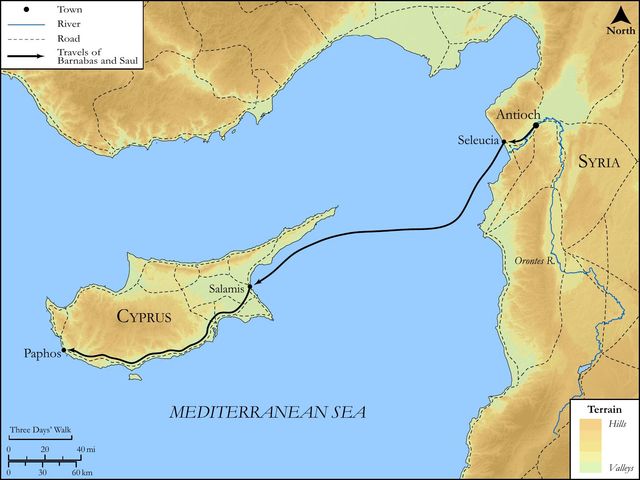
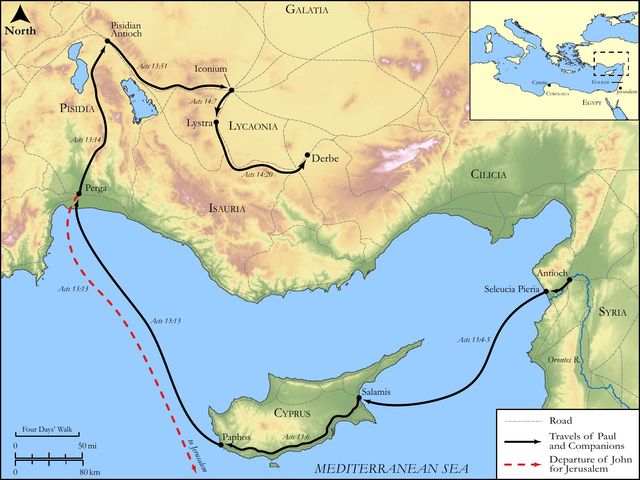
2.They came to Seleucia, the sea-port town opposite to Cyprus, thence crossed the sea to Cyprus, and in that island the first city they came to was Salamis, a city on the east side of the island (Act 13:5); and, when they had sown good seed there, thence they went onward through the isle (Act 13:6) till they came to Paphos, which lay on the western coast.
3.They preached the word of God wherever they came, in the synagogues of the Jews; so far were they from excluding them that they gave them the preference, and so left those among them who believed not inexcusable; they would have gathered them, but they would not. They did not act clandestinely, nor preach the Messiah to others unknown to them, but laid their doctrine open to the censure of the rulers of their synagogues, who might, if they had any thing to say, object against it. Nor would they have acted separately, but in concert with them, if they had not driven them out from them, and from their synagogues.
4.They had John for their minister; not their servant in common things, but their assistant in the things of God, either to prepare their way in places where they designed to come or to carry on their work in places where they had begun it, or to converse familiarly with those to whom they preached publicly, and explain things to them; and such a one might be many ways of use to them, especially in a strange country.
II.A particular account of their encounter with Elymas the sorcerer, whom they met with at Paphos, where the governor resided; a place famous for a temple built to Venus there, thence called Paphian Venus; and therefore there was more than ordinary need that the Son of God should there be manifested to destroy the works of the devil.
1.There the deputy, a Gentile, Sergius Paulus by name, encouraged the apostles, and was willing to hear their message. He was governor of the country, under the Roman emperor; proconsul or propraetor, such a one as we should call lord lieutenant of the island. He had the character of a prudent man, an intelligent, considerate man, that was ruled by reason, not passion nor prejudice, which appeared by this, that, having a character of Barnabas and Saul, he sent for them, and desired to hear the word of God. Note, When that which we hear has a tendency to lead us to God, it is prudence to desire to hear more of it. Those are wise people, however they may be ranked among the foolish of this world, who are inquisitive after the mind and will of God. Though he was a great man, and a man in authority, and the preachers of the gospel were men that made no figure, yet, if they have a message from God, let him know what it is, and, if it appear to be so, he is ready to receive it.
2.There Elymas, a Jew, a sorcerer, opposed them, and did all he could to obstruct their progress. This justified the apostles in turning to the Gentiles, that this Jew was so malignant against them.
(1.)This Elymas was a pretender to the gift of prophecy, a sorcerer, a false-prophet - one that would be taken for a divine, because he was skilled in the arts of divination; he was a conjurer, and took on him to tell people their fortune, and to discover things lost, and probably was in league with the devil for this purpose; his name was Barjesus - the son of Joshua; it signifies the son of salvation; but the Syriac calls him, Bar-shoma - the son of pride; filius inflationis - the son of inflation.
(2.)He was hanging on at court, was with the deputy of the country. It does not appear that the deputy called for him, as he did for Barnabas and Saul; but he thrust himself upon him, aiming, no doubt, to make a hand of him, and get money by him.
(3.)He made it his business to withstand Barnabas and Saul, as the magicians of Egypt, in Pharaoh's court, withstood Moses and Aaron, Ti2 3:8. He set up himself to be a messenger from heaven, and denied that they were. And thus he sought to turn away the deputy from the faith (Act 13:8), to keep him from receiving the gospel, which he saw him inclined to do. Note, Satan is in a special manner busy with great men and men of power, to keep them from being religious; because he knows that their example, whether good or bad, will have an influence upon many. And those who are in any way instrumental to prejudice people against the truths and ways of Christ are doing the devil's work.
(4.)Saul (who is here for the first time called Paul) fell upon him for this with a holy indignation. Saul, who is also called Paul, Act 13:9. Saul was his name as he was a Hebrew, and of the tribe of Benjamin; Paul was his name as he was a citizen of Rome. Hitherto we have had him mostly conversant among the Jews, and therefore called by his Jewish name; but now, when he is sent forth among the Gentiles, he is called by his Roman name, to put somewhat of a reputation upon him in the Roman cities, Paulus being a very common name among them. But some think he was never called Paul till now that he was instrumental in the conversion of Sergius Paulus to the faith of Christ, and that he took the name Paulus as a memorial of this victory obtained by the gospel of Christ, as among the Romans he that had conquered a country took his denomination from it, as Germanicus, Britannicus, Africanus; or rather, Sergius Paulus himself gave him the name Paulus in token of his favour and respect to him, as Vespasian gave his name Flavius to Josephus the Jew. Now of Paul it is said,
[1.]That he was filled with the Holy Ghost upon this occasion, filled with a holy zeal against a professed enemy of Christ, which was one of the graces of the Holy Ghost - a spirit of burning; filled with power to denounce the wrath of God against him, which was one of the gifts of the Holy Ghost - a spirit of judgment. He felt a more than ordinary fervour in his mind, as the prophet did when he was full of power by the Spirit of the Lord (Mic 3:8), and another prophet when his face was made harder than flint (Eze 3:9), and another when his mouth was made like a sharp sword, Isa 49:2. What Paul said did not come from any personal resentment, but from the strong impressions which the Holy Ghost made upon his spirit.
[2.]He set his eyes upon him, to face him down, and to show a holy boldness, in opposition to his wicked impudence. He set his eyes upon him, as an indication that the eye of the heart-searching God was upon him, and saw through and through him; nay, that the face of the Lord was against him, Psa 34:16. He fixed his eyes upon him, to see if he could discern in his countenance any marks of remorse for what he had done; for, if he could have discerned the least sign of this, it would have prevented the ensuing doom.
[3.]He gave him his true character, not in passion, but by the Holy Ghost, who knows men better than they know themselves, Act 13:10. He describes him to be, First, An agent for hell; and such there have been upon this earth (the seat of the war between the seed of the woman and of the serpent) ever since Cain who was of that wicked one, an incarnate devil, slew his brother, for no other reason than because his own works were evil and his brother's righteous. This Elymas, though called Bar-jesus - a son of Jesus, was really a child of the devil, bore his image, did his lusts, and served his interests, Joh 8:44. In two things he resembled the devil as a child does his father - 1. In craftiness. The serpent was more subtle than any beast of the field (Gen 3:1), and Elymas, though void of all wisdom, was full of all subtlety, expert in all the arts of deceiving men and imposing upon them. 2. In malice. He was full of all mischief - a spiteful ill-conditioned man, and a sworn implacable enemy to God and goodness. Note, A fulness of subtlety and mischief together make a man indeed a child of the devil. Secondly, An adversary to heaven. If he be a child of the devil, it follows of course that he is an enemy to all righteousness, for the devil is so. Note, Those that are enemies to the doctrine of Christ are enemies to all righteousness, for in it all righteousness is summed up and fulfilled.
[4.]He charged upon him his present crime, and expostulated with him upon it: "Wilt thou not cease to pervert the right ways of the Lord, to misrepresent them, to put false colours upon them, and so to discourage people from entering into them, and walking in them?" Note, First, The ways of the Lord are right: they are all so, they are perfectly so. The ways of the Lord Jesus are right, the only right ways to heaven and happiness. Secondly, There are those who pervert these right ways, who not only wander out of these ways themselves (as Elihu's penitent, who owns, I have perverted that which was right and it profited me not), but mislead others, and suggest to them unjust prejudices against these ways: as if the doctrine of Christ were uncertain and precarious, the laws of Christ unreasonable and impractical, and the service of Christ unpleasant and unprofitable, which is an unjust perverting of the right ways of the Lord, and making them seem crooked ways. Thirdly, Those who pervert the right ways of the Lord are commonly so hardened in it that, though the equity of those ways be set before them by the most powerful and commanding evidence, yet they will not cease to do it. Etsi suaseris, non persuaseris - You may advise, but you will never persuade; they will have it their own way; they have loved strangers, and after them they will go.
[5.]He denounced the judgment of God upon him, in a present blindness (Act 13:11): "And now, behold, the hand of the Lord is upon thee, a righteous hand. God is now about to lay hands on thee, and make thee his prisoner, for thou art taken in arms against him; thou shalt be blind, not seeing the sun for a season." This was designed both for the proof of his crime, as it was a miracle wrought to confirm the right ways of the Lord, and consequently to show the wickedness of him who would not cease to pervert them, as also for the punishment of his crime. It was a suitable punishment; he shut his eyes, the eyes of his mind, against the light of the gospel, and therefore justly were the eyes of his body shut against the light of the sun; he sought to blind the deputy (as an agent for the god of this world, who blindeth the minds of those that believe not, lest the light of the gospel should shine unto them, Co2 4:4), and therefore is himself struck blind. Yet it was a moderate punishment: he was only struck blind, when he might most justly have been struck dead; and it was only for a season; if he will repent, and give glory to God, by making confession, his sight shall be restored; nay, it should seem, though he do not, yet his sight shall be restored, to try if he will be led to repentance either by the judgments of God or by his mercies.
[6.]This judgment was immediately executed: There fell on him a mist and a darkness, as on the Sodomites when they persecuted Elisha. This silenced him presently, filled him with confusion, and was an effectual confutation of all he said against the doctrine of Christ. Let not him any more pretend to be a guide to the deputy's conscience who is himself struck blind. It was also an earnest to him of a much sorer punishment if he repent not; for he is one of those wandering stars to whom is reserved the blackness of darkness for ever, Jde 1:13. Elymas did himself proclaim the truth of the miracle, when he went about seeking some to lead him by the hand; and where now is all his skill in sorcery, upon which he had so much valued himself, when he can neither find his way nor find a friend that will be so kind as to lead him!
3.Notwithstanding all the endeavours of Elymas to turn away the deputy from the faith, he was brought to believe, and this miracle, wrought upon the magician himself (like the boils of Egypt, which were upon the magicians, so that they could not stand before Moses, Exo 9:11), contributed to it. The deputy was a very sensible man, and observed something uncommon, and which intimated its divine original,
(1.)In Paul's preaching: he was astonished at the doctrine of the Lord, the Lord Christ - the doctrine that is from him, the discoveries he has made of the Father - the doctrine that is concerning him, his person, natures, offices, undertaking. Note, The doctrine of Christ has a great deal in it that is astonishing; and the more we know of it the more reason we shall see to wonder and stand amazed at it.
(2.)In this miracle: When he saw what was done, and how much Paul's power transcended that of the magician, and how plainly Elymas was baffled and confounded, he believed. It is not said that he was baptized, and so made a complete convert, but it is probable that he was. Paul would not do his business by the halves; as for God, his work is perfect. When he became a Christian, he neither laid down his government, nor was turned out of it, but we may suppose, as a Christian magistrate, by his influence helped very much to propagate Christianity in that island. The tradition of the Romish church, which has taken care to find bishoprics for all the eminent converts we read of in the Acts, has made this Sergius Paulus bishop of Narbon in France, left there by Paul in his journey to Spain.
III.Their departure from the island of Cyprus.
It is probable that they did a great deal more there than is recorded, where an account is given only of that which was extraordinary - the conversion of the deputy. When they had done what they had to do,
1.They quitted the country, and went to Perga. Those that went were Paul and his company, which, it is probable, was increased in Cyprus, many being desirous to accompany him. Anachthentes hoi peri ton Paulon - Those that were about Paul loosed from Paphos, which supposes that he went too; but such an affection had his new friends for him that they were always about him, and by their good will would be never from him.
2.Then John Mark quitted them, and returned to Jerusalem, without the consent of Paul and Barnabas; either he did not like the work, or he wanted to go and see his mother. It was his fault, and we shall hear of it again.
Historical interpretation
Historical reception
2 surviving comments on this verse. Each one is dated, so this reads as a timeline rather than a list.
As soon as they were ordained they went forth, and hasted to Cyprus, that being a place where was no ill-design hatching against them, and where moreover the Word had been sown already. In Antioch there were (teachers) enough, and Phoenice too was near to Palestine; but Cyprus not so. However, you are not to make a question of the why and wherefore, when it is the Spirit that directs their movements: for they were not only ordained by the Spirit, but sent forth by Him likewise. "And when they were come to Salamis, they preached the word of God in the synagogues of the Jews." Do you mark how they make a point of preaching the word to them first?
"So they, being sent forth by the Holy Ghost, departed unto Seleucia; and from thence they sailed to Cyprus." It shows that the Spirit did all.
Continue studying Acts 13:4 across the web’s major study libraries — every link below opens this exact verse, chapter, or book on the destination site.
Read & Compare
 BibleGatewayThis verse in more than 200 translations and 70 languages.
 Bible.comThe YouVersion reader — hundreds of translations, reading plans, and highlights.
 ESV.orgCrossway's official English Standard Version reader.
 NET BibleThe NET translation with 60,000+ translators' notes on every rendering decision.
 STEP BibleTyndale House's free study tool — original text, vocabulary, and scholarly resources.
 BibliaLogos Bible Software's free web reader.
 USCCBThe New American Bible (Revised Edition) with the U.S. bishops' study notes.
Commentaries
 BibleHub CommentariesDozens of classic commentaries on this verse, gathered on one page.
 StudyLightMore than 100 commentary sets — the largest collection on the web.
 BibleRefPlain-English commentary on what this verse means, verse by verse.
 Enduring WordDavid Guzik's free commentary on this chapter, widely used by Bible teachers.
 Bible Study ToolsVerse commentary alongside Greek and Hebrew study aids.
Original Language & Research
- BibleHub InterlinearThe verse word by word — original language, transliteration, and English.
- BibleHub LexiconEvery word's original-language definition and Strong's entry.
 Blue Letter BibleDeep-study tools — Strong's numbers, concordance, and word studies.
 CNTR CollationThe earliest Greek manuscripts of this verse, collated letter by letter.
Sermons, Hymns & Audio


TrulyRandomVerse is not affiliated with these sites and doesn’t control their content. They’re linked because they’re genuinely useful.
Summary
This verse marks the crucial commencement of Paul and Barnabas's first missionary journey, explicitly stating that their departure was not by human initiative but by the direct commission and empowerment of the Holy Spirit. It details their initial travel from Antioch's port city, Seleucia, to the island of Cyprus, setting the geographical stage for the expansion of the gospel into the Gentile world under divine guidance.
Context
ShowHideLiterary Context
Acts 13:4 immediately follows the powerful narrative of the Antiochian church's corporate prayer and fasting, during which the Holy Spirit directly intervened to call Barnabas and Saul for a specific work. Acts 13:1-3 establishes the setting: a vibrant, Spirit-filled church in Antioch, rich with prophets and teachers. The laying on of hands in Acts 13:3 signifies their formal commissioning and endorsement by the church, acting in obedience to the Spirit's directive. Thus, verse 4 is the direct, obedient response to this divine call, translating spiritual discernment into physical action and initiating the first major missionary outreach beyond the immediate sphere of Jerusalem and Judea. It is the practical outworking of the Spirit's command, moving from prayer and prophecy to purposeful travel.
Historical & Cultural Context
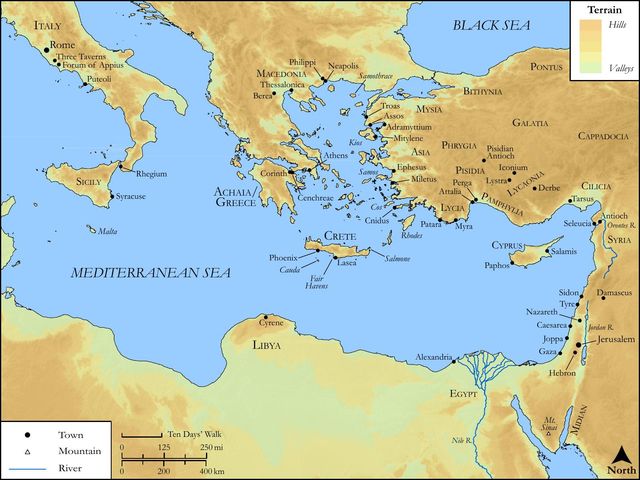
Antioch in Syria was a major Hellenistic city, a significant center of early Christianity, and a strategic hub for missionary endeavors due to its diverse population and commercial importance. Seleucia Pieria, located about 16 miles southwest of Antioch, served as its primary port, making it the natural departure point for sea voyages. Cyprus, a large island in the eastern Mediterranean, was Barnabas's homeland (Acts 4:36), providing a familiar initial destination for the missionaries. As a Roman senatorial province, Cyprus had established Roman roads and administrative centers, facilitating travel and communication. Its population included both Jewish communities and a significant Gentile presence, offering fertile ground for the gospel's expansion, particularly among those who were already familiar with Jewish synagogues.
Key Themes
ShowHideThis verse powerfully underscores the theme of Divine Initiative and Guidance in the early church's mission. The phrase "being sent forth by the Holy Ghost" highlights that the impetus and direction for this monumental undertaking originated entirely with God, not human planning or ambition. This divine commissioning is central to understanding the authority and effectiveness of the apostles' work, demonstrating that the expansion of the gospel is fundamentally God's work through His Spirit, as prophesied in Acts 1:8. Furthermore, the immediate and decisive departure of Barnabas and Saul exemplifies Obedience and Availability to God's call, setting a precedent for missional living. Their journey also illustrates the Strategic Nature of Early Missions, beginning from a major urban center and moving to a familiar, yet diverse, island, showcasing a Spirit-led approach to spreading the gospel that balanced familiarity with new frontiers.
Exposition and Analysis
ShowHideKey Word Analysis
ShowHideFrom ἐκ and πέμπω; meaning "to despatch" or "send away (forth)." This word emphasizes a deliberate, purposeful commission. It's not merely a departure but an active sending out by a higher authority, implying a specific task and destination. The missionaries are not acting on their own impulse but as agents of the Holy Spirit.
From (an awful thing); meaning "sacred," "pure," "morally blameless," or "consecrated." When applied to "Ghost" (Spirit), it denotes the divine, set-apart nature of the Third Person of the Trinity, who is the source of all holiness and purity.
From πνέω; meaning "a current of air," "breath," or "breeze"; figuratively, "a spirit," "the rational soul," or "vital principle." In this context, it refers specifically to the Holy Spirit, the divine agent of God's power, presence, and direction, who empowers and guides believers in their mission. The combination "Holy Ghost" (Holy Spirit) signifies the divine, active, and empowering presence behind the apostles' mission.
Verse Breakdown
ShowHide"¶ So they, being sent forth by the Holy Ghost,"
This opening clause establishes the divine origin and authority of the mission. The "they" refers to Barnabas and Saul (Paul), who were specifically chosen and commissioned. The crucial phrase "being sent forth by the Holy Ghost" (Greek: ὑπὸ τοῦ πνεύματος τοῦ ἁγίου ἐκπεμφθέντες, hypo tou pneumatos tou hagiou ekpemphthentes) signifies that their departure was not a human strategic decision alone, but a direct result of the Holy Spirit's initiative and empowerment. This passive construction ("being sent forth") highlights the Spirit as the active agent, making the apostles instruments of a divine plan.
"departed unto Seleucia;"
This phrase details the immediate physical action taken in response to the divine commission. "Departed" (Greek: κατέρχομαι, katérchomai) indicates a movement down, often to a port or coast. Seleucia was the port city for Antioch, serving as the logical and practical embarkation point for sea travel from Antioch to other regions. This shows the practical steps taken in obedience to the Spirit's leading.
"and from thence they sailed to Cyprus."
This final clause specifies their first destination. After departing from Seleucia, they embarked on a sea journey to Cyprus. Cyprus was a large island, strategically located in the eastern Mediterranean, and notably, it was Barnabas's home island. This initial destination suggests a combination of divine guidance and practical considerations, perhaps leveraging Barnabas's familiarity with the island to establish an early foothold for the gospel. The act of "sailing" underscores the beginning of their trans-regional, maritime missionary journey.
Literary Devices
ShowHideThe verse employs several significant literary devices. Passive Voice is prominent in "being sent forth by the Holy Ghost," which effectively emphasizes the divine agency over human initiative. This grammatical choice underscores that the mission's impetus is God's, not the apostles'. The phrase also functions as a form of Metonymy, where "Holy Ghost" represents the power, will, and active direction of God himself. The precise geographical naming of "Seleucia" and "Cyprus" provides Verisimilitude, lending a strong sense of historical accuracy and realism to the narrative, grounding the spiritual event in tangible, verifiable locations. This detailed geographical progression also serves as Foreshadowing, hinting at the extensive journeys and widespread reach of the gospel that will characterize the remainder of the Book of Acts, demonstrating the Spirit's plan for global evangelization unfolding step by step.
Theological and Thematic Connections
ShowHideActs 13:4 profoundly illustrates the foundational truth that Christian mission is not merely a human endeavor but a divine enterprise initiated, empowered, and directed by the Holy Spirit. This verse sets the precedent for Spirit-led ministry, demonstrating that true effectiveness in spreading the gospel flows from discerning and obeying God's specific call. It emphasizes the active role of the Third Person of the Trinity in guiding the church's expansion, transforming prayer and discernment into tangible, strategic action. The departure of Barnabas and Saul signifies the church's transition from a primarily localized witness to a deliberate, cross-cultural outreach, driven by the Spirit's global vision for redemption.
Reflection and Application
ShowHideActs 13:4 serves as a timeless blueprint for Christian service and mission, reminding us that genuine spiritual fruitfulness stems from a deep reliance on and obedience to the Holy Spirit. In an age where human strategies and programs often dominate, this verse calls believers back to the fundamental truth that God's work must be done God's way – by His Spirit. It challenges us to cultivate a posture of listening, discerning, and yielding to the Spirit's leading in every aspect of our lives, whether in our personal witness, vocational calling, or corporate church ministry. Just as Barnabas and Saul were "sent forth," so too are all believers commissioned by the Spirit to participate in God's ongoing mission in the world. This requires not only a willingness to go but also a readiness to be guided, trusting that the Spirit who initiates the call will also provide the means, the path, and the power to accomplish His purposes. Our effectiveness is directly proportional to our dependence on His divine initiative.
Questions for Reflection
ShowHideFAQ
ShowHideWhat is the significance of the Holy Ghost "sending forth" Barnabas and Saul?
ShowHideThe significance is profound, highlighting that the entire missionary enterprise was divinely initiated and empowered, not merely a human strategic decision. The phrase "being sent forth by the Holy Ghost" (Greek: ekpempō by pneûma hágios) means they were purposefully dispatched or commissioned by the Holy Spirit. This underscores the theological truth that Christian mission is fundamentally God's work, executed through His Spirit. It provides divine authority and backing for their journey, ensuring that their efforts were aligned with God's will and would be accompanied by His power, as seen in the subsequent events of Acts 13. This divine commissioning also serves as a model for all believers, reminding us that true spiritual effectiveness flows from discerning and obeying the Spirit's leading.
Christ-Centered Fulfillment
ShowHideActs 13:4, with its emphasis on being "sent forth by the Holy Ghost," finds its ultimate Christ-centered fulfillment in the person and mission of Jesus Himself. Jesus, the Son, was perfectly "sent forth" by the Father, empowered by the Holy Spirit, to accomplish the ultimate mission of redemption. From His conception by the Holy Spirit (Luke 1:35), to His anointing by the Spirit at His baptism for public ministry (Luke 3:22), and His performing miracles "by the Spirit of God" (Matthew 12:28), Jesus's entire earthly life was a Spirit-empowered mission. He was the quintessential missionary, sent to proclaim the good news of the kingdom of God (Luke 4:43). The sending of Barnabas and Saul by the Holy Spirit is therefore an extension of Christ's own mission, demonstrating that the Spirit, whom Jesus promised to send (John 14:26), continues the work of Christ through His church. The Spirit empowers believers to be Christ's witnesses (Acts 1:8), extending His presence and purpose to the ends of the earth, making the mission of the apostles a direct continuation and fulfillment of the redemptive mission inaugurated by Christ.