


Acts 13:2
Bible text: King James Version (1769 Blayney text) · Public domain
Bible text: King James Version with Strong's numbers · Public domain
Bible text: Berean Standard Bible · Public domain
Bible text: American Standard Version (1901) · Public domain
Bible text: World English Bible, Messianic edition · Public domain
Bible text: Geneva Bible (1599) · Public domain
Bible text: Young's Literal Translation · Public domain
- λειτουργούντωνleitourgountōnAs were ministeringG3008V-PAP-GPMVerb Present Active Participle Genitive Plural Masculine
- δὲdenowG1161CONJConjunction
- αὐτῶνautōntheyG846P-GPMPersonal pronoun Genitive Plural Masculine
- τῷtōto theG3588T-DSMDefinite article Dative Singular Masculine
- κυρίῳkuriōLordG2962N-DSM-TNoun Dative Singular Masculine Title
- καὶkaiandG2532CONJConjunction
- νηστευόντωνnēsteuontōnfastingG3522V-PAP-GPMVerb Present Active Participle Genitive Plural Masculine
- εἶπενeipensaidG2036V-2AAI-3SVerb 2nd Aorist Active Indicative 3rd Singular
- τὸtotheG3588T-NSNDefinite article Nominative Singular Neuter
- πνεῦμαpneumaSpiritG4151N-NSNNoun Nominative Singular Neuter
- τὸto<the>G3588T-NSNDefinite article Nominative Singular Neuter
- ἅγιον·hagionHolyG40A-NSNAdjective Nominative Singular Neuter
- ἀφορίσατεaphorisatedo set apartG873V-AAM-2PVerb Aorist Active Imperative 2nd Plural
- δήdēthenG1211PRTParticle or Disjunctive
- μοιmoito MeG3165P-1DSPersonal pronoun Dative 1st Singular
- τὸνton<the>G3588T-ASMDefinite article Accusative Singular Masculine
- τεtebothG5037CONJConjunction
- ΒαρναβᾶνBarnabanBarnabasG921N-ASM-PNoun Accusative Singular Masculine Individual
- καὶkaiandG2532CONJConjunction
- τὸνton<the>G3588T-ASMDefinite article Accusative Singular Masculine
- ΣαῦλονSaulonSaulG4569N-ASM-PNoun Accusative Singular Masculine Individual
- εἰςeisforG1519PREPPreposition
- τὸtotheG3588T-ASNDefinite article Accusative Singular Neuter
- ἔργονergonworkG2041N-ASNNoun Accusative Singular Neuter
- ὃhoto whichG3739R-ASNRelative pronoun Accusative Singular Neuter
- προσκέκλημαιproskeklēmaiI have calledG4341V-RNI-1SVerb Perfect Middle Or Passive Deponent Indicative 1st Singular
- αὐτούςautousthemG846P-APMPersonal pronoun Accusative Plural Masculine
English is a literal word-by-word gloss of the Greek, not the KJV's wording. Why?
This is the original text the KJV's translators worked from — each Greek word with its own literal English meaning in this verse, prepared by scholars at Tyndale House, Cambridge. The KJV translates whole sentences, not word by word, so its wording differs: one Greek word can become several English words, and the KJV may choose “charity” where the gloss reads “love”. Both are faithful — they answer different questions. For the KJV's own rendering, switch to the KJV text.
Details
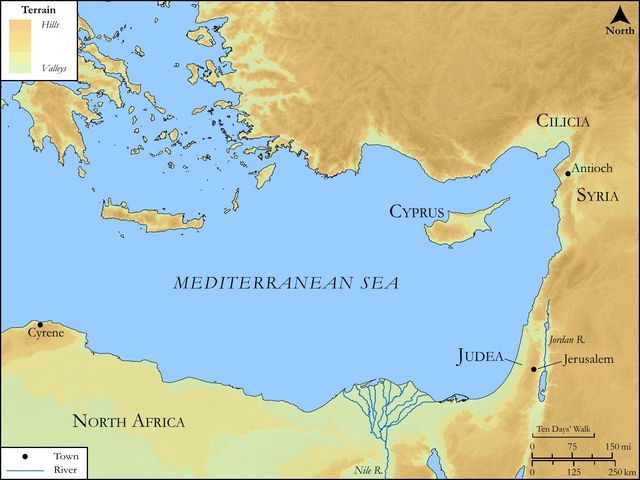
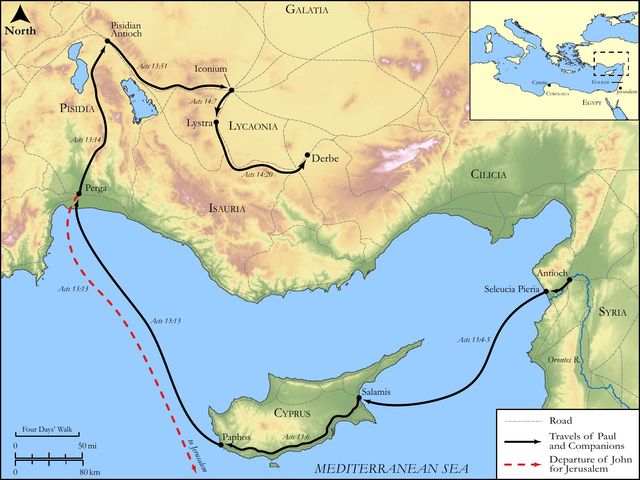
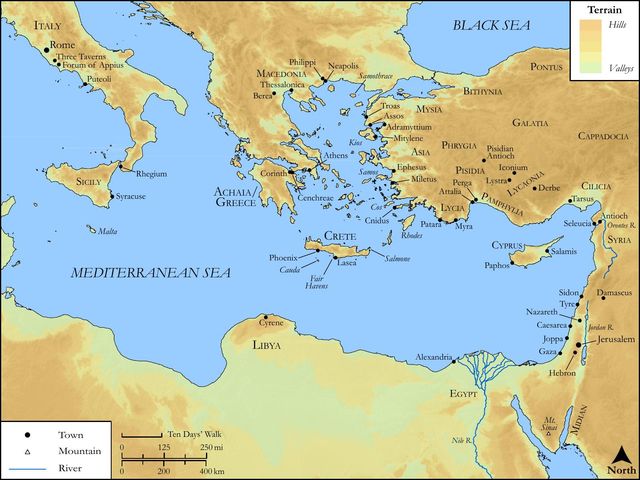
See on the biblical-era maps
Study this verse
Public-domain commentary
Matthew Henry
From his Commentary on the Whole Bible. Henry comments on passages, not single verses — this entry covers Acts 13:1–3. His three-level outline is real structure in the source text, so it is rendered as structure.
We have here a divine warrant and commission to Barnabas and Saul to go and preach the gospel among the Gentiles, and their ordination to that service by the imposition of hands, with fasting and prayer.
I.Here is an account of the present state of the church at Antioch, which was planted, Act 11:20.
1.How well furnished it was with good ministers; there were there certain prophets and teachers (Act 13:1), men that were eminent for gifts, graces, and usefulness. Christ, when he ascended on high, gave some prophets and some teachers (Eph 4:11); these were both. Agabus seems to have been a prophet and not a teacher, and many were teachers who were not prophets; but those here mentioned were at times divinely inspired, and had instructions immediately from heaven upon special occasions, which gave them the title of prophets; and withal they were stated teachers of the church in their religious assemblies, expounded the scriptures, and opened the doctrine of Christ with suitable applications. These were the prophets, and scribes, or teachers, which Christ promised to send (Mat 23:34), such as were every way qualified for the service of the Christian church. Antioch was a great city, and the Christians there were many, so that they could not all meet in one place; it was therefore requisite they should have many teachers, to preside in their respective assemblies, and to deliver God's mind to them. Barnabas is first named, probably because he was the eldest, and Saul last, probably because he was the youngest; but afterwards the last became first, and Saul more eminent in the church. Three others are mentioned.
(1.)Simeon, or Simon, who for distinction-sake was called Niger, Simon the Black, from the color of his hair; like him that with us was surnamed the Black Prince.
(2.)Lucius of Cyrene, who some think (and Dr. Lightfoot inclines to it) was the same with this Luke that wrote the Acts, originally a Cyrenian, and educated in the Cyrenian college or synagogue at Jerusalem, and there first receiving the gospel.
(3.)Manaen, a person of some quality, as it should seem, for he was brought up with Herod the tetrarch, either nursed of the same milk, or bred at the same school, or pupil to the same tutor, or rather one that was his constant colleague and companion - that in every part of his education was his comrade and intimate, which gave him a fair prospect of preferment at court, and yet for Christ's sake he quitted all the hopes of it; like Moses, who, when he had come to years, refused to be called the son of Pharaoh's daughter. Had he joined in with Herod, with whom he was brought up, he might have had Blastus's place, and have been his chamberlain; but it is better to be fellow-sufferer with a saint than fellow-persecutor with a tetrarch.
2.How well employed they were (Act 13:2): They ministered to the Lord, and fasted. Observe,
(1.)Diligent faithful teachers do truly minister unto the Lord. Those that instruct Christians serve Christ; they really do him honour, and carry on the interest of his kingdom. Those that minister to the church in praying and preaching (both which are included here), minister unto the Lord, for they are the church's servants for Christ's sake; to him they must have an eye in their ministrations, and from him they shall have their recompence.
(2.)Ministering to the Lord, in one way or other, ought to be the stated business of churches and their teachers; to this work time ought to be set apart, nay, it is set apart, and in this work we ought to spend some part of every day. What have we to do as Christians and ministers but to serve the Lord Christ? Col 3:24; Rom 14:18.
(3.)Religious fasting is of use in our ministering to the Lord, both as a sign of our humiliation and a means of our mortification. Though it was not so much practised by the disciples of Christ, while the bridegroom was with them, as it was by the disciples of John and of the Pharisees; yet, after the bridegroom was taken away, they abounded in it, as those that had well learned to deny themselves and to endure hardness.
II.The orders given by the Holy Ghost for the setting apart of Barnabas and Saul, while they were engaged in public exercises, the ministers of the several congregations in the city joining in one solemn fast or day of prayer: The Holy Ghost said, either by a voice from heaven, or by a strong impulse on the minds of those of them that were prophets, Separate me Barnabas and Saul for the work whereunto I have called them. He does not specify the work, but refers to a former call of which they themselves knew the meaning, whether others did or no: as for Saul, he was particularly told that he must bear Christ's name to the Gentiles (Act 9:15), that he must be sent to the Gentiles (Act 22:21); the matter was settled between them at Jerusalem before this, that as Peter, James, and John laid out themselves among those of the circumcision, so Paul and Barnabas should go to the heathen, Gal 2:7-9. Barnabas, it is likely, knew himself designed for this service as well as Paul. Yet they would not thrust themselves into this harvest, though it appeared plenteous, till they received their orders from the Lord of the harvest: Thrust in thy sickle for the harvest is ripe, Rev 14:15. The orders were, Separate me Barnabas and Saul. Observe here,
1.Christ by his Spirit has the nomination of his ministers; for it is by the Spirit of Christ that they are qualified in some measure for his services, inclined to it, and taken off from other cares inconsistent with it. There are some whom the Holy Ghost has separated for the service of Christ, has distinguished from others as men that are offered and that willingly offer themselves to the temple service; and concerning them directions are given to those who are competent judges of the sufficiency of the abilities and the sincerity of the inclination: Separate them.
2.Christ's ministers are separated to him and to the Holy Ghost: Separate them to me; they are to be employed in Christ's work and under the Spirit's guidance, to the glory of God the Father.
3.All that are separated to Christ as his ministers are separated to work; Christ keeps no servants to be idle. If any man desires the office of a bishop, he desires a good work; that is what he is separated to, to labour in the word and doctrine. They are separated to take pains, not to take state.
4.The work of Christ's ministers, to which they are to be separated, is work that is already settled, and that which all Christ's ministers hitherto have been called to, and which they themselves have first been, by an external call, directed to and have chosen.
III.Their ordination, pursuant to these orders:
not to the ministry in general (Barnabas and Saul had both of them been ministers long before this), but to a particular service in the ministry, which had something peculiar in it, and which required a fresh commission, which commission God saw fit at this time to transmit by the hands of these prophets and teachers, for the giving of this direction to the church, that teachers should ordain teachers (for prophets we are not now any longer to expect), and that those who have the dispensing of the oracles of Christ committed to them should, for the benefit of posterity, commit the same to faithful men, who shall be able also to teach others, Ti2 2:2. So here, Simeon, and Lucius, and Manaen, faithful teachers at this time in the church of Antioch, when they had fasted and prayed, laid their hands on Barnabas and Saul, and sent them away (Act 13:3), according to the directions received. Observe,
1.They prayed for them. When good men are going forth about good work, they ought to be solemnly and particularly prayed for, especially by their brethren that are their fellow-labourers and fellow-soldiers.
2.They joined fasting with their prayers, as they did in their other ministrations, Act 13:3. Christ has taught us this by his abstaining from sleep (a night-fast, if I may so call it) the night before he sent forth his apostles, that he might spend it in prayer.
3.They laid their hands on them. Hereby,
(1.)They gave them their manumission, dismission, or discharge from the present service they were engaged in, in the church of Antioch, acknowledging that they went off not only fairly and with consent, but honourably and with a good report.
(2.)They implored a blessing upon them in their present undertaking, begged that God would be with them, and give them success; and, in order to this, that they might be filled with the Holy Ghost in their work. This very thing is explained Act 14:26, where it is said, concerning Paul and Barnabas, that from Antioch they had been recommended to the grace of God for the work which they fulfilled. As it was an instance of the humility of Barnabas and Saul that they submitted to the imposition of the hands of those that were their equals, or rather their inferiors; so it was of the good disposition of the other teachers that they did not envy Barnabas and Saul the honour to which they were preferred, but cheerfully committed it to them, with hearty prayers for them; and they sent them away with all expedition, out of a concern for those countries where they were to break up fallow ground.
Historical interpretation
Four Centuries of Reception
5 surviving comments on this verse. Each one is dated, so this reads as a timeline rather than a list.
Select a marker to jump to its quote. Markers stagger vertically where authors wrote within a few decades of each other.
It must be noticed that the Holy Spirit does not speak to those who happen to be there by chance but to those who serve him and observe fasting. And it must be noticed again that they did not lay hands on the deacons at random but on those who were previously fasting and praying.
"As they ministered to the Lord, and fasted, the Holy Ghost said, Separate Me Barnabas and Saul for the work whereunto I have called them." What means, "Ministering?" Preaching. "Separate for Me," it says, "Barnabas and Saul." What means, "Separate for Me?" For the work, for the Apostleship. See again by what persons he is ordained. By Lucius the Cyrenean and Manaen, or rather, by the Spirit. The less the persons, the more palpable the grace. He is ordained henceforth to Apostleship, so as to preach with authority.
But mark also the authority of the Holy Ghost: "As they ministered to the Lord, and fasted, the Holy Ghost said, Separate Me Barnabas and Saul." What being would have dared, if not of the same authority, to say this? "Separate," etc. But this is done, that they may not keep together among themselves. The Spirit saw that they had greater power, and were able to be sufficient for many. And how did He speak to them? Probably by prophets: therefore the writer premises, that there were prophets also. And they were fasting and ministering: that thou mayest learn that there was need of great sobriety. In Antioch he is ordained, where he preaches. Why did He not say, Separate for the Lord, but, "For me?" It shows that He is of one authority and power.
The Holy Spirit said: Set apart for me Barnabas and Paul for the work to which I have called them. This seems to have happened after the death of Herod, who died in the third year of the reign of Claudius, which, according to the chronicles, is the thirteenth year after the passion of the Lord. Since it is clear that Paul, along with Barnabas, was set apart for the apostleship after so much time had passed since the Lord's passion, it becomes evident that those who wrote or accepted the book we mentioned above about the death of Saint Mary are greatly mistaken. For it is written in that same fabrication, as we have often said, that in the second year after the Lord's ascension, when that most blessed Mother of God was about to die, the apostles, who had already been dispersed throughout the world to preach, suddenly came together in a cloud to visit her; among them was Paul, recently converted to the faith, and immediately made an apostle to the Gentiles with Barnabas. But it happened very differently: that is, he was not ordained an apostle in the second year after the Lord's passion, but in the thirteenth. Anyone who believes blessed Luke understands this; and thus the aforementioned book about the death of blessed Mary, being obviously mistaken in its timing, also proves to be of dubious faith in other respects.
Separate for me Barnabas and Saul for the work, to which I have called them. It seems that Saul, according to the order of history, in the thirteenth year after the passion of the Lord, received the apostleship with Barnabas and the name of Paul. But in the fourteenth year, according to the agreement of James, Cephas, and John, he set out to teach the Gentiles. Nor does the ecclesiastical history contradict, saying that the apostles were commanded to preach in Judea for twelve years.
Continue studying Acts 13:2 across the web’s major study libraries — every link below opens this exact verse, chapter, or book on the destination site.
Read & Compare
 BibleGatewayThis verse in more than 200 translations and 70 languages.
 Bible.comThe YouVersion reader — hundreds of translations, reading plans, and highlights.
 ESV.orgCrossway's official English Standard Version reader.
 NET BibleThe NET translation with 60,000+ translators' notes on every rendering decision.
 STEP BibleTyndale House's free study tool — original text, vocabulary, and scholarly resources.
 BibliaLogos Bible Software's free web reader.
 USCCBThe New American Bible (Revised Edition) with the U.S. bishops' study notes.
Commentaries
 BibleHub CommentariesDozens of classic commentaries on this verse, gathered on one page.
 StudyLightMore than 100 commentary sets — the largest collection on the web.
 BibleRefPlain-English commentary on what this verse means, verse by verse.
 Enduring WordDavid Guzik's free commentary on this chapter, widely used by Bible teachers.
 Bible Study ToolsVerse commentary alongside Greek and Hebrew study aids.
Original Language & Research
- BibleHub InterlinearThe verse word by word — original language, transliteration, and English.
- BibleHub LexiconEvery word's original-language definition and Strong's entry.
 Blue Letter BibleDeep-study tools — Strong's numbers, concordance, and word studies.
 CNTR CollationThe earliest Greek manuscripts of this verse, collated letter by letter.
Sermons, Hymns & Audio


TrulyRandomVerse is not affiliated with these sites and doesn’t control their content. They’re linked because they’re genuinely useful.
Summary
Acts 13:2 marks a pivotal moment in the early church, detailing the Holy Spirit's direct intervention to commission Barnabas and Saul (Paul) for their inaugural missionary journey. This divine directive occurred during a time of worship and fasting by the church leaders in Antioch, underscoring that the expansion of the Gospel is not merely a human endeavor but a Spirit-initiated and Spirit-empowered mission, setting the trajectory for the evangelization of the Gentile world.
Context
ShowHideLiterary Context
This verse is situated within a significant narrative shift in the book of Acts. Chapters 1-12 primarily focus on the Gospel's spread in Jerusalem and Judea, largely through Peter's ministry. With chapter 13, the focus explicitly shifts to the Gentile mission, spearheaded by Paul and Barnabas, emanating from the diverse and thriving church in Antioch. The preceding verses (Acts 11:19-30) establish Antioch as a hub of Christian activity, where believers were first called "Christians" and where Barnabas and Saul had been ministering for a year, teaching many people. The immediate context of Acts 13:1 lists the prophets and teachers in Antioch, highlighting the spiritual maturity and leadership depth of this community, which was actively engaged in corporate worship and spiritual disciplines, creating a fertile ground for divine revelation.
Historical & Cultural Context
The church in Antioch was strategically located as a major Roman city in Syria, a bustling commercial and cultural center with a diverse population, including a significant Jewish diaspora and a large Gentile presence. Unlike Jerusalem, Antioch was more open to Gentile inclusion, having already seen a large influx of Gentile converts (Acts 11:20-21). This cultural melting pot made it an ideal launching pad for a mission to the broader Roman Empire, which was characterized by its extensive road network, common language (Koine Greek), and relative peace (Pax Romana), all facilitating the spread of the Gospel. The practice of "ministering to the Lord and fasting" was a common spiritual discipline in both Jewish and early Christian traditions, signifying deep devotion, seeking divine guidance, and preparing for significant spiritual undertakings.
Key Themes
ShowHideActs 13:2 powerfully articulates several foundational themes central to the book of Acts and Christian theology. Foremost is the Sovereignty and Guidance of the Holy Spirit, demonstrating that the church's mission is not humanly conceived but divinely directed. The Spirit actively calls, commissions, and empowers individuals for specific tasks, as seen throughout the book of Acts. Another key theme is the Importance of Spiritual Disciplines, particularly worship and fasting, as prerequisites for discerning God's will and receiving divine revelation. The leaders' posture of devotion highlights that spiritual preparation is essential for spiritual breakthrough, echoing principles found in passages like Luke 2:37 and Matthew 6:16-18. Finally, the verse underscores the theme of Divine Calling and Separation for Service, emphasizing that God sets apart specific individuals for particular "work" in His kingdom, a concept foundational to the church's missional identity and the individual believer's purpose, as articulated in passages like Ephesians 4:11-12.
Exposition and Analysis
ShowHideKey Word Analysis
ShowHideThis verb signifies performing a public service, often with a religious or sacred connotation. In this context, it describes the leaders' active service and worship before God, implying a formal, perhaps liturgical, act of devotion. It suggests a dedicated and intentional engagement in spiritual duties, not merely a casual gathering.
To abstain from food, typically for religious reasons. Fasting in the biblical context is often associated with intense prayer, mourning, seeking divine intervention, or preparing for significant spiritual encounters. Here, it indicates a deep spiritual earnestness and a posture of humility and dependence on God as the leaders sought His will.
This verb means "to set off by boundary," "to limit," "to exclude," or "to appoint." It conveys the idea of a distinct, deliberate setting apart for a specific purpose. In this instance, it is a divine command to consecrate Barnabas and Saul for a unique and divinely ordained work, signifying a formal commissioning and dedication.
Verse Breakdown
ShowHide"As they ministered to the Lord, and fasted,"
This opening clause establishes the spiritual atmosphere and the leaders' posture. The ongoing nature of "ministered" (imperfect tense in Greek) and "fasted" (also imperfect) suggests a sustained period of corporate worship and spiritual discipline. Their devotion to the Lord created the receptive environment for divine communication, highlighting that God often speaks when His people are actively seeking Him.
"the Holy Ghost said,"
This is the pivotal declaration, emphasizing the divine initiative. The phrase indicates a direct, audible, and authoritative communication from the Holy Spirit, not merely an inner prompting or a collective consensus. It signifies the Spirit's active and personal involvement in guiding the church's mission and selecting its personnel.
"Separate me Barnabas and Saul for the work whereunto I have called them."
This is the specific divine command. "Separate me" implies that the Holy Spirit is claiming Barnabas and Saul for His own specific purposes. The phrase "the work whereunto I have called them" underscores that their calling was not new or sudden, but rather a pre-ordained divine purpose that was now being formally activated and publicly revealed. This "work" would be the extensive missionary journeys to the Gentiles.
Literary Devices
ShowHideThe verse employs several significant literary devices. Divine Speech is prominently featured, with the direct quotation "the Holy Ghost said, Separate me Barnabas and Saul..." This device lends immense authority and immediacy to the command, emphasizing that the mission is divinely ordained and not a human initiative. The use of the Imperfect Tense for "ministered" and "fasted" creates a sense of ongoing action, portraying the leaders' sustained devotion as a continuous backdrop for the divine intervention. Furthermore, the passage functions as a Narrative Transition, marking a distinct shift in the book of Acts from the Jerusalem-centric mission to the expansive Gentile mission. The specific naming of "Barnabas and Saul" also serves as Foreshadowing, signaling their future prominence and the monumental impact of their impending ministry, which will dominate the subsequent chapters of Acts.
Theological and Thematic Connections
ShowHideActs 13:2 is a foundational text for understanding the missional nature of the church and the indispensable role of the Holy Spirit in its global outreach. It reveals that God's mission is not a human strategy but a divine imperative, initiated and sustained by the Spirit. The Spirit's direct command to "separate" Barnabas and Saul underscores the concept of divine calling, where individuals are sovereignly chosen and equipped for specific kingdom purposes. This event sets a precedent for the church's responsibility to identify, affirm, and send out those whom the Spirit calls, demonstrating a communal discernment and obedience to God's leading that is vital for effective ministry.
Reflection and Application
ShowHideActs 13:2 offers profound insights for contemporary believers and the church today. It reminds us that genuine spiritual activity often precedes divine direction; it was in their posture of worship and fasting that the Holy Spirit spoke. This encourages us to cultivate a lifestyle of deep devotion, prayer, and spiritual discipline, creating an environment where we are attuned to God's voice. The specific calling of Barnabas and Saul highlights that God has a unique "work" for each of us, whether in vocational ministry or in our daily lives, and we are called to discern and embrace that purpose. Furthermore, the communal nature of the Spirit's address to the church leaders in Antioch emphasizes the importance of corporate discernment. Churches today are called to be communities that collectively seek God's will, affirm the callings of individuals, and corporately send out those whom the Spirit has set apart for specific tasks, fostering a culture of missional obedience and support.
Questions for Reflection
ShowHideFAQ
ShowHideHow did the Holy Spirit "say" this to the church leaders? Was it an audible voice or an inner prompting?
ShowHideWhile the text does not explicitly state how the Holy Spirit spoke, the Greek verb "said" (εἶπεν, eipen) typically denotes direct, clear, and authoritative communication. In the context of Acts, the Holy Spirit often communicates through various means: sometimes audibly (as perhaps implied here), through prophetic utterances (as suggested by the presence of "prophets" in Acts 13:1), or through strong, undeniable inner convictions confirmed by the community. Given the gravity of the command—initiating the Gentile mission—it was likely a clear and unmistakable revelation, understood and accepted by the leaders as a direct divine directive, rather than a mere personal feeling. This directness underscores the Spirit's active leadership in the early church's expansion, fulfilling Christ's promise of empowerment in Acts 1:8.
Christ-Centered Fulfillment
ShowHideActs 13:2 finds its ultimate Christ-centered fulfillment in the ongoing mission of the church, which is the very body of Christ, empowered by His Spirit to continue His redemptive work on earth. Jesus Himself commissioned His disciples with the Great Commission in Matthew 28:18-20, commanding them to "go and make disciples of all nations." This verse in Acts demonstrates the Holy Spirit, whom Christ promised to send (John 14:26), actively carrying out that commission by selecting and sending forth specific individuals like Barnabas and Saul. Just as Christ was "sent" by the Father to accomplish His "work" of salvation (John 4:34), so too the Holy Spirit "separates" and sends His servants for the continuation of that saving work. The mission initiated here by the Spirit is nothing less than the expansion of Christ's kingdom, bringing the good news of His atoning sacrifice and resurrection to all peoples, thereby fulfilling the redemptive purposes of God in Christ for the world. The Spirit's call on Barnabas and Saul is a direct outworking of Christ's sovereign headship over His church, ensuring that His mission to gather His elect from every tribe, tongue, people, and nation will be accomplished (Revelation 7:9-10).