


2 Timothy 1:11
Bible text: King James Version (1769 Blayney text) · Public domain
Bible text: Berean Standard Bible · Public domain
Bible text: American Standard Version (1901) · Public domain
Bible text: World English Bible, Messianic edition · Public domain
Bible text: Geneva Bible (1599) · Public domain
Bible text: Young's Literal Translation · Public domain
- εἰςeistoG1519PREPPreposition
- ὃhowhichG3739R-ASNRelative pronoun Accusative Singular Neuter
- ἐτέθηνetethēnwas appointedG5087V-API-1SVerb Aorist Passive Indicative 1st Singular
- ἐγὼegōI myselfG1473P-1NSPersonal pronoun Nominative 1st Singular
- κῆρυξkēruxa heraldG2783N-NSMNoun Nominative Singular Masculine
- καὶkaiandG2532CONJConjunction
- ἀπόστολοςapostolosan apostleG652N-NSMNoun Nominative Singular Masculine
- καὶkaiandG2532CONJConjunction
- διδάσκαλοςdidaskalosa teacherG1320N-NSMNoun Nominative Singular Masculine
- ἐθνῶν·ethnōnof gentilesG1484N-GPNNoun Genitive Plural Neuter
English is a literal word-by-word gloss of the Greek, not the KJV's wording. Why?
This is the original text the KJV's translators worked from — each Greek word with its own literal English meaning in this verse, prepared by scholars at Tyndale House, Cambridge. The KJV translates whole sentences, not word by word, so its wording differs: one Greek word can become several English words, and the KJV may choose “charity” where the gloss reads “love”. Both are faithful — they answer different questions. For the KJV's own rendering, switch to the KJV text.
Details
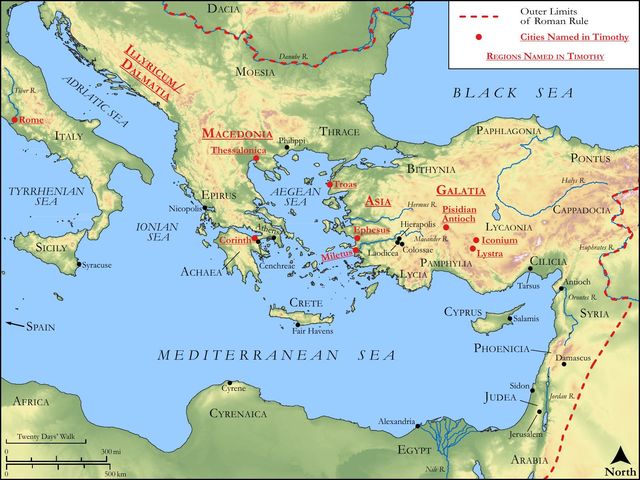
See on the biblical-era maps

Study this verse
Public-domain commentary
Matthew Henry
From his Commentary on the Whole Bible. Henry comments on passages, not single verses — this entry covers 2 Timothy 1:6–14. His four-level outline is real structure in the source text, so it is rendered as structure.
Here is an exhortation and excitation of Timothy to his duty (Ti2 1:6): I put thee in remembrance. The best men need remembrancers; what we know we should be reminded of. Pe2 3:1, I write this, to stir up your pure minds by way of remembrance.
I.He exhorts him to stir up the gift of God that was in him.
Stir it up as fire under the embers. It is meant of all the gifts and graces the God had given him, to qualify him for the work of an evangelist, the gifts of the Holy Ghost, the extraordinary gifts that were conferred by the imposition of the apostle's hands. These he must stir up; he must exercise them and so increase them: use gifts and have gifts. To him that hath shall be given, Mat 25:29. He must take all opportunities to use these gifts, and so stir them up, for that is the best way of increasing them. Whether the gift of God in Timothy was ordinary or extraordinary (though I incline to the latter), he must stir it up, otherwise it would decay. Further, you see that this gift was in him by the putting on of the apostle's hands, which I take to be distinct from his ordination, for that was performed by the hands of the presbytery, Ti1 4:14. It is probable that Timothy had the Holy Ghost, in his extraordinary gifts and graces, conferred on him by the laying on of the apostle's hands (for I reckon that none but the apostles had the power of giving the Holy Ghost), and afterwards, being thus richly furnished for the work of the ministry, was ordained by the presbytery. Observe,
1.The great hindrance of usefulness in the increase of our gifts is slavish fear. Paul therefore warns Timothy against this: God hath not given us the spirit of fear, Ti2 1:7. It was through base fear that the evil servant buried his talent, and did not trade with it, Mat 25:25. Now God hath therefore armed us against the spirit of fear, by often bidding us fear not. "Fear not the face of man; fear not the dangers you may meet with in the way of your duty." God hath delivered us from the spirit of fear, and hath given us the spirit of power, and of love, and of a sound mind. The spirit of power, or of courage and resolution to encounter difficulties and dangers; - the spirit of love to God, which will carry us through the opposition we may meet with, as Jacob made nothing of the hard service he was to endure for Rachel: the spirit of love to God will set us above the fear of man, and all the hurt that a man can do us; - and the spirit of a sound mind, or quietness of mind, a peaceable enjoyment of ourselves, for we are oftentimes discouraged in our way and work by the creatures o our own fancy and imagination, which a sober, solid, thinking mind would obviate, and would easily answer.
2.The spirit God gives to his ministers is not a fearful, but a courageous spirit; it is a spirit of power, for they speak in his name who has all power, both in heaven and earth; and it is a spirit of love, for love to God and the souls of men must inflame ministers in all their service; and it is a spirit of a sound mind, for they speak the words of truth and soberness.
II.He exhorts him to count upon afflictions, and get ready for them:
"Be not thou therefore ashamed of the testimony of our Lord, nor of me his prisoner. Be not thou ashamed of the gospel, of the testimony thou hast borne to it." Observe,
1.The gospel of Christ is what we have none of us reason to be ashamed of. We must not be ashamed of those who are suffering for the gospel of Christ. Timothy must not be ashamed of good old Paul, though he was now in bonds. As he must not himself be afraid of suffering, so he must not be afraid of owning those who were sufferers for the cause of Christ.
(1.)The gospel is the testimony of our Lord; in and by this he bears testimony of himself to us, and by professing our adherence to it we bear testimony of him and for him.
(2.)Paul was the Lord's prisoner, his prisoner, Eph 4:1. For his sake he was bound with a chain.
(3.)We have no reason to be ashamed either of the testimony of our Lord or of his prisoners; if we are ashamed of either now, Christ will be ashamed of us hereafter. "But be thou partaker of the afflictions of the gospel, according to the power of God, that is, expect afflictions for the gospel's sake, prepare for them, count upon them, be willing to take thy lot with the suffering saints in this world. Be partaker of the afflictions of the gospel;" or, as it may be read, Do thou suffer with the gospel; "not only sympathize with those who suffer for it, but be ready to suffer with them and suffer like them." If at any time the gospel be in distress, he who hopes for life and salvation by it will be content to suffer with it. Observe,
[1.]Then we are likely to bear afflictions as well, when we fetch strength and power from God to enable us to bear them: Be thou partaker of the afflictions of the gospel, according to the power of God.
[2.]All Christians, but especially ministers, must expect afflictions and persecutions for the sake of the gospel.
[3.]These shall be proportioned, according to the power of God (Co1 10:13) resting upon us.
2.Mentioning God and the gospel, he takes notice what great things God has done for us by the gospel, Ti2 1:9, Ti2 1:10. To encourage him to suffer, he urges two considerations: -
(1.)The nature of that gospel which he was called to suffer for, and the glorious and gracious designs and purposes of it. It is usual with Paul, when he mentions Christ, and the gospel of Christ, to digress from his subject, and enlarge upon them; so full was he of that which is all our salvation, and ought to be all our desire. Observe,
[1.]The gospel aims at our salvation: He has saved us, and we must not think much to suffer for that which we hope to be saved by. He has begun to save us, and will complete it in due time; for God calls those things that are not (that are not yet completed) as though they were (Rom 4:17); therefore he says, who has saved us.
[2.]It is designed for our sanctification: And called us with a holy calling, called us to holiness. Christianity is a calling, a holy calling; it is the calling wherewith we are called, the calling to which we are called, to labour in it. Observe, All who shall be saved hereafter are sanctified now. Wherever the call of the gospel is an effectual call, it is found to be a holy call, making those holy who are effectually called.
[3.]The origin of it is the free grace and eternal purpose of God in Christ Jesus. If we had merited it, it had been hard to suffer for it; but our salvation by it is of free grace, and not according to our works, and therefore we must not think much to suffer for it. This grace is said to be given us before the world began, that is, in the purpose and designs of God from all eternity; in Christ Jesus, for all the gifts that come from God to sinful man come in and through Christ Jesus.
[4.]The gospel is the manifestation of this purpose and grace: By the appearing of our Saviour Jesus Christ, who had lain in the bosom of the Father from eternity, and was perfectly apprised of all his gracious purposes. By his appearing this gracious purpose was made manifest to us. Did Jesus Christ suffer for it, and shall we think much to suffer for it?
[5.]By the gospel of Christ death is abolished: He has abolished death, not only weakened it, but taken it out of the way, has broken the power of death over us; by taking away sin he has abolished death (for the sting of death is sin, Co1 15:56), in altering the property of it, and breaking the power of it. Death now of an enemy has become a friend; it is the gate by which we pass out of a troublesome, vexatious, sinful world, into a world of perfect peace and purity; and the power thereof is broken, for death does not triumph over those who believe the gospel, but they triumph over it. O death! where is thy sting? O grave! where is thy victory? Co1 15:55.
[6.]He has brought life and immortality to light by the gospel; he has shown us another world more clearly than it was before discovered under any former dispensation, and the happiness of that world, the certain recompence of our obedience by faith: we all with open face, as in a glass, behold the glory of God. He has brought it to light, not only set it before us, but offered it to us, by the gospel. Let us value the gospel more than ever, as it is that whereby life and immortality are brought to light, for herein it has the pre-eminence above all former discoveries; so that it is the gospel of life and immortality, as it discovers them to us, and directs us in the ready way that leads thereto, as well as proposes the most weighty motives to excite our endeavours in seeking after glory, honour, and immortality.
(2.)Consider the example of blessed Paul, Ti2 1:11, Ti2 1:12. He was appointed to preach the gospel, and particularly appointed to teach the Gentiles. He though it a cause worth suffering for, and why should not Timothy think so too? No man needs to be afraid nor ashamed to suffer for the cause of the gospel: I am not ashamed, says Paul, for I know whom I have believed, and am persuaded that he is able to keep that which I have committed unto him against that day. Observe, [1.] Good men often suffer many things for the best cause in the world: For which cause I suffer these things; that is, "for my preaching, and adhering to the gospel." [2.] They need not be ashamed, the cause will bear them out; but those who oppose it shall be clothed with shame. [3.] Those who trust in Christ know whom they have trusted. The apostle speaks with a holy triumph and exultation, as much as to say, "I stand on firm ground. I know I have lodged the great trust in the hands of the best trustee." And am persuaded, etc. What must we commit to Christ? The salvation of our souls, and their preservation to the heavenly kingdom; and what we so commit to him he will keep. There is a day coming when our souls will be enquired after: "Man! Woman! thou hadst a soul committed to thee, what hast thou done with it? To whom it was offered, to God or Satan? How was it employed, in the service of sin or in the service of Christ?" There is a day coming, and it will be a very solemn and awful day, when we must give an account of our stewardship (Luk 16:2), give an account of our souls: now, if by an active obedient faith we commit it to Jesus Christ, we may be sure he is able to keep it, and it shall be forthcoming to our comfort in that day.
III.He exhorts him to hold fast the form of sound words, Ti2 1:13.
1. "Have a form of sound words" (so it may be read), "a short form, a catechism, an abstract of the first principles of religion, according to the scriptures, a scheme of sound words, a brief summary of the Christian faith, in a proper method, drawn out by thyself from the holy scriptures for thy own use;" or, rather, by the form of sound words I understand the holy scriptures themselves. 2. "Having it, hold it fast, remember it, retain it, adhere to it. Adhere to it in opposition to all heresies and false doctrine, which corrupt the Christian faith. Hold that fast which thou hast heard of me." Paul was divinely inspired. It is good to adhere to those forms of sound words which we have in the scriptures; for these, we are sure, were divinely inspired. That is sound speech, which cannot be condemned, Tit 2:8. But how must it be held fast? In faith and love; that is, we must assent to it as a faithful saying, and bid it welcome as worthy of all acceptation. Hold it fast in a good heart, this is the ark of the covenant, in which the tables both of law and gospel are most safely and profitably deposited, Psa 119:11. Faith and love must go together; it is not enough to believe the sound words, and to give an assent to them, but we must love them, believe their truth and love their goodness, and we must propagate the form of sound words in love; speaking the truth in love, Eph 4:15. Faith and love which are in Christ Jesus; it must be Christian faith and love, faith and love fastening upon Jesus Christ, in and by whom God speaks to us and we to him. Timothy, as a minister, must hold fast the form of sound words, for the benefit of others. Of healing words, so it may read; there is healing virtue in the word of God; he sent his word, and healed them. To the same purport is that (Ti2 1:14), That good thing which was committed unto thee keep by the Holy Ghost, which dwelleth in us. That good thing was the form of sound words, the Christian doctrine, which was committed to Timothy in his baptism and education as he was a Christian, and in his ordination as he was a minister. Observe, (1.) The Christian doctrine is a trust committed to us. It is committed to Christians in general, but to ministers in particular. It is a good thing, of unspeakable value in itself, and which will be of unspeakable advantage to us; it is a good thing indeed, it is an inestimable jewel, for it discovers to us the unsearchable riches of Christ, Eph 3:8. It is committed to us to be preserved pure and entire, and to be transmitted to those who shall come after us, and we must keep it, and not contribute any thing to the corrupting of its purity, the weakening of its power, or the diminishing of its perfection: Keep it by the Holy Ghost that dwelleth in us. Observe, Even those who are ever so well taught cannot keep what they have learned, any more than they could at first learn it, without the assistance of the Holy Spirit. We must not think to keep it by our own strength, but keep it by the Holy Ghost. (2.) The Holy Ghost dwells in all good ministers and Christians; they are his temples, and he enables them to keep the gospel pure and uncorrupt; and yet they must use their best endeavours to keep this good thing, for the assistance and indwelling of the Holy Ghost do not exclude men's endeavours, but they very well consist together.
Historical interpretation
Six Centuries of Reception
2 surviving comments on this verse. Each one is dated, so this reads as a timeline rather than a list.
Select a marker to jump to its quote. Markers stagger vertically where authors wrote within a few decades of each other.
"Whereunto I am appointed a preacher and an Apostle, and a teacher of the Gentiles." Why does he so constantly repeat this, and call himself a teacher of the Gentiles? Because he wishes to persuade them that they also ought to draw close to the Gentiles. Be not therefore dismayed at my sufferings. The sinews of death are unstrung. It is not as a malefactor that I suffer, but because I am "a teacher of the Gentiles." At the same time he makes his discourse worthy of credit.
Now revealed through the appearing of our Savior Jesus Christ, who abolished death and brought life and immortality to light through the Gospel, for which I was appointed a preacher and an apostle and a teacher of the Gentiles.
Already long ago it was prefigured that we would be saved, but now it has been revealed through the incarnation of our Savior God. For such is the will of God, that the world should be saved through faith, now and not at another time, it has now been revealed.
who abolished death. To the one who forgives sin, and granted resurrection.
life and immortality to light. That is, revealing. The word is worthy of life.
Paul says, through the Gospel. For through it, both eternal life and resurrection have been made clear.
for which I was appointed. First, he says what is, then he also implies this: You must also go to the Gentiles. Moreover, he also makes the statement more credible.
Continue studying 2 Timothy 1:11 across the web’s major study libraries — every link below opens this exact verse, chapter, or book on the destination site.
Read & Compare
 BibleGatewayThis verse in more than 200 translations and 70 languages.
 Bible.comThe YouVersion reader — hundreds of translations, reading plans, and highlights.
 ESV.orgCrossway's official English Standard Version reader.
 NET BibleThe NET translation with 60,000+ translators' notes on every rendering decision.
 STEP BibleTyndale House's free study tool — original text, vocabulary, and scholarly resources.
 BibliaLogos Bible Software's free web reader.
 USCCBThe New American Bible (Revised Edition) with the U.S. bishops' study notes.
Commentaries
 BibleHub CommentariesDozens of classic commentaries on this verse, gathered on one page.
 StudyLightMore than 100 commentary sets — the largest collection on the web.
 BibleRefPlain-English commentary on what this verse means, verse by verse.
 Enduring WordDavid Guzik's free commentary on this chapter, widely used by Bible teachers.
 Bible Study ToolsVerse commentary alongside Greek and Hebrew study aids.
Original Language & Research
- BibleHub InterlinearThe verse word by word — original language, transliteration, and English.
- BibleHub LexiconEvery word's original-language definition and Strong's entry.
 Blue Letter BibleDeep-study tools — Strong's numbers, concordance, and word studies.
 CNTR CollationThe earliest Greek manuscripts of this verse, collated letter by letter.
Sermons, Hymns & Audio


TrulyRandomVerse is not affiliated with these sites and doesn’t control their content. They’re linked because they’re genuinely useful.
Summary
In 2 Timothy 1:11, the Apostle Paul articulates his divinely ordained commission, asserting his specific roles as a preacher, an apostle, and a teacher, particularly designated for the Gentiles. This declaration, made from a position of imprisonment and facing the end of his life, underscores the unwavering conviction in his calling and the authoritative foundation of the Gospel message he had faithfully proclaimed and entrusted to Timothy. It serves as a powerful testament to the sovereign hand of God in selecting and equipping His servants for specific purposes within His redemptive plan.
Context
ShowHideLiterary Context
This verse is situated within Paul's second letter to Timothy, widely considered his final inspired writing. The epistle is deeply personal and pastoral, serving as a charge to Timothy, Paul's spiritual son and protégé, to remain steadfast in the faith, guard the truth, and endure hardship for the sake of the Gospel. Paul's affirmation of his own appointment in 2 Timothy 1:11 follows his exhortation to Timothy not to be ashamed of the testimony about the Lord or of Paul, His prisoner, but to join him in suffering for the Gospel by the power of God (2 Timothy 1:8). By reiterating his own divine mandate, Paul reinforces the legitimacy and power of the message Timothy is called to uphold and pass on, despite the trials and false teachings that threatened the nascent church.
Historical & Cultural Context
Paul writes this letter from a Roman prison, likely facing imminent execution under Emperor Nero. This period was marked by intense persecution of Christians, and the early church was grappling with internal challenges such as doctrinal deviations and external pressures. The mention of "Gentiles" is crucial, reflecting the profound shift in God's redemptive plan from primarily focusing on Israel to encompassing all nations. Paul's unique calling as the "apostle to the Gentiles" (Romans 11:13) was a significant historical development, breaking down centuries-old barriers between Jews and non-Jews. His ministry involved extensive missionary journeys across the Roman Empire, establishing churches and spreading the Gospel to diverse cultural groups, often facing hostility from both Jewish and pagan authorities.
Key Themes
ShowHide2 Timothy 1:11 contributes to several overarching themes within 2 Timothy and Paul's broader theology. A primary theme is Divine Appointment and Authority, emphasizing that Paul's ministry was not self-initiated but divinely commissioned, lending absolute authority to his message and enabling him to endure immense suffering (Acts 9:15). Another key theme is Faithful Stewardship of the Gospel, as Paul models for Timothy the unwavering commitment required to guard and transmit the "deposit" of truth (2 Timothy 1:13-14). The verse also highlights the Universality of God's Salvation, showcasing God's plan to extend His grace to all peoples, not just Israel, through Paul's specific mission to the Gentiles, thereby fulfilling ancient prophecies of a global redemption (Isaiah 49:6).
Exposition and Analysis
ShowHideKey Word Analysis
ShowHideThis verb signifies to "place," "put," or "set forth," often with the connotation of establishing or ordaining. In this context, it powerfully conveys that Paul's roles were not self-chosen or merely human assignments but were divinely initiated and established by God. It speaks to the sovereign act of God in setting Paul apart for a specific purpose, underscoring the divine origin and authority of his ministry.
Derived from a verb meaning "to send forth," an apostle is a delegate or an ambassador. In the New Testament, it refers specifically to those commissioned by Christ Himself with authority to preach the Gospel and establish the church. Paul's claim to apostleship was unique, not having been one of the original twelve, but directly appointed by the resurrected Christ, particularly for the Gentile mission. This title signifies his authoritative, Christ-given commission and the foundational nature of his ministry.
This term refers to "a race" or "a tribe," but specifically in the biblical context, it denotes non-Jewish peoples, often implying pagan nations. Paul's explicit mention of the Gentiles highlights the distinct focus of his divine calling. While other apostles primarily ministered to Jews, Paul was uniquely chosen to bring the message of salvation to the non-Jewish world, signifying the breaking down of ethnic barriers in Christ and the universal scope of God's redemptive plan.
Verse Breakdown
ShowHide"Whereunto I am appointed"
This introductory phrase links Paul's commission directly to the Gospel of Christ, which he has just described as God's power for salvation, revealed through the abolition of death and the bringing of life and immortality to light (2 Timothy 1:10). Paul's appointment is thus intrinsically tied to the proclamation of this glorious Gospel, emphasizing that his ministry is not arbitrary but divinely purposed and empowered.
"a preacher"
Paul first identifies himself as a kēryx, a herald or one who publicly proclaims a message. This role emphasizes the public, authoritative, and urgent declaration of the Gospel. Paul's primary task was to announce the good news of Jesus Christ, not merely to discuss or debate, but to declare a divine truth with conviction.
"and an apostle"
Following "preacher," Paul states his role as an apóstolos, one "sent forth" with authority. This title signifies his unique, direct commission from the resurrected Christ to represent Him and establish His church. It underscores the divine origin and authoritative nature of his message, distinguishing him as a foundational figure in the early church, particularly for the Gentile world.
"and a teacher"
Lastly, Paul identifies himself as a didáskalos, an instructor or one who imparts understanding of doctrine. This role complements the previous two, indicating that Paul not only proclaimed the Gospel but also systematically explained its truths, discipled believers, and built them up in sound doctrine. It highlights the necessity of instruction and theological depth in Christian ministry.
"of the Gentiles"
This concluding phrase specifies the primary audience of Paul's multifaceted ministry. It underscores his unique, God-given mission to bring the message of salvation to the non-Jewish world, demonstrating God's universal love and the inclusion of all peoples into the family of God through Christ. This emphasis on the Gentiles was a hallmark of Paul's apostolic calling.
Literary Devices
ShowHideThe verse employs several significant Literary Devices. The most prominent is Anaphora, seen in the repeated conjunction "and" ("and an apostle, and a teacher"), which creates a rhythmic emphasis and highlights the distinct yet complementary nature of Paul's three divinely appointed roles. This repetition serves to build a Climax, moving from the general role of a "preacher" (one who declares) to the specific, authoritative role of an "apostle" (one sent with divine authority), and finally to the nurturing role of a "teacher" (one who instructs and builds up). This progression underscores the comprehensive nature of Paul's commission. The entire statement functions as a powerful Declaration of Apostolic Authority and divine mandate, reinforcing the legitimacy of Paul's ministry, especially crucial as he encourages Timothy to persevere in the face of opposition. The specific mention "of the Gentiles" also serves as a Specification, narrowing the focus of his broad commission and emphasizing the unique scope of his calling.
Theological and Thematic Connections
ShowHidePaul's declaration in 2 Timothy 1:11 serves as a profound theological statement about the nature of Christian ministry and God's sovereign plan of salvation. It highlights that true ministry originates not from human ambition or self-selection but from a divine appointment. Paul's three distinct roles—preacher, apostle, and teacher—illustrate the multifaceted demands of proclaiming, establishing, and instructing in the Gospel. This verse underscores the universality of God's saving grace, demonstrating His intention to gather a people for Himself from every nation, tribe, and tongue. Paul's specific designation "of the Gentiles" further emphasizes that the Gospel transcends ethnic and cultural boundaries, offering salvation to all who believe, regardless of their background. This divine commission ensures the authoritative transmission of the Gospel and the establishment of the church as a global body.
Reflection and Application
ShowHidePaul's unwavering conviction in his divine appointment, even from a Roman prison cell, offers a powerful model for believers today. His declaration reminds us that our purpose and effectiveness in serving God stem not from our own abilities or self-promotion, but from God's sovereign call and empowering grace. Just as Paul was uniquely appointed, every Christian is uniquely gifted and called to participate in God's kingdom work, whether in public proclamation, authoritative leadership, or diligent instruction. This verse challenges us to discern our own divine appointments, embrace them with humility and courage, and faithfully steward the gifts and opportunities God has given us. It also underscores the enduring importance of clear, consistent, and doctrinally sound proclamation and teaching of God's Word, ensuring that the transformative truth of the Gospel reaches all people groups and builds up believers in their faith. We are called to be faithful stewards of the Gospel, just as Paul was, ensuring its pure transmission to the next generation.
Questions for Reflection
ShowHideFAQ
ShowHideWhat is the significance of Paul listing these three specific roles: preacher, apostle, and teacher?
ShowHidePaul's listing of "preacher," "apostle," and "teacher" is highly significant because it encapsulates the comprehensive nature of his divinely appointed ministry. As a preacher (kēryx), he publicly proclaimed the Gospel, making the initial declaration of salvation. As an apostle (apóstolos), he carried the unique authority of one directly commissioned by the resurrected Christ, laying the foundational doctrines and establishing churches. As a teacher (didáskalos), he provided in-depth instruction and theological understanding, nurturing believers in sound doctrine. These roles, though distinct, were complementary, demonstrating the full scope of ministry required to effectively spread the Gospel and build up the church. This multifaceted commission ensured that the message was not only announced but also authoritatively established and deeply understood by new converts, particularly among the Gentiles.
Why does Paul emphasize his appointment "of the Gentiles" in this verse?
ShowHidePaul emphasizes his appointment "of the Gentiles" because it was the distinctive and primary focus of his apostolic calling, as revealed to him by the resurrected Christ (Acts 9:15). While other apostles primarily ministered to the Jewish people, Paul was uniquely chosen to bring the message of salvation to the non-Jewish world. This emphasis highlights the revolutionary nature of the Gospel, which breaks down ethnic and cultural barriers, demonstrating God's universal love and His plan to include all nations in His covenant people (Ephesians 2:14-16). By reiterating this, Paul reinforces the legitimacy and importance of his mission, which often faced opposition from those who believed salvation was exclusively for the Jews.
Christ-Centered Fulfillment
ShowHidePaul's declaration in 2 Timothy 1:11 finds its ultimate Christ-centered fulfillment in the person and work of Jesus Christ Himself. Paul, as a "preacher," "apostle," and "teacher," perfectly mirrors the roles of Christ, who is the ultimate herald of God's kingdom (Mark 1:14-15), the supreme "one sent" by the Father to accomplish redemption (John 3:17), and the master "teacher" who taught with unparalleled authority (Matthew 7:29). Paul's commission to the Gentiles directly fulfills God's ancient promise that through Abraham's seed, all nations would be blessed (Genesis 12:3), a promise ultimately realized in Christ's atoning work on the cross, which reconciled both Jews and Gentiles to God in one body (Ephesians 2:14-16). Paul's ministry, therefore, is a direct extension of Christ's own mission to seek and save the lost, culminating in the Great Commission for His followers to make disciples of all nations (Matthew 28:19-20). Thus, Paul's divinely appointed roles serve as a powerful testament to the universal scope of Christ's redemptive work and the ongoing mission of His church to proclaim His saving truth to the ends of the earth (Acts 1:8).