


Colossians 1:28
“Paul's Labor for the Church”Colossians 1:24–2:5
Bible text: King James Version (1769 Blayney text) · Public domain
Bible text: King James Version with Strong's numbers · Public domain
Bible text: Berean Standard Bible · Public domain
Bible text: American Standard Version (1901) · Public domain
Bible text: World English Bible, Messianic edition · Public domain
Bible text: Geneva Bible (1599) · Public domain
Bible text: Young's Literal Translation · Public domain
- ὃνhonwhomG3739R-ASMRelative pronoun Accusative Singular Masculine
- ἡμεῖςhēmeiswe ourselvesG3165P-1NPPersonal pronoun Nominative 1st Plural
- καταγγέλλομενkatangellomenpreachG2605V-PAI-1PVerb Present Active Indicative 1st Plural
- νουθετοῦντεςnouthetountesadmonishingG3560V-PAP-NPMVerb Present Active Participle Nominative Plural Masculine
- πάνταpantaeveryG3956A-ASMAdjective Accusative Singular Masculine
- ἄνθρωπονanthrōponmanG444N-ASMNoun Accusative Singular Masculine
- καὶkaiandG2532CONJConjunction
- διδάσκοντεςdidaskontesteachingG1321V-PAP-NPMVerb Present Active Participle Nominative Plural Masculine
- πάνταpantaeveryG3956A-ASMAdjective Accusative Singular Masculine
- ἄνθρωπονanthrōponmanG444N-ASMNoun Accusative Singular Masculine
- ἐνeninG1722PREPPreposition
- πάσῃpasēallG3956A-DSFAdjective Dative Singular Feminine
- σοφίᾳsophiawisdomG4678N-DSFNoun Dative Singular Feminine
- ἵναinaso thatG2443CONJConjunction
- παραστήσωμενparastēsōmenwe may presentG3936V-AAS-1PVerb Aorist Active Subjunctive 1st Plural
- πάνταpantaeveryG3956A-ASMAdjective Accusative Singular Masculine
- ἄνθρωπονanthrōponmanG444N-ASMNoun Accusative Singular Masculine
- τέλειονteleionperfectG5046A-ASMAdjective Accusative Singular Masculine
- ἐνeninG1722PREPPreposition
- ΧριστῷChristōChristG5547N-DSM-TNoun Dative Singular Masculine Title
- ἸησοῦIēsouJesusG2424N-DSM-PNoun Dative Singular Masculine Individual
English is a literal word-by-word gloss of the Greek, not the KJV's wording. Why?
This is the original text the KJV's translators worked from — each Greek word with its own literal English meaning in this verse, prepared by scholars at Tyndale House, Cambridge. The KJV translates whole sentences, not word by word, so its wording differs: one Greek word can become several English words, and the KJV may choose “charity” where the gloss reads “love”. Both are faithful — they answer different questions. For the KJV's own rendering, switch to the KJV text.
Words in [ ] are added by the English.
Details
See on the biblical-era maps
Study this verse
Public-domain commentary
Matthew Henry
From his Commentary on the Whole Bible. Henry wrote on whole passages, and this entry covers Colossians 1:12–29. He set out his notes in a four-level outline, kept here as he numbered it.
Here is a summary of the doctrine of the gospel concerning the great work of our redemption by Christ. It comes in here not as the matter of a sermon, but as the matter of a thanksgiving; for our salvation by Christ furnishes us with abundant matter of thanksgiving in every view of it: Giving thanks unto the Father, Colossians 1:12. He does not discourse of the work of redemption in the natural order of it; for then he would speak of the purchase of it first, and afterwards of the application of it. But here he inverts the order, because, in our sense and feeling of it, the application goes before the purchase. We first find the benefits of redemption in our hearts, and then are led by those streams to the original and fountain-head. The order and connection of the apostle's discourse may be considered in the following manner: -
I.He speaks concerning the operations of the Spirit of grace upon us.
We must give thanks for them, because by these we are qualified for an interest in the mediation of the Son: Giving thanks to the Father, etc., Colossians 1:12, Colossians 1:13. It is spoken of as the work of the Father, because the Spirit of grace is the Spirit of the Father, and the Father works in us by his Spirit. Those in whom the work of grace is wrought must give thanks unto the Father. If we have the comfort of it, he must have the glory of it. Now what is it which is wrought for us in the application of redemption? 1. "He hath delivered us from the power of darkness, Colossians 1:13. He has rescued us from the state of heathenish darkness and wickedness. He hath saved us from the dominion of sin, which is darkness (1 John 1:6), from the dominion of Satan, who is the prince of darkness (Ephesians 6:12), and from the damnation of hell, which is utter darkness," Matthew 25:30. They are called out of darkness, 1 Peter 2:9. 2. "He hath translated us into the kingdom of his dear Son, brought us into the gospel-state, and made us members of the church of Christ, which is a state of light and purity." You were once darkness, but now are you light in the Lord, Ephesians 5:8. Who hath called you out of darkness into his marvellous light, 1 Peter 2:9. Those were made willing subjects of Christ who were the slaves of Satan. The conversion of a sinner is the translation of a soul into the kingdom of Christ out of the kingdom of the devil. The power of sin is shaken off, and the power of Christ submitted to. The law of the Spirit of life in Christ Jesus makes them free from the law of sin and death; and it is the kingdom of his dear Son, or the Son of his peculiar love, his beloved Son (Matthew 3:17), and eminently the beloved, Ephesians 1:6. 3. "He hath not only done this, but hath made us meet to partake of the inheritance of the saints in light, Colossians 1:12. He hath prepared us for the eternal happiness of heaven, as the Israelites divided the promised land by lot; and has given us the earnest and assurance of it." This he mentions first because it is the first indication of the future blessedness, that by the grace of God we find ourselves in some measure prepared for it. God gives grace and glory, and we are here told what they both are. (1.) What that glory is. It is the inheritance of the saints in light. It is an inheritance, and belongs to them as children, which is the best security and the sweetest tenure: If children, then heirs, Romans 8:17. And it is an inheritance of the saints-proper to sanctified souls. Those who are not saints on earth will never be saints in heaven. And it is an inheritance in light; the perfection of knowledge, holiness, and joy, by communion with God, who is light, and the Father of lights, James 1:17; John 1:5. (2.) What this grace is. It is a meetness for the inheritance: "He hath made us meet to be partakers, that is, suited and fitted us for the heavenly state by a proper temper and habit of soul; and he makes us meet by the powerful influence of his Spirit." It is the effect of the divine power to change the heart, and make it heavenly. Observe, All who are designed for heaven hereafter are prepared for heaven now. As those who live and die unsanctified go out of the world with their hell about them, so those who are sanctified and renewed go out of the world with their heaven about them. Those who have the inheritance of sons have the education of sons and the disposition of sons: they have the Spirit of adoption, whereby they cry, Abba, Father. Romans 8:15. And, because you are sons, God hath sent forth the Spirit of his Son into your hearts, crying, Abba, Father, Galatians 4:6. This meetness for heaven is the earnest of the Spirit in our heart, which is part of payment, and assures the full payment. Those who are sanctified shall be glorified (Romans 8:30), and will be for ever indebted to the grace of God, which hath sanctified them.
II.Concerning the person of the Redeemer.
Glorious things are here said of him; for blessed Paul was full of Christ, and took all occasions to speak honourably of him. He speaks of him distinctly as God, and as Mediator. 1. As God he speaks of him, Colossians 1:15-17. (1.) He is the image of the invisible God. Not as man was made in the image of God (Genesis 1:27), in his natural faculties and dominion over the creatures: no, he is the express image of his person, Hebrews 1:3. He is so the image of God as the son is the image of his father, who has a natural likeness to him; so that he who has seen him has seen the Father, and his glory was the glory of the only-begotten of the Father, John 1:14; John 14:9. (2.) He is the first-born of every creature. Not that he is himself a creature; for it is prōtotokos pasēs ktiseōs - born or begotten before all the creation, or before any creature was made, which is the scripture-way of representing eternity, and by which the eternity of God is represented to us: I was set up from everlasting, from the beginning, or ever the earth was; when there was no depth, before the mountains were settled, while as yet he had not made the earth, Proverbs 8:23-26. It signifies his dominion over all things, as the first-born in a family is heir and lord of all, so he is the heir of all things, Hebrews 1:2. The word, with only the change of the accent, prōtotokos, signifies actively the first begetter or producer of all things, and so it well agrees with the following clause. Vid. Isidor. Peleus. epist. 30 lib. 3. (3.) He is so far from beginning himself a creature that he is the Creator: For by him were all things created, which are in heaven and earth, visible and invisible, Colossians 1:16. He made all things out of nothing, the highest angel in heaven, as well as men upon earth. He made the world, the upper and lower world, with all the inhabitants of both. All things were made by him, and without him was not any thing made which was made, John 1:3. He speaks here as if there were several orders of angels: Whether thrones, or dominions, or principalities, or powers, which must signify either different degrees of excellence or different offices and employments. Angels, authorities, and powers, 1 Peter 3:22. Christ is the eternal wisdom of the Father, and the world was made in wisdom. He is the eternal Word, and the world was made by the word of God. He is the arm of the Lord, and the world was made by that arm. All things are created by him and for him; di' autou kai eis auton. Being created by him, they were created for him; being made by his power, they were made according to his pleasure and for his praise. He is the end, as well as the cause of all things. To him are all things, Romans 11:36; eis auton ta panta. (4.) He was before all things. He had a being before the world was made, before the beginning of time, and therefore from all eternity. Wisdom was with the Father, and possessed by him in the beginning of his ways, before his works of old, Proverbs 8:22. And in the beginning the Word was with God and was God, John 1:1. He not only had a being before he was born of the virgin, but he had a being before all time. (5.) By him all things consist. They not only subsist in their beings, but consist in their order and dependences. He not only created them all at first, but it is by the word of his power that they are still upheld, Hebrews 1:3. The whole creation is kept together by the power of the Son of God, and made to consist in its proper frame. It is preserved from disbanding and running into confusion.
2.The apostle next shows what he is as Mediator, Colossians 1:18, Colossians 1:19.
(1.)He is the head of the body the church: not only a head of government and direction, as the king is the head of the state and has right to prescribe laws, but a head of vital influence, as the head in the natural body: for all grace and strength are derived from him: and the church is his body, the fulness of him who filleth all in all, Ephesians 1:22, Ephesians 1:23.
(2.)He is the beginning, the first-born from the dead, archē, prōtotokos - the principle, the first-born from the dead; the principle of our resurrection, as well as the first-born himself. All our hopes and joys take their rise from him who is the author of our salvation. Not that he was the first who ever rose from the dead, but the first and only one who rose by his own power, and was declared to be the Son of God, and Lord of all things. And he is the head of the resurrection, and has given us an example and evidence of our resurrection from the dead. He rose as the first-fruits, 1 Corinthians 15:20.
(3.)He hath in all things the pre-eminence. It was the will of the Father that he should have all power in heaven and earth, that he might be preferred above angels and all the powers in heaven (he has obtained a more excellent name than they, Hebrews 1:4), and that in all the affairs of the kingdom of God among men he should have the pre-eminence. He has the pre-eminence in the hearts of his people above the world and the flesh; and by giving him the pre-eminence we comply with the Father's will, That all men should honour the Son even as they honour the Father, John 5:23.
(4.)All fulness dwells in him, and it pleased the Father it should do so (Colossians 1:19), not only a fulness of abundance for himself, but redundance for us, a fulness of merit and righteousness, of strength and grace. As the head is the seat and source of the animal spirits, so is Christ of all graces to his people. It pleased the Father that all fulness should dwell in him; and we may have free resort to him for all that grace for which we have occasion. He not only intercedes for it, but is the trustee in whose hands it is lodged to dispense to us: Of his fulness we receive, and grace for grace, grace in us answering to that grace which is in him (John 1:16), and he fills all in all, Ephesians 1:23.
III.Concerning the work of redemption.
He speaks of the nature of it, or wherein it consists; and of the means of it, by which it was procured.
1.Wherein it consists. It is made to lie in two things: - (1.) In the remission of sin: In whom we have redemption, even the forgiveness of sins, Colossians 1:14. It was sin which sold us, sin which enslaved us: if we are redeemed, we must be redeemed from sin; and this is by forgiveness, or remitting the obligation to punishment. So Ephesians 1:7, In whom we have redemption, the forgiveness of sins, according to the riches of his grace. (2.) In reconciliation to God. God by him reconciled all things to himself, Colossians 1:20. He is the Mediator of reconciliation, who procures peace as well as pardon for sinners, who brings them into a state of friendship and favour at present, and will bring all holy creatures, angels as well as men, into one glorious and blessed society at last: things in earth, or things in heaven. So Ephesians 1:10, He will gather together in one all things in Christ, both which are in heaven and which are on earth. The word is anakephalaiōsasthai - he will bring them all under one head. The Gentiles, who were alienated, and enemies in their minds by wicked works, yet now hath he reconciled, Colossians 1:21. Here see what was their condition by nature, and in their Gentile state-estranged from God, and at enmity with God: and yet this enmity is slain, and, notwithstanding this distance, we are now reconciled. Christ has laid the foundation for our reconciliation; for he has paid the price of it, has purchased the proffer and promise of it, proclaims it as a prophet, applies it as a king. Observe, The greatest enemies to God, who have stood at the greatest distance and bidden him defiance, may be reconciled, if it by not their own fault.
2.How the redemption is procured: it is through his blood (Colossians 1:14); he has made peace through the blood of his cross (Colossians 1:20), and it is in the body of his flesh through death, Colossians 1:22. It was the blood which made an atonement, for the blood is the life; and without the shedding of blood there is no remission, Hebrews 9:22. There was such a value in the blood of Christ that, on account of Christ's shedding it, God was willing to deal with men upon new terms to bring them under a covenant of grace, and for his sake, and in consideration of his death upon the cross, to pardon and accept to favour all who comply with them.
IV.Concerning the preaching of this redemption. Here observe,
1.To whom it was preached: To every creature under heaven (Colossians 1:23), that is, it was ordered to be preached to every creature, Mark 16:15. It may be preached to every creature; for the gospel excludes none who do not exclude themselves. More or less it has been or will be preached to every nation, though many have sinned away the light of it and perhaps some have never yet enjoyed it.
2.By whom it was preached: Whereof I Paul am made a minister. Paul was a great apostle; but he looks upon it as the highest of his titles of honour to be a minister of the gospel of Jesus Christ. Paul takes all occasions to speak of his office; for he magnified his office, Romans 11:13. And again in Colossians 1:25, Whereof I am made a minister. Observe here,
(1.)Whence Paul had his ministry: it was according to the dispensation of God which was given to him (Colossians 1:25), the economy or wise disposition of things in the house of God. He was steward and master-builder, and this was given to him: he did not usurp it, nor take it to himself; and he could not challenge it as a debt. He received it from God as a gift, and took it as a favour.
(2.)For whose sake he had his ministry: "It is for you, for your benefit: ourselves your servants for Jesus' sake, 2 Corinthians 4:5. We are Christ's ministers for the good of his people, to fulfil the word of God (that is, fully to preach it), of which you will have the greater advantage. The more we fulfil our ministry, or fill up all the parts of it, the greater will be the benefit of the people; they will be the more filled with knowledge, and furnished for service."
(3.)What kind of preacher Paul was. This is particularly represented.
[1.]He was a suffering preacher: Who now rejoice in my sufferings for you, Colossians 1:24. He suffered in the cause of Christ, and for the good of the church. He suffered for preaching the gospel to them. And, while he suffered in so good a cause, he could rejoice in his sufferings, rejoice that he was counted worthy to suffer, and esteem it an honour to him. And fill up that which is behind of the afflictions of Christ in my flesh. Not that the afflictions of Paul, or any other, were expiations for sin, as the sufferings of Christ were. There was nothing wanting in them, nothing which needed to be filled up. They were perfectly sufficient to answer the intention of them, the satisfaction of God's justice, in order to the salvation of his people. But the sufferings of Paul and other good ministers made them conformable to Christ; and they followed him in his suffering state: so they are said to fill up what was behind of the sufferings of Christ, as the wax fills up the vacuities of the seal, when it receives the impression of it. Or it may be meant not of Christ's sufferings, but of his suffering for Christ. He filled that which was behind. He had a certain rate and measure of suffering for Christ assigned him; and, as his sufferings were agreeable to that appointment, so he was still filling up more and more what was behind, or remained of them to his share.
[2.]He was a close preacher: he preached not only in public, but from house to house, from person to person. Whom we preach, warning every man, and teaching every man in all wisdom, Colossians 1:28. Every man has need to be warned and taught, and therefore let every man have his share. Observe, First, When we warn people of what they do amiss, we must teach them to do better: warning and teaching must go together. Secondly, Men must be warned and taught in all wisdom. We must choose the fittest seasons, and use the likeliest means, and accommodate ourselves to the different circumstances and capacities of those we have to do with, and teach them as they are able to bear. That which he aimed at was to present every man perfect in Christ Jesus, teleios, either perfect in the knowledge of the Christian doctrine (Let us therefore, as many as are perfect, be thus minded, Philippians 3:15; 2 Timothy 3:17), or else crowned with a glorious reward hereafter, when he will present to himself a glorious church (Ephesians 5:27), and bring them to the spirits of just men made perfect, Hebrews 12:23. Observe, Ministers ought to aim at the improvement and salvation of every particular person who hears them. Thirdly, He was a laborious preacher, and one who took pains: he was no loiter, and did not do his work negligently (Colossians 1:29): Whereunto I also labour, striving according to his working, which worketh in me mightily. He laboured and strove, used great diligence and contended with many difficulties, according to the measure of grace afforded to him and the extraordinary presence of Christ which was with him. Observe, As Paul laid out himself to do much good, so he had this favour, that the power of God wrought in him the more effectually. The more we labour in the work of the Lord the greater measures of help we may expect from him in it (Ephesians 3:7): According to the gift of the grace of God given unto me, by the effectual working of his power.
3.The gospel which was preached. We have an account of this: Even the mystery which hath been hid from ages, and from generations, but is now made manifest to his saints, Colossians 1:26, Colossians 1:27. Observe,
(1.)The mystery of the gospel was long hidden: it was concealed from ages and generations, the several ages of the church under the Old Testament dispensation. They were in a state of minority, and training up for a more perfect state of things, and could not look to the end of those things which were ordained, 2 Corinthians 3:13.
(2.)This mystery now, in the fulness of time, is made manifest to the saints, or clearly revealed and made apparent. The veil which was over Moses's face is done away in Christ, 2 Corinthians 3:14. The meanest saint under the gospel understands more than the greatest prophets under the law. He who is least in the kingdom of heaven is greater than they. The mystery of Christ, which in other ages was not made known unto the sons of men, is now revealed unto his holy apostles and prophets by the Spirit, Ephesians 3:4, Ephesians 3:5. And what is this mystery? It is the riches of God's glory among the Gentiles. The peculiar doctrine of the gospel was a mystery which was before hidden, and is now made manifest and made known. But the great mystery here referred to is the breaking down of the partition-wall between the Jew and Gentile, and preaching the gospel to the Gentile world, and making those partakers of the privileges of the gospel state who before lay in ignorance and idolatry: That the Gentiles should be fellow-heirs, and of the same body, and partakers together of his promise in Christ by the gospel, Ephesians 3:6. This mystery, thus made known, is Christ in you (or among you) the hope of glory. Observe, Christ is the hope of glory. The ground of our hope is Christ in the word, or the gospel revelation, declaring the nature and methods of obtaining it. The evidence of our hope is Christ in the heart, or the sanctification of the soul, and its preparation for the heavenly glory.
4.The duty of those who are interested in this redemption: If you continue in the faith, grounded and settled, and be not moved away from the hope of the gospel which you have heard, Colossians 1:23. We must continue in the faith grounded and settled, and not be moved away from the hope of the gospel; that is, we must be so well fixed in our minds as not to be moved from it by any temptations. We must be stedfast and immovable (1 Corinthians 15:58) and hold fast the profession of our faith without wavering, Hebrews 10:23. Observe, We can expect the happy end of our faith only when we continue in the faith, and are so far grounded and settled in it as not to be moved from it. We must not draw back unto perdition, but believe unto the saving of the soul, Hebrews 10:39. We must be faithful to death, through all trials, that we may receive the crown of life, and receive the end of our faith, the salvation of our souls, 1 Peter 1:9.
Historical interpretation
Historical reception
1 surviving comment on this verse from the historical church.
"Whom we," not Angels: "teaching" and "admonishing": not imperiously nor using constraint, for this too is of God's lovingkindness to men, not to bring them to Him after the manner of a tyrant. Seeing it was a great thing he had said, "teaching," he added, "admonishing," which is rather like a father than an instructor. "Whom," saith he, "we proclaim, admonishing every man, and teaching every man in all wisdom." So that all wisdom is needed. That is, saying all things in wisdom. For the ability to learn such things exists not in every one. "That we may present every man perfect in Christ Jesus." What sayest thou, "every man"? Yea; this is what we are earnestly desirous of doing, he saith. For what, if this do not come to pass? the blessed Paul endeavored. "Perfect." This then is perfection, the other is imperfect: so that if one have not even the whole of wisdom, he is imperfect. "Perfect in Christ Jesus," not in the Law, nor in Angels, for that is not perfection. "In Christ," that is, in the knowledge of Christ. For he that knows what Christ has done, will have higher thoughts than to be satisfied with Angels.
Continue studying Colossians 1:28 across the web’s major study libraries — every link below opens this exact verse, chapter, or book on the destination site.
Read & Compare
 BibleGatewayThis verse in more than 200 translations and 70 languages.
 Bible.comThe YouVersion reader — hundreds of translations, reading plans, and highlights.
 ESV.orgCrossway's official English Standard Version reader.
 NET BibleThe NET translation with 60,000+ translators' notes on every rendering decision.
 STEP BibleTyndale House's free study tool — original text, vocabulary, and scholarly resources.
 BibliaLogos Bible Software's free web reader.
 USCCBThe New American Bible (Revised Edition) with the U.S. bishops' study notes.
Commentaries
 BibleHub CommentariesDozens of classic commentaries on this verse, gathered on one page.
 StudyLightMore than 100 commentary sets — the largest collection on the web.
 BibleRefPlain-English commentary on what this verse means, verse by verse.
 Enduring WordDavid Guzik's free commentary on this chapter, widely used by Bible teachers.
 Bible Study ToolsVerse commentary alongside Greek and Hebrew study aids.
Original Language & Research
- BibleHub InterlinearThe verse word by word — original language, transliteration, and English.
- BibleHub LexiconEvery word's original-language definition and Strong's entry.
 Blue Letter BibleDeep-study tools — Strong's numbers, concordance, and word studies.
 CNTR CollationThe earliest Greek manuscripts of this verse, collated letter by letter.
Sermons, Hymns & Audio


TrulyRandomVerse is not affiliated with these sites and doesn’t control their content. They’re linked because they’re genuinely useful.
Written with AI assistance. Always check it against Scripture.
This verse
Paul preaches Christ, warning and teaching every person in all wisdom, so that he may present every one of them mature and complete in Christ Jesus.
“Whom we preach,”
The “Whom” is Christ of verse 27. The content of the gospel is the risen and reigning Lord.
“warning every man, and teaching every man in all wisdom;”
Warning guards against the errors troubling Colossae, and teaching grounds believers in sound doctrine. “Every man” is repeated so that every person is included.
“that we may present every man perfect in Christ Jesus:”
The goal is a mature believer, brought before God complete. “In Christ Jesus” places that maturity within union with him.
Passage studyColossians 1:24–2:5
Christ in You, the Hope of Glory
Summary
Paul writes from prison to a church that Epaphras founded and that Paul himself has yet to see. He tells them he is glad to suffer for them, because God has made him a steward of his word, and the word he carries is a mystery hidden for ages and now revealed: “Christ in you, the hope of glory”, given to the Gentiles as freely as to Israel. So Paul preaches Christ, warns and teaches every man, and labours in the power Christ supplies, aiming to present every believer mature in Christ. He wrestles for the Colossians, for Laodicea and for all who have yet to see his face, that their hearts may be comforted and knit together in love, and that they may know the mystery of God, which is Christ himself, “in whom are hid all the treasures of wisdom and knowledge.” Rooted in him, they can see through persuasive words, and Paul, far away in body, rejoices over their good order and steady faith.
Why Paul rejoices in his sufferings
Paul writes from prison, most likely in Rome around A.D. 60–62. He has just set out the supremacy of Christ over all creation and the church (Colossians 1:15–20) and the peace God made “through the blood of his cross” (Colossians 1:20), by which the Colossians, once enemies, were reconciled (Colossians 1:21–23). Now he turns to his own part in that work, and he begins with joy: “Who now rejoice in my sufferings for you.” The pain is real, and the joy rests on knowing what the pain is for. He suffers “for you”, for the good of the Colossians, and “for his body’s sake, which is the church.”
The word for church, ekklēsía, means “a calling out”. It was used for a public assembly and for a Jewish congregation, and here it means the whole community of believers, on earth and in heaven, whom Christ has called to himself. Paul has just called Christ “the head of the body, the church” (Colossians 1:18). In one body the members share each other’s lot, “whether one member suffer, all the members suffer with it” (1 Corinthians 12:26), and so what an apostle endures strengthens the whole church.
What does “fill up that which is behind of the afflictions of Christ” mean?
This is the hardest phrase in the passage and the one people most often ask about. Some fear it means that Christ’s suffering on the cross fell short and needed Paul’s to complete it. It does not mean that. When Jesus died he said, “It is finished” (John 19:30), and “by one offering he hath perfected for ever them that are sanctified” (Hebrews 10:14). His atoning work is complete.
The word Paul uses for afflictions, thlîpsis, means pressure, and the New Testament uses it for anguish, burden, persecution, tribulation and trouble. These are the hardships that come to believers because they belong to Christ and carry his message into a world hostile to God. The verb antanaplēróō means to supplement, or to fill up in turn. The church, as it carries the gospel through history, has a measure of such suffering to bear, and Paul in his turn takes up his share of it “in my flesh”, in his own body.
They are called the afflictions of Christ because Christ makes his people’s sufferings his own. When he stopped Saul on the road to Damascus, he asked, “Saul, Saul, why persecutest thou me?” (Acts 9:4). Paul longed to know “the fellowship of his sufferings” (Philippians 3:10). He spoke of “always bearing about in the body the dying of the Lord Jesus, that the life also of Jesus might be made manifest in our body” (2 Corinthians 4:10–11), and he wrote that we suffer with Christ “that we may be also glorified together” (Romans 8:17). Suffering of this kind spreads the gospel, strengthens the saints and shows Christ living in his people, and the glory at the end of it is shared with him.
A servant and steward in God’s household
“Whereof I am made a minister” tells how Paul came to this work: God appointed him. The word diákonos comes from a root meaning to run errands, and it was used for an attendant, a waiter at table, a servant. Paul uses it of himself again and again, because it speaks of service and of humility. The Greek includes the pronoun egṓ, “I”, which it usually leaves to the verb, and here it puts weight on Paul’s own calling.
He serves “according to the dispensation of God”. The word oikonomía means the management of a household or estate, a stewardship. A steward in a large household was trusted with authority and resources to run his master’s affairs, and the Colossians would have known the picture well. God has an ordered plan, and he has put a part of it into Paul’s hands. Paul says the same elsewhere, that “a dispensation of the gospel is committed unto me” (1 Corinthians 9:17), and he reminds the Ephesians of “the dispensation of the grace of God which is given me to you-ward” (Ephesians 3:2), in a passage that describes that stewardship at length (Ephesians 3:2–9).
The trust was “given to me for you”. It was given for the Colossians and for the Gentiles generally, since Paul calls himself “the minister of Jesus Christ to the Gentiles” (Romans 15:16). Its aim was “to fulfil the word of God”. The verb plēróō means to fill up, to make full, to complete. God’s word was true before Paul ever preached it, and his task was to preach it in full and carry it as far as God intended, including the part long kept secret, “That the Gentiles should be fellowheirs, and of the same body” (Ephesians 3:6). At its heart that word is Christ, the Word made flesh (John 1:14), “the image of the invisible God” (Colossians 1:15).
The mystery hidden for ages and now revealed
The word mystḗrion comes from a word meaning to shut the mouth, and in the Greek world it suggested the silence kept by people initiated into religious rites. Paul uses it for a truth that could be known only because God revealed it, kept back until his appointed time and now told openly. In the New Testament a mystery is a secret that God has now made known.
“Hid” is apokrýptō, to conceal away, to keep fully secret. God withheld this truth on purpose, “from ages and from generations”. The ages, aiṓn, are the long spans of time, and the generations, geneá, are the peoples who lived through them one after another. Together they take in the whole of history before Christ. The prophets did glimpse the Gentiles’ share, as when God tells his servant, “I will also give thee for a light to the Gentiles” (Isaiah 49:6), but the full scope of it, and the way it would come about, waited for the Messiah.
“But now is made manifest to his saints.” The verb phaneróō means to make apparent or visible, to bring into the open, and its passive form shows God as the one revealing. The saints, hágios, are all believers, the people God has set apart for himself. Paul says the same at the close of Romans, where he speaks of “the mystery, which was kept secret since the world began, But now is made manifest” (Romans 16:25–26), and to the Corinthians, of “the hidden wisdom, which God ordained before the world unto our glory” (1 Corinthians 2:7–8). He tells the Ephesians that this mystery was made known to him by revelation (Ephesians 3:3–6). Because God has shown it to all his saints, it belongs to every believer, and that answers the claim being made around Colossae that the deepest truths were secret knowledge for a chosen few.
Christ in you, the hope of glory
“To whom God would make known” puts the revealing in God’s own will: he chose to tell it. The verb gnōrízō means to make known. What he made known is “the riches of the glory of this mystery”, words that speak of its great worth and splendour, and Paul names it in five words: “Christ in you, the hope of glory.” The word “which” (hós) points back to the mystery, so the mystery is Christ in you. The preposition en, “in”, speaks of close union. Christ lives in every believer, and the Holy Spirit makes his presence real and active. Paul writes, “if Christ be in you, the body is dead because of sin; but the Spirit is life because of righteousness” (Romans 8:10–11), and goes on, “if the Spirit of him that raised up Jesus from the dead dwell in you, he that raised up Christ from the dead shall also quicken your mortal bodies by his Spirit that dwelleth in you” (Romans 8:11).
That indwelling Christ is “the hope of glory”. The word elpís means expectation and confidence, the sure expectation of good to come, resting on God’s faithfulness. The glory, dóxa, is what God has prepared for his people: their transformation, eternal life, full fellowship with God and a share in Christ’s risen life. Christ in you now is the pledge and down payment of that glory. “Now is Christ risen from the dead, and become the firstfruits of them that slept” (1 Corinthians 15:20–23), and those who are his will follow him. Paul writes that “the sufferings of this present time are not worthy to be compared with the glory which shall be revealed in us” (Romans 8:18–25), and Peter blesses God, who “hath begotten us again unto a lively hope by the resurrection of Jesus Christ from the dead” (1 Peter 1:3–4). The riches of the mystery are Christ himself, for “in him dwelleth all the fulness of the Godhead bodily” (Colossians 2:9).
Among the Gentiles
The word éthnos means a race or tribe, and in particular a foreign, non-Jewish people. For centuries God’s covenant blessings had been known chiefly as Israel’s, and the early church wrestled hard over how Gentiles were to be received, as the council at Jerusalem shows (Acts 15). Paul called himself “the apostle of the Gentiles” (Romans 11:13) and was often persecuted for preaching this, and the church at Colossae was probably made up largely of Gentiles. Christ now dwells in them as fully as in any Jewish believer. He “hath broken down the middle wall of partition between us” (Ephesians 2:14), to “make in himself of twain one new man” (Ephesians 2:11–22), so that “ye are all one in Christ Jesus” (Galatians 3:28). This is the mystery Paul sets out for the Ephesians as well (Ephesians 3:4–6).
Warning, teaching and presenting every man perfect
“Whom we preach” names the message, and the message is a person: the “Whom” (hós) is Christ. The verb katangéllō means to proclaim or announce publicly, the work of a herald. As Paul preaches he does two things. Warning, nouthetéō, means “to put in mind”, to caution, admonish or gently reprove, the loving correction that steers someone away from error and harm. Teaching, didáskō, is patient instruction in God’s truth that builds a believer up. Warning guards and corrects, and teaching builds, and Paul joined the two in his own ministry, reminding the Ephesian elders, “I ceased not to warn every one night and day with tears” (Acts 20:31). Both are done “in all wisdom”, en pâs sophía, with the understanding God gives, which is true wisdom set against the false wisdom offered at Colossae.
The phrase “every man” comes three times in the verse, from pâs, “all” or “every”, and ánthrōpos, a human being. Paul’s work is for every person, without partiality. Its goal comes in the words “that we may present”, hína (“that”, marking a purpose) with parístēmi, to set before or present, as a bride is presented to her groom. Paul wants to bring every believer before God “perfect in Christ Jesus”.
Does “perfect” mean sinless?
The word téleios comes from télos, an end or goal, and means complete, mature, fully developed, having reached the end it was made for. Here it speaks of maturity. Paul is describing spiritual adulthood, the grown faith of a believer who has left infancy behind, and that is a different thing from sinless perfection. Hebrews speaks of “them that are of full age, even those who by reason of use have their senses exercised to discern both good and evil” (Hebrews 5:14). Christ gave teachers to the church “for the perfecting of the saints” (Ephesians 4:11–13), “Till we all come in the unity of the faith, and of the knowledge of the Son of God, unto a perfect man, unto the measure of the stature of the fulness of Christ” (Ephesians 4:13). Scripture itself is given “That the man of God may be perfect, throughly furnished unto all good works” (2 Timothy 3:16–17).
This maturity is “in Christ Jesus”, Christós Iēsoûs. It grows within a believer’s union with him, and he is both its measure and its means. Paul will soon say, “ye are complete in him” (Colossians 2:10). Christ is “the wisdom of God” (1 Corinthians 1:24), and he is the Teacher who said, “Ye call me Master and Lord: and ye say well; for so I am” (John 13:13), who corrected his disciples’ mistakes and taught them patiently. He is “the author and finisher of our faith” (Hebrews 12:2), and our growth is his gift as we are made like the Son, whom God has made perfect for evermore (Hebrews 7:28).
The work of this verse belongs to the whole church as well as to its pastors. Christ sent his disciples out “Teaching them to observe all things whatsoever I have commanded you” (Matthew 28:19–20), and Paul trusted the Romans to be “able also to admonish one another” (Romans 15:14).
Labouring by Christ’s mighty working
“Whereunto I also labour” ties Paul’s effort to that goal. The verb kopiáō, from a word for toil, means to feel fatigue, to work to the point of weariness. Paul uses it elsewhere: “I laboured more abundantly than they all: yet not I, but the grace of God which was with me” (1 Corinthians 15:10). “Striving” is agōnízomai, from agṓn, a contest, the word behind our “agonize”. It means to compete for a prize like an athlete or to contend with an opponent, and it pictures Paul’s ministry as a hard and earnest fight.
He strives “according to his working, which worketh in me mightily”. The noun enérgeia, the root of our word “energy”, means active, effective power, and in the New Testament it is used almost always of supernatural power. The verb “worketh”, energéō, comes from the same root, and “mightily” is en dýnamei, “in power”, from dýnamis. The power at work in Paul is Christ’s, the same Christ who dwells in his people and who is “the head of all principality and power” (Colossians 2:10).
Is the work Paul’s or God’s?
It is both, and fully both. Paul toils hard, and the strength for his toil comes from Christ, so the work is truly God’s and is truly done by a man. Paul tells the Philippians, “work out your own salvation with fear and trembling. For it is God which worketh in you both to will and to do of his good pleasure” (Philippians 2:12–13). He says that “our sufficiency is of God” (2 Corinthians 3:5) and that he was made a minister “by the effectual working of his power” (Ephesians 3:7), and he praises the God who “is able to do exceeding abundantly above all that we ask or think, according to the power that worketh in us” (Ephesians 3:20). So we give ourselves wholly to the work and lean wholly on his power, which keeps us from idleness and from self-reliance alike.
Paul’s great conflict for believers he had yet to meet
The chapter break carries the thought straight on: “For I would that ye knew what great conflict I have for you.” The “For”, gár, gives the reason behind what he has just said. “I would”, thélō, is a strong and deliberate wish, and “knew”, eídō, is a verb of seeing that in this form means to know or to be aware. Paul wants them to grasp how much he carries for them.
“What great conflict” is hēlíkos agṓn, “how great a struggle”. The agṓn is the contest behind the “striving” of the verse before, an intense struggle like a wrestling match, and it gives us the word “agony”. Paul fights it in prayer, in teaching and in steady endurance, against the false teaching that threatened these churches, and he fights it “for”, perí, on behalf of, the Colossians. He asks others to share it, begging the Romans to “strive together with me in your prayers to God for me” (Romans 15:30), and he tells the Philippians they have “the same conflict which ye saw in me” (Philippians 1:30). The battle is spiritual, for “we wrestle not against flesh and blood, but against principalities, against powers” (Ephesians 6:12).
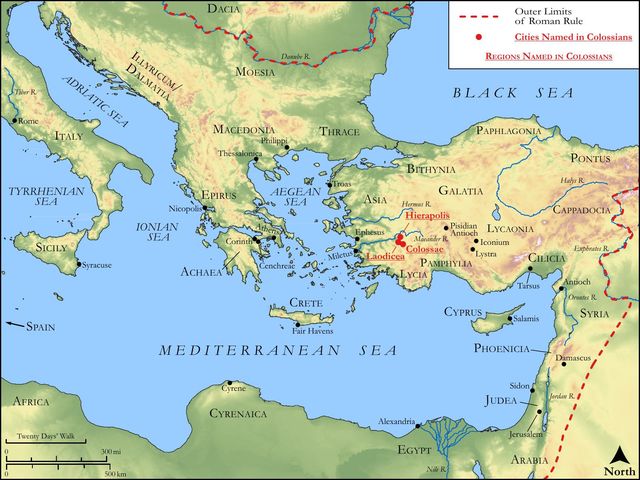
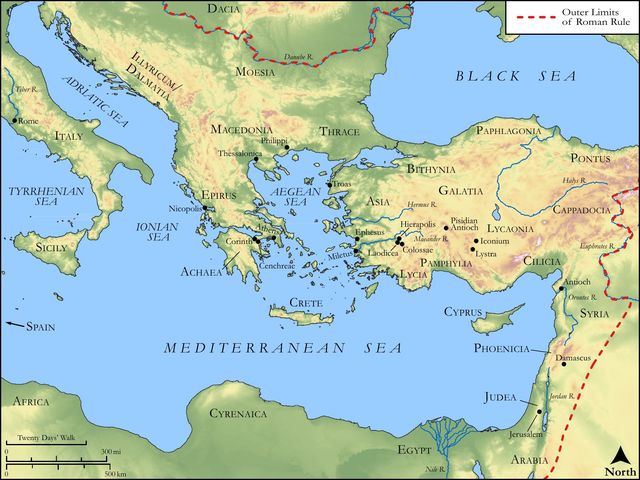
The struggle is also “for them at Laodicea”, Laodíkeia. Colossae lay in the Lycus Valley of Phrygia in Asia Minor, one of three cities there with Laodicea and Hierapolis, and their churches faced the same dangers. The church at Colossae was founded through Epaphras (Colossians 1:7), and Paul’s care reaches all “as many as have not seen my face in the flesh”. His heart for the churches was a longing heart, as when he tells the Thessalonians he “endeavoured the more abundantly to see your face with great desire” (1 Thessalonians 2:17).
Paul’s agony for the church reflects, in a small way, the far greater conflict Christ endured in Gethsemane and on the cross. Christ prayed for “them also which shall believe on me through their word” (John 17:20–23), people who would come to faith in him long after his face was seen on earth, and “he ever liveth to make intercession for them” (Hebrews 7:25). Paul wrestles so that believers stand firm, kept from being “carried about with every wind of doctrine” (Ephesians 4:14).
Hearts comforted and knit together in love
Paul’s struggle has an aim: “That their hearts might be comforted.” The verb parakaléō means to call near, to invite or plead, to exhort or console, so the comfort Paul seeks includes strength and encouragement for the heart, kardía, the centre of a person’s thought, feeling and will. Such comfort comes from “the God of all comfort” (2 Corinthians 1:3–4).
“Being knit together in love” uses symbibázō, to drive together, to unite in fellowship or affection, a word that can also mean to infer, show or teach. It pictures a close and purposeful joining, like the fibres of woven cloth or the parts of a body, held together in agápē love. Christ is the head, “From whom the whole body fitly joined together and compacted by that which every joint supplieth” grows up in love (Ephesians 4:15–16), and later in this chapter Paul speaks of the body “knit together” under him (Colossians 2:19). Love is the mark of his disciples, “By this shall all men know that ye are my disciples, if ye have love one to another” (John 13:35), and Jesus prayed “That they all may be one” (John 17:21). Paul urges the same, “Endeavouring to keep the unity of the Spirit in the bond of peace” (Ephesians 4:1–3). A church held together in love stands firm together when error comes.
The next phrase is “unto all riches of the full assurance of understanding”. The word plērophoría means entire confidence, a full and settled conviction, like the “full assurance of faith” in Hebrews (Hebrews 10:22). Its riches are an understanding of God’s truth held with the whole heart as well as the mind, and it steadies the soul against deceit.
All of this leads “to the acknowledgement of the mystery of God, and of the Father, and of Christ”. The word epígnōsis means full knowledge and recognition. The mystery of God is Christ himself, the one in whom God’s saving purpose is embodied and revealed, and the words move from God to the Father and then to Christ, in whom God is fully known. Jesus said, “he that hath seen me hath seen the Father” (John 14:9). Paul counted all things loss “for the excellency of the knowledge of Christ Jesus my Lord” (Philippians 3:8), and he speaks of preaching “the wisdom of God in a mystery” (1 Corinthians 2:7).
All the treasures of wisdom and knowledge are in Christ
“In whom are hid all the treasures of wisdom and knowledge.” The “whom” is Christ, and this one sentence holds the heart of the letter’s answer to Colossae. Christ is more than a teacher who passes on wisdom. He is its source and its embodiment, and every true treasure of understanding is found in him.
The word for “hid”, apókryphos, means hidden away, kept in store. The word for treasures, thēsaurós, comes from tithēmi, to place, and means a deposit, wealth, a storehouse, so the treasures are laid up in Christ in rich and endless supply. Wisdom, sophía, is practical insight, moral discernment and an understanding of God’s purposes, the ability to use knowledge rightly and to tell truth from error. Knowledge, gnōsis, is the knowing of truth itself. The false teachers boasted of a superior knowledge, and Paul places all knowledge worth having in Christ.
These treasures are hidden in him the way riches are kept in a storehouse. They lie open to those who seek them in Christ, by faith and by the light of the Holy Spirit, and they stay out of sight for anyone who looks for wisdom apart from him. The true secret is Christ himself, and growing in wisdom means digging deeper into him through Scripture, prayer and fellowship for the whole of life.
Scripture speaks with one voice here. “For the LORD giveth wisdom: out of his mouth cometh knowledge and understanding” (Proverbs 2:6). Paul cries, “O the depth of the riches both of the wisdom and knowledge of God!” (Romans 11:33), and he says that Christ Jesus “of God is made unto us wisdom” (1 Corinthians 1:30). Christ is the Word who was with God and was God and became flesh (John 1:1–14), the Son by whom God “hath in these last days spoken unto us” (Hebrews 1:1–3), and “the true Light, which lighteth every man that cometh into the world” (John 1:9). Paul prays that God would give believers “the spirit of wisdom and revelation in the knowledge of him” (Ephesians 1:17–19).
The enticing words Paul warns against
“And this I say, lest any man should beguile you with enticing words.” The “And”, dé, links the warning to all he has just said about Christ. Paul has shown them the treasure, and now he tells them why: so that they can recognise a counterfeit.
The verb paralogízomai joins para, “alongside” or “amiss”, with logízomai, “to reckon”, and means to misreckon, to reason falsely. It describes deceit carried out through clever but faulty argument that leads people to wrong conclusions, often to trap them. The “enticing words”, pithanología, join peithō, “to persuade”, with logos, “word”, and mean persuasive speech, plausible talk. Such words sound reasonable and even profound, and they are hollow at the core.
From what Paul writes in this chapter, the teaching that threatened Colossae mixed several things: Jewish rules about circumcision, food and festivals (Colossians 2:16–17), harsh treatment of the body (Colossians 2:21–23), the worship of angels (Colossians 2:18), and claims to a secret, higher knowledge, an early form of what was later called Gnostic teaching, perhaps mixed with local pagan beliefs. Its teachers offered a deeper spirituality or a fuller salvation than the plain gospel, and they appealed to curiosity and to the wish to rise above other believers. Every one of their additions implied that Christ was insufficient.
Paul answers with Christ. “As ye have therefore received Christ Jesus the Lord, so walk ye in him: Rooted and built up in him, and stablished in the faith” (Colossians 2:6–7). “Beware lest any man spoil you through philosophy and vain deceit”, for in Christ dwells all the fulness of the Godhead, “And ye are complete in him” (Colossians 2:8–10). Christ is “the way, the truth, and the life” (John 14:6), the Word who was in the beginning with God (John 1:1–3). The apostles give the same warning elsewhere: “Let no man deceive you with vain words” (Ephesians 5:6), they “by good words and fair speeches deceive the hearts of the simple” (Romans 16:18), and “with feigned words make merchandise of you” (2 Peter 2:3). Our safeguard is to know Christ well and rest in him, so that any teaching which shrinks his glory or adds to what he has done is seen for what it is.
Absent in the flesh, present in the spirit
Paul closes this part of the letter with joy, as he opened it. “For though I be absent in the flesh, yet am I with you in the spirit.” The word ápeimi means to be away. Prison keeps Paul from them, and many of them have yet to see him at all. Yet his mind, his love and his prayers are with them. He uses almost the same words to the Corinthians, “as absent in body, but present in spirit” (1 Corinthians 5:3). The bond between believers runs deeper than distance, because “There is one body, and one Spirit” (Ephesians 4:4–6), and believers keep “the unity of the Spirit” (Ephesians 4:3).
He is “joying and beholding”. The joy is chairō, and “beholding”, blepō, means seeing clearly. What he sees is their “order”, táxis, from tassō, “to arrange”. It means a regular arrangement, a fixed succession, proper conduct, and it was used of soldiers drawn up in formation. The church at Colossae was well ordered and living in harmony by Christ’s ways, as Paul elsewhere asks, “Let all things be done decently and in order” (1 Corinthians 14:40), “For God is not the author of confusion, but of peace” (1 Corinthians 14:33). That order comes from Christ the head, from whom the whole body is knit together and grows (Colossians 2:19).
He also sees “the stedfastness of your faith in Christ”. The word steréōma, from stereoō, “to make firm”, means firmness, solidity, something established, like a solid foundation or a secure fortress. Their faith stood firm, and Christ was both what they trusted and what held them up. It is the faith that stands “fast in one spirit, with one mind striving together for the faith of the gospel” (Philippians 1:27), that resists the devil “stedfast in the faith” (1 Peter 5:8–9), and that is built like the wise man’s house, which stood because “it was founded upon a rock” (Matthew 7:24–25). Paul’s joy over them is joy in what Christ has done among them, and it prepares them for his call to stay “Rooted and built up in him” (Colossians 2:7).
Living from Christ in us
Christ lives in everyone who belongs to him, and that is our hope of glory. Whatever we bear for his name, he counts as his own, and he uses it to build up his church. The glory ahead is shared with him, so the hardships of the way are worth bearing.
Every believer has a part in the work Paul describes. We warn and teach one another, we pray for believers we have never met as Paul did, and we aim at maturity in Christ for ourselves and for each other. We can work hard at it and still rest, because the power that works in us is his.
When polished voices offer something more than Christ, we already have the treasure. All the treasures of wisdom and knowledge are hid in him, and the way to stand firm is to keep walking in him, knit together in love with his people, until he presents us complete.
Colossians 1:24
“Who now rejoice in my sufferings for you,”
“Now” puts the joy in the present, while Paul is still in prison. His joy comes from knowing his pain bears fruit in the faith of others.
“and fill up that which is behind”
“That which is behind” means what is still lacking, the share of suffering that remains for Christ’s people to bear as the gospel goes out.
“of the afflictions of Christ in my flesh”
These are the hardships of Christ’s followers, borne for his sake and because of their union with him. “In my flesh” means in Paul’s own body, a real and physical suffering.
“for his body’s sake, which is the church:”
The church gains from it. An apostle’s endurance serves the health, growth and witness of the whole body.
Colossians 1:25
“Whereof I am made a minister,”
“Whereof” looks back to the church of verse 24. Paul is the church’s servant because God made him one.
“according to the dispensation of God”
“According to”, katá, shows his ministry following an arrangement God has made, a trust within God’s ordered plan.
“which is given to me for you,”
The stewardship is a gift, and it is given for the good of the Colossians and of all Gentile believers.
“to fulfil the word of God;”
Paul’s charge is to preach God’s word fully and to carry it everywhere God intends, including the mystery he names next.
Colossians 1:26
“Even the mystery”
“Even” explains what the word of God of verse 25 is: the mystery now revealed.
“which hath been hid from ages and from generations,”
Two related words together take in all of time and all its peoples. The hiding was God’s deliberate choice.
“but now is made manifest to his saints:”
“But now” marks the turning point in God’s plan. What was hidden is open to every believer.
Colossians 1:27
“To whom God would make known”
“To whom” means the saints of verse 26. God himself willed to reveal it.
“what is the riches of the glory of this mystery among the Gentiles;”
“Riches” and “glory” together speak of a treasure of great worth, and it is given among the nations.
“which is Christ in you,”
The mystery is a person living in his people, the deepest truth of the new covenant.
“the hope of glory:”
Christ’s presence now is the certain pledge of the glory to come, an anchor for the soul.
Colossians 1:28 This verse
“Whom we preach,”
The “Whom” is Christ of verse 27. The content of the gospel is the risen and reigning Lord.
“warning every man, and teaching every man in all wisdom;”
Warning guards against the errors troubling Colossae, and teaching grounds believers in sound doctrine. “Every man” is repeated so that every person is included.
“that we may present every man perfect in Christ Jesus:”
The goal is a mature believer, brought before God complete. “In Christ Jesus” places that maturity within union with him.
Colossians 1:29
“Whereunto I also labour,”
“Whereunto” means “to this end”, the goal of verse 28. Paul’s labour is weary, wholehearted toil.
“striving according to his working,”
The athlete’s or soldier’s effort is matched to Christ’s power and enabled by it.
“which worketh in me mightily.”
“Working” and “worketh” come from one root, and together they stress a power that is active and continuous.
Colossians 2:1
“For I would that ye knew”
Paul wants them to understand his care deeply, with the heart as well as the mind.
“what great conflict I have for you,”
His agṓn is a wrestling for their good, carried on through prayer, teaching and endurance.
“and for them at Laodicea,”
The neighbouring church faced the same dangers and shares in the same care.
“and for as many as have not seen my face in the flesh;”
“Face” and “flesh” stand for meeting someone in person. Paul’s care reaches every believer, known or unknown to him.
Colossians 2:2
“That their hearts might be comforted,”
“Their” takes in the Colossians, the Laodiceans and all who have yet to see Paul. The comfort is strength against the anxiety false teaching brings.
“being knit together in love,”
Love is the setting in which that comfort is found and kept, a close union of heart and mind that holds a church together.
“and unto all riches of the full assurance of understanding,”
“All riches” speaks of an abundant, overflowing certainty.
“to the acknowledgement of the mystery of God, and of the Father, and of Christ;”
The phrase rises from God to the Father and then to Christ, the fullest revelation of God’s saving plan.
Colossians 2:3
“In whom”
Christ himself, the sphere in which these riches are found, the person who is their source.
“are hid all the treasures”
“All”, pâs, gathers every treasure of truth into Christ, a storehouse that never runs dry.
“of wisdom and knowledge.”
Wisdom applies the truth and knowledge grasps it, and both are complete in him.
Colossians 2:4
“And this I say,”
Paul presses the point home, and it carries his authority as an apostle and his care as a pastor.
“lest any man should beguile you”
“Any man” means any teacher who might slip in among them. The danger is deceit through false reasoning.
“with enticing words.”
Plausible, polished arguments that promise a deeper wisdom and lead away from Christ.
Colossians 2:5
“For though I be absent in the flesh,”
His imprisonment keeps him from them in body.
“yet am I with you in the spirit,”
His thoughts, affections and prayers are with them, and the Spirit joins the body of Christ across any distance.
“joying and beholding your order,”
He rejoices over a church that is well arranged and living in harmony, standing in good order like a well-kept rank.
“and the stedfastness of your faith in Christ.”
Their faith is solid and settled, the very thing that will keep them firm against the errors he is about to answer.
Last revised