


1 Corinthians 12:11
Bible text: King James Version (1769 Blayney text) · Public domain
Bible text: Berean Standard Bible · Public domain
Bible text: American Standard Version (1901) · Public domain
Bible text: World English Bible, Messianic edition · Public domain
Bible text: Geneva Bible (1599) · Public domain
Bible text: Young's Literal Translation · Public domain
- πάνταpantaAllG3956A-APNAdjective Accusative Plural Neuter
- δὲdenowG1161CONJConjunction
- ταῦταtautathese thingsG3778D-APNDemonstrative pronoun Accusative Plural Neuter
- ἐνεργεῖenergeiworksG1754V-PAI-3SVerb Present Active Indicative 3rd Singular
- τὸtotheG3588T-NSNDefinite article Nominative Singular Neuter
- ἓνhenoneG1520A-NSNAdjective Nominative Singular Neuter
- καὶkaiandG2532CONJConjunction
- τὸtotheG3588T-NSNDefinite article Nominative Singular Neuter
- αὐτὸautosameG846P-NSNPersonal pronoun Nominative Singular Neuter
- πνεῦμαpneumaSpiritG4151N-NSNNoun Nominative Singular Neuter
- διαιροῦνdiairounapportioningG1244V-PAP-NSNVerb Present Active Participle Nominative Singular Neuter
- ἰδίᾳidiaindividuallyG2398A-DSFAdjective Dative Singular Feminine
- ἑκάστῳhekastōto eachG1538A-DSMAdjective Dative Singular Masculine
- καθὼςkathōseven asG2531CONJConjunction
- βούλεταιbouletaiHe willsG1014V-PNI-3SVerb Present Middle Or Passive Deponent Indicative 3rd Singular
English is a literal word-by-word gloss of the Greek, not the KJV's wording. Why?
This is the original text the KJV's translators worked from — each Greek word with its own literal English meaning in this verse, prepared by scholars at Tyndale House, Cambridge. The KJV translates whole sentences, not word by word, so its wording differs: one Greek word can become several English words, and the KJV may choose “charity” where the gloss reads “love”. Both are faithful — they answer different questions. For the KJV's own rendering, switch to the KJV text.
Details
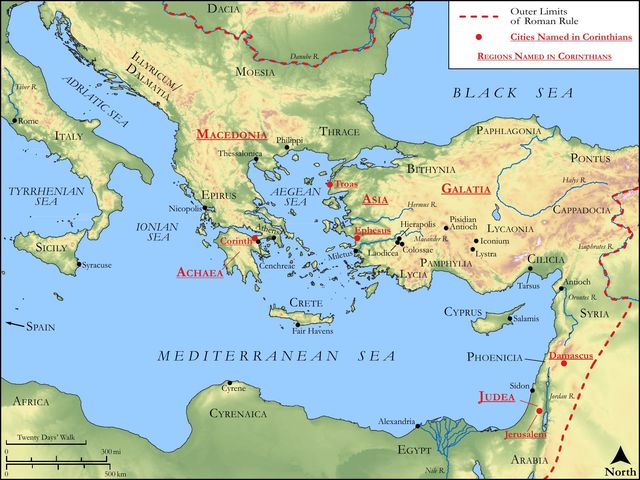
See on the biblical-era maps

Study this verse
Public-domain commentary
Matthew Henry
From his Commentary on the Whole Bible. Henry comments on passages, not single verses — this entry covers 1 Corinthians 12:1–11. His two-level outline is real structure in the source text, so it is rendered as structure.
The apostle comes now to treat of spiritual gifts, which abounded in the church of Corinth, but were greatly abused. What these gifts were is at large told us in the body of the chapter; namely, extraordinary offices and powers, bestowed on ministers and Christians in the first ages, for conviction of unbelievers, and propagation of the gospel. Gifts and graces, charismata and charis, greatly differ. Both indeed were freely given of God. But where grace is given it is for the salvation of those who have it. Gifts are bestowed for the advantage and salvation of others. And there may be great gifts where there is not a dram of grace, but persons possessed of them are utterly out of the divine favour. They are great instances of divine benignity to men, but do not by themselves prove those who have them to be the objects of divine complacency. This church was rich in gifts, but there were many things scandalously out of order in it. Now concerning these spiritual gifts, that is, the extraordinary powers they had received from the Spirit,
I.The apostle tells them he would not have them ignorant either of their original or use.
They came from God, and were to be used for him. It would lead them far astray if they were ignorant of one or the other of these. Note, Right information is of great use as to all religious practice. It is wretched work which gifted men make who either do not know or do not advert to the nature and right use of the gifts with which they are endowed.
II.He puts them in the mind of the sad state out of which they had been recovered:
You were Gentiles, carried away to dumb idols, even as you were led, Co1 12:2. While they were so, they could have no pretensions to be spiritual men, nor to have spiritual gifts. While they were under the conduct of the spirit of Gentilism, they could not be influenced by the Spirit of Christ. If they well understood their former condition, they could not but know that all true spiritual gifts were from God. Now concerning this observe,
1.Their former character: they were Gentiles. Not God's peculiar people, but of the nations whom he had in a manner abandoned. The Jews were, before, his chosen people, distinguished from the rest of the world by his favour. To them the knowledge and worship of the true God were in a manner confined. The rest of the world were strangers to the covenant of promise, aliens from the commonwealth of Israel, and in a manner without God, Eph 2:12. Such Gentiles were the body of the Corinthians, before their conversion to Christianity. What a change was here! Christian Corinthians were once Gentiles. Note, It is of great use to the Christian, and a proper consideration to stir him up both to duty and thankfulness, to think what once he was: You were Gentiles.
2.The conduct they were under: Carried away to these dumb idols, even as you were led. They were hurried upon the grossest idolatry, the worship even of stocks and stones, through the force of a vain imagination, and the fraud of their priests practising on their ignorance, for, whatever were the sentiments of their philosophers, this was the practice of the herd. The body of the people paid their homage and worship to dumb idols, that had ears but could not hear, and mouths but could not speak, Psa 115:5, Psa 115:6. Miserable abjectness of mind! And those who despised these gross conceptions of the vulgar yet countenanced them by their practice. O dismal state of Gentilism! Could the Spirit of God be among such stupid idolators, or they be influenced by it? How did the prince of this world triumph in the blindness of mankind! How thick a mist had he cast over their minds!
III.He shows them how they might discern those gifts that were from the Spirit of God, true spiritual gifts:
No man, speaking by the Spirit, calls Jesus accursed. Thus did both Jews and Gentiles: they blasphemed him as an impostor, and execrated his name, and deemed it abominable. And yet many Jews, who were exorcists and magicians, went about, pretending to work wonders by the Spirit of God (vid. Lightfoot's Horae in loc.), and many among the Gentiles pretended to inspiration. Now the apostle tells them none could act under the influence, nor by the power, of the Spirit of God, who disowned and blasphemed Christ: for the Spirit of God bore uncontrollable witness to Christ by prophecy, miracles, his resurrection from the dead, the success of his doctrine among men, and its effect upon them; and could never so far contradict itself as to declare him accursed. And on the other hand no man could say Jesus was the Lord (that is, live by this faith, and work miracles to prove it), but it must be by the Holy Ghost. To own this truth before men, and maintain it to the death, and live under the influence of it, could not be done without the sanctification of the Holy Ghost. No man can call Christ Lord, with a believing subjection to him and dependence upon him, unless that faith be wrought by the Holy Ghost. No man can confess this truth in the day of trial but by the Holy Ghost animating and encouraging him. Note, We have as necessary a dependence on the Spirit's operation and influence for our sanctification and perseverance as on the mediation of Christ for our reconciliation and acceptance with God: and no man could confirm this truth with a miracle but by the Holy Ghost. No evil spirit would lend assistance, if it were in his power, to spread a doctrine and religion so ruinous to the devil's kingdom. The substance of what the apostle asserts and argues here is that whatever pretences there were to inspiration or miracles, among those who were enemies to Christianity, they could not be from the Spirit of God; but no man could believe this with his heart, nor prove with a miracle that Jesus was Christ, but by the Holy Ghost: so that the extraordinary operations and powers among them did all proceed from the Spirit of God. He adds,
IV.These spiritual gifts, though proceeding from the same Spirit, are yet various.
They have one author and original, but are themselves of various kinds. A free cause may produce variety of effects; and the same giver may bestow various gifts, Co1 12:4. There are diversities of gifts, such as revelations, tongues, prophecy, interpretations of tongues; but the same Spirit. There are differences of administrations, or different offices, and officers to discharge them, different ordinances and institutions (see Co1 12:28-30), but the same Lord, who appointed all, Co1 12:6. There are diversities of operations, or miraculous powers, called energēmata dunameōn (Co1 12:10), as here energēmata, but it is the same God that worketh all in all. There are various gifts, administrations, and operations, but all proceed from one God, one Lord, one Spirit; that is, from Father, Son, and Holy Ghost, the spring and origin of all spiritual blessings and bequests: all issue from the same fountain; all have the same author. However different they may be in themselves, in this they agree; all are from God. And several of the kinds are here specified, Co1 12:8-10. Several persons had their several gifts, some one, some another, all from and by the same Spirit. To one was given the word of wisdom; that is, say some, a knowledge of the mysteries of the gospel, and ability to explain them, an exact understanding of the design, nature, and doctrines, of the Christian religion. Others say an uttering of grave sentences, like Solomon's proverbs. Some confine this word of wisdom to the revelations made to and by the apostles. - To another the word of knowledge, by the same Spirit; that is, say some, the knowledge of mysteries (Co1 2:13): wrapped up in the prophecies, types, and histories of the Old Testament: say others, a skill and readiness to give advice and counsel in perplexed cases. - To another faith, by the same Spirit; that is, the faith of miracles, or a faith in the divine power and promise, whereby they were enabled to trust God in any emergency, and go on in the way of their duty, and own and profess the truths of Christ, whatever was the difficulty or danger. - To another the gift of healing, by the same Spirit; that is, healing the sick, either by laying on of hands, or anointing with oil, or with a bare word. - To another the working of miracles; the efficacies of powers, energēmata dunameōn, such as raising the dead, restoring the blind to sight, giving speech to the dumb, hearing to the deaf, and the use of limbs to the lame. - To another prophecy, that is, ability to foretel future events, which is the more usual sense of prophecy; or to explain scripture by a peculiar gift of the Spirit. See Co1 14:24. - To another the discerning of Spirits, power to distinguish between true and false prophets, or to discern the real and internal qualifications of any person for an office, or to discover the inward workings of the mind by the Holy Ghost, as Peter did those of Ananias, Act 5:3. - To another divers kinds of tongues, or ability to speak languages by inspiration. - To another the interpretation of tongues, or ability to render foreign languages readily and properly into their own. With such variety of spiritual gifts were the first ministers and churches blessed.
V.The end for which these gifts were bestowed:
The manifestation of the Spirit is given to every man to profit withal, Co1 12:7. The Spirit was manifested by the exercise of these gifts; his influence and interest appeared in them. But they were not distributed for the mere honour and advantage of those who had them, but for the benefit of the church, to edify the body, and spread and advance the gospel. Note, Whatever gifts God confers on any man, he confers them that he may do good with them, whether they be common or spiritual. The outward gifts of his bounty are to be improved for his glory, and employed in doing good to others. No man has them merely for himself. They are a trust put into his hands, to profit withal; and the more he profits others with them, the more abundantly will they turn to his account in the end, Phi 4:17. Spiritual gifts are bestowed, that men may with them profit the church and promote Christianity. They are not given for show, but for service; not for pomp and ostentation, but for edification; not to magnify those that have them, but to edify others.
VI.The measure and proportion in which they are given:
All these worketh one and the same Spirit, dividing to every man as he will. It is according to the sovereign pleasure of the donor. What more free than a gift? And shall not the Spirit of God do what he will with his own? May he not give to what persons he pleases, and in what proportion he pleases; one gift to one man, and another to another; to one more, and another fewer, as he thinks fit? Is he not the best judge how his own purpose shall be served, and his own donatives bestowed? It is not as men will, nor as they may think fit, but as the Spirit pleases. Note, The Holy Ghost is a divine person. He works divine effects and divides divine gifts a he will, by his own power, and according to his own pleasure, without dependence or control. But though he distributes these gifts freely and uncontrollably, they are intended by him, not for private honour and advantage, but for public benefit, for the edification of the body, the church.
Historical interpretation
Four Centuries of Reception
13 surviving comments on this verse. Each one is dated, so this reads as a timeline rather than a list.
Select a marker to jump to its quote. Markers stagger vertically where authors wrote within a few decades of each other.
For if there is one God of the universe, the Father of Christ, "of whom are all things;" and one Lord Jesus Christ, our [Lord], "by whom are all things;" and also one Holy Spirit, who wrought in Moses, and in the prophets and apostles; and also one baptism, which is administered that we should have fellowship with the death of the Lord; and also one elect Church; there ought likewise to be but one faith in respect to Christ. For "there is one Lord, one faith, one baptism; one God and Father of all, who is through all, and in all." ... And it is manifest that all these gifts [possessed by believers] "worketh one and the self-same Spirit."
For were we to say that the apostles were at once prophets and righteous, we should say well, "since one and the self-same Holy Spirit works in all."
And now we perceive where, and how, and when the divine apostle mentions the perfect man, and how he shows the differences of the perfect. And again, on the other hand: "The manifestation of the Spirit is given for our profit. For to one is given the word of wisdom by the Spirit; to another the word of knowledge according to the same Spirit; to another faith through the same Spirit; to another the gifts of healing through the same Spirit; to another the working of miracles; to another prophecy; to another discernment of spirits; to another diversities of tongues; to another the interpretation of tongues: and all these worketh the one and the same Spirit, distributing to each one according as He wills." Such being the case, the prophets are perfect in prophecy, the righteous in righteousness, and the martyrs in confession, and others in preaching, not that they are not sharers in the common virtues, but are proficient in those to which they are appointed.
Let not, therefore, any one that works signs and wonders judge any one of the faithful who is not vouchsafed the same: for the gifts of God which are bestowed by Him through Christ are various; and one man receives one gift, and another another. For perhaps one has the word of wisdom, and another the word of knowledge; another, discerning of spirits; another, foreknowledge of things to come; another, the word of teaching; another, long-suffering; another, continence according to the law: for even Moses, the man of God, when he wrought signs in Egypt, did not exalt himself against his equals: and when he was called a god, he did not arrogantly despise his own prophet Aaron. Nor did Joshua the Son of Nun, who was the leader of the people after him, though in the war with the Jebusites he had made the sun stand still over against Gibeon, and the moon over against the valley of Ajalon, because the day was not long enough for their victory, insult over Phineas or Caleb. Nor did Samuel, who had done so many surprising things, disregard David the beloved of God: yet they were both prophets, and the one was high priest, and the other was king. And when there were only seven thousand holy men in Israel who had not bowed the knee to Baal, [1 Kings 19:18; Romans 11:4] Elijah alone among them, and his disciple Elisha, were workers of miracles. Yet neither did Elijah despise Obadiah the steward, who feared God, but wrought no signs...
Paul is here attributing to the Holy Spirit what he earlier attributed to all three persons. Because they are of one nature and power, the Three do what the One does. There is only one God, whose grace is distributed to individuals as he wishes, not according to the merits of any particular person but for the upbuilding of his church. All those things which the world wants to imitate but cannot, because it is carnal, may be seen in the church, which is the house of God, where they are granted by the gift and instruction of the Holy Spirit.
Let us assert of the Holy Spirit only what is written. Let us not busy ourselves about what is not written. The Holy Spirit has authored the Scriptures. He has spoken of himself all that he wished, or all that we could grasp. Let us confine ourselves to what he has said, for it is reckless to do otherwise.
One and the same rain comes down on all the world, yet it becomes white in the lily, red in the rose, purple in the violets and hyacinths, different and many-colored in manifold species. Thus it is one in the palm tree and another in the vine, and all in all things, though it is uniform and does not vary in itself. For the rain does not change, coming down now as one thing and now as another, but it adapts itself to the thing receiving it and becomes what is suitable to each. Similarly the Holy Spirit, being One and of one nature and indivisible, imparts to each one his grace “according as he will.” The dry tree when watered brings forth shoots. So too does the soul in sin, once made worthy through repentance of the grace of the Holy Spirit, flower into justice. Though the Spirit is one in nature, yet by the will of God and in the name of the Son, he brings about many virtuous effects. For he employs the tongue of one for wisdom, illumines the soul of another by prophecy, to another he grants the power of driving out devils, to another the gift of interpreting the sacred Scriptures. He strengthens the self-control of one while teaching another the nature of almsgiving, and still another to fast and humble himself, and another to despise the things of the body. He prepares another for martyrdom. He acts differently in different persons, though he himself is not diverse.
The Spirit spoke also in the patriarchs and the prophets, and finally the apostles then began to be more perfect after they had received the Holy Spirit. Thus there is no separation of the divine power and grace, for although “there are varieties of gifts, yet there is the same Spirit.”
It belongs to God’s justice that he divides and to his power that he divides according to his will or because he wishes to give to each one what he knows will be of profit.
Next, the comfort which he before gave, when he said, "the same Spirit," this also he here sets before us, saying, "But all these worketh the one and the same Spirit, dividing to each one severally even as he will." And he not only gives consolation but also stops the mouth of the gainsayer, saying here, "dividing to each one severally even as he will." For it was necessary to bind up also, not to heal only, as he doth also in the Epistle to the Romans, when he saith, "But who art thou that repliest against God?" So likewise here, "dividing to each one severally as he will."
And that which was of the Father, this he signifieth to be of the Spirit also. For as concerning the Father, he saith, "but it is the same God who worketh all things in all;" so also concerning the Spirit, "but all these things worketh one and the same Spirit." But, it will be said, "He doth it, actuated by God." Nay, he no where said this, but thou feignest it. For when he saith, "who actuateth all things in all," he saith this concerning men: thou wilt hardly say that among those men he numbers also the Spirit, though thou shouldst be ever so manifold in thy doting and madness. For because he had said "through the Spirit," that thou mightest not suppose this word, "through," to denote inferiority or the being actuated, he adds, that "the Spirit worketh," not "is worked," and worketh "as he will," not as he is bidden. For as concerning the Father, the Son saith that "He raiseth up the dead and quickeneth;" in like manner also, concerning Himself, that "He quickeneth whom He will:" thus also of the Spirit, in another place, that He doeth all things with authority and that there is nothing that hinders Him; (for the expression, "bloweth where it listeth" though it be spoken of the wind is apt to establish this;) but here, that "He worketh all things as He will." And from another place to learn that He is not one of the things actuated, but of those that actuate. "For who knoweth," says he, "the things of a man, but the spirit of the man? even so the things of God none knoweth save the Spirit of God." Now that "the spirit of a man," i.e., the soul, requires not to be actuated that it may know the things of itself, is, I suppose, evident to every one. Therefore neither doth the Holy Ghost, that he may "know the things of God." For his meaning is like this, "the secret things of God" are known to the Holy Spirit as to the soul of man the secret things of herself." But if this be not actuated for that end, much less would That which knoweth the depths of God and needs no actuation for that knowledge, require any actuating Power in order to the giving gifts to the Apostles. But besides these things, that also, which I before spake of, I will mention again now. What then is this? That if the Spirit were inferior and of another substance, there would have been no avail in his consolation, nor in our hearing the words, "of the same Spirit." For he who hath received from the king, I grant, may find it a very soothing circumstance, that he himself gave to him; but if it be from the slave, he is then rather vexed, when one reproaches him with it. So that even hence is it evident, that the Holy Spirit is not of the substance of the servant, but of the King.
Wherefore as he comforted them, when he said, that "there are diversities of ministrations, but the same Lord; and diversities of operations, but the same God;" so also when he said above, "there are diversities of gifts, but the same Spirit;" and after this again when he said, "But all these worketh the one and the same Spirit, dividing to every man severally as he will."
"Let us not, I pray you, be at a loss," saith he; "neither let us grieve, saying, 'Why have I received this and not received that?' neither let us demand an account of the Holy Spirit. For if thou knowest that he vouchsafed it from providential care, consider that from the same care he hath given also the measure of it, and be content and rejoice in what thou hast received: but murmur not at what thou hast not received; yea, rather confess God's favor that thou hast not received things beyond thy power."
Notice that Paul does not say “according to the will of each and every member” but “according to the will of the Spirit.”
For not everyone has all of them, but some have these and others those, although each has the Gift himself by whom the things proper to each one are divided, namely, the Holy Spirit.
Here Paul is comforting those who received the lesser gifts, pointing out that they too come from the Holy Spirit.
Continue studying 1 Corinthians 12:11 across the web’s major study libraries — every link below opens this exact verse, chapter, or book on the destination site.
Read & Compare
 BibleGatewayThis verse in more than 200 translations and 70 languages.
 Bible.comThe YouVersion reader — hundreds of translations, reading plans, and highlights.
 ESV.orgCrossway's official English Standard Version reader.
 NET BibleThe NET translation with 60,000+ translators' notes on every rendering decision.
 STEP BibleTyndale House's free study tool — original text, vocabulary, and scholarly resources.
 BibliaLogos Bible Software's free web reader.
 USCCBThe New American Bible (Revised Edition) with the U.S. bishops' study notes.
Commentaries
 BibleHub CommentariesDozens of classic commentaries on this verse, gathered on one page.
 StudyLightMore than 100 commentary sets — the largest collection on the web.
 BibleRefPlain-English commentary on what this verse means, verse by verse.
 Enduring WordDavid Guzik's free commentary on this chapter, widely used by Bible teachers.
 Bible Study ToolsVerse commentary alongside Greek and Hebrew study aids.
Original Language & Research
- BibleHub InterlinearThe verse word by word — original language, transliteration, and English.
- BibleHub LexiconEvery word's original-language definition and Strong's entry.
 Blue Letter BibleDeep-study tools — Strong's numbers, concordance, and word studies.
 CNTR CollationThe earliest Greek manuscripts of this verse, collated letter by letter.
Sermons, Hymns & Audio


TrulyRandomVerse is not affiliated with these sites and doesn’t control their content. They’re linked because they’re genuinely useful.
Summary
1 Corinthians 12:11 serves as a foundational declaration regarding the distribution of spiritual gifts within the church, asserting that all these diverse manifestations of divine power are orchestrated by the singular Holy Spirit. This verse underscores the Spirit's sovereign authority and deliberate intention in bestowing specific gifts upon each believer, ensuring both unity in source and diversity in function for the common good of the body of Christ.
Context
ShowHideLiterary Context
This verse concludes Paul's initial enumeration of spiritual gifts in 1 Corinthians 12:8-10—gifts such as the word of wisdom, the word of knowledge, faith, gifts of healing, working of miracles, prophecy, discerning of spirits, various kinds of tongues, and the interpretation of tongues. It acts as a crucial summary statement, emphasizing the singular origin of these diverse gifts before Paul transitions into the profound analogy of the church as the human body in 1 Corinthians 12:12-27, where each member, though different, is indispensable. The immediate literary flow highlights the unity of the Spirit as the source, counteracting any potential for division or hierarchy based on giftedness within the Corinthian church.
Historical & Cultural Context
The city of Corinth was a bustling, cosmopolitan port city, known for its wealth, diverse population, and a syncretistic religious environment that often blended Greek philosophical thought with various mystery cults. Within the Corinthian church, there were significant issues of division, pride, and a misunderstanding of spiritual gifts, particularly the overemphasis on speaking in tongues (glossolalia) to the detriment of other gifts and the overall edification of the community. Paul's letter addresses these internal conflicts, seeking to correct their theology and practice concerning spiritual gifts, marriage, worship, and the resurrection. His emphasis on the Spirit's sovereignty and the purpose of gifts for the common good directly confronts the self-exaltation and disunity prevalent among them.
Key Themes
ShowHideThis verse powerfully contributes to several major theological themes within 1 Corinthians and the broader New Testament. Firstly, it champions the Unity of the Spirit, asserting that despite the multiplicity of gifts, their origin is one and the same divine Spirit, reinforcing the singular nature of God's work in the church. Secondly, it highlights the Diversity of Gifts, demonstrating God's intentional design to equip believers with varied abilities, ensuring the comprehensive functioning of the body. This diversity is not chaotic but divinely ordered. Thirdly, and perhaps most profoundly, it underscores the Sovereignty of the Holy Spirit in the distribution of these gifts. The Spirit's giving is not based on human merit, desire, or effort, but entirely on His divine will and purpose, as also seen in passages like Romans 12:6 and Ephesians 4:7. This theme counters any human boasting or feelings of inadequacy, placing the focus squarely on God's gracious and wise provision.
Exposition and Analysis
ShowHideKey Word Analysis
ShowHideThis verb signifies being active, efficient, or effectual. It conveys the idea of the Spirit's dynamic and powerful operation, not merely a passive bestowing but an active, ongoing working through the gifts. The Spirit is the dynamic agent behind the manifestation of these supernatural abilities, making them effective for their intended purpose.
This term refers to a current of air, breath, or wind, but in this context, it denotes the Holy Spirit—the third person of the Trinity. It emphasizes the divine origin and nature of the gifts, distinguishing them from human talents or abilities. The Spirit is the divine source and animating power of all spiritual manifestations in the church.
This verb, in the middle voice, means to "will," "be willing," or "intend." It speaks to the deliberate and sovereign choice of the Holy Spirit. The distribution of gifts is not random or arbitrary, nor is it subject to human petition or merit, but is entirely according to the Spirit's divine will and purpose.
Verse Breakdown
ShowHide"But all these worketh that one and the selfsame Spirit"
This opening clause serves as a powerful counterpoint ("But") to the preceding list of diverse gifts. It emphatically declares that every single one of these varied manifestations originates from a single, unified, and unchanging source: the Holy Spirit. The phrase "one and the selfsame" (Greek: to auto) strongly emphasizes the singular identity and consistent nature of the Spirit, ensuring that the diversity of gifts does not imply a multiplicity of divine sources or a fragmented God. The Spirit is the active agent, "working" or energizing these gifts.
"dividing to every man severally as he will"
This second clause details the Spirit's method and motive in distributing the gifts. The Spirit is actively "dividing" or distributing these gifts, not indiscriminately, but "to every man severally" (Greek: hekastō idia), meaning to each individual believer uniquely and personally. This personal distribution ensures that each member of the body is equipped for their specific function. Crucially, this distribution is "as he will" (Greek: kathos bouletai), highlighting the absolute sovereignty and deliberate intention of the Holy Spirit. It is the Spirit's prerogative and wise design that determines who receives which gift and when, not human desire, merit, or effort.
Literary Devices
ShowHidePaul employs several effective literary devices in this concise verse. The most prominent is Emphasis through repetition and specific phrasing. The phrase "that one and the selfsame Spirit" strongly emphasizes the singular, unified source of all gifts, directly confronting any potential for division or a hierarchical view of gifts within the Corinthian church. This is further reinforced by the contrast implied by "But," setting the unified source against the diverse manifestations listed previously. There is also a subtle form of Personification of the Holy Spirit, attributing to Him the active verbs "worketh" and "dividing," and the volitional act of "will." This highlights the Spirit not as an impersonal force, but as a divine Person with agency, purpose, and sovereign will. The structure of the verse itself, moving from the diverse "these" to the singular "Spirit" and then back to the diverse but individually distributed "every man severally," creates a sense of Unity in Diversity, which is the overarching theme of the entire chapter.
Theological and Thematic Connections
ShowHide1 Corinthians 12:11 is a cornerstone for understanding the Holy Spirit's role in empowering the church. It establishes the Spirit's divine sovereignty in distributing spiritual gifts, ensuring that every believer is uniquely equipped for ministry within the body of Christ. This truth fosters humility, as gifts are not earned but graciously given, and promotes interdependence, as no single individual possesses all gifts, necessitating the cooperation of all members. The Spirit's intentional distribution ensures the church's holistic functionality and growth, preventing both elitism among those with prominent gifts and discouragement among those with less visible ones. It underscores that the purpose of all gifts is for the common good and the building up of the church, not for individual glory or self-aggrandizement.
Reflection and Application
ShowHideThis verse offers profound implications for individual believers and the corporate church today. For the individual, it instills a deep sense of humility and gratitude, reminding us that any spiritual capacity or effectiveness we possess is a direct, unmerited gift from the sovereign Holy Spirit. It frees us from the burden of striving to earn gifts or comparing ourselves to others, encouraging us instead to faithfully steward what we have been given. For the church, it cultivates a spirit of unity and mutual appreciation. Recognizing that the same Spirit empowers different members with diverse gifts fosters an environment where every contribution is valued and necessary for the health and growth of the body. It challenges us to actively identify, affirm, and utilize the unique gifting within our communities, trusting the Spirit's wisdom in His distribution. This understanding also guards against spiritual pride or envy, as all gifts flow from the same divine source and are given for the same ultimate purpose: the glory of God and the edification of His people.
Questions for Reflection
ShowHideFAQ
ShowHideDoes 1 Corinthians 12:11 mean that spiritual gifts are given only once at conversion and never change?
ShowHideWhile the Holy Spirit indwells believers at conversion and bestows gifts "as He will," this verse primarily emphasizes the Spirit's sovereign distribution, not the timing or immutability of that distribution. Other passages suggest that gifts can be stirred up (2 Timothy 1:6), and the context of the Spirit's ongoing work in the church implies a dynamic relationship. While foundational gifts may be given at conversion, the Spirit's activity is continuous, equipping believers for various needs and seasons of ministry throughout their lives. The core truth is that the source and sovereignty remain with the Spirit, regardless of when or how a gift manifests or develops.
Christ-Centered Fulfillment
ShowHide1 Corinthians 12:11, while focusing on the Holy Spirit's work, finds its ultimate Christ-centered fulfillment in the Spirit's role as the agent who applies the work of Christ to believers and builds His body. The diverse gifts distributed by the Spirit are not ends in themselves, but tools for the church to continue the mission of Christ on earth. Jesus Himself promised the coming of the Spirit to empower His disciples for witness (Acts 1:8), and the Spirit's work in gifting believers directly flows from Christ's ascension and His position as the head of the church (Ephesians/4-8-11). The Spirit's sovereign distribution ensures that the church, as the body of Christ, is fully equipped to manifest His presence, proclaim His gospel, and carry out His redemptive purposes in the world. Every gift, therefore, serves to build up the church into the fullness of Christ (Ephesians 4:13), reflecting His character and extending His kingdom until He returns.